Pronouns in Storytelling and Narrative Flow

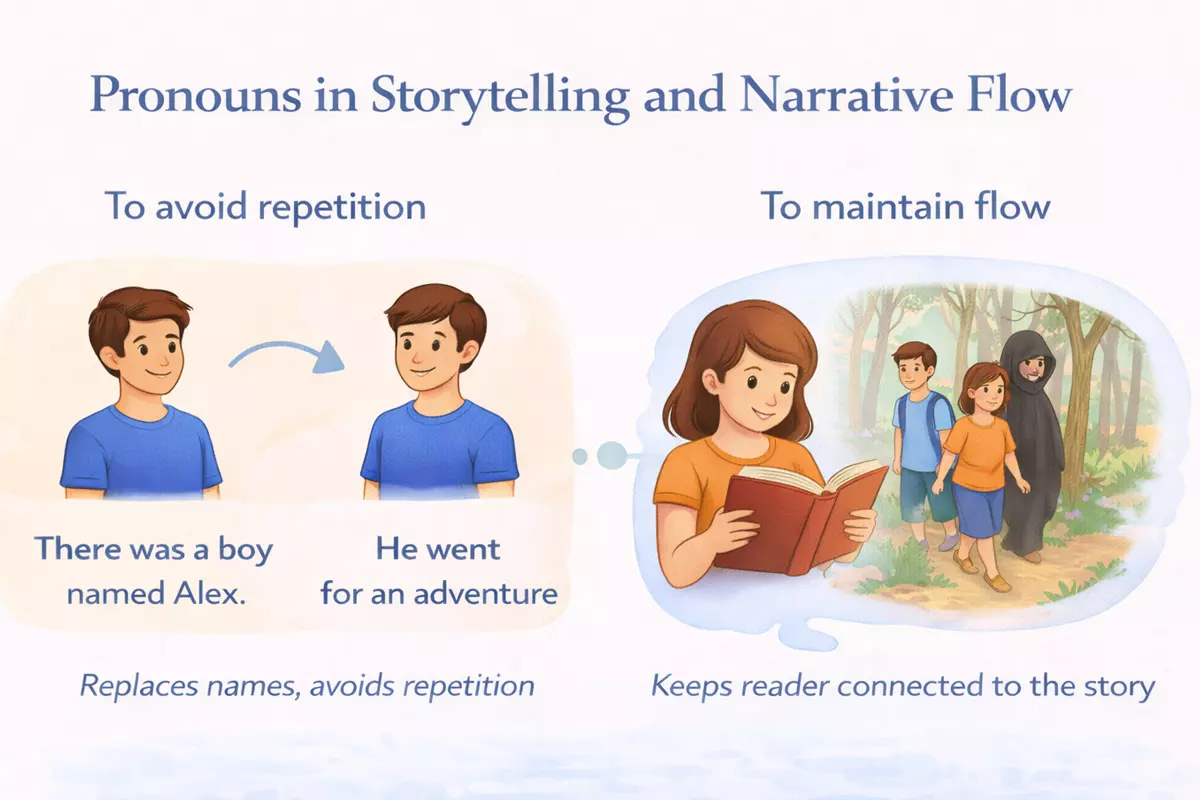 Here we how pronouns guide readers, introduce and refer to characters, keep stories clear, and manage shifts in focus. It also discusses pronoun use in dialogue versus narration, avoiding ambiguity, editing for clarity, and practical improvement.
- How pronouns guide readers through a story
- Introducing characters and establishing reference
- Maintaining clarity across sentences and paragraphs
- Shifting focus between characters safely
- Pronouns in dialogue vs narration
- Avoiding ambiguity in long narratives
- Editing strategies for story clarity
- Practice: improve narrative passages using pronouns
Selecting appropriate words to identify characters plays a crucial role in storytelling, as it subtly influences how readers perceive scenes and emotions. The specific terms used to refer to people in narratives can shape the rhythm and pacing of a story, affecting the overall flow and the reader’s connection to the characters. By carefully choosing how characters are referenced, authors can either enhance clarity or introduce an element of mystery, ultimately guiding the audience’s experience and engagement with the narrative.
How pronouns guide readers through a story
Pronouns act as subtle signposts in narratives, helping audiences keep track of characters and events without constant repetition of names. By using words like he, she, they, or it, writers create smoother sentences and maintain a natural rhythm. This linguistic shorthand not only clarifies who is involved in each scene, but also reduces distraction, letting readers focus on the unfolding plot.
Maintaining Narrative Clarity
Clear reference is essential for coherence, especially in stories with multiple characters. Well-chosen pronouns help readers follow which character is acting or being described, even as scenes shift or new figures are introduced. Ambiguous or inconsistent use can cause confusion, breaking immersion and slowing the pace.
Enhancing Flow and Pacing
Narratives that overuse names can feel repetitive and awkward. Pronouns allow authors to vary sentence structure, keeping the prose lively and readable. This variation supports pacing, as concise references let scenes move quickly when needed, or slow down for emphasis.
Common Pronoun Uses in Storytelling
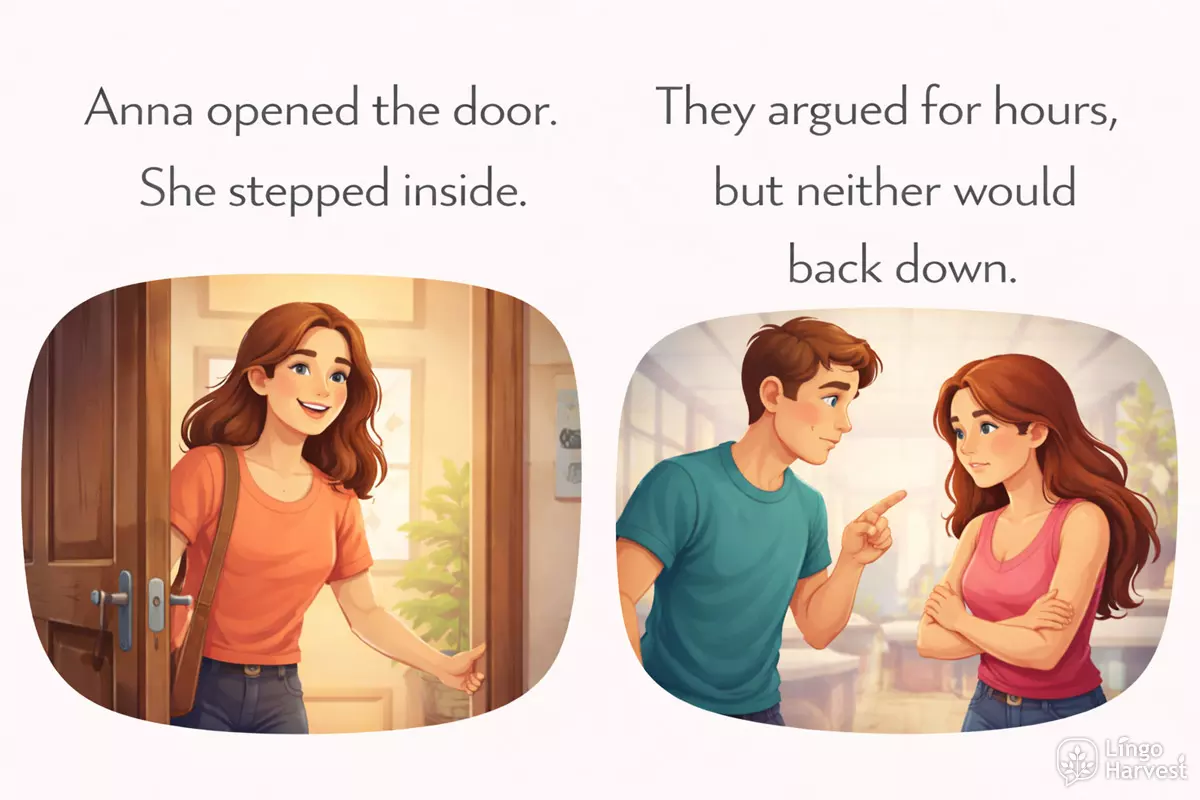
- Referring back to a character just introduced (“Anna opened the door. She stepped inside.”)
- Shifting perspectives without confusion (“They argued for hours, but neither would back down.”)
- Linking actions across sentences (“The cat leapt onto the table. It knocked over a vase.”)
- Maintaining suspense (“Someone was watching. They waited in the shadows.”)
- Distinguishing between groups (“The teachers gathered in the lounge. They discussed the upcoming event.”)
- Avoiding awkward repetition (“John picked up the book. He flipped through the pages.”)
- Signaling changes in point of view (“I couldn’t believe my luck. You would have felt the same.”)
- Blending dialogue and narration (“‘I’ll go first,’ she said, hoping they would follow.”)
- Implying relationships (“Her mother smiled. She was proud of her daughter.”)
- Describing collective action (“The villagers gathered at dawn. They prepared for the festival.”)
Types of Pronouns and Their Narrative Functions
| Pronoun Type | Storytelling Function |
|---|---|
| Personal (he, she, they) | Tracks individuals or groups, keeps character references clear |
| Demonstrative (this, that, these, those) | Directs attention to specific objects or ideas in the narrative |
| Relative (who, which, that) | Links clauses, adds descriptive detail about characters or items |
| Reflexive (myself, herself, themselves) | Emphasizes actions performed by the subject upon itself |
| Indefinite (someone, anyone, everything) | Introduces uncertainty or generalizes about people or things |
Thoughtful use of reference words shapes the reader’s experience, ensuring they always know who or what is at the center of attention. By weaving pronouns seamlessly into the narrative, authors create stories that are both engaging and easy to follow.
Introducing characters and establishing reference
Effective storytelling relies on how clearly readers can identify who is involved in the narrative. When a new character enters the story, the writer must present them in a way that readers will remember and recognize later, especially when using pronouns to refer back. If a character’s introduction is vague or easily confused with others, later references can cause confusion or disrupt the flow of the story.
First mentions: clarity and detail
When a character appears for the first time, it’s helpful to provide enough information—such as their name, role, or distinguishing traits—to make them memorable. This avoids ambiguity when pronouns like “he,” “she,” or “they” are used in subsequent sentences. Consider introducing characters with:
- Full names or titles (e.g., “Detective Maya Lin”)
- Roles or relationships (“her childhood friend, Sam”)
- Distinctive physical features (“the tall man with a scar”)
- Unique clothing or accessories (“the woman in the red hat”)
- Notable actions (“the boy who rescued the kitten”)
- Speech patterns or catchphrases (“‘Absolutely not,’ grumbled Mr. Jones”)
- Setting-based identifiers (“the stranger at the city gate”)
- Occupation or status (“the retired pilot”)
- Age or generational hints (“the youngest daughter”)
- Group associations (“one of the village elders”)
Maintaining reference with pronouns
Once a character is established, writers can use pronouns to keep the narrative smooth and avoid repetition. However, it’s important to ensure that pronoun use doesn’t lead to ambiguity, especially when multiple characters of the same gender or group are present. A common technique is to occasionally repeat the character’s name or title to re-anchor the reference for the reader.
| First Introduction | Subsequent Pronoun Reference |
|---|---|
| The gardener, Mrs. Patel, trimmed the hedges. | She paused to wipe her brow. |
| Lucas, the youngest apprentice, entered the workshop. | He set down his tools. |
| The twins, Ava and Zoe, raced down the path. | They laughed as they ran. |
| Captain Gomez adjusted her cap before boarding the ship. | Her crew waited for instructions. |
Re-establishing reference after interruptions
After a scene shift or dialogue exchange, readers may lose track of who “he” or “she” refers to. Writers often reintroduce the name or a descriptive phrase to clarify. This can be especially important in stories with large casts or frequent point-of-view changes.
- Repeat the character’s name after a new paragraph or scene.
- Use a role or descriptor: “The detective glanced at her notes.”
- Include a brief reminder: “Maya, still holding the letter, spoke first.”
Ensuring that each character’s introduction is clear and that references remain unambiguous allows readers to stay immersed in the narrative, following the story’s developments without stumbling over unclear pronouns.
Maintaining clarity across sentences and paragraphs
When constructing a narrative, it is essential for readers to easily follow who or what each pronoun refers to as the story unfolds. Ambiguity often arises when multiple characters or elements are introduced in quick succession, or when references shift from one subject to another without clear signposting. To avoid confusion, writers can employ several practical strategies that foster a seamless reading experience.
Strategies for Clear Pronoun Reference
- Repeat the noun before switching subjects: If a scene moves from Sarah to Jacob, restate the name before using "he" or "she" to help the reader recalibrate.
- Limit the number of characters per scene: Fewer active participants reduce the chance of unclear references.
- Use proper names at paragraph openings: Starting a new paragraph with a character’s name before using pronouns anchors the reference point.
- Alternate pronoun and noun usage: Don’t rely solely on pronouns for several sentences in a row; mix in names or descriptive titles.
- Be mindful of gender-neutral pronouns: Clarify who "they" refers to, especially when both singular and plural interpretations are possible.
- Break up long sentences: Shorter sentences often reduce ambiguity, making it easier to track who is acting or being described.
- Use context clues: Actions, dialogue, or unique attributes can reinforce the identity of the pronoun’s antecedent.
- Check for pronoun distance: The farther a pronoun is from its noun, the harder it is to follow; keep them close together.
- Revise for possible misreadings: Read passages aloud or ask someone else to read them to catch unclear references.
- Introduce new subjects with clear transitions: Phrases like "Meanwhile," or "As for..." can help.
Common Pronoun Ambiguity Pitfalls
Writers often stumble when two or more characters of the same gender appear in the same scene, or when a sentence contains several nouns. Consider the following examples and how to clarify them:
- Unclear: Maria told Anna that she would leave early. (Who is "she"?)
- Clear: Maria told Anna, "I will leave early." / Maria told Anna that Anna would leave early.
- Unclear: The dog chased the cat until it ran up the tree. (Did the dog or the cat run?)
- Clear: The dog chased the cat until the cat ran up the tree.
Pronoun Reference Patterns
Understanding the typical ways pronouns are used can help prevent confusion. Here are several patterns and their potential issues:
- Direct repetition: "John picked up the book. John opened it." (Clear, but repetitive.)
- Pronoun substitution: "John picked up the book. He opened it." (Clear if only one male is present.)
- Ambiguous pronoun: "John gave Mark his coat." (Unclear whose coat.)
- Clarified: "John gave Mark John's coat." or "John gave Mark Mark's coat."
- Using descriptive phrases: "The teacher spoke to the student. The student listened carefully."
- Using demonstrative pronouns: "This surprised her." (Make sure "this" is obvious from context.)
- Dropping pronouns in dialogue: "‘I can help,’ she said." (Speaker is clear.)
- Introducing a new subject: "As for the others, they waited outside."
Examples of Clear and Unclear Pronoun Use
| Unclear Example | Clear Revision |
|---|---|
| After Lily met with Emma, she went home. | After Lily met with Emma, Lily went home. |
| Tom showed Jack his drawing. | Tom showed Jack Tom's drawing. |
| The birds flew over the trees and they looked beautiful. | The birds flew over the trees, and the birds looked beautiful. |
| Sam called Alex because he was late. | Sam called Alex because Alex was late. |
| When the car hit the pole, it broke. | When the car hit the pole, the pole broke. |
By actively considering pronoun reference and context, storytellers help their audience stay oriented, supporting both immersion and narrative flow.
Shifting focus between characters safely
Smoothly moving the reader’s attention from one character to another is crucial for narrative clarity. Abrupt or confusing switches in perspective, especially in stories with several protagonists or viewpoints, can make readers lose track of who is speaking, thinking, or acting. To maintain narrative flow, writers need to guide the audience with clear pronoun use and contextual cues.
Strategies for Managing Character Perspective
- Anchor the viewpoint: Begin each scene or paragraph with a reference to the current focal character (name, pronoun, or unique trait).
- Use clear transitions: Signal a shift in perspective with explicit language or scene breaks.
- Maintain pronoun consistency: Stick to one character’s pronouns within a segment to avoid ambiguity.
- Employ internal thoughts: Distinctive thought patterns or inner monologue can cue readers to a new viewpoint.
- Leverage dialogue tags: Use “he said,” “she wondered,” or names to clarify speakers, especially in group scenes.
- Vary sentence structure: Shifting narrative style or voice helps reinforce a change in focus.
- Limit rapid switches: Frequent changes can disorient; allow time for the reader to adjust.
- Use paragraphing: Start a new paragraph when the viewpoint character changes.
- Clarify with context: Surround pronouns with context clues (actions, settings, or relationships) to specify who is being referenced.
- Watch for pronoun confusion: When two characters share the same pronoun (e.g., both are “she”), use names more often or restructure sentences.
Common Pitfalls and Solutions
| Problem | How to Address |
|---|---|
| Unclear pronoun reference | Reintroduce the character’s name or use a descriptive phrase. |
| Head-hopping within a paragraph | Limit each paragraph to one character’s perspective. |
| Overuse of character names | Balance names with pronouns and context for natural flow. |
| Confusing dialogue attribution | Use clear dialogue tags and action beats to identify speakers. |
| Ambiguous scene transitions | Signal changes with scene breaks or transitional language. |
Pronoun Patterns That Aid Clarity
- Alternating character names and pronouns on first mention in a new scene
- Using “the younger man,” “her friend,” or similar descriptors for variety
- Switching to first-person (“I”) for internal monologue within third-person narration
- Choosing gender-neutral pronouns when appropriate to avoid confusion
- Introducing characters with both name and pronoun: “Maria took the lead. She pointed to the map.”
- Repeating names after dialogue exchanges to re-anchor the perspective
- Clarifying group actions: “They agreed, but Anna hesitated.”
- Using possessive forms: “His idea was clear, but her response was guarded.”
- Distinguishing similar names or pronouns with nicknames or roles
- Employing scene-setting cues: “Back at the cabin, Jason…”
By consciously guiding readers through shifts in character focus, writers ensure that the story remains immersive and easy to follow. Clear pronoun use, strategic naming, and well-signaled transitions all work together to support a seamless narrative experience.
Pronouns in dialogue vs narration
Understanding how pronouns function in conversations between characters compared to descriptive passages is crucial for narrative clarity. In direct speech, pronouns often echo the speaker’s perspective and emotional state, while narration typically maintains a consistent viewpoint—first, second, or third person—throughout the story. This difference shapes both immersion and reader comprehension.
How pronouns shift between speech and description
When characters speak, they use pronouns naturally, reflecting their relationships, familiarity, and intent. The narrator, on the other hand, chooses pronouns based on narrative distance and the chosen point of view. For example, dialogue may use "I" or "you" repeatedly, but narration might shift to "he," "she," or names to avoid confusion.
- In dialogue: "I don't know if you can trust him." (Speaker’s direct address)
- In narration: She wondered if she could trust him. (Narrator’s perspective)
- Dialogue often features repetition of "you," "we," "they" for emphasis or clarity.
- Narration avoids overuse by using names or context clues.
- First-person narration uses "I" or "we" outside of dialogue, but maintains character voice.
- Second-person narration ("you") is rare in narration but common in dialogue.
- Third-person narrative typically uses "he," "she," "they," and names.
- Pronoun ambiguity is more likely in narration if multiple characters share a pronoun ("she said to her").
- Dialogue clarifies with direct address or context ("Anna, can you help her?").
- Possessive forms ("his," "her," "their") may shift meaning depending on who is speaking or narrating.
- Pronouns in speech often reveal relationships ("my brother," "our team").
- Narrative pronouns may signal shifts in scene or point of view.
Comparing pronoun use: spoken vs. narrated
| Dialogue Example | Narration Example |
|---|---|
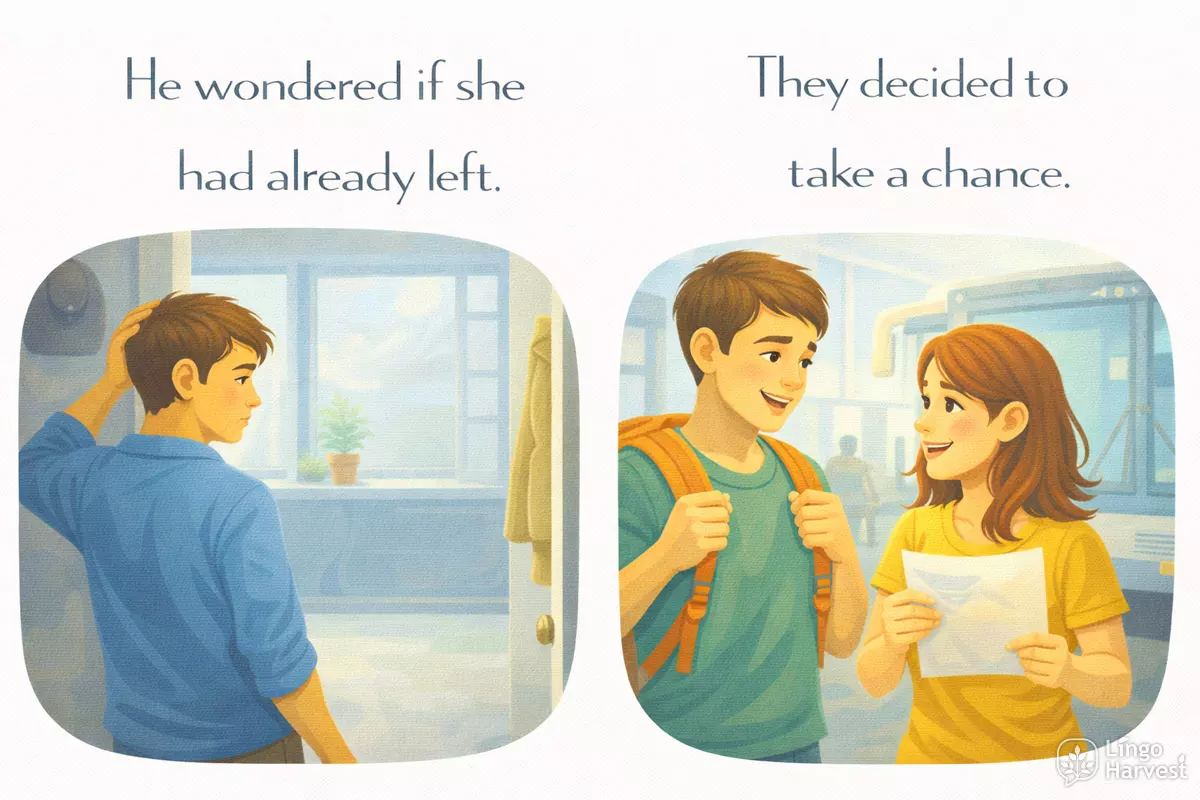
| "Did you see her leave?" | He wondered if she had already left. |
| "We should try our luck." | They decided to take a chance. |
| "That's mine, not yours!" | She insisted it belonged to her, not to him. |
| "Are they coming with us?" | He asked whether the others would join them. |
| "I'll meet you at the park." | She promised she would meet him at the park. |
Best practices for smooth narrative flow
Writers should pay attention to consistency and clarity. Overusing pronouns without clear antecedents in narration can confuse readers, especially when multiple characters of the same gender are present. In dialogue, pronouns add realism and immediacy but may require context to avoid ambiguity.
- Clarify antecedents when several characters are involved.
- Vary sentence structure to avoid repetitive pronoun use.
- Use names when pronouns could refer to more than one character.
- Match pronoun choice to point of view and narrative distance.
- Let dialogue reflect informal, natural speech patterns.
- Adapt pronoun use to the tone and style of the story.
In summary, how pronouns are used in speech and narration affects not just sentence flow, but also the reader’s connection to characters and events. Thoughtful choices help maintain clarity, pacing, and immersion throughout the story.
Avoiding ambiguity in long narratives
Pronoun confusion often creeps in as stories grow longer and more complex, especially when several characters interact across multiple scenes. Readers can lose track of who "he," "she," or "they" refers to if context isn’t clear. This can disrupt immersion and weaken the narrative flow, making it essential for writers to use strategies that clarify pronoun references over the course of extended storytelling.
Clear Referents and Strategic Naming
One of the most effective ways to minimize confusion is to repeat character names at key moments, particularly after scenes or paragraphs with multiple people. Alternating pronouns and names, rather than relying exclusively on pronouns, helps anchor the reader:
- Reintroduce a character’s name after a dialogue exchange or action sequence.
- Use descriptive identifiers (e.g., “the detective,” “her brother”) for variety and clarity.
- Vary sentence structure to avoid ambiguous pronoun clusters.
- Ensure each pronoun clearly points to the last mentioned, relevant character.
Tracking Multiple Characters
When scenes include several participants, especially those of the same gender, ambiguity can increase. Consider the following approaches to make references unmistakable:
- Assign distinct speech or action tags to each character.
- Introduce characters with unique traits or titles to differentiate them.
- Limit the number of characters in a scene to reduce confusion.
- Break up long paragraphs; start a new paragraph when the subject changes.
Common Pitfalls and Solutions
Writers sometimes fall into patterns that amplify confusion. Here’s a comparison of problematic usage and revised, clearer alternatives:
| Ambiguous Example | Clear Example |
|---|---|
| He gave him his book before he left. | James gave Mark his book before Mark left. |
| She told her she should go home. | Maria told Sarah that Sarah should go home. |
| They arrived and they sat down. | The twins arrived and the guests sat down. |
| After she saw her, she waved. | After Linda saw Anna, Linda waved. |
Techniques for Sustained Clarity
Maintaining narrative coherence requires attention to detail throughout the story. Keep these practical tips in mind:
- Establish a pattern for pronoun use early, then stick to it for consistency.
- Use context clues—actions, settings, or dialogue tags—to reinforce who is being referenced.
- When switching perspectives, signal the change clearly with breaks or headings.
- Edit with a focus on pronoun clarity; read passages aloud to catch confusing references.
- Ask beta readers to identify points of confusion you may overlook.
Careful handling of pronouns is a subtle but critical part of crafting compelling, readable fiction. By proactively addressing potential confusion, writers can ensure their stories remain engaging and easy to follow, no matter how intricate the plot or cast becomes.
Editing strategies for story clarity
Careful revision is essential when working with pronouns in storytelling. Ambiguous references or repetitive use can disrupt the reader’s immersion. To keep your narrative flowing smoothly, focus on reviewing each pronoun’s antecedent and consider whether the reader can easily follow who or what is being referenced. Sometimes, swapping a pronoun for a character’s name or a descriptive noun phrase can eliminate confusion, especially when multiple entities share the same gender or number.
Common pronoun pitfalls in narrative
Writers often encounter several frequent problems with pronoun usage:
- Unclear antecedents: “She grabbed her bag and told her to hurry.” (Who is “she” and who is “her”?)
- Pronoun overload in dialogue-heavy scenes
- Switching between first and third person without clear transitions
- Gender-neutral pronouns used inconsistently
- Possessive pronouns that don’t match the intended subject
Practical approaches to revising pronouns
To clarify your story’s flow, try these techniques:
- Read passages aloud to catch awkward or unclear references.
- Replace pronouns with character names or roles if there’s any doubt about identity.
- Vary sentence structure to avoid repetitive patterns (“He did this. He did that.”).
- Limit pronoun chains—avoid sentences with several pronouns and no explicit subjects.
- Use context clues or brief reminders (“the detective said” instead of “he said”) in crowded scenes.
- Check for consistency when using “they” as a singular pronoun.
- Ensure pronouns agree in number and gender with their antecedents.
- Break long sentences into shorter ones if pronoun references become tangled.
- Ask beta readers to note any places where they lost track of who’s who.
- Keep an eye out for pronouns near scene breaks or point-of-view shifts, where context can be lost.
Examples of ambiguous vs. clear pronoun use
| Ambiguous Pronoun Use | Clear Pronoun Use |
|---|---|
| When Alex met Jordan, he smiled. | When Alex met Jordan, Alex smiled. |
| Sara told Mia she would win the prize. | Sara said Mia would win the prize. |
| The dog chased the cat, but it escaped. | The dog chased the cat, but the cat escaped. |
| After John and Mark finished, he left. | After John and Mark finished, Mark left. |
Final review tips
Before considering your story polished, do a targeted pass just for pronouns. Mark any passages where a reader might stumble or misinterpret the subject. When in doubt, clarity always wins over brevity. By systematically refining pronoun use, you strengthen the connection between your narrative voice and the reader, ensuring a seamless and engaging experience.
Practice: improve narrative passages using pronouns
Clear and effective use of pronouns can transform awkward, repetitive sentences into smooth, engaging narrative. Let’s explore practical ways to revise passages by replacing repeated nouns with appropriate pronouns, maintaining clarity while improving the overall flow.
Common Issues in Narrative Writing
Writers often repeat character names or objects, which can make stories feel stiff or monotonous. Overusing nouns instead of pronouns disrupts rhythm and distracts the reader from the unfolding events.
- Excessive repetition of names (e.g., “Maria went to the store. Maria bought apples. Maria walked home.”)
- Unclear pronoun references, leading to confusion
- Switching between first, second, and third person unnecessarily
- Overuse of “it,” “they,” or “this” without clear antecedents
- Neglecting gender-neutral or inclusive pronouns where appropriate
- Pronoun-antecedent disagreement (e.g., “Each student must bring their pencil.”)
- Ambiguous pronoun use in scenes with multiple characters
- Using pronouns too soon before establishing the noun
- Redundant pronouns following the noun (e.g., “Emily, she ran fast.”)
- Unnecessary repetition of pronouns in dialogue tags
Revision Practice: From Repetition to Flow
Below are several short narrative passages. Try rewriting them by substituting pronouns for repeated nouns, making sure the meaning stays clear and the text sounds natural.
-
Anna picked up Anna’s backpack. Anna realized Anna had forgotten Anna’s lunch again.
-
The dog barked loudly. The dog chased the ball across the yard. The dog wagged the dog’s tail.
-
Mr. Lee looked at Mr. Lee’s watch. Mr. Lee sighed because Mr. Lee was late for Mr. Lee’s meeting.
-
Jack and Tom raced to the gate. Jack reached the gate before Tom, but Jack waited for Tom to catch up.
-
Sofia opened Sofia’s laptop. Sofia noticed Sofia had saved Sofia’s file in the wrong folder.
-
The children finished the children’s homework. The children put the children’s books away and thanked the children’s teacher.
-
Daniel called Daniel’s sister. Daniel told Daniel’s sister that Daniel would visit Daniel’s sister on Saturday.
-
The company updated the company’s website. The company announced the company’s new policy on the company’s homepage.
-
Maya met Maya’s friend at the café. Maya showed Maya’s friend Maya’s photos from Maya’s trip.
-
Leo found Leo’s keys. Leo remembered Leo had left Leo’s keys on Leo’s desk.
Show answers
- Anna picked up her backpack. She realized she had forgotten her lunch again.
- The dog barked loudly. It chased the ball across the yard and wagged its tail.
- Mr. Lee looked at his watch. He sighed because he was late for his meeting.
- Jack and Tom raced to the gate. Jack reached it before Tom, but he waited for Tom to catch up. (Or: Jack reached it first, but waited for him to catch up.)
- Sofia opened her laptop. She noticed she had saved her file in the wrong folder.
- The children finished their homework. They put their books away and thanked their teacher.
- Daniel called his sister. He told her that he would visit her on Saturday.
- The company updated its website. It announced its new policy on its homepage.
- Maya met her friend at the café. She showed her friend her photos from her trip.
- Leo found his keys. He remembered he had left them on his desk.
Quick Reference: Pronoun Substitution Patterns
Recognizing how to swap nouns for pronouns is essential. Here’s a handy list of common noun-to-pronoun replacements in storytelling:
- Maria → she/her
- John → he/him
- The children → they/them
- The cat → it
- My friend → they/them (gender-neutral)
- The teacher → he/she/they
- The book → it
- Sam and Alex → they/them
- Everyone → they/them
- My parents → they/them
- Each student → he/she/they (depending on context)
- The team → it/they (depending on style)
- The car → it
- My neighbor → he/she/they
- The birds → they
- Someone → they
- My brother and I → we/us
- Your friends → they/them
- The city → it
- The trees → they
Spot the Problem: Which Pronoun Fits?
Choose the most natural pronoun for each blank:
- Lucy forgot to bring _____ umbrella.
- The boys finished _____ homework before dinner.
- My cat is old, but _____ still likes to play.
- Neither Jane nor Mark remembered _____ keys.
- Emma called _____ brother after work.
- The team celebrated _____ win.
- I can’t find my phone — have you seen _____?
- The students opened _____ books and started reading.
- The company updated _____ website yesterday.
- Neither of the children packed _____ lunch.
Show answers
- her
- their
- it
- their
- her
- its
- it
- their
- its
- their
Before and After: Pronoun Improvements
For a quick comparison, note how pronoun use streamlines narrative:
| Original | Improved with Pronouns |
|---|---|
| Emily saw Emily’s friend across the street. Emily waved at Emily’s friend. | Emily saw her friend across the street. She waved at her. |
| The children played in the park. The children laughed and shouted as the children ran. | The children played in the park. They laughed and shouted as they ran. |
| Michael grabbed Michael’s coat and left Michael’s house quickly. | Michael grabbed his coat and left his house quickly. |
| The cake looked delicious. The cake was covered in chocolate. The cake was a birthday cake. | The cake looked delicious. It was covered in chocolate and was a birthday cake. |
Practicing these substitutions and recognizing where pronouns enhance clarity will help you write narratives that are both vivid and easy to follow.