Below vs Under vs Beneath: Level and Coverage Explained Simply

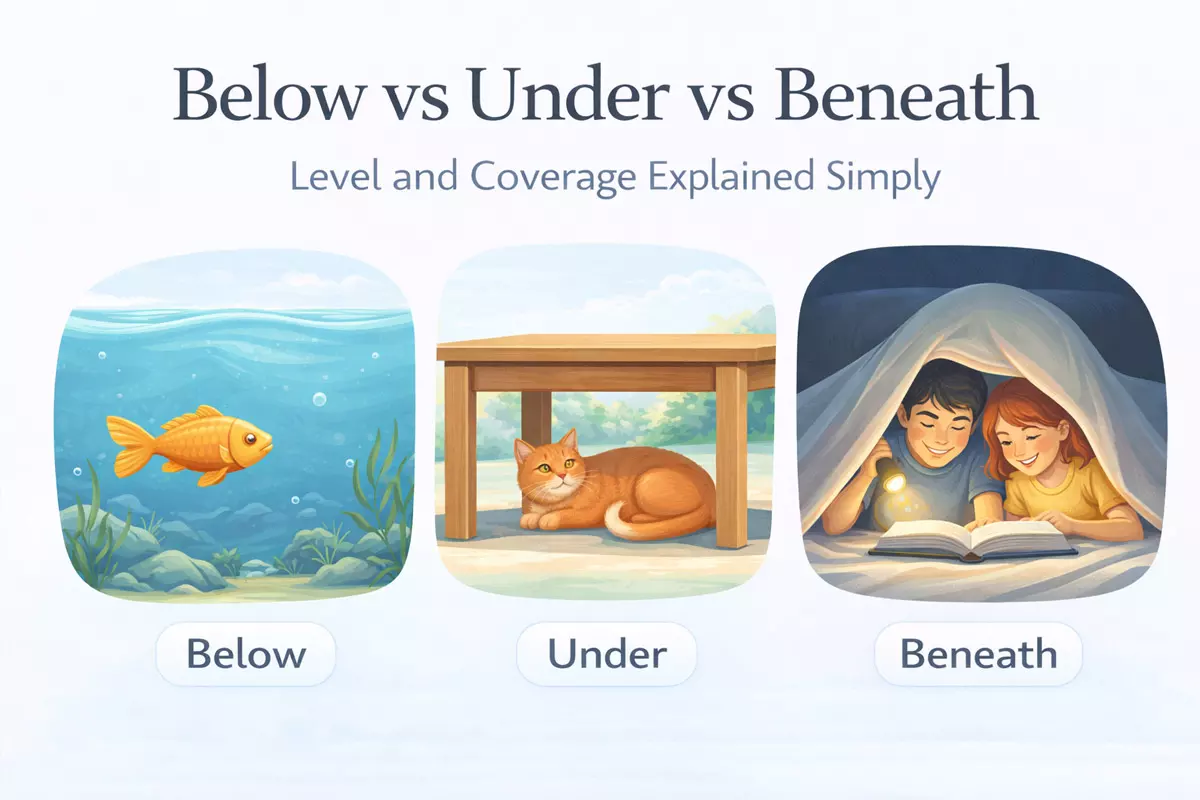 This article explains the basic meanings of below and under, how under can mean coverage rather than just level, and how beneath sounds more formal or literary. It covers common phrases, learner confusions, and offers practice with explanations.
When describing something located beneath or covered by another object, English offers several words, such as under, below, beneath, and underneath, each with subtle differences. Generally, under and underneath imply direct vertical coverage or contact, while below suggests a lower position without direct contact. Beneath can be more formal or poetic, often emphasizing something hidden or less visible. Understanding these distinctions helps ensure your descriptions of position or coverage are both accurate and clear in any context.
Basic level and height meanings of below and under
When talking about vertical position, “below” and “under” both describe something at a lower level or altitude compared to a reference point. However, they’re not always interchangeable. The difference often comes down to whether we’re focusing on strict height or actual physical coverage/obstruction.
“Below”: Focus on vertical level
“Below” is generally used to describe something at a lower point in space, often without any suggestion of one thing covering or touching the other. It emphasizes vertical position or rank, not physical covering. For example, “The valley is below the mountain” simply means the valley is at a lower elevation.
- The temperature dropped below zero.
- The picture hangs below the clock.
- Fish swim below the surface.
- Clouds floated below the airplane.
- Her grades were below average.
- We could see the city lights below us from the hill.
- The shelf below the window is empty.
- Children sat below the stage, looking up.
- The text below explains the rules.
- His rank is below captain.
“Under”: Suggests coverage or direct position
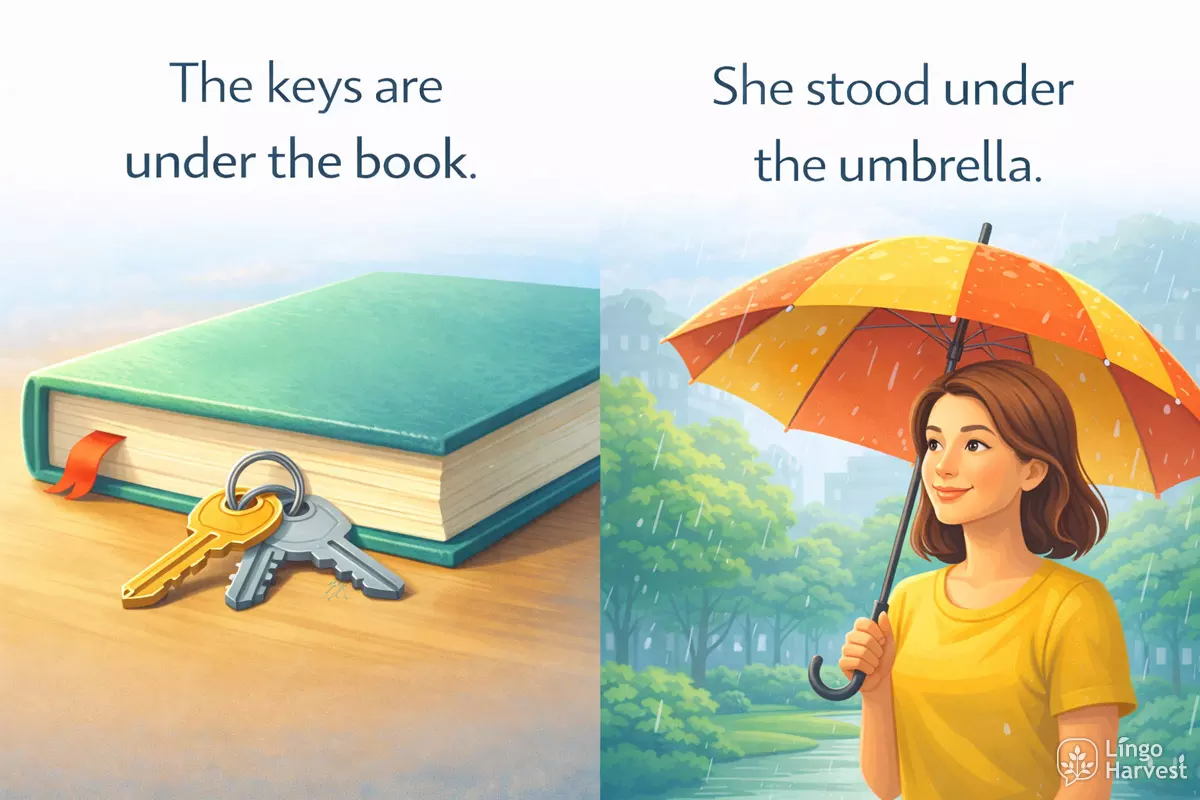
“Under” often implies that something is directly beneath and possibly covered or affected by another object. This word can suggest contact, support, or being hidden/shaded.
- The cat is under the table. (cat is directly beneath, possibly covered)
- The keys are under the book.
- She stood under the umbrella.
- The ball rolled under the couch.
- The workers are under a lot of pressure. (figurative use)
- The tunnel goes under the river.
- The dog hid under the bed.
- The letter was under a pile of papers.
- He waited under the tree for shade.
- The ice cracked under his weight.
At a glance: Level vs. Coverage
| Word | Main Idea | Typical Usage |
|---|---|---|
| Below | Lower in height or order, not necessarily covered | Temperature below freezing, text below a heading, city below the mountain |
| Under | Directly beneath; often with contact or coverage | Cat under the table, book under the pillow, tunnel under the road |
In summary, “below” is about relative height or position in a vertical sense, while “under” often hints at something being covered, supported, or directly beneath another object. Both can describe lower placement, but the nuance depends on whether you mean simple level or actual coverage.
When under implies coverage rather than just level
In English, the word under doesn’t always refer only to position or altitude. Sometimes, it suggests that something is covered or shielded by another object. This nuance can be subtle, but it’s an important difference when choosing the right word for clarity and precision.
How "under" shows coverage
When we say something is "under" something else, it often means the upper object is physically above and also acting as a cover, protector, or barrier. For example, if you’re "under a blanket," you are not just lower than the blanket—you’re enveloped by it.
- Sitting under an umbrella (protected from the rain or sun)
- Hiding under the bed (concealed by the bed above)
- Sleeping under the covers (wrapped or shielded by them)
- Under a bridge (the bridge serves as a shelter or barrier above)
- Under a tree (getting shade from the tree’s foliage)
- Under a coat (wearing a layer that covers you)
- Keeping valuables under the floorboards (hidden beneath, and also covered by, the boards)
- Under a tarp (protected from rain by the tarp overhead)
- Under a pile of clothes (covered by the clothes)
- Under a layer of snow (snow acts as a blanket or covering)
- Under a hat (the hat covers your head)
- Under a tablecloth (the surface is covered by the cloth)
- Under a sheet of paper (the paper is above, acting as a cover)
- Under the surface (concealed by whatever is above, such as water or soil)
- Under a mask (your face is covered by the mask)
Comparing "under" with "beneath" and "below"
While "under" often implies coverage, "beneath" and "below" tend to focus purely on position, not protection or concealment. For example, "beneath the stars" or "below sea level" tell you where something is, but not that it’s covered or shielded.
| Phrase | Coverage Implied? | Typical Use |
|---|---|---|
| Under the blanket | ✅ Yes | Being covered/wrapped for warmth |
| Beneath the blanket | ❌ No (usually) | Poetic or formal way to indicate position |
| Below the blanket | ❌ No | Lower than the blanket, not covered |
| Under the bridge | ✅ Yes | Sheltered by the bridge above |
| Beneath the bridge | ❌ No (usually) | Describes location, rarely coverage |
| Below the bridge | ❌ No | Lower than the bridge (e.g., water level) |
Understanding this distinction can help you choose the most accurate word when describing situations involving both position and coverage.
How beneath adds a formal or literary tone
Using the word beneath instead of "under" or "below" immediately brings a more elevated, poetic, or old-fashioned feeling to writing. This term often appears in literature, speeches, and formal documents, where the goal is to create a sense of depth or dignity. While "under" and "below" are common in everyday English, "beneath" stands out as more expressive and serious, which is why it’s a favorite among writers aiming for a particular mood.
Contexts where "beneath" feels more refined
- Describing emotions or qualities (e.g., beneath her calm exterior)
- Poetic descriptions of nature (the stream flowed beneath the ancient bridge)
- Implying hierarchy or status (considered it beneath him)
- Historical or fantasy settings (beneath the castle walls)
- Formal speeches or ceremonial language
- Exploring hidden meanings or layers
- Expressing moral or social judgments (such behavior is beneath you)
- Metaphors and symbolism (beneath the surface)
- Describing secrets or mysteries (truths hidden beneath the lies)
- Classic literature and poetry
Why writers choose "beneath"
Writers often select "beneath" for its ability to evoke a sense of something hidden, profound, or dignified. It’s not just about physical position; this word can suggest underlying motives, secret emotions, or things of greater significance. Its less frequent use in casual speech means it draws attention, making passages more memorable and weighty.
Common patterns and phrases with "beneath"
- Beneath the surface → Beneath the surface, the problem was much deeper than it seemed.
- Beneath the stars → They slept beneath the stars on a warm summer night.
- Beneath the waves → A hidden reef lies beneath the waves.
- Beneath contempt → Such behavior is beneath contempt.
- Beneath notice → His mistake was too minor to be beneath notice.
- Beneath the moonlight → The town looked peaceful beneath the moonlight.
- Beneath his dignity → He felt that apologizing publicly was beneath his dignity.
- Beneath the rubble → Survivors were trapped beneath the rubble.
- Beneath the shadows → Something moved quietly beneath the shadows.
- Beneath the canopy → We rested beneath the canopy of tall trees.
- Beneath the mask → Beneath the mask, she was smiling.
- Beneath the clouds → The city spread out beneath the clouds.
- Beneath her smile → Beneath her smile, there was clear sadness.
- Beneath the surface calm → Beneath the surface calm, tensions were rising.
- Beneath my feet → I felt the ground shake beneath my feet.
Comparison: "Beneath" vs "Under" vs "Below" in tone
| Expression | Typical Tone | Example |
|---|---|---|
| Beneath | Formal, literary, poetic | Beneath the willow tree, she wept in silence. |
| Under | Neutral, everyday speech | The keys are under the mat. |
| Below | Technical, spatial, factual | The temperature dropped below freezing. |
In summary, "beneath" lends a sense of gravity and artistry that everyday alternatives lack. Its use is a deliberate stylistic choice, signaling to readers that something more nuanced or symbolic may be at play.
Common phrases in technical and everyday language
When choosing between "below," "under," and "beneath," context matters—both in technical writing and daily conversations. Each term can appear in set expressions, instructions, or descriptive phrases, and sometimes the choice is determined by convention rather than strict rules.
Typical expressions and collocations
You’ll often encounter specific patterns where one word is favored over the others. Here’s a list of frequent phrases and settings for each:
- Below: "below sea level," "below freezing," "see below," "temperature below 0°C," "listed below," "the text below," "below average," "below the surface," "details below"
- Under: "under the table," "under pressure," "under construction," "under review," "under the law," "under your breath," "under control," "under the influence," "under warranty," "under attack"
- Beneath: "beneath the surface," "beneath contempt," "beneath the stars," "beneath notice," "beneath the waves," "beneath the ground," "beneath the dignity," "beneath a layer of..."
Contextual differences in technical and everyday usage
In technical fields, such as engineering, meteorology, or documentation, "below" is frequently used to indicate measurement or position relative to a reference point, while "under" tends to describe physical location or state. "Beneath" often appears in more formal, literary, or poetic contexts, or when emphasizing layers or hierarchy.
| Phrase | Usual Context or Meaning |
|---|---|
| below sea level | Measurement relative to sea level (geography, science) |
| under the table | Physical location (everyday, literal) or idiomatically about secret payments |
| beneath contempt | Describes something unworthy of respect (formal/literary) |
| under construction | Describes a state or process (technical, signage) |
| below average | Statistical comparison or evaluation |
| beneath the surface | Literal (under the outer layer) or figurative (hidden meaning) |
| under review | In process of being examined (business, administration) |
| listed below | Refers to information further down in a document |
Quick tips for choosing the right word
- Use "below" for levels, measurements, and written references.
- Choose "under" for physical positions, states, or actions.
- Select "beneath" for formal, poetic, or layered contexts.
Awareness of these common phrases and their preferred settings will help you communicate your meaning more clearly, whether you're drafting technical documents or chatting with friends.
Typical learner confusions between under and below
Learners often stumble when choosing between "under" and "below" because both words are commonly used to describe position, yet have subtle distinctions in usage. The confusion usually arises from cases where either could technically fit, but one is more natural or accurate depending on the context.
When both seem possible but only one is correct
Many English students instinctively reach for "under" in any situation involving vertical positioning, but native speakers use "below" in specific scenarios. For instance, "under" often implies direct contact or a sense of being covered, whereas "below" suggests a position at a lower level but not necessarily in contact.
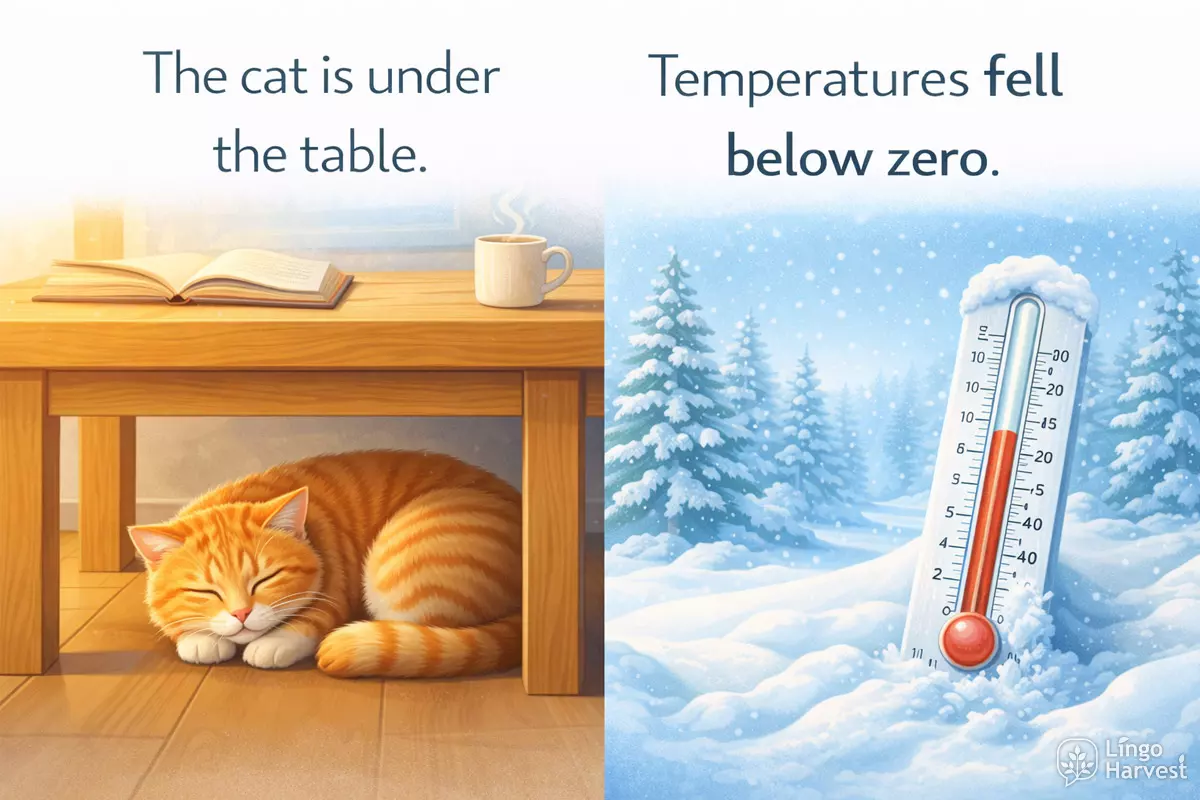
- Under is typical for physical covering or support: “The cat is under the table.”
- Below is standard for indicating lower levels or ranking: “Temperatures fell below zero.”
- Under is used with laws or rules: “Under the new regulations...”
- Below appears in written texts to refer to information: “See the chart below.”
Common mix-ups and why they happen
Some frequent mistakes are linked to translating directly from a learner’s native language or to overgeneralizing rules. For example, students might say "The plane flew under the clouds" (when it should be "below the clouds" if there’s no sense of being covered) or "See the answer under" (instead of "below").
| Example | Preferred Usage |
|---|---|
| He hid under the bed. | Under (implies direct covering/contact) |
| The sun set below the horizon. | Below (refers to a lower level, no contact) |
| Your grade is below average. | Below (used for rank or level) |
| She works under pressure. | Under (figurative: condition or influence) |
Quick reference: typical error patterns
Learners tend to:
- Use "under" for locations without physical covering (e.g., "The picture is under the clock" instead of "below the clock")
- Choose "below" for physical objects in contact (e.g., "The shoes are below the bed" instead of "under the bed")
- Forget that "under" can be figurative (e.g., "under stress", "under the law")
- Use "under" instead of "below" in written instructions (e.g., "see under")
Understanding these patterns helps learners avoid the most frequent pitfalls and use each word more naturally in context.
Practice: choose the best option and explain why
Understanding when to use "below," "under," or "beneath" can be confusing, especially since they sometimes overlap. Try these exercises to see how well you can apply the rules of level (vertical position), coverage, and formality. For each sentence, pick the correct word and explain your choice.
Choose the right word for each sentence
- The cat is hiding ______ the table.
- Please write your name ______ the line.
- They found shelter ______ a large tree during the storm.
- The temperature dropped ______ zero last night.
- There is a secret tunnel ______ the castle.
- The painting was hanging ______ the window.
- She wore a sweater ______ her coat.
- The diver swam ______ the surface of the water.
- The treasure was buried ______ the sand.
- The sun disappeared ______ the horizon.
Show answers
- under – "The cat is hiding under the table." Under is used because the cat is physically covered by the table.
- below – "Please write your name below the line." Below shows a lower position without direct contact.
- beneath – "They found shelter beneath a large tree during the storm." Beneath is slightly more formal and emphasizes protection or coverage.
- below – "The temperature dropped below zero last night." Below is used for levels, especially numbers or measurements.
- under – "There is a secret tunnel under the castle." Under suggests direct vertical position and often physical contact.
- above would be correct, but if forced to choose among the three, "below" fits: "The painting was hanging below the window." Below indicates a lower position without direct contact.
- under – "She wore a sweater under her coat." Under is used for layers of clothing.
- beneath – "The diver swam beneath the surface of the water." Beneath is often used in formal or literary contexts, especially for layers of nature.
- under – "The treasure was buried under the sand." Under is used because the sand covers the treasure.
- below – "The sun disappeared below the horizon." Below is used for position relative to a line or level.
Common contexts and explanations
- Under is for physical coverage or direct vertical position, especially when one thing is touching or covering another.
- Below is used for lower levels, measurements, or when there is separation.
- Beneath is more formal, often describing something hidden, protected, or literary imagery.
Extended practice: choose and justify
Match the following phrases with the best preposition and explain your choice:
- The bookshelf is (under / below / beneath) the clock.
- He felt nervous (under / below / beneath) her gaze.
- The valley lies (under / below / beneath) the mountain.
- There is a parking lot (under / below / beneath) this building.
- The village is (under / below / beneath) sea level.
- She walked (under / below / beneath) the bridge.
- The document was hidden (under / below / beneath) the stack of files.
- He refused to act (under / below / beneath) his principles.
- The cat slept (under / below / beneath) the warm blanket.
- The cave stretches far (under / below / beneath) the surface.
Show answers
- below – “The bookshelf is below the clock.” (Lower position on the wall, no contact.)
- under – “He felt nervous under her gaze.” (Figurative pressure or influence.)
- beneath – “The valley lies beneath the mountain.” (Formal/literary, emphasizing what is above.)
- under – “There is a parking lot under this building.” (Directly underneath, physical structure.)
- below – “The village is below sea level.” (Measurement or level.)
- under – “She walked under the bridge.” (Passing directly beneath.)
- beneath – “The document was hidden beneath the stack of files.” (Covered, slightly formal.)
- beneath – “He refused to act beneath his principles.” (Abstract, moral sense.)
- under – “The cat slept under the warm blanket.” (Physical coverage.)
- beneath – “The cave stretches far beneath the surface.” (Depth, descriptive style.)
Review these examples and explanations to build confidence distinguishing these prepositions in both literal and figurative situations.