Avoiding Repetition: How Pronouns Make Sentences Clear

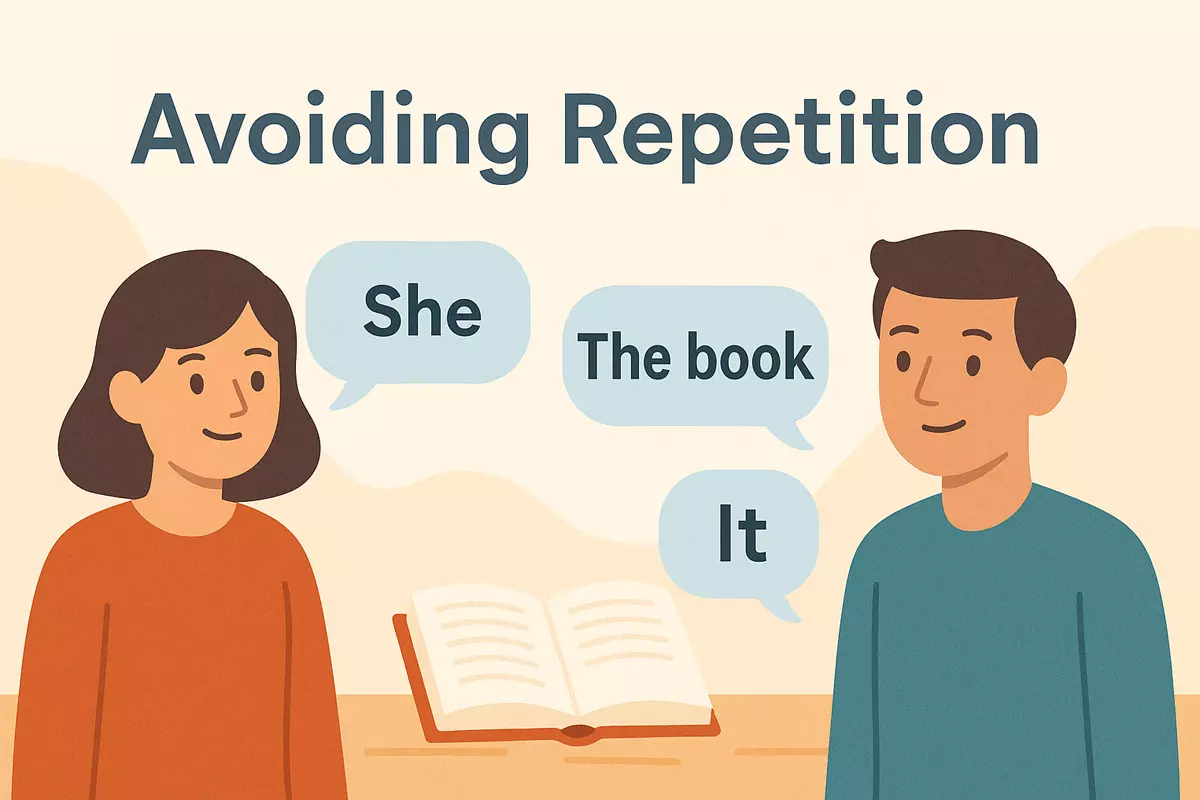 Here we the importance of avoiding repetition, shows how to use pronouns instead of nouns, explains how to keep pronoun references clear, and offers examples and practice to help avoid ambiguous pronouns in writing.
To keep your writing clear and engaging, avoid repeating the same nouns too frequently, as this can make sentences dull or confusing. Instead, use pronouns to refer back to earlier nouns. Pronouns help ideas flow smoothly and make your message more enjoyable and easier to follow. By varying your word choices and incorporating pronouns appropriately, you can maintain your readers’ interest and ensure your writing remains concise and natural throughout.
Why Avoid Repetition?
Clear, concise writing is easier for readers to follow. When the same words or names are repeated too often, sentences can feel clunky and tedious. Overuse of the same noun or phrase distracts from the main message and can make even simple ideas seem awkward or confusing.
Benefits of Reducing Redundancy
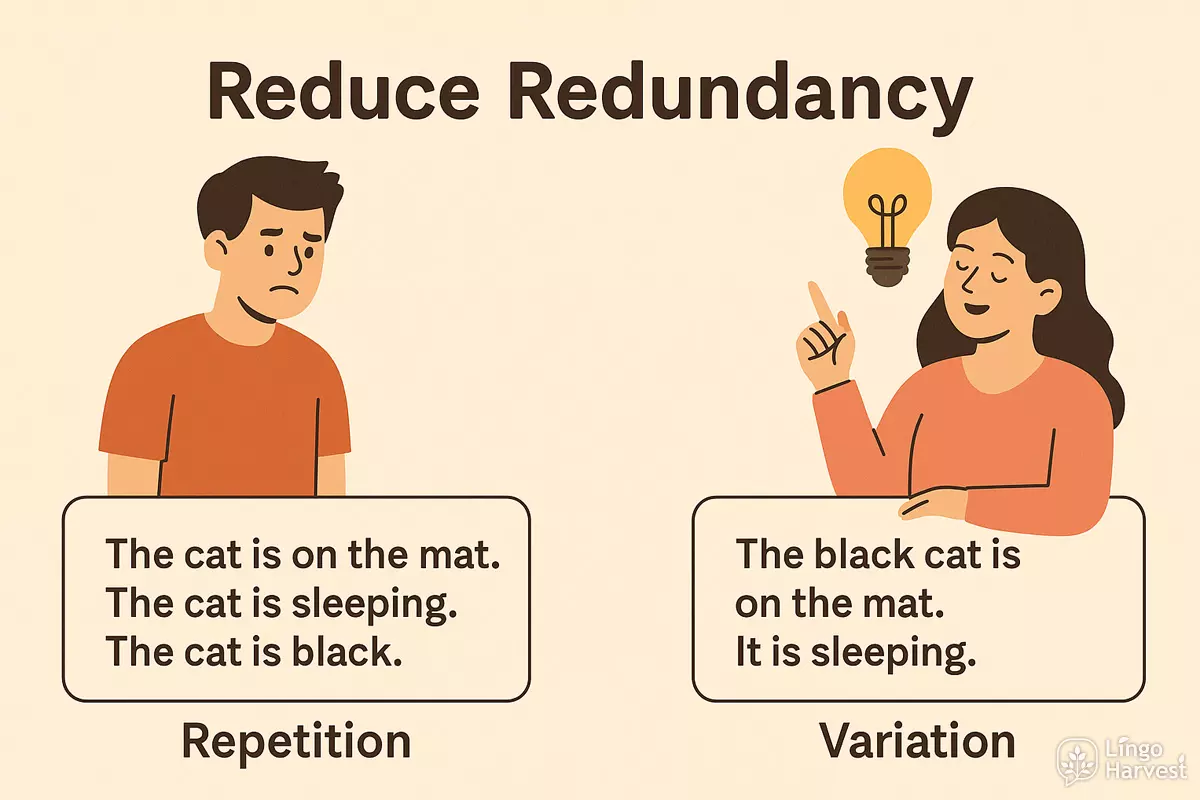
- Improves readability: Sentences flow more smoothly when unnecessary repetition is removed.
- Prevents confusion: Using pronouns or synonyms helps clarify who or what is being discussed, especially in longer passages.
- Makes writing sound natural: Native speakers rarely repeat the same word in every sentence; variation reflects real communication.
- Enhances engagement: Readers are more likely to stay interested when language is varied and lively.
Common Problems Caused by Repeating Words
- Monotonous tone that bores the reader
- Ambiguity if it’s unclear which noun is being referenced
- Sentences that sound robotic or unnatural
- Loss of focus on the main idea
How Pronouns Help
Pronouns are essential tools for writers and speakers. They stand in for nouns, so you don’t have to keep repeating the same name or thing. This makes sentences shorter and clearer. For example, instead of saying, “Maria took Maria’s book because Maria needed Maria’s book,” you can say, “Maria took her book because she needed it.” The meaning stays clear, but the phrasing is far less awkward.
| Repetitive Sentence | Improved with Pronouns |
|---|---|
| Tom forgot Tom's keys, so Tom went back for Tom's keys. | Tom forgot his keys, so he went back for them. |
| The dog barked because the dog saw the cat. | The dog barked because it saw the cat. |
| Sara likes Sara's coffee because Sara made Sara's coffee fresh. | Sara likes her coffee because she made it fresh. |
| The team won the game. The team celebrated the team’s victory. | The team won the game and celebrated their victory. |
Summary
Effective communication relies on variety and clarity. By minimizing repeated words and using pronouns appropriately, you make your writing more inviting and understandable. This simple shift not only polishes your style but also helps readers stay focused on your message.
Replacing Nouns with Pronouns
When writing, repeating the same words can make sentences sound awkward or boring. Pronouns help by standing in for nouns, making language smoother and less repetitive. They allow you to avoid restating names or objects that the reader already knows about. For example, instead of saying “Maria saw Maria’s cat,” you could say “Maria saw her cat.” This keeps the sentence clear and natural.
Why Use Pronouns?
Using pronouns streamlines your writing. It helps readers follow along without getting distracted by constant repetition. It also clarifies who or what you’re talking about, as long as it’s clear from the context. Pronouns can refer to people, places, things, or ideas that have already been mentioned.
Common Types of Pronouns
There are several categories of pronouns, each serving a different purpose. Here are some of the most frequently used types:
- Personal pronouns: I, you, he, she, it, we, they
- Possessive pronouns: mine, yours, his, hers, its, ours, theirs
- Reflexive pronouns: myself, yourself, himself, herself, itself, ourselves, yourselves, themselves
- Demonstrative pronouns: this, that, these, those
- Relative pronouns: who, whom, whose, which, that
- Indefinite pronouns: someone, anyone, everyone, nobody, each, few, many, all
- Interrogative pronouns: who, what, which, whose
Examples: Before and After Using Pronouns
Let’s look at how sentences can be improved:
- Anna likes Anna’s dog. → Anna likes her dog.
- The book was on the table. The book was red. → The book was on the table. It was red.
- John and Mark went to John and Mark’s school. → John and Mark went to their school.
- The students finished the students’ homework. → The students finished their homework.
- Sarah gave the pencil to Sarah. → Sarah gave the pencil to herself.
- This is the car that I bought. The car is blue. → This is the car that I bought. It is blue.
- My friends and I enjoyed my friends’ and my trip. → My friends and I enjoyed our trip.
- The teacher told the teacher’s students to listen. → The teacher told her students to listen.
- Michael saw Michael’s reflection. → Michael saw his reflection.
- The cake was delicious. The cake was made by Tom. → The cake was delicious. It was made by Tom.
Guidelines for Effective Use
- Make sure the noun you’re replacing is clear to the reader.
- Use pronouns to avoid unnecessary repetition, but not so much that sentences become confusing.
- Check that each pronoun agrees in number and gender with the noun it replaces.
- Introduce the noun before using a pronoun for it.
Quick Reference: Noun vs. Pronoun
| Noun Example | Pronoun Replacement |
|---|---|
| Jessica saw Jessica’s friends. | Jessica saw her friends. |
| The bicycle is new. The bicycle is fast. | The bicycle is new. It is fast. |
| Tom and Jerry finished Tom and Jerry’s project. | Tom and Jerry finished their project. |
| The cake was made by Maria. The cake was delicious. | The cake was made by Maria. It was delicious. |
By using pronouns thoughtfully, your writing becomes clearer, more concise, and easier to read. Always ensure the reference is obvious, so your sentences remain smooth and understandable.
Pronoun Reference and Clarity
Selecting the right pronoun makes writing more precise and easier to follow. When readers can easily tell which noun a pronoun refers to, sentences flow smoothly and confusion is avoided. Ambiguous references, on the other hand, force readers to pause and reread, which disrupts understanding.
Common Sources of Pronoun Confusion
Unclear references often happen when more than one possible noun is present, or when the pronoun is too far from its antecedent. Consider these frequent trouble spots:
- Using "it" when several singular nouns are in the previous sentence
- Switching between "he" and "she" without clear identification
- Referring to whole ideas or events with "this" or "that" without explanation
- Placing the pronoun before introducing the noun it replaces
- Overusing "they" when the group isn’t obvious
Examples of Clear and Unclear Pronoun Use
| Unclear Reference | Clear Reference |
|---|---|
| When Sarah met Anna, she was running late. | When Sarah met Anna, Sarah was running late. |
| The book was on the table, but it was gone later. | The book was on the table, but the table was empty later. |
| Tom told Jack that he needed to leave. | Tom told Jack, "I need to leave." |
| The students discussed the test with the teachers, and they were helpful. | The students discussed the test with the teachers, who were helpful. |
Tips for Ensuring Pronoun Clarity
- Introduce the noun before using a pronoun for it
- Keep pronouns close to their referents
- Replace ambiguous pronouns with the specific noun when needed
- Use gender-neutral pronouns carefully to avoid confusion
- Restate the noun if there’s any chance of misunderstanding
- For abstract references, clarify with a phrase (e.g., "This result shows...")
- Check each pronoun: ask, "To whom or what does this refer?"
- Revise sentences with multiple possible antecedents
- Read sentences aloud to spot awkward or confusing references
In summary, precise use of pronouns removes ambiguity and guides readers through your ideas. With careful attention to reference, writing becomes much clearer and more effective.
Avoiding Ambiguous Pronouns
Clarity in writing often depends on how well pronouns are used. When a pronoun could refer to more than one noun, the meaning of a sentence can become confusing. This is especially common when several people or objects are mentioned, and then "he," "she," "it," or "they" is used without making it obvious who or what is being referred to.
Common Pitfalls with Unclear Pronoun References

Writers sometimes assume their intended meaning is obvious, but readers may not know which noun a pronoun stands for. For example, in the sentence “Anna spoke to Maria after she finished the project,” it’s unclear whether “she” refers to Anna or Maria. These kinds of ambiguities can slow down readers and lead to misunderstandings.
Tips for Making Pronoun References Clear
- Repeat the noun if there could be confusion.
- Place pronouns close to their intended noun.
- Revise sentences to avoid multiple possible antecedents.
- Use names or descriptive phrases instead of pronouns when needed.
- Break up complex sentences into shorter statements for clarity.
- Check each pronoun: Ask yourself, “Is it 100% clear who or what this refers to?”
- Avoid using “it” or “this” at the start of a sentence without a clear reference.
- Use gender-neutral pronouns carefully, ensuring the antecedent is unmistakable.
- Read your sentences aloud to catch possible ambiguities.
- Request feedback from someone unfamiliar with your text to spot unclear references.
Examples of Ambiguous vs. Clear Pronoun Use
| Ambiguous Sentence | Improved Sentence |
|---|---|
| Mark told Alex that he would win the prize. | Mark told Alex, “You will win the prize.” |
| When Sarah met Lisa, she was tired. | When Sarah met Lisa, Lisa was tired. |
| The box was placed on the table, but it was broken. | The box was placed on the table, but the box was broken. |
| After putting the book on the shelf, it fell. | After putting the book on the shelf, the book fell. |
| Tom called Jim while he was driving. | Tom, who was driving, called Jim. |
Quick Checklist for Pronoun Clarity
- ✅ Is the pronoun’s antecedent unmistakable?
- ✅ Are there multiple nouns that the pronoun could refer to?
- ✅ Would repeating the noun improve understanding?
- ✅ Does the sentence flow naturally with the pronoun replaced?
Paying attention to these strategies helps ensure your writing is clear and easy to follow, even when pronouns are used to avoid repetition.
Examples in Real Sentences
Using pronouns helps writers and speakers avoid awkward repetition, making communication smoother and easier to understand. Let’s look at how substituting nouns with pronouns can clarify meaning and streamline expression. The following sentences illustrate how replacing repeated nouns with the correct pronouns keeps language natural and clear.
Before and After: Avoiding Redundancy
- Maria finished Maria’s homework before Maria went to bed. → Maria finished her homework before she went to bed.
- The dog chased the dog’s tail because the dog was bored. → The dog chased its tail because it was bored.
- John and Lisa called John and Lisa’s friends to invite John and Lisa’s friends to the party. → John and Lisa called their friends to invite them to the party.
- The children played while the children’s parents watched the children. → The children played while their parents watched them.
- My brother said my brother would help. → My brother said he would help.
Variety of Pronouns in Context
- Susan lost her keys, but she found them later.
- The students submitted their assignments on time.
- When the cat saw the bird, it jumped onto the windowsill.
- Tom and I went to the store. We bought some fruit.
- Did you remember to bring your umbrella?
- Alex and Mark said they would join us for lunch.
- Julia told me that she would call later.
- The machine stopped working because it overheated.
- Have you seen my phone? I can’t find it anywhere.
- If anyone calls, tell them I’ll be back soon.
Comparing Repetitive and Improved Sentences
| Repetitive Version | With Pronouns |
|---|---|
| Lisa put Lisa’s book on Lisa’s desk. | Lisa put her book on her desk. |
| The teacher gave the teacher’s students the teacher’s notes. | The teacher gave her students her notes. |
| The car lost the car’s keys. | The car lost its keys. |
| Ben told Ben’s story to Ben’s friends. | Ben told his story to his friends. |
Through these real-world cases, it’s clear that pronouns are essential for concise and readable language. Replacing repeated names or nouns with the right pronoun not only prevents redundancy but also keeps sentences flowing smoothly.
Practice
Understanding how pronouns clarify writing is easier with hands-on activities. These tasks help you notice where repeating nouns makes sentences awkward and how substituting with pronouns improves clarity and flow.
Identify and Replace
Read the sentences below. Spot where the same noun is used repeatedly, then replace some of them with an appropriate pronoun.
- Anna forgot Anna’s keys, so Anna went back to Anna’s car to get Anna’s keys.
- The dog chased the cat, and the dog barked loudly at the cat.
- My brother likes my brother’s bike because my brother thinks my brother’s bike is fast.
Show answers
- Anna forgot her keys, so she went back to her car to get them.
- The dog chased the cat, and it barked loudly at her.
- My brother likes his bike because he thinks it is fast.
Pronoun Selection Quiz
Choose the correct pronoun to replace the underlined words in each sentence.
- Maria and Maria’s friends are going to the park. (they/she/them)
- The book is on the table. (it/he/they)
- James saw James’s teacher at the store. (her/him/them)
- My parents and I invited my parents and I to the party. (us/we/them)
Show answers
- they
- it
- her
- us
Common Pronoun Replacements
Here are some typical noun-pronoun substitutions. Use these as a guide when editing sentences for conciseness:
- the teacher → she or he
- the books → they
- my friends and I → we
- the dog → it
- the children → they
- my mother → she
- the car → it
- my brother → he
- the apples → they
- the team → they
- Sarah and Tom → they
- the house → it
- the students → they
- my family → they
- the movie → it
Before and After: Comparing Sentences
See how using pronouns can transform repetitive sentences into smoother ones. The table below compares examples:
| Repetitive Sentence | Improved with Pronouns |
|---|---|
| Emily took Emily’s coat because Emily was cold. | Emily took her coat because she was cold. |
| The cats climbed the tree, and the cats meowed. | The cats climbed the tree and they meowed. |
| Jack and Jill went up the hill. Jack and Jill fetched water. | Jack and Jill went up the hill. They fetched water. |
| The computer stopped working, so the computer was repaired. | The computer stopped working, so it was repaired. |
| My friends visited my friends’ favorite restaurant. | My friends visited their favorite restaurant. |
Regularly practicing these substitutions will help you write with greater clarity and avoid unnecessary repetition.