Singular vs Plural Pronouns: Subtle Meaning Differences

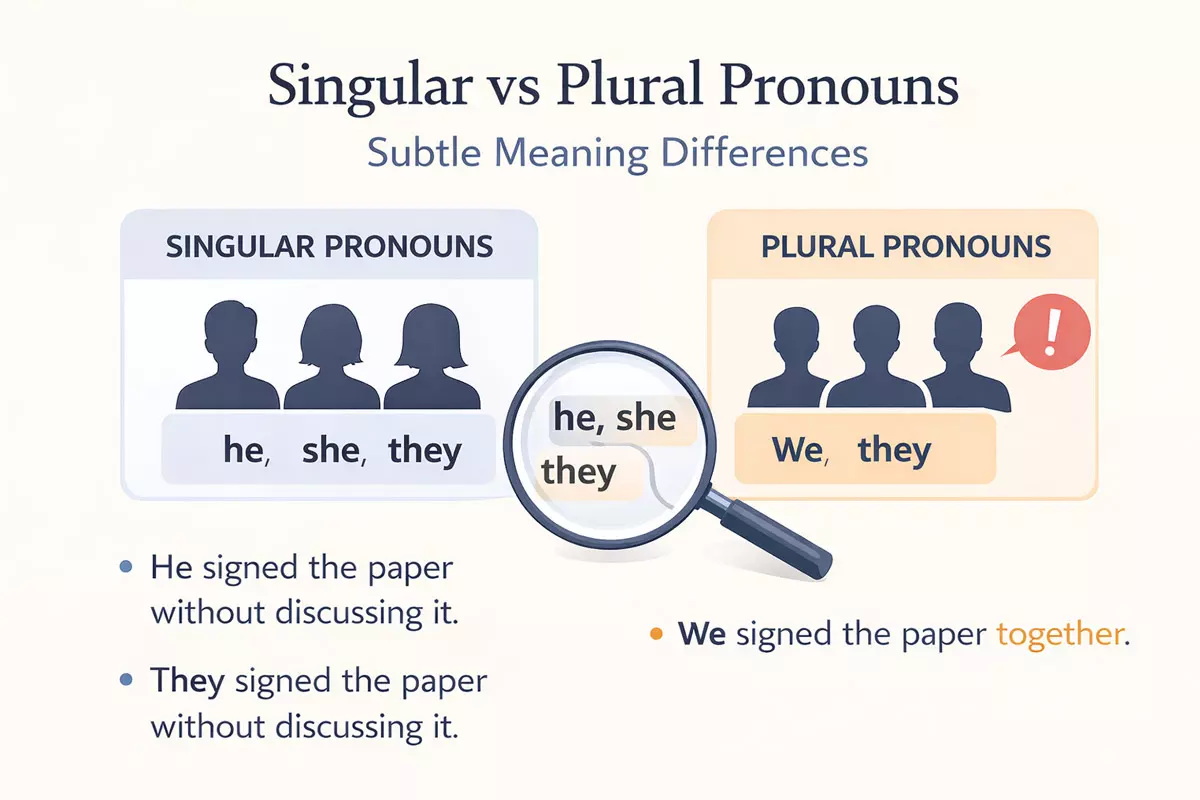 Here we how singular and plural pronouns affect meaning, including their use with collective and indefinite nouns, formal versus informal preferences, context-based shifts, common learner errors, and provides practice on choosing the right pronoun.
- How singular and plural pronouns affect meaning
- They as singular vs they as plural
- Pronouns with collective nouns
- Formal vs informal preferences for number choice
- Context-driven shifts in meaning
- Agreement issues with indefinite pronouns
- Common learner confusion patterns
- Practice: choose singular or plural pronouns correctly
Selecting words that indicate whether you are referring to one person or multiple people may appear straightforward, but such choices can significantly change the meaning of your sentences. These subtle distinctions can influence how your message is received and understood by others. By paying close attention to singular and plural terms, you can enhance the clarity and precision of your communication, ensuring that your intended meaning is accurately conveyed and reducing the likelihood of misunderstandings.
How singular and plural pronouns affect meaning
Choosing between a singular or plural pronoun does more than just match a word to the number of people or things involved—it can subtly change the entire message. The difference between “he” and “they,” or “it” and “they,” affects clarity, responsibility, and even inclusivity in communication. Using the right form helps readers or listeners understand exactly who or what is being referred to, and can also signal whether a statement is meant to be personal or general.
Clarity and precision
Singular pronouns like “she,” “he,” or “it” point to one specific person or object, making it clear who or what is involved. Plural pronouns such as “they” or “we” indicate more than one, which can broaden the scope and sometimes make statements more general. Being precise with pronoun choice prevents confusion and ensures your audience knows exactly what you mean.
Examples: Shifting meaning with pronoun number
- He forgot his keys. (One man left his keys behind.)
- They forgot their keys. (Several people left their keys behind.)
- It is broken. (A single item doesn’t work.)
- They are broken. (Multiple items don’t work.)
- She will call you. (Expect a call from one woman.)
- They will call you. (Expect calls from more than one person, or possibly a nonbinary individual.)
- I need my book. (One person needs one book.)
- We need our books. (A group needs their books.)
- You are late. (Directed at one person or a group, depending on context.)
- You all are late. (Clearly directed at more than one person.)
Responsibility and tone
Pronoun number can shift how responsibility or action is assigned. Singular forms put the spotlight on one person or thing, while plural forms can spread accountability or make statements less direct. For example, “You forgot the deadline” singles someone out, while “You all forgot the deadline” distributes the blame across a group. In formal or sensitive situations, this difference can help soften the message or make it more inclusive.
Summary: Singular vs. plural pronouns in context

| Singular Pronoun Example | Plural Pronoun Example | How the Meaning Changes |
|---|---|---|
| She finished the project. | They finished the projects. | One person completed a task vs. multiple people worked on several tasks. |
| It is missing. | They are missing. | A single item is lost vs. multiple items are lost. |
| I want my lunch. | We want our lunch. | One person is hungry vs. a group is hungry. |
| You need to sign. | You all need to sign. | Instruction for one person vs. a group instruction. |
In summary, the choice between singular and plural pronouns shapes not only grammatical correctness but also the nuance and intention behind your statements. Understanding these differences helps you communicate more effectively, whether you’re writing, speaking, or clarifying meaning in conversation.
They as singular vs they as plural
English speakers often use they for both individuals and groups, but the meaning can shift depending on context. When they refers to a single person, it usually signals that the person's gender is unknown, unspecified, or non-binary. In contrast, plural they always points to more than one person or thing. These subtle distinctions can influence how a sentence is interpreted and may even affect the tone.
Recognizing singular vs plural usage
You can usually tell whether they is singular or plural by looking at clues elsewhere in the sentence. Verb agreement, context, and prior nouns are all helpful. Here are some ways to spot the difference:
- If they replaces a singular antecedent (like "someone" or a named individual), it's singular.
- If they refers to a group, team, or list of names, it's plural.
- Singular they pairs with singular verbs ("they are" is grammatically accepted for both singular and plural).
- Context often reveals whether one person or multiple people are meant.
Common examples
Notice the subtle differences in these sentences:
- Singular: "Someone left their umbrella. I hope they come back for it."
- Plural: "The students finished their exams. They were relieved."
- Singular: "If a guest arrives early, please show them to their seat."
- Plural: "The neighbors said they would help."
- Singular: "Each applicant must submit their resume if they wish to be considered."
- Plural: "The dogs barked because they heard a noise."
- Singular: "Alex said they will join us later." (referring to one non-binary person)
- Plural: "The engineers said they fixed the problem."
- Singular: "Every student should make sure they understand the instructions."
- Plural: "My friends said they are coming over."
Subtle meaning differences and clarity
Choosing between singular and plural they can shape the nuance of your message. Singular they is inclusive and avoids assumptions about gender, while plural they is straightforward for groups. Sometimes, ambiguity arises if the context does not make the reference clear, so it's often helpful to clarify the antecedent if confusion might occur.
| Singular "they" | Plural "they" |
|---|---|
| Refers to one person whose gender is unknown, unspecified, or non-binary | Refers to more than one person or thing |
| "If anyone calls, tell them I'm busy." | "The children said they were tired." |
| Often follows singular antecedents like "someone," "anybody," or a person’s name | Usually replaces plural antecedents, such as "students," "neighbors," or "dogs" |
| Promotes gender inclusivity and neutrality | Standard plural pronoun use |
Understanding the difference not only helps with clarity but also ensures your language is respectful and precise.
Pronouns with collective nouns
When a group noun like "team," "family," or "audience" is the subject, choosing between singular and plural pronouns can subtly shift the meaning. The choice depends on whether you view the group as a single unit or as individuals. In American English, collective nouns are often treated as singular, but British English frequently treats them as plural, especially when the focus is on the members acting separately.
How meaning changes with pronoun choice
Using a singular pronoun (it, its) emphasizes the group as a whole, while plural forms (they, their, them) highlight the individuals within it. This distinction often affects the nuance of your sentence, especially in formal writing or when clarity is essential.
| Collective Noun | Singular Pronoun Example | Plural Pronoun Example |
|---|---|---|
| Team | The team won its first game. | The team celebrated their individual achievements. |
| Family | My family is selling its house. | My family are packing their bags separately. |
| Committee | The committee reached its decision. | The committee can’t agree; they are divided. |
| Class | The class finished its project. | The class handed in their assignments on different days. |
| Audience | The audience showed its appreciation. | The audience took their seats. |
| Jury | The jury delivered its verdict. | The jury argued among themselves. |
| Staff | The staff receives its paycheck monthly. | The staff have their own lockers. |
| Group | The group made its decision. | The group shared their experiences. |
| Band | The band released its new album. | The band tuned their instruments. |
| Company | The company changed its logo. | The company thanked their employees. |
Quick tips for choosing the right pronoun
- If you mean the group as a single entity, stick to singular pronouns.
- For focus on individual members, use plural pronouns.
- Be consistent within a sentence or paragraph.
- Consider your audience: British English readers may expect more plural usage.
- Check the verb agreement as well—singular pronouns pair with singular verbs, and vice versa.
In summary, your pronoun choice with these nouns can affect clarity and tone. Being aware of this subtlety helps avoid ambiguity and communicates your intended meaning more precisely.
Formal vs informal preferences for number choice
In English, the decision to use singular or plural pronouns often shifts depending on the level of formality and the context. In formal writing or speech, people tend to follow established grammatical conventions more strictly, while informal contexts allow for greater flexibility and even creative choices in pronoun usage. This can subtly affect the perceived meaning, level of politeness, or inclusivity in communication.
Common Patterns in Different Contexts
Choosing between singular and plural forms is rarely arbitrary. In professional or academic contexts, singular pronouns like "he," "she," or the singular "they" are often used for precision when referring to an individual whose gender is known or unspecified. In contrast, plural forms such as "they" or "we" are favored in group settings or when addressing audiences collectively, which can soften directives or make statements feel more inclusive.
- Formal: "Each student must submit his or her assignment by Friday."
- Informal: "Everyone needs to get their stuff in by Friday."
- Formal: "One should always check one's work."
- Informal: "You should always check your work."
- Formal: "We request that attendees silence their devices."
- Informal: "Please turn off your phones."
- Formal: "Applicants must ensure their documents are complete."
- Informal: "Make sure your paperwork's all there."
- Formal: "It is required that all participants sign their names."
- Informal: "Everyone, sign your name please."
Comparing Singular and Plural Choices
When it comes to addressing groups or individuals, the number choice can influence not just clarity, but also tone and relationship dynamics. Plural pronouns are often adopted in informal speech to avoid awkwardness or to generalize, while singular forms may sound more detached or official.
| Context | Preferred Pronoun Use |
|---|---|
| Academic writing | Singular ("he or she," "they"); precise reference |
| Business emails | Plural ("we," "they"); inclusive or collective tone |
| Casual conversation | Plural ("they," "you guys"); relaxed, generalizing |
| Instructions or policies | Singular or plural; depends on directness and audience |
| Social media | Plural ("they," "you all"); informal, engaging |
Subtle Meaning Differences
The selection of singular versus plural pronouns can subtly convey hierarchy, distance, or solidarity. Using "one" or a singular "he/she" in formal contexts might create a sense of authority, while switching to "you" or "we" in informal interactions feels more direct and collaborative. These choices, while sometimes minor, can shape the emotional tone and effectiveness of communication.
Context-driven shifts in meaning
How we interpret singular and plural pronouns often depends on the situation and the people involved. The choice between "I" and "we," or "he" and "they," can subtly shift the focus, responsibility, or inclusivity of a statement. For example, using "we" instead of "I" can suggest shared responsibility or collective action, even if only one person is directly involved. Conversely, opting for a singular pronoun can highlight individual perspective or accountability.
How context influences pronoun nuance
Pronouns rarely exist in a vacuum. Their meaning can shift dramatically based on conversational cues, group dynamics, and cultural expectations. Consider a manager saying, "We need to improve our results." This could mean the whole team, just the management, or even the company as a whole—context fills in the details. In contrast, "You need to improve your results" singles out an individual, which can feel more direct or even confrontational.
- "We" in a corporate memo often includes the entire company, but in a small meeting, it may refer only to those present.
- "They" might mean a specific group, or it could refer to people in general, depending on prior conversation.
- Switching from "you" (singular) to "you all" or "you guys" (plural) can signal a shift from addressing one person to a group.
- First-person plural ("we") sometimes softens criticism: "We made a mistake" vs. "You made a mistake."
- Inclusive "we" brings the listener in: "We need to work on this together."
- Exclusive "we" refers only to the speaker's group: "We have decided..." (meaning the speaker and others, but not the listener).
- Generic "they" serves as a gender-neutral singular: "Someone left their umbrella."
- Singular pronouns can indicate authority: "I have decided" vs. "We have decided."
- Plural pronouns may distribute responsibility: "We didn't meet the deadline."
- In storytelling, shifting from "he" to "they" can broaden the narrative or anonymize the subject.
- Legal or formal writing often uses "the party" or "they" to avoid gender or number assumptions.
- In academic writing, "we" may refer to the author and reader, or just the author and co-researchers.
Comparing subtle changes in pronoun meaning
| Pronoun Choice | Potential Shift in Meaning |
|---|---|
| "I" | Emphasizes individual responsibility or opinion |
| "We" (inclusive) | Suggests shared action or responsibility, includes the listener |
| "We" (exclusive) | Refers to a group that excludes the listener, sometimes implying distance |
| "They" | Can indicate a specific group, people in general, or avoid gender specifics |
| "You" (singular) | Addresses an individual directly, can feel personal or pointed |
| "You" (plural) | Targets a group; regional forms include "you all," "y'all," "you guys" |
Ultimately, the meaning behind pronoun selection is shaped by the relationship between speakers, the setting, and even cultural norms. Paying attention to these subtle cues can enhance both clarity and empathy in communication.
Agreement issues with indefinite pronouns
Choosing the correct verb form with indefinite pronouns can be tricky, especially since some of these pronouns seem plural but are grammatically singular. Words like everyone, anybody, and nothing refer to unspecified people or things, and their agreement patterns often trip up even advanced writers. Understanding which indefinite pronouns take singular verbs, which take plural, and which allow both is essential for clear, precise writing.
Common patterns and pitfalls
Most indefinite pronouns are grammatically singular. However, some are always plural, and a handful can swing either way depending on context. Here’s a breakdown to clarify:
- Singular only: anybody, everyone, nobody, each, something, nothing, somebody
- Plural only: both, few, many, several
- Singular or plural (depending on noun): all, any, more, most, some
Examples of correct and incorrect agreement
Consider these examples to see how agreement changes:
- ✅ Everyone is welcome.
- ❌ Everyone are welcome.
- ✅ Many were invited.
- ✅ None are missing. (when referring to plural items)
- ✅ None is missing. (when referring to a singular idea)
Singular vs plural: subtle meaning shifts

Sometimes, the choice between singular and plural subtly changes the meaning. For example, “none are” implies not a single one out of a group, while “none is” can refer to a single amount or entity.
| Indefinite Pronoun | Typical Agreement | Example Sentence |
|---|---|---|
| Everybody | Singular | Everybody knows the answer. |
| Both | Plural | Both have arrived. |
| None | Singular or plural | None is missing. / None are missing. |
| Some | Singular or plural | Some of the pie is gone. Some of the cookies are missing. |
| Each | Singular | Each has a ticket. |
| Several | Plural | Several were chosen. |
Agreement with possessive pronouns
Matching possessive forms with indefinite pronouns can cause confusion. For singular indefinite pronouns, traditional grammar prescribes singular possessive pronouns (his, her, its). However, modern usage increasingly accepts singular they for gender inclusivity:
- Everyone should bring his or her notebook. (traditional)
- Everyone should bring their notebook. (modern, inclusive)
Awareness of these patterns helps writers avoid common errors and communicate their intended meaning with greater precision.
Common learner confusion patterns
Many English learners find it tricky to distinguish when to use singular versus plural pronouns, especially in sentences where the difference subtly changes the meaning. This challenge often stems from differences between a learner’s native language and English, as well as from the evolving use of pronouns in modern contexts.
Typical trouble spots
- Confusing they/them as always plural, missing its singular usage for a person of unknown or non-binary gender.
- Using it for people, especially when translating directly from languages where this is acceptable.
- Switching between he and they mid-sentence without clarity, leading to ambiguous references.
- Applying she/her or he/him to collective nouns (like “team” or “family”) instead of they/them.
- Assuming that “everyone,” “someone,” or “nobody” must be followed by a plural pronoun.
- Forgetting that some nouns take a singular verb but a plural pronoun in British English (e.g., “The team are winning; they are happy”).
- Overusing “they” to avoid gender, resulting in confusion about exactly who is being discussed.
- Struggling to match pronouns with indefinite subjects, such as “each,” “either,” or “neither.”
- Incorrectly using “it” for animals or babies, when “he” or “she” might be preferred in certain contexts.
- Not recognizing that “you” can be both singular and plural, depending on context.
- Mixing up reflexive forms: “themselves” vs. “himself/herself.”
- Uncertainty about pronoun-antecedent agreement in sentences with multiple nouns.
Subtle meaning shifts
Sometimes, changing from a singular to a plural pronoun—or vice versa—can subtly shift the intended meaning of a sentence. Here’s a comparison of some common scenarios:
| Example Sentence | Meaning Shift |
|---|---|
| “If a student loses their book…” | Singular “they”—refers to one unspecified student; gender neutral. |
| “If students lose their books…” | Plural—refers to all students; each has their own book. |
| “Every child must bring his or her lunch.” | Traditional singular; may sound formal or outdated. |
| “Every child must bring their lunch.” | Modern singular; inclusive and widely accepted. |
| “The team won its game.” | Team as a single unit; US English preference. |
| “The team won their game.” | Team as individuals; more common in UK English. |
How to reduce confusion
To minimize mistakes, learners should pay close attention to context, the specific noun being replaced, and the style of English (American vs. British). Reading and listening to varied sources helps reinforce correct pronoun choices. Practice with real-life examples and feedback can make these subtle distinctions more intuitive over time.
Practice: choose singular or plural pronouns correctly
Understanding whether to use a singular or plural pronoun often depends on the noun being replaced, the context, and the intended meaning. Below, you’ll work through practical exercises to help solidify your grasp of these distinctions. Pay close attention to subtle meaning differences that arise when switching between singular and plural forms.
Quick Reference: Common Singular and Plural Pronouns
- Singular: he, she, it, him, her, his, its, himself, herself
- Plural: they, them, their, theirs, themselves
- Singular they: they, them, their (used for a person whose gender is unknown or unspecified)
Choose the Correct Pronoun
Read each sentence below and select the pronoun that best fits the context. Consider the number and meaning of the noun being replaced.
- Every student must bring his / their own lunch.
- The committee announced its / their decision yesterday.
- Neither of the boys remembered his / their lines.
- Both cats licked its / their paws after eating.
- If anyone calls, tell him / them I’m not available.
- The team celebrated its / their victory together.
- Someone left his / their umbrella in the hall.
- The children forgot his / their coats on the playground.
- Each of the employees submitted his / their report on time.
- Many drivers ignore his / their speed limits.
Show answers
- their (singular “they” for inclusivity and gender neutrality)
- its (committee as a single unit)
- his (refers to “neither,” which is singular)
- their (cats is plural)
- them (singular “they” for unknown caller)
- its or their (depends: “team” as a unit = its; as individuals = their)
- their (singular “they” for unspecified person)
- their (children is plural)
- their (singular “they” is now widely accepted; “his” is traditional)
- their (drivers is plural)
Comparison of Singular vs Plural Pronoun Use
The table below highlights some typical scenarios where choosing between singular and plural pronouns changes the meaning or tone of a sentence.
| Context | Preferred Pronoun |
|---|---|
| Generic singular (unknown gender) | they/their/them |
| Group acting as one unit | its |
| Group as individuals | their |
| Each/Every/Neither/Anyone (singular indefinite) | they/their (modern); he/his or she/her (traditional) |
| Explicit plural noun (e.g., students, cats) | they/their/them |
Spot the Subtle Difference
- The team won its first game. (The team as a collective entity)
- The team changed their uniforms. (The team members as individuals)
- Someone forgot their bag. (Gender-neutral, singular person)
- They forgot their bags. (Multiple people, plural)
Mastering the distinction between singular and plural pronouns not only ensures grammatical accuracy but also helps convey nuance and inclusivity in writing and speech.