Indefinite Pronouns in Questions and Negatives

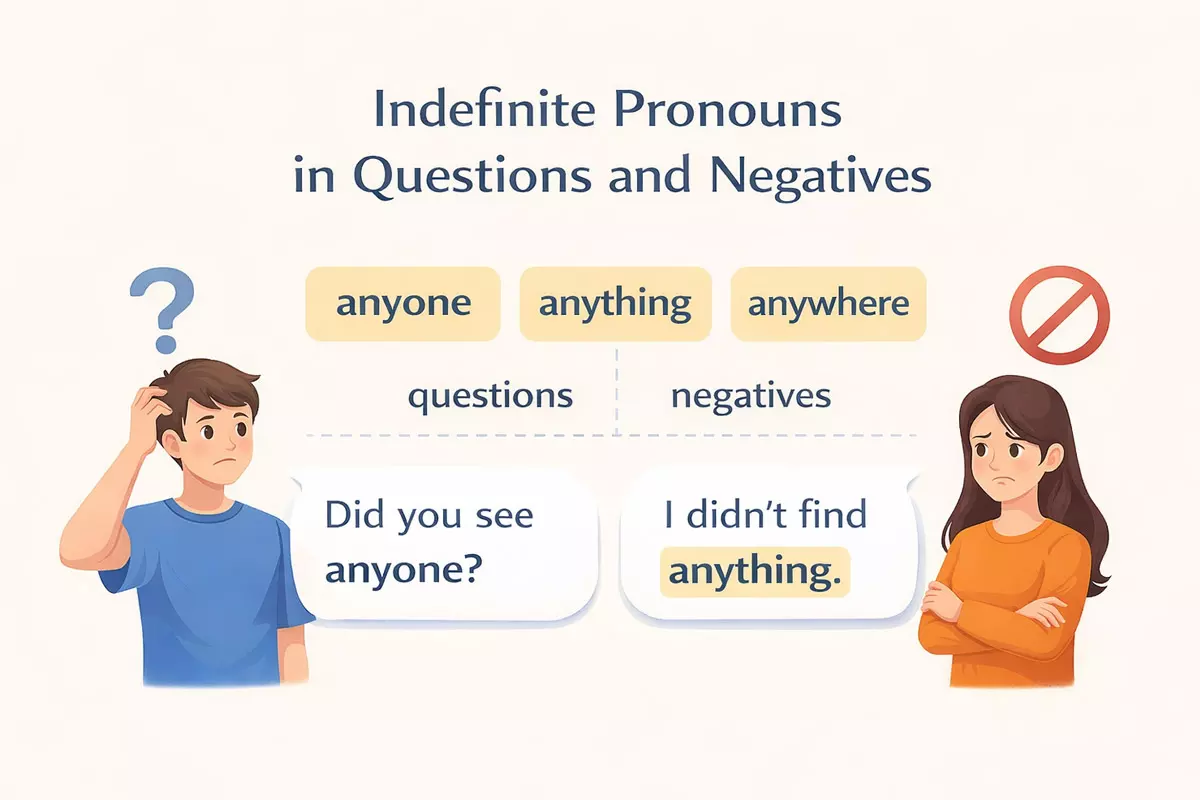 Here we how indefinite pronouns are used in questions and negatives, including any-, some-, and no- forms. It also covers meaning changes, common mistakes, spoken versus written usage, and offers practice rewriting questions and negatives.
- Why questions and negatives affect pronoun choice
- Any-, some-, and no- forms in questions
- Negative meaning without double negatives
- Short answers with indefinite pronouns
- Spoken vs written patterns in negatives
- Common learner mistakes in questions
- Meaning changes caused by form choice
- Practice: rewrite questions and negatives correctly
Learning how to ask questions or express negatives about people or things in a general sense is important for sounding fluent in English. One key aspect is using nonspecific pronouns such as anyone, anything, nobody, or nothing. For example, you might ask, "Is anyone coming to the meeting?" or say, "Nobody knows the answer." These pronouns help you refer to people or things without being specific, which is useful in everyday conversation and makes your English sound more natural and accurate.
Why questions and negatives affect pronoun choice
The form of a sentence—whether it’s a question or a negative—directly influences which indefinite pronouns you should use. In English, certain pronouns are reserved for questions, while others naturally fit with negative statements. This distinction helps convey meaning clearly and avoids confusion.
Indefinite pronouns in questions
When forming questions, speakers typically reach for pronouns starting with any- (like anyone or anything) or some- (such as someone or something). The choice depends on whether the question is open-ended or carries an expectation of a positive answer. For example:
- Is anyone home?
- Did you see anything unusual?
- Would you like something to drink?
- Is someone at the door?
Using some- forms in questions often implies the speaker expects a “yes” answer or is offering or requesting something, while any- forms sound more neutral or general.
Indefinite pronouns in negatives
Negative sentences usually require any- pronouns, rather than some- forms. This is because any- pronouns signal an absence or lack, which fits the logic of a negative. For example:
- I don’t know anybody here.
- She didn’t eat anything for lunch.
- We can’t find anywhere to park.
- They never invited anyone.
Attempting to use some- pronouns in negative sentences usually results in ungrammatical or confusing statements.
Comparison: Indefinite pronouns in questions, negatives, and positives

| Sentence Type | Preferred Indefinite Pronouns | Example |
|---|---|---|
| Question (neutral) | anyone, anything, anywhere | Did you see anyone? |
| Question (expecting yes/offer/request) | someone, something, somewhere | Would you like something to eat? |
| Negative | anyone, anything, anywhere | I didn’t meet anyone. |
| Positive | someone, something, somewhere | Someone called you. |
Common indefinite pronouns and their usage
- anyone – used in questions and negatives
- someone – used in statements and offers/requests
- anything – for questions and negatives
- something – for positives, offers, and requests
- anywhere – typical in negatives and open questions
- somewhere – used when the speaker expects a positive
- nobody – for negatives, sometimes for emphasis
- everybody – refers to all people, in positive contexts
- nothing – negative statements
- everything – positive, all-inclusive statements
- none – negative, refers to not one or not any
- each – positive, distributive sense
In summary, the structure of a sentence determines which indefinite pronoun is natural and correct. Recognizing these patterns helps learners and speakers avoid errors and communicate more precisely.
Any-, some-, and no- forms in questions
When forming questions in English, indefinite pronouns based on any-, some-, and no- often appear, but they are not always interchangeable. The choice between these forms depends on the speaker’s expectations, the formality of the context, and whether a positive, negative, or neutral answer is anticipated.
Usage patterns and expectations
The any- forms (such as anyone, anything, anywhere) are most common in questions when the speaker is open to any possible answer, or when the question is neutral or negative in tone. In contrast, some- forms (someone, something, somewhere) are used when the speaker expects the answer to be positive, or is offering or suggesting. No- forms (no one, nothing, nowhere) are rare in direct questions but appear in rhetorical or surprise questions.
Common forms in questions
- Did anyone see what happened?
- Is anybody available to help right now?
- Did you find anything useful in the report?
- Have you been anywhere interesting lately?
- Did someone leave a bag here?
- Is somebody waiting for you outside?
- Did you hear something strange?
- Is there somewhere we can sit?
- Did no one answer the phone?
- Was nobody informed about the change?
- Did you say nothing about the problem?
- Is nowhere open at this hour?
Examples and contrasts
| Form | Example in a Question |
|---|---|
| anyone / anybody | Has anyone seen my keys? |
| someone / somebody | Did somebody call me? |
| anything | Is there anything I can do? |
| something | Would you like something to drink? |
| nothing | Why did nothing happen? |
| nowhere | Is there nowhere else to go? |
Guidelines for choosing the right form
- Use any- when you are unsure if the thing or person exists, or in open-ended questions.
- Choose some- when offering, requesting, or expecting a positive answer.
- Reserve no- forms for rhetorical, emphatic, or surprise questions.
Understanding these subtle differences helps speakers sound more natural and precise in English. The choice between any-, some-, and no- forms can shift the tone, expectation, or even the implied meaning of a question.
Negative meaning without double negatives
In English, it’s common to express a negative idea with just one negative word, especially when using indefinite pronouns. Instead of stacking negatives (which is often considered incorrect or informal in standard English), we usually rely on a single negative form to convey the intended meaning. This approach keeps sentences clear and avoids confusion that double negatives can create.
How negative meaning is formed
When asking questions or making negative statements, indefinite pronouns like anyone, anything, anywhere, and nobody play a key role. In standard usage, only one negative element is needed. For example, “I don’t know anyone here” is preferred over “I don’t know no one here.” The latter would be considered non-standard or incorrect in most contexts.
Common indefinite pronouns for negatives
Here are several pronouns and expressions typically used to give a negative sense without doubling up on negatives:
- anyone: I didn’t see anyone in the office.
- anybody: She didn’t speak to anybody after the meeting.
- anything: We didn’t hear anything unusual.
- anywhere: He couldn’t find his keys anywhere.
- nobody: Nobody answered the phone.
- no one: No one knew the correct answer.
- nothing: Nothing was mentioned about the delay.
- nowhere: There was nowhere to park.
- neither: Neither option seems acceptable.
- none: None of the files were saved.
- never: I have never seen this before.
- not anybody: She did not invite anybody.
- not anything: He didn’t say anything about the issue.
- not anywhere: We couldn’t go anywhere that day.
- not one: Not one person complained.
- not ever: I don’t ever want to repeat that experience.
- not a single: Not a single email was answered.
- not at all: I’m not interested at all.
Examples: single negative elements
Notice how these sentences maintain a negative sense without using two negatives at once:
- “I haven’t seen anybody today.”
- “There is nothing in the fridge.”
- “She never goes anywhere on weekends.”
- “No one answered the phone.”
- “We found nothing in the box.”
- “He said nothing about the meeting.”
Comparing standard and non-standard forms
| Standard (Single Negative) | Non-Standard (Double Negative) |
|---|---|
| I didn’t see anyone. | I didn’t see no one. |
| She has nothing to say. | She doesn’t have nothing to say. |
| We went nowhere yesterday. | We didn’t go nowhere yesterday. |
| He never eats anything spicy. | He doesn’t never eat nothing spicy. |
In formal written and spoken English, sticking to a single negative word in a clause is the norm. This makes the meaning direct and easy to understand, while double negatives can result in ambiguity or unintended positive meanings. For clarity and correctness, one negative is enough to express the idea.
Short answers with indefinite pronouns
When responding to questions or negatives that use indefinite pronouns, English speakers often use short, direct answers. These replies typically include the relevant indefinite pronoun rather than repeating the whole question. This approach keeps conversations natural and efficient.
Common indefinite pronouns in short answers
Words like someone, anyone, everyone, no one, something, anything, everything, and nothing are frequently used in concise responses. The choice depends on the type of question (positive, negative, or open-ended).
- Is anyone here? – No one.
- Did someone call? – Yes, someone did.
- Did you see anything? – Nothing.
- Has everyone finished? – Not everyone.
- Did anybody help you? – No one.
- Is there something you want? – Nothing right now.
- Did you forget anything? – I remembered everything.
- Did someone leave this bag? – No, nobody did.
- Has anyone seen my keys? – Someone found them.
- Did you eat something? – Nothing yet.
Patterns in short answers
Short responses with indefinite pronouns often use the pronoun alone or with a simple auxiliary verb. If you want to be more polite or formal, you can add short phrases, but the indefinite pronoun is still the focus.
| Question | Short Answer |
|---|---|
| Did anyone call? | No one. |
| Is there anything to eat? | Nothing. |
| Has everyone arrived? | Not yet. |
| Did somebody help you? | Someone did. |
| Did you see anyone? | No one. |
| Is something wrong? | Nothing's wrong. |
Tips for natural responses
- Use no one, nothing, or nobody for negative responses.
- Choose someone, something, or somebody for positive answers.
- For open questions, anyone or anything might fit.
- “Not everyone” or “Not everything” can soften negatives.
- Keep answers brief to sound more fluent and confident.
Short answers with indefinite pronouns help you avoid unnecessary repetition and make your English sound more natural in daily interactions.
Spoken vs written patterns in negatives
Negative sentences with indefinite pronouns often differ between conversation and formal writing. In everyday speech, people tend to use simpler forms, sometimes bending prescriptive grammar rules. Written language, especially in academic or professional contexts, usually sticks to standard forms and avoids double negatives. These differences can affect which indefinite pronouns are chosen and how negatives are constructed.
Common spoken features

- Use of double negatives (e.g., “I don’t know nothing”) for emphasis or informality.
- Preference for “any-” words in negative sentences: “I don’t have any money.”
- Shortened or contracted negatives: “I haven’t got anyone here.”
- Ellipsis or omission: “Got no idea.”
- Frequent use of “nobody,” “nothing,” “nowhere” in place of “anybody,” “anything,” “anywhere.”
- Flexible word order: “Nobody saw me” vs. “Didn’t nobody see me?” (regional).
- Repetition for emphasis: “No one ever says nothing.”
- Direct negation with indefinite pronouns: “I got nothing.”
- Colloquial contractions: “Ain’t nobody coming.”
- Informal tag questions: “You haven’t seen anyone, have you?”
Written language patterns
- Strict avoidance of double negatives: “I don’t know anything.”
- Preference for “any-” forms in negatives: “She didn’t find anything.”
- Clear subject–verb agreement: “Nobody is available.”
- Complete sentences: “There is nothing to report.”
- Minimal use of contractions: “He has not spoken to anyone.”
- Consistent, formal pronoun choice: “No one,” “nothing,” “none.”
- Explicit negatives: “There were no errors found.”
- Standardized word order: “No one noticed the mistake.”
| Spoken Example | Typical Written Equivalent |
|---|---|
| I don’t know nothing. | I don’t know anything. |
| Ain’t nobody here. | No one is here. |
| Got nothing to say. | I have nothing to say. |
| Didn’t see nobody. | I didn’t see anyone. |
| You haven’t seen anybody, have you? | Have you seen anyone? |
| No one ever says nothing. | No one ever says anything. |
| I haven’t got anyone here. | I do not have anyone here. |
| There’s nobody at home. | There is no one at home. |
Summary of tendencies
In summary, informal speech allows more flexibility with negatives and indefinite pronouns, often prioritizing clarity or emphasis over strict correctness. Formal writing, by contrast, maintains established rules and avoids ambiguity. Understanding these patterns is essential for effective communication in both casual and professional settings.
Common learner mistakes in questions
When using indefinite pronouns such as someone, anyone, something, anything, and related words in interrogative sentences, learners frequently make errors with both form and meaning. These mistakes often come from translating directly from their native language or misunderstanding the nuance between different pronouns.
Mixing up “some-” and “any-” forms
A typical error is confusing when to use “some-” and when to use “any-” in questions. While “any-” is standard in most questions, “some-” is sometimes used when offering or requesting in a polite way. Misusing these forms can make a question sound unnatural or even change its meaning.
| Incorrect Question | Correct Form |
|---|---|
| Do you have some pen? | Do you have any pens? |
| Can anyone help me with this? | Can someone help me with this? (for a request) |
| Is there anything I can do for you? | Is there something I can do for you? (offering help) |
| Did you see anyone at the party? | Did you see someone at the party? (if you think the answer is yes) |
Overusing “any-” in positive questions
Another issue is using “any-” pronouns in situations where “some-” is expected, especially in offers and requests. This can sound too formal or even negative.
- Would you like anything to drink? → Would you like something to drink?
- Can I get you anything? → Can I get you something?
Confusing singular and plural forms
Learners sometimes forget that indefinite pronouns like someone and anyone are singular, so the verb should also be singular.
- Are someone coming? ❌ → Is someone coming? ✅
- Do anybody know the answer? ❌ → Does anybody know the answer? ✅
Omitting auxiliary verbs
In questions, auxiliary verbs are essential. Learners sometimes drop “do/does/did” or use the wrong word order.
- You saw anyone at the station? ❌ → Did you see anyone at the station? ✅
- She is looking for something? ❌ → Is she looking for something? ✅
Summary of common errors
- Using “some-” instead of “any-” in standard questions
- Choosing “any-” when “some-” is needed for offers or requests
- Incorrect verb agreement with indefinite pronouns
- Dropping auxiliary verbs in question formation
- Direct translation from native language leading to unnatural phrasing
Paying attention to these patterns can help learners ask questions more naturally and avoid confusion when using indefinite pronouns.
Meaning changes caused by form choice
The selection of indefinite pronouns in questions and negatives often signals subtle shifts in interpretation. English offers several forms—such as anyone, someone, no one, and everyone—each with distinct implications for expectation, openness, and presupposition. The way speakers choose among these can alter the overall nuance or the presupposed information in a sentence.
Question contexts: openness vs. expectation
In questions, the choice between any- and some- forms reveals the speaker’s assumptions. Any- forms typically express a neutral or open stance, while some- forms often suggest the speaker expects a positive answer or has a particular person in mind.
- Did anyone call? (Open: no expectation)
- Did someone call? (Expectation: likely yes)
- Is there anything you need? (Open offer)
- Is there something you need? (Assumes some need exists)
Negative contexts: scope and strength
With negatives, the indefinite form chosen can impact the strength and scope of negation. Using any- forms after negation produces a broad, non-committal denial, whereas no- forms create a strong, categorical statement.
| Form in Negative | Meaning or Effect |
|---|---|
| I don’t have any money. | General denial; open to all amounts. |
| I have no money. | Strong, emphatic denial; absolutely none. |
| She didn’t see anyone. | Neutral, broad scope; not a single person. |
| She saw no one. | Emphatic; absolutely nobody. |
Subtle differences: polarity and emphasis
Some forms are sensitive to negative or positive environments (polarity sensitivity). For example, anyone and anything naturally fit with negatives and questions, while someone and something are typically used in positives or when suggesting likelihood. This distinction can affect both the grammaticality and the pragmatic impact of a sentence.
- He didn’t eat anything. ✅
- He didn’t eat something. ❌ (odd unless contextually justified)
- Did you see anyone?
- Did you see someone? (Implies expectation of a specific person)
In summary, selecting among indefinite pronoun forms in questions and negatives can change not only the literal meaning but also the implied attitude, emphasis, or assumption behind a statement. Understanding these fine distinctions helps speakers and learners interpret and convey intended meaning more precisely.
Practice: rewrite questions and negatives correctly
Working with indefinite pronouns in English questions and negatives can be tricky. Understanding how to use words like anyone, anything, someone, and nothing is essential for clarity and accuracy in communication. Let's practice transforming sentences by correcting mistakes with indefinite pronouns. Review the examples and try the activities below to build your confidence.
Common indefinite pronoun corrections
In English, questions and negative sentences usually require forms with any- (such as anyone, anything). Positive sentences often use some- (like someone, something). Notice how the meaning changes in each case:
| Incorrect Sentence | Corrected Version |
|---|---|
| Did you see someone in the garden? | Did you see anyone in the garden? |
| I didn't hear someone call my name. | I didn't hear anyone call my name. |
| Is there nothing in the box? | Is there anything in the box? |
| She doesn't want something to eat. | She doesn't want anything to eat. |
| Do you need something from the store? | Do you need anything from the store? |
| We haven't bought someone a gift yet. | We haven't bought anyone a gift yet. |
| He didn't say nothing about the plans. | He didn't say anything about the plans. |
| Are you looking for something in particular? | Are you looking for anything in particular? |
| They don't have somewhere to go tonight. | They don't have anywhere to go tonight. |
| Did anybody call me? | ✅ Correct as written |
Rewrite these sentences
Rewrite the following sentences so that the indefinite pronouns are used correctly for questions or negatives. Make sure to change only the pronoun or adverb if necessary.
- She doesn't want someone to help her.
- Do you see something unusual outside?
- We haven't gone somewhere interesting this year.
- Is there nobody at home?
- I didn't talk to someone at the party.
- Do you know someone who speaks Italian?
- They don't need something right now.
- Did you find nothing in your bag?
Show answers
- She doesn't want anyone to help her.
- Do you see anything unusual outside?
- We haven't gone anywhere interesting this year.
- Is there anybody at home?
- I didn't talk to anyone at the party.
- Do you know anyone who speaks Italian?
- They don't need anything right now.
- Did you find anything in your bag?
Tips for indefinite pronouns in negatives and questions
- Use any- forms in negatives and most questions: anyone, anything, anywhere.
- Avoid double negatives: use anything instead of nothing after a negative verb.
- In positive sentences offering or requesting, some- is sometimes acceptable: "Would you like something to drink?"
- For strong negative emphasis, use no- forms only with affirmative verbs: "Nobody was there."