Negative Questions in English: Meaning and Usage

 Here we what negative questions are, how to form them with auxiliaries, be, and modals, their meanings and uses for confirmation, differences between formal and informal forms, common learner mistakes, and offers practice exercises.
Have you ever noticed that questions in English can sometimes sound uncertain or even challenge your expectations? When sentences include not or n't, they introduce subtle nuances to the conversation, allowing speakers to express surprise, doubt, or seek confirmation in a more sophisticated way. This use of negative forms in questions doesn't just add complexity to the language; it also reflects the speaker's attitude, making the exchange more dynamic and engaging for both parties.
What Negative Questions Are
Negative questions are questions that include a negative word, such as “not,” “never,” or contractions like “isn’t” or “don’t.” Instead of simply asking for information, these types of questions often carry additional emotion or expectation. They can express surprise, check assumptions, show doubt, or invite agreement, depending on the situation and tone. When native speakers use a negative question, they are often not just seeking facts. For example, asking “Didn’t you see the sign?” could show surprise that someone missed it, or it might politely check if the person really didn’t notice. In daily conversation, negative questions can soften requests or opinions, making them sound less direct or more friendly.
Basic Forms of Negative Questions
Negative questions usually appear in two main forms: with contractions and without contractions. The choice between them can subtly change the tone or the level of formality.
| Negative Question Form | Example |
|---|---|
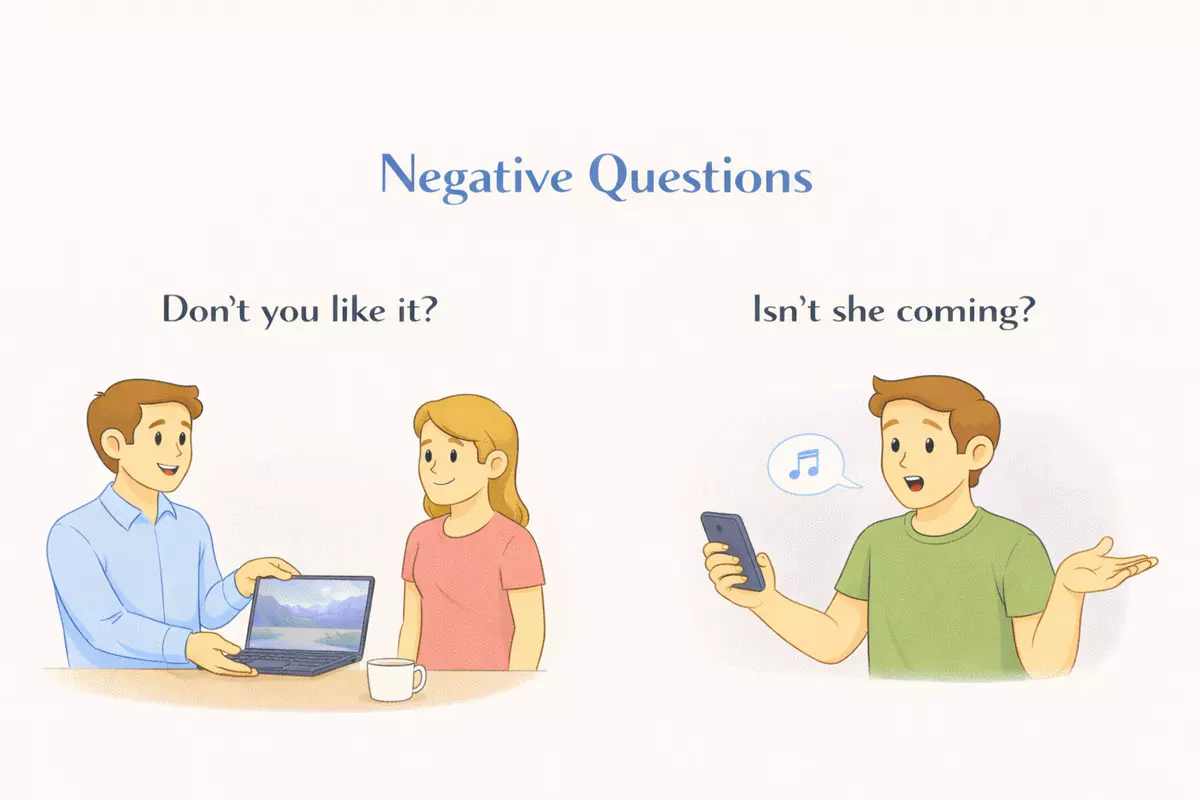
| With Contraction | Isn't she coming to the party? |
| Without Contraction | Is she not coming to the party? |
| With “never” | Have you never tried sushi? |
| With “no one” or “nothing” | Did no one call you? |
Common Uses and Functions
Negative questions serve several key functions in English. Here are some typical uses:
- Expressing surprise or disbelief: “Didn’t you finish your homework?”
- Checking assumptions: “Aren’t you coming with us?”
- Inviting agreement: “Don’t you think this is a great idea?”
- Making polite suggestions: “Wouldn’t it be better to wait?”
- Clarifying misunderstandings: “Didn’t you say you were free tonight?”
- Showing disappointment: “Haven’t you cleaned your room yet?”
- Softening criticism: “Shouldn’t you check your answers?”
- Encouraging action: “Why don’t we start now?”
- Expressing concern: “Hasn’t he called you back?”
- Seeking confirmation: “Isn’t this your bag?”
Key Characteristics
- They often expect a particular answer, sometimes “yes” and sometimes “no,” depending on context and intonation.
- Depending on how they are phrased, negative questions can sound more formal (“Is she not coming?”) or casual (“Isn’t she coming?”).
- They can be used with all auxiliary verbs (do, be, have, will, etc.) and in all tenses.
- Some negative questions are rhetorical, meant more to express a feeling than to get an answer.
Understanding how and when to use negative questions helps make your English more natural and expressive. By recognizing the subtle meanings and intentions behind these questions, you can participate more confidently in conversations and respond appropriately to nuance.
Forming Negative Questions with Auxiliaries
Negative questions in English often use auxiliary verbs (also called "helping verbs") like do, does, did, have, will, can, and should. These structures are used to ask about something you expect to be true, to show surprise, or to check assumptions. To make these questions, the auxiliary comes before the subject, and the negative particle "not" is placed after the auxiliary. In spoken English, contractions (like "don't," "isn't," or "haven't") are common, though the full forms are also correct.
Basic Structure
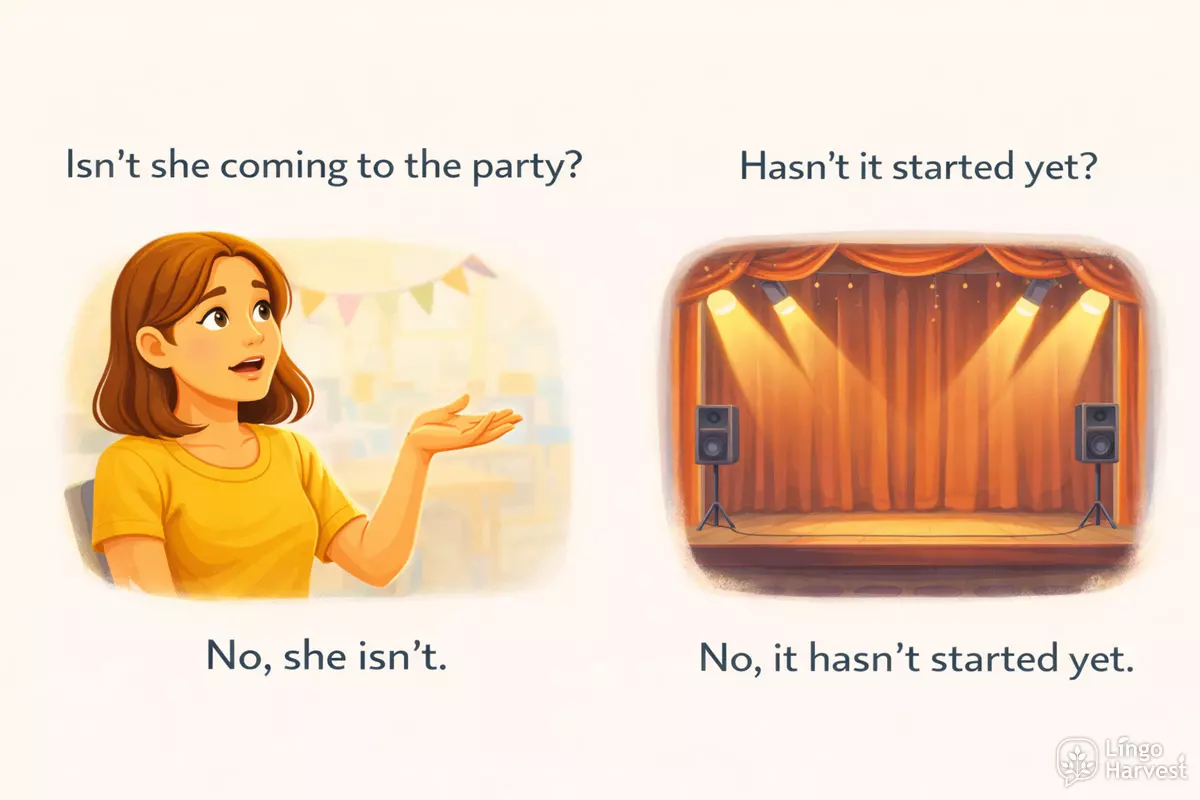
The general pattern for these questions is:
- Auxiliary + not + subject + main verb + ...?
- Or, with contractions: Auxiliary (with n't) + subject + main verb + ...?
For example:
- Don't you like pizza? → Yes, I do.
- Isn't she coming to the party? → No, she isn’t.
- Hasn't it started yet? → No, it hasn’t started yet.
- Didn't they call you? → Yes, they did.
Common Auxiliaries Used in Negative Questions
The following table shows typical auxiliaries and how they form negative questions with examples:
| Auxiliary Verb | Example Negative Question |
|---|---|
| Do/Does/Did | Don't you know the answer? Doesn't it work? Didn't he call? |
| Is/Are/Was/Were | Isn't she here? Aren't we late? Wasn't it obvious? |
| Have/Has/Had | Haven't you finished? Hasn't it arrived? Hadn't we agreed? |
| Will/Would/Can/Could/Should | Won't you join us? Wouldn't that be nice? Can't you see? Shouldn't we start? |
Expanded List of Negative Question Patterns
Here are some more examples to illustrate different auxiliaries and contexts:
- Shouldn't you be working? → Yes, I should.
- Couldn't we try something else? → Yes, we could.
- Isn't it raining outside? → Yes, it is.
- Haven't they left yet? → No, they haven’t left yet.
- Doesn't your brother live nearby? → Yes, he does.
- Didn't we meet last year? → Yes, we did.
- Wasn't this supposed to be easy? → Yes, it was.
- Won't you need help? → Yes, I will.
- Wouldn't you like some coffee? → Yes, I would.
- Aren't you tired? → Yes, I am.
- Hadn't we planned this before? → Yes, we had.
- Can't they hear us? → Yes, they can.
- Isn't that your bag? → Yes, it is.
- Doesn't it make sense? → Yes, it does.
- Shouldn't it be finished by now? → Yes, it should.
Notes on Usage and Meaning
Negative questions can sound more formal or polite, especially when checking information or making suggestions. The choice between contracted and full forms can also affect the tone. For example, "Did you not see that?" is more formal than "Didn't you see that?" It's also important to note that negative questions sometimes expect a "yes" answer, especially if the speaker is surprised or expects agreement. Understanding these patterns helps you recognize and form negative questions naturally in conversation and writing.
Negative Questions with Be and Modals
English often uses negative questions formed with the verb be and modal verbs to express surprise, confirm information, or show expectations. These constructions can sound more emotional or polite, depending on the context and intonation. Understanding how to use them correctly helps you sound more natural and nuanced in conversation.
Forming Negative Questions with Be
To create a negative question with be, place the verb before the subject, followed by not. The negative can be contracted (isn't, aren't, wasn't, weren't), especially in spoken English. These structures are common when you expect a certain answer or want to confirm something you believe to be true.
- Isn't he coming to the meeting? → No, he isn’t.
- Aren't we supposed to finish this today? → Yes, we are.
- Wasn't she at the party last night? → Yes, she was.
- Weren't you invited? → Yes, I was.
- Isn't it raining outside? → Yes, it is.
Negative Questions with Modal Verbs
When forming negative questions with modals (like can, should, will, must), the modal comes first, followed by not and the subject. You might use contractions (can't, shouldn't, won't, mustn't) for a more conversational tone. These questions often invite agreement or express doubt.
- Can't you see the sign? → Yes, I can.
- Shouldn't we leave soon? → Yes, we should.
- Won't they help us? → Yes, they will.
- Couldn't you call her? → Yes, I could.
- Mustn't we be careful? → Yes, we must.
- Wouldn't it be better to wait? → Yes, it would.
- Mayn't I join you? (rare and formal) → Yes, you may.
- Won't you stay for dinner? → Yes, I will.
- Shouldn't it be easier? → Yes, it should.
- Can't this be fixed? → Yes, it can.
Full vs. Contracted Forms
Contracted forms are common in speech and informal writing, while full forms may sound more formal or emphatic. Sometimes, using the full form adds extra emphasis or shows stronger emotion.
| Full Form | Contracted Form |
|---|---|
| Is he not coming? | Isn't he coming? |
| Can you not see? | Can't you see? |
| Will she not join us? | Won't she join us? |
| Should we not ask? | Shouldn't we ask? |
| Are they not ready? | Aren't they ready? |
Uses and Meanings
Why use these structures? They often convey surprise (❌ "Isn't it obvious?"), expectation (✅ "Shouldn't you be at work?"), or polite offers ("Wouldn't you like some tea?"). The speaker usually assumes a particular answer, often "yes." Sometimes, these questions soften suggestions or disagreements, making them less direct.
- Expressing surprise: "Isn't this your bag?"
- Checking expectations: "Shouldn't you have finished?"
- Polite invitations: "Wouldn't you like to try?"
- Challenging or confirming information: "Can't that be true?"
Choosing between contracted and full forms, as well as understanding the nuance each modal brings, allows for clearer, more effective communication in English conversations.
Meaning and Speaker Attitude
Negative questions in English often carry subtle shades of meaning that go beyond the simple request for information. The way a negative question is phrased and the context in which it is used can reveal the speaker’s expectations, emotional stance, or even surprise. In many cases, these questions suggest that the speaker has a particular viewpoint or assumption about the answer.
How Negative Questions Express Attitude
When someone uses a negative question, they might be seeking confirmation of something they believe to be true, or they may be expressing doubt, criticism, or disappointment. The tone and emphasis can shift the meaning significantly. Consider the difference between genuine curiosity and a rhetorical question that expects agreement.
- Confirmation: “Don’t you like chocolate?” (The speaker expects that you do.)
- Surprise: “Haven’t you finished yet?” (The speaker is surprised that it’s not done.)
- Criticism: “Aren’t you supposed to be working?” (Implying you should be working now.)
- Polite offers: “Wouldn’t you like some tea?” (A gentle way to offer something.)
- Disbelief: “Isn’t that your car?” (Implying it definitely is.)
- Challenging: “Don’t you ever listen?” (Suggesting you never do.)
- Encouragement: “Don’t you want to try again?” (Hoping you will.)
- Impatience: “Haven’t we waited long enough?” (Implying it’s time to act.)
- Invitations: “Won’t you join us?” (Inviting someone politely.)
- Expectation: “Aren’t they coming?” (Assuming they are expected to arrive.)
Comparison with Positive Questions
Negative questions often signal that the speaker assumes a particular answer, while positive forms are more open-ended. The choice between the two can make interactions sound more polite, more persuasive, or more confrontational.
| Form | Typical Speaker Attitude | Example |
|---|---|---|
| Negative Question | Expectation or surprise; hinting at a “yes” answer | “Isn’t it raining?” (expects it is) |
| Positive Question | Neutral; open to any answer | “Is it raining?” (genuinely unsure) |
| Negative Tag Question | Seeking agreement, often politely | “You’re coming, aren’t you?” |
| Negative Rhetorical Question | Expressing opinion, often disbelief or criticism | “Don’t you know better?” |
Interpreting Responses to Negative Questions
One subtle aspect of these questions is that answers can be ambiguous, especially with “yes” or “no.” In English, “yes” usually confirms the positive idea, and “no” confirms the negative. For example, in response to “Don’t you like pizza?”, “Yes” means “I do like pizza,” while “No” means “I don’t like pizza.” This can be confusing for learners, so context and intonation are important.
Ultimately, using negative questions is a way to project a stance or expectation, not just to get information. Paying attention to tone and context will help you understand and use them more effectively in conversation.
Negative Questions for Confirmation
Sometimes, English speakers use negative questions to check if their assumptions are correct or to express surprise. These questions can sound a bit more emotional or suggest that the speaker expects a certain answer. For example, asking “Didn’t you see the email?” shows that the speaker believes the other person probably did see it. This structure is common in casual conversation and is especially useful when you want to confirm information you think is true.
How Negative Questions Seek Agreement
When someone uses a negative question to confirm details, they’re inviting the listener to agree or clarify. This is different from simple information-seeking questions. The speaker often expects a “yes” answer, confirming what they suspect. However, these questions can sometimes create confusion, because the expected answer (“yes” or “no”) isn’t always clear, and the context matters.
- “Aren’t you coming to the meeting?” (The speaker thinks you are coming.)
- “Didn’t we already finish that project?” (The speaker believes the project is done.)
- “Hasn’t she called you yet?” (The speaker expects she should have called.)
- “Isn’t this your bag?” (The speaker thinks the bag belongs to you.)
- “Don’t you like coffee?” (The speaker assumes you like coffee.)
- “Wasn’t it raining earlier?” (The speaker believes it was raining.)
- “Can’t you drive?” (The speaker expects you can drive.)
- “Shouldn’t we leave now?” (The speaker thinks it’s time to go.)
- “Wouldn’t that be easier?” (The speaker believes it would be easier.)
- “Aren’t they your friends?” (The speaker thinks the people are your friends.)
- “Didn’t you hear the announcement?” (The speaker assumes you heard it.)
- “Doesn’t this look great?” (The speaker expects agreement.)
- “Haven’t you visited Paris before?” (The speaker thinks you have visited.)
- “Isn’t it your birthday today?” (The speaker believes today is your birthday.)
- “Don’t we have a meeting now?” (The speaker thinks there is a meeting now.)
- “Didn’t I give you the keys?” (The speaker believes they gave you the keys.)
- “Aren’t we supposed to submit this by Friday?” (The speaker expects the deadline is Friday.)
- “Hasn’t the movie started yet?” (The speaker thinks the movie has started.)
Positive and Negative Short Answers
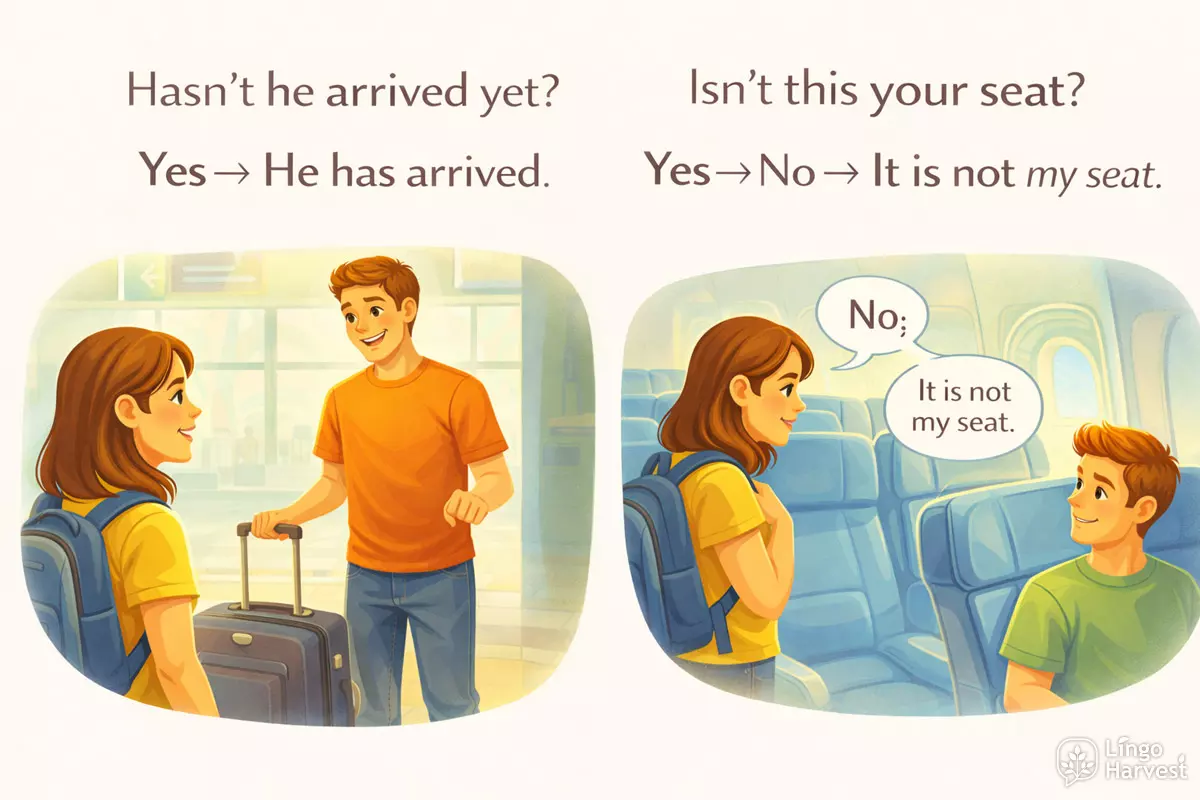
The way you answer these questions can be tricky. In English, “yes” usually agrees with the positive meaning, and “no” agrees with the negative. For example, to “Didn’t you see it?” replying “Yes” means “Yes, I saw it,” and “No” means “No, I didn’t.” This can be confusing for learners, especially if their native language works differently.
| Question | Possible Answers & Meaning |
|---|---|
| Didn’t you finish your homework? | Yes → I finished it. No → I did not finish it. |
| Hasn’t he arrived yet? | Yes → He has arrived. No → He has not arrived. |
| Isn’t this your seat? | Yes → It is my seat. No → It is not my seat. |
| Don’t you like pizza? | Yes → I like pizza. No → I do not like pizza. |
When to Use This Pattern
This question type works best when you want to check assumptions or invite agreement. It’s often used in friendly conversation, but can sometimes sound critical if the tone is not careful. Being aware of context and intonation helps avoid misunderstandings when using or responding to these confirmation questions.
Formal vs Informal Negative Forms
Negative questions in English can sound quite different depending on whether the context is formal or casual. The choice of words and contractions not only affects politeness but can also subtly change the meaning or tone. Understanding how to use these forms appropriately helps you sound natural in various situations, from business meetings to everyday conversations with friends.
Patterns in Formal English
In more official settings, full forms and less contracted structures are preferred. These forms tend to sound more polite, clear, and sometimes more distant. For instance, you might hear these questions in interviews, academic discussions, or when speaking to someone you don't know well.
- “Do you not agree with this proposal?” → No, I don’t agree with it.
- “Is he not coming to the event?” → No, he isn’t coming.
- “Have they not received the documents yet?” → No, they haven’t received them yet.
- “Should we not reconsider our approach?” → Yes, we should reconsider it.
- “Did you not understand the instructions?” → No, I didn’t understand them.
- “Has she not completed the assignment?” → No, she hasn’t completed it yet.
- “Will you not be attending the conference?” → No, I won’t be attending.
Informal and Conversational Forms
In everyday speech, contractions are much more common. These forms are less formal and often sound friendlier, more direct, or even challenging, depending on intonation. They are typical among friends, family, or colleagues in relaxed settings.
- “Don’t you agree?” → Yes, I do.
- “Isn’t he coming?” → Yes, he is.
- “Haven’t they got the documents yet?” → No, they haven’t got them yet.
- “Shouldn’t we think about this again?” → Yes, we should.
- “Didn’t you get the instructions?” → Yes, I did.
- “Hasn’t she finished the assignment?” → Yes, she has.
- “Won’t you be at the conference?” → Yes, I will.
- “Aren’t you hungry?” → Yes, I am.
- “Wasn’t it obvious?” → Yes, it was.
- “Can’t you see?” → Yes, I can.
Side-by-Side Comparison
It’s helpful to see how these forms look next to each other. Notice how the contracted versions are shorter and often used in speech, while the full forms are more typical in writing or formal dialogue.
| Formal (Full Form) | Informal (Contracted) |
|---|---|
| Do you not agree? | Don’t you agree? |
| Is he not joining us? | Isn’t he joining us? |
| Have they not arrived? | Haven’t they arrived? |
| Will you not attend? | Won’t you attend? |
| Should we not continue? | Shouldn’t we continue? |
Choosing the Right Style
When deciding which form to use, consider your audience and the relationship you have with them. Using full forms can add formality and politeness, while contractions create a sense of ease and familiarity. Overusing informal patterns in professional contexts may seem disrespectful, while sticking to only formal versions in casual talk can sound stiff or unnatural.
Remember, tone and context matter as much as grammar. Listening to native speakers and noting how they switch between these forms is a great way to improve your own usage.
Common Learner Mistakes
Many English learners find negative questions tricky because their meaning and expected response can differ from what seems logical. Understanding these pitfalls helps avoid confusion in both speaking and comprehension. Below are some frequent errors and misconceptions, along with practical examples to clarify usage.
Misinterpreting the Intended Meaning
Negative questions like “Don’t you like coffee?” can cause uncertainty. Learners often think such questions simply ask for confirmation, but in reality, they may express surprise, expectation, or even a challenge. Answering “yes” or “no” can also be confusing, as the response may not match the speaker’s intent.
- Assuming all negative questions are genuine questions (sometimes they show surprise or criticism).
- Believing that “yes” always means agreement and “no” always means disagreement.
- Missing the emotional or rhetorical nuance behind a negative question.
Incorrect Word Order and Auxiliary Use
Forming negative questions requires careful placement of auxiliaries and negatives. Mistakes often include:
- Placing “not” in the wrong position (e.g., “You do not like pizza?” instead of “Don’t you like pizza?”).
- Omitting the auxiliary verb (e.g., “Not you like pizza?”).
- Forgetting subject-auxiliary inversion (e.g., “You don’t like pizza?” for a written question).
Problems with Short and Full Forms
Using contractions or full forms can change the tone or register. Learners sometimes mix them up, leading to awkward or overly formal questions.
- Using “Do not you like…?” instead of “Don’t you like…?”
- Applying contractions incorrectly (e.g., “Doesn’t he works here?” instead of “Doesn’t he work here?”).
Confusing Responses to Negative Questions
One of the most common sources of confusion is how to answer. In English, a “yes” answer to “Don’t you like apples?” means “Yes, I do like apples.” In some languages, “yes” would mean “Yes, I don’t like apples.” This leads to misunderstandings.
| Negative Question | Expected Answer (English meaning) |
|---|---|
| Don’t you like tea? | Yes, I do. (I like tea.) ✅ No, I don’t. (I don’t like tea.) |
| Isn’t he coming? | Yes, he is. (He is coming.) No, he isn’t. (He is not coming.) |
| Haven’t you finished? | Yes, I have. (I have finished.) No, I haven’t. (I have not finished.) |
| Can’t she swim? | Yes, she can. (She can swim.) No, she can’t. (She cannot swim.) |
Overusing Negative Questions
Learners sometimes use negative questions too often, especially when trying to sound polite or indirect. In English, excessive use can sound confrontational or express disbelief, so moderation is important.
- Using negative questions when a neutral or positive question is clearer.
- Assuming negative forms are softer or more polite in all situations.
Summary List: Frequent Mistakes
- Reversing subject and auxiliary incorrectly
- Misunderstanding the speaker’s emotion or context
- Mistaking the appropriate answer (“yes” or “no”)
- Incorrect use of contractions
- Overusing negative questions in conversation
- Forgetting auxiliary verbs in questions
- Directly translating from the learner’s native language
- Assuming all negative questions have the same meaning
- Responding in a way that sounds unnatural or confusing
- Neglecting the difference between spoken and written forms
By being aware of these typical errors, learners can better understand and use negative questions naturally and accurately in English conversations.
Practice Exercises and Self-Check
Test your understanding of negative questions in English with these interactive tasks. These exercises will help you recognize different forms, meanings, and uses, and give you a chance to check your progress. Read each instruction carefully and try to answer before revealing the solutions.
1. Identify the Type
Decide whether each sentence below is a real question (genuine information request) or a rhetorical/confirming negative question:
- Haven't you finished your homework yet?
- Isn't this your bag?
- Didn't you go to the meeting?
- Why didn't you call me?
- Don't you like chocolate?
- Wasn't she expecting you?
- Haven't we discussed this before?
- Didn't they warn you about this?
- Aren't you feeling well today?
- Hasn't he already explained everything?
Show answers
- Confirming (surprise/expectation)
- Confirming (expecting “yes”)
- Real question (checking information)
- Real question (asking for reason)
- Confirming (expecting “yes”)
- Confirming (expecting “yes”)
- Confirming (shared knowledge)
- Real question (checking information)
- Confirming (concern)
- Confirming (expecting “yes”)
2. Change to Negative Questions
Rewrite these affirmative questions using the appropriate negative form. Pay attention to contractions and word order.
- Do you know the answer?
- Is she coming to the party?
- Did they finish the project?
- Can you help me?
- Are you ready?
- Has he called you?
- Were they informed?
- Will you join us?
- Did she understand the task?
- Have we met before?
Show answers
- Don't you know the answer?
- Isn't she coming to the party?
- Didn't they finish the project?
- Can't you help me?
- Aren't you ready?
- Hasn't he called you?
- Weren't they informed?
- Won't you join us?
- Didn't she understand the task?
- Haven't we met before?
3. Response Practice
For each negative question below, write a short answer as you would in conversation. Consider whether “yes” or “no” is the expected answer in English.
- Didn't you see the sign?
- Aren't we meeting at 6?
- Isn't this your seat?
- Haven't they called yet?
- Wasn't he aware of the rules?
- Don't you remember her name?
- Hasn't she finished the report?
- Weren't we supposed to leave earlier?
- Didn't they send you an email?
- Aren't you joining us tonight?
Show answers
- No, I didn't.
- Yes, we are.
- Yes, it is.
- No, they haven't.
- Yes, he was.
- No, I don't.
- Yes, she has.
- Yes, we were.
- No, they didn't.
- Yes, I am.
4. Common Forms of Negative Questions
Here is a reference table showing the structure of negative questions in English with different auxiliaries and pronouns. Notice the use of contractions and word order.
| Subject | Negative Question (Contracted) | Negative Question (Full form) |
|---|---|---|
| I | Don't I know you? | Do I not know you? |
| You | Haven't you met her? | Have you not met her? |
| He/She/It | Isn't he coming? | Is he not coming? |
| They | Didn't they leave? | Did they not leave? |
| We | Aren't we late? | Are we not late? |
5. Spot the Error
Some of the following sentences contain mistakes in the structure of negative questions. Find and correct any errors:
- Doesn't she likes pizza?
- Didn't you finished your work?
- Isn't it raining?
- Haven't we met before?
- Don't he play football?
- Didn't she understands the question?
- Doesn't they know the answer?
- Haven't he called you yet?
- Didn't we agreed on this?
- Doesn't it looks strange?
Show answers
- Doesn't she like pizza?
- Didn't you finish your work?
- Correct
- Correct
- Doesn't he play football?
- Didn't she understand the question?
- Don't they know the answer?
- Hasn't he called you yet?
- Didn't we agree on this?
- Doesn't it look strange?
Review these exercises regularly to get comfortable with both forming and interpreting negative questions. This will improve your confidence in everyday conversations and in understanding the subtle meanings these questions can carry.