Avoiding Overuse of Pronouns in Clear and Effective Writing

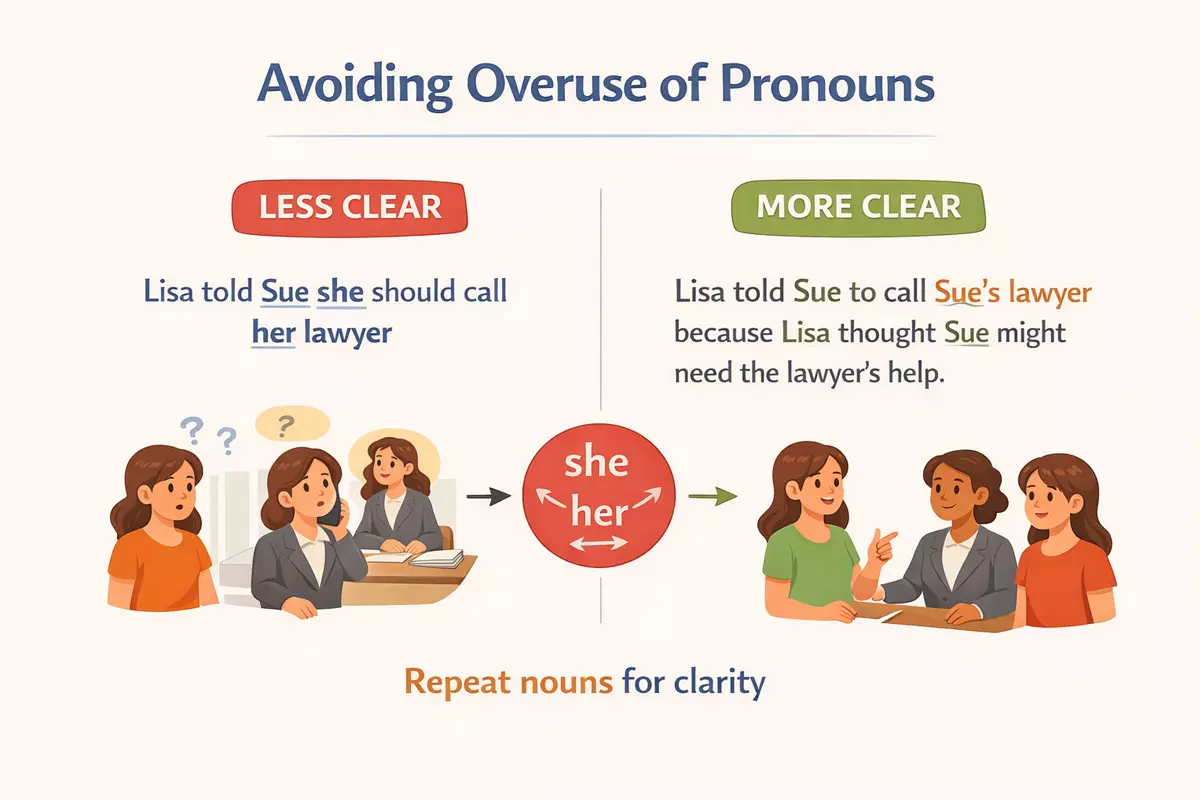 This article explains when pronouns help or hinder clarity, how to recognize pronoun overload, and ways to balance nouns and pronouns. It covers editing tips, examples, and practice exercises to improve readability and avoid reader fatigue.
- When pronouns improve clarity and when they hurt it
- Signs of pronoun overload in a paragraph
- Balancing nouns and pronouns for readability
- Reintroducing nouns to prevent confusion
- Pronoun chains and reader fatigue
- Editing techniques to spot overuse
- Before-and-after rewriting examples
- Practice: revise texts with excessive pronouns
Overusing pronouns such as he, she, it, or they may result in unclear and repetitive writing, making it difficult for readers to understand who or what is being referenced. To improve clarity and maintain reader engagement, it is important to use specific nouns when appropriate and to vary your sentence structure. This approach not only helps prevent confusion but also adds variety and interest to your writing, making your message more effective and enjoyable to read.
When pronouns improve clarity and when they hurt it
Using pronouns thoughtfully can make your writing easier to follow, but careless or excessive use can cause confusion. The key is finding a balance—knowing when to use a pronoun to avoid repetition, and when to restate the noun for precision. Let’s look at what helps and what hinders understanding.
How pronouns help your writing
Pronouns are valuable for keeping sentences from becoming repetitive and cumbersome. They allow you to refer back to previously mentioned nouns smoothly, creating a natural flow. Consider these benefits:
- Reduce redundancy in sentences
- Keep writing concise and less monotonous
- Maintain a conversational tone
- Clarify relationships when the referent is obvious
- Help avoid awkward repetition of names or titles
- Allow for smoother transitions between sentences
- Support cohesive connections in paragraphs
- Make dialogue sound natural
Where pronouns can cause confusion
Problems arise when it’s not clear what a pronoun refers to, especially if multiple nouns are present or if the reference is distant. In these cases, overusing pronouns can muddy your message. Watch for these trouble spots:
- Two or more possible antecedents in the same sentence
- Long gaps between the noun and its pronoun
- Introducing new topics and using “it,” “they,” or “this” without clear context
- Switching subjects without reintroducing names
- Using pronouns at the start of a paragraph without first naming the subject
- Ambiguous references (e.g., "He told him...")
- Generic pronouns like “it” or “they” with no clear meaning
- Pronouns that could refer to abstract or collective nouns
Clear vs. confusing pronoun use
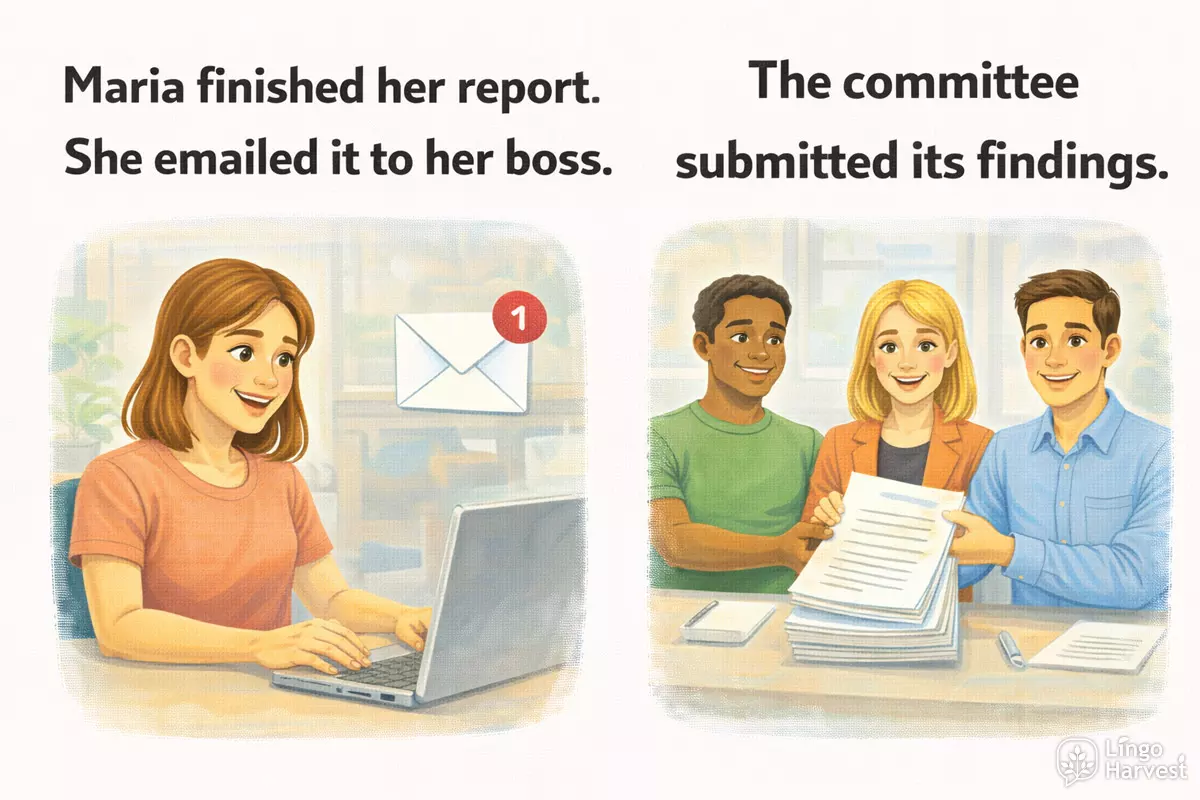
| Effective Use ✅ | Unclear Use ❌ |
|---|---|
| Maria finished her report. She emailed it to her boss. | Maria and Jane finished her report. She emailed it. |
| The committee submitted its findings. | The committee met with the team, and they shared its findings. |
| After discussing the project, the team decided to proceed. They began planning immediately. | After discussing the project, the team and the manager decided to proceed. They began planning immediately. |
| The dog chased the ball because it was rolling fast. | The dog chased the cat, but it escaped. |
Tips for striking the right balance
- Repeat the noun if there’s any risk of confusion
- Check that every pronoun clearly points to one specific noun
- Limit pronoun use in complex or technical explanations
- Read your sentences aloud to spot ambiguous references
- Introduce the noun before using a pronoun in new paragraphs
- Vary sentence structure to avoid chains of pronouns
- Ask someone else to read your text for clarity
- Use pronouns naturally, as you would in conversation, but always prioritize clarity
Ultimately, pronouns serve your writing best when they make your meaning unmistakable. Use them to streamline sentences, but don’t be afraid to repeat a noun when it helps your reader keep track of who or what you’re discussing.
Signs of pronoun overload in a paragraph
When a passage leans too heavily on pronouns, readers can quickly lose track of who or what is being discussed. Overusing words like "he," "she," "it," "they," and "this" can create confusion and make the writing feel vague or repetitive. Spotting these issues early helps improve clarity and flow.
Common indicators of excessive pronoun use
- Repeated use of the same pronoun in consecutive sentences
- Ambiguous references—unclear what "it" or "they" refers to
- Paragraphs where nouns are rarely or never restated
- Sentences that begin with a pronoun multiple times in a row
- Difficulty tracking which character or object is being discussed
- Pronouns used in rapid succession without context (e.g., "He took it and gave it to her")
- Pronouns referring to different subjects without clear transitions
- Confusion when multiple people or things of the same gender or type are involved
- Overreliance on "this" or "that" without specifying the noun
- Paragraphs that sound monotonous or repetitive due to similar sentence structures
- Readers needing to reread to understand who or what is being referenced
- Feedback from editors or peers about unclear references
Example: Overloaded vs. Balanced Use
| Overloaded Example | Improved Version |
|---|---|
| She went to the store. She saw her friend. She waved at her. She bought some bread, and she left. | Maria went to the store, where she saw her friend Lisa. Maria waved and then bought some bread before leaving. |
| They told them about it, but they didn’t understand it. | The teachers told the students about the assignment, but the students didn’t understand the instructions. |
Writers can prevent confusion by varying sentence structure and reintroducing nouns where needed. Replacing some pronouns with specific names or objects not only clarifies meaning but also strengthens engagement. If you find your writing relies on pronouns in nearly every sentence, it’s a good sign that revision is needed for clarity and variety.
Balancing nouns and pronouns for readability
Clear writing often depends on how well you alternate between specific nouns and pronouns. Overusing pronouns can cause confusion, making it difficult for readers to track who or what is being discussed. On the other hand, repeating the same noun too often can make your text sound awkward and repetitive. Achieving a smooth flow means thoughtfully choosing when to restate the noun and when to use a pronoun instead.
Why mix nouns and pronouns?
Alternating between nouns and pronouns helps your audience understand the subject without becoming lost or bored. Pronouns like "he," "she," "it," and "they" prevent redundancy, while nouns like "the teacher," "the book," or "the committee" anchor your reader in the subject matter. The right mix keeps sentences concise and context clear.
Common pitfalls of overusing pronouns
- Ambiguous references: Too many pronouns in a row can make it unclear who or what is being discussed.
- Loss of specificity: Readers might forget which person, group, or object is being referred to.
- Choppy flow: Relying solely on pronouns can make your writing feel abrupt or disconnected.
Effective strategies for alternating references
- Reintroduce the noun after several sentences or when another subject enters the discussion.
- Vary sentence structure to naturally incorporate both nouns and pronouns.
- Use descriptive phrases occasionally in place of either a noun or pronoun for variety.
- Check each pronoun to ensure its antecedent is unmistakable.
Examples: Noun and pronoun balance in action
| Unbalanced Version | Improved Version |
|---|---|
| The cat chased the mouse. The cat caught the mouse. The cat ate the mouse. | The cat chased the mouse. It caught it and then ate it. |
| Maria finished the report. Maria sent the report to the manager. Maria waited for feedback. | Maria finished the report and sent it to the manager. She then waited for feedback. |
| The committee met on Tuesday. The committee discussed the budget. The committee made a decision. | The committee met on Tuesday, discussed the budget, and made a decision. |
| John went to the store. John bought groceries. John forgot his wallet. | John went to the store to buy groceries, but he forgot his wallet. |
Quick tips for smoother writing
- After two or three pronouns, restate the noun for clarity.
- Read your work aloud; if you lose track of who "he" or "they" refers to, so will your readers.
- When in doubt, clarify—especially if multiple subjects are involved.
- Balance is key: too many pronouns confuse, too many nouns bore.
Reintroducing nouns to prevent confusion
Clear writing often depends on specifying exactly who or what is being discussed. Overusing pronouns like "he," "she," "it," or "they" can cause your readers to lose track of the subject, especially in complex or lengthy passages. When several people, objects, or ideas are involved, it's helpful to repeat the specific noun now and then to remind your audience who or what you mean.
When should you repeat a noun?
Writers sometimes hesitate to repeat words, but strategic repetition can actually help your reader. Consider bringing back the noun:
- After several sentences have passed since it was last named
- When switching to a new paragraph or topic
- If multiple similar pronouns appear close together
- Whenever a pronoun could refer to more than one possible noun
- At the start of a new section or example
Examples of clarity through noun reintroduction
Compare how these sentences can shift from confusing to clear just by including the noun again:
- Maria gave Anna her book after she finished reading it.
→ Maria gave Anna her book after Maria finished reading it. - The engineers sent the designers their feedback. They appreciated it.
→ The engineers sent the designers their feedback. The designers appreciated it. - The dog chased the cat, but it was too fast.
→ The dog chased the cat, but the cat was too fast.
Common situations where noun repetition helps
- Describing actions involving multiple people or groups
- Explaining sequences of events
- Referring to different objects with similar pronouns
- Clarifying ownership or relationships
- Presenting dialogue between several speakers
- Summarizing research or data with many variables
- Writing instructions with steps involving different items
- Storytelling with several characters
- Technical writing with similar terms
- Academic writing where precision matters
Pronoun overuse versus noun reintroduction
| Pronoun Overuse Example | Improved with Noun Reintroduction |
|---|---|
| After John met Mark, he told him about the project. He liked it. | After John met Mark, John told Mark about the project. Mark liked the project. |
| The committee reviewed the proposal. They rejected it, but they suggested changes. | The committee reviewed the proposal. The committee rejected the proposal but suggested changes. |
| The car followed the truck because it was slow. | The car followed the truck because the truck was slow. |
| Susan told her sister that she would call her later. | Susan told her sister that Susan would call her later. |
By restating the noun at key points, you help your reader track who or what is being discussed, making your writing more precise and much easier to follow. This small adjustment can make a significant difference, especially in complex sentences or technical explanations.
Pronoun chains and reader fatigue
When writers link several pronouns together in a passage, readers can quickly lose track of who or what each one refers to. This pattern, often called a "pronoun chain," makes sentences harder to follow, especially when multiple characters or subjects are involved. Keeping reference points clear is crucial for smooth reading and comprehension.
Why pronoun chains cause confusion
Long sequences of pronouns force readers to mentally backtrack and decode each reference. The brain must repeatedly connect "he," "she," "they," or "it" to earlier nouns, which increases cognitive load. Over time, this can lead to frustration and disengagement, particularly in dense or technical writing.
- Readers may misinterpret who is performing actions.
- Ambiguous references can muddle the main ideas.
- Excessive pronouns slow down reading speed.
- Complex chains distract from the core message.
Common signs of pronoun overload
- Several sentences in a row start with "he," "she," "they," or "it."
- Unclear which noun a pronoun replaces.
- Readers must re-read to understand the subject.
- Multiple characters or objects discussed in close proximity.
Examples: Chains that challenge comprehension

Compare the following pairs. The first sentence in each pair relies on a string of pronouns, while the second offers clearer reference.
| Pronoun Chain Example | Clearer Alternative |
|---|---|
| He told him that he would help if he needed it. | John told Mark that he would help if Mark needed assistance. |
| When she gave her the book, she was grateful for it. | When Anna gave Maria the book, Maria was grateful for the gift. |
| They said they would finish it before they left. | The students said they would finish the project before leaving. |
| After it was opened, it was clear it was broken. | After the package was opened, it was clear the item was broken. |
| He took it to her, but she said it was hers. | Paul took the notebook to Lisa, but she said the notebook was hers. |
Strategies to prevent reader fatigue
- Replace some pronouns with the actual nouns, especially after introducing new subjects.
- Vary sentence structure to break up repetitive patterns.
- Check each pronoun’s reference: is it unmistakably clear?
- Read passages aloud to spot confusion or ambiguity.
- Introduce or reintroduce names or specific nouns when context shifts.
Ultimately, minimizing tangled pronoun sequences helps readers stay focused and reduces mental effort. By balancing pronoun use with clear, specific language, writers create more engaging and accessible text.
Editing techniques to spot overuse
Spotting when pronouns are used too frequently is a crucial part of revising for clarity and precision. Overusing words like "he," "she," "they," or "it" can make writing vague or confusing. Editors and writers can employ several strategies to pinpoint and resolve these issues.
Read Aloud for Flow and Clarity
Reading your text out loud is a practical way to detect awkward or repetitive references. If a sentence feels unclear or if you lose track of who or what a pronoun refers to, that's a sign of overuse. Listening helps highlight ambiguous passages that might otherwise go unnoticed.
Highlight or Search for Pronouns
Use your word processor’s search feature to highlight every instance of common pronouns. This visual approach quickly reveals clusters where substitutes or rephrasing may be necessary.
Track Referents
Check that each pronoun has a clear, recent antecedent. If you find yourself rereading to figure out what "it" or "they" means, consider revising for clarity. Keeping referents close to their pronouns reduces confusion.
Compare Original and Revised Sentences
Sometimes, side-by-side comparison can help you spot improvement areas. The table below shows how varying sentence structures can reduce reliance on pronouns and improve clarity:
| Original Sentence | Revised Sentence |
|---|---|
| He took it to his office because he needed it. | James took the report to his office because he needed the data for his meeting. |
| They said it was important, but they didn’t explain why. | The managers emphasized the policy’s importance, but offered no explanation. |
| She placed it on the table before she left. | Maria placed the contract on the table before leaving the room. |
| It was broken when they found it. | The lamp was broken when the children found it. |
Checklist for Identifying Overuse
- Look for consecutive sentences starting with "he," "she," "they," or "it."
- Notice if a paragraph relies on the same pronoun multiple times without reintroducing the noun.
- Check for ambiguous references where it’s unclear what the pronoun refers to.
- Observe if pronouns make the writing monotonous or hard to follow.
- Use find-and-replace to count pronoun frequency in your document.
- Replace unnecessary pronouns with specific nouns or names.
- Vary sentence structure to avoid repetitive patterns.
- Ask a peer to review your writing for unclear pronoun use.
- Read the text backwards paragraph by paragraph to focus on sentence structure rather than content flow.
- Check for pronouns at the start of several sentences in a row.
By applying these practical methods, you can effectively minimize unnecessary pronouns and enhance the overall clarity and professionalism of your writing.
Before-and-after rewriting examples
Seeing how sentences change when pronouns are reduced can clarify the benefits of more explicit wording. Below, several samples illustrate how to transform vague or repetitive phrasing into clearer, more precise statements. Each instance demonstrates a common pitfall—such as overusing "it," "they," or "this"—and offers an improved revision.
Sample transformations for clarity
- Original: She gave it to him because he needed it.
Revised: Maria handed the report to John because John needed the information. - Original: They say it is important, but they don't explain why.
Revised: Many experts claim the policy is important, but these experts do not explain the reasons behind its significance. - Original: It was raining, so they canceled it.
Revised: Because of the rain, the organizers canceled the outdoor concert. - Original: This is a problem because it makes it hard to understand.
Revised: Ambiguous references create confusion and make the main argument difficult to understand. - Original: He took it and put it on the table.
Revised: Daniel picked up the book and placed the book on the table. - Original: They finished it before they left.
Revised: The students completed the assignment before leaving the classroom. - Original: She said it was interesting, but she didn't explain it.
Revised: Lisa described the experiment as interesting, but she did not explain the experiment in detail. - Original: It is easy to forget it.
Revised: Remembering the deadline is easy to overlook. - Original: He wanted it because he liked it.
Revised: Mark wanted the job because he liked the responsibilities involved. - Original: They did it quickly.
Revised: The engineers completed the repairs quickly. - Original: It was broken, so she fixed it.
Revised: The clock was broken, so Sarah repaired the clock. - Original: They discussed it at the meeting.
Revised: The committee discussed the budget proposal at the meeting.
Common patterns and improved constructions
Writers can identify and revise sentences with excessive pronoun use by watching for certain patterns. Here are several cues that typically signal an opportunity for clearer language:
- Multiple "it" or "they" references in one sentence
- Pronouns with unclear antecedents
- Chains of pronouns referring to different things
- Repeated pronouns when the noun could be used again for clarity
- Use of "this" or "that" without specifying the subject
| Original Sentence | Improved Version |
|---|---|
| It was late, so they left it until morning. | Because it was late, the team postponed the decision until morning. |
| They made it because they thought it would help. | The researchers created the model because they believed the model would help the project. |
| She read it, then she gave it to him. | Emma read the article, then Emma gave the article to Tom. |
| This is important, but it is often ignored. | Clear communication is important, but clear communication is often ignored in technical writing. |
By consciously replacing vague pronouns with specific nouns, writers can create sharper, more effective sentences. This process not only improves readability but also reduces ambiguity, making the text more accessible to a broader audience.
Practice: revise texts with excessive pronouns
Improving clarity often means reducing unnecessary pronouns in your writing. When too many pronouns—such as "he," "she," "it," or "they"—appear close together, readers may get confused about what each one refers to. Below, you’ll find practical exercises to help you recognize and revise passages where pronouns are overused.
Identify and Revise: Sample Sentences
First, examine these sentences. Decide how you might rewrite each one to use more precise nouns or restructure the sentence for clarity.
- She told him that he should finish his work before he leaves, but he said he was too tired.
- When they arrived, they saw that they had forgotten their tickets, so they had to go back to get them.
- If it rains, it will make it difficult for us to finish it on time.
- He gave her his book because she lost hers, but she said she would return it when she found hers.
- They told them that they needed their approval before they could start, but they never replied.
- When he met him at the office, he realized he had forgotten his laptop.
- She reminded her that she needed to submit her form before she left.
- If they don’t fix it soon, it will cause them serious problems later.
- He thanked him for helping him when he needed it most.
- After she spoke to her manager, she said she felt more confident.
Show answers
- Maria told Jack that he should finish his work before leaving, but Jack said he was too tired.
- When the group arrived, they realized the tickets were missing, so they went back to get them.
- If it rains, finishing the project on time will be difficult for our team.
- John gave Anna his book because she lost her copy, but Anna said she would return it when she found her own.
- The team told the client that they needed approval before starting, but the client never replied.
- When Mark met Paul at the office, Mark realized he had forgotten his laptop.
- Lisa reminded Emma that Emma needed to submit the form before leaving.
- If the issue isn’t fixed soon, it will cause serious problems later.
- David thanked Alex for the help Alex gave when David needed it most.
- After Sarah spoke to her manager, Sarah said she felt more confident.
Common Strategies for Reducing Pronoun Overuse
Writers can minimize excessive pronouns by applying several techniques:
- Replace pronouns with specific nouns where context allows.
- Combine sentences to remove redundant subjects.
- Use passive or active voice strategically to clarify the agent or recipient.
- Rewrite to avoid repeating the same pronoun multiple times in a sentence.
- Introduce proper names or descriptive noun phrases (e.g., "the committee," "the manager").
- Vary sentence structure to distribute information more clearly.
- Check if a pronoun is even necessary, or if omitting it clarifies the sentence.
- Use synonyms or refer to groups by their role (e.g., "the team," "the children").
- Split long, complex sentences into two simpler ones.
- Summarize repetitive actions or ideas instead of repeating pronouns.
Exercise: Revise a Paragraph
Read the following passage and edit to reduce unnecessary pronouns. Try to make the meaning clearer by specifying who or what is being discussed.
He went to the store because he needed some milk. When he got there, he realized he had forgotten his wallet. He called his friend to ask if he could bring it to him, but his friend was busy. He decided to go back home to get it himself.
Show answers
Mark went to the store to buy milk. Upon arrival, Mark realized his wallet was at home. He called his friend Alex and asked for help, but Alex was busy. Mark then decided to return home to get the wallet himself.
Quick Reference: Replacing Pronouns with Nouns
Below is a table showing common pronoun-heavy phrases and their improved versions with more explicit noun references.
| Pronoun-heavy Version | Revised Version |
|---|---|
| They said they would fix it if they had time. | The technicians promised to repair the machine if their schedule allowed. |
| She took it and gave it to him after she found it. | Maria picked up the package and handed it to Tom after finding it. |
| He asked her if she had seen it, but she said she hadn’t. | John asked Lisa if she had seen the document, but Lisa had not. |
| If they want it, they need to ask for it. | If the students want an extension, they need to request it. |
| He told her he would help her if she needed it. | Michael told Anna he would help with the assignment if Anna needed assistance. |
Practicing these revision strategies will help you write more precise, readable texts and reduce confusion caused by unnecessary pronouns.