Pronouns in Conversation and Turn-Taking

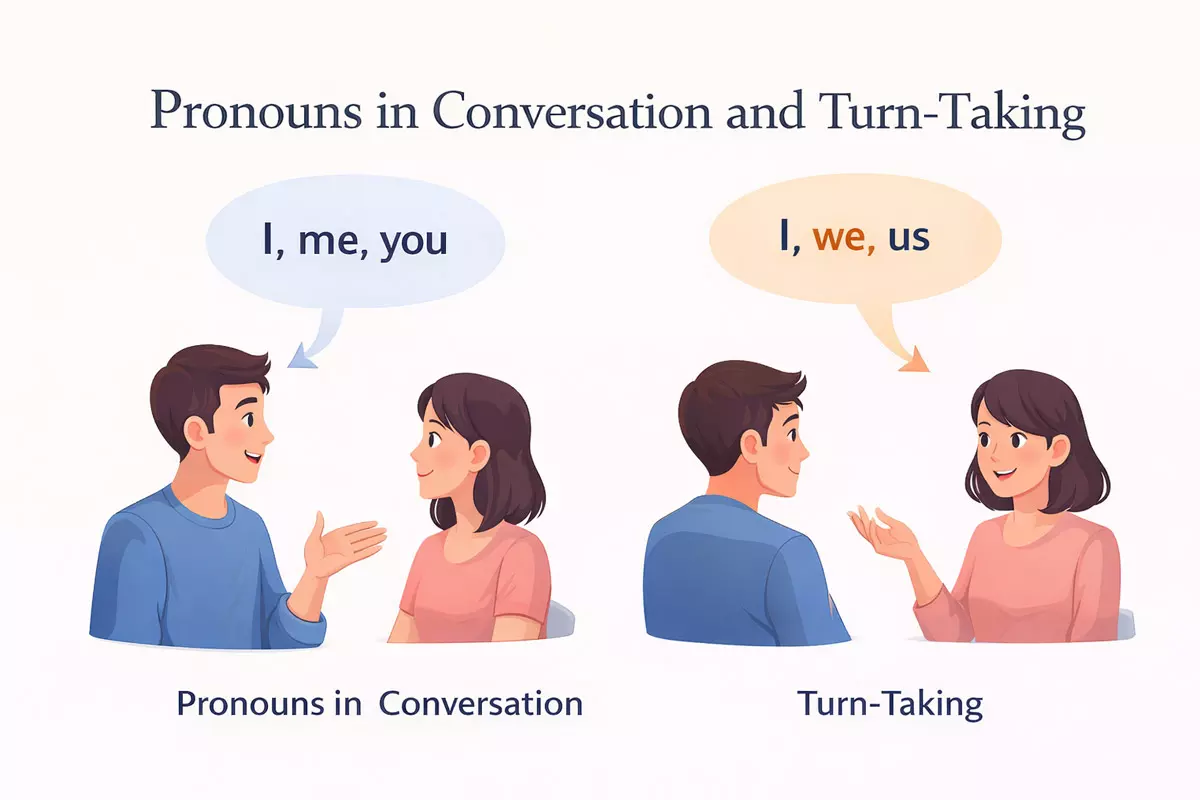 This article explains how pronouns help manage conversational turns, refer back to shared information, and signal agreement or disagreement. It covers spoken patterns, learner issues, and includes practice dialogues with pronouns.
- How pronouns help manage conversational turns
- Referring back to shared information
- Pronouns in responses, clarifications, and follow-ups
- Using pronouns to show agreement or disagreement
- Turn-taking signals in spoken interaction
- Natural spoken examples and patterns
- Common learner issues in conversation
- Practice: complete dialogues using pronouns
The words we use to refer to ourselves and others subtly influence who takes the next turn in conversation and shape the overall flow of dialogue. By examining these patterns of reference, we can uncover unexpected ways in which everyday interactions are organized and guided. Understanding these dynamics not only highlights the complexity of communication but also helps explain how conversational rhythm and participation are managed in both casual and formal settings.
How pronouns help manage conversational turns
Pronouns play a subtle but essential role in organizing the flow of conversation. By using these referring expressions, speakers can signal shifts in topic, clarify who is being addressed, and indicate when it’s someone else’s turn to speak. Because pronouns are inherently tied to participants or previously mentioned topics, they help manage the smooth handover of speaking rights in dialogue.
Signaling Attention and Address
When a speaker uses a second-person pronoun (“you”), it often serves as a direct cue that a response is expected. This can prompt the listener to take the next turn, or prepare to answer a question. First-person pronouns (“I”, “we”) can signal that the speaker is taking responsibility for the current statement, while third-person pronouns (“he”, “she”, “they”) may shift focus to someone not present or introduce a new participant into the conversational spotlight.
Maintaining Coherence and Reference
Pronouns allow speakers to refer back to earlier topics without repeating information, which keeps conversation efficient and cohesive. This referencing helps listeners track who or what is being discussed, reducing confusion and making it easier to know when to jump in or let others continue.
- “You” often prompts a reply or signals a question.
- “I” can mark a personal opinion or experience, indicating the speaker is holding the floor.
- “We” may invite shared responsibility or group response.
- “They” can shift the topic to outsiders, sometimes reducing immediate need for a reply.
- Switching from “he” to “you” can cue a change in focus or turn allocation.
- Repeated use of “she” or “he” can remind listeners of ongoing narrative threads.
- Demonstrative pronouns (“this”, “that”) can direct attention and signal a new or closing topic.
- Reflexive pronouns (“myself”, “yourself”) are sometimes used to emphasize or clarify who should respond.
- Indefinite pronouns (“someone”, “everyone”) can diffuse responsibility or invite open participation.
- Switching pronoun perspective (from “I” to “you”) can hand over the conversational turn.
Comparison of Pronoun Functions in Turn-Taking
| Pronoun Type | Typical Turn-Taking Effect |
|---|---|
| First-person (“I”, “we”) | Maintains speaker’s hold on the floor; may invite shared response with “we” |
| Second-person (“you”) | Directs a question or prompt; signals expectation of reply |
| Third-person (“he”, “she”, “they”) | Shifts discussion to others; can relieve immediate turn pressure |
| Demonstrative (“this”, “that”) | Signals topic shift or summary; can cue next speaker |
By understanding these patterns, speakers and listeners can navigate conversation more smoothly, using pronouns to subtly manage participation, clarify intent, and guide the natural flow of turn-taking. This nuanced use of language supports both efficiency and clarity in everyday interactions.
Referring back to shared information
In conversation, speakers frequently draw on information already introduced or mutually understood within the group. This process, often achieved through pronouns and other referring expressions, helps maintain conversational flow and coherence. Instead of repeating full names or detailed descriptions, participants use words like "he," "she," "it," or "they" to efficiently point back to previously mentioned people, objects, or ideas. This referencing is crucial for smooth turn-taking and for keeping everyone on the same page without unnecessary repetition.
How Pronouns Anchor Conversation
Pronouns serve as verbal shortcuts, relying on context and shared background to make communication more efficient. The listener must track these references to follow the conversation accurately. If the context shifts or becomes ambiguous, speakers often clarify by restating the referent or choosing a more specific term.
- He/She/They – for people previously mentioned
- It – for objects or abstract topics already discussed
- This/That – to point to something in the immediate context or just mentioned
- These/Those – for plural references
- One/Ones – to reference a subset or specific item from a group
- Such – to refer to a previously described quality or type
- Here/There – to indicate previously discussed locations
- Do so/Did so – for actions just mentioned
- Former/Latter – to distinguish between two previously named options
- Same – to indicate repetition or identity with an earlier point
- Each/All – to refer collectively to earlier items or people
- Whose – to clarify possession in a shared context
- Which – to specify among options already known
- Where/When – for referring back to known times or places
Managing Reference Across Turns
Participants must keep track of who or what pronouns refer to, especially as new speakers join in or topics shift. When listeners lose track, misunderstandings can arise. Skilled speakers often anticipate confusion and provide clarifying detail, such as reintroducing a name or using a descriptive phrase.
| Pronoun/Expression | Common Referent Type |
|---|---|
| He/She/They | Previously mentioned person or people |
| It | Previously discussed object or topic |
| This/That | Immediate or just-mentioned item/idea |
| Do so | Action just carried out |
| Former/Latter | Distinguishing between two prior items |
Repairing Reference Problems
When ambiguity arises, conversation partners often use repair strategies—clarifying, rephrasing, or restating the referent. These moves keep the dialogue coherent and allow turn-taking to proceed smoothly. For example, if someone says, "He said he’d call," and it’s unclear who "he" refers to, another person might ask, "Do you mean John or Mike?" Such clarification is a fundamental part of managing shared information during conversation. Effective use of referencing not only reduces redundancy but also signals active listening and shared understanding, which are vital for collaborative communication.
Pronouns in responses, clarifications, and follow-ups
The use of pronouns after an initial turn in conversation plays a crucial role in managing reference, cohesion, and efficiency. When participants reply, clarify, or extend a previous statement, they often rely on pronouns to signal shared understanding or to smoothly maintain the flow of talk. These small words allow speakers to avoid unnecessary repetition, but they also require careful interpretation, especially when more than one possible referent exists.
How pronouns create coherence in replies
In follow-up turns, pronouns like he, she, they, or it typically refer back to someone or something introduced earlier. This backward reference (anaphora) helps listeners track topics without restating names or full descriptions. For example, after “Did you see Maria at the meeting?”, a response like “She left early” is clear because the referent is established.
Clarifying ambiguous pronoun use
Sometimes, pronouns in responses can be unclear. Ambiguity may arise if several entities could match the pronoun, or if the conversation shifts topics rapidly. In such cases, speakers might clarify by rephrasing or specifying the referent, either immediately or upon request.
- “He said he’d call.” → “Wait, who do you mean by ‘he’?”
- “They’re already here.” → “Do you mean the delivery team or the guests?”
- “It was broken.” → “What was broken?”
- “She approved it.” → “Who approved what?”
Pronoun choices in follow-up moves
The form of pronouns chosen in follow-up utterances often reflects the conversational context. Singular or plural, gendered or neutral, and even demonstrative pronouns (like this, that) all serve different functions. Patterns of use can also signal inclusion or exclusion, focus, or even politeness.
| Pronoun | Common Use in Follow-Ups |
|---|---|
| he/she | Refers to a previously mentioned individual |
| they | Can refer to a group or a singular person (gender-neutral) |
| it | Refers to a thing, idea, or previous event |
| this/that | Used to point to something just mentioned or immediately relevant |
| we | Signals group inclusion (speaker + others) |
| you | Addresses the listener directly, sometimes generic |
Examples of pronouns in conversational turns
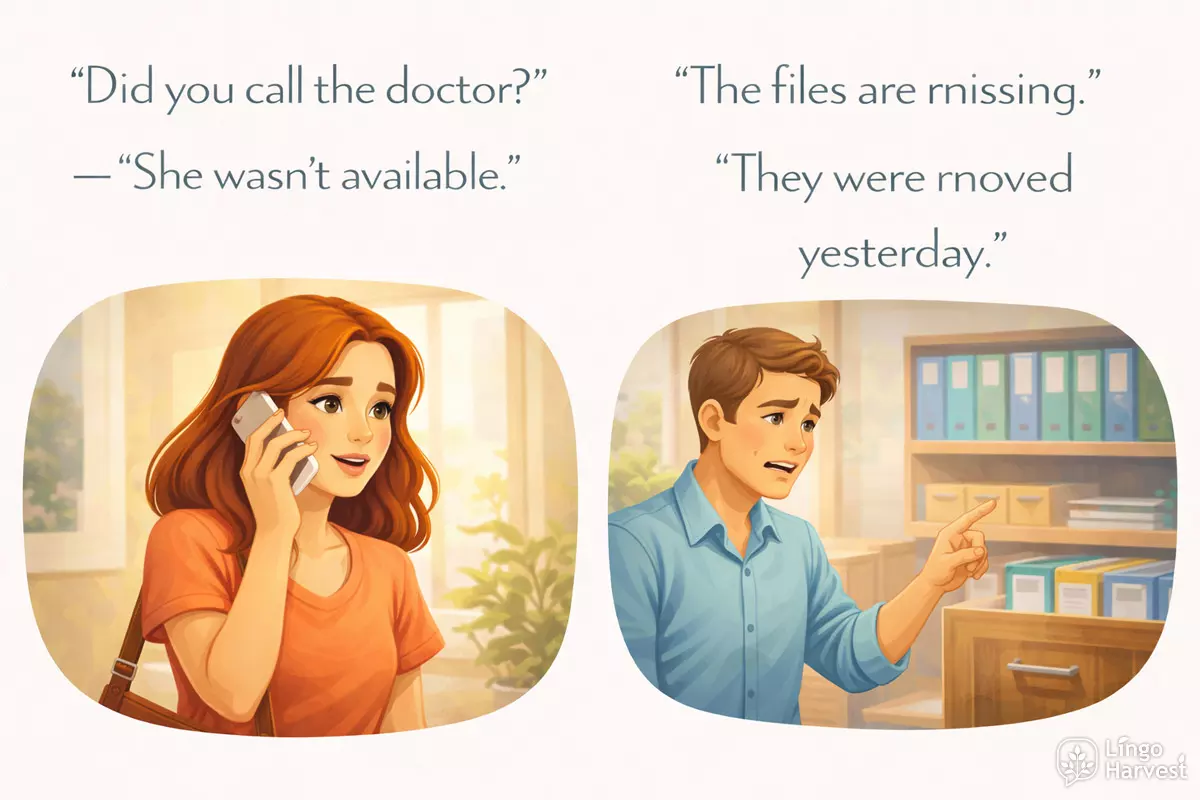
- “Did you call the doctor?” – “She wasn’t available.”
- “The files are missing.” – “They were moved yesterday.”
- “Who wants coffee?” – “I do.”
- “Let’s start the meeting.” – “We should wait for John.”
- “I found a wallet.” – “Where did you find it?”
- “The concert was canceled.” – “That’s disappointing.”
- “I met two new neighbors.” – “What are they like?”
- “Is the printer working?” – “It needs ink.”
- “Are you coming to the party?” – “We might be late.”
- “My phone died.” – “When did that happen?”
Effective use of pronouns in replies and clarifications ensures conversations are efficient, connected, and clear. By tracking reference and context, speakers help listeners follow the flow of ideas and maintain smooth turn-taking.
Using pronouns to show agreement or disagreement
Pronouns play a subtle but important role in signaling how speakers align themselves in conversation. When agreeing or disagreeing, the choice of pronoun can clarify who is included in an opinion, soften direct confrontation, or emphasize a shared perspective. This can affect the tone of a discussion and influence how turns are taken.
How pronouns signal alignment in conversation
Speakers often use "we," "you," or "they" to align with or distance themselves from others' statements. For instance, saying "I agree" feels more personal than "We all agree," which builds group consensus. On the other hand, "You might think..." can gently introduce a contrasting view, while "They say..." shifts responsibility away from the speaker.
Common pronoun patterns for agreement ✅ and disagreement ❌
- I agree/I disagree – direct, personal alignment or opposition
- We think/We don't think – includes the speaker in a group position
- You’re right/You’re wrong – addresses the other person directly
- They believe/They don’t believe – refers to others outside the conversation
- That’s what I thought too – shows shared perspective
- I see it differently – signals respectful disagreement
- We could consider – invites joint reflection, softening disagreement
- You might be onto something, but... – acknowledges before disagreeing
- No, I don't think so – clear personal dissent
- They seem to agree with you – brings in third-party support
- We’re all on the same page – unites the group in agreement
- I’m not sure I agree – hedging personal disagreement
- That’s not how I see it – frames disagreement as perspective
Comparing pronoun use in agreement and disagreement
| Agreement Example | Disagreement Example |
|---|---|
| We totally agree with your point. | I don’t see it that way. |
| You’re right—it makes sense. | You might be mistaken about that. |
| They also support this idea. | They would probably disagree. |
| I feel the same way. | That’s not how I understand it. |
Impact on turn-taking
Using pronouns carefully can help manage the flow of conversation. Inclusive pronouns like "we" encourage others to join in, while "I" or "you" can make turns more personal or confrontational. Choosing the right pronoun often signals whether you are inviting agreement, opening the floor for debate, or closing a topic. Adjusting pronoun use is one way speakers negotiate both agreement and disagreement smoothly during conversational turns.
Turn-taking signals in spoken interaction
In everyday conversation, participants rely on a range of cues to signal when it is appropriate to speak, pause, or yield the floor. These cues are both verbal and nonverbal, helping speakers coordinate their contributions smoothly. Among these signals, pronouns often play a subtle but important role in managing who is being addressed and when a speaker might be inviting a response.
Types of Turn-Taking Cues
Spoken exchanges feature several mechanisms that guide the flow of talk. Some are explicit, while others are more implicit or context-dependent. Recognizing these cues allows conversational partners to avoid overlaps and awkward silences.
- Intonation patterns – Rising or falling pitch can suggest a speaker’s turn is ending or continuing.
- Pauses – Brief silences may indicate readiness for another to speak.
- Pronoun use – Shifting from “I” to “you” or using “we” can invite participation or shift the focus.
- Direct address – Using someone’s name or a direct pronoun (“What do you think, Alex?”) directs the turn.
- Completion of thoughts – Finishing a syntactic unit signals a possible transition.
- Discourse markers – Words like “so,” “well,” or “anyway” mark shifts or openings for response.
- Gestures – Nods, eye contact, or hand movements can encourage another to take the floor.
- Backchannel responses – Short affirmations (“uh-huh,” “right”) signal listening and may prompt a speaker to continue or yield.
- Overlap and interruption – Sometimes, simultaneous speech is a signal of eagerness or urgency to take a turn.
- Repetition or reformulation – Repeating or rephrasing a question can nudge someone to respond.
Examples of Pronoun Shifts in Turn Management
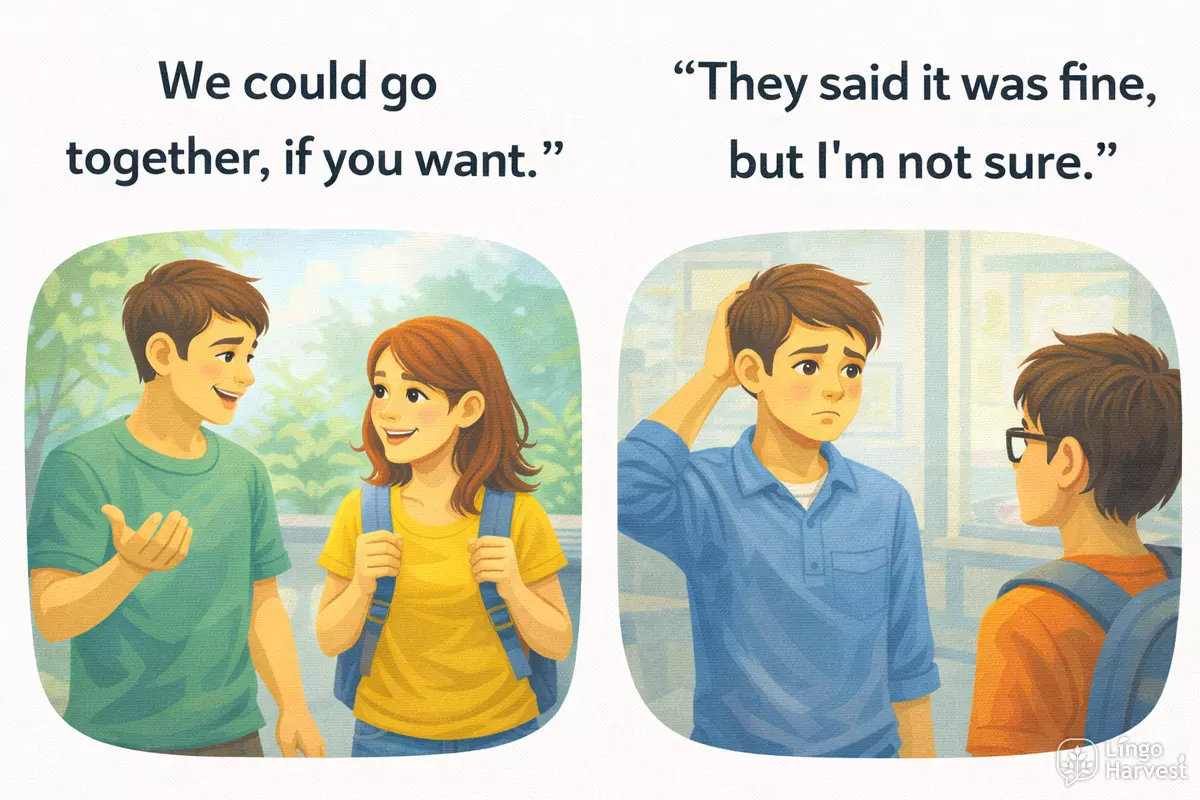
Pronouns are frequently used to negotiate who should speak next or to clarify roles in the interaction. Consider these common conversational moves:
- “I think that’s a good idea. What do you think?” (passes turn)
- “We could go together, if you want.” (invites joint action)
- “You mentioned earlier…” (signals focus on the other’s input)
- “They said it was fine, but I’m not sure.” (shifts topic or referent)
- “I just wanted to add…” (signals intention to take or keep the floor)
Comparing Verbal and Nonverbal Signals
| Verbal Cue | Nonverbal Cue |
|---|---|
| Pronoun shift (“What do you think?”) | Direct eye contact with the next speaker |
| Discourse marker (“So…”) | Nodding toward someone |
| Pause at end of utterance | Raising eyebrows in expectation |
| Explicit address (“Alex, your turn.”) | Leaning forward or pointing |
Understanding these diverse strategies helps reveal how the subtle use of language—including pronouns—shapes the organization of conversation and ensures participants can contribute at the right moments.
Natural spoken examples and patterns
In everyday conversation, speakers rely on pronouns to keep communication smooth and efficient. Pronouns help avoid repetition and allow speakers to refer to people, objects, or ideas already mentioned or understood from context. Their use is closely linked to conversational turn-taking, where quick, clear references are essential for maintaining flow. Looking at how pronouns are used in real dialogue reveals several recurring structures and strategies.
Common Pronoun Usage in Conversation
- Substituting names: “Did she call you?” instead of repeating the person’s name.
- Clarifying turn ownership: “I was saying...” to reclaim or clarify whose turn it is.
- Managing group reference: “We should leave soon,” including the speaker and listeners.
- Directing questions: “What do you think?” to hand over the conversational turn.
- Signaling topic shifts: “As for that, I’m not sure.”
- Implicit referencing: “They said it might rain,” where ‘they’ is contextually understood.
- Polite hedging: “One could argue that…” for general statements.
- In-group/out-group marking: “We don’t do it that way,” vs. “They always do this.”
- Repairing misunderstandings: “No, he meant the other one.”
- Elliptical responses: “Who wants coffee?” “I do!”
- Overlapping speech: “You know, I was just about to say that!”
- Echoing for emphasis: “They did? They really did?”
- Shifting focus: “She, not me, handled it.”
- Addressing absent parties: “He was looking for you.”
- Generalization: “You never know what’ll happen.”
Patterns in Turn-Taking with Pronouns
Pronoun choice often signals who is expected to speak next or whose perspective is foregrounded. For instance, using “you” can directly invite a response, while “we” may foster a sense of shared perspective and encourage group participation. Shifts from “I” to “we” or “they” can mark changes in alignment or topic.
| Speaker Utterance | Turn-Taking Function |
|---|---|
| “Are you coming with us?” | Invites the next speaker’s response |
| “I didn’t hear that.” | Clarifies speaker’s stance or experience |
| “We should get started.” | Signals group involvement, prompts action |
| “They said it’s closed.” | References outside information, shifts topic |
| “Is she okay?” | Introduces a new participant or topic |
Observations from Real Dialogue
- Pronouns are often context-dependent; listeners rely on shared knowledge to interpret them.
- Turn-taking cues are embedded in pronoun choices and intonation.
- Repair strategies frequently involve clarifying or correcting pronoun references.
- Discourse markers like “so,” “well,” or “but” often accompany pronoun shifts to manage turns.
Understanding these naturally occurring patterns helps explain how speakers maintain coherence, signal shifts, and manage conversational roles using pronouns.
Common learner issues in conversation
Navigating pronouns and turn-taking can be especially challenging for language learners. Difficulties often arise from differences between the learner’s native language and the conversational patterns of the target language. These challenges can cause misunderstandings, awkward pauses, or even unintentional impoliteness. Understanding where learners typically struggle can help with targeted practice and smoother communication.
Frequent struggles with pronoun use
Learners sometimes confuse subject and object pronouns, or overuse names instead of pronouns, making speech sound unnatural. The following list shows some common trouble spots in English conversation:
- Mixing up "he" and "she"
- Using "me" instead of "I" (or vice versa)
- Forgetting to use "it" for objects or animals
- Overusing someone’s name instead of "he" or "she"
- Using "they" for a single person incorrectly
- Skipping pronouns entirely (e.g., "Is raining" instead of "It is raining")
- Incorrect reflexive forms (e.g., "myself" instead of "me")
- Confusion with possessives ("his" vs. "her")
- Uncertainty with "this/that" vs. "he/she/it"
- Problems with generic “you” (as in “You never know”)
Turn-taking confusion
Smooth conversation relies on knowing when to speak, pause, or hand the turn to someone else. Learners may struggle with:
- Interrupting others unintentionally
- Missing cues to take their turn
- Not responding quickly enough, leading to awkward silences
- Failing to use language that signals turn changes (such as “What do you think?”)
- Overlapping speech due to timing misjudgment
- Using inappropriate fillers (e.g., “um,” “uh”) or using none at all
Comparison of pronoun challenges
| Common Error | Typical Example | Possible Impact |
|---|---|---|
| Gender mix-up | “He is my sister.” | Confuses listener; misidentifies people |
| Omitted pronoun | “Is raining today.” | Sentence sounds incomplete or unclear |
| Repeated names | “Anna said Anna will come.” | Speech sounds unnatural, disrupts flow |
| Wrong object pronoun | “Give to I.” | Grammatical error; may cause confusion |
Tips for overcoming these issues
- Practice pronoun substitution drills
- Record and review conversations to notice mistakes
- Listen to native speakers for natural turn-taking patterns
- Use role-play to practice giving and receiving turns
- Focus on context to choose the correct pronoun
- Watch for cues in body language and intonation
With awareness and targeted practice, learners can become more confident and natural in their use of pronouns and in managing conversational flow.
Practice: complete dialogues using pronouns
Understanding how pronouns function in everyday conversation is essential for clear and natural turn-taking. Below, you will find a variety of exercises designed to help you practice filling in missing pronouns in short dialogues, as well as tips for choosing the right form in context. These activities encourage attention to both subject and object pronouns, as well as possessive forms, all of which play a key role in smooth exchanges.
Fill-in-the-blank Dialogues
Read each dialogue and supply the correct pronoun (he, she, it, they, him, her, them, his, their, etc.) where a blank appears. Consider who or what is being referenced in the conversation.
- A: Where is Anna?
B: _______ is in the kitchen. - A: Did you see the new students?
B: Yes, I met _______ yesterday. - A: Is this your book?
B: No, it isn’t _______. - A: What did John say about the meeting?
B: _______ said it was postponed. - A: Are the keys on the table?
B: No, I put _______ in the drawer. - A: Will you call Sarah?
B: I already called _______. - A: Who owns this backpack?
B: It’s _______. - A: Where is the cat?
B: _______ is under the bed. - A: Did you finish the report?
B: Yes, I sent _______ to you by email. - A: Are you going to invite Mark and Lisa?
B: Yes, I will invite _______ tonight.
Show answers
- 1. She
- 2. them
- 3. mine
- 4. He
- 5. them
- 6. her
- 7. mine
- 8. It
- 9. it
- 10. them
Choosing the Right Pronoun: Quick Reference
This list highlights common pronoun uses in conversational turns. Review these to help you select the most appropriate form during dialogue completion tasks.
- he, she, it, they – used as the subject of a sentence
- him, her, it, them – used as the object of a verb or preposition
- his, her, its, their – possessive adjectives, used before nouns
- his, hers, its, theirs – possessive pronouns, used without a noun following
- we, us, our, ours – first person plural forms
Short Dialogue Completion
Try to fill in the correct pronoun in each mini-dialogue below:
- A: Is this your coat?
B: No, it’s not _______. - A: Will you help me with this box?
B: Sure, let’s move _______ together. - A: The children are outside.
B: I’ll call _______ for dinner. - A: Where did Lucy go?
B: _______ went to the library. - A: Are these your keys?
B: Yes, they’re _______. - A: Did you see my phone?
B: Yes, I found _______ on the sofa. - A: Is Mark coming with us?
B: Yes, _______ is on his way. - A: We can’t carry all these bags.
B: Let’s ask Anna to help _______. - A: Are you and Tom ready?
B: Yes, _______ are ready. - A: Is this seat free?
B: Yes, you can take _______.
Show answers
- mine
- it
- them
- She
- mine
- it
- he
- us
- we
- it
Practicing these exchanges will help you gain fluency in using pronouns naturally during conversation, ensuring clarity and smooth transitions between speakers.