Most Common Pronoun Errors by Learners

 Here we why pronoun errors are common, outlines frequent subject-object and agreement mistakes, misuse of reflexives, confusion with it, they, and this, register-related issues, and how errors vary by proficiency.
Many language learners find it challenging to use pronouns like he, she, and it correctly, often resulting in mistakes that cause confusion or awkwardness in their sentences. These errors can stem from differences in grammar rules between languages or uncertainty about which pronoun fits each context. By recognizing these common issues and practicing their correct use, learners can improve their clarity and confidence when speaking or writing in a new language. Developing this skill is essential for effective and natural communication.
Why pronoun errors are so frequent
Many language learners regularly mix up pronouns for reasons that go deeper than simply forgetting a rule. Pronouns are small words, but they carry a lot of grammatical information—like gender, case, and number—that isn’t always obvious or consistent across languages. When a learner’s native language handles these details differently, it’s easy to make mistakes, even at advanced levels.
Influence of the First Language
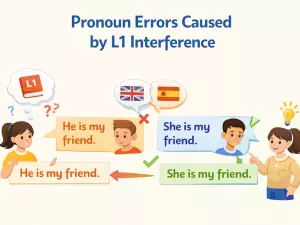
One major source of confusion comes from transferring patterns from a learner’s mother tongue. Some languages don’t mark gender or case on pronouns, while others have totally different systems for addressing people or things. This leads to interference, where learners apply familiar structures to the new language.
- Mixing up “he” and “she” if the native language doesn’t distinguish gender
- Using “it” for people, especially when “it” refers to objects in the learner’s first language
- Omitting pronouns where their own language allows dropping them
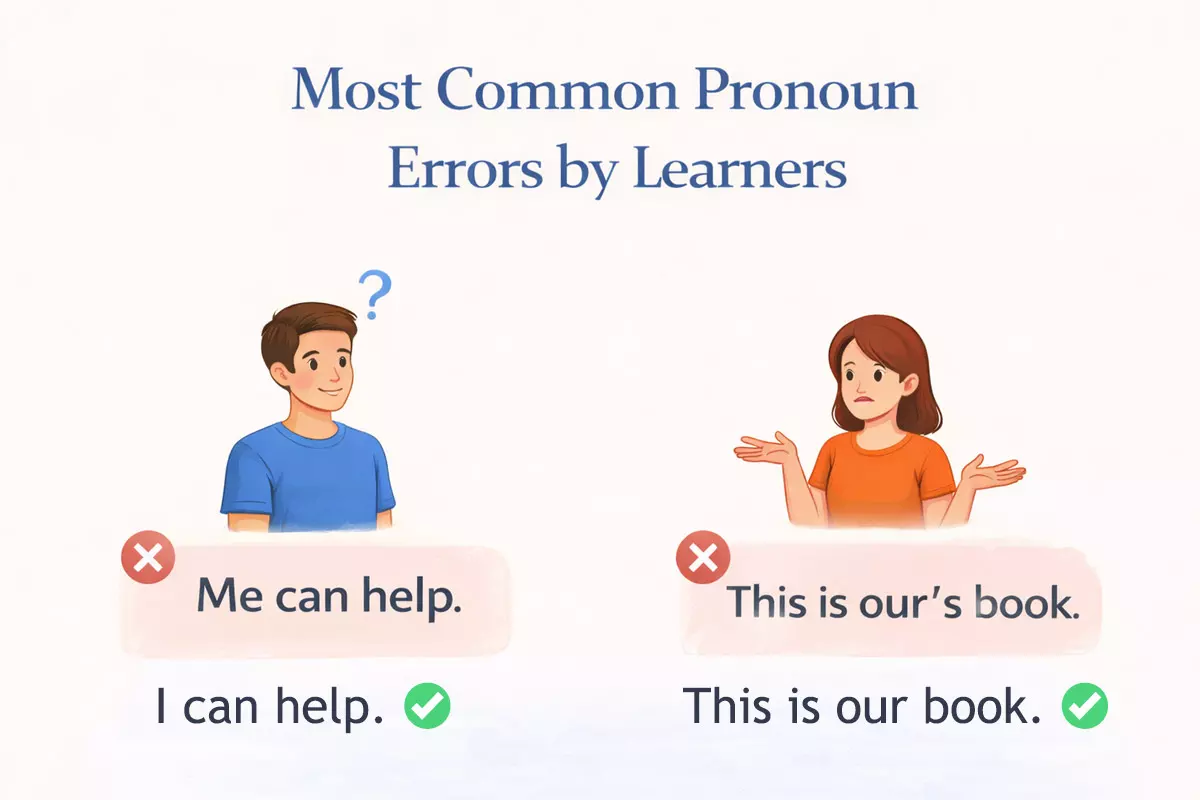
- Choosing object forms (“me,” “him”) in place of subject forms (“I,” “he”)
- Confusing possessive forms: “her book” vs. “hers”
- Misusing reflexive pronouns (“myself,” “himself”)
- Overusing or underusing “they” as a singular pronoun
- Problems with “whose” and “who’s”
- Uncertainty between “that” and “which” in relative clauses
- Switching between “you” (singular/plural) in languages with multiple “you” forms
- Incorrect use of “one” as a generic pronoun
- Substituting “this” and “these” or “that” and “those”
- Forgetting to match pronoun and antecedent in number (“Everybody has their own idea”)
- Using “them” for inanimate objects, where “it” is expected
- Mixing up “who” and “whom”
- Errors in formal vs. informal address (e.g., “tu” vs. “vous” in French)
Complex Pronoun Systems
English, like many languages, has a range of pronoun forms for different functions. Memorizing these forms and when to use them can be difficult, especially when some forms are rarely used or only appear in formal writing. For example, the distinction between “who” and “whom,” or “she” and “her,” is not always intuitive.
| Pronoun Type | Examples |
|---|---|
| Subject | I, you, he, she, it, we, they |
| Object | me, you, him, her, it, us, them |
| Possessive Adjective | my, your, his, her, its, our, their |
| Possessive Pronoun | mine, yours, his, hers, its, ours, theirs |
| Reflexive | myself, yourself, himself, herself, itself, ourselves, yourselves, themselves |
Pronouns and Context
Unlike nouns, pronouns depend heavily on context. Learners must keep track of who or what each pronoun refers to, especially in longer sentences or conversations. This can be challenging, leading to ambiguous or incorrect references. Additionally, conversational shortcuts or regional variations (like using “them” for objects) can add to the confusion.
Summary
Ultimately, pronoun mistakes are widespread because they combine grammatical complexity, interference from a learner’s first language, and subtle context cues. Being aware of these sources can help learners focus their practice and reduce errors over time.
Top subject vs object mistakes
Many English learners struggle to choose between subject and object pronouns, leading to some of the most persistent errors in writing and conversation. Understanding when to use “I” versus “me,” or “he” versus “him,” is essential for clear and correct communication. These mistakes often happen because the learner’s native language either doesn’t distinguish between subject and object forms, or does so differently than English.
What’s the difference?
Subject pronouns perform the action in a sentence (like “she” in “She runs”). Object pronouns receive the action (like “her” in “I see her”). Mixing them up can make sentences sound unnatural or confusing.
Common mix-ups and examples

Learners often swap subject and object forms, especially after prepositions or in compound subjects/objects. Here are some of the most frequent trouble spots:
- Using “me” instead of “I” at the start of a sentence: Me and John went to the store ❌ → John and I went to the store ✅
- Using “I” instead of “me” after prepositions: Between you and I ❌ → Between you and me ✅
- Swapping “he”/“him” or “she”/“her” in questions: Who did you see? He? ❌ → Who did you see? Him? ✅
- Incorrect object in compound objects: She invited Tom and I ❌ → She invited Tom and me ✅
- Getting “they” and “them” wrong: Them are coming over ❌ → They are coming over ✅
- Using “us” instead of “we” as the subject: Us need to leave ❌ → We need to leave ✅
- After “than” or “as” in comparisons: She is taller than me (informal/ok) vs. She is taller than I (am) (formal)
- With infinitives: They want we to help ❌ → They want us to help ✅
- After “let”: Let she do it ❌ → Let her do it ✅
- With “who” vs. “whom”: Who did you meet? (spoken/ok), Whom did you meet? (formal/written)
Quick reference: Subject vs. object pronouns
| Subject Pronoun | Object Pronoun |
|---|---|
| I | me |
| you | you |
| he | him |
| she | her |
| we | us |
| they | them |
| it | it |
Tips to avoid confusion
A helpful way to check your choice: try the sentence with the pronoun alone. For example, “She invited Tom and I” becomes “She invited I” (which sounds wrong). Practicing with simple sentences helps reinforce the correct forms. Pay special attention after prepositions and in compound structures, as these are hotspots for mistakes. Over time, careful listening and reading will make these patterns feel more natural.
Agreement errors with pronouns
One of the most frequent issues learners encounter involves making sure pronouns match the words they refer to in number, gender, and person. When these elements do not align, sentences can become confusing or grammatically incorrect. This type of problem can happen in both spoken and written English, especially when dealing with complex sentences or unfamiliar vocabulary.
Common types of agreement mismatches
Pronoun agreement mistakes often fall into a few major categories. Each type can affect clarity and correctness in different ways:
- Singular/plural mismatch: Using a singular pronoun for a plural noun, or vice versa (e.g., "Everyone must bring their pens" instead of "Everyone must bring his or her pen").
- Gender disagreement: Using "he" for a female subject or "she" for a male subject, especially when the gender is clear from context.
- Person inconsistency: Switching between first, second, and third person inappropriately (e.g., "If one studies hard, you will succeed").
- Ambiguous reference: When it’s unclear what noun a pronoun is replacing, leading to confusion.
- Indefinite pronouns: Words like "everyone," "anybody," and "each" are singular, but many learners mistakenly pair them with plural pronouns.
- Relative pronoun confusion: Using "who," "which," or "that" incorrectly based on the noun they refer to.
- Collective nouns: Treating words like "team" or "group" inconsistently as singular or plural depending on the context.
Typical examples of mismatched pronouns
Below are some frequent mistakes learners make, with corrections to illustrate proper usage:
- Each student must submit their homework on time. ❌ → Each student must submit his or her homework on time. ✅
- The dog chased their tail. ❌ → The dog chased its tail. ✅
- The teachers explained his lesson. ❌ → The teachers explained their lesson. ✅
- If someone calls, tell them I’ll call back. ❌ (traditional grammar prefers "him or her," but "them" is now commonly accepted in informal English)
- Neither of the boys brought their books. ❌ → Neither of the boys brought his book. ✅
- My friend lost their wallet. ❌ → My friend lost his or her wallet. ✅
- If a person wants to succeed, you have to work hard. ❌ → If a person wants to succeed, he or she has to work hard. ✅
- The committee made their decision. ❌ → The committee made its decision. ✅
- Every child should do their best. ❌ → Every child should do his or her best. ✅
- Each of the players wore their uniform. ❌ → Each of the players wore his uniform. ✅
Summary of agreement patterns
To help compare the correct forms, here is a quick reference for matching pronouns with their antecedents:
| Antecedent | Correct Pronoun(s) | Common Error(s) |
|---|---|---|
| Each student | his or her | their |
| The team | it | they |
| People | they | he, she |
| Someone | he or she (or they in informal use) | they (in formal writing) |
| The company | it | they |
| My friend | he or she | they |
Paying attention to how pronouns relate to their nouns can help learners avoid many of these pitfalls. Practice with real examples and careful proofreading are key to building confidence and accuracy.
Overuse or misuse of reflexive pronouns
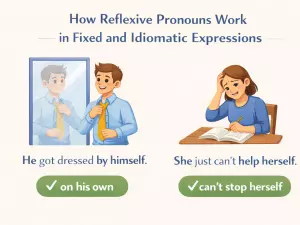
Many English learners mistakenly insert reflexive forms (like "myself," "yourself," "themselves") where a simple subject or object pronoun is correct, or use them in contexts where they’re unnecessary. This typically happens because reflexive pronouns are used differently in other languages, or because learners think they sound more formal or emphatic in English. However, using these forms incorrectly can make sentences awkward or even grammatically wrong.
Common mistakes with reflexive pronouns
- Using a reflexive pronoun instead of a subject or object pronoun (e.g., "Myself went to the store" instead of "I went to the store").
- Adding a reflexive pronoun for emphasis when it’s not needed (e.g., "She herself did the homework" instead of "She did the homework").
- Using a reflexive pronoun after prepositions where it is not required (e.g., "He gave the book to myself" instead of "He gave the book to me").
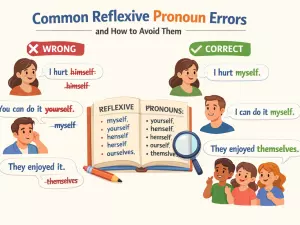
- Incorrectly matching the reflexive pronoun with the subject (e.g., "They did it hisself" instead of "They did it themselves").
- Using reflexive forms with verbs that do not take them in English (e.g., "I enjoyed myself the movie" instead of "I enjoyed the movie").
- Placing a reflexive pronoun as the subject of a sentence (e.g., "Herself is coming" instead of "She is coming").
- Using reflexive pronouns for routine actions where they are not required (e.g., "He washed himself his hands" instead of "He washed his hands").
- Adding reflexive pronouns after verbs that are not reflexive in English (e.g., "I remember myself" instead of "I remember").
- Using a reflexive pronoun for another person in a sentence (e.g., "She told myself" instead of "She told me").
- Employing reflexive forms to create passive meaning (e.g., "The book was written by himself" instead of "He wrote the book himself" or "The book was written by him").
How to use reflexive pronouns correctly
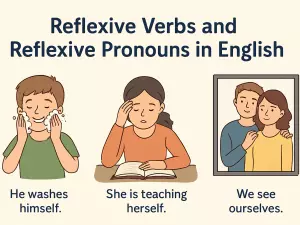
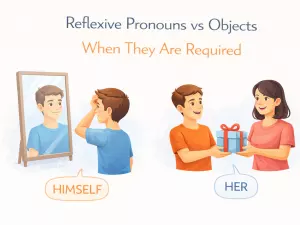
Reflexive pronouns are mainly used when the subject and the object of the verb are the same person or thing (e.g., "She taught herself Spanish"). They can also add emphasis (e.g., "The president himself attended the meeting"), but this is less common in everyday speech.
Examples: Correct vs. Incorrect Usage
| Incorrect | Correct |
|---|---|
| Myself will call you tomorrow. | I will call you tomorrow. |
| Please give the keys to myself. | Please give the keys to me. |
| She enjoyed herself the concert. | She enjoyed the concert. |
| They did it hisself. | They did it themselves. |
| He washed himself his hands. | He washed his hands. |
| Herself is coming to the meeting. | She is coming to the meeting. |
Tips to avoid mistakes
- Check if the subject and object are the same person before using a reflexive pronoun.
- Remember that most verbs do not need reflexive forms in English.
- Use ordinary pronouns ("me," "him," "her," etc.) after prepositions, unless the action is truly reflexive.
- When in doubt, try the sentence without the reflexive pronoun; if it still makes sense, it’s probably correct.
By learning the proper contexts for reflexive pronouns, English learners can make their speech and writing clearer and more natural.
Confusion with it, they, and this
Learners often mix up singular and plural pronouns, especially when choosing between it, they, and this. Each functions differently, but their uses can overlap in ways that cause mistakes. For example, it refers to a single object or abstract idea, they to multiple items or people, and this often introduces something new or points out something close in context.
Common Patterns of Mistakes
- Using it for plural nouns: "The books are old. It is on the table." ❌ instead of "They are on the table." ✅
- Choosing they for singular non-human nouns: "The car is new. They is fast." ❌ instead of "It is fast." ✅
- Replacing this with it when introducing something: "It is my friend, Anna." ❌ vs. "This is my friend, Anna." ✅
- Switching between this and they incorrectly: "They is my idea." ❌ should be "This is my idea." ✅
- Confusing it with this after mentioning something: "I have a new phone. This is black." (Acceptable, but "It is black." is more natural after the first mention.)
Quick Reference: When to Use Each Pronoun
| Pronoun | Typical Use | Example |
|---|---|---|
| it | Singular, non-human or abstract noun | The cat is hungry. It wants food. |
| they | Plural nouns (people, animals, things); also singular "they" for unknown gender | The dogs are barking. They are loud. |
| this | Introducing or pointing to something close (singular) | This is my favorite book. |
Examples of Correct and Incorrect Usage

- The window is open. It is cold. ✅
- The windows are open. They are cold. ✅
- I got a new job. This is exciting. ✅
- The apples are fresh. It tastes good. ❌ → They taste good. ✅
- This is my brother. He is a doctor. ✅
- My friends arrived. They are waiting outside. ✅
- Here is a pen. This is yours. ✅
- The movie was long. It was interesting. ✅
- I have two cats. It are playful. ❌ → They are playful. ✅
- I bought a cake. This is for you. ✅
Understanding the differences among these pronouns helps learners sound more natural and avoid confusion in both writing and conversation. Practice with varied sentence patterns is key to mastering their usage.
Register-related pronoun mistakes
Learners often struggle to match pronoun usage to the appropriate level of formality, which can lead to awkward or even confusing communication. Using a pronoun that is too casual in a formal setting, or vice versa, may unintentionally signal disrespect or distance. This issue is especially common in English due to its relatively subtle distinctions, but it can also occur in other languages with more explicit formal/informal pronoun forms.
What is register in pronoun usage?
Register refers to the degree of formality in language. In pronoun choice, this means selecting words that fit the context—whether it’s a professional email, a conversation with a friend, or addressing someone in authority. Many languages, such as French, Spanish, and German, have specific formal and informal pronouns. In English, while the differences are less marked, shifts in register still occur, such as using "one" for formal writing or "you" in everyday speech.
Common mistakes and examples
- Using "you guys" in business emails instead of "you" or "everyone"
- Addressing a professor as "Hey you!" instead of "Professor Smith" or "you"
- Switching between "tu" and "vous" incorrectly in French
- Using "du" with strangers in German, rather than the formal "Sie"
- Employing "one" in casual texts when "you" is expected
- Referring to oneself as "we" in formal writing without clear justification
- Using "he/she" in official documents when gender-neutral or plural forms are more appropriate
- Addressing elders with informal pronouns in languages like Korean or Japanese
- Using "they" as a singular pronoun in a conservative or highly formal context where it might not be accepted
- Switching between formal and informal address within a single conversation
- Forgetting to maintain the same register in group emails or announcements
- Translating informal pronoun habits from one's native language into English or vice versa
Comparing formal and informal pronouns
| Language | Informal Pronoun | Formal Pronoun | Typical Context |
|---|---|---|---|
| French | tu | vous | Friends, family / Strangers, authority |
| German | du | Sie | Close acquaintances / Formal, business |
| Spanish | tú | usted | Peers, children / Formal, elders |
| Russian | ты | вы | Friends, informal / Professional, respectful |
| English | you (informal), guys | one, you (formal), everyone | Casual speech / Academic, official |
Tips for avoiding register errors
- Pay attention to the relationship and context before choosing a pronoun.
- When in doubt, opt for the more formal form, especially in writing.
- Observe how native speakers address different audiences.
- Practice switching registers in sample dialogues or writing exercises.
- Ask for feedback on your usage from teachers or colleagues.
Mastering the nuances of pronoun register takes practice and awareness, but it’s essential for clear and respectful communication across different contexts. Checking the pronoun forms before sending an email or speaking in a new environment can help learners avoid misunderstandings and make a positive impression.
Error patterns by proficiency level
Learners at different stages of language development tend to make distinct types of pronoun mistakes. These patterns often reflect the complexity of the structures being acquired and the learner’s familiarity with English grammar rules. Understanding how missteps shift with increasing experience can help teachers target instruction more effectively and learners become more aware of their own progress.
Typical mistakes at beginner level
At the elementary stage, errors are often basic and frequent. Learners may struggle with even the most common subject and object pronouns, as well as possessives. Some frequent issues include:
- Confusing “he” and “she” (e.g., “She is my brother.”)
- Using “it” for people (“It is my teacher.”)
- Omitting pronouns entirely (“Is raining.” instead of “It is raining.”)
- Incorrect object pronouns (“Me like apples.” instead of “I like apples.”)
- Mixing up “my” and “mine” (“This is mine book.”)
- Using “his” for feminine nouns (“Her bag is his.”)
- Plural confusion (“They is my friends.”)
- Repeating nouns and pronouns (“My mother she is nice.”)
- Using “he” or “she” for animals or things
- Confusing “we” and “us”
Intermediate learner patterns
As learners progress, mistakes become more subtle. Intermediate users may still struggle, especially when sentences get more complex or when reflexive and relative pronouns are introduced. Common patterns include:
- Incorrect use of reflexive pronouns (“He did it hisself.”)
- Mixing up “who” and “whom” (“The person whom called.”)
- Confusion between “their” and “they’re”
- Misuse of “each other” and “one another”
- Forgetting to match pronoun gender and number in longer sentences
- Overusing “it” as a dummy subject where not needed
- Incorrect placement of pronouns with phrasal verbs (“Turn it off the light.”)
- Unclear reference (ambiguous pronoun use)
- Problems with indefinite pronouns (“Everyone must do their homework.”)
Advanced proficiency: persistent or subtle mistakes
Even at higher levels, certain pronoun errors may persist, often due to interference from the learner’s first language or the nuance of English usage. The following table highlights some subtle distinctions and recurring issues that advanced learners might encounter:
| Challenging Area | Typical Advanced Error |
|---|---|
| Generic “they” | Overcorrection to “he/she” in contexts where “they” is accepted |
| Relative pronouns | Using “which” for people (“The man which called”) |
| Pronoun reference | Unclear or ambiguous antecedents in complex sentences |
| Formal/informal register | Using “whom” in informal speech, or avoiding it where it is required |
| Reflexive misuse | Unnecessary reflexives (“Myself will do it.”) |
Summary of shifting error types
As learners become more proficient, their challenges with pronouns shift from simple form errors to subtle issues of style, reference, and register. Early instruction can focus on basic distinctions and pronoun agreement, while more advanced learners benefit from attention to nuance and context. Recognizing these evolving patterns is key to effective language learning and teaching.
Practice: spot and correct pronoun errors
Understanding how to use pronouns correctly is essential for clear communication. Many language learners struggle with choosing the right pronoun or matching it to its antecedent. Below, you’ll find a variety of practice activities and examples to help you recognize and fix common mistakes involving pronouns.
Identify the Error
Read each sentence carefully. Decide if there is a pronoun mistake, and if so, correct it.
- Everyone should bring their own lunch.
- Me and Sarah went to the store.
- The dog wagged its tail because they were happy.
- Each of the students must hand in their assignment.
- Neither John nor Paul said they was ready.
- This is the person whom won the prize.
- Maria lost her keys, but she found them later.
- Who’s book is this?
- If anyone calls, tell them I’ll call back.
- Us teachers have a meeting this afternoon.
Show answers
- Everyone should bring his or her own lunch. (Traditional grammar prefers singular; "their" is common in informal speech.)
- Sarah and I went to the store.
- The dog wagged its tail because it was happy.
- Each of the students must hand in his or her assignment. (Again, "their" is common but not strictly singular.)
- Neither John nor Paul said they were ready.
- This is the person who won the prize.
- Maria lost her keys, but she found them later. (Correct)
- Whose book is this?
- If anyone calls, tell him or her I’ll call back. ("Them" is acceptable in informal contexts.)
- We teachers have a meeting this afternoon.
Common Mistakes: Subject and Object Pronouns
Many learners confuse subject and object pronouns. Here are some examples of typical errors and their corrections:
- Me went to the park. → I went to the park.
- Her gave me the book. → She gave me the book.
- It was John and me who finished the work. → It was John and I who finished the work.
- The teacher spoke to he and I. → The teacher spoke to him and me.
- Us went shopping. → We went shopping.
Pronoun Reference and Agreement Table
Mistakes often occur when pronouns do not clearly refer to a noun or do not agree in number/gender. The table below shows common errors and correct forms:
| Incorrect Example | Corrected Version |
|---|---|
| The students lost their book. | The students lost their books. |
| Neither Anna nor Mike brought their umbrella. | Neither Anna nor Mike brought his or her umbrella. |
| Each of the boys has their own locker. | Each of the boys has his own locker. |
| If a student wants to succeed, they must study. | If a student wants to succeed, he or she must study. ("They" is informal.) |
| Jane told Sally that she would win. | Jane told Sally that Sally would win. (Clarify who "she" is.) |
Quick Correction Task
Try to spot the pronoun error in each sentence and rewrite it correctly.
- Him and me are going to the concert.
- Somebody forgot their wallet.
- Between you and I, this is a secret.
- My friend and myself went hiking.
- Neither of the girls brought their shoes.
- Me and Sarah finished the assignment.
- Everyone have finished their work.
- Us students need more time.
- The manager spoke to John and I.
- Each of the players did their best.
Show answers
- He and I are going to the concert.
- Somebody forgot his or her wallet. (“Their” is common in informal English.)
- Between you and me, this is a secret.
- My friend and I went hiking.
- Neither of the girls brought her shoes.
- Sarah and I finished the assignment.
- Everyone has finished their work.
- We students need more time.
- The manager spoke to John and me.
- Each of the players did his or her best. (“Their” is widely accepted in modern usage.)
Regular practice with real examples helps you internalize correct pronoun use. When in doubt, check if the pronoun matches in number and gender, and whether it fits its role in the sentence.