Reflexive Pronouns vs Objects: When They Are Required

 Here we the list and meaning of reflexive pronouns, explains differences like myself vs me, shows when reflexives are required, highlights common verbs and errors, explains set phrases, and provides practice choosing the right form in sentences.
- Reflexive pronouns list and basic meaning
- Reflexive vs object: myself vs me, herself vs her
- When reflexives are required: actions returning to the subject
- Verbs that typically take reflexives vs those that don’t
- Common learner errors: myself used for politeness or formality
- Reflexives after prepositions: by myself, to myself
- Reflexives in set patterns: behave yourself, enjoy yourself
- Practice: choose reflexive or object in real sentences
Knowing when to use reflexive words like myself instead of direct objects can be challenging, even for native speakers. The key is to recognize whether the subject and the object of the sentence refer to the same person. Reflexive pronouns such as myself, yourself, or themselves are used when the action of the verb is performed on the subject itself, as in I taught myself to play guitar. If the action is directed at someone else, use a direct object instead, as in I taught her to play guitar. This distinction helps ensure clear and correct communication.
Reflexive pronouns list and basic meaning
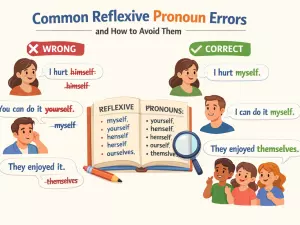
Reflexive pronouns are used when the subject and object of a verb are the same person or thing. They show that someone is performing an action on themselves, rather than on someone else. In English, these pronouns always end in -self (singular) or -selves (plural).
Common reflexive pronouns in English
- myself (for "I")
- yourself (for "you" singular)
- himself (for "he")
- herself (for "she")
- itself (for "it")
- ourselves (for "we")
- yourselves (for "you" plural)
- themselves (for "they")
Each of these forms matches a specific subject pronoun. For example, "I" pairs with "myself," while "they" pairs with "themselves." Reflexive pronouns are never used as the subject of a sentence; they always refer back to the subject.
Basic meanings and uses
Generally, these pronouns indicate that the action of the verb returns to the doer. For instance, in "She hurt herself," "herself" refers to "she," showing that the person did the action to her own body. They can also be used for emphasis, such as "I did it myself," meaning "I did it, not someone else."
| Subject Pronoun | Reflexive Pronoun | Example |
|---|---|---|
| I | myself | I taught myself to cook. |
| you (singular) | yourself | You should ask yourself first. |
| he | himself | He fixed it himself. |
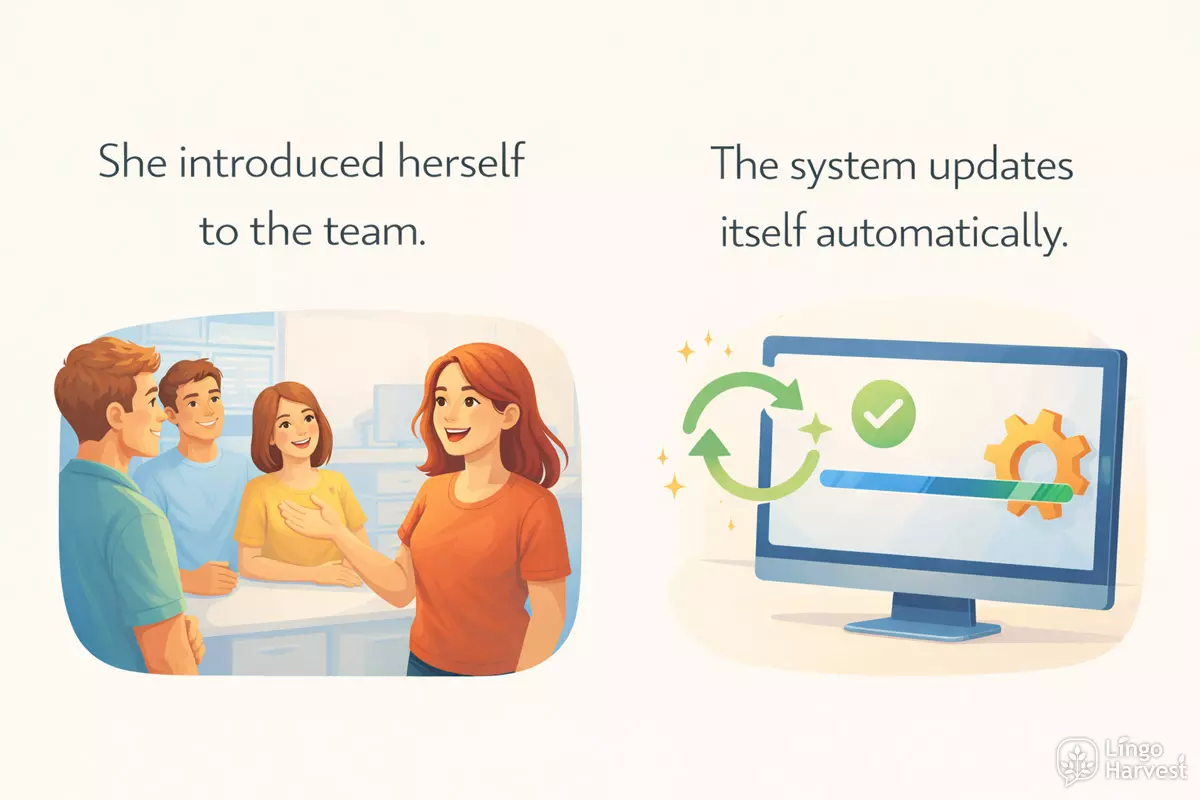
| she | herself | She introduced herself to the team. |
| it | itself | The system updates itself automatically. |
| we | ourselves | We prepared ourselves for the exam. |
| you (plural) | yourselves | Please make yourselves comfortable. |
| they | themselves | They explained themselves clearly. |
Reflexive pronouns are essential in certain situations, especially when the verb requires the subject and object to be the same, or when you want to emphasize that the subject acted alone. Choosing the correct form depends on the subject of the sentence. Misusing these forms can lead to confusion or awkwardness in English sentences.
Reflexive vs object: myself vs me, herself vs her
Choosing between words like “myself” and “me,” or “herself” and “her,” depends on the function of the pronoun in the sentence. Reflexive pronouns are used when the subject and object of the verb are the same person, while object pronouns simply receive the action from someone else. Getting this distinction right makes your sentences clearer and more natural.
When to use reflexive pronouns
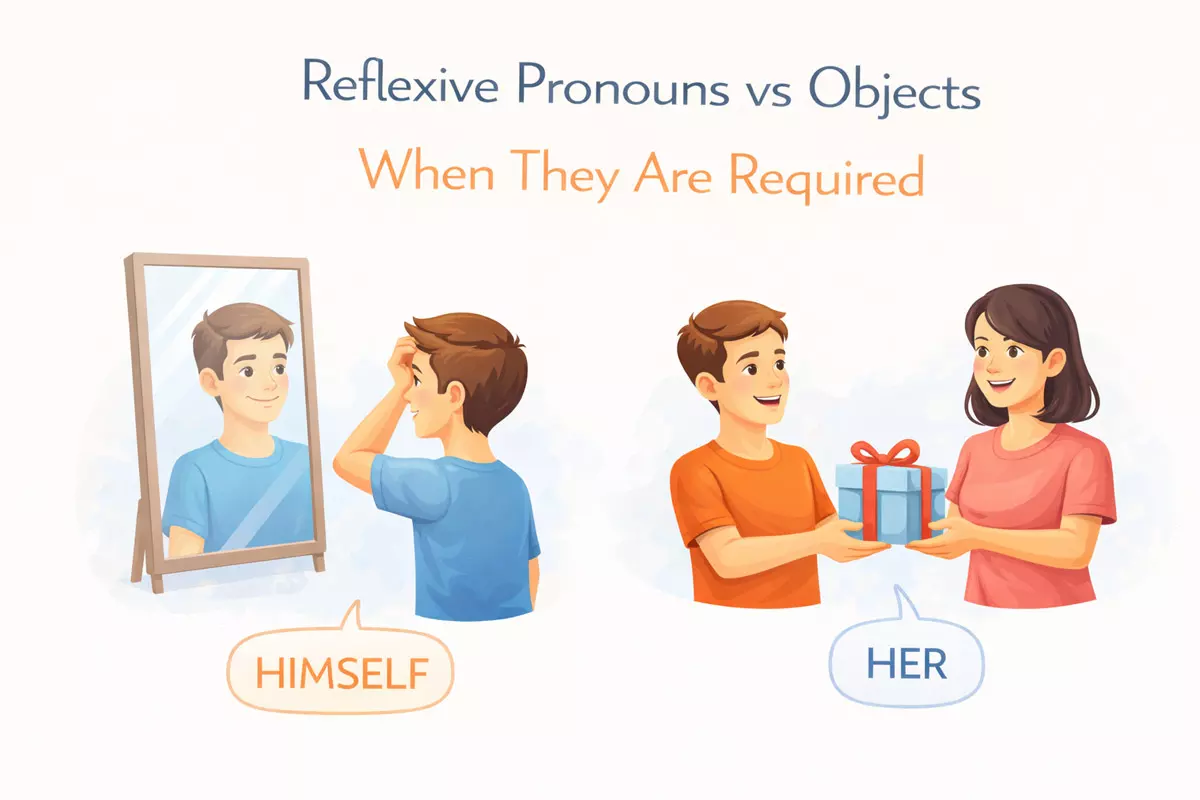
Reflexives like “myself” or “herself” are required when the subject does something to itself. They’re also used for emphasis, but never as a simple replacement for the object pronoun. For example:
- I taught myself to play piano. (subject and object are the same person)
- She looked at herself in the mirror.
- I made this cake myself. (emphasis: no one else helped)
When to use object pronouns
Object pronouns like “me” and “her” are correct when the subject and object are different people, or when the pronoun is the object of a preposition. For instance:
- She called me last night.
- Can you help her with her homework?
- This gift is from me to her.
Common mistakes and correct usage
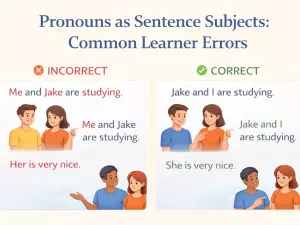
It’s easy to confuse these forms, especially in speech. Using a reflexive pronoun in place of an object pronoun is a frequent error in English. Here’s a structured comparison:
| Incorrect Usage ❌ | Correct Usage ✅ |
|---|---|
| She gave the book to myself. | She gave the book to me. |
| Between you and myself, this is a secret. | Between you and me, this is a secret. |
| They invited herself to the party. | They invited her to the party. |
| Please contact myself if you have questions. | Please contact me if you have questions. |
| He blames herself for the mistake. | He blames her for the mistake. |
Quick reference: choosing the right pronoun
If you’re unsure, ask: Is the person doing something to themselves? If yes, use the reflexive form. Otherwise, go with the object pronoun. Here are more examples to illustrate the difference:
- I hurt myself while cooking. (reflexive)
- The teacher praised me. (object)
- She introduced herself to the group. (reflexive)
- Could you send her the file? (object)
- I’ll take care of it myself. (reflexive/emphasis)
- He made dinner for her. (object)
- Don’t blame yourself for everything. (reflexive)
- This is a surprise for me. (object)
- She reminded herself to be patient. (reflexive)
- They congratulated her on the new job. (object)
Remember, reflexive pronouns are not interchangeable with object pronouns. Using them correctly helps your English sound natural and precise.
When reflexives are required: actions returning to the subject
Some verbs describe actions that move back onto the person or thing doing them—this is where reflexive pronouns come in. If the subject and the object of the verb are the same, English typically uses words like “myself,” “yourself,” or “themselves.” Not every verb works this way, but for many, leaving out the reflexive would make the meaning unclear or even ungrammatical.
Reflexive pronouns show the action loops back
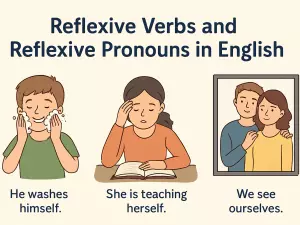
When someone performs an action on themselves, you need a reflexive pronoun. For example, in “She hurt herself,” the subject “she” is also the recipient of the action. Without “herself,” the sentence could mean she hurt someone else. This distinction is crucial in English, especially with verbs that can take either a direct object or a reflexive.
- I taught myself to play guitar. (not “I taught me”)
- He introduced himself to the group. (not “He introduced him”)
- They blame themselves for the mistake. (not “They blame them”)
- She reminded herself to call. (not “She reminded her”)
- We prepared ourselves for the test. (not “We prepared us”)
- You should take care of yourself. (not “You should take care of you”)
- The cat cleaned itself. (not “The cat cleaned it”)
- He prides himself on his honesty.
- She made herself a sandwich.
- I found myself in a difficult situation.
- They taught themselves Spanish.
- We enjoyed ourselves at the party.
- He hid himself behind the door.
- She convinced herself to try.
- I hurt myself skating.
- Did you see yourself in the mirror?
- They congratulated themselves.
- She dressed herself quickly.
When reflexives are not optional
Some verbs require a reflexive to make sense when the subject and object are the same. Using a regular object pronoun (me, her, us, etc.) is either incorrect or changes the meaning. These cases are not about emphasis, but about basic grammar.
- Correct: He introduced himself. ✅
- Incorrect: He introduced him. ❌ (means he introduced another male)
- Correct: She blamed herself. ✅
- Incorrect: She blamed her. ❌ (means she blamed another female)
Summary of key reflexive uses
Reflexive pronouns are required:
- When the subject and object refer to the same person or thing
- With certain verbs (introduce, teach, blame, hurt, etc.) when the action is directed back at the subject
- To avoid confusion or ambiguity in meaning
Using the right pronoun here is not just about style—it’s necessary for clarity and correctness. When in doubt, check if the action is looping back to the subject; if so, a reflexive is probably needed.
Verbs that typically take reflexives vs those that don’t
Some English verbs almost always require reflexive pronouns, while others rarely or never do. This distinction is key for using reflexives correctly. Reflexive pronouns (myself, yourself, herself, etc.) are needed when the subject and object are the same person or thing. However, many verbs simply don’t work with reflexives or only take them in idiomatic expressions.
Common verbs that require reflexive pronouns
With certain verbs, omitting the reflexive changes or destroys the meaning. Here are verbs that typically need a reflexive pronoun when the action returns to the subject:
- Enjoy oneself (e.g., She enjoyed herself at the party.)
- Introduce oneself (He introduced himself to the group.)
- Hurt oneself (Be careful not to hurt yourself.)
- Blame oneself (Don’t blame yourself.)
- Teach oneself (She taught herself French.)
- Express oneself (He finds it hard to express himself.)
- Prepare oneself (Prepare yourself for bad news.)
- Defend oneself (They defended themselves.)
- Kill oneself (He almost killed himself.)
- Avail oneself (of) (She availed herself of the opportunity.)
Verbs that rarely or never take reflexive pronouns
Some verbs are almost never used with reflexives, even if the subject and object are the same. Using a reflexive here would sound unnatural or be incorrect:
- Meet (NOT: I met myself yesterday.)
- Feel (NOT: I feel myself happy.)
- Remember (NOT: I remember myself as a child.)
- Relax (NOT: I relaxed myself.)
- Change (NOT: I changed myself.)
- Move (NOT: I moved myself to London.)
- Wash (intransitive) (OK: I washed. NOT: I washed myself, unless you specify body parts.)
- Dress (intransitive) (OK: I dressed. NOT: I dressed myself, except for emphasis.)
- Leave (NOT: I left myself at home.)
- Notice (NOT: I noticed myself in the mirror.)
Comparison: Typical reflexive vs non-reflexive verbs
| Usually takes reflexive | Rarely/never takes reflexive |
|---|---|
| Introduce oneself ✅ She introduced herself. |
Meet ❌ I met myself. |
| Blame oneself ✅ Don’t blame yourself. |
Relax ❌ I relaxed myself. |
| Hurt oneself ✅ He hurt himself. |
Change ❌ I changed myself. |
| Teach oneself ✅ She taught herself. |
Move ❌ I moved myself to Paris. |
Understanding which verbs are compatible with reflexive pronouns helps avoid awkward or incorrect sentences. Some verbs can take reflexives for emphasis (“I dressed myself”), but this is the exception, not the norm. Always consider whether the action truly returns to the subject, and whether native speakers would use a reflexive in that context.
Common learner errors: myself used for politeness or formality
Learners of English sometimes choose "myself" (or other reflexive pronouns) in situations where a simple object pronoun is actually correct. This often happens because "myself" can sound more formal or polite to non-native speakers, especially in emails, business communication, or speech. However, in standard English, "myself" has specific grammatical roles, and using it incorrectly can make sentences sound awkward or ungrammatical.
When "myself" is misused
Reflexive pronouns like "myself," "yourself," and "himself" are intended for two main contexts:
- When the subject and object of the verb are the same (e.g., "I hurt myself.")
- For emphasis (e.g., "I made this myself.")
Problems arise when speakers use "myself" instead of "me" just to sound more formal or polite, especially after prepositions or as the object of a verb.
Typical incorrect uses
- Incorrect: Please contact myself if you have questions. ❌
- Incorrect: The report was sent to John and myself. ❌
- Incorrect: Between you and myself, this is a secret. ❌
Compare these with the correct forms:
- Correct: Please contact me if you have questions. ✅
- Correct: The report was sent to John and me. ✅
- Correct: Between you and me, this is a secret. ✅
Why does this happen?
Many learners believe that using "myself" (or "yourself") is more polite or formal than "me" or "you." In reality, this is a misunderstanding. Native speakers will notice the misuse, and it can distract from your message.
Common situations where mistakes occur
- After prepositions: "for myself" instead of "for me"
- As the object with another person: "to Sarah and myself"
- In business emails: "Please send it to myself"
- When closing emails: "If you need anything, contact myself"
- In introductions: "My name is Alex, and this is myself"
- With passive voice: "The document was reviewed by myself"
- During meetings: "You can ask myself any questions"
- After "between": "between John and myself"
- In spoken English for emphasis: "I'll do it myself" (correct for emphasis, but often confused)
- With lists: "Thank you from Jane and myself"
Summary of correct usage
Reflexive pronouns should only be used when you are referring back to the subject of the sentence, or for emphasis. In all other cases, use object pronouns like "me," "him," or "us." Overusing reflexives in formal or polite contexts is a common pitfall for English learners, and avoiding it will make your speech and writing sound more natural.
Reflexives after prepositions: by myself, to myself
Using reflexive pronouns after prepositions is a core part of English grammar, especially when talking about actions people do alone or for themselves. Reflexives such as "myself," "yourself," "himself," and so on, often follow prepositions like "by," "for," "with," or "to." This structure helps clarify who benefits from or is affected by the action, and it often eliminates ambiguity.
Common Prepositions Used with Reflexives
Some prepositions are frequently paired with reflexive forms to express different meanings. Here are some typical patterns:
- by + reflexive: to show someone is alone or did something without help (e.g., by herself, by ourselves)
- to + reflexive: to indicate talking or doing something for one’s own benefit (e.g., to myself, to themselves)
- for + reflexive: to show the action is for the subject’s own advantage (e.g., for himself, for ourselves)
- with + reflexive: less common, but can be used in idiomatic expressions (e.g., with yourself)
Examples of Reflexives after Prepositions
Here’s a set of practical examples showing how reflexive pronouns fit after prepositions in real sentences:
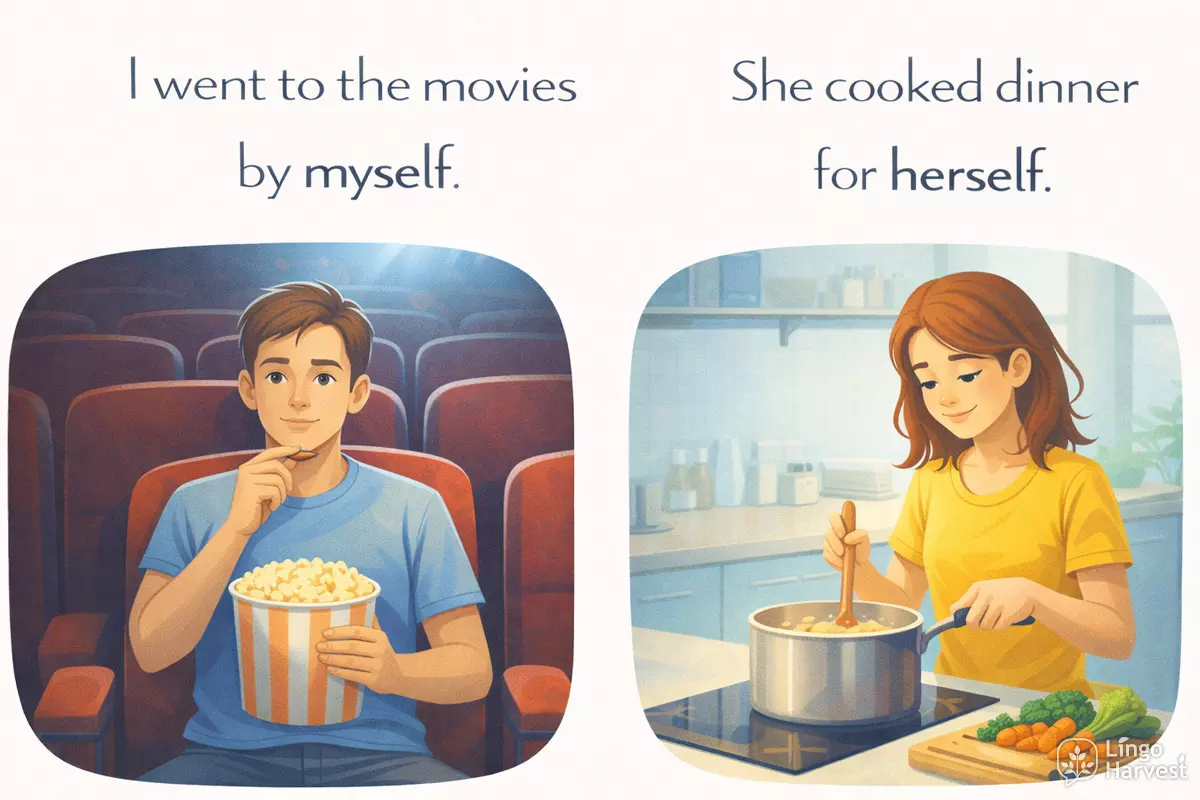
- I went to the movies by myself.
- She cooked dinner for herself.
- He was talking to himself in the mirror.
- They finished the project by themselves.
- You should be proud of yourself.
- We need to focus on ourselves for a while.
- The cat entertained itself with a toy.
- I kept the secret to myself.
- He learned to rely on himself.
- You can help yourself to some coffee.
- She spoke to herself quietly.
- We completed the task by ourselves.
- He bought a gift for himself.
- The kids made lunch by themselves.
- She was left by herself in the classroom.
- I made this cake for myself.
- They congratulated themselves on their success.
- He kept the information to himself.
- She introduced herself to the group.
When to Use Reflexive Pronouns After Prepositions
Reflexive pronouns are necessary after prepositions when:
- The subject and object refer to the same person or thing.
- You want to emphasize that someone did something alone or without help.
- The action is directed back to the subject, especially with mental or emotional verbs (e.g., talk to yourself, blame yourself).
Comparison: Reflexive vs. Non-Reflexive Pronouns After Prepositions
| With Reflexive Pronoun | With Object Pronoun |
|---|---|
| I did it by myself. (alone, no help) |
I did it by me. ❌ Incorrect in standard English |
| She kept it to herself. (didn’t tell anyone) |
She kept it to her. ❌ Not natural/incorrect |
| They spoke among themselves. (within their group) |
They spoke among them. ❌ Unclear or incorrect |
| He bought a gift for himself. (he is both giver and receiver) |
He bought a gift for him. (for another male, not reflexive) |
Key Takeaways
Reflexive pronouns after prepositions are essential for clarity and correctness, especially when the subject and object are the same. They help express actions done alone, for oneself, or within a group. Using object pronouns in these slots is generally incorrect and can change the meaning or make sentences ungrammatical.
Reflexives in set patterns: behave yourself, enjoy yourself
Certain English verbs and expressions require reflexive pronouns as part of their standard usage. These aren’t just for emphasis or to clarify the subject—they’re fixed patterns. In these cases, omitting the reflexive would either sound unnatural or change the meaning entirely.
Common verbs and expressions that take reflexive pronouns
Some verbs almost always appear with a reflexive pronoun when they mean someone is doing the action to themselves. Here are some of the most frequent examples:
- behave yourself → Please behave yourself in the meeting.
- enjoy yourself → Enjoy yourself at the party.
- help yourself (to something) → Help yourself to some water.
- introduce yourself → Please introduce yourself to the group.
- pride yourself (on something) → She prides herself on being punctual.
- absent yourself (from) → He had to absent himself from the discussion.
- avail yourself (of something) → Please avail yourself of the free resources.
- content yourself (with something) → He contented himself with a simple answer.
- apply yourself (to a task) → If you apply yourself, you’ll improve quickly.
- express yourself → Try to express yourself clearly.
- adapt yourself (to) → She adapted herself to the new routine.
- prepare yourself (for something) → Prepare yourself for a busy week.
- blame yourself → Don’t blame yourself for the mistake.
- hurt yourself → Be careful not to hurt yourself.
- amuse yourself → The kids amused themselves with a game.
- teach yourself → You can teach yourself basic coding.
- remind yourself → Remind yourself to take breaks.
- see yourself (as) → He sees himself as a problem-solver.
Notice how some of these, like “enjoy yourself” or “behave yourself,” are almost never used without the reflexive in everyday English.
Why do these patterns exist?
In many cases, the reflexive form is used because the verb’s meaning would be unclear or incomplete without it. For example, “help” without a reflexive usually means to assist someone else, but “help yourself” means to take what you want (often food or drink) without asking. Similarly, “introduce” needs a reflexive to show who is being presented.
Examples in context
Let’s look at how these set phrases appear in real sentences:
- Please behave yourself while I’m gone.
- Enjoy yourself at the party!
- She introduced herself to the new neighbors.
- You should pride yourself on your honesty.
- He helped himself to another slice of cake.
- I reminded myself to send the email.
- They prepared themselves for the exam.
Comparing reflexive vs. non-reflexive usage
Some verbs can be used with or without reflexives, but the meaning changes. Here’s a quick overview:
| Verb Phrase | Meaning |
|---|---|
| enjoy | Take pleasure in something (often an activity or object) |
| enjoy yourself | Have a good time; have fun (the focus is on the person’s experience) |
| help | Assist someone else |
| help yourself | Take what you want (esp. food) without asking |
| introduce | Present someone to others |
| introduce yourself | Present yourself to others |
Summary
Fixed verb + reflexive patterns are a core part of English idiomatic usage. Learning these helps you sound natural, and ensures you don’t accidentally change the meaning or make your sentences awkward. When in doubt, check if the verb commonly appears with a reflexive in set phrases—especially in instructions, invitations, or when describing actions people do to themselves.
Practice: choose reflexive or object in real sentences
Understanding when to use a reflexive pronoun (like "myself" or "themselves") or an object pronoun (such as "me," "her," or "us") is essential for clear and correct English. Below, you’ll find targeted exercises and real-world examples to help you master this distinction.
Read each sentence and decide if the blank should be filled with a reflexive pronoun or an object pronoun. Think about whether the action is done to the subject (reflexive) or to someone/something else (object).
Choose the correct pronoun
- She made ____ a cup of tea before leaving.
- Could you help ____ with this suitcase?
- We enjoyed ____ at the concert last night.
- He saw ____ in the mirror and laughed.
- The teacher asked ____ to stay after class.
- Did you hurt ____ while playing football?
- They introduced ____ to the new colleague.
- My friends called ____ yesterday.
- I taught ____ how to cook pasta.
- Please give ____ the keys when you arrive.
Show answers
- herself
- me
- ourselves
- himself
- me
- yourself
- themselves
- me
- myself
- me
Common patterns: reflexive vs. object pronoun
Some verbs and expressions almost always require one type of pronoun. Review these patterns and try to remember which type goes with each:
- Reflexive needed: enjoy yourself, introduce yourself, hurt yourself, look at yourself, teach yourself
- Object needed: help me, call him, ask them, tell us, give her
Spot the difference: examples
Look at the sentences and notice how the meaning changes depending on the pronoun:
- She cut herself. (She was the one hurt.)
- She cut him. (Someone else was hurt.)
- I reminded myself to buy milk. (I gave a reminder to me.)
- I reminded her to buy milk. (I told someone else.)
Quick check: fill in the blanks
- We invited Anna to join ____ for dinner.
- The cat washed ____ after eating.
- Could you show ____ the way?
- He blamed ____ for the mistake.
- She reminded ____ to call her parents.
- The children dressed ____ for school.
- Please help ____ to some tea.
- I taught ____ how to use the software.
- They found ____ in an awkward situation.
- Did you hurt ____ during the game?
Show answers
- us
- itself
- me
- himself
- herself
- themselves
- yourself
- myself
- themselves
- yourself
By practicing with real sentences and reviewing common patterns, you’ll develop an instinct for choosing the right pronoun form in context. Keep experimenting with your own examples for even better results!