Pronoun Errors Caused by L1 Interference

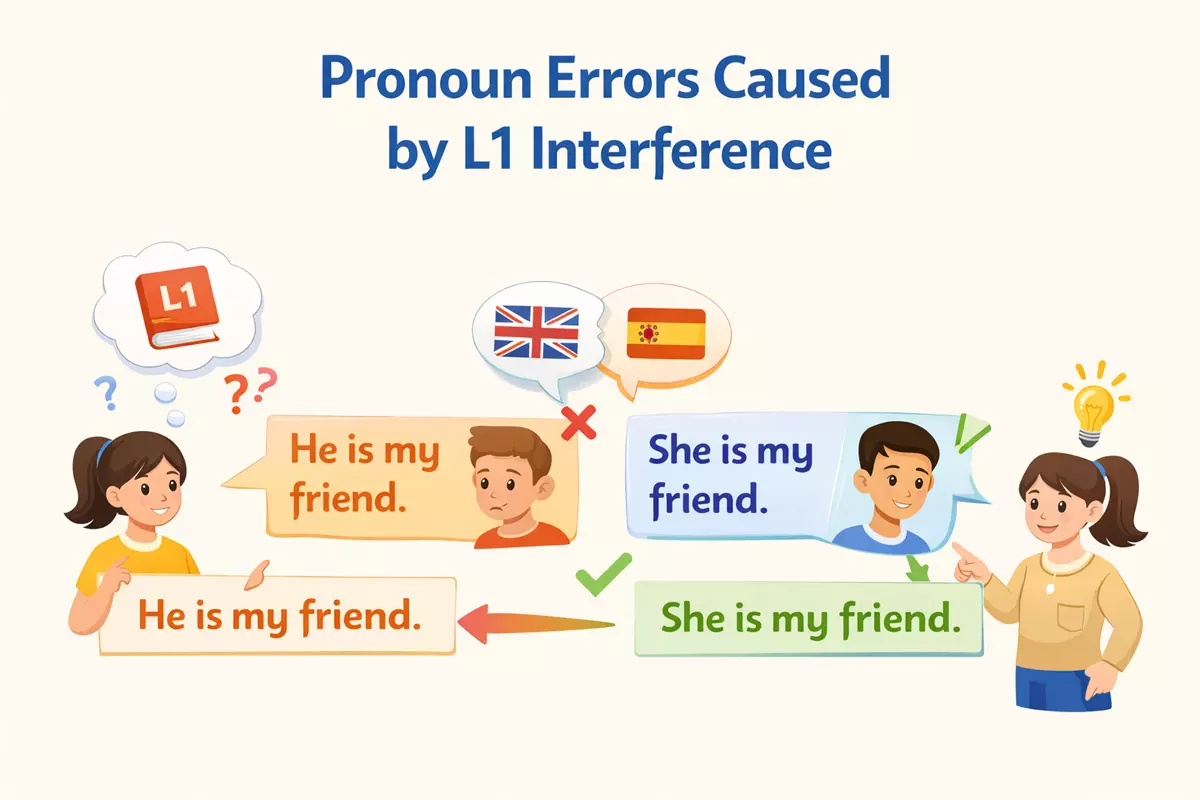 Here we what L1 interference is, common English pronoun errors it causes—like transfer, word order, and agreement mistakes—plus omission or overuse. It also gives examples, tips to spot interference, correction strategies, and practice exercises.
Learning a new language is often challenging, particularly when habits from your native language influence your English. Many learners make mistakes with pronouns like he, she, or it because they automatically use the grammar rules they already know, even when those rules do not apply in English. As a result, it is common to see confusion or errors in sentence structure and word choice. Recognizing these tendencies is an important first step in improving language skills and becoming more confident in English communication.
What L1 interference is and why it matters
When learning a new language, our first language (commonly called L1) often shapes the way we use grammar, vocabulary, and even pronouns in the target language. This influence, known as L1 interference or language transfer, happens when learners unconsciously apply rules or habits from their native tongue to the new language. In the context of pronouns, these cross-linguistic influences can cause confusion, leading to mistakes that persist even at advanced stages of language learning.
How L1 interference affects pronoun use
Pronoun errors are a classic example of how native language structures can disrupt accurate communication in another language. For instance, if a learner’s mother tongue doesn’t distinguish gender in pronouns, they may have trouble using “he” and “she” correctly in English. Similarly, languages with different pronoun systems—like those that omit pronouns or use formality distinctions—can lead to unique patterns of mistakes.
- Using “he” and “she” interchangeably due to lack of gender distinction in L1
- Dropping subject pronouns (“is raining” instead of “it is raining”) if L1 allows subject omission
- Confusing “they” and “it” when L1 uses a single pronoun for both animate and inanimate objects
- Overusing formal pronouns (“vous” in French) based on L1 social norms
- Misplacing reflexive pronouns (“himself” instead of “his”)
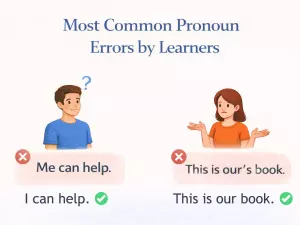
- Using possessive forms incorrectly (e.g., “hers car” instead of “her car”)
- Transferring word order from L1, causing unnatural pronoun placement
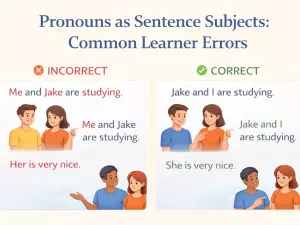
- Mixing up object and subject pronouns (“me go” instead of “I go”)
- Using double pronouns (“I, I think that…”) if L1 repeats pronouns for emphasis
- Incorrectly translating L1 pronoun forms that have no direct English equivalent
Why does this matter for language learners?
L1 transfer is not just a minor hiccup—it can make communication unclear and affect confidence. Persistent pronoun mistakes may lead to misunderstandings or distract listeners from the intended message. For teachers and learners, recognizing the specific patterns caused by native language habits is key to effective correction and practice.
| L1 Pronoun Feature | Typical Pronoun Error in English |
|---|---|
| No gender distinction in pronouns | Mixing up “he” and “she” |
| Subject pronouns often omitted | Leaving out “it” or “they” as subjects |
| Single pronoun for animate/inanimate | Using “it” for people or “he/she” for objects |
| Different pronoun formality levels | Overusing or misusing “you” in formal/informal settings |
| Flexible word order for pronouns | Placing pronouns in unnatural positions within sentences |
Common Pronoun Errors Caused by L1 Transfer

- Anna is my sister. He lives in Berlin. (wrong gender pronoun) → Anna is my sister. She lives in Berlin.
- Went to the store and bought bread. (missing subject pronoun) → I went to the store and bought bread.
- My friend said it is tired. (using “it” for a person) → My friend said he is tired.
- The chair is broken. He needs fixing. (using “he” for an object) → The chair is broken. It needs fixing.
- When finished the task, submitted the report. (subject pronoun omitted) → When I finished the task, I submitted the report.
- The manager spoke to the assistant and said you must be careful. (unclear reference of “you”) → The manager spoke to the assistant and said she must be careful.
Understanding the root causes of pronoun errors helps both teachers and learners develop targeted strategies. By noticing which pronoun patterns are most susceptible to transfer, learners can focus practice on the most challenging areas, making communication smoother and more accurate.
Typical pronoun transfer errors
Learners often carry over habits from their native language when using pronouns in a second language, which leads to a range of predictable mistakes. These issues can affect both spoken and written communication, sometimes causing confusion or misunderstanding. The most frequent problems stem from differences in gender, number, or case systems between the learner's first language and the one they're acquiring.
Common patterns of interference
Many mistakes arise when a learner’s first language handles pronouns differently than the target language. Here are some examples of these recurring patterns:
- Using “he” or “she” incorrectly for inanimate objects (e.g., “The table, she is old”)
- Omitting pronouns entirely where they are required (e.g., “Is raining” instead of “It is raining”)
- Confusing subject and object forms (e.g., “Me go” for “I go”)
- Mixing up “his” and “her” when referring to possessions (e.g., “She lost his bag”)
- Using “they” for singular nouns due to lack of gender-neutral pronouns in L1
- Applying plural pronouns to singular nouns (e.g., “Dogs, it is friendly”)
- Using reflexive pronouns in place of standard pronouns (e.g., “Myself will do it”)
- Transferring gender from L1 where the target language does not mark it (e.g., assigning gendered pronouns to neutral nouns)
- Employing demonstratives (“this,” “that”) in place of personal pronouns
- Overusing “it” to refer to people (e.g., “It is my friend”)
- Confusing “who” and “which” for animate and inanimate references
- Incorrectly using “we” to mean “us” or vice versa
- Misplacing possessive pronouns (e.g., “The my car” instead of “My car”)
- Using “her” for both subject and object (e.g., “Her is coming”)
- Replacing relative pronouns with personal pronouns (e.g., “The man he came”)
Illustrative comparison of error types
Different first languages influence pronoun usage in unique ways. The table below highlights some common transfer patterns for speakers of various backgrounds:
| L1 Influence | Typical Example Error |
|---|---|
| Gendered pronouns for objects (e.g., from French, Spanish, German) | “She is on the table” (for “It is on the table”) |
| No subject pronoun (e.g., from Italian, Russian, Chinese) | “Is raining” (missing “It”) |
| Confusion between “he” and “she” (e.g., from Turkish, Chinese, Arabic) | “My mother, he is a teacher” |
| Incorrect reflexive use (e.g., from Indian English, some Asian languages) | “Myself will call you” |
| Mixing object and subject forms (e.g., from Korean, Japanese) | “Me want water” |
Why these errors matter
Misusing pronouns can obscure meaning and make speech or writing sound unnatural. In some cases, incorrect reference hinders understanding, especially in complex sentences. Teachers and learners benefit from recognizing these interference patterns so they can target practice and feedback where it’s most needed. By focusing on the most common sources of confusion, learners can gradually internalize correct usage and reduce the influence of their first language on pronoun selection.
Word order and agreement issues
Learners often make mistakes with pronouns in English because their first language (L1) follows different structures. These errors can show up in the sequence of words and how pronouns need to match with verbs or nouns. When a native language uses a different sentence pattern, or doesn’t require pronouns to agree in gender or number, it’s easy to transfer these habits into English.
Common patterns transferred from L1
- Placing pronouns before or after verbs in non-standard ways
- Omitting pronouns where English requires them
- Using a subject pronoun where an object pronoun is needed (and vice versa)
- Mixing up gendered pronouns (he/she, his/her) due to lack of gender in L1
- Failing to match pronoun and verb in number (e.g., "They is" instead of "They are")
- Repeating the subject with a pronoun (e.g., "My friend she likes music")
- Incorrectly ordering possessive pronouns (e.g., "book my" instead of "my book")
- Confusing reflexive and non-reflexive pronouns
- Using "it" for people because L1 allows it
- Forgetting agreement in long sentences with multiple nouns
- Translating L1 pronoun forms directly, resulting in ungrammatical combinations
- Overusing pronouns where English omits them ("It rains" vs. "Rains")
Examples of word order and agreement interference
Learners whose first language is Spanish or Chinese, for example, may omit subject pronouns or use them incorrectly because their languages allow for dropped subjects or have different agreement rules. In Russian, pronouns often come after the verb, which can lead to errors like "Is coming he" instead of "He is coming."
Comparison of pronoun agreement across selected languages
| Language | Common L1 Influence on English Pronouns | Typical Error Example |
|---|---|---|
| Spanish | Subject pronouns often dropped; gendered pronouns present | “Is raining” instead of “It is raining” |
| Chinese | No gender distinction in spoken pronouns; lacks verb agreement | “He go to school” instead of “He goes to school” |
| Russian | Flexible word order; pronouns sometimes post-verbal | “Came she yesterday” instead of “She came yesterday” |
| Turkish | Pronouns often omitted; no gender in pronouns | “Is working” for “He/She is working” |
| French | Pronouns required, but agreement sometimes differs in usage | “She have” instead of “She has” |
Why these mistakes persist
These challenges are not simply slips—they’re the result of deeply ingrained patterns from a learner’s native language. Even advanced speakers may struggle with agreement or ordering, especially in fast or informal speech. Awareness of these tendencies can help learners focus on accuracy and gradually adopt correct English patterns. For teachers and learners, understanding how L1 structures differ from English can guide practice and correction. Focusing on high-frequency errors and providing plenty of examples from both languages often leads to better mastery of pronoun usage and agreement.
Pronoun omission or overuse patterns
Language learners often struggle with pronoun use due to influence from their native language. Some languages frequently omit pronouns when the subject is clear from context or verb conjugation, while others require explicit subjects in every clause. This cross-linguistic difference can lead to either dropping pronouns where they are needed in English, or inserting unnecessary pronouns where English would not require them.
Common patterns influenced by first language
Speakers of languages like Chinese, Japanese, or Russian may leave out English pronouns, since their own languages allow or require such omissions. Conversely, those whose native tongues require explicit pronouns might overuse them in languages that permit omission. The following list shows frequent manifestations of these patterns:
- Leaving out "it" in sentences like "It is raining" (e.g., saying "Is raining")
- Omitting subjects such as "he" or "she" in narrative ("Went to the store" instead of "He went to the store")
- Adding pronouns redundantly ("He he goes to work every day")
- Inserting object pronouns unnecessarily ("I saw her yesterday her")
- Dropping "they" in passive or impersonal constructions
- Overusing "you" in general statements ("You can see stars at night" instead of "One can see stars at night")
- Omitting "we" in collaborative contexts ("Finished the project" instead of "We finished the project")
- Repeating pronouns for emphasis not required in English
- Misusing "it" for people or animals ("It is my friend")
- Leaving out dummy subjects ("Is important to study" instead of "It is important to study")
- Overusing reflexive pronouns ("Myself, I think...")
- Omitting necessary object pronouns ("She gave the book" instead of "She gave him the book")
- Using pronouns without clear antecedents ("They said it" with no reference)
- Transferring gendered pronouns incorrectly due to L1 gender rules
- Using "he" or "she" where "it" is appropriate for inanimate objects
- Dropping pronouns in questions ("Want coffee?" instead of "Do you want coffee?")
- Adding pronouns in imperative sentences ("You open the door!")
- Repeating the subject with a pronoun and noun ("The teacher she is nice")
Comparing languages: pronoun requirements
To better understand these tendencies, it's useful to compare how different languages handle pronouns. The table below summarizes whether certain languages typically allow or require subject pronoun omission, which can directly impact learners' habits in English.
| Language | Subject Pronoun Omission Allowed? | Typical L1 Interference in English |
|---|---|---|
| Spanish | ✅ Yes | Omitting subjects ("Is raining" for "It is raining") |
| Chinese | ✅ Yes | Dropping pronouns in all positions |
| Japanese | ✅ Yes | Leaving out both subjects and objects |
| French | ❌ No | Rarely omitting pronouns; may overuse in English |
| Russian | ✅ Yes | Omitting subjects, especially in informal speech |
| German | ❌ No | Usually retains pronouns, but may transfer gender mismatches |
Understanding these variation patterns helps teachers and learners anticipate common mistakes and target instruction more effectively. Recognizing which types of errors are most likely based on a learner’s first language can speed up correction and foster more natural pronoun use in English.
Examples from common language backgrounds
Understanding how first languages (L1s) shape the way pronouns are used in English can clarify why certain mistakes are so persistent. Learners often bring habits and grammatical structures from their native tongues, which can lead to recurring errors, especially with pronouns. Let’s look at some typical patterns and the kinds of confusion that may arise depending on the speaker’s background.
Common Interference Patterns by Language
- Spanish: Omitting subject pronouns in English sentences (e.g., “Is raining” instead of “It is raining”) because Spanish often drops subject pronouns.
- Chinese (Mandarin/Cantonese): Mixing up “he” and “she” due to a lack of gender distinction in spoken pronouns (both are “tā” in Mandarin).
- Russian: Confusing possessive pronouns (“his” vs. “her”) since Russian possessives agree with the noun’s gender, not the owner’s.
- Japanese: Overusing names or omitting pronouns altogether, as Japanese frequently avoids pronouns in favor of context.
- French: Using “it” for people, since French uses “il” and “elle” for both people and objects, but English does not use “it” for humans.
- German: Using “his” for “her” and vice versa when referring to objects, because German assigns grammatical gender to nouns.
- Arabic: Pronoun errors related to gender, as Arabic pronouns always indicate gender, sometimes leading to overcorrection in English.
- Turkish: Omitting pronouns entirely, since Turkish often relies on verb endings to indicate the subject.
- Portuguese: Confusing “your” and “yours” due to differences in possessive structures.
- Korean: Pronoun avoidance or incorrect use, since Korean can often omit pronouns or uses different forms for politeness and hierarchy.
- Vietnamese: Substituting kinship terms or titles for pronouns, reflecting Vietnamese usage.
- Hindi: Using “he” for “she” or vice versa, as Hindi pronouns can be less gender-specific in some contexts.
- Italian: Dropping subject pronouns (“Is raining”) due to frequent subject omission in Italian sentences.
- Thai: Using the speaker’s name instead of “I” or “me,” reflecting Thai social norms.
- Polish: Errors with “it” for people or “he/she” for things, as Polish uses gendered pronouns for both.
- Greek: Repeating pronouns unnecessarily, since Greek often includes them for emphasis.
- Finnish: Mixing up “he” and “she” because Finnish uses a single pronoun (“hän”) for both genders.
- Hungarian: Using “it” for people, as Hungarian pronouns are not gendered.
Comparing Pronoun Interference: Chinese, German, and Spanish
| Language | Typical Pronoun Error | Underlying Cause |
|---|---|---|
| Chinese | Mixing up “he” and “she” | No gender distinction in spoken pronouns |
| German | Using “his” for “her” (or vice versa) for objects | Grammatical gender applies to all nouns |
| Spanish | Omitting subject pronouns (“Is raining”) | Subject pronouns often dropped in Spanish |
| Japanese | Omitting pronouns or overusing names | Pronouns often omitted; names used for clarity |
These examples illustrate how native language structures can shape—and sometimes confuse—pronoun use in English. Recognizing these patterns is the first step toward more accurate and confident communication.
How to notice interference in your writing
Spotting when your native language influences your English pronoun use can be tricky, especially if the differences are subtle. The first step is to become aware of the typical mistakes speakers from your language background tend to make. For example, some languages don’t mark gender in pronouns, while others don’t distinguish between subject and object forms. Recognizing these patterns helps you identify where you might unconsciously transfer habits from your first language.
Common signs of L1 interference
- Mixing up “he” and “she” due to lack of gender distinction in your mother tongue
- Using “it” for people or animals if your first language uses a single pronoun for all nouns
- Incorrectly using “him” instead of “his,” or “her” in place of “she”
- Dropping pronouns altogether, especially if your native language allows omission
- Using “they” for singular nouns when not intended as a singular they
- Mismatching pronoun number (e.g., “they” for a singular noun or “he” for a group)
- Confusing possessive forms like “its” vs. “it’s”
- Repeating nouns where English prefers a pronoun, or vice versa
- Using object pronouns (“me,” “him,” “her”) as subjects
- Shifting between formal and informal pronouns incorrectly, especially if your L1 has distinct forms
- Incorrect reflexive pronouns (e.g., “hisself” instead of “himself”)
- Replacing pronouns with definite articles (“the”) or demonstratives (“this,” “that”)
Examples of L1 Interference in Pronoun Use

- I met Anna yesterday. He was very friendly. ❌ (wrong gender pronoun) → I met Anna yesterday. She was very friendly. ✅
- My dog is sick. It needs a vet. ❌ (using “it” for an animal; “he/she” is clearer) → My dog is sick. He needs a vet. ✅
- John lost him keys. ❌ (wrong form: object pronoun used instead of possessive adjective) → John lost his keys. ✅
- When finished the lesson, went to sleep. ❌ (missing subject pronoun) → When I finished the lesson, I went to sleep. ✅
- The student said they is ready. ❌ (pronoun–verb disagreement) → The student said they are ready. ✅
- My family is coming tomorrow. He is excited. ❌ (singular pronoun for a group) → My family is coming tomorrow. They are excited. ✅
- The company changed it's policy. ❌ (confusing “it’s” and “its”) → The company changed its policy. ✅
- Maria talked to Maria’s teacher, and Maria asked a question. ❌ (repeating a noun instead of using a pronoun) → Maria talked to her teacher, and she asked a question. ✅
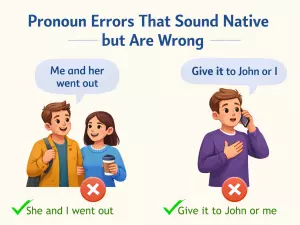
- Me and my friend went home. ❌ (object pronoun used as a subject) → My friend and I went home. ✅
- Excuse me, can you please sign this form, sir? You must do it now. ❌ (overusing “you” without clarifying who “you” refers to) → Excuse me, sir. Could you please sign this form now? ✅
- He hurt hisself while running. ❌ (nonstandard reflexive pronoun) → He hurt himself while running. ✅
- I saw the manager and the assistant. The said hello. ❌ (replacing a pronoun incorrectly) → I saw the manager and the assistant. They said hello. ✅
Practical strategies for self-checking
After drafting, review your text specifically for pronouns. Ask yourself:
- Is every pronoun clearly referring to a noun?
- Do the pronouns agree in number and gender with their referents?
- Are you using subject and object forms correctly?
- Have you used possessive pronouns where needed?
Reading your writing aloud can also help you notice unnatural pronoun choices that might sound fine in your first language but awkward in English.
Examples of interference patterns
Comparing typical errors caused by first language interference with the correct English forms can clarify what to watch for. Here’s a quick overview:
| Typical Error | Correct English Form |
|---|---|
| She love his dog. | She loves her dog. |
| Me go to school every day. | I go to school every day. |
| The book, he is on the table. | The book is on the table. |
| My brother, she is a doctor. | My brother, he is a doctor. |
| He gave the book to I. | He gave the book to me. |
| It’s color is blue. | Its color is blue. |
Paying attention to these common slip-ups and regularly reviewing your drafts with these patterns in mind can help you gradually reduce interference from your native language. Over time, this awareness leads to more accurate and natural pronoun usage in your English writing.
Correction strategies
Learners often carry over pronoun patterns from their native language, which can cause persistent mistakes in English. To address these issues, targeted techniques can help students notice, understand, and fix incorrect usage. Teachers and learners can benefit from a mix of explicit instruction, meaningful practice, and reflective activities.
Raising Awareness of Differences
Identifying how the first language differs from English in pronoun use is a useful first step. For instance, some languages do not distinguish gender in third-person pronouns, or they may omit pronouns altogether. Encouraging learners to compare typical errors with standard English forms helps build conscious awareness.
- Contrastive analysis exercises (comparing L1 and English sentences)
- Error analysis using real examples from students’ writing or speech
- Highlighting ambiguous or missing pronoun references in context
- Discussing common L1 transfer patterns in class
Targeted Practice Activities
Focused practice is essential for breaking old habits and building new ones. Activities should challenge learners to notice and correct pronoun mistakes in context.
- Pronoun substitution drills with increasing complexity
- Sentence rewriting to fix ambiguous or incorrect pronouns
- Short dialogues or stories where students identify and correct errors
- Peer-editing exercises with a checklist for pronoun forms
- Gap-fill exercises requiring correct pronoun insertion
- Role-play scenarios emphasizing gender and number agreement
- Visual aids showing pronoun-antecedent relationships
- Dictation with deliberate pronoun confusion for correction
- Games like “Pronoun Bingo” or “Pronoun Hunt” in reading texts
Explicit Explanation and Feedback
Clear rules and immediate feedback help reinforce correct forms. Teachers should provide direct explanations of English pronoun rules, especially where they differ from the learner’s first language.
- Mini-lessons on subject/object/reflexive pronoun forms
- Charts contrasting English and L1 pronoun systems
- Individualized feedback focusing on recurring pronoun mistakes
- Encouraging self-correction through guided questioning (e.g., “Who is ‘he’ here?”)
Common L1 Interference Patterns and English Corrections
Some pronoun errors are especially resistant to change because they reflect deep-seated L1 habits. The table below compares a few frequent patterns with their correct English forms.
| L1 Influence Example | Correct English Form |
|---|---|
| He go to school every day. (missing -s, L1 lacks subject-verb agreement) | He goes to school every day. |
| She love her mother. (L1 uses one form for all pronouns) | She loves her mother. |
| It is raining, but she forgot her umbrella. (“She” refers to an object, L1 uses gender for objects) | It is raining, but it is in the car. (“It” for objects) |
| My friend, they are here. (L1 allows plural pronoun for singular noun) | My friend, he/she is here. |
Encouraging Self-Monitoring
Building habits for self-correction is the ultimate goal. Learners can be trained to check their own writing and speaking for pronoun accuracy.
- Reading aloud and listening for pronoun consistency
- Using editing checklists before submitting work
- Recording and replaying spoken tasks to spot errors
- Pairing up for mutual correction in conversation practice
Combining these approaches—awareness, practice, explicit instruction, and self-monitoring—can gradually reduce errors caused by first language interference and help learners gain confidence in using English pronouns correctly.
Practice: identify L1-based errors
Recognizing errors that stem from first language (L1) interference is a crucial step for teachers and learners aiming to improve English pronoun use. In this section, you’ll find practical exercises and real-world examples to help develop your ability to spot and analyze mistakes rooted in L1 transfer. Pay attention to how native language structures can influence English pronoun selection, number, gender, and omission.
Common L1-Influenced Pronoun Mistakes
Below are typical errors learners might make due to the influence of their mother tongue. Consider why these mistakes occur and what L1 features might be causing them:
- Using "he" or "she" for objects (e.g., "The table is old. She is brown.")
- Omitting the subject pronoun (e.g., "Is raining today.")
- Confusing "his" and "her" (e.g., "Maria lost his book.")
- Overusing "it" for people (e.g., "My friend is nice. It helps me.")
- Mixing up "they" and "it" for collective nouns (e.g., "The team is strong. They wins.")
- Incorrect reflexive forms (e.g., "He enjoyed himselfs.")
- Direct translation of L1 structures (e.g., "Is for you the pen.")
- Using gender-neutral pronouns incorrectly (e.g., "Each student must bring their pencil. He must be ready.")
- Pronoun repetition (e.g., "My brother he is tall.")
- Missing object pronoun (e.g., "I saw yesterday.")
- Incorrect possessive pronoun (e.g., "This is mine book.")
- Using "it" for people from L1 influence (e.g., "My sister is sick. It is staying home.")
- Switching pronouns mid-sentence (e.g., "My mother is a doctor. He works at the hospital.")
- Pluralizing pronouns unnecessarily (e.g., "Theyselves went to the market.")
- Confusing "who" and "which" for people and things (e.g., "The man which called me.")
Spot the Error
Read each sentence below. Decide if the pronoun is used correctly. If not, identify the L1-based error.
- My friend is a teacher. She works at the school.
- The dog is hungry. He wants food.
- Is raining since morning.
- Maria is my sister. He likes music.
- The book is on the table. She is blue.
- I saw yesterday.
- Each student must bring his pencil. They must be sharp.
- The children enjoyed themselves at the park.
- My brother he is very tall.
- The team is strong. They wins every match.
Show answers
- Correct. No error.
- Correct in English, though some L1s may not assign gender to animals.
- Error: Subject pronoun omitted ("It is raining..."). Common in languages that drop subjects.
- Error: Gender mismatch due to L1 influence. Should be "She likes music."
- Error: Using "she" for object. Should be "It is blue."
- Error: Object pronoun missing. Should be "I saw him/her yesterday."
- Error: Inconsistent pronoun reference. Should be "Each student must bring his or her pencil. It must be sharp." or use singular "they" consistently.
- Correct. No error.
- Error: Pronoun repetition. Should be "My brother is very tall."
- Error: Pronoun/verb agreement influenced by L1. Should be "The team is strong. It wins every match."
Comparing L1 and English Pronoun Use
Some L1s have features that directly impact English pronoun patterns. Here’s a comparison of a few such features:
| Feature in L1 | Possible English Error | Example |
|---|---|---|
| No gender distinction in pronouns | Mixing up "he" and "she" | "My mother is a doctor. He works at the hospital." |
| Pronoun omission allowed | Dropping subjects in English | "Is raining today." |
| Objects assigned gender in L1 | Using "he/she" for things | "The table is old. She is brown." |
| Reflexive forms constructed differently | Incorrect English reflexives | "He enjoyed hisself." |
Reflection Task
Think about your own or your students’ first language. What pronoun patterns differ from English? Write down two examples of errors that could result from these differences.
Show answers
- Spanish L1: "Is raining" instead of "It is raining."
- Chinese L1: "He" and "she" confused, e.g., "My sister, he is kind."