How Reflexive Pronouns Work in Fixed and Idiomatic Expressions

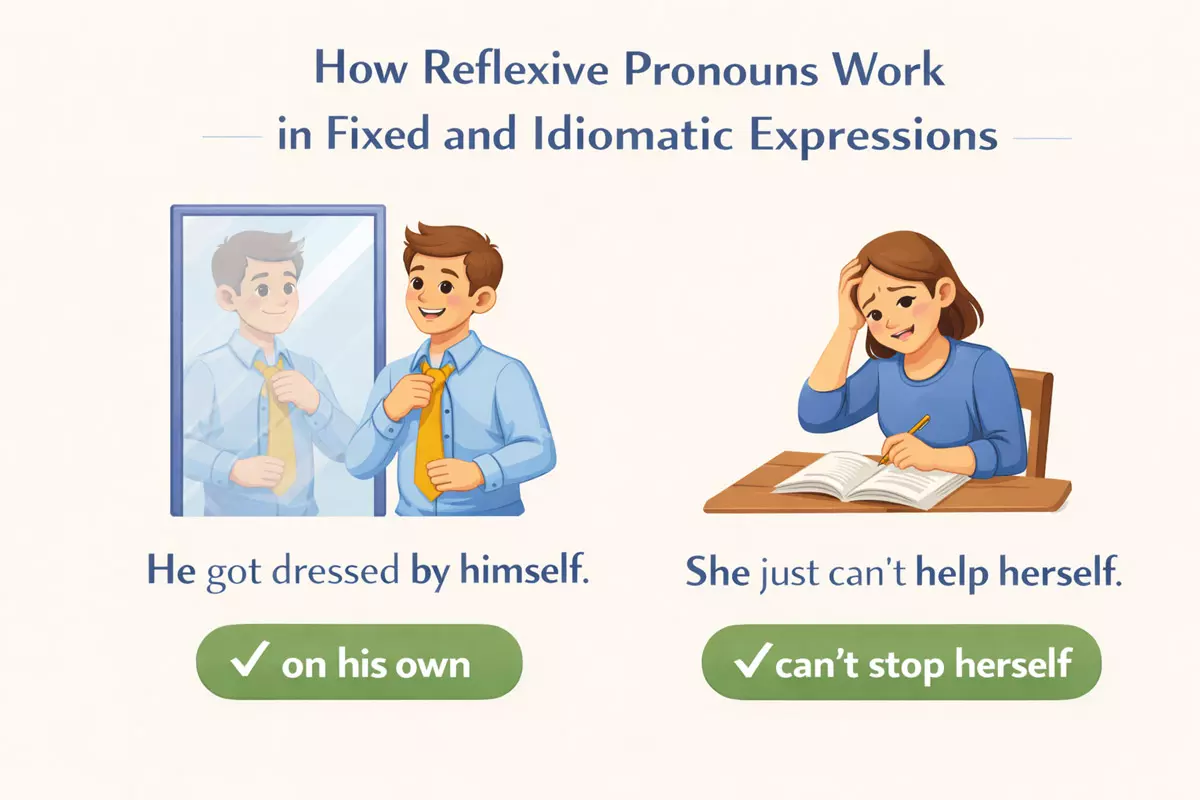 Here we why reflexive pronouns are used in fixed English expressions, lists common phrases, explains meaning changes if reflexives are omitted, contrasts reflexives for emphasis versus idioms, discusses register and learner errors, and offers learning tips.
- Why reflexives appear in fixed expressions
- Common expressions with yourself, myself, themselves
- Meaning loss when reflexives are removed
- Reflexives vs intensive emphasis
- Register differences in fixed phrases
- Common learner misuse
- Memorization vs rule-based learning
- Practice: complete fixed expressions correctly
Have you ever noticed that some English phrases feel incomplete without words like myself or themselves? These self-referential terms, known as reflexive pronouns, often appear in set phrases and common expressions, highlighting interesting quirks in how the English language functions. Their use can add emphasis, clarify meaning, or simply follow established patterns that have developed over time, illustrating the subtle ways language evolves and adapts to our communication needs.
Why reflexives appear in fixed expressions
Reflexive pronouns are often found in set phrases and idiomatic language because they add emphasis, clarity, or a particular nuance that would otherwise be missing. In many cases, these forms are not strictly necessary for the literal meaning, but have become established through usage, making the expressions sound natural or complete. Sometimes, using a reflexive in these contexts signals that the action is performed for the subject’s own benefit or without outside help.
Functions of reflexive pronouns in idioms and fixed phrases
- Emphasis: Highlighting that the subject is acting alone or independently (e.g., "by myself", "do it yourself").
- Idiomatic necessity: Completing expressions where omission of the pronoun would sound odd or change the meaning ("help yourself", "behave yourself").
- Distinction: Differentiating between literal and figurative meanings ("find yourself" can mean to discover your identity, not just to locate your body).
- Politeness or formality: Soften commands or make offers more courteous ("Make yourself at home").
- Self-reference: Indicating actions affecting only the subject, especially in emotional or psychological contexts ("talk to yourself", "convince yourself").
Common examples of fixed expressions with reflexives
Below are some frequent set phrases that use reflexive pronouns. While their literal meanings may be clear, their idiomatic usage often adds a special nuance.
- enjoy yourself → Enjoy yourself at the conference and make new connections.
- find yourself → She found herself reflecting on the decision later that evening.
- take care of yourself → Please take care of yourself during the recovery period.
- help yourself (to food or drink) → Help yourself to refreshments during the break.
- see for yourself → Review the data and see for yourself how the trend develops.
- behave yourself → He reminded the interns to behave themselves during the meeting.
- keep to yourself → She tends to keep to herself in unfamiliar professional settings.
- pull yourself together → He had to pull himself together before delivering the speech.
- introduce yourself → Please introduce yourself to the panel at the start.
- make a name for yourself → She made a name for herself in the field of data science.
- pride yourself on → The organization prides itself on ethical research practices.
- remind yourself → It is important to remind yourself of the long-term objectives.
- convince yourself → He convinced himself that the revision was necessary.
- blame yourself → Do not blame yourself for circumstances beyond your control.
- lose yourself (in something) → She lost herself in the analysis of the results.
- express yourself → The course encourages students to express themselves clearly.
- dress yourself → The child is learning to dress himself independently.
- defend yourself → Participants must be able to defend themselves against criticism.
- by yourself (alone) → The task must be completed by yourself, without assistance.
- do it yourself (DIY) → The guide explains how to do it yourself safely.
How reflexives change meaning in set phrases
The presence of a reflexive pronoun often shifts an expression’s meaning from a simple action to one involving self-interest, independence, or internal experience. For example, “help yourself” differs from “help you” by focusing on the listener’s own action, not assistance from another. Similarly, “find yourself” typically refers to self-discovery, not simply being found.
| Expression | Effect of Reflexive |
|---|---|
| Pull yourself together | Encourages regaining self-control independently |
| Keep to yourself | Means to remain private or not share personal matters |
| See for yourself | Invites direct personal verification |
| Introduce yourself | Requires the subject to present their own identity |
| Enjoy yourself | Emphasizes personal enjoyment, not enjoyment of others |
Ultimately, reflexive pronouns in fixed expressions are less about strict grammar and more about convention, emphasis, and subtle meaning shifts. Recognizing these patterns helps learners sound more natural and understand the deeper intent behind common phrases.
Common expressions with yourself, myself, themselves
Reflexive pronouns such as yourself, myself, and themselves often appear in fixed phrases and idiomatic expressions that don’t always translate literally. Many of these constructions have become so common that their meanings are instantly recognized by native speakers, even when the logic isn’t obvious. Understanding these expressions will help you sound more natural and interpret everyday conversation with ease.
Frequently Used Idiomatic Phrases
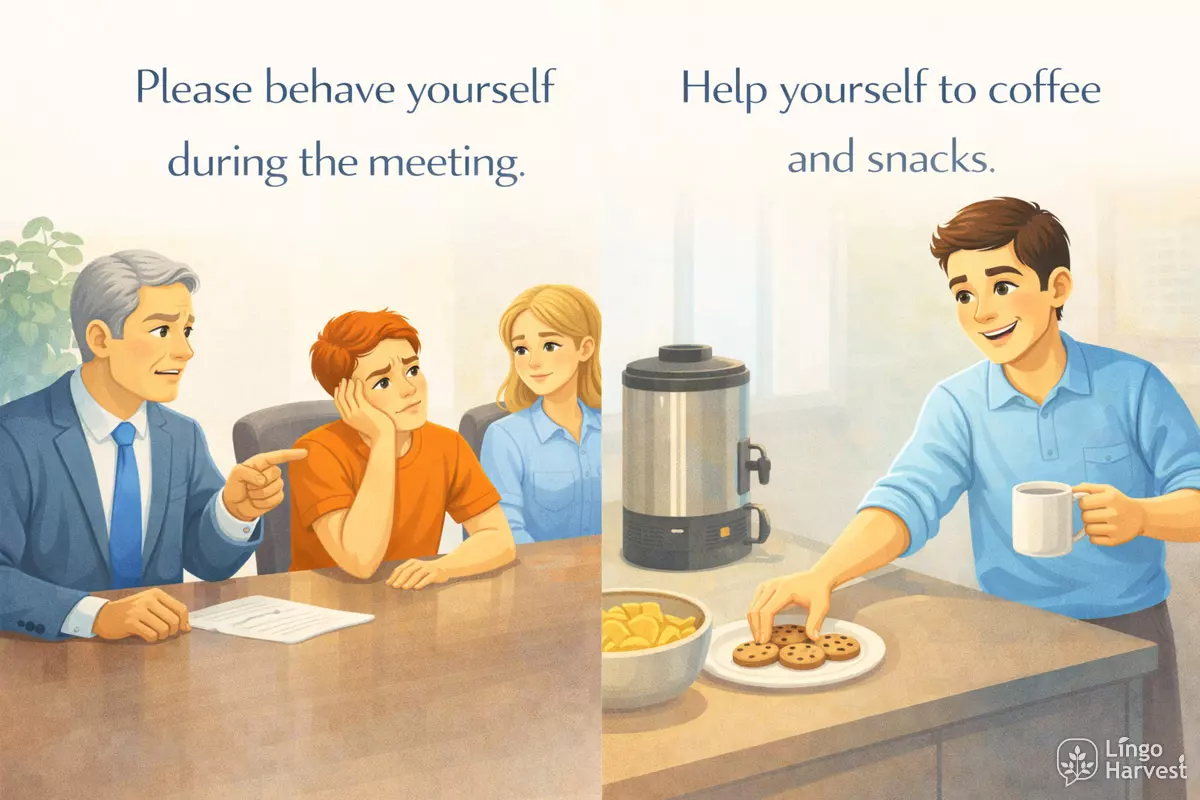
Here are some widely used idioms and set phrases that rely on reflexive pronouns. Each item includes a quick meaning and a natural example.
- Behave yourself – Act properly; follow the rules. → Please behave yourself during the meeting.
- Help yourself – Take what you want (usually food or drink). → Help yourself to coffee and snacks.
- Enjoy yourself – Have a good time. → Enjoy yourself at the event.
- Make yourself at home – Relax as if you were in your own house. → Make yourself at home while you wait.
- See for yourself – Check personally; verify something independently. → Review the results and see for yourself.
- By myself / By yourself / By themselves – Alone; without assistance. → She completed the task by herself.
- Blame yourself – Take responsibility for something negative. → Do not blame yourself for the delay.
- Find yourself – Discover your identity or purpose, often after reflection. → He moved abroad to find himself.
- Express yourself – Share your thoughts or feelings openly. → The course helps students express themselves clearly.
- Remind myself/themselves – Prompt oneself or others to remember. → I reminded myself to submit the form.
- Convince yourself – Persuade yourself of something. → She convinced herself that the plan would work.
- Keep to yourself – Remain private; not share personal matters. → He tends to keep to himself at work.
- Talk to yourself – Speak aloud when alone, often while thinking. → He was talking to himself while solving the problem.
- Introduce yourself – Present your name and basic info to someone new. → Please introduce yourself to the group.
- Pride yourself on – Take satisfaction in a trait or achievement. → The team prides itself on accuracy.
- Teach yourself – Learn independently, without a teacher. → She taught herself basic programming.
- Lose yourself (in something) – Become deeply absorbed in an activity. → He lost himself in the research.
- Help themselves (to something) – Take something without asking (sometimes negative). → Some guests helped themselves to extra supplies.
- Be beside yourself (with emotion) – Overwhelmed by a strong feeling. → She was beside herself with worry.
Comparing Usage and Meaning
Some of these structures have subtle distinctions or are used differently in specific contexts. The table below highlights a few of the most frequent patterns:
| Expression | Typical Meaning |
|---|---|
| Help yourself | Inviting someone to take what they want (often food or drink) |
| By myself / By yourself / By themselves | Doing something alone, without help |
| Behave yourself | Instruction to act properly or politely |
| See for yourself | Encouragement to verify or experience something firsthand |
Learning these expressions helps you understand how reflexive pronouns often carry special meanings in English, going beyond their basic grammatical role. With practice, you’ll recognize and use them naturally in conversation.
Meaning loss when reflexives are removed
Reflexive pronouns play a crucial role in certain fixed and idiomatic expressions. Removing them doesn't merely alter the structure—it can erase or distort the intended meaning. In many set phrases, the reflexive is integral: it signals emphasis, self-involvement, or a specific nuance that disappears if you drop it.
How Removing Reflexives Changes Meaning
In many idioms, removing the reflexive pronoun changes the meaning, removes the idiomatic sense, or makes the phrase incomplete. Compare the pairs below.
- Help yourself (take what you want) vs. Help (assist someone else) → Help yourself to tea. vs. Help your guest with the bags.
- Enjoy yourself (have a good time) vs. Enjoy (needs an object) → Enjoy yourself tonight. vs. Enjoy the concert.
- Introduce yourself (present your identity) vs. Introduce (introduce someone/something) → Introduce yourself to the panel. vs. Introduce your colleague to the panel.
- Make yourself at home (idiom: relax) vs. Make at home (not idiomatic) → Make yourself at home. vs. Make at home
- See for yourself (verify personally) vs. See (just notice/observe) → Check the file and see for yourself. vs. I see the problem.
- Blame yourself (self-blame) vs. Blame (blame someone/something else) → Do not blame yourself. vs. Do not blame the team.
- Remind yourself (prompt your own memory) vs. Remind (prompt someone else) → Remind yourself to call. vs. Remind him to call.
- Find yourself (identity/purpose) vs. Find (locate something) → She traveled to find herself. vs. She found her passport.
Consequences for idiomatic meaning
When reflexives are omitted in these set expressions, the listener may be confused or interpret the phrase literally, stripping away the idiomatic flavor. This can cause misunderstandings or make the statement sound unnatural. For learners and even native speakers, recognizing where reflexives are essential helps maintain clear and effective communication.
| Expression with Reflexive | Without Reflexive |
|---|---|
| Help yourself ✅ (take what you want) | Help ❌ (unclear or a command) |
| Behave yourself ✅ (act properly) | Behave ❌ (less specific, incomplete) |
| Suit yourself ✅ (do as you wish) | Suit ❌ (fit, match—different meaning) |
| See for yourself ✅ (check personally) | See ❌ (observe, lacks emphasis) |
In summary, reflexive pronouns are not just optional add-ons in these fixed expressions—they are often the key to their real meaning. Their removal usually results in ambiguity, a complete loss of intent, or a shift to a different standard meaning.
Reflexives vs intensive emphasis
English reflexive pronouns like myself, yourself, and themselves serve two main functions: they can either reflect the action back onto the subject (true reflexive use), or add extra stress for emphasis (intensive use). Recognizing which function is in play helps make sense of fixed and idiomatic expressions where these words appear.
How reflexive pronouns show action
In reflexive constructions, the subject and object are the same. This is common in sentences such as:
- She taught herself to play piano.
- They blamed themselves for the mistake.
- I hurt myself while cooking.
Here, the reflexive pronoun is required because the action loops back to the subject.
Intensive pronouns for extra focus
Sometimes, a pronoun like myself or himself doesn’t refer back to the subject out of necessity, but rather adds emphasis. This is known as the intensive use. Removing the pronoun doesn’t change the meaning, but it does soften the emphasis:
- The manager himself approved the budget.
- I baked this cake myself.
- The children cleaned their room themselves.
Comparing reflexive and intensive roles
It’s easy to confuse these two uses, especially in idiomatic or set phrases. Here’s a side-by-side comparison to clarify:
| Reflexive Use (action returns to subject) |
Intensive Use (adds emphasis only) |
|---|---|
| He introduced himself at the meeting. → He did the introducing, and he was introduced. |
He himself introduced the speaker. → Emphasizes that he, not someone else, did it. |
| She prepared herself for the exam. → She did the preparing, for her own benefit. |
She herself answered the phone. → Stresses that she, personally, took the call. |
| We found ourselves lost in the city. → We became lost; the result came back to us. |
We ourselves witnessed the event. → Highlights that it was us, not others, who saw it. |
| You should treat yourself kindly. → The action is directed back to you. |
You yourself said it. → Emphasis on who made the statement. |
Tips for telling them apart
- If removing the pronoun changes the meaning or leaves the sentence ungrammatical, it’s reflexive.
- If the sentence still works without it, but loses emphasis, it’s intensive.
- Intensive forms often appear right after the noun or pronoun they highlight.
- Reflexive forms are needed as objects when the subject and object are the same person or thing.
Understanding these distinctions is key for interpreting and using idiomatic expressions correctly, as some phrases rely on reflexive structure while others simply use the form for emphasis.
Register differences in fixed phrases
Fixed and idiomatic expressions that use reflexive pronouns often shift in formality depending on the context, region, or audience. Some expressions feel at home in casual speech, while others are reserved for more formal or literary settings. Recognizing these differences helps you choose the right phrase for the situation and avoid sounding out of place.
Formal vs. informal reflexive idioms
Certain reflexive constructions belong almost exclusively to formal writing or speech. For example, “avail oneself of” is standard in legal or academic English, but would sound stiff in a friendly conversation. By contrast, phrases like “help yourself” or “behave yourself” are much more common in everyday language. The level of formality can change the tone of your message and affect how your words are received.
Common reflexive fixed phrases by register
Here are examples of fixed expressions with reflexive pronouns, grouped by their typical register:
- Informal: “Enjoy yourself,” “Suit yourself,” “Help yourself,” “Behave yourself,” “Control yourself,” “Take care of yourself,” “Make yourself at home,” “Pull yourself together,” “See for yourself,” “Find yourself (doing something),” “Get yourself into trouble,” “Lose yourself (in something),” “Treat yourself,” “Knock yourself out,” “Keep yourself busy”
- Formal: “Avail oneself of,” “Apply oneself (to),” “Compose oneself,” “Present oneself,” “Acquit oneself well,” “Absorb oneself in,” “Conduct oneself,” “Betray oneself,” “Express oneself,” “Perjure oneself”
Many of these expressions also carry regional or generational nuances. For instance, “compose oneself” may be more common in British English or among older speakers, while “treat yourself” is widely used in contemporary American English.
Comparing register in reflexive idioms
Some phrases have near-equivalents with different levels of formality. Compare these pairs:
| Informal Expression | More Formal Equivalent |
|---|---|
| “Help yourself” | “Avail yourself of” |
| “Calm yourself down” | “Compose oneself” |
| “Show yourself” | “Present oneself” |
| “Do it yourself” | “Undertake it oneself” |
| “Get yourself together” | “Collect oneself” |
Choosing between these options depends on the setting and your relationship with the listener or reader. Using a formal phrase in a relaxed environment can sound awkward, while an informal one in a professional context may seem disrespectful or too casual.
When register matters
If you’re unsure which expression fits, consider the audience, the medium (spoken or written), and the purpose. For example, in a business email, “compose oneself” or “present oneself” would be safer than “get yourself together” or “show yourself.” In contrast, among friends, direct and informal language is almost always preferred.
Understanding these subtle differences in set phrases not only improves your fluency but also helps you communicate with just the right tone for every occasion.
Common learner misuse
Misunderstandings often arise when using reflexive pronouns in set phrases or idiomatic contexts. Many learners assume that reflexives always refer back to the subject or can be freely added for emphasis, but fixed expressions often break these patterns. This leads to errors that can sound odd or even change the meaning of a sentence.
Overusing reflexives in idioms
Learners sometimes insert reflexive pronouns where native speakers would not. For example, in English, we say “enjoy yourself,” but not “relax yourself” (the correct form is just “relax”). In other languages, the rules differ, which can lead to direct translation errors.
Confusing reflexive and non-reflexive forms
It’s common to mix up when a reflexive is required versus when it’s incorrect or changes the meaning. For example, “help yourself” is a fixed phrase meaning “take what you want,” but “help yourself to the project” does not mean to work on the project—it’s not idiomatic.
Frequent mistakes and confusing patterns

- Using a reflexive pronoun with verbs that aren’t reflexive in the target language (e.g., “meet myself” instead of “meet someone”).
- Dropping the reflexive where it’s required (e.g., “behave” instead of “behave yourself”).
- Directly translating idiomatic reflexive expressions from one language to another, leading to unnatural phrasing.
- Assuming all verbs can be made reflexive for emphasis (“I’ll do it myself” is correct, but “I’ll eat myself” is not).
- Using reflexives with passive constructions (“It was done by myself” instead of “I did it myself” or “It was done by me”).
- Inserting reflexives into fixed expressions that do not allow them (“make yourself a coffee” is fine, but “make yourself a homework” is incorrect).
- Confusing “by myself” (alone) with “myself” (reflexive or emphatic).
- Translating “se” constructions from languages like Spanish or French into English incorrectly (“It washes itself” instead of “It can be washed”).
- Using reflexives with intransitive verbs (“arrive myself” instead of “arrive”).
- Overusing “myself/yourself” for emphasis, making speech sound unnatural.
| Incorrect Usage | Correct Idiomatic Expression |
|---|---|
| I enjoyed myself the party. | I enjoyed the party. / I had a good time at the party. |
| I’ll see myself you tomorrow. | I’ll see you tomorrow. |
| She introduced myself to the group. | She introduced herself to the group. |
| I made myself a homework. | I did my homework myself. / I did my own homework. |
| He explained the problem himself to me. | He explained the problem to me himself. |
| Relax yourself! | Relax! |
| I cut me with a knife. | I cut myself with a knife. |
| It was done by myself. | I did it myself. / It was done by me. |
| Help to yourself. | Help yourself. |
| I can take care myself. | I can take care of myself. |
Why these mistakes happen
Learners often apply rules from their native languages, or misapply general patterns of reflexive usage. Fixed expressions and idioms, however, rarely follow predictable rules. Practice and exposure to authentic examples are the best ways to internalize correct patterns. When in doubt, check a reliable reference or ask a native speaker, especially for set phrases and idiomatic uses.
Memorization vs rule-based learning
When it comes to reflexive pronouns in fixed and idiomatic expressions, learners often wonder whether to rely on remembering whole phrases or try to apply general grammatical principles. The answer is nuanced: while some reflexive constructions follow predictable patterns, many idiomatic uses must simply be learned as set chunks because they defy standard rules.
When rules help
In many standard sentences, reflexive pronouns follow clear logic: the subject and object are the same person or thing. For example, "She introduced herself" or "We blamed ourselves" can be understood by applying the rule that reflexives refer back to the subject. This makes such sentences easier to generate and understand with a rule-based approach.
- He hurt himself. ✅
- They prepared themselves. ✅
- You can help yourself. ✅
When memorization is required
However, fixed expressions and idioms often break these expectations. For example, "by itself" means "alone," regardless of the subject, and "keep to yourself" doesn't literally involve keeping something physically. These must be memorized, since their meanings are not transparent from the grammar alone. Trying to construct such idioms with rules leads to errors.
- by myself/yourself ("alone")
- behave yourself ("act properly")
- find yourself ("realize you are in a situation")
- help yourself ("take freely")
- keep to yourself ("avoid sharing")
- come to yourself ("recover awareness")
- enjoy yourself ("have fun")
- pride yourself on ("take pride in")
- see for yourself ("check personally")
- make yourself at home ("feel comfortable")
- be beside yourself ("be extremely upset")
- cut yourself off ("isolate")
- convince yourself ("persuade oneself")
- remind yourself ("remember to do")
- take care of yourself ("look after yourself")
- talk to yourself ("speak aloud to oneself")
- lose yourself in ("become absorbed")
Comparison: Rule-based vs. Idiomatic Reflexive Use
| Rule-based Example | Idiomatic/Fixed Example |
|---|---|
| She introduced herself (subject = object) | Help yourself (means "take some") |
| We blamed ourselves (reflexive = subject) | By yourself (means "alone") |
| They protected themselves (follows standard rule) | Make yourself at home (means "feel comfortable") |
| I taught myself (subject does the action to self) | Be beside yourself (means "be very upset") |
Ultimately, fixed and idiomatic expressions with reflexive pronouns often resist systematic explanation. While knowing the core rules is essential, building a repertoire of common idioms comes from exposure and memorization. Successful learners blend both approaches: applying rules where possible, but also recognizing when a phrase must be learned as a whole.
Practice: complete fixed expressions correctly
Mastering fixed and idiomatic expressions with reflexive pronouns is crucial for natural English. These expressions often have set forms, so it’s important to use the correct pronoun and word order. Below, you’ll find exercises and examples to help you recognize and use these structures accurately.
Common Reflexive Expressions to Complete
Try completing these expressions with the correct reflexive pronoun. Remember, some idioms only work with certain reflexives, and others are used for all persons.
- He found __________ in a difficult situation.
- They did it all by __________.
- She made __________ at home.
- We enjoyed __________ at the party.
- Sometimes you have to stand up for __________.
- I taught __________ to play the guitar.
- The cat cleaned __________ after eating.
- Help __________ to more coffee.
- You should introduce __________ to the new manager.
- The kids behaved __________ very well today.
- He prides __________ on his punctuality.
- They blamed __________ for the mistake.
- She hurt __________ while jogging.
- We convinced __________ it was a good idea.
- You must express __________ clearly in the interview.
Show answers
- himself
- themselves
- herself
- ourselves
- yourself
- myself
- itself
- yourself
- yourself
- themselves
- himself
- themselves
- herself
- ourselves
- yourself
Recognizing Fixed and Idiomatic Patterns
Some expressions always use reflexive pronouns with specific verbs or prepositions. Here’s an expanded list of typical patterns to remember:
- by myself/yourself/etc. (alone, without help) → She completed the assignment by herself.
- pride oneself on (be proud of) → The organization prides itself on transparency.
- find oneself (realize one’s situation) → He found himself in a difficult position.
- enjoy oneself (have fun) → They enjoyed themselves at the reception.
- help yourself (take freely) → Help yourself to coffee and snacks.
- teach oneself (learn without a teacher) → She taught herself basic programming.
- blame oneself (feel responsible) → Do not blame yourself for the mistake.
- introduce yourself (say who you are) → Please introduce yourself to the group.
- convince oneself (persuade oneself) → She convinced herself that the plan was realistic.
- behave oneself (act properly) → He reminded the students to behave themselves.
- express yourself (communicate clearly) → The course helps learners express themselves clearly.
- hurt oneself (be injured) → He hurt himself while lifting the box.
- make oneself at home (relax as if at home) → Make yourself at home while you wait.
- stand up for yourself (defend your rights) → You should stand up for yourself when treated unfairly.
- clean oneself (wash or groom) → The patient was unable to clean himself without assistance.
Subtle Differences: "By Myself" vs. "Myself"
Some expressions change meaning with or without "by." Compare these examples:
| Phrase | Meaning |
|---|---|
| I did it myself. | I (not someone else) did it. |
| I did it by myself. | I did it alone, with no help. |
| She introduced herself. | She said her own name (to someone). |
| He found himself in trouble. | He realized he was in a bad situation. |
Quick Quiz: Choose the Correct Reflexive Form
Pick the right reflexive pronoun for each sentence.
- Did you make this cake __________?
- We can handle it __________.
- The dog hurt __________ jumping off the sofa.
- She prides __________ on her cooking.
- I reminded __________ to lock the door.
- They introduced __________ at the meeting.
- He found __________ in a difficult situation.
- The children enjoyed __________ at the party.
- You should take care of __________ during the trip.
- The company prides __________ on quality service.
Show answers
- yourself
- ourselves
- itself
- herself
- myself
- themselves
- himself
- themselves
- yourself
- itself
Practicing these expressions will help you sound more fluent and avoid common mistakes with reflexive pronouns in English. Review the patterns above, and try making your own examples for extra reinforcement.