Reflexive Verbs and Reflexive Pronouns in English

 Learn what reflexive pronouns are, which verbs need them, and common reflexive verb patterns. See how they add emphasis, compare reflexive vs non-reflexive meanings, fix typical mistakes, hear how they sound in speech, and do homework practice tasks.
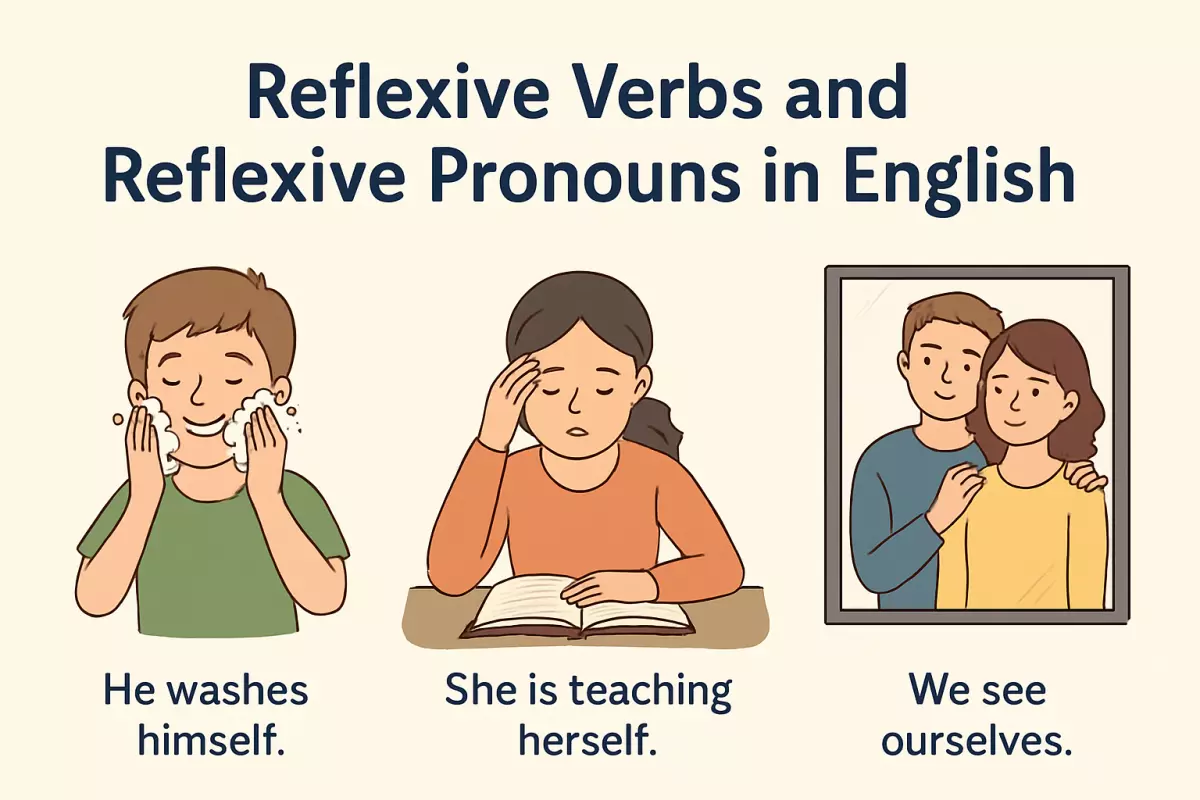
Reflexive pronouns like myself and herself explain actions that come back to the same person, as in I taught myself or She blamed herself. They help you describe routines, learning, and mistakes clearly and naturally, showing that the subject is both the doer and the receiver. Knowing when to use them can make everyday English sound smoother and more precise in conversation and writing.
What reflexive pronouns are
These pronouns point back to the subject of the clause. They are used when the person or thing doing the action is also the one affected by it, or when the speaker wants to add emphasis (for example, “I did it myself”).
| Subject pronoun | Reflexive form |
|---|---|
| I | myself |
| you (singular) | yourself |
| he | himself |
| she | herself |
| it | itself |
| we | ourselves |
| you (plural) | yourselves |
| they | themselves |
Core pattern: subject and object are the same
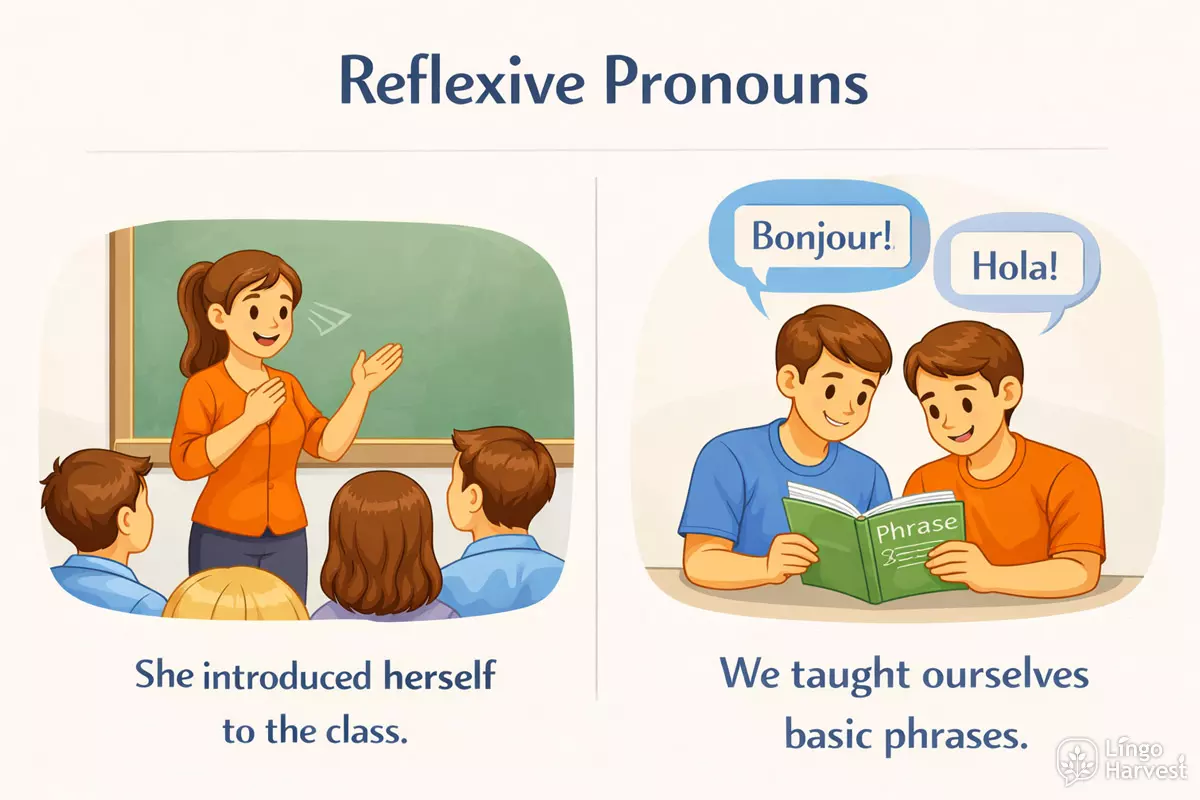
The most common use is when the verb’s object refers to the same person or group as the subject. In other words: Subject → verb → reflexive form. This is especially frequent with actions people can do to their own body, mind, or possessions.
- ✅ I hurt myself on the door.
- ✅ She introduced herself to the class.
- ✅ We taught ourselves basic phrases.
- ✅ They prepared themselves for the test.
- ✅ He blamed himself for the mistake.
- ✅ You should pace yourself during the race.
- ✅ The cat cleaned itself after eating.
- ✅ I found myself thinking about it again.
- ✅ She promised herself to be more patient.
- ✅ We reminded ourselves to lock the door.
- ✅ They defended themselves in court.
- ✅ He cut himself while cooking.
Emphasis: “by myself / ourselves” and “I did it myself”
These forms can also add emphasis, showing that the subject acted alone or personally. In this meaning, the pronoun often feels optional, but it changes the focus of the sentence.
- ✅ I fixed the bike myself. (no help; personal effort)
- ✅ She spoke to the manager herself. (not through someone else)
- ✅ We built it ourselves. (not hired out)
- ✅ They finished the project themselves. (without assistance)
- ✅ He went to the appointment by himself. (alone)
- ✅ The children got dressed by themselves. (independently)
Common usage limits (to avoid unnatural sentences)
English does not use these forms as widely as some languages do. Many everyday actions are expressed without them unless there is contrast, emphasis, or a real risk of confusion.
- ❌ I washed myself. → ✅ I washed. (use the longer form mainly for emphasis or contrast)
- ❌ He sat himself down. → ✅ He sat down. (unless you want a deliberate, forceful tone)
- ❌ She relaxed herself. → ✅ She relaxed. (the reflexive version can sound awkward)
- ✅ Use the reflexive form when it clarifies meaning: “He shot himself” (not someone else).
A practical check: if you can replace the pronoun with “him/her/them” and it would refer to a different person, then the reflexive form is doing real work to show the subject and object are the same.
When verbs require reflexive pronouns
Some English verbs and verb patterns sound incomplete or unnatural unless the subject “acts back” on itself. In these cases, the reflexive pronoun is not just optional emphasis; it is part of the normal structure, especially in set phrases, formal instructions, and fixed collocations.
1) Verbs used for self-directed actions (common in careful or formal English)
These verbs can take an object, and when the object is the same person as the subject, English often prefers a reflexive pronoun to make that relationship explicit.
- absent oneself: “She absented herself from the meeting.”
- avail oneself (of): “You may avail yourself of the library resources.”
- busy oneself (with): “He busied himself with paperwork.”
- compose oneself: “Please compose yourself before speaking.”
- content oneself (with): “They contented themselves with a simple meal.”
- distance oneself (from): “The company distanced itself from the comments.”
- excuse oneself: “I’ll excuse myself for a moment.”
- exert oneself: “Don’t exert yourself too much.”
- ingratiate oneself (with): “He tried to ingratiate himself with the team.”
- perjure oneself: “A witness must not perjure himself.”
- pride oneself (on): “She prides herself on punctuality.”
- reconcile oneself (to): “He reconciled himself to the decision.”
- refresh oneself: “You can refresh yourself after the trip.”
- regain/collect oneself: “She collected herself and continued.”
2) Fixed phrases where the reflexive is essentially required
In the expressions below, dropping the reflexive usually changes the meaning or produces a sentence that sounds wrong in standard usage.
- help yourself (to) ✅ “Help yourself to some tea.” ❌ “Help to some tea.”
- make yourself at home ✅ “Make yourself at home.”
- make yourself heard/understood/clear ✅ “Speak up so you can make yourself heard.”
- behave yourself ✅ “Behave yourself during the ceremony.”
- enjoy yourself ✅ “Enjoy yourself at the party.”
- apply yourself (to) ✅ “Apply yourself to the task.”
- commit yourself (to) ✅ “He committed himself to the project.”
- introduce yourself ✅ “Please introduce yourself to the group.”
- express yourself ✅ “It’s important to express yourself clearly.”
- assert yourself ✅ “She learned to assert herself at work.”
- repeat yourself ✅ “Could you repeat yourself?”
- find yourself (doing/in) ✅ “You may find yourself agreeing.”
3) Patterns that signal “subject = object”
Look for these cues. They often predict that a reflexive pronoun is the natural object.
- Verb + oneself + preposition (formal): “He acquitted himself of his duties.”
- Verb + oneself + adjective/past participle: “She made herself available.” / “He made himself known.”
- Verb + oneself + to-infinitive: “She forced herself to concentrate.”
- Verb + oneself + into/out of: “He talked himself into going.” / “She worked herself out of a job.”
- Instructional imperatives: “Brace yourself.” “Prepare yourself.” “Make yourself comfortable.”
4) Common learner pitfall: using a reflexive where English prefers a normal object
English does not use reflexives as broadly as some other languages. Use them when the verb pattern expects “self,” not just because the subject and object happen to match.
- ❌ “He washed himself the car.” → ✅ “He washed the car.”
- ❌ “She explained herself the rules.” → ✅ “She explained the rules.”
- ❌ “I met myself with the manager.” → ✅ “I met the manager.”
- ❌ “We discussed ourselves the plan.” → ✅ “We discussed the plan.”
Common reflexive verb patterns
English uses reflexive pronouns in a few recurring ways. The key is to notice when the subject and object refer to the same person or thing, and when the pronoun is added for emphasis rather than necessity.
1) Verb + reflexive pronoun (same person does the action and receives it)
This is the most direct use: the action “comes back” to the subject. It is common with actions people can do to their own bodies, appearance, or behavior.
- wash yourself / wash myself / wash ourselves
- dress yourself (He dressed himself quickly.)
- shave yourself (He shaved himself before work.)
- dry yourself (Dry yourself with this towel.)
- hurt yourself (Be careful not to hurt yourself.)
- cut yourself (I cut myself while cooking.)
- burn yourself (Don’t burn yourself on the pan.)
- introduce yourself (Please introduce yourself to the group.)
- prepare yourself (Prepare yourself for questions.)
- teach yourself (She taught herself to code.)
- help yourself (Help yourself to some water.)
- blame yourself (Don’t blame yourself for the delay.)
In many everyday situations, English often drops the reflexive pronoun when the meaning is obvious: “He shaved” and “He shaved himself” can both be correct. Adding the pronoun can make the meaning more explicit or contrastive.
2) Verb + reflexive pronoun for emphasis (not required for grammar)
Sometimes the pronoun does not show “object = subject,” but instead highlights who did something or that no one else helped. This often overlaps with by myself/yourself (meaning “alone”).
- I made it myself. (emphasis: I did it, not someone else)
- She fixed the bike herself. (she did the work personally)
- We saw it ourselves. (first-hand experience)
- He spoke to the manager himself. (not through someone else)
- They built the shelves themselves. (no outside help)
- I’ll do it myself. (often implies “so you don’t have to” or “since no one else will”)
- She lives by herself. (alone)
- He learned by himself. (independently)
Placement matters: “I myself” is possible but sounds more formal; “I did it myself” is the common choice in neutral speech.
3) “Get” + reflexive pronoun (change of state, often informal)
With get, the reflexive pronoun can show that the subject caused a change to themselves, sometimes intentionally, sometimes accidentally. This pattern is more common in informal English.
- get yourself ready → prepare
- get yourself dressed → put on clothes
- get yourself organized → become organized
- get yourself into trouble → cause problems for yourself
- get yourself hurt → be injured because of your actions
- get yourself lost → become lost (often by mistake)
4) Verb + reflexive pronoun + preposition (common fixed combinations)
Many natural-sounding combinations use a preposition after the reflexive pronoun. These are often idiomatic, so learning them as chunks helps.
- pride yourself on (She prides herself on being punctual.)
- busy yourself with (He busied himself with paperwork.)
- apply yourself to (Apply yourself to the task.)
- commit yourself to (They committed themselves to the project.)
- throw yourself into (She threw herself into her studies.)
- see yourself as (Do you see yourself as a leader?)
- distinguish yourself from (He distinguished himself from the competition.)
- talk to yourself (I sometimes talk to myself when I’m thinking.)
- keep to yourself (He keeps to himself at parties.)
- take care of yourself (Take care of yourself.)
5) Common non-reflexive alternatives (when English usually avoids the reflexive)
Some verbs that are reflexive in other languages are typically non-reflexive in English. Using a reflexive pronoun here can sound unnatural unless you are adding special emphasis.
- ✅ He feels tired. ❌ He feels himself tired.
- ✅ She relaxed after work. ❌ She relaxed herself after work. (possible, but unusual)
- ✅ They met at noon. ❌ They met themselves at noon.
- ✅ I remember his name. ❌ I remember myself his name.
- ✅ She sat down. ❌ She sat herself down. (only in specific contexts, often when directing someone)
When you are unsure, check the meaning: if the verb already describes an internal state or a natural intransitive action, English often does not need a reflexive pronoun.
Emphatic use of reflexive pronouns
Reflexive pronouns can be used for emphasis rather than to show that the subject and object are the same person. In this role, they highlight who did something, often meaning “and not anyone else,” “personally,” or “without help.” They do not function as the object of the verb; instead, they add extra focus to a noun or pronoun already in the clause.
Core pattern and placement
The most common structure is: subject + reflexive pronoun or noun/pronoun + reflexive pronoun. Position affects what sounds natural, but the meaning stays similar.
- After the subject (common in speech): “I myself checked the figures.”
- After the object or at the end (often more formal): “I checked the figures myself.”
- After a noun it modifies: “The manager himself replied.”
- With emphasis on contrast (often with “not” or implied contrast): “She wrote the code herself (not her assistant).”
Meaning: “personally” vs “without help”
Emphasising reflexives often carry one of two practical meanings. Context usually makes the intended meaning clear.
- Personally / in person: “The CEO himself called.” (It was surprising or important that he did it.)
- Without help: “They built the shelves themselves.” (No one helped them.)
- Both meanings possible: “I’ll speak to her myself.” (I will do it personally; I won’t delegate.)
Common usage patterns (with examples)
- “I’ll do it myself.” ✅ (I will do it; no help / no delegation.)
- “She fixed the problem herself.” ✅
- “We prepared everything ourselves.” ✅
- “The author himself signed my copy.” ✅ (focus on who did it)
- “The children themselves chose the rules.” ✅
- “You yourself said it was urgent.” ✅ (points back to the listener’s words)
- “I saw it myself.” ✅ (stronger than “I saw it”; speaker as direct witness)
- “They can decide for themselves.” ✅ (independently; no outside control)
- “The machine itself isn’t dangerous.” ✅ (contrast with something around it)
- “The door opened itself.” ✅ (by itself; no agent mentioned)
- “The team itself is strong, but the schedule is tough.” ✅ (contrastive focus)
- “The president herself attended the meeting.” ✅ (unexpectedly high-level)
- “I want to hear it from you yourself.” ✅ (directly from you)
- “He learned to cook himself.” ✅ (without help; self-taught)
- “We’ll handle the complaint ourselves.” ✅ (no outsourcing)
Common mistakes to avoid
- ❌ Using an emphasising reflexive where an object is required: “She introduced herself the manager.” → ✅ “She introduced herself to the manager.”
- ❌ Doubling the subject unnecessarily: “Myself will call you.” → ✅ “I will call you myself.”
- ❌ Confusing emphasis with true reflexive meaning: “He hurt himself” (reflexive object: he injured his own body) is different from “He did it himself” (emphasis: no help / personally).
Reflexive vs non-reflexive meanings
Some verbs can be used in two different ways: with a reflexive pronoun to show the subject and object are the same person, or without it to show the action is directed at someone or something else. The choice changes who receives the action, and sometimes it also changes the meaning of the verb.
How the meaning changes
- Reflexive use: the subject does something to the subject (I → me). It often answers “to whom?” with “to myself/yourself/etc.”
- Non-reflexive use: the subject does something to another person/thing (I → him/them/it) or the verb is intransitive (no object).
- Common signal: if you can replace the object with “someone else” and the sentence still makes sense, the reflexive form is a real choice, not just decoration.
- Meaning shift: with some verbs, adding the reflexive pronoun creates an idiomatic meaning (for example, “help yourself” means “take what you want”).
Side-by-side examples (what changes and why)
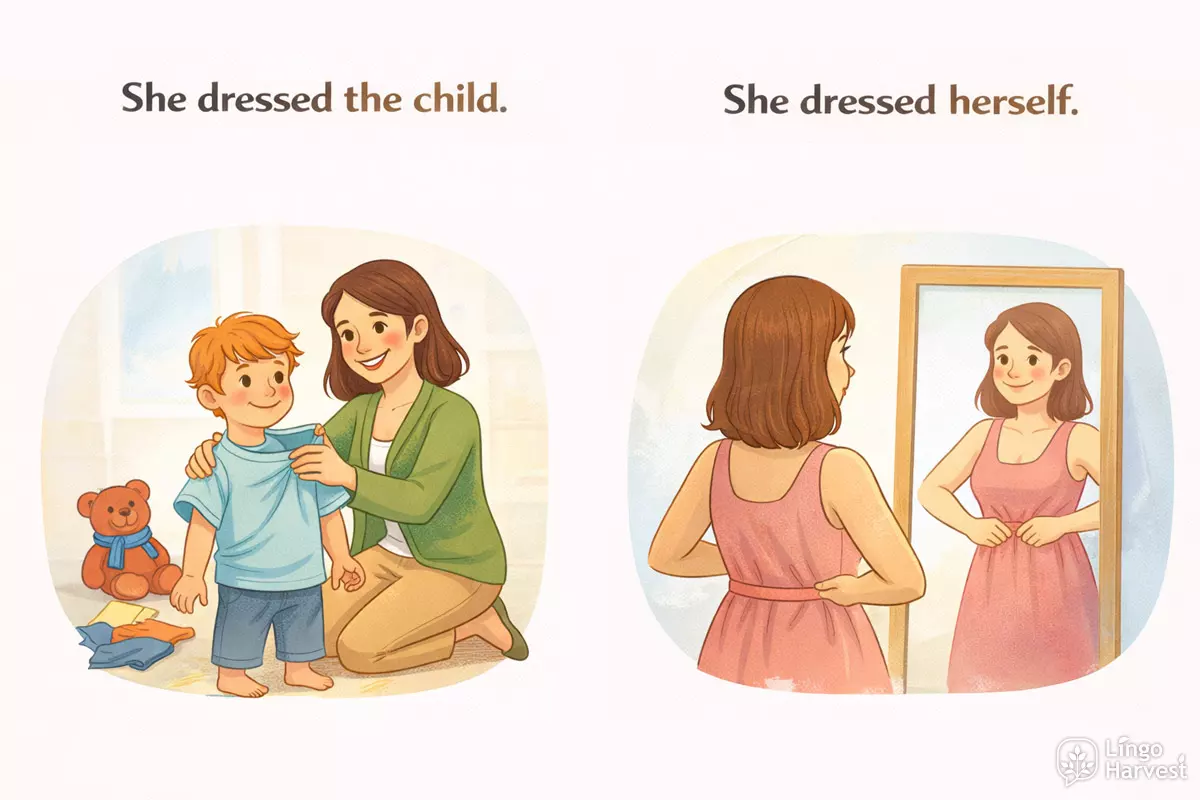
| Non-reflexive (different target / no object) | Reflexive (same person as subject) |
|---|---|
| I shaved him. | I shaved myself. |
| She dressed the child. | She dressed herself. |
| They introduced the speaker. | They introduced themselves. |
| He hurt his friend. | He hurt himself. |
| Can you remind me? | I reminded myself to call. |
| We blamed the manager. | We blamed ourselves. |
| She applied the cream to her hands. | She applied herself to the task. |
| He found his keys. | He found himself in a difficult situation. |
| They enjoyed the concert. | They enjoyed themselves at the concert. |
| Please behave well. | Please behave yourself. |
Patterns to notice in real usage
- Daily routines often allow both forms: “She washed (her hands)” vs “She washed herself.” The reflexive version focuses on the whole person, not just a body part.
- “Enjoy yourself” is usually not literal: it means “have a good time,” not “take pleasure in yourself.”
- “Help yourself” is a set phrase: it means “serve yourself/take what you want,” especially with food or drink.
- “Introduce yourself” is expected when meeting people: “Introduce yourself to the group.” Non-reflexive “introduce” usually takes a different object (“introduce a colleague”).
- Some verbs become more formal or emphatic with a reflexive pronoun: “I asked myself why…” highlights inner thought; “I asked why…” is possible but less explicit about self-questioning.
- Reflexive pronouns can prevent ambiguity: “He saw him” (someone else) vs “He saw himself” (his own reflection or image).
- Meaning can shift to “become” or “end up”: “find yourself” often means arriving in a situation unexpectedly (“She found herself alone”).
- “Apply yourself” is not about putting something on your body: it means “work hard at” something (“apply yourself to your studies”).
- “Behave yourself” is directive: it’s common with children or in mild scolding; “behave” without an object is more neutral.
Typical learner mistakes and corrections
Errors with self-pronouns usually come from overusing them, choosing the wrong form, or translating patterns directly from another language. The fixes are mostly about checking whether the subject and object are the same person, and whether English actually needs a reflexive form in that verb pattern.
Common problems and how to fix them
- Adding a reflexive pronoun when English does not use one
❌ I washed myself and dressed myself quickly.
✅ I washed and dressed quickly.
→ In everyday English, many “daily routine” actions don’t require a self-pronoun unless you need contrast or emphasis. - Using a self-pronoun after “meet”
❌ Nice to meet myself / I want to meet myself with you tomorrow.
✅ Nice to meet you. / I want to meet you tomorrow.
→ “Meet” normally takes a direct object (you/him/them). Reflexive use is rare and has a different meaning (philosophical “meet oneself”). - Using a self-pronoun after “feel” in standard patterns
❌ I feel myself tired.
✅ I feel tired. / I don’t feel well.
→ “Feel” is typically followed by an adjective, not a reflexive object. - Using a self-pronoun after “relax”
❌ I want to relax myself.
✅ I want to relax.
→ “Relax” is usually intransitive. If you need an object, use a different verb: “calm myself down”. - Confusing reflexive pronouns with reciprocal meaning (“each other”)
❌ They hugged themselves.
✅ They hugged each other.
→ Use each other / one another when two or more people act on one another. - Wrong form: myself/yourself/himself, etc.
❌ She cut herself while he shaved herself.
✅ She cut herself while he shaved himself.
→ Match the pronoun to the subject (he → himself, they → themselves). - Mixing “yourself” and “yourselves”
❌ Please help yourself, everyone.
✅ Please help yourselves, everyone.
→ Use plural when addressing a group. - Using “themself” in contexts where your course expects “themselves”
❌ Each student should introduce themself. (may be marked wrong in some settings)
✅ Each student should introduce themselves. (common in many style guides)
→ Singular “they” varies by style. Follow your teacher/exam convention. - Placing the reflexive pronoun in the wrong position
❌ I looked in the mirror myself.
✅ I looked at myself in the mirror.
→ With verbs like “look at,” the self-pronoun comes after the preposition. - Confusing reflexive meaning with emphasis (“I did it myself”)
❌ I taught myself English. (when you mean “without help,” not “self-study”)
✅ I learned English by myself. (without help) / I taught myself English. (self-study)
→ “Teach myself” focuses on being your own teacher; “by myself” focuses on doing it alone. - Using “by myself” when you need a true reflexive object
❌ He blamed by himself for the mistake.
✅ He blamed himself for the mistake.
→ “By myself” means “alone.” “Himself” is the object receiving the action. - Omitting the reflexive pronoun when it is required for meaning
❌ She prides on her work.
✅ She prides herself on her work.
→ Some verbs are commonly used with a reflexive object in fixed patterns: “pride oneself on,” “avail oneself of” (formal), “busy oneself with”. - Using a reflexive pronoun after “enjoy” in normal contexts
❌ Enjoy yourself the movie.
✅ Enjoy the movie.
→ “Enjoy yourself” means “have a good time” and does not take another direct object. - Using “myself/yourself” as a polite substitute for “me/you”
❌ Please contact myself if you have questions.
✅ Please contact me if you have questions.
→ Self-pronouns are not more formal; use them only for reflexive meaning or emphasis. - Using a reflexive pronoun with “remember/forget” when the meaning is just mental recall
❌ I remembered myself to lock the door.
✅ I remembered to lock the door.
→ Reflexive “remind myself” is possible, but “remember myself” is not the usual pattern.
Quick checks that prevent most errors
- Same person? If the subject does something to the same person, a reflexive object may be needed: “She hurt herself.”
- Common English pattern? Many verbs don’t take a self-pronoun even if your first language does: “He sat down,” not “He sat himself.”
- Emphasis or contrast? Use self-pronouns for emphasis: “I fixed it myself” (not just “I fixed it”).
- Reciprocal action? If two people act on each other, choose “each other”: “They introduced each other.”
Reflexives in spoken English
In everyday conversation, reflexive pronouns often show up in a few predictable patterns: to mark that the subject and object are the same person, to add emphasis, or to soften what you say. Spoken usage also includes some informal habits (especially with by myself) that are common in speech but less common in careful writing.
Common spoken patterns (with examples)
- True reflexive meaning (subject = object): “I cut myself shaving.” / “She blamed herself.”
- After a verb + preposition: “He’s talking to himself.” / “She’s really hard on herself.”
- Emphasis on the subject (often after the noun/pronoun): “I did it myself.” / “The manager himself called.”
- Emphasis on the object: “I made the cake myself.” (focus: no help)
- With by to mean ‘alone/without help’: “I’ll go by myself.” / “Did you do that by yourself?”
- Short answers and confirmations: “Me? I’ll do it myself.” / “He said it himself.”
- To strengthen a warning or instruction: “Don’t hurt yourself.” / “Help yourself.”
- Fixed phrase for enjoyment: “Enjoy yourself.” / “Did you guys enjoy yourselves?”
- Fixed phrase for behaving well: “Behave yourself.” / “Kids, behave yourselves.”
- Polite softening (common in service situations): “Make yourself comfortable.” / “Please, make yourselves at home.”
- To show personal involvement or responsibility: “I told myself I’d stop.” / “She promised herself she’d try again.”
- To show a change in state (often with get): “Get yourself ready.” / “He got himself into trouble.”
- To highlight independence: “She lives by herself.” / “He built that shed himself.”
- With “all by” for extra emphasis: “I did it all by myself.” / “She fixed it all by herself.”
- With “between” (careful: plural vs. singular): “Keep it between ourselves.” / “It’s just between you and me.”
Informal choices that are common in speech
- Using a reflexive where standard grammar prefers an object pronoun (often heard, but not formal): ❌ “Send it to myself.” → ✅ “Send it to me.”
- Using myself/yourself to sound more formal or polite (can sound unnatural if overused): “If you have questions, ask me” is usually more natural than “ask myself.”
- Dropping the reflexive when the meaning is still clear: In casual talk, people sometimes say “I washed and got dressed” instead of “I washed myself and got dressed,” especially when the action is obviously done to the subject.
Quick usage checks for natural speech
- Use a reflexive pronoun when the subject does something to the same person: “He taught himself guitar.”
- Use an object pronoun when it’s not truly reflexive: “She introduced me to her friends.” (not “introduced myself”)
- Use the emphatic form to add “personally/without help”: “I’ll call him myself.”
- Use by + reflexive for “alone”: “Are you here by yourself?”
Homework: reflexive verb practice tasks
Work through these exercises to build accuracy with reflexive pronouns (myself, yourself, himself, herself, itself, ourselves, yourselves, themselves) and the patterns where English uses them (or avoids them). Focus on meaning: whether the subject and object are the same person/thing, and whether the pronoun is required, optional for emphasis, or incorrect.
Task 1: Choose the correct pronoun (or no pronoun)
Complete each sentence with the best option.
- I taught ____ to play the guitar.
- Did you enjoy ____ at the party?
- She looked at ____ in the mirror.
- We introduced ____ to the new neighbors.
- He cut ____ while cooking.
- The cat cleaned ____ after eating.
- Please help ____ to some water.
- They blamed ____ for the mistake.
- I can do it ____; I don’t need help.
- My parents pride ____ on being punctual.
- He behaves ____ in meetings.
- She sat by ____ and read quietly.
Show answers
- myself
- yourself
- herself
- ourselves
- himself
- itself
- yourself
- themselves
- myself
- themselves
- himself
- herself
Task 2: Fix what’s wrong (some sentences are already correct)
Rewrite only the sentences that need changes. Keep the meaning as close as possible.
- I washed me and went to bed.
- She always enjoys herself when she travels.
- He explained myself the rules.
- We met ourselves at the station.
- They introduced themselves to the teacher.
- My brother hurt him playing football.
- I feel myself tired today.
- Please make yourself at home.
- She dressed her quickly and left.
- The door opened itself slowly.
Show answers
- I washed myself and went to bed.
- No change.
- He explained the rules to me. (or: He explained the rules to myself ❌)
- We met at the station. (No reflexive needed.)
- No change.
- My brother hurt himself playing football.
- I feel tired today. (Most natural in modern English.)
- No change.
- She dressed quickly and left. (Or: She dressed herself quickly and left.)
- No change. (Acceptable when meaning “by itself,” without help.)
Task 3: Required, optional, or incorrect?
For each sentence, decide if the reflexive pronoun is required, optional (emphasis), or incorrect. Then correct the incorrect ones.
- I made this cake myself.
- He washed himself after the game.
- She arrived herself at 6 p.m.
- We enjoyed ourselves on the trip.
- They sat themselves down.
- He said to myself that it would be fine.
- The children dressed themselves.
- Do you remember yourself meeting him?
- I locked the door behind myself.
- She taught herself French.
Show answers
- Optional (emphasis).
- Required.
- Incorrect → She arrived at 6 p.m.
- Required.
- Optional (emphasis) → They sat down. (Reflexive adds a “deliberate action” feel.)
- Incorrect → He said to me that it would be fine. (Or: I said to myself...)
- Required (if meaning “without help”).
- Incorrect → Do you remember meeting him?
- Often incorrect in standard usage → I locked the door behind me. (“Behind myself” is nonstandard for most learners.)
- Required.
Task 4: Build sentences from patterns
Write one sentence for each pattern. Use the cues in parentheses to guide meaning.
- teach + reflexive (a skill you learned alone)
- enjoy + reflexive (a social event)
- hurt + reflexive (a small accident)
- by + reflexive (being alone, not “without help”)
- do + it + reflexive (emphasis: no help needed)
- pride + reflexive + on (a habit or value)
- introduce + reflexive (a formal situation)
- blame + reflexive (regret)
- make + reflexive + at home (a guest)
- behave + reflexive (self-control)
Task 5: Short editing checklist (apply to your own writing)
- Ask: “Is the subject doing the action to the same person/thing?” If yes, a reflexive pronoun may be needed.
- Check common non-reflexive verbs in English: feel, relax, concentrate, remember, meet usually do not take a reflexive pronoun.
- Use reflexives for emphasis only when it adds meaning: “I did it myself” (not just “I did it”).
- Prefer object pronouns after prepositions in standard cases: “behind me,” “for him,” “with them” (not “behind myself” unless you are using a special stylistic effect).
- When in doubt, test substitution: if “me/him/her/us/them” makes sense and the meaning is not “same person,” avoid the reflexive form.