Common Reflexive Pronoun Errors and How to Avoid Them

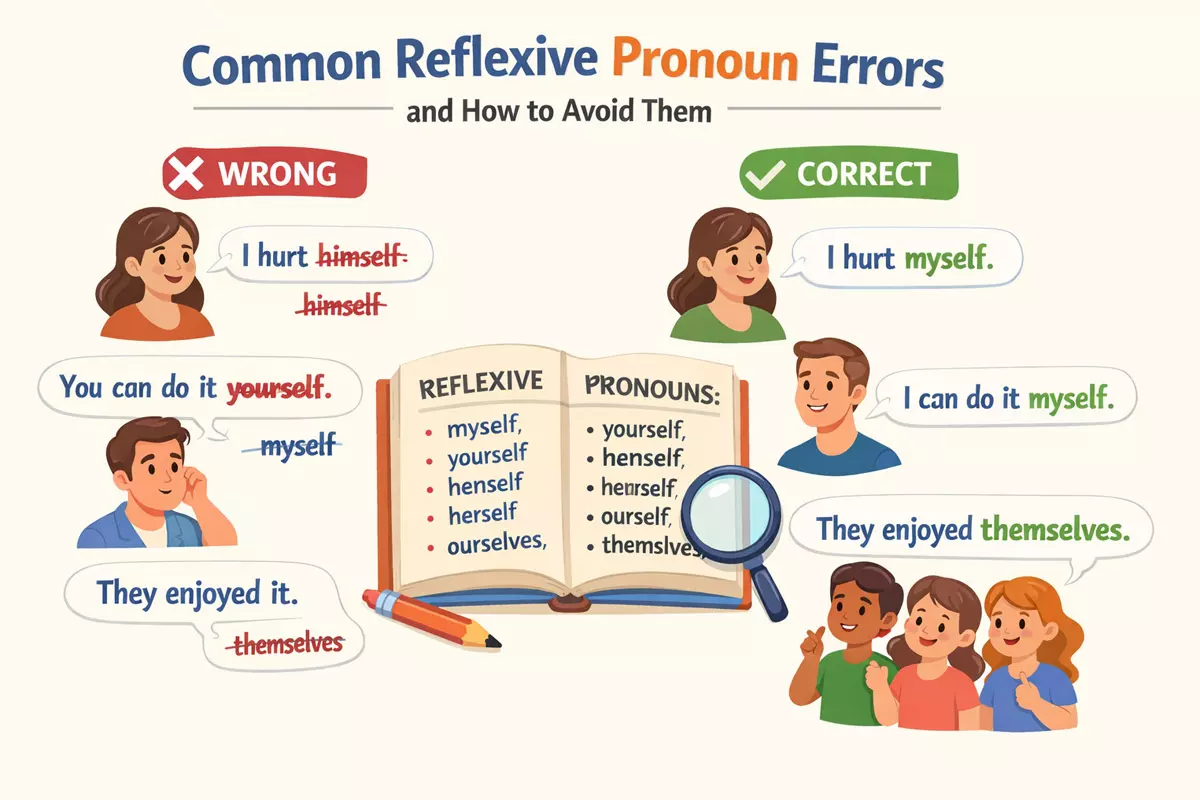 Here we common errors with reflexive pronouns, including confusing them with object pronouns, omitting them when required, overusing myself, using them incorrectly with certain verbs or after prepositions, and distinguishing between correct and natural usage.
- Why reflexive pronouns cause frequent errors
- Using reflexives when an object pronoun is required
- Missing reflexives where they are grammatically necessary
- Overusing myself for politeness or emphasis
- Reflexives with verbs that do not take them
- Reflexive pronouns after prepositions
- Differences between correct and natural usage
- Practice: identify and correct reflexive errors
Mixing up words such as myself or themselves can confuse even confident writers and speakers, but learning how to use these self-referencing terms correctly is essential for clear and effective communication. These pronouns are typically used for emphasis or to reflect the subject of the sentence, but they are often misused in place of simple pronouns like me or them. By paying attention to how and when to use reflexive pronouns, you can avoid common mistakes and ensure your English sounds natural and precise.
Why reflexive pronouns cause frequent errors
Mistakes with reflexive pronouns are surprisingly common, even among native speakers. One key reason is that English reflexive forms look similar to other pronouns, creating confusion about when and how to use them. People often choose reflexive forms simply because they "sound right" or seem more formal, which can lead to incorrect usage.
Common sources of confusion
- Reflexive pronouns are sometimes used for emphasis, but not all emphatic uses are correct.
- Many learners mix up subject and object pronouns with reflexives, especially in compound subjects or objects.
- Some verbs in English do not take reflexive pronouns, even if their equivalents do in other languages.
- English allows both reflexive and non-reflexive forms in certain cases, leading to uncertainty.
Typical error patterns
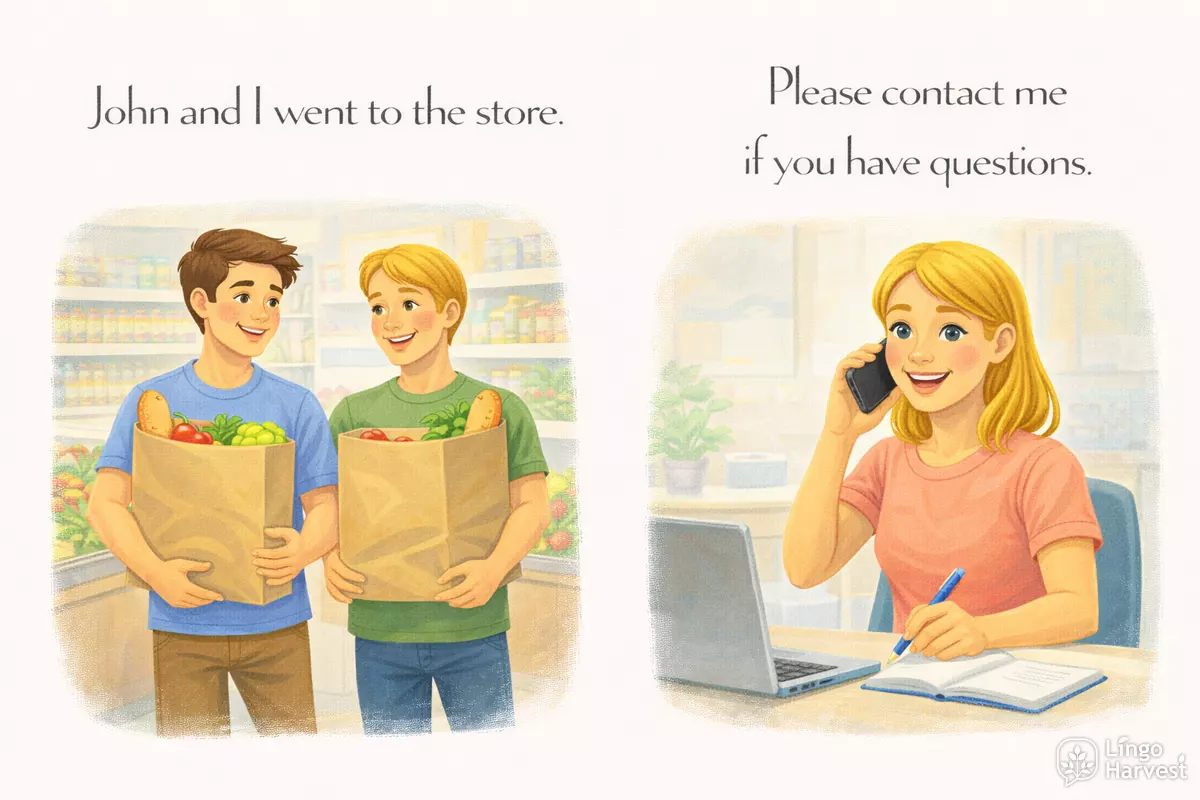
Below is a comparison of correct and incorrect reflexive pronoun usage. Notice how subtle the differences can be:
| ❌ Incorrect Usage | ✅ Correct Usage |
|---|---|
| Myself and John went to the store. | John and I went to the store. |
| Please contact myself if you have questions. | Please contact me if you have questions. |
| She did it by her own. | She did it by herself. |
| He and myself will handle it. | He and I will handle it. |
| The report was prepared by myself. | I prepared the report myself. |
| Send the documents to John and myself. | Send the documents to John and me. |
| Me and Sarah finished first. | Sarah and I finished first. |
| Between you and I, this is confidential. | Between you and me, this is confidential. |
Why these mistakes happen
- Overcorrection: Some speakers use reflexive forms to sound more formal or "correct," but this can backfire.
- Influence from other languages: In languages like Spanish or French, reflexive verbs are more common, leading to transfer errors.
- Uncertainty with compound subjects/objects: When more than one person is involved, it's easy to misapply reflexive forms.
- Emphasis confusion: People sometimes use reflexives for emphasis in places where they are not needed.
Understanding these patterns helps learners and even native speakers avoid the most frequent pitfalls. The key is to remember that reflexive pronouns are only needed when the subject and object refer to the same person or group, or for certain idiomatic phrases.
Using reflexives when an object pronoun is required
One of the most frequent mistakes with reflexive pronouns is substituting them for standard object pronouns like him, her, or them in sentences where a reflexive is not appropriate. This happens especially in English learners’ writing and speech, but even native speakers occasionally slip up. Reflexive pronouns—such as myself, yourself, himself, ourselves—should only be used when the subject and object of the verb are the same person or group. Otherwise, use a regular object pronoun.
Common Misuses: Examples and Corrections
It’s easy to spot errors by looking at typical sentences where the wrong pronoun appears. Review the following sentences and note which version is correct:
- ❌ Please contact myself if you have questions. → ✅ Please contact me if you have questions.
- ❌ She gave the book to myself. → ✅ She gave the book to me.
- ❌ The manager will speak to yourself soon. → ✅ The manager will speak to you soon.
- ❌ He introduced herself to the group. → ✅ He introduced her to the group.
- ❌ They invited ourselves to the event. → ✅ They invited us to the event.
- ❌ Could you send the files to ourselves? → ✅ Could you send the files to us?
- ❌ My boss asked myself and John to attend. → ✅ My boss asked John and me to attend.
- ❌ She told myself the news. → ✅ She told me the news.
- ❌ The teacher assigned the project to themselves. → ✅ The teacher assigned the project to them.
- ❌ He asked myself for help. → ✅ He asked me for help.
When to Use Each Pronoun
To clarify the distinction, here’s a comparison of when to use object pronouns versus reflexive pronouns:
| Situation | Correct Pronoun |
|---|---|
| Subject and object are different people/entities | Object pronoun (me, you, him, her, us, them) |
| Subject and object are the same person | Reflexive pronoun (myself, yourself, himself, herself, ourselves, themselves) |
| Emphasizing that someone did something alone | Reflexive pronoun (e.g. “I did it myself.”) |
| Indirect reference or after prepositions (except by oneself) | Object pronoun (e.g. “The gift is for her.”) |
Quick Tips to Avoid This Error
- Ask yourself if the subject and object refer to the same person. If not, avoid the reflexive.
- Remember: reflexive pronouns are never used as the main object of a sentence unless reflecting the subject.
- Check for prepositions like “for,” “to,” or “with.” If the pronoun after these does not refer back to the subject, use an object pronoun.
By keeping these distinctions in mind, you’ll avoid one of the most persistent reflexive pronoun mistakes and ensure your writing sounds natural and correct.
Missing reflexives where they are grammatically necessary
One of the most common mistakes English learners make is leaving out reflexive pronouns in places where they're required for clarity or correctness. Reflexive pronouns (myself, yourself, himself, herself, itself, ourselves, yourselves, themselves) must be used when the subject and the object of a verb are the same person or thing. Omitting them can lead to sentences that are confusing or even ungrammatical.
Why reflexive pronouns matter
Reflexive pronouns are not just for emphasis; they often play a crucial grammatical role. Without them, sentences can lose their intended meaning or sound odd. This is especially important in English for certain verbs and expressions that require a reflexive form to indicate that the action returns to the subject.
Common situations where reflexives are required
- When the subject performs an action on themselves: He hurt himself.
- After certain verbs that typically take reflexive pronouns: She prides herself on her work.
- In idiomatic expressions: Behave yourself!
- To clarify meaning and avoid ambiguity: They introduced themselves to the group.
- With "by" to mean "alone": She did it by herself.
- In instructions or warnings: Help yourself to some coffee.
- With prepositions when the subject and object are the same: He was talking to himself.
- To indicate exclusive action: I made it myself.
- For emphasis: The manager herself approved the project.
- With verbs like "enjoy," "prepare," "teach," "express," and "find" when the action is directed back at the subject: He taught himself French.
Examples: Correct vs. Incorrect Usage
| Incorrect Sentence | Correct Sentence |
|---|---|
| She looked at in the mirror. | She looked at herself in the mirror. |
| They introduced to the class. | They introduced themselves to the class. |
| He taught French. | He taught himself French. |
| I hurt during the game. | I hurt myself during the game. |
| We prepared for the exam. | We prepared ourselves for the exam. |
| Help to some cake. | Help yourself to some cake. |
| You should behave. | You should behave yourself. |
| He blamed for the mistake. | He blamed himself for the mistake. |
| The children amused at the party. | The children amused themselves at the party. |
| She expressed clearly. | She expressed herself clearly. |
How to avoid leaving out reflexives
Double-check sentences where the subject and object refer to the same entity. If the action is done back to the doer, a reflexive pronoun is often necessary. Reviewing common verbs and idioms that require reflexives can help prevent this error. Practice and awareness are key—pay attention to how native speakers use reflexives in context.
Overusing myself for politeness or emphasis
Many English speakers mistakenly use "myself" in situations where it isn’t needed, often believing it sounds more formal, polite, or professional. This habit can make sentences awkward or grammatically incorrect. Reflexive pronouns like "myself" should only be used when the subject and object of the verb are the same person, or for genuine emphasis, not simply to sound courteous or important.
Common scenarios where "myself" is misused
- Introducing yourself: "Myself, John, will be leading the meeting." ❌
- As a substitute for "I" or "me": "Please contact myself if you have questions." ❌
- In group phrases: "John and myself finished the project." ❌
- To sound more formal: "Myself will send the email." ❌
- When the verb’s action does not return to the subject: "The manager asked myself to help." ❌
Correct uses vs. incorrect uses
| Incorrect Use | Correct Use |
|---|---|
| Myself and Sarah will be there. | Sarah and I will be there. |
| Please send it to myself. | Please send it to me. |
| Let John or myself know. | Let John or me know. |
| I completed the report myself. (when not for emphasis) | I completed the report. (unless stressing "by myself") |
| The CEO and myself approved the plan. | The CEO and I approved the plan. |
When is "myself" actually appropriate?
- To refer back to the subject for clarity: "I made myself a sandwich."
- For emphasis, showing you did something alone: "I wrote the entire proposal myself."
Overusing "myself" can make your writing or speech sound unnatural or even distract from your message. When in doubt, try replacing "myself" with "I" or "me"—if the sentence still makes sense, you probably don’t need the reflexive form. Focus on clarity and use reflexive pronouns only when they truly serve a grammatical or emphatic purpose.
Reflexives with verbs that do not take them
One of the most frequent errors in English involves adding reflexive pronouns (myself, yourself, himself, etc.) to verbs that don't require them. This mistake often comes from translating directly from other languages or misunderstanding when reflexives are appropriate. In English, only certain verbs naturally take reflexive pronouns, and adding them elsewhere can make sentences sound awkward or incorrect.
Common Mistakes with Unnecessary Reflexives
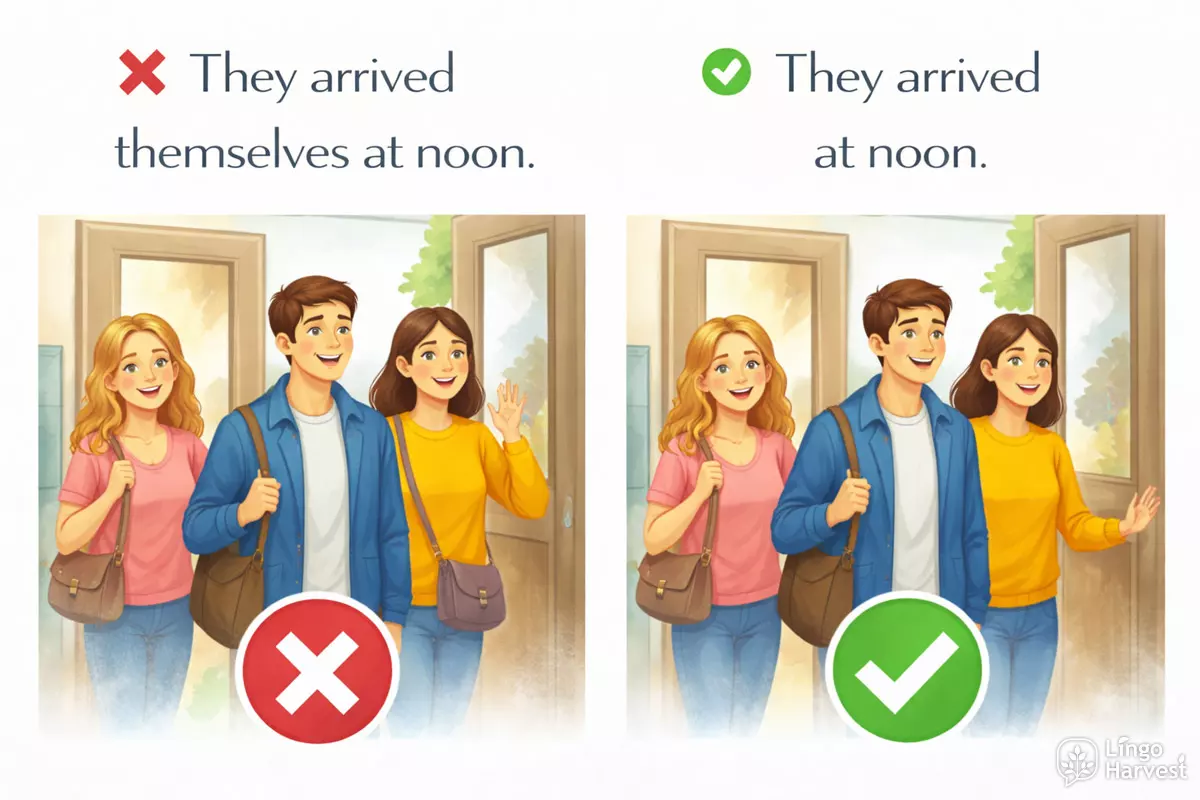
Some verbs never pair with reflexives in standard English. Using a reflexive with these verbs is ungrammatical, even if it might make sense in other languages. Here are some examples of incorrect and correct usage:
- ❌ I enjoyed myself the movie.
✅ I enjoyed the movie. - ❌ She met herself at the park.
✅ She met her friend at the park. - ❌ They arrived themselves at noon.
✅ They arrived at noon. - ❌ We discussed about ourselves the project.
✅ We discussed the project. - ❌ He remembered himself to call.
✅ He remembered to call. - ❌ You should concentrate yourself.
✅ You should concentrate. - ❌ I will return myself tomorrow.
✅ I will return tomorrow. - ❌ We need to adapt ourselves to change. (Note: "adapt" can be reflexive in some contexts, but not always.)
- ❌ She apologized herself for the mistake.
✅ She apologized for the mistake. - ❌ He changed himself clothes.
✅ He changed clothes.
Verbs That Rarely or Never Take Reflexive Pronouns
To help avoid this pitfall, here is a list of verbs that typically do not take reflexive pronouns in English:
- arrive
- meet
- enjoy (unless the meaning is "have fun")
- remember
- forget
- change (clothes, seats, etc.)
- discuss
- apologize
- concentrate
- adapt (depends on context)
- return
- move (houses/locations)
- open
- close
- start
- finish
- stop
- help
Why This Error Happens
This kind of mistake is especially common among learners whose native languages use reflexive forms more broadly. For example, in Spanish or French, many verbs are reflexive even when their English equivalents are not. English, however, seldom uses reflexives except to emphasize that the subject and object are the same person (e.g., "He hurt himself").
Quick Reference: Acceptable vs. Unacceptable Reflexive Use
| Incorrect (with reflexive) | Correct (without reflexive) |
|---|---|
| She introduced herself to her friend. | ✅ (Correct reflexive usage) |
| They enjoyed themselves at the party. | ✅ (Correct reflexive usage) |
| He arrived himself late. | He arrived late. |
| We discussed ourselves the plan. | We discussed the plan. |
| I remembered myself the meeting. | I remembered the meeting. |
| You should concentrate yourself. | You should concentrate. |
| She apologized herself for being late. | She apologized for being late. |
In summary, reflexive pronouns should only be used with verbs that require them. If you’re unsure, check if the action is being done to the subject by the subject. When in doubt, leave the reflexive out—most English verbs don’t need it.
Reflexive pronouns after prepositions
When a preposition comes before a pronoun, English often requires the reflexive form if the pronoun refers back to the subject of the sentence. This is a frequent source of mistakes for learners, especially in phrases involving actions directed at the speaker or writer. Using the standard object pronoun instead of the reflexive can lead to confusion or awkwardness, so it's important to know when reflexives are necessary.
Common situations requiring reflexive forms
Reflexive pronouns are typically used after prepositions when the subject and the object of the preposition are the same person or thing. This pattern appears in many everyday expressions, especially those involving location, feelings, or actions performed for one's own benefit.
- He bought a gift for himself.
- She was proud of herself.
- We did it by ourselves.
- I made the cake by myself.
- The cat looked at itself in the mirror.
- You should believe in yourself.
- They kept the secret to themselves.
- He talked to himself while working.
- She cared for herself after surgery.
- We are responsible for ourselves.
- Did you do this for yourself?
- The children entertained themselves during the trip.
- He found a solution by himself.
- She kept the news to herself.
- I can manage by myself.
Frequent errors and correct patterns
Learners sometimes mistakenly use object pronouns (me, him, her, us, them) after prepositions when the reflexive form is required. This can sound unnatural and sometimes changes the meaning. Here's a comparison of incorrect and correct usage:
| Incorrect | Correct |
|---|---|
| He bought a gift for him. | He bought a gift for himself. |
| She was proud of her. | She was proud of herself. |
| We did it by us. | We did it by ourselves. |
| I made the cake by me. | I made the cake by myself. |
| The cat looked at it in the mirror. | The cat looked at itself in the mirror. |
When not to use reflexives
Not every preposition + pronoun combination needs a reflexive. If the pronoun does not refer to the subject, use the standard object form. For example, “He bought a gift for her” is correct if “her” is another person. Overusing reflexive forms can also lead to errors, so pay attention to context.
Differences between correct and natural usage
Native speakers often use reflexive pronouns differently from what grammar guides recommend. While the rules state that words like myself, yourself, and themselves should only refer back to the subject of the sentence, everyday language sometimes bends these rules for emphasis or clarity. Understanding these distinctions can help you avoid common mistakes and sound more fluent.
Standard vs. Everyday Patterns
Textbooks define reflexive pronouns as tools for showing that the subject and object are the same person or group. However, in natural conversation, people may use reflexives in ways that don’t strictly follow this rule. For example, “I did it myself” (correct) versus “If you have any questions, contact myself” (not standard, but sometimes heard in speech).
- Correct: She taught herself to play the piano. ✅
- Incorrect (but common): Please send the documents to myself. ❌
- Natural (informal emphasis): We’ll handle it ourselves. ✅
- Incorrect (over-formal): John and myself will attend the meeting. ❌
When Rules and Real Usage Conflict
Sometimes, speakers use reflexive pronouns for emphasis or to sound formal, even though it’s not technically correct. This often happens in business or group settings, but it can sound awkward to those familiar with the rules. Consider the following:
| Grammatical Use | Common (but incorrect) Use |
|---|---|
| She made herself a cup of tea. | Send the report to John or myself. |
| I’ll do it myself. | Myself and Sarah will call you. |
| They blamed themselves for the error. | Please see myself if you have questions. |
| You should treat yourself to a break. | Contact myself for further info. |
Tips for Sounding Natural and Correct
- Use reflexive pronouns only when the subject and object are the same.
- Avoid using reflexives as substitutes for regular object pronouns (me, him, her).
- For emphasis, reflexives are fine: “I’ll handle it myself.”
- In formal writing, stick to the standard forms.
- Listen for how native speakers use reflexives, but be aware of context and register.
Recognizing the gap between prescriptive rules and actual speech can help you avoid awkward phrasing, especially in professional contexts. Being aware of these nuances will make your English both clear and natural.
Practice: identify and correct reflexive errors
Understanding how to use reflexive pronouns correctly can help you avoid awkward or unclear sentences. Below, you’ll find practical activities and examples designed to help you spot and fix common mistakes with reflexive pronouns like "myself," "yourself," "himself," "herself," "itself," "ourselves," "yourselves," and "themselves."
Spot the error: Which sentence is correct?
Read each pair of sentences below. One contains an error with a reflexive pronoun; the other is correct. Decide which is right.
-
- A. She made herself a cup of tea.
- B. She made her a cup of tea.
-
- A. Please contact myself if you have questions.
- B. Please contact me if you have questions.
-
- A. They did the work themselves.
- B. They did the work themself.
-
- A. The cat cleaned itself after eating.
- B. The cat cleaned herself after eating.
Show answers
- 1: A is correct (herself is needed; "her" is not reflexive here).
- 2: B is correct ("me" is the correct object pronoun; "myself" is only for emphasis or reflexive actions).
- 3: A is correct ("themselves" matches the plural subject "they").
- 4: A is correct ("itself" is for animals when gender is unknown or irrelevant).
Common mistakes with reflexive pronouns
Some errors are especially frequent. Here’s a list of classic misuses. Try to identify what’s wrong with each example, then think about how to fix it.
- He gave the book to myself.
- Myself and John went to the store.
- She introduced herself to myself.
- Please send the report to myself or Sarah.
- You must do it by yourselves (to one person).
- I hurt me while playing football.
- Themselves forgot the keys.
- The dog saw themselves in the mirror.
- Help yourselfs to some cake.
- We’ll see ourself out.
Show answers
- He gave the book to me (not myself).
- John and I went to the store.
- She introduced herself to me.
- Please send the report to me or Sarah.
- You must do it by yourself (for one person).
- I hurt myself while playing football.
- They forgot the keys.
- The dog saw itself in the mirror.
- Help yourselves to some cake.
- We’ll see ourselves out.
Quick reference: Reflexive pronoun forms
Refer to this table when you’re unsure about which reflexive form to use for each subject pronoun.
| Subject Pronoun | Reflexive Pronoun |
|---|---|
| I | myself |
| you (singular) | yourself |
| he | himself |
| she | herself |
| it | itself |
| we | ourselves |
| you (plural) | yourselves |
| they | themselves |
Rewrite practice: Correct the reflexive use
Each sentence below contains a reflexive pronoun error. Rewrite each one to make it correct.
- Myself will handle the project.
- She gave the tickets to myself and Tom.
- We did the assignment by ourself.
- The children can dress hisself.
- You should be proud of yourselves (speaking to one person).
Show answers
- I will handle the project.
- She gave the tickets to me and Tom.
- We did the assignment by ourselves.
- The children can dress themselves.
- You should be proud of yourself.
Practice with these examples regularly to build your confidence in using reflexive pronouns correctly.