Using Anticipatory “It” in Academic and Formal Contexts

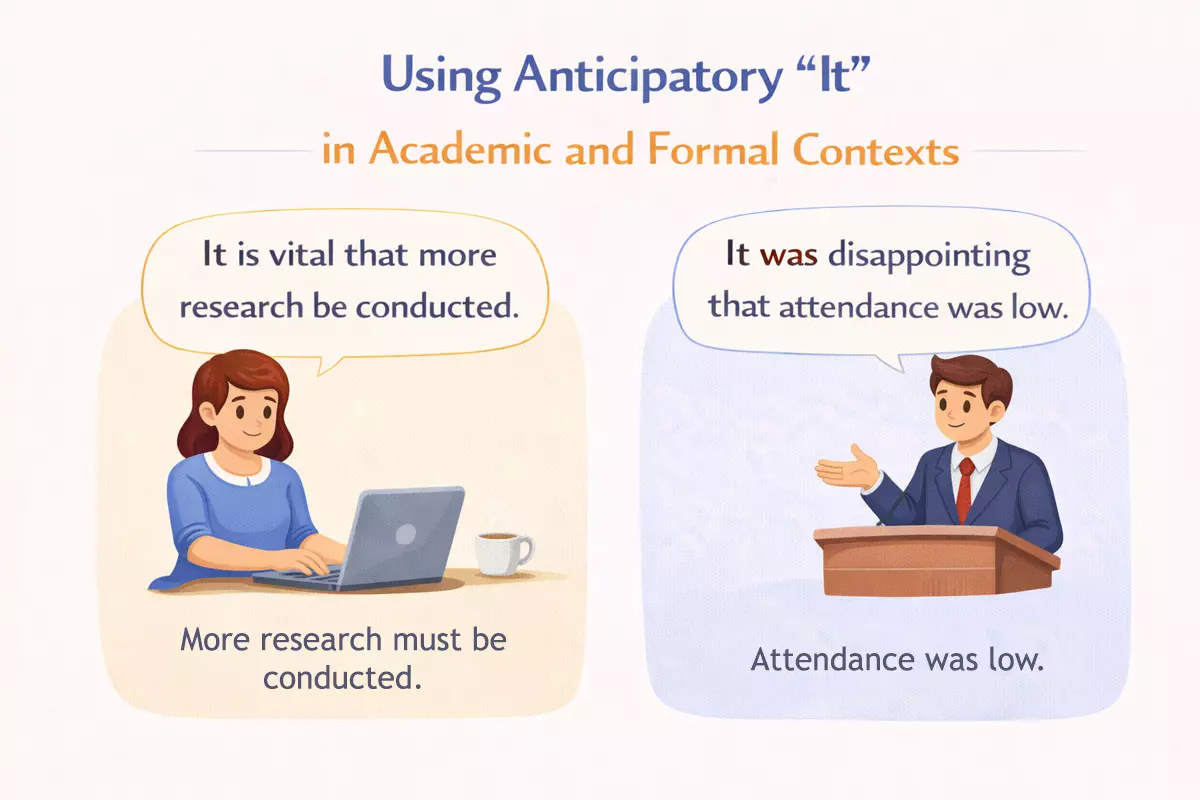 Here we what anticipatory it means, reasons for delaying heavy subjects in English, common academic patterns, it plus adjective plus clause structures, typical learner mistakes, and how to transform sentences into a more formal, impersonal style.
Mastering the subtle use of introductory "it" can significantly enhance your writing in academic and professional contexts by enabling you to present complex ideas with clarity and sophistication. This technique not only helps you organize information more effectively but also allows you to emphasize key points and guide your readers through your argument. By skillfully employing introductory "it," you can improve the flow of your writing, making your arguments more persuasive and your overall message more engaging for your audience.
What anticipatory it means
In English grammar, the term “anticipatory it” refers to using the pronoun it at the beginning of a sentence as a placeholder, while the real subject or content appears later. This construction is especially common in academic and formal writing to sound more objective or to emphasize particular information. Rather than starting directly with the subject, writers introduce it to shift focus or manage sentence flow, making statements clearer and often more polite.
How anticipatory “it” works
Anticipatory “it” allows writers to place important or complex information later in the sentence, which can make the statement easier to process. The actual subject is usually introduced with a clause or a phrase (often starting with that, to, or wh- words). This technique is particularly useful when the “real” subject is long or abstract.
- It is important that students understand the assignment.
- It seems that the results were inconclusive.
- It was surprising how quickly the team solved the problem.
- It is necessary to submit the form by Friday.
- It appears that the data supports the hypothesis.
- It is unlikely that the weather will improve.
- It is possible to reduce costs with this method.
- It is clear that more research is needed.
- It is difficult to determine the cause.
- It is believed that the policy will change.
Why use anticipatory “it”?
This structure is favored in formal contexts for several reasons:
- It helps foreground the key information by moving it to the end.
- It makes sentences less awkward when the real subject is lengthy.
- It provides a neutral, impersonal tone appropriate for academic writing.
- It can soften statements, making them less direct or more polite.
Common patterns with anticipatory “it”
Writers often use this technique with certain verbs and adjectives. Here are frequent patterns:
- It is + adjective + that-clause (e.g., It is essential that…)
- It is + adjective + to-infinitive (e.g., It is wise to…)
- It seems/appears/looks + that-clause
- It is + noun + to-infinitive (e.g., It is a challenge to…)
Anticipatory “it” vs. regular “it”

| Anticipatory “it” | Referential “it” |
|---|---|
| It is important to check your work. (“It” has no specific reference; the real subject is “to check your work.”) |
The book is on the table. It belongs to Sam. (“It” refers to “the book.”) |
| It seems that the meeting is canceled. (“It” is a placeholder for “that the meeting is canceled.”) |
I saw the car. It was red. (“It” refers to “the car.”) |
| It is clear that more data are needed. (“It” stands for the idea “that more data are needed.”) |
The cat is sleeping. It looks comfortable. (“It” refers to “the cat.”) |
| It is difficult to explain the results. (“It” anticipates “to explain the results.”) |
This is my phone. It is new. (“It” refers to “the phone.”) |
In summary, anticipatory “it” is a useful grammatical device for structuring sentences in a way that enhances clarity, formality, and objectivity—qualities highly valued in academic and professional communication.
Why English delays heavy subjects
English sentences often place longer, more complex elements—the so-called "heavy subjects"—later in the sentence, rather than at the very start. This tendency is especially noticeable in academic and formal writing, where clarity and flow are prioritized. Instead of beginning with lengthy noun phrases or clauses, English often uses the anticipatory "it" to introduce the sentence and postpone the heavier material until the end. This structural choice helps readers process information more smoothly.
Processing Ease and Readability
Readers can quickly grasp the main point when a sentence starts simply and reserves complex details for later. Placing a long subject at the beginning can overload the reader's working memory, making comprehension more difficult. By delaying the heavy element, English allows for a smoother, more digestible information flow.
Examples of Heavy Subject Placement
- It is important that students understand the theory before applying it.
- It seems that the experiment failed due to contamination.
- It is unlikely that the proposal will be accepted.
- It became clear that further research was necessary.
- It is surprising how quickly the results changed.
- It is difficult to predict the outcome.
- It was decided to postpone the meeting.
- It is well known that exercise improves health.
- It is possible that funding will increase next year.
- It is necessary to submit the report by Friday.
- It was suggested that the policy be revised.
- It is unfortunate that so many errors occurred.
Comparing Sentence Structures
To highlight the difference, compare sentences with and without anticipatory "it." The table below shows how English prefers to shift heavy subjects to the end.
| Original (Heavy Subject First) | Preferred (Anticipatory "It") |
|---|---|
| That the committee approved the new policy is surprising. | It is surprising that the committee approved the new policy. |
| To complete the project on time will be difficult. | It will be difficult to complete the project on time. |
| Whether the results are valid remains unclear. | It remains unclear whether the results are valid. |
| That so many students passed was unexpected. | It was unexpected that so many students passed. |
Summary of Reasons
- Helps readers identify the main verb and topic quickly
- Reduces cognitive load and confusion
- Improves sentence rhythm and cohesion, especially in complex writing
- Makes academic arguments and explanations easier to follow
In sum, English prefers to delay complicated subjects for the sake of clarity and reader comprehension, using structures like the anticipatory "it" to guide readers through complex information.
Common academic patterns with it
Anticipatory “it” is widely used in scholarly writing to create emphasis, maintain objectivity, and improve sentence flow. This grammatical device often introduces complex subjects, highlight important findings, or soften claims. Academic texts frequently use anticipatory “it” to shift the focus from the subject to what follows, making arguments clearer and more formal.
Typical structures found in academic writing
Writers in research papers, theses, and formal reports rely on several recurring patterns with anticipatory “it.” These forms help manage sentence complexity and guide the reader’s attention:
- It is important to note that…
- It has been demonstrated that…
- It is widely accepted that…
- It appears that…
- It is worth mentioning that…
- It is evident from the data that…
- It is necessary to consider…
- It should be emphasized that…
- It remains unclear whether…
- It is generally believed that…
- It is possible to argue that…
- It is assumed that…
- It is not surprising that…
- It is essential to recognize…
- It has been observed that…
- It is difficult to determine…
- It can be seen that…
- It is suggested that…
- It is unlikely that…
These patterns frequently introduce abstract subjects or highlight the writer’s interpretation without personalizing the claim.
Comparing anticipatory “it” to alternative structures
Writers sometimes choose between using anticipatory “it” and more direct forms. The following table illustrates how anticipatory constructions compare with their direct counterparts:
| Anticipatory “It” Structure | Direct Alternative |
|---|---|
| It is important to consider the results. | Considering the results is important. |
| It has been demonstrated that the method is effective. | The method has been demonstrated to be effective. |
| It is unclear whether this approach is viable. | Whether this approach is viable is unclear. |
| It is necessary to review the literature. | Reviewing the literature is necessary. |
| It is evident that the data supports the hypothesis. | The data evidently supports the hypothesis. |
Why use anticipatory “it” in academic contexts?
This construction is favored because it allows for impersonal, objective tone—an essential feature in scholarly communication. By foregrounding the judgment or assessment, writers can present information neutrally, avoiding personal bias. The anticipatory “it” also helps manage long or complex clauses by delaying the subject, which can make dense material more accessible to readers. In summary, these patterns not only support clarity and formality but also help achieve the distancing and precision valued in academic and professional prose.
It + adjective + clause structures
When expressing opinions, evaluations, or describing situations in formal writing, the anticipatory "it" is often paired with adjectives, followed by a that-clause or an infinitive clause. This construction allows writers to emphasize the judgment or reaction rather than the subject itself. For instance, instead of directly stating "To finish the project on time is important," a more academic phrasing would be "It is important to finish the project on time." This approach clarifies the focus and maintains an objective tone.
Common Patterns and Usage
The structure generally follows this pattern: "It + be + adjective + (for/of someone) + to-infinitive/that-clause." This setup is especially useful in academic and formal contexts to frame information impersonally. Here are some typical adjectives that frequently appear in such sentences:
- important — It is important to follow the instructions carefully.
- necessary — It is necessary to update the software regularly.
- essential — It is essential to get enough sleep.
- possible — It is possible to finish the task today.
- impossible — It is impossible to predict the outcome.
- likely — It is likely that prices will increase.
- unlikely — It is unlikely that the plan will change.
- clear — It is clear that more research is needed.
- obvious — It is obvious that he made a mistake.
- interesting — It is interesting to see how language evolves.
- strange — It is strange that no one noticed the error.
- surprising — It is surprising how quickly she learned.
- helpful — It is helpful to take notes while studying.
- dangerous — It is dangerous to drive in icy conditions.
- beneficial — It is beneficial to exercise regularly.
- appropriate — It is appropriate to dress formally for the event.
- difficult — It is difficult to stay focused for long periods.
- easy — It is easy to make mistakes when you rush.
These adjectives set the tone for the evaluation or assessment that follows in the clause.
Examples with That-Clauses and Infinitives
Writers often use a that-clause or a to-infinitive to specify the situation or action being discussed. Notice how the structure creates a formal, academic impression:
- It is essential that students submit their assignments on time.
- It is unlikely that the results will change significantly.
- It is difficult to predict future trends in this field.
- It is surprising that so few studies address this issue.
- It is beneficial for employees to receive regular feedback.
Comparison of Patterns
The following table outlines the main variations, showing how the structure can shift based on the adjective and the type of clause used:
| Pattern | Example |
|---|---|
| It + be + adjective + to-infinitive | It is easy to understand the instructions. |
| It + be + adjective + (for/of + noun) + to-infinitive | It is important for researchers to follow protocols. |
| It + be + adjective + that-clause | It is clear that further research is needed. |
| It + be + adjective + (for/of + noun) + that-clause | It is unusual for data to be missing from the report. |
Why Use These Constructions?
This anticipatory "it" structure helps maintain objectivity and formality, especially when the real subject is complex or abstract. It shifts attention to the evaluation itself, which is often preferred in academic and professional writing. Additionally, such phrasing avoids awkward or wordy sentences, ensuring clarity and flow.
Formal tone and impersonal style
Academic and professional writing often avoids direct personal references, favoring objectivity and distance. One way writers achieve this is by using anticipatory “it” structures. These constructions help shift the focus away from the writer or reader, allowing the subject matter to take precedence and fostering a sense of neutrality.
In formal contexts, anticipatory “it” frequently introduces statements where the real subject is a clause or infinitive phrase that appears later. This technique not only clarifies complex ideas but also helps maintain a polished, impersonal register. For example, instead of saying “To understand the results is important,” a writer would say, “It is important to understand the results.” This subtle shift creates a more detached and scholarly impression.
Common functions of anticipatory "it"
- Presenting opinions or evaluations without personal involvement (e.g., “It is widely believed that…”)
- Introducing facts or generalizations (e.g., “It is known that…”)
- Highlighting necessity or obligation (e.g., “It is necessary to…”)
- Signaling difficulty or ease (e.g., “It is challenging to…”)
- Expressing possibility or likelihood (e.g., “It is possible that…”)
- Stating importance or relevance (e.g., “It is crucial to…”)
- Making judgments or recommendations (e.g., “It is advisable to…”)
- Describing frequency or commonality (e.g., “It is rare to…”)
- Noting time or sequence (e.g., “It is now clear that…”)
- Emphasizing results or consequences (e.g., “It is evident that…”)
Comparing impersonal vs. personal forms
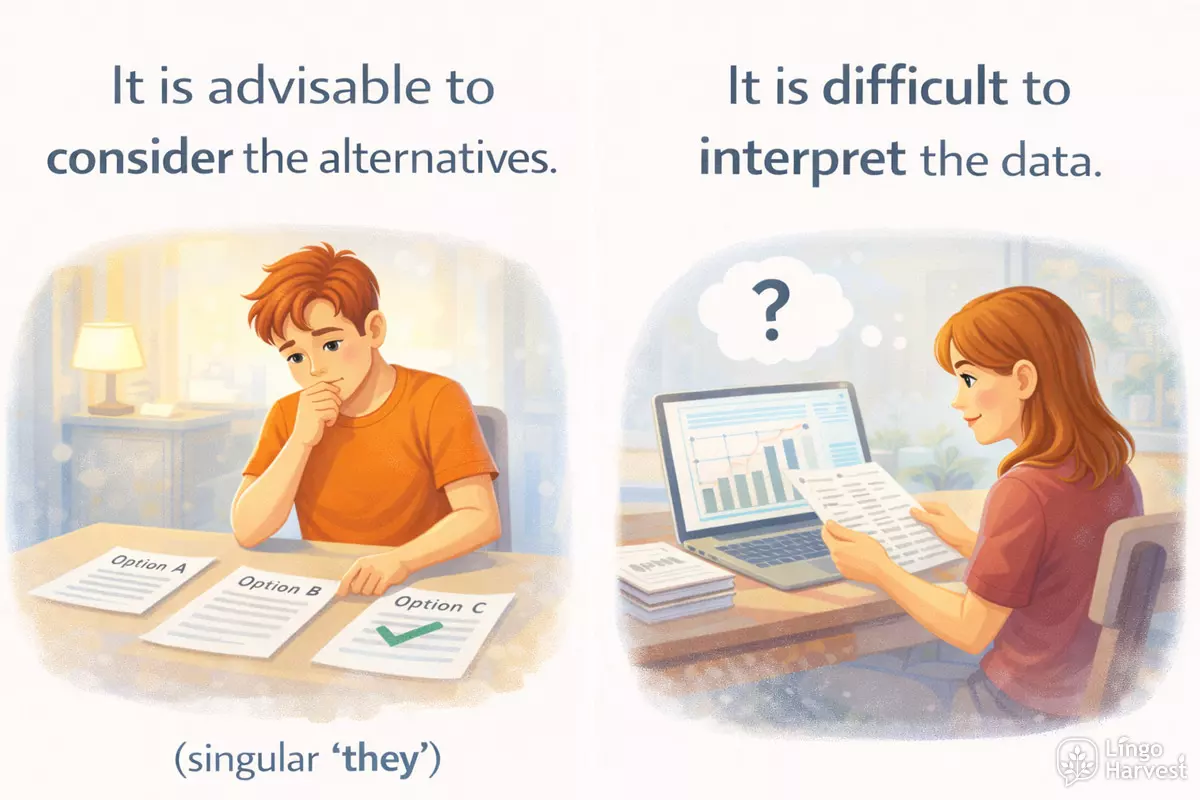
| Personal/Direct | Impersonal with anticipatory “it” |
|---|---|
| We believe that further research is needed. | It is believed that further research is needed. |
| You should consider the alternatives. | It is advisable to consider the alternatives. |
| I found it difficult to interpret the data. | It is difficult to interpret the data. |
| People know that climate change is a threat. | It is known that climate change is a threat. |
Using these impersonal forms aligns with the conventions of academic discourse. The anticipatory “it” helps writers avoid subjective language and frame arguments in a way that appears more unbiased and universally applicable. This not only enhances credibility but also ensures clarity and focus on the subject rather than the individual perspective.
Common learner mistakes
Misusing anticipatory “it” in academic and formal writing often leads to unclear sentences or grammatical errors. Many learners confuse anticipatory “it” with other uses of “it,” or incorrectly structure sentences, which can make their arguments less precise or harder to follow. Below are some of the most frequent pitfalls, along with guidance to help you avoid them.
Omitting the Anticipatory “It”
Writers sometimes forget to include “it” when introducing clauses, especially when translating from languages with different structures. This results in awkward or incomplete sentences, such as:
- “Is important to review the data.” ❌ (Missing “it”)
- Correct: “It is important to review the data.” ✅
Incorrect Word Order
Another common error is placing the clause or phrase before “it,” which breaks the anticipatory structure:
- “To revise the plan it is necessary.” ❌
- Correct: “It is necessary to revise the plan.” ✅
Confusing Anticipatory “It” with Dummy “It”
Some learners use “it” in sentences where a real subject is present, resulting in redundancy or confusion. Remember, anticipatory “it” introduces clauses or phrases that are the real subject or object.
- Incorrect: “It the committee decided to postpone the meeting.” ❌
- Correct: “It was decided to postpone the meeting.” ✅
Omitting the “That” Clause or Infinitive
When using anticipatory “it,” the supporting clause (often “that…” or “to…”) must follow. Omitting this makes the sentence incomplete:
- “It is obvious.” (Obvious what?)
- Better: “It is obvious that more research is needed.”
Frequent Sentence Patterns and Errors
Many mistakes come from using the wrong pattern when forming sentences with anticipatory “it.” The table below summarizes typical correct and incorrect forms:
| Incorrect Form | Correct Form |
|---|---|
| Is clear that the results are valid. | It is clear that the results are valid. |
| Was agreed to extend the deadline. | It was agreed to extend the deadline. |
| Seems the hypothesis is flawed. | It seems the hypothesis is flawed. |
| Is unlikely the experiment will succeed. | It is unlikely the experiment will succeed. |
Overusing Anticipatory “It”
While this structure is useful, relying on it too often can make writing repetitive and dull. Vary your sentence structures by sometimes using the clause as the subject directly, especially in less formal contexts.
Summary of Frequent Issues
- Leaving out “it” at the start of sentences that require it
- Placing the subordinate clause before “it”
- Mixing up anticipatory “it” with pronoun “it”
- Omitting the necessary clause or infinitive after “it is…”
- Using the structure in every sentence, creating monotony
Awareness of these typical errors can help you use anticipatory “it” more accurately and confidently in academic and formal writing.
Rewriting sentences using anticipatory it
Anticipatory “it” helps writers reframe sentences to enhance clarity, focus, or formality, especially in academic and formal writing. By shifting the real subject later in the sentence, “it” constructions allow the writer to emphasize information or introduce complex ideas smoothly. This approach is particularly useful when presenting arguments, describing processes, or highlighting important findings.
Common patterns for anticipatory “it”
Several structures are frequently used when reworking statements with anticipatory “it”. These include:
- It is + adjective + that... (e.g., It is important that students understand the concept.)
- It is + noun + to/that... (e.g., It is a challenge to complete the project on time.)
- It seems/appears that... (e.g., It appears that the results are inconclusive.)
- It is + past participle + that/to... (e.g., It is believed that climate change affects migration patterns.)
- It is + time/expression + since... (e.g., It has been years since the last update.)
- It is + not + adjective + to/that... (e.g., It is not unusual for data to fluctuate.)
- It turns out that... (e.g., It turns out that the hypothesis was incorrect.)
- It is + necessary/essential/possible + to/that... (e.g., It is essential to follow the guidelines.)
- It is + adverb + that... (e.g., It is generally accepted that exercise improves health.)
- It was + adjective + for + noun + to... (e.g., It was difficult for the team to meet the deadline.)
Transforming sentences: Examples
Below is a comparison of original sentences and their revised forms using anticipatory “it”. Notice how the focus or tone shifts, often resulting in more formal or academic-sounding statements.
| Original Sentence | With Anticipatory “It” |
|---|---|
| That students submit their work on time is crucial. | It is crucial that students submit their work on time. |
| To understand this chapter requires patience. | It requires patience to understand this chapter. |
| Finishing the report by Friday will be challenging. | It will be challenging to finish the report by Friday. |
| Whether the solution is effective remains unclear. | It remains unclear whether the solution is effective. |
| That the results are accurate is likely. | It is likely that the results are accurate. |
| Explaining the theory in simple terms is difficult. | It is difficult to explain the theory in simple terms. |
| Why the team failed is not obvious. | It is not obvious why the team failed. |
| Completing the experiment without errors is essential. | It is essential to complete the experiment without errors. |
| That this method works is surprising. | It is surprising that this method works. |
| Finding reliable sources can be difficult. | It can be difficult to find reliable sources. |
When to use anticipatory “it”
Writers often choose these constructions when they want to:
- Emphasize a judgment, evaluation, or opinion.
- Make sentences less awkward or front-loaded.
- Maintain a formal, objective tone in academic writing.
- Delay the subject for stylistic or rhetorical effect.
Mastering these structures allows writers to produce clearer, more polished prose and to adjust emphasis according to context. This flexibility is especially valuable in research papers, reports, and scholarly discussions.
Practice: transform sentences into formal style
Understanding how to use anticipatory “it” can elevate the clarity and professionalism of your academic writing. The following exercises will help you recognize and practice transforming informal or direct sentences into a more formal structure by introducing anticipatory “it.” This approach is common in scholarly texts, especially when emphasizing information or shifting focus within a sentence.
Instructions
Below, you will find a set of informal sentences. Your task is to rewrite each one using anticipatory “it” to make the statement more suitable for formal or academic contexts. After you’ve attempted your rewrites, check your responses using the answer key provided.
- People agree that climate change is a major challenge.
- Finishing the project before Friday will be difficult.
- That she won the award surprised everyone.
- You must submit all assignments on time.
- Learning a new language takes time.
- They decided to postpone the meeting because of the weather.
- John’s absence was unexpected.
- That the experiment failed disappointed the team.
- We know that exercise benefits health.
- Understanding the instructions is important.
Common Patterns for Anticipatory “It”
Here are some typical structures used to introduce anticipatory “it” in formal contexts:
- It is + adjective + (for/of + noun/pronoun) + to-infinitive
(e.g., It is important to submit assignments on time.) - It is + adjective + that-clause
(e.g., It is surprising that she won the award.) - It seems/appears + that-clause
(e.g., It seems that people agree on this issue.) - It was + past participle + that-clause
(e.g., It was decided that the meeting would be postponed.) - It takes/requires + noun/pronoun + time to + verb
(e.g., It takes time to learn a new language.)
Transformation Table: Informal vs. Formal (Anticipatory "It")
| Informal Sentence | Formal Sentence (with anticipatory “it”) |
|---|---|
| People agree that climate change is a major challenge. | It is generally agreed that climate change is a major challenge. |
| Finishing the project before Friday will be difficult. | It will be difficult to finish the project before Friday. |
| That she won the award surprised everyone. | It was surprising that she won the award. |
| You must submit all assignments on time. | It is essential that all assignments be submitted on time. |
| Learning a new language takes time. | It takes time to learn a new language. |
| They decided to postpone the meeting because of the weather. | It was decided that the meeting would be postponed because of the weather. |
| John’s absence was unexpected. | It was unexpected that John was absent. |
| That the experiment failed disappointed the team. | It was disappointing that the experiment failed. |
| We know that exercise benefits health. | It is well known that exercise benefits health. |
| Understanding the instructions is important. | It is important to understand the instructions. |
Practice Answers
Show answers
- It is generally agreed that climate change is a major challenge.
- It will be difficult to finish the project before Friday.
- It was surprising that she won the award.
- It is essential that all assignments be submitted on time.
- It takes time to learn a new language.
- It was decided that the meeting would be postponed because of the weather.
- It was unexpected that John was absent.
- It was disappointing that the experiment failed.
- It is well known that exercise benefits health.
- It is important to understand the instructions.
With regular practice, using anticipatory “it” will become a natural part of your formal writing style, enabling you to construct sentences that are both precise and appropriately academic.