Pronoun Use in Long and Complex Sentence Structures

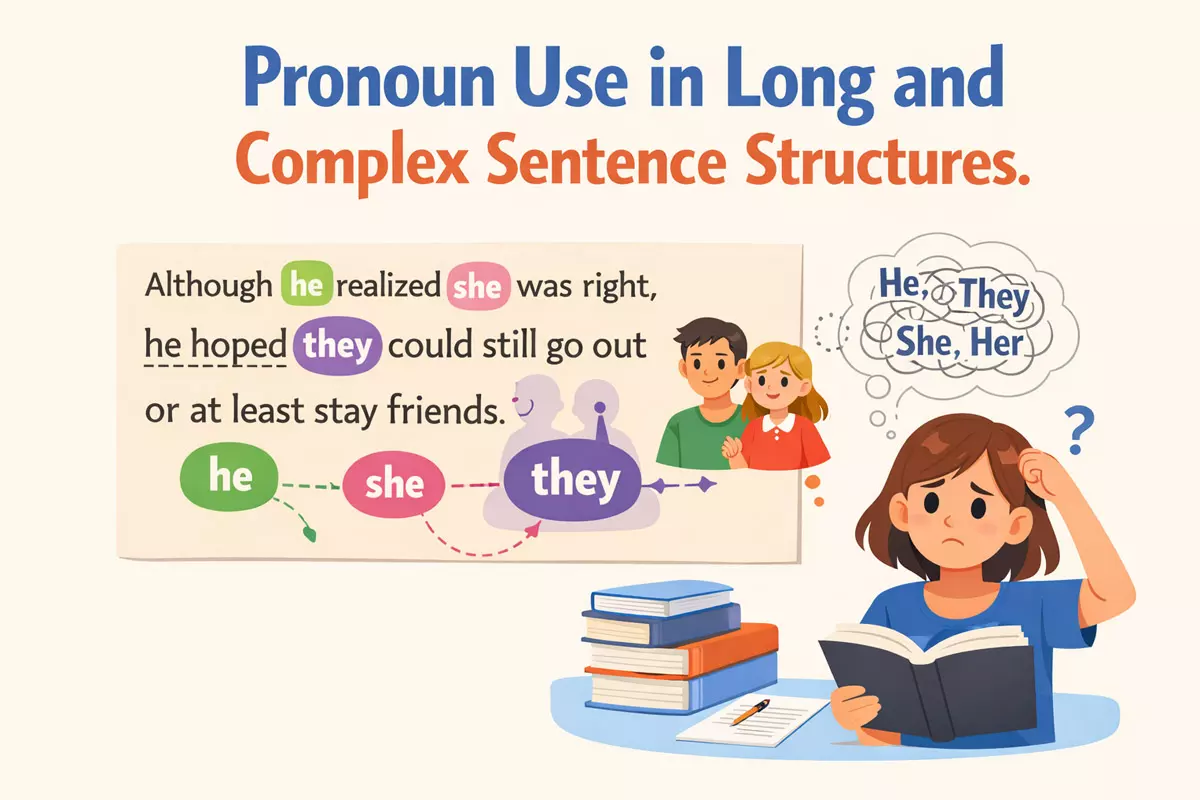 Here we why long sentences cause pronoun confusion, especially with multiple clauses and complex structures. It gives strategies for clear pronoun use, editing tips, and practice exercises to help simplify and clarify pronoun-heavy sentences.
- Why long sentences increase pronoun confusion
- Multiple clauses and competing antecedents
- Pronoun placement in complex structures
- Avoiding overload in nested clauses
- Breaking sentences for clarity
- Formal writing considerations
- Editing strategies for complex syntax
- Practice: simplify pronoun-heavy sentences
Referring to people and things accurately within long, complex sentences can be surprisingly difficult, especially if you want your writing to remain clear and easy to follow. Choosing the right words to connect ideas—such as pronouns and relative clauses—is crucial for ensuring your message makes sense and flows smoothly. Developing skill in this area is important for anyone aiming to communicate with precision and subtlety, whether in academic writing, professional correspondence, or everyday conversation.
Why long sentences increase pronoun confusion
Lengthy and intricate sentence structures often make it harder for readers to keep track of which noun a pronoun is referring to. As more clauses and descriptive phrases are added, the connection between pronouns like "he," "she," "they," or "it" and their intended nouns can become ambiguous, especially when multiple people or objects are mentioned.
More Distance, Less Clarity
When a pronoun appears far from its antecedent (the word it refers to), readers may lose track of the original subject. This is particularly common in sentences with several clauses or embedded details. The further apart the pronoun and its reference, the more likely it is that confusion will arise.
Multiple Referents in a Single Sentence
Introducing several individuals or items in one sentence increases the chances that a pronoun could logically refer to more than one of them. For example:
- Maria gave Anna her book after she finished reading it.
- When the dog chased the cat, it ran into the garden.
In both cases, “her” and “it” can refer to more than one possible noun, making the meaning unclear.
Common Patterns That Lead to Ambiguity
Writers often fall into certain patterns that create confusion with pronouns in longer sentences. Here are some frequent scenarios:
- Using several nouns of the same gender or number before a pronoun
- Inserting lengthy descriptive phrases between the noun and the pronoun
- Mixing active and passive constructions in a single sentence
- Switching topics or actors without clear transitions
- Relying on pronouns to refer to entire phrases or actions, not just single words
- Introducing lists or sequences, then using "they" or "it" without clarity
- Embedding dialogue or quotations between references
- Referring to abstract concepts with "this," "that," or "which" without clear definition
- Using pronouns immediately after conjunctions ("and," "but," "so") with multiple possible antecedents
- Overusing pronouns when repetition of the noun would be clearer
Examples: Short vs. Long Sentences

To illustrate how sentence length impacts pronoun clarity, compare the following examples:
| Short Sentence | Long/Complex Sentence |
|---|---|
| Lisa dropped her keys. | Lisa saw Anna at the café, and after they talked about their plans for the weekend, she dropped her keys near the counter as she was leaving. |
| The cat chased the mouse. | The cat, which had been watching the mouse from under the table for several minutes, finally chased it across the kitchen when the dog barked unexpectedly. |
| He fixed the bike. | After John borrowed Mike’s bike and rode it to the park, he fixed it in the garage because it had a flat tire. |
| She called her friend. | While Emily was preparing dinner and talking to her sister about the event, she called her friend to confirm the time, which confused everyone involved. |
In each pair, the longer sentence contains more potential sources of ambiguity, as multiple nouns and actions appear between the pronoun and its intended referent.
Takeaway: Simplify for Clarity
To minimize confusion, consider breaking up long sentences or repeating the noun instead of using a pronoun when several possibilities exist. Keeping sentence structures straightforward helps ensure that readers can easily follow who or what each pronoun refers to, especially in complex or technical writing.
Multiple clauses and competing antecedents
Long sentences often include several clauses—main, subordinate, relative, or conditional—that can introduce ambiguity when referring to people or things with pronouns. As sentence complexity increases, it becomes more challenging to determine which noun a pronoun is meant to replace, especially when several possible antecedents are present. Careful construction and clear referencing are crucial for reader comprehension.
Common sources of pronoun ambiguity
- Multiple nouns of the same gender or number appearing before the pronoun
- Intervening clauses that separate the pronoun from its intended referent
- Compound subjects or objects joined by "and," "or," or "nor"
- Use of generic nouns (e.g., "person," "group," "team") alongside specific names
- Switching between singular and plural nouns in close proximity
- Relative clauses that introduce additional nouns
- Parenthetical statements that add extra details and nouns
- Ellipsis or omitted words that require inference
- Pronouns placed at the start of a new clause without clear reference
- Shifts in perspective or topic within the same sentence
Strategies for resolving ambiguities
Writers can use several techniques to clarify which noun a pronoun refers to in a complex sentence:
- Repeat the noun instead of using a pronoun when confusion is likely
- Reorder clauses so the pronoun follows its antecedent closely
- Replace vague pronouns with more specific language (e.g., "the teacher" instead of "she")
- Break long sentences into shorter, clearer statements
- Use demonstratives ("this," "that") for added clarity
- Add descriptive phrases to reinforce the referent (e.g., "the manager, who approved the plan, said he…")
Examples: Ambiguous vs. clear pronoun reference
| Ambiguous Sentence | Clear Sentence |
|---|---|
| When Sarah spoke to Emily, she was upset. | When Sarah spoke to Emily, Sarah was upset. |
| After the manager gave the report to the assistant, he left the room. | After the manager gave the report to the assistant, the manager left the room. |
| The dog chased the cat because it was scared. | The dog chased the cat because the cat was scared. |
| The students told the teachers they needed more time. | The students told the teachers that the students needed more time. |
| Lisa asked Maria if she could borrow her book. | Lisa asked Maria if Lisa could borrow Maria's book. |
Checklist for clear pronoun reference in complex sentences
- Is the pronoun’s referent the closest preceding noun?
- Would repeating the noun improve clarity?
- Do all readers interpret the pronoun the same way?
- Are multiple possible antecedents present?
- Can the sentence be restructured for simplicity?
Awareness of these issues helps writers maintain clarity and precision when using pronouns in intricate sentence structures.
Pronoun placement in complex structures
In lengthy or intricate sentences, the location of pronouns can affect clarity and flow. When sentences include multiple clauses, relative phrases, or embedded quotations, it’s important to keep track of which noun each pronoun refers to. Pronouns that are too far from their antecedents may confuse readers, especially in sentences with several nouns or ideas. To maintain coherence, writers often position pronouns as close as possible to their referents and avoid ambiguous placements.
Common patterns in complex sentences
Writers use several strategies to help readers follow pronoun references in dense sentence structures. Here are some frequent patterns:
- Placing the pronoun immediately after the noun it refers to, especially in relative clauses.
- Repeating the noun for emphasis or clarity when multiple potential antecedents exist.
- Positioning pronouns at the start of subordinate clauses to signal a new subject.
- Using demonstrative pronouns (this, that, these, those) to refer to whole ideas or sentences, rather than single nouns.
- Introducing pronouns after transition words to clarify the shift in topic.
- Avoiding pronouns at the beginning of sentences when the referent isn’t clear from the previous context.
- Placing object pronouns immediately before or after the verb, depending on the clause type.
- Employing reflexive pronouns for emphasis, especially in longer sentences.
- Ensuring subject and object pronouns are not easily confused in sentences with parallel structure.
- Rewording sentences to reduce the distance between pronoun and noun when ambiguity arises.
Examples of pronoun placement
Let’s compare how pronouns can be positioned in sentences with different levels of complexity:
| Sentence Structure | Pronoun Placement Example |
|---|---|
| Simple clause | Maria called her friend. |
| With relative clause | Maria, who said she would arrive early, called her friend. |
| Multiple clauses | When Maria finished her work, she called her friend because she missed her. |
| Embedded quotation | Maria said, “I will call her after I finish,” and then she did. |
| Ambiguous antecedent | Maria told Anna that she would arrive early. (Who is “she”?) |
Troubleshooting unclear pronoun use
Ambiguity often arises when a pronoun could refer to more than one noun. To resolve this, writers can repeat the noun, restructure the sentence, or use a more specific pronoun. In academic and technical writing, clarity is prioritized, so it’s common to avoid pronouns altogether in especially complex structures.
- Clear: After Maria finished her work, Maria called Anna because Anna missed her.
- Unclear: After Maria finished her work, she called her because she missed her.
By paying attention to pronoun placement, writers ensure their sentences remain clear—even as ideas become more intricate.
Avoiding overload in nested clauses
When sentences become long and complex, especially with multiple embedded clauses, pronoun clarity can quickly suffer. Readers may lose track of which noun a pronoun refers to, or become confused by too many references in a short span. Managing this cognitive load is essential for both clear writing and effective comprehension.
Recognizing the risk of pronoun confusion
Nested clauses often stack several ideas within a single sentence, increasing the potential for ambiguous or overloaded pronoun use. For example, in the sentence "The manager who supervised the team that developed the software said he was impressed," it may not be clear whether "he" refers to the manager or someone from the team. To prevent this, writers need strategies for managing pronoun reference.
Techniques for maintaining clarity
- Repeat the noun if there is any doubt about the referent.
- Break up long sentences into shorter, more manageable chunks.
- Use specific pronouns (such as "themselves," "herself," "itself") when possible.
- Limit the number of pronouns in a single sentence.
- Vary sentence structure to avoid back-to-back clauses with different referents.
- Introduce pronoun referents close to their pronouns to reduce memory load.
- Favor active voice for clearer subject-pronoun relationships.
- Use names or descriptive phrases when pronouns might be ambiguous.
- Check each pronoun by asking, “To whom or what does this refer?”
- Read sentences aloud to catch potential confusion in complex structures.
Common pitfalls and effective alternatives
| Problematic Sentence | Clearer Revision |
|---|---|
| When the engineers who designed the bridge met the inspectors, they said it was unsafe. | When the engineers who designed the bridge met the inspectors, the inspectors said the bridge was unsafe. |
| The teacher told the student that she would need to improve her grades. | The teacher told the student, "You will need to improve your grades." |
| After the committee reviewed the proposal, they sent it to the board, which approved it. | After the committee reviewed the proposal, the board approved it following their recommendation. |
| The dog chased the cat, which ran up the tree, but it still barked at it. | The dog chased the cat, which ran up the tree, but the dog still barked at the cat. |
Effective management of pronoun use in complex sentences helps readers follow the intended meaning without unnecessary effort. By applying these strategies, writers can prevent misunderstanding and ensure their writing remains accessible, even as sentence structures grow more intricate.
Breaking sentences for clarity
When sentences grow longer and more intricate, readers can lose track of which pronouns refer to which nouns. This confusion often leads to misunderstanding or misinterpretation of the intended message. One effective strategy for preventing ambiguity is to divide lengthy statements into shorter, more focused ones. By doing so, each pronoun’s reference becomes easier to identify, and the overall flow of information improves.
Why sentence length affects pronoun clarity
Pronouns rely on clear antecedents, but in extended or compound sentences, multiple nouns can intervene. This increases the likelihood that a pronoun such as he, she, or they might point to the wrong subject or object. Breaking up sentences helps maintain a one-to-one relationship between a pronoun and its antecedent, reducing the cognitive load for the reader.
Signs your sentence may need to be divided
- Contains more than two pronouns with possible ambiguous references
- Includes several clauses joined by conjunctions like and, but, or while
- Uses multiple subjects or objects within the same sentence
- Has parenthetical or interrupting phrases that distance pronouns from their antecedents
- Requires re-reading to determine who or what a pronoun refers to
Examples: Before and after splitting sentences

Consider how breaking up complex sentences can clarify which nouns the pronouns refer to:
| Original Sentence | Revised Sentences |
|---|---|
| When Maria gave Anna her book, she thanked her for lending it, but she forgot to return it to her after reading it. | Maria gave Anna her book. Anna thanked Maria for lending it. However, Anna forgot to return the book after reading it. |
| John spoke to Alex about his project because he thought it needed more work, and he wanted him to succeed. | John spoke to Alex about Alex’s project. John thought the project needed more work. He wanted Alex to succeed. |
| The teacher told the student that she should submit her assignment, but she didn’t realize the deadline had passed. | The teacher told the student to submit her assignment. The student didn’t realize the deadline had passed. |
| Sara and Emily went to the store because she wanted to buy groceries, but they forgot their list so she had to remember everything. | Sara and Emily went to the store. Emily wanted to buy groceries. They forgot their list, so Emily had to remember everything. |
Tips for splitting complex sentences
- Identify each pronoun and its intended noun; if unclear, separate into individual sentences
- Replace pronouns with specific nouns when needed to reinforce clarity
- Use transition words (however, then, afterward) to maintain flow across sentences
- Read the sentences aloud to check if the meaning is immediately clear
- Limit each sentence to one main idea or action whenever possible
Splitting lengthy sentences not only improves how pronouns are understood but also makes writing more readable and precise. When in doubt, shorter sentences with explicit nouns help ensure that every reference is unmistakable.
Formal writing considerations
When constructing lengthy or intricate sentences, writers need to be especially attentive to clarity in pronoun use. Ambiguous references can confuse readers, especially in academic and professional contexts where precision is critical. Careful placement and clear antecedents help ensure readers can easily track who or what each pronoun refers to.
Clarity and ambiguity avoidance
A primary goal is to prevent ambiguity. In sentences with multiple nouns, a pronoun may refer back to more than one possible antecedent. To avoid this, repeat the noun if necessary, or restructure the sentence. For example, instead of "When Maria gave Anna her book, she thanked her," specify: "When Maria gave Anna her book, Anna thanked Maria."
Consistency and formality
Maintaining consistent pronoun forms throughout a document is essential. Shifting between formal and informal pronouns, or between singular and plural, can distract readers and undermine the professionalism of the text. Additionally, avoid conversational shortcuts and vague references that might be acceptable in speech but are out of place in formal documents.
Common challenges in extended sentence structures
Writers often face recurring issues when using pronouns in complex sentences. Some common pitfalls include:
- Unclear antecedents due to multiple nouns
- Pronoun-antecedent disagreement in number or gender
- Overuse of relative clauses leading to confusion
- Switching between first, second, and third person without reason
- Using "it" or "they" without a clear reference
- Referencing entire clauses or sentences with "this," "which," or "that"
- Ambiguous use of reflexive pronouns ("himself," "themselves")
- Over-reliance on passive constructions that mask agency
- Inconsistent use of gender-neutral pronouns
- Excessive nominalization that distances the pronoun from its noun
- Stacking multiple pronouns in a single sentence
- Using "one" and "you" interchangeably
- Introducing pronouns before their referents
- Neglecting to clarify possessive relationships
- Improper use of demonstrative pronouns ("these," "those")
Comparison of pronoun strategies in formal writing
| Strategy | Example |
|---|---|
| Repeat the noun for clarity | The committee reviewed the proposal before the committee submitted its recommendations. |
| Use explicit antecedents | After the researchers collected the data, the researchers analyzed it thoroughly. |
| Restructure to avoid pronoun confusion | Instead of "He told John that he was late," write, "He told John, 'You are late.'" |
| Employ gender-neutral language | Each student should submit their assignment by Friday. |
Writers aiming for clarity in academic or business communication should regularly review their drafts for these issues. Reading sentences aloud or having a peer review the text can help catch ambiguous references. Ultimately, attention to detail in pronoun use within complex structures enhances both readability and professionalism.
Editing strategies for complex syntax
When working with lengthy or intricate sentences, it's easy for pronoun references to become unclear or ambiguous. Careful editing is essential to maintain clarity, especially when multiple clauses or embedded phrases are involved. Editors can use several practical techniques to make sure pronouns consistently refer to the correct nouns and that readers can easily follow the intended meaning.
Key steps for clarifying pronoun references
- Identify all pronouns: Highlight every pronoun in a sentence and check that each has a clear, unmistakable antecedent.
- Reduce ambiguity: If a pronoun could refer to more than one noun, rewrite the sentence or replace the pronoun with the noun itself.
- Break up long sentences: Divide overly complex structures into shorter, manageable units to improve readability and pronoun clarity.
- Check for proximity: Make sure pronouns are placed close to their antecedents whenever possible.
- Use parallel structure: When listing or comparing, keep sentence patterns consistent so pronoun references remain obvious.
- Revise for consistency: Stick to the same point of view and pronoun set throughout a passage to avoid confusion.
- Eliminate unnecessary pronouns: Remove redundant pronouns or rewrite to reduce repetition.
- Read aloud: Hearing the sentence can help spot awkward or unclear pronoun usage.
- Consult with others: Ask a peer to review tricky sentences for potential misinterpretation.
- Use specific determiners: Substitute demonstratives (this, that, these, those) or definite articles when appropriate for extra clarity.
Common pronoun pitfalls in complex sentences
Writers often encounter particular trouble spots when editing lengthy or multi-clause constructions. The following table illustrates frequent issues and practical solutions:
| Problem | Editing Solution |
|---|---|
| Ambiguous pronoun reference | Replace the pronoun with the noun, or restructure the sentence for clarity. |
| Pronoun too far from antecedent | Move the pronoun closer to its antecedent, or split the sentence. |
| Multiple possible antecedents | Specify the noun intended, or rephrase to eliminate confusion. |
| Shift in pronoun point of view | Revise all pronouns to maintain a consistent perspective. |
| Unnecessary repetition of pronouns | Omit redundant pronouns and streamline the sentence. |
Practical checklist for reviewing complex syntax
- Does every pronoun have a clear, singular antecedent?
- Are all references unambiguous, even in lengthy sentences?
- Have you avoided switching between “he/she/they” within the same context?
- Could breaking up the sentence improve pronoun clarity?
- Are noun-pronoun pairs close together for easy understanding?
By systematically applying these techniques, editors can untangle even the most complicated sentence structures, ensuring that pronoun usage remains precise and reader-friendly throughout a text.
Practice: simplify pronoun-heavy sentences
Long sentences crammed with pronouns can confuse readers, especially when it’s unclear who or what each pronoun refers to. This section offers hands-on exercises to help you identify and revise such sentences for clarity. You’ll see real examples, try your hand at rewriting, and check your work against suggested answers.
Recognizing Pronoun Overload
Before practicing simplification, take a look at these sentences. Each one uses several pronouns, making it difficult to follow. Try to spot where the confusion arises.
- When she gave her the book, she said she would return it after she read it.
- They told them that they should call them if they needed them.
- He knew it was important, but he forgot to mention it when he saw her.
- If you see him, tell him he should bring it to her before she leaves.
- She asked him if he could help her because she couldn’t do it herself.
- They promised they would finish it, but they didn’t tell anyone when they would do it.
- When John met Mike, he told him that he needed to finish his project soon.
- After they left, they realized they had forgotten their keys at their house.
- She told her that she would meet her at her office after her meeting.
- If the team wants to win, they need to believe in themselves and support each other.
Practice: Rewrite for Clarity
Choose several sentences from the list above and try to rewrite them so that the meaning is clear and the pronoun references are explicit. Replace vague pronouns with specific nouns where needed.
- When she gave her the book, she said she would return it after she read it.
- They told them that they should call them if they needed them.
- When John met Mike, he told him that he needed to finish his project soon.
- After they left, they realized they had forgotten their keys at their house.
- She told her that she would meet her at her office after her meeting.
- When he emailed him, he said he would reply after he reviewed it.
- They reminded them that they should submit their reports before they sent them.
- After she spoke to her, she realized she had misunderstood her message.
- When they invited them to the event, they asked them to bring their guests.
- He promised her that he would send her the document once he finished it.
Show answers
- When Maria gave Anna the book, Anna said she would return the book after she read it.
- The managers told the new employees that the employees should call the managers if the employees needed help.
- When John met Mike, John told Mike that Mike needed to finish Mike’s project soon.
- After the Smith family left, the Smith family realized they had forgotten their keys at their house.
- Emma told Olivia that Emma would meet Olivia at Olivia’s office after Olivia’s meeting.
- When David emailed Paul, David said he would reply after David reviewed the message.
- The supervisors reminded the interns that the interns should submit the interns’ reports before the interns sent the reports.
- After Laura spoke to Nina, Laura realized Laura had misunderstood Nina’s message.
- When the hosts invited the guests to the event, the hosts asked the guests to bring the guests’ companions.
- Michael promised Sarah that Michael would send Sarah the document once Michael finished the document.
Quick Comparison: Original vs. Simplified
| Original Sentence | Clear Version |
|---|---|
| She asked him if he could help her because she couldn’t do it herself. | Sophia asked Daniel if he could help her because Sophia couldn’t do the task herself. |
| He knew it was important, but he forgot to mention it when he saw her. | Michael knew the deadline was important, but he forgot to mention it to Sarah when he saw her. |
| If you see him, tell him he should bring it to her before she leaves. | If you see Alex, tell him he should bring the report to Lisa before Lisa leaves. |
| They promised they would finish it, but they didn’t tell anyone when they would do it. | The students promised they would finish the project, but they didn’t tell anyone when they would complete it. |
Tips for Reducing Pronoun Confusion
- Replace ambiguous pronouns with specific nouns, especially when multiple people or things could be referenced.
- Break long sentences into shorter ones if each clause refers to a different subject or object.
- Repeat the noun occasionally for clarity, particularly after several clauses or when new characters are introduced.
- Review your writing by reading aloud; unclear pronoun references often become obvious when spoken.
- Ask someone else to read your sentence and explain who or what each pronoun refers to.
By practicing these strategies, you’ll write sentences that are easier to understand and less likely to confuse your audience.