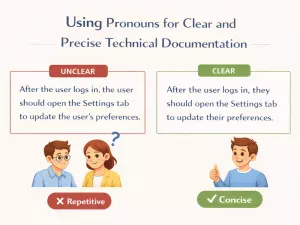
Pronoun Use in Legal and Technical Writing Contexts

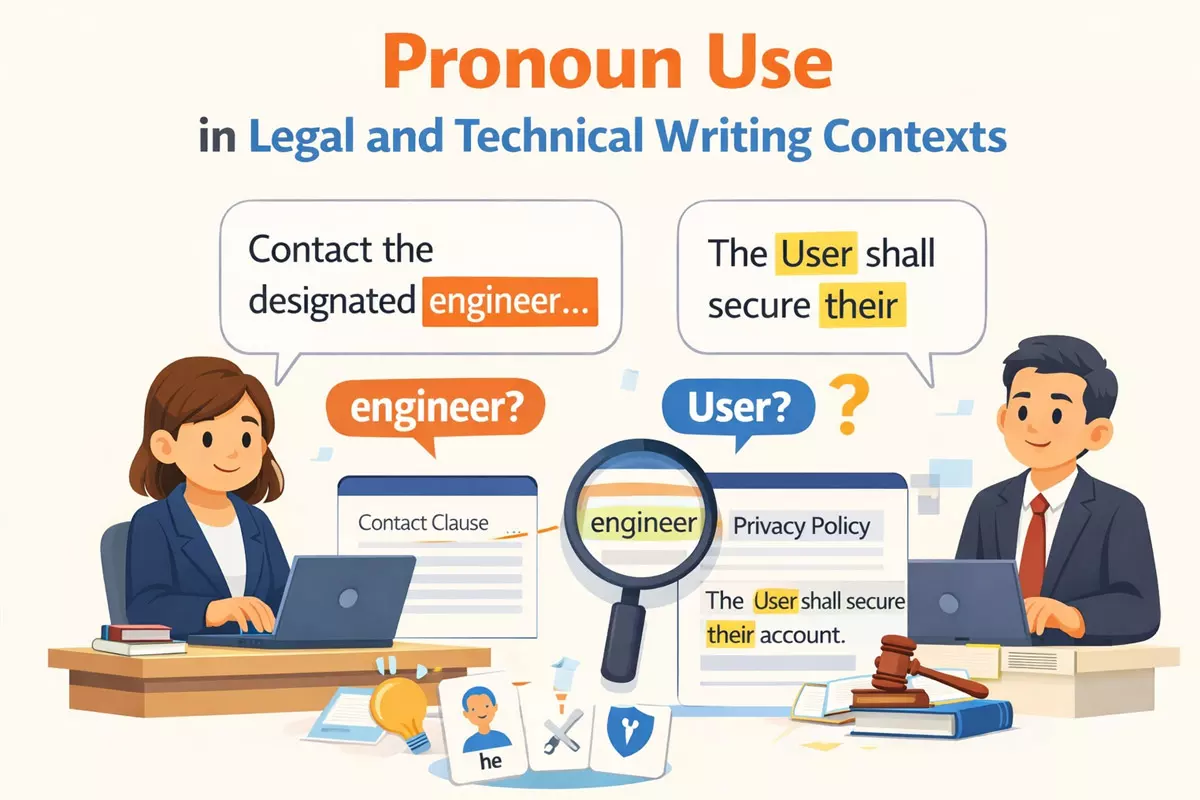 Here we why pronouns are risky in legal and technical writing, examines clarity versus readability, details pronoun restrictions, and shows when repetition or impersonal terms are better.
- Why pronouns are risky in legal and technical texts
- Precision vs readability trade-offs
- Avoiding ambiguity in legal reference
- Pronoun restrictions in technical standards
- When repetition is preferred over pronouns
- Impersonal constructions and defined terms
- Examples from legal and technical writing
- Practice: revise sentences for precision
Choosing the appropriate language in legal and technical documents is essential for ensuring clarity, precision, and inclusivity. The terms used to refer to individuals or organizations can significantly affect the interpretation of a document, as well as its accessibility to a wider audience. Careful selection of words helps avoid ambiguity and miscommunication, which is particularly important in contexts where misunderstandings can have serious consequences. Ultimately, thoughtful terminology contributes to more effective and equitable documentation.
Why pronouns are risky in legal and technical texts
Ambiguity is a major concern when using pronouns such as “it,” “they,” or “this” in legal or technical writing. In everyday language, these words often refer back to the most recent noun, but in dense documents with multiple entities or concepts, readers can easily lose track of what each pronoun is referencing. This confusion can lead to misinterpretation, costly errors, or even legal disputes.
Potential for Misunderstanding
Pronouns risk obscuring meaning because they rely on context that may not be clear to every reader. In legal contracts or technical manuals, a single unclear pronoun can change obligations, responsibilities, or operational steps. When several parties or components are involved, it becomes even harder to trace pronoun references with certainty.
Common Problem Areas
- Multiple parties (e.g., “the buyer,” “the seller,” “the contractor”)
- Lists of processes or steps
- References to previous sections or clauses
- Technical descriptions involving several parts or systems
- Instructions with conditional statements
- Definitions that change over the course of a document
- Where gendered pronouns are used for non-person entities
- Repetitive use of “it” or “they” without clear antecedents
- Cross-references spanning multiple pages
- Generic use of “this,” “that,” or “these” for abstract concepts
Consequences of Ambiguous Pronouns
Misused pronouns can have serious effects. In legal documents, unclear references might lead to contractual loopholes or unenforceable terms. In technical writing, a vague “it” could cause a user to apply a procedure to the wrong component, risking safety or equipment failure. Precision is not just preferred—it’s essential for clarity and enforceability.
Comparison: Pronouns vs. Explicit References

| Pronoun Example | Explicit Reference Example |
|---|---|
| If it fails, contact support. | If the sensor fails, contact support. |
| The contractor shall deliver the goods. They must be inspected. | The contractor shall deliver the goods. The goods must be inspected. |
| When this occurs, reset the system. | When a power outage occurs, reset the system. |
| It is the responsibility of the party to ensure compliance. | It is the responsibility of the buyer to ensure compliance. |
Best Practices for Legal and Technical Writing
- Replace pronouns with explicit nouns whenever possible.
- Define entities clearly at the start and use consistent terminology.
- Minimize the distance between a noun and its pronoun reference.
- Review drafts for ambiguous references, especially after revisions.
- Use bullet points or tables to clarify complex relationships.
In summary, careful management of pronouns in precise writing environments reduces the risk of confusion, disputes, and operational mistakes. By favoring clear, explicit references, writers can ensure their documents remain unambiguous and reliable.
Precision vs readability trade-offs
Writers in legal and technical fields constantly juggle the need for accuracy with the desire for accessible language. Using pronouns, for example, can make documents flow better, but they also risk introducing ambiguity. On the other hand, sticking strictly to nouns and formal references preserves clarity, yet can create dense or repetitive prose that is challenging to follow. Striking a balance depends on context, audience, and the consequences of misunderstanding.
Legal Documents: Prioritizing Clarity
Legal language traditionally avoids pronouns when possible, favoring precise repetition of party names or defined terms. This minimizes the risk of misinterpretation, particularly in contracts or statutes where even slight confusion can lead to disputes. However, this approach often results in lengthy sentences and significant redundancy, which can make reading and comprehension more difficult for non-experts.
Technical Writing: Navigating Complexity
Technical manuals and specifications often face similar issues. Overuse of pronouns like "it," "they," or "this" can obscure which process, component, or entity is being referenced, especially in documents with multiple subjects. Conversely, excessive repetition can bog down the text, making instructions harder to follow and increasing cognitive load. Writers must judge when a pronoun is clear from context and when explicit reference is necessary.
Common Approaches to Pronoun Use
- Repeating full terms for legal parties or technical elements
- Using defined abbreviations after initial introduction
- Employing pronouns only when the referent is unmistakable
- Adding clarifying parentheticals after pronouns (e.g., "it (the device)")
- Structuring sentences to keep referents close to pronouns
- Utilizing passive voice to avoid unclear subjects or objects
- Rewriting sentences to reduce pronoun necessity
- Providing glossaries or definition sections for recurring terms
- Testing drafts with readers unfamiliar with the subject
- Adopting standardized templates with consistent pronoun rules
- Using gender-neutral pronouns or singular "they" for inclusivity
- Limiting pronoun use in lists and procedural steps
- Highlighting referents visually (bold, italics) for clarity
- Employing cross-references to anchor pronouns to definitions
- Breaking up long sentences to reduce ambiguity
Comparing Approaches
| Method | Advantages ✅ / Drawbacks ❌ |
|---|---|
| Full Noun Repetition | ✅ Maximum clarity ❌ Tedious, repetitive |
| Selective Pronoun Use | ✅ Improves flow ❌ Risk of ambiguity |
| Abbreviations/Definitions | ✅ Balances brevity and clarity ❌ Requires reader recall |
| Parenthetical Clarification | ✅ Immediate reference ❌ Can clutter text |
| Contextual Sentence Structure | ✅ Reduces confusion ❌ Needs careful editing |
Ultimately, the most effective legal and technical writing adapts its approach to the document’s purpose. Clarity should never be sacrificed for brevity, but readability is also crucial for ensuring that information is understood and correctly applied. Careful revision, reader testing, and adherence to established best practices can help writers find the right equilibrium between exactness and accessibility when using pronouns.
Avoiding ambiguity in legal reference
Clarity is paramount when drafting legal documents, especially when using pronouns. Unclear references can lead to costly disputes or unintended interpretations. Legal writers must take extra care to ensure that every pronoun unmistakably points to its intended antecedent. This often means favoring repetition or more explicit language over the natural flow found in everyday writing.
Common sources of confusion
- Using "it," "they," or "their" without a clear noun nearby
- Multiple parties or entities in the same sentence or paragraph
- Switching between singular and plural entities
- Proximity of several possible antecedents
- Long sentences with embedded clauses
- Legal terms that can refer to either people or organizations
- Section references that rely on "this," "such," or "said"
- Ambiguous use of gender-neutral pronouns
- References to prior agreements or documents
- Undefined abbreviations or acronyms
Best practices for clear legal referencing
- Repeat the full party name or defined term rather than using "he," "she," "it," or "they" when confusion is possible
- Define all parties and terms at the start of the document
- Use formatting (such as capitalization) for defined terms, e.g., “Company”, “Supplier”
- Limit sentence length and complexity
- Refer to specific sections or clauses by number or title, not just "herein" or "above"
- Use gender-neutral language consistently
- Clarify pronoun reference by restating the noun if a paragraph is long
- Review drafts for possible alternate meanings
- Ask a colleague to review for pronoun clarity
Examples: Clear vs. ambiguous pronoun use
| Ambiguous Example | Clear Revision |
|---|---|
| If the Supplier delivers the goods and they are defective, it must replace them. | If the Supplier delivers goods that are defective, the Supplier must replace the defective goods. |
| The Buyer and Seller agree that it will pay the taxes. | The Buyer and Seller agree that the Buyer will pay the taxes. |
| The Company shall send the notice to the Client within five days of its receipt. | The Company shall send the notice to the Client within five days of the Company's receipt of the notice. |
| Upon termination, it will be returned to the owner. | Upon termination, the equipment will be returned to the owner. |
Ultimately, precision in referencing parties, terms, and obligations ensures that legal documents are interpreted as intended. Writers should always prioritize explicitness over brevity when the risk of confusion exists, and take advantage of defined terms, consistent terminology, and careful review to minimize ambiguity.
Pronoun restrictions in technical standards
Many technical standards and specifications deliberately limit or avoid the use of personal pronouns to ensure clarity, precision, and universal applicability. This practice is especially common in documents that must be interpreted consistently by diverse readers across organizations and jurisdictions. Instead of "you," "we," or "they," technical writing often substitutes specific nouns or passive constructions to remove ambiguity about who is responsible for an action.
Common approaches to pronoun limitation
- Replacing personal pronouns with precise nouns (e.g., "the user" instead of "you")
- Using passive voice to avoid specifying an actor ("The system shall be tested" instead of "You shall test the system")
- Preferring the imperative mood for instructions ("Install the software" rather than "You should install the software")
- Referring to entities by their defined roles or titles ("The operator must..." rather than "He/She must...")
- Omitting pronouns entirely when context makes the subject clear
- Utilizing consistent terminology to minimize referential confusion
- Adopting gender-neutral expressions wherever possible
- Clarifying antecedents when pronouns are unavoidable
- Standardizing language across similar documents for uniformity
- Specifying actions as requirements rather than as personal directives
Rationale for minimizing pronouns
The main reason for restricting pronoun use is to prevent misinterpretation. Technical standards frequently serve as legal references, and any ambiguity around "who" is obligated or permitted to perform an action can lead to inconsistent application. Avoiding personal pronouns also helps make documents more universally accessible, since roles may change depending on the reader’s context.
Typical pronoun-related conventions
| Original Phrase | Preferred in Standards |
|---|---|
| You must calibrate the device. | The operator must calibrate the device. |
| We recommend updating the firmware. | Firmware updates are recommended. |
| They should verify the results. | The testing team should verify the results. |
| He or she must sign the report. | The authorized signatory must sign the report. |
| Install it before use. | The software must be installed before use. |
Benefits and challenges
Limiting pronouns can make documents more precise and reduce the risk of misinterpretation. However, it may also result in less natural or more repetitive text, which can impact readability. Technical writers must balance the need for unambiguous language with the goal of maintaining accessible, user-friendly documentation.
When repetition is preferred over pronouns
In legal and technical writing, clarity and precision often outweigh the desire for conciseness. Repeating the full name of a party, object, or concept can be essential to avoid confusion, especially in documents where multiple entities or terms are used repeatedly. While pronouns can streamline sentences, they can also introduce ambiguity if the reader must guess what “it,” “they,” or “this” refers to. This is particularly true in contexts where similar terms or multiple actors are involved in the same passage.
Why repetition aids clarity
Using the explicit term instead of a pronoun ensures the reader always knows exactly which subject or object is being discussed. This eliminates the risk of misinterpretation—an important safeguard in contracts, statutes, technical specifications, and manuals. Even if the repetition feels redundant, it can prevent costly mistakes or misunderstandings.
Situations that call for explicit repetition
- Multiple parties: When more than one person, company, or object is referenced, repeating the names or terms avoids confusion (e.g., “the Contractor” and “the Subcontractor”).
- Dense technical descriptions: In instructions or documentation, repeating the specific part or process reduces the risk of errors.
- First use in a section: The initial mention of a term in each section or paragraph should be explicit, rather than using a pronoun.
- Legal definitions: When a defined term is used, repeat it exactly for consistency.
- Cross-references: When referring to another section, repeat the full heading or reference to avoid ambiguity.
- Lists with similar items: When listing similar or related items, repeat the full term for each to prevent confusion.
- Complex sentences: If a sentence contains multiple clauses or subjects, repeating the term can make the sentence easier to follow.
- Formal requirements: Some legal and technical documents mandate repetition by convention or regulation.
- When pronouns could refer to more than one antecedent: If there is any doubt about what a pronoun refers to, use the full term.
- When introducing a new concept: Avoid using a pronoun for a concept that has not yet been clearly identified by name.
Comparing repetition and pronoun use

| Repetition | Pronouns |
|---|---|
| “The Lessor shall inspect the property. The Lessor shall notify the Lessee of any defects.” | “The Lessor shall inspect the property. He shall notify the Lessee of any defects.” |
| “The data processor must encrypt the data. The data processor must store the data securely.” | “The data processor must encrypt the data. It must store the data securely.” |
| “Section 5.2 outlines the requirements. Section 5.2 also details the timeline.” | “Section 5.2 outlines the requirements. It also details the timeline.” |
| “The sensor module connects to the control unit. The sensor module transmits data continuously.” | “The sensor module connects to the control unit. It transmits data continuously.” |
Key takeaways for writers
Choosing repetition over pronouns is often the safer path in legal and technical writing. Whenever there is a chance of ambiguity, or when the cost of misunderstanding is high, explicit repetition of terms helps ensure accuracy and reader confidence. While pronouns have their place in less formal or more narrative writing, formal documents benefit from explicitness and consistency.
Impersonal constructions and defined terms
Precision and clarity are essential in legal and technical writing. One common strategy is to use language that avoids personal pronouns or specific agents, often called impersonal constructions. These structures help writers maintain objectivity, reduce ambiguity, and ensure that documents apply broadly rather than to individuals. Instead of "you must submit the form," a technical manual might state "the form must be submitted." This shift removes personal reference and makes instructions universally applicable.
Common Impersonal Constructions
Writers use several established patterns to avoid direct pronoun use. Here are frequent approaches:
- Passive voice (e.g., "The contract shall be signed")
- Third-person references ("The user agrees to...")
- Nominalizations ("Completion of the task is required")
- Generalized noun phrases ("Any party may terminate")
- Use of "one" as a generic subject ("One must comply with...")
- Instructions without explicit subject ("Enter the password")
- Abstract nouns ("Payment is due upon receipt")
- Legal personhood terms ("The Company will...")
- Impersonal verbs ("It is understood that...")
- Formulas with "shall" or "must" ("The equipment shall be maintained")
- Reference to defined roles ("The Contractor shall...")
- Use of "the undersigned" or "holder" ("The undersigned agrees...")
- Statements of fact ("Failure to comply results in...")
- Generalized determiners ("Any employee found...")
- Conditional language ("If required, documentation must be provided")
- Non-human agents ("Software will update automatically")
- Unattributed requirements ("Proof of identity is necessary")
- Use of "it is" clauses ("It is the responsibility of...")
Defined Terms in Legal and Technical Writing
Defined terms are another tool for avoiding ambiguity and repetitive pronoun use. By assigning specific meanings to words or phrases, writers ensure consistency throughout a document. For example, a contract might define "Client" as "ABC Corporation" and use "Client" thereafter, eliminating the need for "he," "she," or "they."
| Defined Term | Example Usage |
|---|---|
| Party | Each Party shall bear its own costs. |
| Licensee | The Licensee must comply with all terms. |
| Effective Date | This Agreement commences on the Effective Date. |
| Service Provider | The Service Provider will deliver support. |
| Recipient | The Recipient agrees to confidentiality obligations. |
| Product | The Product shall be free from defects. |
| Confidential Information | Confidential Information must not be disclosed. |
| Term | The Term of this Agreement is one year. |
By relying on impersonal constructions and carefully crafted defined terms, legal and technical documents achieve both neutrality and precision. This approach minimizes the risk of misinterpretation and streamlines communication, especially when documents must apply to multiple parties or remain valid over time.
Examples from legal and technical writing
Pronouns play a critical role in both legal documents and technical manuals, yet their use is often guided by different conventions and priorities. In legal contexts, clarity and precision are paramount, so writers frequently avoid ambiguous pronouns or replace them with specific nouns. Technical writing, on the other hand, may use pronouns to reduce repetition, but always with an eye toward unambiguous reference and user understanding.
Common pronoun strategies in legal documents
- Substituting party names for pronouns (e.g., "the Plaintiff" instead of "he/she").
- Using defined terms in place of pronouns for clarity.
- Avoiding "they" as a singular pronoun due to potential ambiguity.
- Explicitly defining pronouns at the outset ("‘Seller’ refers to Acme Corp.").
- Repetition of nouns where necessary to avoid confusion.
- Using gender-neutral language where possible, such as "the individual" or "the party".
- Omitting pronouns entirely in favor of passive constructions ("Payment shall be made...").
- Employing demonstrative pronouns only when the antecedent is unmistakably clear.
- Rarely using "it" for organizations unless previously defined.
- Avoiding pronouns that could refer to multiple antecedents in the same sentence.
Pronoun use in technical manuals and documentation
- Using "it" for machines, systems, or devices after clearly establishing the referent.
- Preferring the imperative mood, often omitting pronouns ("Press the button" instead of "You should press the button").
- Including second-person pronouns ("you") in user guides for direct instructions.
- Employing "we" in collaborative or instructional contexts ("We will now configure the server").
- Avoiding "he" or "she" unless describing a hypothetical user; favoring “they” for inclusivity, when clarity is preserved.
- Replacing pronouns with explicit terms to prevent misunderstanding, especially in troubleshooting steps.
- Using "this" and "that" only when the referent is obvious within the context.
- Minimizing pronoun chains in complex procedures.
- Defining any abbreviations or acronyms before using pronouns for them ("The Central Processing Unit (CPU) ... it ...").
- Rewriting sentences to eliminate ambiguous references.
Comparing approaches: Legal vs. Technical Writing
| Legal Writing | Technical Writing |
|---|---|
| Uses explicit party names instead of pronouns | Uses "it" or "you" after establishing the referent |
| Defines pronouns at document outset | Omits pronouns in imperative instructions |
| Avoids "they" as singular | Uses "they" for inclusivity when clear |
| Prioritizes unambiguous reference, sometimes at the expense of brevity | Balances clarity with readability and conciseness |
These approaches illustrate how pronoun use is tailored to the needs of each discipline. Legal writers emphasize precision and avoidance of ambiguity, while technical communicators focus on usability and clarity for their audience. Understanding these patterns can help writers in both fields make informed choices to improve their documents.
Practice: revise sentences for precision
Clarity and exactness are crucial in legal and technical documents. Ambiguous pronoun use can lead to misunderstandings or even legal disputes. The exercises below will help you identify and correct vague or imprecise pronoun references, ensuring your writing communicates your intended meaning without confusion.
Common Problems with Pronoun References
- Unclear antecedents: When it’s not obvious what a pronoun refers to.
- Ambiguous references: When a pronoun could refer to more than one noun.
- Overuse of “it,” “this,” or “they” without specifying the subject.
- Shifting between singular and plural pronouns in a confusing way.
Exercise: Identify and Revise
Below are several sentences drawn from legal or technical contexts. Each contains a problematic pronoun. Revise each sentence to clarify the reference and improve precision.
- The engineer reviewed the manual and updated it before the presentation.
- If the contractor fails to deliver the materials on time, they will be held liable for damages.
- The parties agreed to terminate the contract after it was found to be unworkable.
- The supervisor informed the technician that he should complete the inspection by noon.
- The software and the hardware must be compatible; if not, it may cause system errors.
- The witness stated that the defendant saw him at the scene.
- The committee discussed the report and decided to revise it.
- After reviewing the documents, they were filed in the cabinet.
- The client told the attorney that she needed more time.
- The instructions were unclear, which made it difficult to assemble the device.
Show answers
- The engineer reviewed the manual and updated the manual before the presentation.
Or: The engineer reviewed and updated the manual before the presentation. - If the contractor fails to deliver the materials on time, the contractor will be held liable for damages.
- The parties agreed to terminate the contract after the contract was found to be unworkable.
- The supervisor informed the technician that the technician should complete the inspection by noon.
Or (if the supervisor is meant): The supervisor stated that he should complete the inspection by noon. - The software and the hardware must be compatible; if not, the incompatibility may cause system errors.
- The witness stated that the defendant saw the witness at the scene.
- The committee discussed the report and decided to revise the report.
- After reviewing the documents, the reviewer filed them in the cabinet.
- The client told the attorney that the client needed more time.
Or (if the attorney is meant): The client told the attorney that the attorney needed more time. - The unclear instructions made assembly of the device difficult.
Patterns for Precise Pronoun Use
Legal and technical writers often use specific strategies to avoid ambiguity. Here are some examples:
- Repeat the noun instead of using a pronoun when confusion is possible.
- Use descriptive noun phrases (e.g., "the primary contractor" instead of "he").
- Clarify with appositives: "The manager, Ms. Lee, approved the change."
- Use demonstrative pronouns with a clear noun: "This requirement," "Those invoices."
- Recast sentences to eliminate the need for pronouns.
- Maintain consistent use of singular or plural forms throughout a section.
- Introduce abbreviations or defined terms for repeated reference.
- In complex sentences, place the pronoun as close as possible to its antecedent.
- Avoid using "it" or "they" at the start of a sentence unless the reference is unmistakable.
- In procedural writing, specify roles (e.g., "the operator" instead of "they").
- When discussing multiple parties, assign clear labels (e.g., "Plaintiff," "Defendant").
- For collective nouns, clarify if the group or individuals are meant: "The team members" vs. "the team."
- Use passive voice judiciously to avoid unclear agents, or specify the actor explicitly.
- When referencing documents, repeat the document’s title or type as needed.
- Consider footnotes or parentheticals for lengthy or technical explanations.
Comparison: Vague vs. Precise Pronoun Use
| Vague Example | Precise Revision |
|---|---|
| The manager told the assistant that she would review the contract. | The manager told the assistant that the manager would review the contract. |
| If they are not approved, the forms will be returned. | If the forms are not approved, the forms will be returned. |
| The device must be tested before it is installed. | The device must be tested before the device is installed. |
| The lawyer and the client discussed the case before he filed the motion. | The lawyer and the client discussed the case before the lawyer filed the motion. |
| The specifications were updated, which improved it. | The updated specifications improved the project. |