Conditionals in Legal, Technical, and Policy Writing

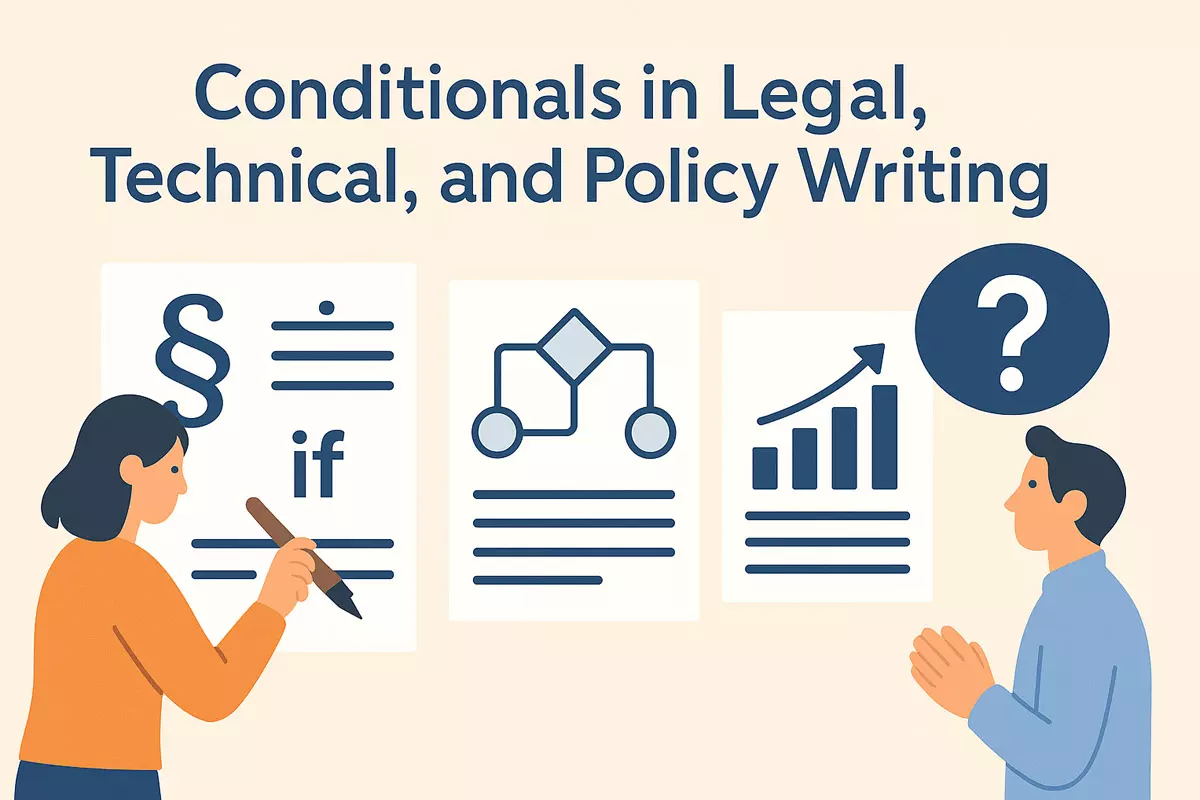 Here we the importance of conditional structures in legal and technical texts, compares strict and flexible conditions, highlights ambiguity risks, reviews common formatting patterns, and gives practical examples and tips for clear drafting.
- Why conditional structures are essential in legal and technical texts
- Strict vs flexible condition types in documentation
- Ambiguity risks when drafting conditional requirements
- Common conjunctions and formatting patterns
- Examples from policies, agreements, and manuals
- Practice: choose precise conditionals for legal/technical clarity
Crafting precise statements that rely on specific circumstances is crucial in legal, technical, and policy documents because the phrasing of “if-then” scenarios directly impacts the clarity, obligations, permissions, and outcomes described within these texts. The way writers construct such conditional statements often determines how easily a document can be interpreted and enforced, which is vital for ensuring that all parties understand their rights and responsibilities. Careful attention to conditional language helps prevent ambiguity and supports fair, consistent application of rules.
Why conditional structures are essential in legal and technical texts
Legal and technical documents rely heavily on conditional language to ensure clarity, precision, and predictability. By specifying what should happen if certain circumstances arise, writers can cover a wide range of potential scenarios and minimize ambiguity. This approach helps readers understand not just what must be done, but also under which situations particular rules or outcomes apply.
Clarifying obligations, permissions, and prohibitions
Conditionals help distinguish between mandatory actions, allowed exceptions, and outright prohibitions. For example, a regulation may state that a process is permitted only if specific safety measures are in place, or that penalties apply unless a deadline extension is granted. Such distinctions are crucial for compliance and for interpreting the intent of a rule.
Managing complexity and exceptions
The complexity of legal and technical systems often requires numerous exceptions, special cases, and dependencies. Conditional structures make it possible to build layered instructions, specifying how general principles interact with particular circumstances. This prevents oversights and reduces the risk of conflicting interpretations.
Common forms of conditional expressions
Writers in these fields use various patterns to express conditions, including:
| Expression | Meaning / Function | Example |
|---|---|---|
| If... then... | links a condition to a consequence | If you miss the deadline, then the application is rejected. |
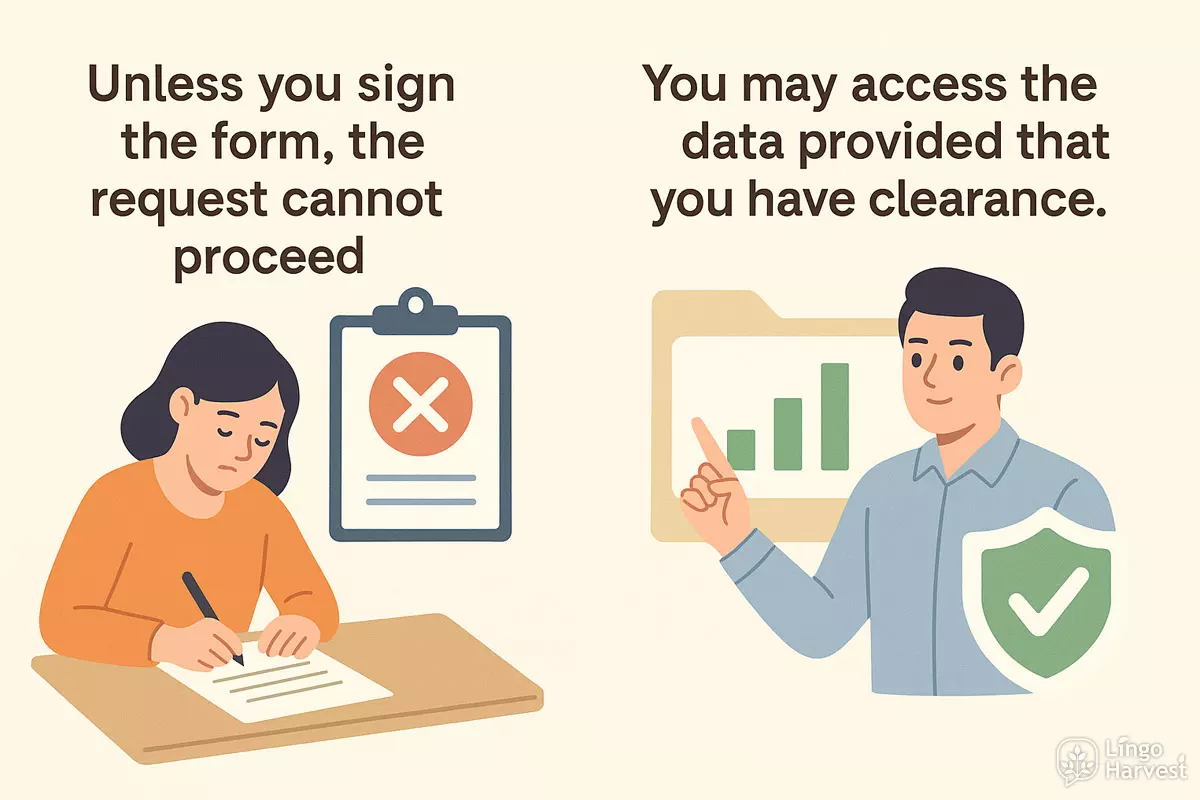
| Unless | states exceptions or carve-outs | Unless you sign the form, the request cannot proceed. |
| Provided that | adds a restrictive requirement | You may access the data provided that you have clearance. |
| In the event that | formal way to introduce contingencies | In the event that the system fails, a backup will activate. |
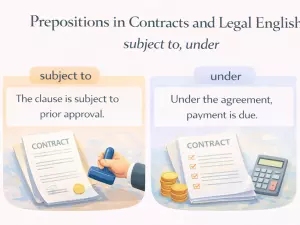
| Subject to | indicates dependency on another rule or situation | Approval is subject to final verification. |
| When / Where | introduces situational triggers | When the alarm sounds, evacuate immediately. |
| Except as | establishes exclusions | Except as noted, all fees are non-refundable. |
| Only if | highlights necessity of a precondition | You may leave only if the supervisor approves. |
| So long as | expresses a continuing requirement | You can remain here so long as you follow the rules. |
| Unless and until | sets dual conditions for change | The policy remains active unless and until it is replaced. |
| Insofar as | qualifies the extent of applicability | The rule applies insofar as safety is concerned. |
| Without prejudice to | indicates a condition that does not affect other provisions | This clause is valid without prejudice to existing agreements. |
| Notwithstanding | introduces exceptions to previous statements | Notwithstanding the rules, temporary access was granted. |
| On condition that | specifies a prerequisite | You may participate on condition that you register first. |
| Provided further that | adds layered conditions | The permit is extended provided further that all fees are paid. |
| Failing which | describes consequences of non-compliance | You must submit proof of address, failing which your application will be rejected. |
| As long as | time-bound or ongoing requirements | You may stay as long as you behave responsibly. |
Comparison: Conditionals in legal vs. technical writing
| Legal Documents | Technical Documentation |
|---|---|
| Used to define rights, duties, and liabilities based on specific triggers | Controls system behavior, user access, or workflow based on parameters |
| Often formal, with phrases like "in the event that" or "provided that" | More direct, using "if-then" statements or flowcharts |
| Frequently addresses exceptions and rare scenarios | Focuses on operational steps, error handling, and configuration |
| Consequences are typically legal or financial | Outcomes are functional, affecting processes or outputs |
Ensuring enforceability and minimizing disputes
Precise conditional statements help prevent misunderstandings and legal challenges. By explicitly outlining what happens under each scenario, drafters can ensure their texts are enforceable and less vulnerable to loopholes. This approach saves time and reduces the risk of costly disputes or technical failures. Overall, using well-structured conditional language is vital for drafting robust, transparent, and reliable legal and technical documents.
Strict vs flexible condition types in documentation
Documentation often relies on conditional statements to clarify rules, requirements, or processes. These conditionals can be described as either strict or flexible, depending on how tightly they constrain actions and interpretations. Recognizing which type is appropriate for a given context helps writers communicate intent clearly and prevent ambiguity.
Understanding strict conditions
Strict conditions are precise and leave no room for interpretation. They are commonly used in legal contracts, technical specifications, and compliance policies where ambiguity could cause errors or disputes. Such conditionals use definitive language like must, shall, or only if. Here are some typical features:
- Require exact circumstances or criteria to be met
- Often enforceable or subject to verification
- Minimize risk of misunderstanding
- Examples: "Access is granted only if the user is authenticated." / "The device shall be powered down before maintenance."
Flexible condition types explained
By contrast, flexible conditionals allow for interpretation or adaptation based on context. These are useful in guidance, recommendations, or policies that need to accommodate a range of scenarios. Phrases such as may, should, if possible, or when appropriate signal flexibility.
- Enable discretion or judgment by the reader
- Accommodate exceptions or evolving circumstances
- Reduce rigidity where not all cases can be anticipated
- Examples: "You may restart the system if performance degrades." / "If appropriate, inform the supervisor."
Comparing strict and flexible conditionals
| Strict Conditionals | Flexible Conditionals |
|---|---|
| Use of mandatory terms: shall, must, only if | Use of discretionary terms: may, should, if feasible |
| Zero tolerance for deviation | Allows for adaptation or exceptions |
| Example: "The report must be submitted by 5 p.m." | Example: "The report should be submitted by 5 p.m." |
| Legal/contractual language, technical protocols | Guidelines, best practices, adaptable policies |
When to choose each type
Selecting between rigid and adaptable conditionals depends on the stakes involved, the need for enforceability, and the audience’s expertise. For safety-critical instructions, legal documents, or software protocols, strict language is preferred. Flexible forms are better for policy handbooks, user guides, or evolving technical standards where context and judgment play a role.
Common vocabulary for each
- Strict: must, shall, will, only if, unless, is required to, no exceptions, prohibited, not permitted
- Flexible: may, should, can, if possible, as appropriate, recommended, typically, generally, where feasible, at discretion, optionally, if necessary
Understanding and correctly applying these types helps prevent confusion and supports clarity in any professional documentation setting.
Ambiguity risks when drafting conditional requirements
When using conditional statements in legal, technical, or policy documents, vague language or unclear logical structure can easily lead to misunderstandings. If the conditions themselves, or their intended consequences, are not precisely defined, parties may interpret requirements differently. This can cause disputes, compliance failures, or even unintended legal obligations.
Common sources of ambiguity
Uncertainty often arises from several recurring issues:
- Use of undefined or broad terms (e.g., "reasonable time", "substantial effort")
- Omission of explicit triggers for conditions
- Multiple conditions joined by "and/or" without clear grouping
- Failure to specify what happens if a condition is not met
- Nested conditionals that obscure the main requirement
- Ambiguous references (e.g., "if it is necessary", without specifying by whom or by what standard)
- Contradictory conditions within the same clause
- Reliance on implied knowledge not documented elsewhere
- Unclear temporal references ("if completed promptly")
- Inconsistent use of modal verbs ("shall", "may", "should")
- Failure to identify the responsible party for action or decision
- Ambiguous scope of applicability ("if applicable", without stating to whom or what it applies)
- Conditional requirements that depend on subjective judgment
- Overlapping or redundant conditions
- Use of double negatives or convoluted phrasing
Patterns that increase or reduce clarity
Some conditional constructions are more prone to misinterpretation than others. Compare the following approaches:
| Pattern | Clarity Risk |
|---|---|
| If X, then Y. | Clear if both X and Y are precisely defined; otherwise, risk of vagueness. |
| If X and/or Y, then Z. | High risk: "and/or" can lead to multiple plausible interpretations. |
| If X unless Y, then Z. | Potential confusion: "unless" can introduce exceptions that are not clearly bounded. |
| If X is deemed necessary, then Y. | Ambiguous: unclear who decides necessity and by what criteria. |
| If X by [date], then Y; otherwise, Z. | Lower risk: provides a fallback and clear temporal boundary. |
Strategies to reduce uncertainty
Writers can minimize misinterpretation by:
- Defining all key terms and conditions up front
- Using unambiguous connectors (e.g., "if... then...", "only if", "except when")
- Specifying responsible parties and decision-makers
- Stating explicit consequences for unmet conditions
- Testing conditional statements with hypothetical scenarios
- Reviewing text for hidden assumptions or implied steps
- Seeking peer or legal review for complex conditionals
Careful drafting and a focus on specificity help ensure that conditional requirements support, rather than undermine, the intended meaning and enforceability of a document.
Common conjunctions and formatting patterns
Writers in legal, technical, and policy fields rely on specific linking words and structures to express conditions and logical relationships with precision. These connectors help clarify obligations, exceptions, permissions, and outcomes. The choice of conjunction or formatting device can alter the interpretation of a clause, so understanding their nuances is essential for clear and enforceable documentation.
Frequently used conditional conjunctions
- If – introduces a basic condition (e.g., "If the applicant submits all forms...").
- Unless – sets an exception (e.g., "Unless otherwise specified...").
- Provided that – adds a limiting or qualifying condition ("The contract is valid, provided that both parties sign.").
- In the event that – formal alternative to "if," often in contracts.
- Except that – carves out exceptions or limitations.
- Only if – imposes a strict prerequisite ("Payment is due only if goods are delivered.").
- So long as – indicates a continuing condition ("The warranty applies so long as the device is unaltered.").
- Unless and until – postpones an effect or obligation ("The license remains valid unless and until revoked.").
- When – signals a triggering event ("When the threshold is met, the policy takes effect.").
- Subject to – flags a dependency or limitation ("Subject to approval, the changes will proceed.").
- Except as otherwise provided – common in statutes to indicate exceptions.
- Even if – introduces a concession ("The rule applies even if the user is unaware.").
- As long as – similar to "so long as," often for ongoing conditions.
- Unless and except – combines two exceptions for emphasis.
- Provided, however, that – introduces a contrasting or secondary condition.
- Insofar as – limits the scope of a condition ("Insofar as it is consistent with law...").
- On condition that – formal phrase for a strict requirement.
Formatting patterns for clarity
The structure and presentation of conditional statements can affect their interpretation. Drafters often use formatting devices to improve readability and minimize ambiguity:
- Numbered or lettered clauses for multi-part conditions.
- Subparagraphs to break down complex requirements.
- Bold or italicized terms to highlight key conditions or exceptions.
- Indentation and bullet points for lists of criteria or steps.
- Use of "shall," "must," "may," "will," and "should" to indicate obligation, permission, or recommendation.
- Headings and subheadings to organize related conditions.
- Tables for side-by-side comparison of scenarios, requirements, or outcomes.
Comparison of common conditional conjunctions
| Conjunction | Typical Use | Example |
|---|---|---|
| If | States a basic condition | If payment is received, access will be granted. |
| Unless | Indicates an exception | Access is denied unless credentials are valid. |
| Provided that | Sets a qualifying requirement | The offer stands, provided that terms are met. |
| Subject to | Imposes a dependency | Subject to approval, funds will be released. |
| Only if | Specifies a strict prerequisite | Refunds are issued only if requested within 30 days. |
Choosing the right connector and formatting method is crucial for accurate interpretation and enforceability. Consistent use of these patterns reduces ambiguity and supports a logical flow, especially in documents where precision is paramount.
Examples from policies, agreements, and manuals
Writers in the legal, technical, and policy fields frequently rely on conditional statements to establish requirements, clarify responsibilities, and specify consequences. Such constructions help define when certain rules apply and what actions must—or must not—be taken under particular circumstances. Below, you’ll find a range of real-world patterns and sample phrases that illustrate how conditionals function in these documents.
Common Conditional Structures
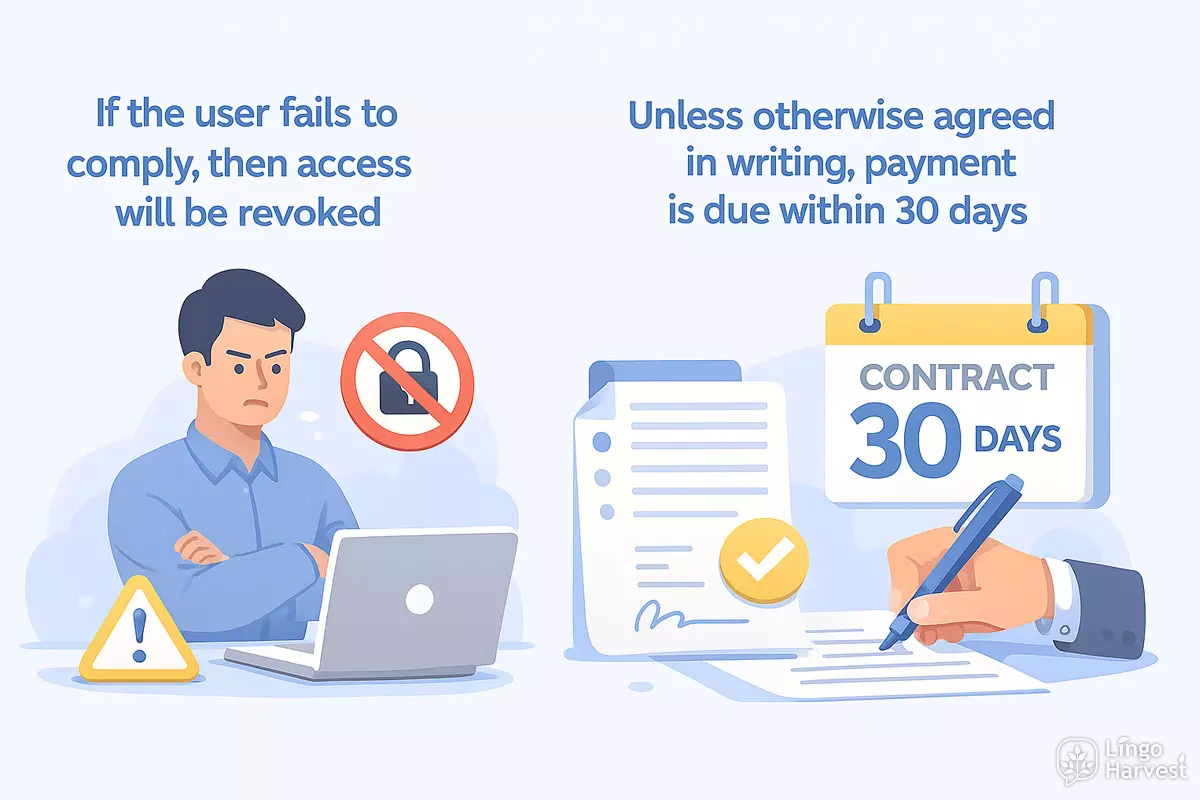
- If… then… — “If the user fails to comply, then access will be revoked.”
- Unless… — “Unless otherwise agreed in writing, payment is due within 30 days.”
- Provided that… — “The warranty is valid provided that the item is installed by a certified technician.”
- In the event that… — “In the event that the agreement is terminated, all data must be deleted.”
- Subject to… — “Subject to approval by the Board, the changes will become effective immediately.”
- Where… — “Where the policyholder is under 18, consent must be obtained from a guardian.”
- Except when… — “Employees may not work remotely except when approved by their manager.”
- Only if… — “Reimbursement is available only if receipts are provided.”
- As long as… — “The license remains valid as long as annual fees are paid.”
- Unless and until… — “The clause remains in effect unless and until superseded by new regulations.”
- Provided, however, that… — “The contractor shall supply materials, provided, however, that the client approves the specifications.”
- Should… — “Should the system fail, support must be contacted within 24 hours.”
- Whenever… — “Whenever confidential information is handled, encryption must be used.”
- On condition that… — “Access is granted on condition that the terms are accepted.”
- Except as otherwise provided… — “Except as otherwise provided in this Agreement, all notices shall be in writing.”
Comparing Conditional Phrasings
The form and formality of conditional language can vary, especially across document types or jurisdictions. Here’s a side-by-side look at how similar requirements might be phrased in different documents:
| Legal Contract | Technical Manual |
|---|---|
| If either party breaches this Agreement, the non-breaching party may terminate with written notice. | If the system displays an error code, refer to the troubleshooting section before contacting support. |
| Unless the Buyer notifies the Seller of defects within 10 days, goods are deemed accepted. | Unless otherwise specified, tighten all bolts to 20 Nm. |
| Provided that the lessee maintains insurance, the lessor will not require a deposit. | Provided that all components are properly installed, the device will function as intended. |
| In the event that the law changes, this Agreement shall be amended accordingly. | In the event that the indicator light flashes red, shut down the machine immediately. |
Conditional Triggers and Consequences
In policies and procedures, conditionals often act as triggers for specific actions or exceptions. For example:
- “If a password is forgotten, a password reset procedure must be initiated.”
- “Unless the employee provides advance notice, absences may be considered unexcused.”
- “Should the annual review uncover deficiencies, corrective measures will be outlined.”
By using these varied conditional forms, documents ensure clarity about when obligations arise, exceptions apply, or further steps are required. This structure supports consistency and helps readers understand the precise circumstances that trigger particular policies or actions.
Practice: choose precise conditionals for legal/technical clarity
Clarity in legal, technical, and policy documents often depends on the type of conditional statements used. Choosing the most accurate form prevents ambiguity and ensures each scenario is covered. Below, you'll find exercises and examples to strengthen your ability to select the right conditional structure for precise written communication.
Recognizing and Rewriting Imprecise Conditionals
Examine the following sentences. Identify whether the conditional is vague or open to misinterpretation, and suggest a revision that increases specificity:
- If the device is not working, contact support.
— How could this be made more precise? - If users fail to update their passwords, access may be restricted.
— What change would clarify the timing and certainty? - If the contract is signed, the payment will be processed.
— How might you tighten the cause-effect relationship?
Show answers
- Specify what "not working" means, e.g., "If the device fails to power on or displays error code 101, contact support."
- Clarify with timing and certainty: "If users do not update their passwords within 30 days, access will be restricted."
- Make the sequence explicit: "Payment will be processed only after the contract is signed by both parties."
Common Precision Patterns for Legal/Technical Conditionals
Writers in legal and technical fields rely on certain patterns to eliminate confusion. Here are examples of precise conditional forms you might use in such documents:
- If and only if...
- Unless...
- Provided that...
- On condition that...
- When (event) occurs, then...
- In the event that...
- No later than (date), if...
- Should (event) happen, then...
- Subject to...
- Except where...
- Only if...
- Except as otherwise provided...
- If applicable, then...
- Unless otherwise agreed...
- Where (condition), (result)...
- Upon (action), (result)...
- In case of...
- So long as...
- As long as...
- Failing which...
Comparing Conditional Forms: Precision and Use Cases
The table below compares commonly used conditionals, their typical applications, and the level of certainty they convey.
| Conditional Form | Use & Nuance | Level of Certainty |
|---|---|---|
| If and only if | Sets a strict, two-way condition; both must be true together | Absolute |
| Unless | Specifies exceptions; excludes scenarios | High (except for exception) |
| Provided that | States a requirement for a result to occur | Conditional |
| Should | Often used for hypothetical or less certain events | Moderate/Uncertain |
| Only if | Restricts result to a single condition | Strict |
Practice: Choose the Most Suitable Conditional
For each scenario, pick the best conditional phrase from the list above:
- Access is granted ______ the applicant submits all required documents.
- The warranty applies ______ the product is used according to instructions.
- Payment will be made ______ the goods are delivered and accepted.
- The agreement is void ______ either party fails to comply with its terms.
Show answers
- on condition that
- only if
- provided that
- if and only if
By consistently applying precise conditional forms, legal and technical writers ensure that obligations, rights, and exceptions are clear to all parties involved.