Conjunctions in Legal and Technical English

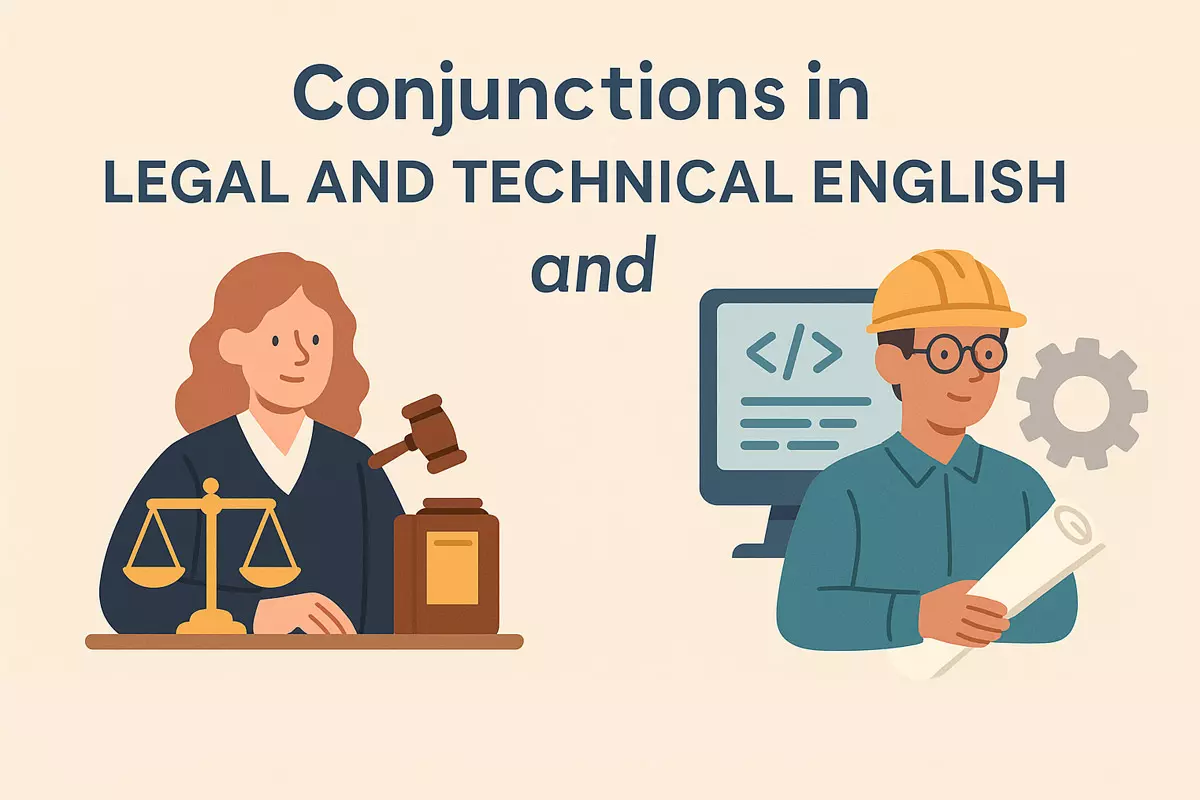 Here we the importance of precise conjunctions in legal and technical writing, reviews commonly used conjunctions, and explains how word choice can change interpretations. It includes real examples and practice choosing the clearest conjunctions.
- Why legal and technical writing requires precise conjunctions
- Common conjunctions in contracts, manuals, and policies
- Meaning differences in strict vs broad interpretations
- Avoiding ambiguity in conditional and exception clauses
- Examples from real technical and legal statements
- Practice: choose the conjunction that gives the clearest meaning
Linking words are essential in both legal and technical writing because they help connect ideas clearly and logically, ensuring that complex information is presented in a coherent and understandable way. The precise choice of these words can significantly affect the clarity and flow of a document, which in turn impacts how well the intended message is conveyed and whether the document is interpreted as intended. In legal contexts, this can even influence the enforceability of agreements and the interpretation of terms.
Why legal and technical writing requires precise conjunctions
Careful use of conjunctions is essential in documents that demand accuracy and clarity, such as contracts, policies, manuals, and specifications. The choice of connecting words can dramatically alter meaning, introduce ambiguity, or clarify complex relationships. In both legal and technical contexts, writers must ensure that logical connections and conditions are unmistakably expressed.
The impact of conjunctions on meaning and obligations
A single conjunction, like and or or, can determine whether requirements are cumulative or alternatives. Misuse may create loopholes or impose unintended duties. For example, in a contract, listing obligations with "and" means all must be fulfilled, while "or" allows for any one of them to suffice.
- And – indicates all listed items are required
- Or – means only one of the options is necessary
- But – introduces contrast or exception
- If – sets a condition for what follows
- Unless – specifies an exception to a rule
- Provided that – adds a restrictive condition
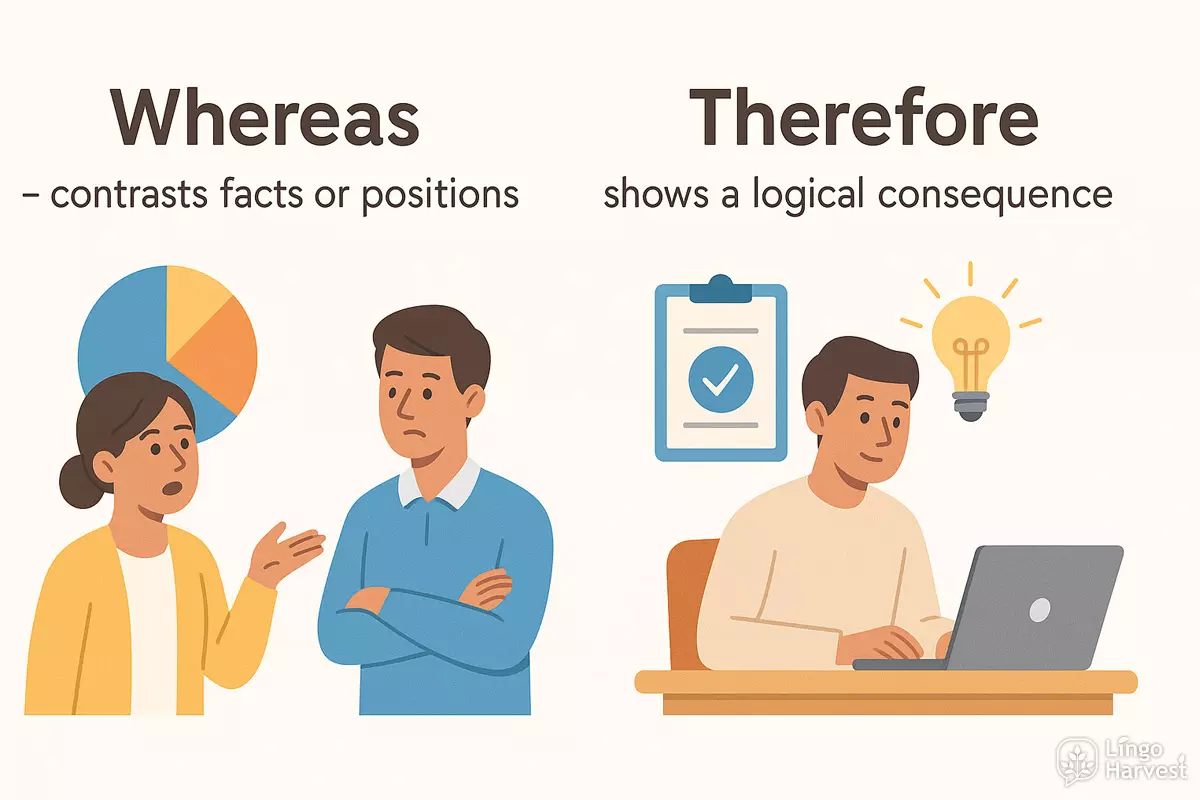
- Whereas – contrasts facts or positions
- Therefore – shows a logical consequence
- However – signals a limitation or exception
- Nor – negative alternative, used after "neither"
- So that – explains purpose or result
- While – indicates simultaneous actions or contrast
- As long as – sets a time or condition limit
- Except – introduces exclusions
- Because – gives a reason or explanation
- Whenever – refers to any time a condition is met
- Insofar as – to the extent that
- Although – presents a concession
- Until – sets a time limit
- Unless and until – combines exception and time condition
Ambiguity and risk in imprecise coordination
Vague or incorrect linking words can lead to disputes, misinterpretations, and even litigation. For instance, the phrase "employees must wear safety glasses and gloves or masks" could be read in multiple ways depending on grouping. Rewording or adding punctuation often helps, but selecting the right conjunction is the first step to unambiguous writing.
Key distinctions: legal vs. technical conjunction use
| Legal Context | Technical Context |
|---|---|
| Defines rights, duties, and exceptions (e.g., "unless," "provided that") | Specifies procedures, requirements, and sequences (e.g., "then," "while") |
| Ambiguity can result in costly disputes | Imprecision may cause safety issues or malfunction |
| Often uses formal, restrictive conjunctions | Uses temporal or conditional conjunctions for step-by-step instructions |
| Focus on obligations, exceptions, and conditions | Focus on process, alternatives, and dependencies |
Ultimately, precise conjunctions help avoid misunderstandings and ensure that every condition, obligation, and alternative in legal and technical writing is interpreted as intended. This precision safeguards both compliance and clarity.
Common conjunctions in contracts, manuals, and policies
In legal and technical writing, conjunctions play a crucial role in clarifying relationships between clauses, listing conditions, and ensuring precise interpretation. Unlike everyday conversation, these documents rely on conjunctions to avoid ambiguity and to specify rights, duties, or sequences of actions. The careful selection and placement of these words can often determine how a clause is interpreted by courts or end users.
Frequently Used Conjunctions and Their Functions
Writers of contracts, policies, and operational manuals tend to favor certain conjunctions for their precision and predictability. Here are some of the most commonly used ones, along with their typical purposes:
- And – combines items or conditions; both must apply.
- Or – presents alternatives; at least one must apply.
- But – introduces exceptions or contrasts.
- If – sets up conditions or requirements.
- Unless – states exceptions to a rule or condition.
- Provided that – adds a specific condition to a statement.
- Whereas – often used in recitals to introduce background facts.
- While – indicates simultaneous actions or contrasts.
- So that – expresses purpose or intended result.
- Because – explains reasons or justifications.
- Therefore – introduces conclusions or consequences.
- Except that – highlights a single exception.
- As long as – sets a time or condition limit.
- Insofar as – limits the extent of a statement.
- Either...or – presents a mutually exclusive choice.
- Neither...nor – excludes both options.
- Notwithstanding – signals that a provision takes effect despite other clauses.
- Where – introduces specific circumstances or locations.
- When – sets timing or triggers for actions.
- For the avoidance of doubt – clarifies intent or interpretation.
Conjunctions: Legal vs. Technical Contexts
The same conjunction can carry different implications depending on context. For instance, "and" in a contract usually means all listed conditions must be met, while in a technical manual it could refer to steps to be performed together. Similarly, "or" can be inclusive or exclusive, so definitions should be clear.
| Conjunction | Typical Use in Legal/Technical Texts |
|---|---|
| And | All listed conditions or items must be satisfied/completed |
| Or | At least one listed condition or item may be satisfied/completed |
| If | Specifies a condition that must be met for a provision to apply |
| Unless | States exceptions or situations where a clause does not apply |
| Provided that | Adds a limiting or additional requirement |
| Notwithstanding | Indicates that the clause prevails despite other provisions |
Precision and Ambiguity: Why Choice Matters
Selecting the right conjunction is not just a matter of style. In legal disputes, the presence or absence of a single word like "and" or "or" can affect outcomes. Technical manuals also depend on these words to prevent user error. For this reason, drafters often define how certain conjunctions should be interpreted at the start of a document, especially in contracts. When drafting or reviewing such documents, pay close attention to these connectors. Their proper use can clarify obligations, prevent misunderstandings, and ensure that instructions or agreements are carried out as intended.
Meaning differences in strict vs broad interpretations
Understanding how conjunctions are interpreted in legal and technical English is crucial, as the scope and application of a rule or obligation often depend on whether the wording is read narrowly or expansively. The same sentence can have very different effects depending on how the conjunctions like "and," "or," and "nor" are construed.
Strict (Narrow) Interpretation
A strict reading applies the conjunctions precisely as written, without inferring additional meaning or intent. In legal contexts, this often means:
- Each listed condition must be met exactly as stated.
- No assumptions are made beyond the literal conjunctions.
- Minimizes ambiguity but can sometimes lead to rigid or unintended results.
For example, "The applicant must submit Form A and Form B" under a strict view requires both forms, with no exceptions.
Broad (Expansive) Interpretation
A broad approach considers context, purpose, and possible legislative or contractual intent. This often results in:
- Allowing for implied meanings or broader conditions.
- Greater flexibility in fulfilling requirements.
- Potential for ambiguity or dispute if the intent is unclear.
For instance, "The applicant must submit Form A or Form B" could, under a broad interpretation, allow any comparable document as long as the main purpose is met.
Comparison of Conjunction Use: Strict vs Broad
| Conjunction | Strict Interpretation | Broad Interpretation |
|---|---|---|
| and | All connected elements are required (no exceptions). | May allow for functional equivalence or partial compliance if justified by context. |
| or | Any one element suffices; no overlap unless specified. | Possibly read as "and/or"—allowing any, some, or all listed options. |
| nor | Strict exclusion of all listed items. | May be read less rigidly, especially if context suggests a less absolute prohibition. |
| either...or | Only one of the alternatives is permitted. | Sometimes interpreted as allowing both, if the purpose is fulfilled. |
| neither...nor | Excludes both options strictly. | Could be softened if the language or context allows exceptions. |
Common Pitfalls and Examples
Ambiguities often arise from conjunctions in legal and technical documents. Here are some patterns where interpretation can shift outcomes:
- “X and Y or Z” – does “or Z” apply to both X and Y, or just Y?
- “A, B, and C or D” – is “or D” an alternative to all the previous items or just C?
- Using “and/or” can create confusion if not clarified.
- Lists with mixed conjunctions may be parsed differently by courts or technical reviewers.
- Negative constructions (“not A or B”) can be interpreted as “neither A nor B,” or as “not A, but possibly B.”
Practical Implications
The way conjunctions are read affects legal liability, compliance obligations, and technical requirements. Drafters should consider whether a strict or broad interpretation serves their intent, and clarify with definitions or examples where possible. In practice, courts and regulatory bodies may default to strict readings unless context or precedent suggests otherwise.
Avoiding ambiguity in conditional and exception clauses
Clear drafting in legal and technical documents is essential, especially when expressing conditions and exceptions. Poorly structured sentences using conjunctions like "if," "unless," or "except" can lead to multiple interpretations, disputes, or unintended loopholes. Writers should select conjunctions carefully and clarify which terms or actions the conditions or exceptions apply to.
Common Pitfalls in Drafting Conditional and Exception Clauses
Writers often create ambiguity by:
- Placing the condition or exception too far from the main verb or subject
- Using "unless" and "except" interchangeably when their meanings differ
- Combining multiple conditions in a single sentence without clear separation
- Leaving the scope of the condition or exception undefined
- Failing to indicate whether a condition is necessary, sufficient, or both
Strategies for Greater Clarity
To reduce misunderstandings, consider these approaches:
- Keep conditional and exception clauses close to the terms they modify
- Use explicit language rather than relying on context or inference
- Break complex sentences into shorter, focused statements
- Define all terms used in conditions or exceptions
- Use numbering or bullet points for multi-part conditions
- Prefer "if and only if" or "provided that" to clarify mutual exclusivity or necessity
- Restate the main rule before introducing exceptions
- Reserve "unless" for genuine exceptions, not for alternatives or additional requirements
- Test the clause by paraphrasing it—if the meaning changes, revise the original
- Ask a colleague to interpret the clause and check for variations in understanding
Examples of Ambiguous vs. Clear Clauses
Ambiguity often arises from vague placement or imprecise conjunctions. Here are contrasting examples to illustrate:
- Ambiguous: The contractor shall complete the work if the materials arrive on time unless otherwise agreed.
- Clear: Unless the parties agree otherwise, the contractor shall complete the work only if the materials arrive on time.
- Ambiguous: Employees may access the lab unless prohibited.
- Clear: Employees may access the lab unless access has been expressly prohibited in writing.
Useful Conjunctions and Phrases for Precision
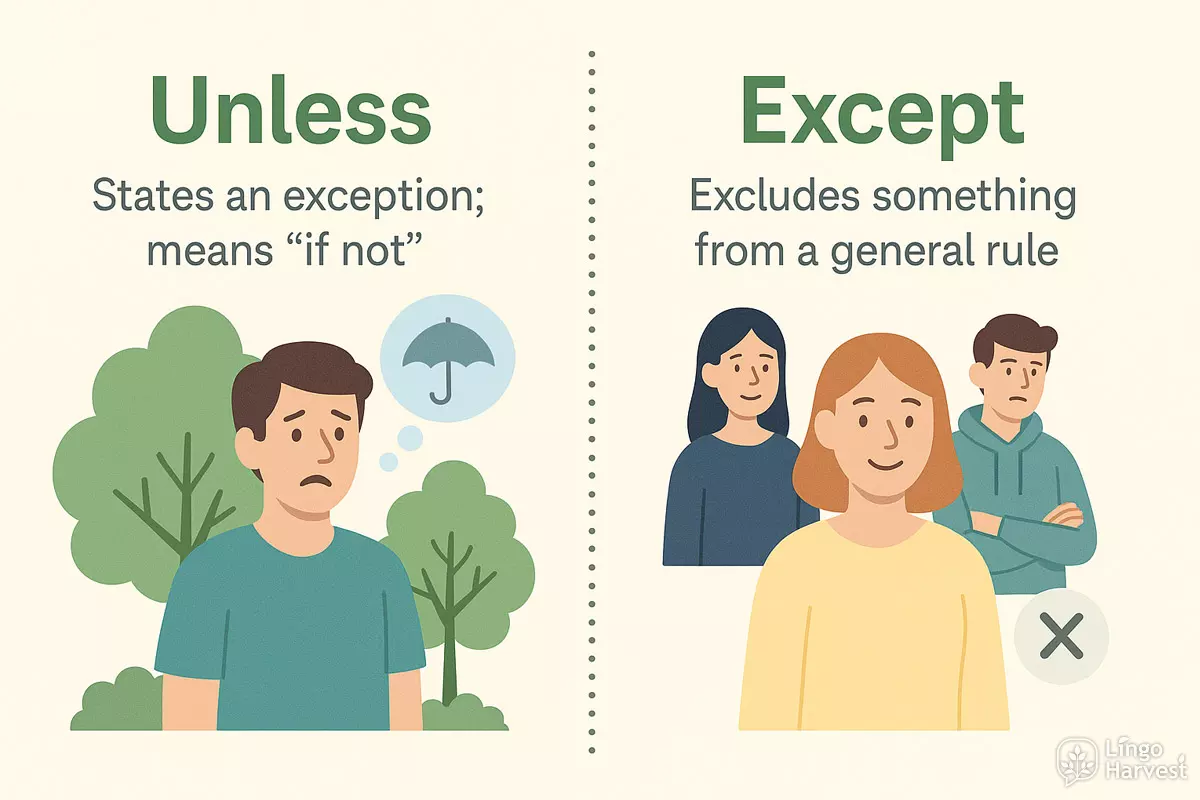
Choosing the right connectors can sharpen the intended meaning. Here is a list of commonly used conjunctions and phrases with brief notes on their typical legal/technical usage:
- If – introduces a condition
- Unless – states an exception; means "if not"
- Except – excludes something from a general rule
- Provided that – sets a specific requirement
- Only if – stresses necessity
- In the event that – formal alternative to "if"
- So long as – indicates a condition that must be continuously met
- Subject to – makes something conditional on another provision
- Notwithstanding – overrides another clause
- Except as otherwise provided – clarifies that exceptions are possible elsewhere
- Unless and until – combines exception with a temporal condition
- On condition that – formal, explicit statement of a requirement
- Save as – British English, meaning "except as"
- Except where – limits the rule to particular circumstances
- So far as – limits the scope of a statement
- Insofar as – similar to "so far as," slightly more formal
- Whether or not – removes conditionality
- Even if – specifies an exception to a condition
Effective use of these conjunctions and careful sentence structure can dramatically reduce the risk of misinterpretation in legal and technical writing. Always review and test conditional and exception clauses for clarity before finalizing any document.
Examples from real technical and legal statements
Conjunctions are essential in both technical and legal writing, often determining the meaning and scope of provisions, instructions, or requirements. In these fields, the careful selection of connectors such as “and,” “or,” and “but” can significantly alter obligations, permissions, or logical relationships. Below, we explore authentic samples and patterns that reveal typical usage and some common pitfalls.
Common conjunction use in legal drafting
Legal documents rely on precise connectors to avoid ambiguity. Here are several real-world patterns and clauses that illustrate this:
- The tenant shall keep the premises clean and shall not cause damage to the property.
- The agreement may be terminated by either party if notice is given or if a breach occurs.
- No person shall knowingly sell, offer for sale, or distribute any prohibited item.
- The contractor must provide insurance certificates and comply with all safety regulations.
- Failure to pay rent or repeated violations may result in eviction.
- Any modification must be in writing and signed by both parties.
- The license is valid for one year unless revoked earlier.
- Goods will be replaced if defective or not as described.
- The employee shall not disclose confidential information nor use it for personal gain.
- All fees, taxes, and charges are the responsibility of the buyer.
Technical documentation: conjunctions in instructions and conditions
In technical manuals and standards, connectors organize steps, options, and requirements. Notice how clarity depends on conjunction choice:
- Press “Enter” and wait for the confirmation message.
- Connect the blue wire or the red wire, but not both.
- Ensure the device is powered off before installation.
- Install the driver and restart your computer.
- The system will alert the user if an error occurs.
- Remove the cover only if maintenance is required.
- Choose “Save” or “Cancel” to proceed.
- Consult the manual if you encounter difficulties.
Comparison of “and” vs. “or” in legal and technical contexts
The distinction between “and” (cumulative) and “or” (alternative) is especially important. See how meaning changes with each connector:
| Phrase with “and” | Phrase with “or” |
|---|---|
| Submit proof of identity and address. | Submit proof of identity or address. |
| All warranties and representations remain valid. | All warranties or representations remain valid. |
| The applicant must be 18 years old and a resident. | The applicant must be 18 years old or a resident. |
| Activate cooling and heating systems. | Activate cooling or heating systems. |
Notable points and pitfalls
Writers must be careful: “and/or” is common in legal English but often discouraged due to possible confusion. Instead, precise alternatives are preferred. Similarly, using “but” or “however” in technical writing can clarify exceptions or limitations, but overuse may create ambiguity. In summary, connectors are more than just grammatical glue in technical and legal English—they define rights, duties, and procedures with clarity or, if used carelessly, with confusion.
Practice: choose the conjunction that gives the clearest meaning
Legal and technical writing often hinges on the precise use of conjunctions. The difference between "and" and "or" can completely change a contract or instruction. Below, you'll find practical exercises and examples to help you refine your sense for the most appropriate linking words in complex sentences.
Task 1: Select the most precise conjunction
For each sentence, choose the conjunction that best clarifies the intended relationship between clauses. Think about whether the meaning is cumulative, alternative, conditional, or contrastive.
- The agreement renews automatically, and / or the parties may renegotiate the terms annually.
- The warranty becomes void, unless / if the product is modified without authorization.
- The supplier must deliver all materials on time, provided that / whereas transportation conditions allow.
- Employees must follow safety protocols, and / or report any violations immediately.
- The document is considered confidential, unless / if it is already publicly available.
- The project may be extended, provided that / whereas additional funding is approved.
- Access to the server is limited to administrators, and / or users with special permission.
- Data must be backed up daily, unless / if the system is under maintenance.
- Refunds will be issued, provided that / whereas the request is made within 14 days.
- All machinery must be turned off before / though performing maintenance.
Show answers
- or
- unless
- provided that
- and
- before
- provided that
- and
- unless
- provided that
- before
Common conjunctions in legal and technical contexts
Understanding the nuances of conjunctions helps avoid ambiguity. Here are some frequently used options, each serving a distinct purpose:
- And – Joins elements that must all be true or present.
- Or – Indicates alternatives; only one condition needs to be met.
- Unless – States an exception to a rule.
- Provided that – Introduces a condition that must be satisfied.
- Whereas – Highlights contrast or background in recitals.
- However – Signals a contrast or exception.
- Therefore – Shows result or consequence.
- While – Indicates simultaneous actions or contrast.
- Before – Refers to a required sequence of actions.
- After – Specifies when something must occur.
- So that – Explains purpose or intention.
- In order that – Formal version for stating purpose.
- Except – Defines an exclusion from a rule.
- Since – Provides a reason or time reference.
- As long as – Sets a condition for something to happen.
Task 2: Spot the ambiguity
Below are sentences where the choice of conjunction affects legal or technical interpretation. Identify which sentence is ambiguous and which is clear.
- You may store the data electronically and physically.
- You may store the data electronically or physically.
- Employees must follow the safety rules and wear protective gear.
- Employees must follow the safety rules or face disciplinary action.
- The system can be accessed by managers and supervisors.
- The system can be accessed by managers or supervisors.
- The report must be submitted today and signed by the director.
- The report must be submitted today or the request will be rejected.
- You may share the document internally and externally.
- You may share the document internally or externally.
Show answers
- Ambiguous: and (unclear if both storage methods are required)
- Clear: or (either method is acceptable)
- Clear: and (both actions are required)
- Clear: or (non-compliance leads to consequence)
- Ambiguous: and (implies both have access; may not be intended)
- Clear: or (either group may have access)
- Clear: and (both conditions must be met)
- Clear: or (choice with consequence)
- Ambiguous: and (implies both sharing types allowed; may confuse)
- Clear: or (either sharing scope allowed)
Table: Comparing conjunctions in contract language
| Conjunction | Effect in Legal/Technical Text |
|---|---|
| And | All listed conditions must be met; cumulative requirement. |
| Or | Any one condition suffices; alternative options allowed. |
| Unless | States an exception; the main rule applies except in specified cases. |
| Provided that | Sets a precondition; the main statement is valid only if the condition is true. |
| Whereas | Introduces background or contrast; often used in recitals and preambles. |
Task 3: Rewrite for clarity
Replace the conjunction in the following sentence to eliminate ambiguity:
"The warranty covers defects in materials and workmanship."
Show answers
"The warranty covers defects in materials or workmanship." (This makes it clear that either type of defect is covered, not just both together.)
Mastering conjunctions in legal and technical English prevents misinterpretation and ensures your writing is precise and enforceable. Practice regularly to develop a keen sense for the right connective in every context.