Half, Quarter, and Fractions as Quantifiers in English

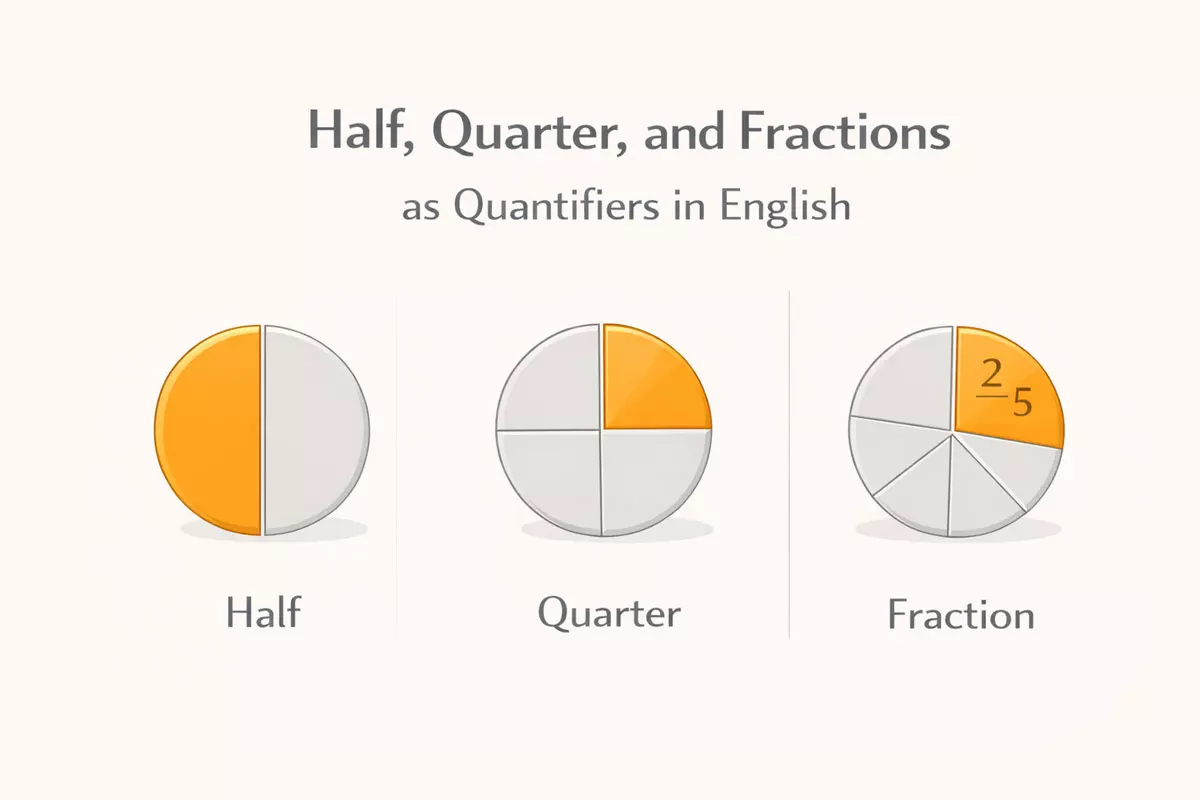 Here we how fractions work as quantifiers in English, their use with both countable and uncountable nouns, differences between precise and approximate meanings, sentence patterns, common expressions, typical learner mistakes, and practical examples.
- How fractions function as quantifiers
- Use with countable and uncountable nouns
- Difference between precise and approximate meaning
- Sentence position and grammatical patterns
- Common fraction-based expressions
- Use in everyday and informational contexts
- Typical learner errors with fractions
- Examples showing correct usage
- Practice: using fractional quantifiers accurately
Knowing how to express portions by dividing things into halves, quarters, thirds, or other fractions is important for clear and effective communication in English. These expressions allow us to discuss amounts, measurements, and the distribution of resources accurately, whether we are cooking, sharing objects, or solving problems. Being able to use terms like half, quarter, or a third helps ensure that everyone understands exactly what is meant, which can prevent confusion and make conversations more precise and efficient in everyday situations.
How fractions function as quantifiers
Fractions like half, quarter, and terms such as third, three-quarters, or eighth are often used to express amounts or proportions in English. When used as quantifiers, they indicate a specific part or share of a whole, whether that's a group, an object, or an abstract quantity. These fractional expressions help speakers be precise about how much of something they mean, which is especially useful in both everyday conversation and formal writing.
Typical sentence patterns
Fractional quantifiers can precede nouns to specify quantity. The structure often depends on whether the noun is countable or uncountable, and whether we are referring to a singular or plural whole. Here are some common patterns:
- Half (of) + noun: Half the cake is gone. / Half of the students passed.
- A quarter (of) + noun: A quarter of the team was injured.
- Fractions + of + noun: Two-thirds of the water evaporated.
- Fraction + possessive: Half his money disappeared.
- Fraction + pronoun: Half of them agreed. / A third of us left early.
Usage notes
The meaning and grammatical behavior of these quantifiers can shift based on context. For example, "half" can be used with or without "of" before a noun, especially when the noun is definite. Some fractions, like "one-third" or "three-quarters," almost always require "of" when followed by a noun.
- With definite nouns: Half the class or half of the class
- With pronouns: Half of them (not half them)
- With indefinite nouns: Half a loaf (not half of a loaf in standard usage)
Comparing fraction quantifiers
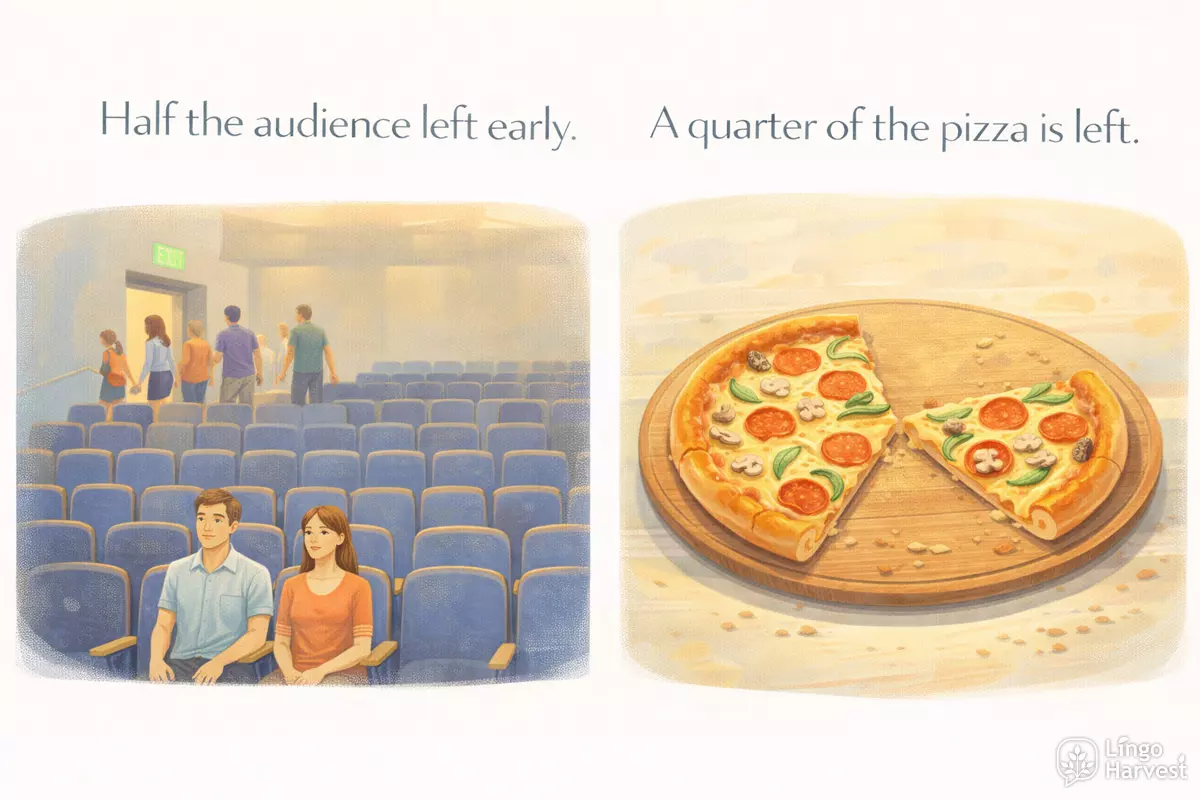
Different fractions communicate different amounts, and their use can affect the overall meaning of a sentence. Here’s a quick comparison of some commonly used fractions as quantifiers:
| Fraction | Example in Sentence | Approximate Value |
|---|---|---|
| Half | Half the audience left early. | 50% |
| A quarter | A quarter of the pizza is left. | 25% |
| One third | One third of the class is absent. | 33% |
| Three-quarters | Three-quarters of the team won prizes. | 75% |
| One eighth | One eighth of the pie remains. | 12.5% |
Key points to remember
- Fractional quantifiers can be used with both countable and uncountable nouns.
- "Of" is required before pronouns and definite nouns, but often omitted with indefinite singular nouns.
- The verb agreement depends on whether the noun after the fraction is singular or plural: Half of the cake is gone vs. Half of the cookies are gone.
- These expressions offer a precise, concise way to convey parts of a whole in English.
Use with countable and uncountable nouns
When using words like half, quarter, and other fractional quantifiers, the type of noun—whether it refers to things you can count (like apples) or things you measure in quantity (like water)—affects how these expressions are formed. The choice of article, pluralization, and even preposition can change depending on the noun’s category.
Countable nouns
With items that can be counted individually, such as books or cars, fractional quantifiers often appear with the plural form. For example, you might say half an apple or three quarters of the books. When referring to a single item, half and quarter usually take an article: half a sandwich, a quarter of a cake.
- half the pencils — Half the pencils were missing after the exam.
- half a loaf — Half a loaf was enough for breakfast.
- a quarter of a pizza — I ate a quarter of a pizza by myself.
- half a mile — The store is only half a mile away.
- four fifths of the tickets — Four fifths of the tickets were sold online.
Uncountable nouns
For substances or concepts that aren’t counted individually—like milk, rice, or information—fractional quantifiers are paired with the singular form, and often require of. For example: half of the water, a quarter of the sugar. Unlike countable nouns, you won’t see pluralization here: you would not say half waters.
- half of the bread — Half of the bread was already stale.
- a quarter of the flour — A quarter of the flour spilled onto the counter.
- half of the information — Half of the information was outdated.
- three quarters of the sand — Three quarters of the sand was removed.
- half of the advice — Half of the advice turned out to be useful.
- a third of the money — A third of the money was donated to charity.
- half of the oil — Half of the oil leaked from the container.
- four fifths of the rice — Four fifths of the rice was already cooked.
- half of the cheese — Half of the cheese has gone bad.
- two thirds of the air — Two thirds of the air in the tank was gone.
Comparing patterns: countable vs. uncountable
| Fractional quantifier | Countable noun example | Uncountable noun example |
|---|---|---|
| half | half a cookie | half of the water |
| a quarter | a quarter of a cake | a quarter of the rice |
| three quarters | three quarters of the books | three quarters of the flour |
| two thirds | two thirds of the apples | two thirds of the sugar |
Notice how the structure shifts: for countable items, the noun is often plural or has an article, while for uncountables, the phrase almost always uses of the plus the singular noun. This distinction is important for sounding natural and accurate when expressing fractions in English.
Difference between precise and approximate meaning
English quantifiers like half, quarter, and various fractions can indicate either a specific, mathematically exact amount or a more flexible, estimated value. The context and the way these expressions are used often determine whether the speaker intends an exact quantity or is just giving a rough idea.
How context affects interpretation
When someone says "half," sometimes they mean exactly 50%, but in everyday conversation, it often just means "about half" or "a large portion." The same goes for other fractions like "a quarter" or "three-quarters." This flexibility helps speakers communicate efficiently, but it can also create ambiguity if precision is needed.
- Precise: "Cut the cake into half." (Exactly 2 equal pieces)
- Approximate: "I finished half my homework." (Maybe slightly more or less than 50%)
- Precise: "A quarter of the class was absent." (Exactly 25%)
- Approximate: "About a quarter of the pizza is left." (Roughly, not exactly 25%)
- Precise: "One third of the votes went to each candidate."
- Approximate: "I waited for half an hour." (Could be 25–35 minutes)
- Approximate: "He gave me half a smile." (Figurative, not measurable)
- Precise: "Mix three-quarters of a cup of sugar."
- Approximate: "There’s only a fraction of the work left." (Unspecified small amount)
- Approximate: "It’s about half finished." (Estimate, not exact)
Common signals of precision versus estimation
Certain words or phrases cue whether an amount is meant to be exact or inexact:
- Adding "about," "roughly," or "almost" before a fraction signals estimation.
- Using fractions in recipes, math, or technical instructions usually signals an exact value.
- Expressions like "half asleep," "half the time," or "quarter to five" are often idiomatic or approximate.
| Expression | Typical Meaning | Precision |
|---|---|---|
| Half of the cake | Exactly 50% | Precise |
| About half the people | Approximately 50% | Approximate |
| A quarter of an hour | Exactly 15 minutes | Precise |
| Roughly a quarter of the audience | Estimated 25% | Approximate |
| Three-quarters full | Approximately 75% | Approximate |
| One third of the class | Exactly 33.3% | Precise |
Why does this distinction matter?
Understanding whether a fraction is being used precisely or loosely helps avoid miscommunication. In casual conversation, estimates are usually sufficient, but in contracts, science, or instructions, specificity is essential. Recognizing these cues in language allows listeners to interpret and respond appropriately.
Sentence position and grammatical patterns
How we use words like “half,” “quarter,” and other fractions as quantifiers in English depends a lot on their place in a sentence and the grammar that surrounds them. These fractional expressions can act as determiners, subjects, objects, or complements, and their placement can subtly change the meaning or emphasis.
Common positions and structures
Fractional quantifiers can appear before nouns, after verbs, or even as part of prepositional phrases. Their use often varies depending on whether the noun they modify is countable or uncountable, and whether it is singular or plural. For example, “half” and “a half of” are both possible, but have slightly different patterns.
- Before a noun: “Half an hour,” “A quarter mile,” “Three-quarters of the cake”
- With 'of' + definite article or possessive: “Half of the class,” “A quarter of my sandwich”
- As subject: “Half is missing,” “A quarter is enough”
- As object: “He ate half,” “She drank a third”
- With plural nouns: “Half the apples are rotten,” “Two-thirds of the students passed”
- Without 'of' for some nouns: “Half time,” “Quarter pound”
- As adverbial modifiers: “He’s half asleep,” “It’s three-quarters finished”
- With prepositions: “Within half an hour,” “After a quarter of a mile”
- With pronouns: “Half of them left,” “A third of us agreed”
- In questions: “Is half the group here?” “Did you want a quarter or a half?”
Grammatical patterns for fractions as quantifiers
The grammatical behavior of fractional quantifiers often depends on the noun phrase and the context. “Half,” “quarter,” and similar expressions sometimes require “of” when followed by a definite noun or pronoun, but can be used without “of” in certain fixed phrases.
| Pattern | Example |
|---|---|
| Fraction + noun (no 'of') | Half a loaf, Quarter mile |
| Fraction + of + definite noun/pronoun | Half of the team, A third of them |
| Fraction + plural noun | Half the apples, Two-thirds of students |
| Fraction as subject | Half is gone, A quarter was eaten |
| Fraction as object | She took half, He lost a third |
| Fraction as adverbial phrase | He’s half asleep, It’s three-quarters finished |
Key points to remember
- “Of” is generally needed when the fractional quantifier is followed by a definite noun or pronoun (“half of the cake,” “a quarter of us”).
- When modifying indefinite or uncountable nouns, “of” can often be omitted (“half an hour,” “quarter pound”).
- Subject-verb agreement follows the fraction’s reference. For example, “Half of the cake is gone” (singular), but “Half of the cookies are gone” (plural).
- In spoken English, fractional quantifiers are sometimes used elliptically (“Want half?”).
Understanding where and how these quantifiers fit into English sentences can help learners and writers use them with greater accuracy and flexibility. The patterns above show how “half,” “quarter,” and other fractions adapt to different grammatical roles.
Common fraction-based expressions
In English, fractions like "half," "quarter," and other forms are widely used as quantifiers to describe amounts, portions, and proportions in both everyday conversation and formal writing. These expressions help speakers indicate non-whole quantities with precision or estimation, whether referring to objects, time, people, or abstract concepts. Understanding how these fractional terms are applied can make communication clearer and more nuanced.
Typical Fraction Quantifiers in English
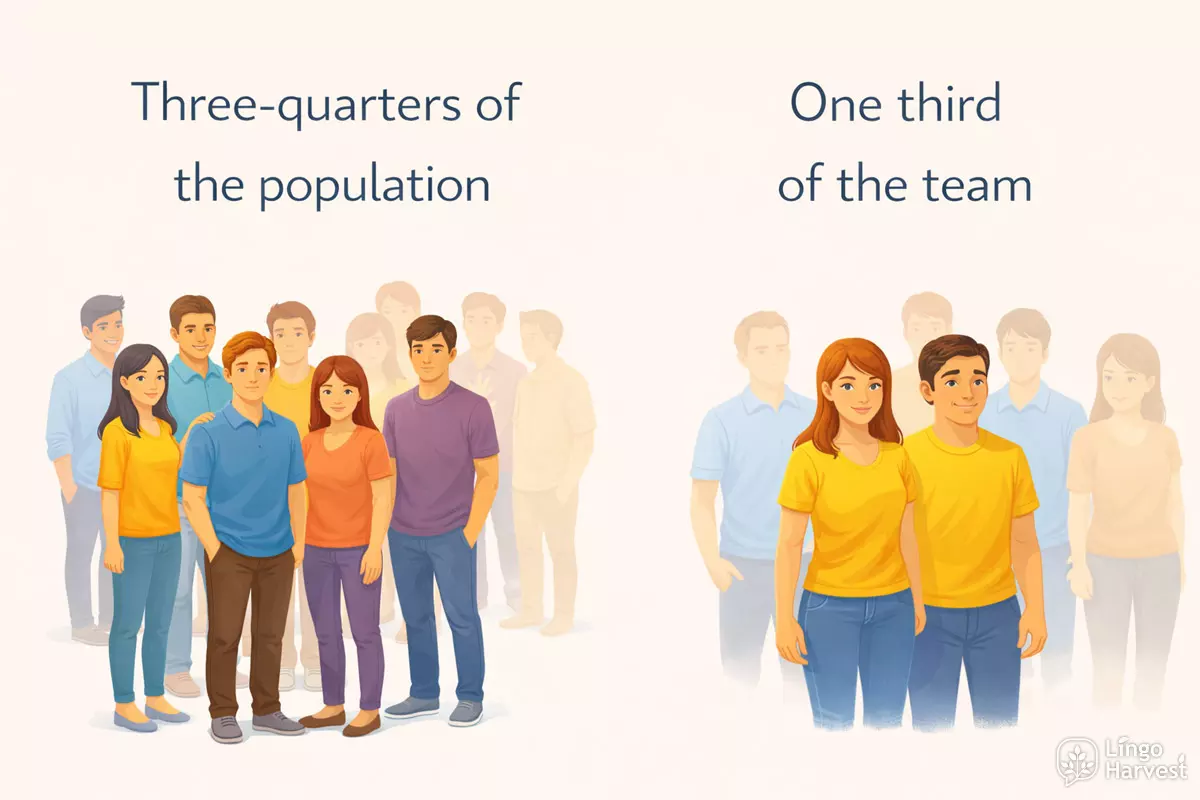
Some fractions are especially common as quantifiers. They often precede countable or uncountable nouns to specify a part of a whole. Here are some widely used patterns:
- Half – "Half the cake is gone." / "Half of the students passed."
- A quarter – "A quarter of an hour" (meaning 15 minutes), "A quarter of the class"
- Three-quarters – "Three-quarters of the population"
- One third – "One third of the team"
- Two-thirds – "Two-thirds of the land"
- One fifth – "One fifth of the participants"
- Three-fifths – "Three-fifths of the votes"
- A fraction of – "A fraction of the cost"
- Half a dozen – "Half a dozen eggs" (meaning six eggs)
- Half an hour – "I'll be there in half an hour"
- A quarter pound – "A quarter pound of cheese"
- Half the time – "He finishes in half the time"
- One and a half – "One and a half days"
- More than half – "More than half the audience agreed"
- Less than a quarter – "Less than a quarter responded"
Patterns and Variations
Fractional quantifiers can be used with or without "of," and their structure may shift depending on whether the noun is definite, indefinite, countable, or uncountable. For example:
- With "of": "Half of the water," "A quarter of the employees"
- Without "of": "Half an apple," "A third chance"
Some expressions are set phrases, such as "half past" (for time), "a quarter to" (for time), or "half-baked" (idiomatic).
Comparison of Fraction-based Quantifiers
| Expression | Typical Usage | Example Sentence |
|---|---|---|
| Half | With singular or plural nouns; countable/uncountable | Half the cake is gone. |
| A quarter | For dividing into four parts | A quarter of the team is absent. |
| One third | Dividing into three equal parts | One third of the students failed. |
| Three-quarters | For three out of four parts | Three-quarters of the city was affected. |
| One fifth | Describing smaller fractions | One fifth of the money was spent. |
Other Uses and Notes
Fractional quantifiers can sometimes be used figuratively, as in "not half bad" (meaning better than expected) or "a fraction of a second" (a very short time). They also appear in set expressions about time ("half past seven," "a quarter to five") and amounts ("half a million," "a quarter of a mile").
Choosing the right fraction-based expression depends on what you want to convey—precision, approximation, or idiomatic meaning. These quantifiers enrich English by allowing speakers to express partial quantities, proportions, and subtle shades of meaning.
Use in everyday and informational contexts
Expressions like "half," "quarter," and other fractional quantifiers are deeply woven into daily English conversations and written explanations. People naturally use these terms to describe amounts, portions, and proportions in both casual situations and when giving precise information. Their flexibility allows speakers to convey rough estimates or exact quantities, depending on the context.
Common Situations and Examples
Fractional quantifiers frequently appear in scenarios involving food, time, measurements, and general descriptions. Here are some typical ways these expressions surface in spoken and written English:
- “Can I have half a cup of tea?”
- “Only a quarter of the class finished early.”
- “Three-quarters of the cake was gone by noon.”
- “He spent half his salary on rent.”
- “A third of the respondents agreed.”
- “About one-fifth of the city’s population commutes by bike.”
- “She ate half an apple.”
- “Less than a quarter of the books were returned on time.”
- “Half the team was absent.”
- “A quarter of an hour left until the meeting.”
- “Roughly two-thirds of the votes were counted.”
- “Half a dozen eggs.”
- “He gave away a third of his collection.”
Patterns of Use in Informational Contexts
In more formal writing, such as reports, news articles, or academic texts, fractional quantifiers help present statistics or summarize data. They make information accessible and relatable, especially when exact numbers are less important than the general proportion. For example, a report might state, “Nearly half of all participants reported improved results,” making the data easier to grasp at a glance.
| Expression | Typical Context | Example Sentence |
|---|---|---|
| Half | Time, food, money | “Half the pizza is left.” |
| Quarter | Time, fractions, groups | “A quarter of the team arrived late.” |
| Third | Statistics, divisions | “One-third of students chose science.” |
| Three-quarters | Surveys, consumption | “Three-quarters of respondents agreed.” |
| Fifth | Demographics, studies | “About a fifth of the population is under 18.” |
Nuances and Flexibility
Fractional quantifiers can refer to both countable and uncountable nouns, and context usually clarifies the meaning. Sometimes a phrase like “half the people” is literal; other times, it simply means “a large part.” Speakers may also combine these quantifiers with approximations (“about half,” “almost a quarter”) to convey uncertainty or generalization, making them practical tools for both accuracy and conversational ease.
Typical learner errors with fractions
Understanding how to use fractional expressions like "half," "quarter," and more complex fractions in English can be a challenge for learners. These quantifiers come with specific grammar rules and patterns, and mistakes often arise from differences between English and other languages or confusion about countability and agreement.
Common mistakes in grammar and agreement
Learners frequently struggle with agreement between the fraction and the noun it modifies. For example, "half of the apples are gone" versus "half of the cake is gone." The verb must agree with the noun being quantified, not the fraction itself. Another area of confusion is when to use "of" after a fraction (e.g., "a quarter of the students") and when it can be omitted (e.g., "half an hour").
Typical usage problems
Misusing articles or omitting necessary words is another pitfall. For example, saying "a half cake" instead of "half a cake," or "the half of people" instead of "half of the people." Learners may also confuse ordinal numbers ("third," "fourth") with fractions ("a third," "a fourth"), leading to awkward constructions.
Frequent errors with pronunciation and spelling
Pronouncing "half" as /hælf/ instead of the correct /hɑːf/ or misspelling "quarter" (e.g., "quater") are small errors that can hinder communication. Some learners also say "one over two" instead of "one half" in contexts where the latter is idiomatic.
Examples of mistakes and corrections
Below is a table showing frequent learner errors with fractional quantifiers and their corrected forms:
| Incorrect Form | Correct Form |
|---|---|
| The half of students is late. | Half of the students are late. |
| One third of cake are missing. | One third of the cake is missing. |
| A half bread, please. | Half a loaf of bread, please. |
| Three quarters from the team was absent. | Three quarters of the team were absent. |
| I waited a quarter hour. | I waited a quarter of an hour. |
| He ate one over four pizza. | He ate a quarter of the pizza. |
| Half of hour passed. | Half an hour passed. |
| She drank two third of the juice. | She drank two thirds of the juice. |
| Half of them is here. | Half of them are here. |
| One fourth students were late. | One fourth of the students were late. |
Additional patterns to watch for
- Using "the" unnecessarily before fractions: the half of instead of half of
- Incorrect pluralization: saying two third instead of two thirds
- Mixing up fraction expressions: a quarter of hour instead of a quarter of an hour
- Confusing "half" as a noun versus an adjective: a half cake vs. half a cake
Awareness of these pitfalls can help learners avoid common traps and use fractional quantifiers more naturally in English.
Examples showing correct usage
Expressions like half, quarter, and other fractional quantifiers serve to indicate portions or parts of a whole. Their correct use depends on whether the noun is countable or uncountable, singular or plural, and whether an article is needed. Below, you'll find practical examples illustrating how these quantifiers function in real sentences.
Using "half" in context
- She drank half a glass of water. ✅
- We spent half the day hiking. ✅
- Only half of the students passed the exam. ✅
- I need half an hour to finish this. ✅
- Incorrect: Half glass of water. ❌ (Missing article)
Examples with "quarter"
- He ate a quarter of the cake. ✅
- They arrived a quarter of an hour late. ✅
- About a quarter of the seats were empty. ✅
- Incorrect: Quarter cake. ❌ (Should be "a quarter of the cake")
Other fractions as quantifiers
- We finished three-quarters of the project before lunch. ✅
- She took a third of the cookies. ✅
- Only one-fifth of the population owns a car. ✅
- The recipe calls for two-thirds of a cup of sugar. ✅
- Incorrect: One-third cookies. ❌ (Should be "one-third of the cookies")
Comparing usage with countable and uncountable nouns
| Fractional Quantifier | Correct Example |
|---|---|
| Half + uncountable noun | She used half the flour. |
| Half + singular countable noun (with article) | He read half a book on the train. |
| Quarter + plural countable noun | Only a quarter of the apples were ripe. |
| Fraction + definite noun | They visited three-quarters of the museum. |
Notice that fractional quantifiers often require "of" before a definite article or pronoun (half of the cake, a quarter of them), but not before indefinite singular nouns (half a glass). Always check the noun type and whether an article is needed to ensure proper usage.
Practice: using fractional quantifiers accurately
Understanding how to use fractional quantifiers such as "half," "a quarter," and "three-quarters" is essential for clear communication, especially when discussing amounts, portions, or divisions in English. Let's explore a variety of practical tasks and examples to help you become more comfortable with these expressions.
Common patterns with fractional quantifiers
Fractional words often appear before nouns or with "of" plus a noun. Here are some frequently used structures:
- Half (of) + noun: Half the cake, half of the students
- A quarter (of) + noun: A quarter of the class, a quarter of an hour
- Three-quarters (of) + noun: Three-quarters of the team
- Fractions + plural nouns: Half the apples, a quarter of the books
- Fractions + uncountable nouns: Half the water, a quarter of the money
- Without 'of' for definite nouns: Half my sandwich, a quarter your time
- With 'of' for pronouns: Half of them, a quarter of it
- With numbers: One and a half hours, two and a quarter miles
- Negative statements: Not even half the tickets were sold
- Comparisons: More than half of the group agreed
Choose the correct quantifier
Pick the most suitable fractional quantifier for each sentence.
- ______ of the pizza was eaten before I arrived.
- Only ______ of the assignments were completed on time.
- She drank ______ of her coffee and left the rest.
- ______ of them wanted to go to the museum.
- It took me ______ an hour to finish the report.
- ______ of the budget has already been spent.
- Nearly ______ of the audience left early.
- ______ of the book was difficult to understand.
- He completed ______ of the tasks by noon.
- About ______ of the journey was done on foot.
Show answers
- Half
- A quarter
- Three quarters
- Half
- A quarter of
- Half
- Half
- A quarter
- Three quarters
- Half
Comparing fractional quantifiers
The table below shows how different fractional quantifiers work with various types of nouns and contexts.
| Fractional Quantifier | Example Usage |
|---|---|
| Half (of) | Half the bread was stale. |
| A quarter (of) | A quarter of the students passed. |
| Three-quarters (of) | Three-quarters of the cake is gone. |
| One and a half | One and a half hours later, he returned. |
| Half of them | Half of them agreed with the plan. |
Identify and correct the mistakes
Some of the sentences below contain errors with fractional quantifiers. Find and correct the mistakes.
- Half of the water in the bottle are gone.
- A quarter the students didn’t attend.
- Three-quarters of my friends was late.
- Half my sandwich is missing.
- Two-thirds of the information were incorrect.
- Half of the chairs is broken.
- A quarter of the cake were eaten.
- Three-quarters the class passed the exam.
- Half of the money are already spent.
- Two-thirds of her colleagues was absent.
Show answers
- Half of the water in the bottle is gone. (water is uncountable)
- A quarter of the students didn’t attend.
- Three-quarters of my friends were late. (friends is plural)
- Half my sandwich is missing. (Correct)
- Two-thirds of the information was incorrect. (information is uncountable)
- Half of the chairs are broken. (chairs is plural)
- A quarter of the cake was eaten. (cake is singular)
- Three-quarters of the class passed the exam.
- Half of the money is already spent. (money is uncountable)
- Two-thirds of her colleagues were absent. (colleagues is plural)
By practicing with these patterns and correcting common mistakes, you will gain greater confidence in using fractional quantifiers precisely in both written and spoken English.