Numerous: Formal Quantifier for Large Numbers in English

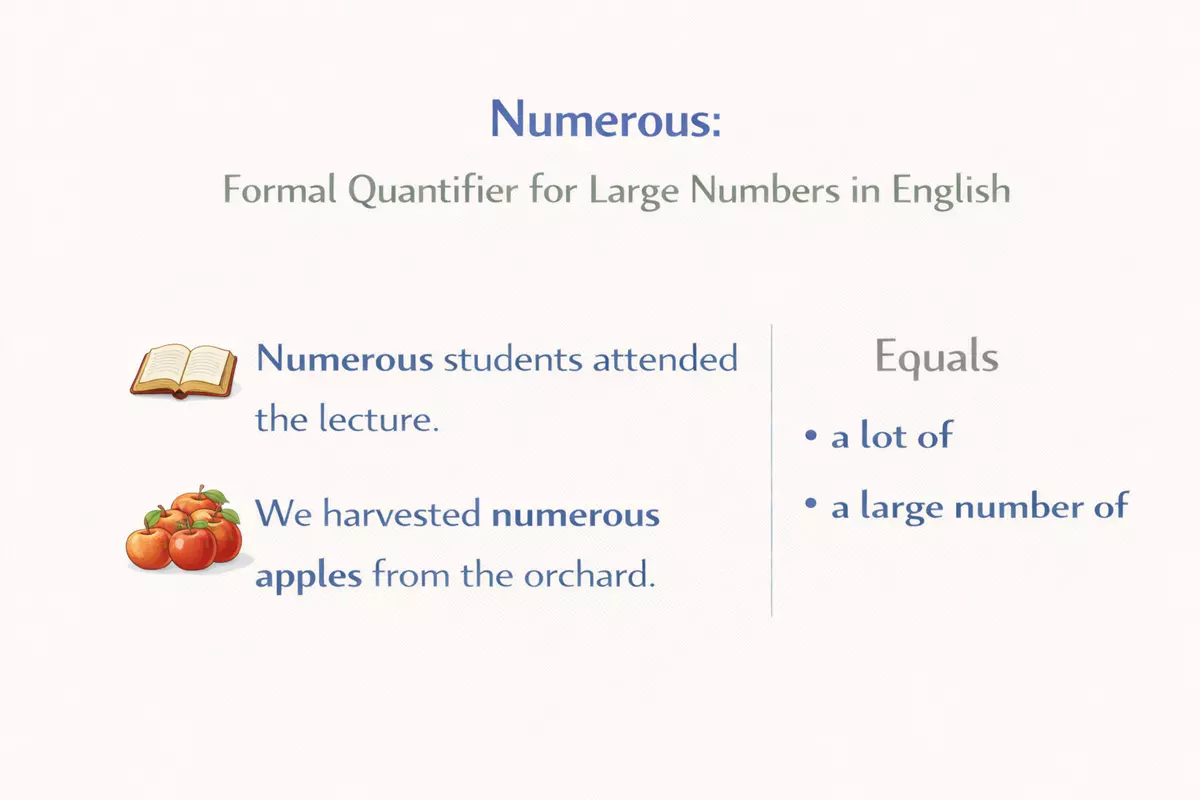 Here we how numerous compares to other large-quantity words, what nouns it typically modifies, and where it sounds natural. It also explains its register, grammar patterns, common mistakes, alternatives, and provides usage examples and practice.
- Meaning and strength compared to other large-quantity words
- Typical noun types used with numerous
- Register and tone: where numerous sounds natural
- Sentence position and grammatical patterns
- Common alternatives and why numerous is more formal
- Typical mistakes and unnatural uses
- Examples from formal and informational contexts
- Practice: choosing numerous vs simpler quantifiers
English speakers often use words like countless, numerous, or a multitude to describe large amounts or impressive totals, reflecting the language’s flexibility in expressing vast quantities. These terms help convey the sense of something being too many to count or overwhelmingly abundant. Examining how people choose and use such words reveals interesting patterns in communication, showing not only how language adapts to convey scale but also how it shapes our perception of abundance and variety in everyday life.
Meaning and strength compared to other large-quantity words
When you use the word numerous in English, you’re signaling that there is a considerable, but not precisely counted, quantity of something. It’s more formal than simply saying “a lot,” yet less overwhelming than terms like “countless” or “myriad.” The nuance of numerous is that it suggests a number large enough to be notable, but not infinite or unmanageable. In professional or academic writing, numerous is often preferred for its clarity and neutrality.
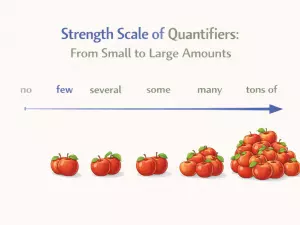
English offers a spectrum of words to describe large quantities, ranging from informal to highly emphatic. The strength of each term varies, and choosing the right one depends on context and the impression you want to give. For instance, “many” is broad and neutral, while “scores of” or “myriad” suggest a much higher count. Some words carry a sense of exaggeration or poetic flair, while others, like “several,” are more restrained.
Comparative strength of common large-quantity terms
| Word/Phrase | Implied Quantity | Formality | Notes |
|---|---|---|---|
| Several | More than a few (typically 3–7) | Neutral | Smallest among these options |
| Many | Large, but vague | Neutral | Common in both speech and writing |
| Numerous | Significantly large | Formal | Preferred in academic/professional contexts |
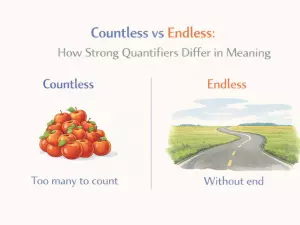
| Countless | Too many to count | Formal/Emphatic | Suggests impossibility of counting |
| Myriad | Extremely large, almost infinite | Formal/Literary | Often used for dramatic effect |
| Scores of | Dozens (20+) | Neutral | Frequently used in news and reports |
| Hundreds of | Explicitly 100 or more | Neutral/Formal | Gives a rough minimum |
| Thousands of | Explicitly 1,000 or more | Neutral/Formal | Used for very large groups |
| Legions of | Vast numbers | Literary/Emphatic | Evokes imagery of armies or crowds |
Choosing the right word for quantity
Selecting between these options depends on your audience, the context, and the emphasis you want to convey. Numerous works well when you want to be precise but not overly dramatic, and when a formal tone is appropriate. If you want to stress an overwhelming number, “countless” or “myriad” might be better choices. For more casual or conversational contexts, “many” or “lots of” are usually sufficient.
- Use numerous in formal reports, research summaries, and academic essays.
- Opt for many in everyday conversation or general writing.
- Choose countless or myriad for rhetorical or literary effect.
- Reserve scores of, hundreds of, or thousands of when you want to give a rough minimum or impress scale.
Understanding these subtle differences ensures your language matches your intent and the expectations of your audience.
Examples of large-quantity words in context

- Numerous studies confirm the effectiveness of this method.
- Countless hours were spent refining the final design.
- The city offers a myriad of cultural experiences.
- Scores of journalists gathered outside the courthouse.
- Hundreds of applications were submitted within the first week.
- Thousands of people attended the annual festival.
- Legions of fans followed the band on tour.
- Many factors contribute to long-term success.
Practice: Choose the most appropriate quantity word
Choose the word or phrase that best fits the meaning and tone of each sentence.
- ________ studies have examined the effects of climate change. (many / numerous / countless)
- She spent ________ nights worrying about the outcome. (several / numerous / countless)
- The museum displays a ________ of rare artifacts. (many / myriad / several)
- ________ people were waiting outside the building. (scores of / few / a little)
- The company received ________ emails after the announcement. (hundreds of / a few / little)
- ________ opportunities exist for graduates in this field. (many / several / a couple of)
- The report lists ________ reasons for the decline. (numerous / one / hardly any)
- ________ volunteers helped organize the event. (thousands of / a bit of / little)
- The author describes ________ challenges faced by the community. (a myriad of / one / a few)
- ________ examples illustrate the point clearly. (several / none / much)
Show answers
- numerous
- countless
- myriad
- scores of
- hundreds of
- many
- numerous
- thousands of
- a myriad of
- several
Typical noun types used with numerous
The word numerous is most often paired with countable, plural nouns, especially when discussing groups, collections, or categories that can be individually counted. In formal writing and academic contexts, this quantifier helps convey the idea of a large but indefinite number. While it is not used with uncountable or singular nouns, it frequently appears with terms denoting people, objects, events, and abstract countable concepts.
Common categories and examples
Writers and speakers tend to use numerous with nouns that represent discrete, countable items. Here are some of the most frequent pairings:
- people (e.g., numerous students, numerous participants)
- places (e.g., numerous cities, numerous countries)
- events (e.g., numerous occasions, numerous incidents)
- objects (e.g., numerous books, numerous devices)
- animals (e.g., numerous species, numerous birds)
- opportunities (e.g., numerous chances, numerous openings)
- problems (e.g., numerous challenges, numerous issues)
- ideas (e.g., numerous suggestions, numerous proposals)
- studies (e.g., numerous reports, numerous experiments)
- examples (e.g., numerous cases, numerous illustrations)
- factors (e.g., numerous variables, numerous reasons)
Key patterns and restrictions
It’s important to remember that numerous does not work with singular or mass nouns. For example, ❌ numerous information or numerous water are incorrect. Instead, it always modifies plural, countable nouns. Below is a summary of compatible and incompatible noun types:
| Noun Type | Can be used with "numerous"? |
|---|---|
| Plural countable nouns | ✅ Yes (numerous books) |
| Singular countable nouns | ❌ No (numerous book) |
| Uncountable (mass) nouns | ❌ No (numerous information) |
| Abstract plural countable nouns | ✅ Yes (numerous ideas) |
Summary
In summary, numerous is reserved for plural, countable nouns—especially those describing people, objects, or events. Using it correctly adds a formal and precise tone to your writing when you want to indicate a large, unspecified quantity.
Register and tone: where numerous sounds natural
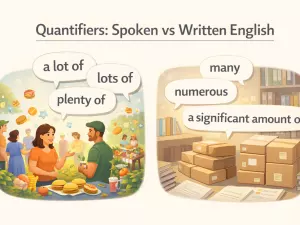
The word numerous fits best in contexts that call for a formal or neutral register. It's typically used in academic writing, professional reports, and journalism, where precision and objectivity are important. In everyday conversation, people more often use simpler alternatives like many or a lot of. Choosing numerous can make your language sound more polished or detached, which is useful when you want to emphasize quantity without sounding emotional or exaggerated.
Typical contexts for "numerous"
Writers and speakers often select this term to convey quantity in a way that feels measured rather than casual or hyperbolic. Below are some common scenarios where this word sounds natural:
- Scientific or technical articles: "Numerous studies confirm the results."
- Formal presentations: "Numerous factors influence climate change."
- Official reports: "Numerous complaints were received last year."
- Academic essays: "Numerous examples can be found in the literature."
- Journalistic writing: "Numerous witnesses described the event."
- Business communication: "Numerous clients expressed interest."
- Legal contexts: "Numerous precedents exist for this case."
- Historical analysis: "Numerous events led to this crisis."
- Government documents: "Numerous proposals were considered."
- Press releases: "Numerous improvements have been implemented."
Alternatives and their tone
Choosing the right quantifier depends on your audience and intent. Here’s a comparison of common options and the tone they convey:
| Quantifier | Register & Tone |
|---|---|
| Numerous | Formal, objective, measured |
| Many | Neutral, widely used in both speech and writing |
| A lot of | Informal, conversational |
| Countless | Emphatic, sometimes hyperbolic |
| Several | Vague, but less than "many" or "numerous" |
| Scores of | Literary, dramatic, or journalistic flair |
When "numerous" feels out of place
In informal speech or casual writing, using numerous can sound stilted or overly formal. For example, saying "There were numerous people at the party" might seem awkward in everyday conversation. Instead, opt for a lot of or plenty of in relaxed settings. Reserve the more formal quantifier for situations where clarity, detachment, or a neutral tone is required.
Sentence position and grammatical patterns
Writers and speakers tend to use "numerous" in specific syntactic environments, most often as a pre-nominal adjective. It typically precedes the noun it qualifies, aligning with the placement of other quantifiers in English. Despite its formal register, "numerous" integrates smoothly into both written and spoken contexts, especially when emphasizing the impressively large scope of a group or collection.
Typical placement of "numerous"
The word "numerous" is almost always used directly before a plural noun without an intervening article or determiner. Unlike some quantifiers, it does not pair with "of" or require a definite article. For example, "numerous options" is correct, while "the numerous of options" is not.
Common grammatical patterns
Here are some frequent patterns and points to note when using "numerous":
- Precedes a plural count noun: numerous students, numerous opportunities
- Cannot be used with singular nouns: ❌ numerous information
- Does not require "of": ❌ numerous of books
- No definite or indefinite article: ❌ a numerous people
- Can be followed by adjectives modifying the noun: numerous talented musicians
- Often appears as subject or object modifier: Numerous challenges arose or She overcame numerous setbacks
- Used in both active and passive constructions: Numerous errors were found
- May be coordinated with other quantifiers: numerous and varied responses
- Seldom stands alone without a noun: ❌ There were numerous
- Frequently found in academic, journalistic, and formal writing
Comparison with similar quantifiers
| Quantifier | Typical Usage Example | Register | Article/“of” Usage |
|---|---|---|---|
| numerous | Numerous studies support this claim. | Formal | No article, no “of” |
| many | Many students enjoy reading. | Neutral | No article, no “of” (except “many of the…”) |
| a large number of | A large number of cases were reported. | Formal/Neutral | Always with “of” |
| several | Several witnesses testified. | Neutral | No article, no “of” |
Summary of usage rules
For clear and accurate expression, use "numerous" exclusively before plural count nouns and avoid pairing it with articles or "of." Its position at the start of a noun phrase and its compatibility with other modifiers make it a flexible yet distinctively formal quantifier.
Common alternatives and why numerous is more formal
Many English speakers use a variety of words to indicate large quantities, but the level of formality can differ significantly. While "numerous" is typically reserved for more formal or academic writing, several other expressions are commonly chosen in everyday speech or informal contexts.
Alternatives for expressing large quantities

Writers and speakers often select from a range of terms to convey the idea of "many." Some frequent options include:
- many — Many people use this app daily.
- a lot of — She has a lot of experience in marketing.
- plenty of — There’s plenty of food for everyone.
- loads of — He has loads of ideas for the project.
- countless — She spent countless hours preparing.
- tons of — They received tons of positive feedback.
- scores of — Scores of supporters gathered outside.
- several — Several options are still available.
- myriad — The city offers a myriad of attractions.
- hundreds of — Hundreds of messages arrived overnight.
- copious — He took copious notes during the lecture.
- masses of — Masses of people filled the square.
- oodles of — The kids had oodles of fun.
- heaps of — She has heaps of work to finish.
- abundant — Clean water is abundant in this region.
- legions of — Legions of fans followed the team.
- thousands of — Thousands of tourists visit each year.
- no end of — We’ve had no end of problems lately.
- innumerable — The book contains innumerable references.
- umpteen — I’ve told you umpteen times already.
Why "numerous" is considered more formal
"Numerous" stands out in professional, scientific, and academic writing because it is precise and avoids the colloquial tone of alternatives like "lots of" or "tons of." It helps convey seriousness and objectivity, which are valued in scholarly or official documents. In contrast, words such as "loads of" may sound casual or even vague, making them less suitable for contexts where clarity and formality are important.
Comparing alternatives: Formality and context
Wording choice often depends on the intended audience and the level of formality required. The table below compares some popular options, highlighting their appropriate settings and perceived formality:
| Expression | Typical Use & Formality |
|---|---|
| Numerous | Formal reports, academic writing; very formal |
| Many | Neutral in tone; suitable for written and spoken English |
| A lot of | Informal speech, casual writing; not used in academic texts |
| Countless | Literary, emphatic contexts; formal or creative writing |
| Loads of | Very informal, spoken English; rarely used in formal documents |
| Myriad | Formal, literary writing; sometimes used for stylistic emphasis |
| Several | Neutral, indicates more than a few but not a large number; general use |
| Copious | Formal, often used in scientific or descriptive contexts |
| Heaps of | Colloquial, very informal; rarely appropriate in formal settings |
| Umpteen | Informal, often playful or exaggerated |
Summary
Selecting the right quantifier depends on formality, context, and audience. "Numerous" remains a preferred choice for contexts demanding precision and professionalism, while alternatives offer flexibility in tone and style for less formal situations.
Typical mistakes and unnatural uses
Using numerous as a formal quantifier for large numbers in English can sometimes lead to awkward phrasing or miscommunication if the context and grammar are not handled correctly. Many learners and even native speakers occasionally misuse this word, especially when trying to sound more formal or academic. Below, we highlight the most frequent pitfalls and unnatural patterns associated with numerous.
Common errors with "numerous"
- Using numerous with uncountable nouns (e.g., numerous information ❌ instead of much information or numerous pieces of information ✅).
- Placing numerous after the noun (Errors numerous were found ❌ instead of Numerous errors were found ✅).
- Combining numerous with determiners like the, these, or those (The numerous people is rarely correct; prefer numerous people or many of the people).
- Using numerous redundantly with other quantifiers (Many numerous examples ❌).
- Applying numerous to singular nouns (Numerous book ❌ instead of Numerous books).
- Attempting to use a comparative or superlative form (more numerous, the most numerous) incorrectly or unnecessarily.
- Choosing numerous in very casual conversation, where many or a lot of would sound more natural.
- Using numerous with negative statements (There aren't numerous options ❌; prefer There aren't many options).
- Forgetting that numerous implies a large number, so using it for small groups is unnatural (Numerous people attended the meeting for a group of three ❌).
- Misplacing the word in the sentence, leading to confusion or ambiguity.
Comparing "numerous" with similar quantifiers
Writers and speakers often confuse numerous with other quantifiers like many, various, and several. The table below clarifies typical usage and contrasts for each term:
| Quantifier | Typical usage & notes |
|---|---|
| Numerous | Formal, emphasizes a large number; only with countable nouns. E.g., Numerous studies. |
| Many | Neutral, common in both speech and writing; can be used with countable nouns. E.g., Many students. |
| Several | Means "more than two but not a large number"; suggests a smaller group than numerous. E.g., Several reasons. |
| Various | Stresses diversity rather than quantity; not always about large numbers. E.g., Various solutions. |
Unnatural or forced patterns
- Replacing a lot of or lots of with numerous in informal speech, which can sound stiff.
- Using numerous to modify abstract mass nouns (numerous happiness ❌).
- Adding adverbs like very or so before numerous (so numerous people ❌).
- Attempting to use numerous as a pronoun (Numerous attended ❌ instead of Numerous people attended).
Awareness of these patterns helps ensure that numerous is used precisely and naturally, especially in academic or formal settings where clarity and correctness are essential.
Examples from formal and informational contexts
Writers, speakers, and researchers often use the term numerous to convey the idea of a large, unspecified quantity in English, especially in settings where exact figures are either unknown or unnecessary. This quantifier appears frequently in reports, academic writing, journalism, and official communications to emphasize scale without providing a specific count.
Common usage patterns
- Numerous studies have shown that regular sleep improves memory and concentration.
- Numerous factors contribute to language learning success, including practice time, motivation, and exposure.
- The project received numerous awards.
- There are numerous examples of this phenomenon.
- Numerous complaints were filed.
- Numerous participants responded to the survey.
- Numerous opportunities exist in this field.
- Officials cited numerous reasons for the delay.
- The region has numerous historic sites.
- Numerous challenges remain unresolved.
- Numerous attempts have been made to solve the issue.
- Researchers observed numerous changes over time.
- The law applies to numerous situations.
- Numerous errors were detected during testing.
- The organization supports numerous initiatives.
Contrasts with other quantifiers
In formal documents, numerous often appears alongside or in contrast to other quantifiers such as several, many, and countless. The choice depends on the writer’s intent and the desired degree of emphasis. While several suggests a smaller, but notable number, numerous implies a larger and possibly more impactful quantity.
| Quantifier | Typical Context or Example |
|---|---|
| Several | Several members abstained from voting. |
| Many | Many residents expressed concern. |
| Numerous | Numerous complaints were received about the service. |
| Countless | Countless hours were spent on research. |
Informational and academic tone
In informational writing, using numerous helps maintain an objective tone by avoiding exaggeration while still highlighting significance. For instance, scientific articles might state, “Numerous experiments have validated the hypothesis,” to indicate a robust body of supporting evidence without listing every study.
Overall, numerous is a flexible and neutral term that signals a substantial quantity, making it especially useful in formal, academic, and informational contexts where clarity and precision in magnitude are important but exact numbers are either unavailable or unnecessary.
Practice: choosing numerous vs simpler quantifiers
Understanding when to use "numerous" and when to opt for more straightforward quantifiers like "many," "a lot of," or "several" depends on context, formality, and nuance. "Numerous" often appears in formal writing or speech, especially when emphasizing the large count of something without specifying an exact number. In contrast, simpler quantifiers are more common in everyday conversation and can be less formal or more precise.
Comparing usage: numerous vs. simpler alternatives
Below is a comparison of "numerous" with other quantifiers in various contexts. This will help illustrate which situations favor the formal option and which call for simpler choices.
| Context | Preferred Quantifier |
|---|---|
| Scientific report | Numerous |
| Casual conversation | Many / A lot of |
| Business presentation | Numerous / Several |
| Personal letter | Lots of / Plenty of |
| Describing a vast collection | Numerous |
| Counting small groups | Several / A few |
| General statement | Many |
| Highlighting variety | Numerous |
| Children’s conversation | A lot of / Lots of |
| Emphasizing importance | Numerous / Many |
Practice: choose the best quantifier
Try selecting the most natural quantifier for each sentence below. Consider the context and level of formality.
- There are _____ reasons to support the new policy. (formal report)
- We saw _____ birds in the park yesterday. (chat with a friend)
- The museum houses _____ artifacts from ancient times. (brochure)
- She made _____ mistakes on the test. (teacher’s feedback)
- _____ opportunities await graduates in this field. (career guide)
- They have _____ pets at home—three dogs and two cats! (family conversation)
- The study identified _____ limitations that require further research. (academic paper)
- I’ve got _____ things to do before dinner. (casual conversation)
- The city attracts _____ tourists every year. (travel article)
- The team discussed _____ possible solutions during the meeting. (workplace context)
Show answers
- Numerous
- Lots of / A lot of / Many
- Numerous
- Several / A few / Many
- Numerous / Many
- Several / A few
- Numerous
- A lot of / Lots of
- Thousands of / Many
- Several / Many
Learning when to choose each quantifier enhances clarity and naturalness in both writing and speaking. Practice adapting your language to suit your audience and context, and you’ll find it easier to select the most effective expression.