Enough: Position, Meaning, and Common Usage Mistakes

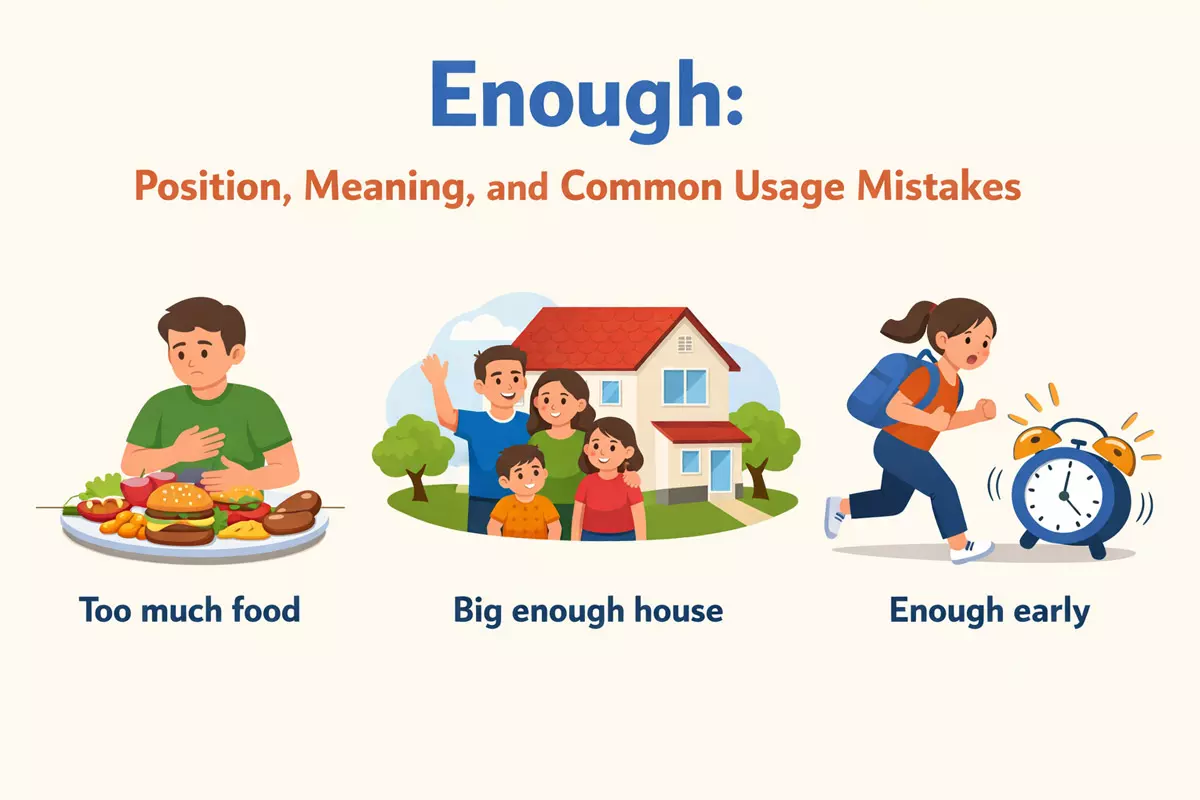 Here we how to use enough with nouns, adjectives, and verbs, highlights the difference between enough and sufficient, explains how placement affects meaning, discusses common word order mistakes, and provides practice with real examples.
Mastering the correct placement and interpretation of the word that signals sufficiency can be tricky, even for advanced English speakers, as small missteps in its usage often lead to confusion or awkward phrasing. This challenge arises because the word can appear in different parts of a sentence, and its position can subtly change the meaning. Being aware of these nuances is essential for clear communication, as using the word incorrectly may distract readers or listeners and undermine the intended message. With careful attention and practice, however, one can improve accuracy and confidence in using this word effectively.
Core meaning of enough in quantity and degree
The word “enough” signals sufficiency—whether you’re talking about countable items, amounts, or levels of quality. It marks the point at which something meets the required or desired threshold, but does not exceed it. Unlike words such as “plenty” or “abundant,” “enough” focuses on adequacy, not surplus.
Understanding “enough” as sufficiency
When “enough” is used, it indicates that the amount or degree is neither too little nor too much. It fits the situation without excess or deficiency. This applies to both tangible things (like food or money nouns) and intangible qualities (such as patience or time).
- We have enough chairs for everyone. (sufficient number, not more than needed)
- She isn’t tall enough to reach the shelf. (degree of height is insufficient)
- Is there enough salt in the soup? (quantity of an ingredient)
- He didn’t speak loudly enough. (degree of volume)
- There’s enough space in the car for three people. (capacity or room)
- You studied enough to pass the exam. (adequacy of preparation)
- Do you have enough information to decide? (sufficiency of knowledge)
- That’s enough for today. (limit reached for time or effort)
- We don’t have enough evidence. (shortfall in amount)
- Is this warm enough for you? (degree of warmth or comfort)
- She’s old enough to vote. (required age met)
- They didn’t work hard enough. (degree of effort)
Comparing “enough” in quantity versus degree

“Enough” is versatile; it can refer to both countable and uncountable nouns, as well as adjectives and adverbs describing degree. Here’s how it looks in different contexts:
| Usage Type | Example |
|---|---|
| Countable noun | We have enough books for everyone. |
| Uncountable noun | There isn’t enough water. |
| Adjective (degree) | She is strong enough to lift it. |
| Adverb (degree) | He didn’t run fast enough. |
Key takeaways
- “Enough” always relates to a standard, requirement, or expectation.
- It can describe both quantity (how much/many) and degree (how well/how far).
- Unlike “too much” or “too little,” it expresses a balance—no excess or lack.
Recognizing how “enough” operates in context helps avoid common pitfalls, such as confusing it with words that describe abundance or shortage. Its core function is to pinpoint adequacy, whether you’re measuring objects, actions, or qualities.
Position before nouns and after adjectives
Understanding where to place "enough" in a sentence is crucial for clear, natural English. The placement changes depending on what "enough" is modifying—whether a noun or an adjective. This section breaks down these patterns with explanations and examples.
Before Nouns
When "enough" refers to quantity or amount, it comes directly before the noun. This usage tells us there is a sufficient number or amount of something. Here are some common structures:
- enough time → We have enough time to finish the task.
- enough money → She doesn’t have enough money to buy the ticket.
- enough chairs → There are enough chairs for everyone.
- enough water → Drink enough water every day.
- enough food → We prepared enough food for the guests.
- enough people → There aren’t enough people to start the meeting.
- enough information → Do we have enough information to decide?
- enough space → There isn’t enough space in the room.
- enough evidence → The police found enough evidence.
- enough energy → He doesn’t have enough energy today.
- enough supplies → We have enough supplies for the trip.
- enough support → She received enough support from her team.
For example: "We have enough chairs for everyone." Here, "enough" tells us the quantity of chairs meets the need.
After Adjectives and Adverbs
When "enough" is used to describe quality, such as how good, tall, or fast something is, it follows the adjective (read about types of adjectives) or adverb. This placement is essential for expressing sufficiency in terms of degree:
- old enough → She is old enough to drive.
- fast enough → The internet connection is fast enough for streaming.
- strong enough → He is strong enough to lift the box.
- big enough → The room is big enough for a meeting.
- clear enough → The instructions are clear enough to follow.
- quiet enough → The library is quiet enough to study.
- brave enough → She was brave enough to speak in public.
- early enough → We arrived early enough to get good seats.
- comfortable enough → The chair is comfortable enough to sit on.
- skilled enough → He is skilled enough to do the job.
- polite enough → The email was polite enough for a formal request.
- confident enough → She felt confident enough to answer the question.
For example: "She isn't tall enough to ride the roller coaster." Here, "enough" comes after "tall" to show the required height is not met.
Common Mistakes and Quick Comparison
Mixing up the order of "enough" is a frequent error. To help, here’s a quick reference comparing the two main patterns:
| Pattern | Example |
|---|---|
| enough + noun | We have enough food. |
| adjective/adverb + enough | He isn’t old enough. |
| not enough + noun | There isn’t enough space. |
| not + adjective/adverb + enough | She isn’t fast enough. |
Remember: "enough" goes before nouns and after adjectives or adverbs. Getting this right helps your sentences sound natural and avoids confusion.
Enough with verbs and infinitives
When "enough" is used with verbs, its position and connection to infinitives often cause confusion. The basic rule is that "enough" follows the main verb, and before an infinitive, it links the verb and the infinitive phrase. Misplacing "enough" can lead to awkward or incorrect sentences.
Where to place "enough" with verbs
The adverb "enough" comes directly after the verb it modifies, but before any infinitive (to + verb) that expresses purpose or result. Getting this order right is essential for clear communication.
- He didn’t run fast enough to win the race. ✅
- She spoke loudly enough for everyone to hear. ✅
- They didn’t work hard enough to finish on time. ✅
- She isn’t old enough to drive. ✅
- He didn’t arrive early enough to catch the bus. ✅
- We didn’t prepare well enough to pass the exam. ✅
- The box wasn’t light enough for me to lift. ✅
- This room isn’t big enough to hold all the guests. ✅
- She didn’t eat quickly enough to leave on time. ✅
- I didn’t save enough to buy a new phone. ✅
Common mistakes (and how to fix them)
Errors often happen when "enough" is placed before the verb or before the adjective/adverb it should modify. Here are some typical mistakes with corrections:
- ❌ He enough ran to win the race. → He ran enough to win the race.
- ❌ She enough spoke loudly for everyone to hear. → She spoke loudly enough for everyone to hear.
- ❌ They worked enough hard to finish on time. → They worked hard enough to finish on time.
Patterns: Verb + "enough" + infinitive
Notice the consistent structure: main verb, then "enough," then the infinitive. Here are more patterns to illustrate:
- Verb + adverb + enough + to + verb (infinitive): She danced gracefully enough to impress the judges.
- Be + adjective + enough + to + verb: He is tall enough to reach the shelf.
- Verb + enough + to + verb: They practiced enough to win.
Quick reference: Correct order with "enough" and infinitives
| Incorrect ❌ | Correct ✅ |
|---|---|
| She enough studied to pass. | She studied enough to pass. |
| He enough drove fast to escape. | He drove fast enough to escape. |
| They enough worked to succeed. | They worked enough to succeed. |
| We enough prepared to win. | We prepared enough to win. |
Remember: keep "enough" after the verb or adjective, and before the infinitive. This simple order helps your sentences sound natural and clear.
Difference between enough and sufficient
While both "enough" and "sufficient" express the idea of adequacy, they are not always interchangeable in English. Their usage depends on subtle differences in formality, context, and sentence structure. Understanding these distinctions helps avoid awkward or incorrect sentences.
Formality and Tone
"Enough" is more common in everyday speech and writing. It sounds natural and direct, making it suitable for informal and formal situations. "Sufficient," on the other hand, is more formal and often appears in technical, academic, or official contexts. If you want your language to sound precise or impersonal, "sufficient" may be the better choice.
Grammatical Position
The placement of these words within a sentence differs. "Enough" can be used before nouns or after adjectives and adverbs, while "sufficient" is generally used only before nouns. This difference affects how sentences are constructed.
| Usage | Examples |
|---|---|
| Before nouns |
|
| After adjectives/adverbs |
|
| Formality |
|
| Negative forms |
|
Examples in Different Contexts
- There isn’t enough water. → Common in daily conversation.
- The data is sufficient for analysis. → Typical in academic or technical writing.
- She didn’t study enough to pass.
- We do not have sufficient information to proceed.
- He’s strong enough to lift it.
- This solution is not sufficient for our needs.
- Do you have enough money?
- There was sufficient cause for concern.
- The room isn’t big enough.
- Your explanation was sufficient.
- Is there enough space for everyone?
- The evidence submitted was not sufficient.
Quick Reference Tips
- Use "enough" with adjectives and adverbs: fast enough, loud enough.
- Use "sufficient" only before nouns: sufficient time, sufficient proof.
- For negatives, use "not enough" or "insufficient."
- Choose "enough" for informal, everyday language; "sufficient" for formal or technical contexts.
In summary, while both words deal with adequacy, their grammatical roles and typical contexts differ. Paying attention to these details will help you sound more natural and precise in English communication.
Common word order mistakes
Understanding where to place "enough" in a sentence causes frequent confusion for English learners. The position of "enough" depends on whether it modifies an adjective, adverb, or noun, and getting this order wrong can make your meaning unclear or even change what you want to say.
Misplacing "enough" with adjectives and adverbs

When "enough" is used with adjectives or adverbs, it should come after them. Many speakers incorrectly place "enough" before these words, often because they are influenced by their native language structure. For example:
- Correct: She is tall enough to reach the shelf.
- Incorrect: She is enough tall to reach the shelf.
- Correct: He ran quickly enough to win.
- Incorrect: He ran enough quickly to win.
Placing "enough" before nouns
With nouns, "enough" must come before the noun it describes. A common error is to put it after the noun, which is not standard in English:
- Correct: We have enough time.
- Incorrect: We have time enough.
- Correct: She didn't bring enough money.
- Incorrect: She didn't bring money enough.
Comparing placement patterns
To make these patterns clearer, here's a structured comparison:
| With Adjectives/Adverbs | With Nouns |
|---|---|
| adjective/adverb + enough (e.g., old enough, fast enough) |
enough + noun (e.g., enough water, enough chairs) |
| She isn’t strong enough. He spoke slowly enough. |
We have enough food. Do you have enough information? |
| Incorrect: She isn’t enough strong. He spoke enough slowly. |
Incorrect: We have food enough. Do you have information enough? |
Common usage mistakes to watch for
Learners often make these mistakes because they try to translate directly from their native language, or because other quantifiers like "too" go before adjectives. To avoid errors, remember these tips:
- After adjectives/adverbs, use "enough" at the end: She is skilled enough.
- Before nouns, use "enough" at the start: enough people, enough time.
- Never use "enough" before adjectives or adverbs: enough tall is always wrong.
- If you use "enough" with "to" + verb, the pattern is: adjective/adverb + enough + to + verb (old enough to drive).
By focusing on these patterns and practicing correct placement, you’ll sound more natural and avoid the most frequent pitfalls with "enough".
Meaning changes caused by placement
The position of the word enough in a sentence isn’t arbitrary; it directly affects both the sentence’s meaning and clarity. Placing enough before or after adjectives, adverbs, or nouns can subtly shift the message you convey. Understanding these patterns is key to avoiding confusion and expressing your intended idea precisely.
Adjectives and Adverbs: After the Modifier
When enough follows an adjective or adverb, it means the quality or degree is sufficient. For example, saying “She is tall enough” means her height meets the requirement. The same pattern applies with adverbs: “He ran quickly enough” indicates his speed was adequate for the purpose.
Nouns: Before the Noun
With nouns, enough comes before the noun to indicate a sufficient quantity. “We have enough chairs” means the number of chairs is satisfactory. Swapping the position (“Chairs enough”) is not standard in modern English and can lead to misunderstanding.
Common Placement Patterns
- Adjective + enough: “old enough,” “loud enough,” “strong enough”
- Adverb + enough: “quickly enough,” “clearly enough,” “soon enough”
- enough + noun: “enough money,” “enough people,” “enough time”
Comparing Placement: How Meaning Shifts
Changing the position of enough can create ambiguity or alter what is being described. See the examples below:
| Example Sentence | Meaning |
|---|---|
| She isn’t old enough to drive. | Her age is insufficient for driving. |
| There isn’t enough time to finish. | The available time is insufficient. |
| He didn’t speak loudly enough. | His volume was not sufficient. |
| Enough people arrived early. | A sufficient number of people arrived early. |
| People arrived early enough. | People’s arrival time was sufficiently early. |
| She has enough experience. | Her level of experience meets the requirement. |
| She is experienced enough. | Her degree of experience is sufficient. |
Placement Mistakes to Watch For
- Saying “enough tall” instead of “tall enough” (incorrect with adjectives)
- Using “time enough” in modern English (archaic; prefer “enough time”)
- Placing “enough” after the noun (“chairs enough”)—not standard usage
- Omitting “enough” where needed (“He isn’t strong to lift it” ❌ instead of “He isn’t strong enough to lift it” ✅)
In summary, the location of enough can change the focus from quality to quantity or from sufficiency of one aspect to another. Paying attention to placement ensures your message is both accurate and natural-sounding.
Examples in spoken and written English
When using "enough," context and sentence structure matter. Its placement can differ between spoken and written forms, but the core meaning remains: indicating sufficiency. Below, you'll find common patterns and real-world sentences to illustrate how "enough" is naturally used in everyday English.
Typical sentence patterns
- Adjective + enough: "Is it warm enough for swimming?"
- Enough + noun: "We have enough chairs for everyone."
- Verb + enough: "She didn’t study enough to pass."
- Enough (independently): "Enough! I can’t listen to this anymore."
- Negative forms: "He isn’t old enough to drive."
- Questions: "Do we have enough time?"
- With adverbs: "He didn’t run fast enough."
- Comparisons: "This solution isn’t good enough."
- Requests: "Could you speak loudly enough for everyone to hear?"
- Written emphasis: "The evidence presented was not sufficient enough to convict." (Note: "sufficient enough" is often considered redundant.)
Common usage mistakes
- ❌ "She is enough tall to reach the shelf." → Incorrect word order (should be "tall enough").
- ❌ "Do you have enough of money?" → Unnecessary 'of' (should be "enough money").
- ❌ "He didn’t try hard enoughly." → Incorrect adverb formation (should be "hard enough").
Spoken vs. written English
In conversation, "enough" often appears in brief, direct responses:
- "That’s enough, thanks."
- "Is there enough for me?"
- "Enough said."
In formal writing, sentences tend to be more complex or explicit:
- "The committee concluded that the data provided was not comprehensive enough to support the claim."
- "Applicants must be old enough to legally work in the country."
Comparing placement and meaning
| Structure | Example |
|---|---|
| Adjective + enough | The soup is hot enough. |
| Enough + noun | We have enough sugar. |
| Verb + enough | Did you sleep enough? |
| Enough (standalone) | Enough! Let’s move on. |
| Negative construction | She isn’t tall enough. |
Understanding these real-life examples and patterns helps learners avoid frequent pitfalls and use "enough" more naturally in both conversation and writing.
Practice: correcting enough usage
Understanding how to use "enough" correctly is important for clear English. Many learners confuse its position in a sentence and the words it modifies. Let's work through some targeted exercises and examples to help you identify and fix common mistakes.
Spot the Error: Which Sentences Use "Enough" Correctly?
Read each sentence below. Decide if "enough" is in the correct position. If not, think about how you would fix it. Read how to use enough before and after nouns.
- She is tall enough to reach the top shelf.
- We have enough money for the tickets.
- Is this room big enough?
- He doesn't run fast enough to win.
- There are chairs enough for everyone.
- You didn’t study enough hard for the exam.
- They have enough of food for the party.
- She is enough old to drive a car.
- Do you have enough time?
- The soup isn’t hot enough.
- He has enough friends in this city.
- We didn’t get enough sleep last night.
- She speaks English enough well.
- There wasn’t enough of rain this year.
- Are you sure you have enough experience?
Show answers
- ✅ She is tall enough to reach the top shelf. (Correct)
- ✅ We have enough money for the tickets. (Correct)
- ✅ Is this room big enough? (Correct)
- ✅ He doesn't run fast enough to win. (Correct)
- ❌ There are chairs enough for everyone.
Correct: There are enough chairs for everyone. - ❌ You didn’t study enough hard for the exam.
Correct: You didn’t study hard enough for the exam. - ❌ They have enough of food for the party.
Correct: They have enough food for the party. - ❌ She is enough old to drive a car.
Correct: She is old enough to drive a car. - ✅ Do you have enough time? (Correct)
- ✅ The soup isn’t hot enough. (Correct)
- ✅ He has enough friends in this city. (Correct)
- ✅ We didn’t get enough sleep last night. (Correct)
- ❌ She speaks English enough well.
Correct: She speaks English well enough. - ❌ There wasn’t enough of rain this year.
Correct: There wasn’t enough rain this year. - ✅ Are you sure you have enough experience? (Correct)
Common Patterns: Where Does "Enough" Go?
Review these example patterns to reinforce correct placement:
- adjective + enough: old enough, tall enough, big enough
- adverb + enough: quickly enough, well enough, loudly enough
- enough + noun: enough time, enough water, enough chairs
Comparison Table: Correct vs Incorrect Usage
| Incorrect | Correct |
|---|---|
| She is enough tall for basketball. | She is tall enough for basketball. |
| Do you have money enough? | Do you have enough money? |
| He doesn’t speak enough loudly. | He doesn’t speak loudly enough. |
| There are enough of chairs. | There are enough chairs. |
| You run fast enoughly. | You run fast enough. |
| I didn’t sleep enough last night. | I didn’t get enough sleep last night. |
Correction Exercise: Fix the Sentences
- He is enough strong to lift the box.
- We didn’t have enough of time to finish.
- She isn’t enough experienced for the job.
- You didn’t run enough quickly to catch the bus.
- There was enough of food for everyone.
- The room is enough big for the meeting.
- He didn’t speak enough clearly during the presentation.
- They weren’t enough careful with the equipment.
- I didn’t arrive enough early to get a seat.
- She isn’t enough confident to lead the team.
Show answers
- He is strong enough to lift the box.
- We didn’t have enough time to finish.
- She isn’t experienced enough for the job.
- You didn’t run quickly enough to catch the bus.
- There was enough food for everyone.
- The room is big enough for the meeting.
- He didn’t speak clearly enough during the presentation.
- They weren’t careful enough with the equipment.
- I didn’t arrive early enough to get a seat.
- She isn’t confident enough to lead the team.
Using "enough" accurately is mostly about word order and knowing which words it modifies. Practice helps you become more confident and natural in your English sentences.