Countless vs Endless: How Strong Quantifiers Differ in Meaning

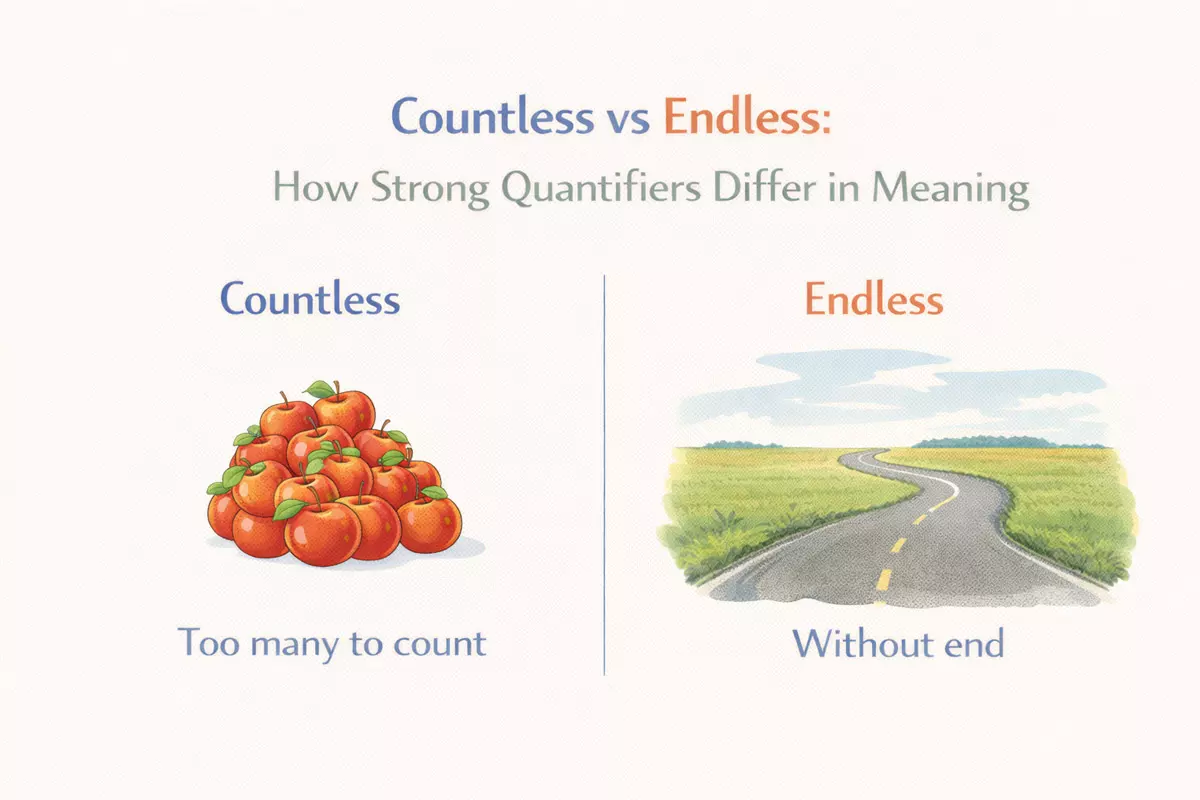 The article clarifies the core meanings of countless and endless, contrasts quantity with continuity, lists common noun pairings, discusses emotional nuances, shows when substitution fails, and offers examples and practice for choosing the right quantifier.
- Core meaning of each quantifier
- Difference between quantity and continuity
- Nouns commonly used with countless
- Nouns commonly used with endless
- Emotional and stylistic connotations
- Situations where substitution does not work
- Examples showing contrast in context
- Practice: selecting the correct quantifier
Have you ever wondered if there is a difference between saying something has no limit and saying it is too many to be counted? While these phrases may sound similar, they actually highlight subtle but important distinctions in how we describe magnitude and infinity. Saying something has no limit suggests true boundlessness or endlessness, whereas saying something is too many to be counted typically refers to a very large, yet still finite, quantity. Exploring these differences can reveal fascinating nuances in the way we express vastness and the concept of infinity in everyday language.
Core meaning of each quantifier
When comparing terms like "countless" and "endless," it helps to focus on how each word frames quantity or extent. Both are strong quantifiers, but they highlight different qualities and carry distinct implications.
What "countless" conveys
"Countless" emphasizes a number so high that it cannot be easily counted, but it still implies there is a finite total—even if it's extremely large. The idea is that the objects or instances could, in theory, be counted, but doing so would be impractical or unnecessary. It often suggests abundance or a large collection.
- Implies a very large, but finite, number
- Focuses on quantity—too many to count easily
- Used for things like stars, grains of sand, choices, examples, or opportunities
- Suggests overwhelming variety rather than never-ending duration
What "endless" implies
"Endless" suggests something with no limits or termination. It is less about counting and more about the lack of an endpoint or boundary. This term is often used to describe duration, distance, or processes that seem to go on forever.
- Implies infinity or an absence of end
- Focuses on duration, length, or continuity
- Used for things like time, roads, discussions, or possibilities
- Can describe both literal and figurative absence of limits
| Quantifier | Core Meaning | Typical Usage | Example Phrase |
|---|---|---|---|
| Countless | So many they cannot be conveniently counted, but still finite | Large numbers, abundance | Countless stars in the sky |
| Endless | Without end or limit; infinite or unending | Duration, continuity, length | Endless road ahead |
Key differences and usage patterns
Speakers typically reach for "countless" to stress the overwhelming number of items, while "endless" is reserved for situations where boundaries dissolve or time stretches on indefinitely. For example, you might have "countless reasons" for a decision, but an "endless debate" about it. Common collocations for each quantifier include:
- Countless: opportunities, examples, problems, variations, stories, hours, people, questions, possibilities, tasks, details, memories, benefits, challenges, resources, options, discoveries, achievements, choices, adventures
- Endless: possibilities, road, time, debate, patience, supply, summer, cycle, horizon, stream, loop, list, energy, fascination, work, journey, repetition, curiosity, fascination, growth
Understanding these nuances lets you choose the right word for the context—whether you want to stress the vastness of a number or the absence of any end.
Difference between quantity and continuity
Understanding how "countless" and "endless" function in English involves recognizing two distinct concepts: amount and ongoing nature. "Countless" emphasizes an overwhelming number, suggesting something is so plentiful that it can't be easily counted. In contrast, "endless" focuses on the idea of something that has no finish or boundary, highlighting duration or continuity rather than sheer number.
How "countless" relates to quantity
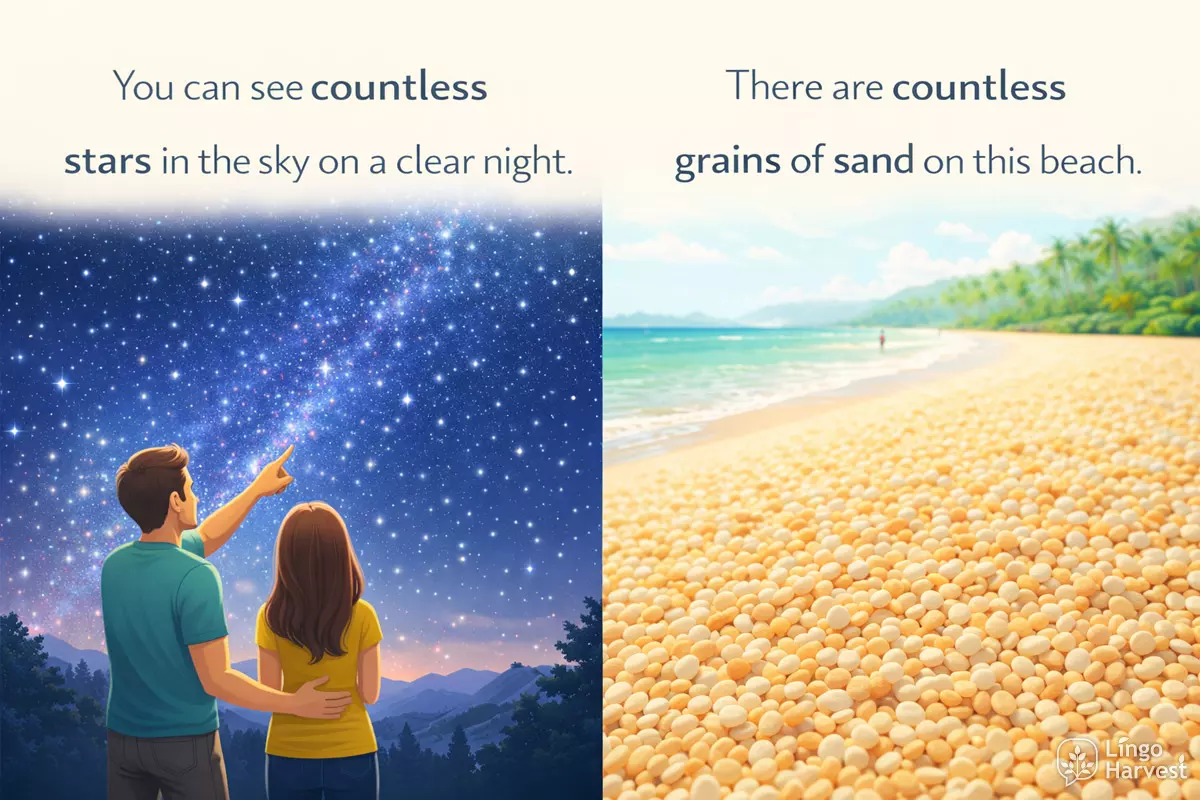
Quantity-based expressions like "countless" are used when discussing things that exist in such large numbers they defy easy calculation. The focus is on the overwhelming total, not on whether the thing continues or has a limit in time.
- Countless stars in the sky → You can see countless stars in the sky on a clear night.
- Countless grains of sand on a beach → There are countless grains of sand on this beach.
- Countless emails in your inbox → I woke up to countless emails in my inbox.
- Countless reasons to smile → She has countless reasons to smile today.
- Countless opportunities → The city offers countless opportunities for young professionals.
- Countless books in a library → The university library contains countless books.
- Countless species of insects → Scientists study countless species of insects worldwide.
- Countless memories from childhood → He shared countless memories from his childhood.
- Countless drops of water in the ocean → The ocean holds countless drops of water.
- Countless choices on a menu → The restaurant has countless choices on the menu.
The idea of continuity in "endless"
When using "endless," the emphasis shifts from how many to how long. It describes something that feels like it goes on forever, without a clear end point or interruption. This can refer to time, space, or even abstract experiences.
- Endless road stretching into the horizon → An endless road stretches into the horizon.
- Endless conversation that never seems to conclude → They got stuck in an endless conversation.
- Endless summer days → Childhood feels full of endless summer days.
- Endless patience → Teaching young children requires endless patience.
- Endless possibilities → The new technology opens up endless possibilities.
- Endless loop in programming → A missing condition caused an endless loop in the code.
- Endless cycle of chores → It feels like an endless cycle of chores at home.
- Endless supply of coffee → The office seems to have an endless supply of coffee.
- Endless laughter at a party → There was endless laughter at the party.
- Endless waiting in a queue → We endured endless waiting in the queue.
Comparing "countless" and "endless"
The core distinction is whether the speaker is referring to a huge amount (quantity) or to something without a finish (continuity). While both words suggest "a lot," they do so in fundamentally different ways.
| Aspect | Countless | Endless |
|---|---|---|
| Focus | Number/amount | Duration/continuity |
| Typical Use | Things that can, in theory, be counted | Processes, experiences, or things without a clear end |
| Example | Countless stars | Endless night |
| Opposite | Limited, few | Finite, brief |
Choosing between these terms depends on whether you want to stress an overwhelming quantity or the sense of something persisting without limit. The difference shapes both the mood and meaning of your statement.
Nouns commonly used with countless
When the adjective countless is used, it typically modifies nouns that refer to things so numerous they are difficult or impossible to quantify. This word often appears with plural count nouns, especially those representing items, experiences, or entities that accumulate over time or exist in vast numbers. The choice of noun can subtly affect the tone or emphasis of a sentence, highlighting the overwhelming quantity or the speaker's sense of awe.
Typical contexts and patterns
Writers and speakers use countless to express the idea of abundance, whether discussing achievements, problems, or possibilities. It can also convey a sense of exaggeration or emphasis, depending on context. The following are some of the most frequent nouns paired with this quantifier:
- Opportunities → The program offers countless opportunities for growth.
- Times → I’ve explained this rule countless times.
- Examples → The book provides countless examples of real usage.
- Hours → She spent countless hours preparing for the exam.
- People → Countless people were affected by the decision.
- Stories → He shared countless stories from his travels.
- Questions → The lecture raised countless questions.
- Ways → There are countless ways to solve this problem.
- Options → The platform gives users countless options.
- Stars → On a clear night, you can see countless stars.
- Instances → There are countless instances of this pattern in the data.
- Attempts → She made countless attempts before succeeding.
- Errors → The first draft contained countless errors.
- Memories → He holds countless memories of his childhood.
- Reasons → They gave countless reasons for the delay.
- Tasks → The job involves countless tasks each day.
- Challenges → Entrepreneurs face countless challenges.
- Visits → The site receives countless visits every month.
- Calls → Customer support handles countless calls daily.
- Victories → The team celebrated countless victories over the years.
Common themes in usage
The nouns above generally fall into a few broad categories. These include actions or events (such as attempts or calls), abstract concepts (opportunities, reasons), and groups or collections of things and people (stories, stars). The aim is to evoke a sense of enormity or untrackable quantity.
Comparison with similar quantifiers
While countless suggests an overwhelming number, it is used differently from other strong quantifiers like endless or infinite. For example, endless often pairs with concepts that can be continuous or never-ending, whereas countless more often emphasizes a large but not literally unending total. Here’s a quick comparison of usage patterns:
| Quantifier | Typical Nouns |
|---|---|
| countless | examples, hours, attempts, stories, opportunities, stars |
| endless | possibilities, debate, road, stream, cycle, patience |
| numerous | studies, factors, occasions, benefits, complaints |
| infinite | space, potential, variety, wisdom, love |
In summary, countless is best reserved for plural nouns that convey a sense of overwhelming number, most often in contexts where the exact total is either unknown or irrelevant. This usage helps speakers and writers emphasize scale without resorting to literal figures.
Nouns commonly used with endless
When we use the word “endless,” it often describes things that seem to have no limit, boundary, or conclusion. “Endless” tends to pair with nouns that evoke a sense of vastness, repetition, or duration—whether literal or figurative. This is distinct from “countless,” which focuses on items too many to be counted. Let’s look at some of the most frequent and natural collocations for “endless.”
Typical contexts and themes
Most commonly, “endless” is found with nouns connected to time, space, quantity, or experiences. It can suggest something overwhelmingly large, emotionally exhausting, or even monotonous.
- Possibilities → The new technology opens up endless possibilities.
- Opportunities → Living abroad creates endless opportunities for personal growth.
- Questions → The announcement sparked endless questions from the audience.
- Debate → The proposal led to endless debate in the media.
- Roads → They drove along an endless road through the desert.
- Time → It felt like we had endless time that summer.
- List → He keeps an endless list of things to do.
- Supply → The office seems to have an endless supply of paper.
- Stream → She talked in an endless stream of ideas.
- Patience → Teaching beginners requires endless patience.
- Variety → The city offers an endless variety of restaurants.
- Choices → Online shopping gives consumers endless choices.
- Cycle → He felt trapped in an endless cycle of meetings.
- Loop → A bug caused the program to run in an endless loop.
- Journey → Learning a language is an endless journey.
- Horizon → The sun disappeared beyond the endless horizon.
- Chain → One delay caused an endless chain of problems.
- Arguments → They were caught in endless arguments over small details.
- Meetings → The week was filled with endless meetings.
- Work → She feels buried under endless work.
Usage patterns and nuances
The nouns that sound natural with “endless” often refer to things that can be experienced as ongoing or unceasing. For example, “endless opportunities” suggests a limitless future, while “endless meetings” hints at something tedious and unending. “Endless patience” emphasizes an ability to wait or tolerate without apparent limit.
Comparison with ‘countless’
To clarify how “endless” stands apart from a similar quantifier, here’s a look at how these words pair with different nouns:
| Noun | Common with “Endless” | Common with “Countless” |
|---|---|---|
| Possibilities | ✅ | ✅ |
| Questions | ✅ | ✅ |
| Roads | ✅ | ❌ |
| Meetings | ✅ | ❌ |
| Stars | ❌ | ✅ |
| List | ✅ | ✅ |
| Supply | ✅ | ❌ |
| Stories | ❌ | ✅ |
As the table shows, “endless” is more often used for things that seem to go on without stopping (like “endless roads” or “endless meetings”), while “countless” is better for things that are too numerous to count (like “countless stars” or “countless stories”). Some nouns work well with both, but the nuance shifts: “endless questions” implies they never stop, while “countless questions” means there are too many to count.
Summary
In summary, “endless” typically modifies nouns that evoke the idea of something continuing without interruption, whether that’s time, effort, or experiences. When choosing between strong quantifiers, pay attention to whether you want to stress duration or number.
Emotional and stylistic connotations
Choosing between "countless" and "endless" does more than just indicate quantity; it also shapes the emotional tone and stylistic flavor of your writing. Both words amplify the idea of "many," but their nuances can subtly shift the mood or imagery you create. "Countless" tends to carry a sense of awe or overwhelming abundance. It suggests so many items that they defy counting, often evoking amazement or admiration. For example, describing "countless stars" conjures a vast, almost magical, expanse. In contrast, "endless" leans more into the idea of something that has no limit or boundary in space or time. It can be used to evoke feelings of eternity, monotony, or even frustration, such as in "endless waiting" or "endless possibilities."
Typical contexts and emotional impact
Writers often choose these terms based on the emotional response they want to elicit. Consider the following:
- Countless is commonly used to suggest wonder, admiration, or overwhelming scale (e.g., "countless treasures," "countless memories").
- Endless can evoke hope and opportunity ("endless opportunities"), but also fatigue or despair ("endless meetings").
Comparing expressive effects
For a clearer look at how each word colors a sentence or phrase, see the table below:
| Expression | Implied Feeling or Mood |
|---|---|
| Countless stars | Awe, vastness, beauty |
| Countless problems | Overwhelm, exasperation |
| Endless road | Longevity, journey, monotony |
| Endless patience | Admiration, resilience, endurance |
| Endless debate | Frustration, lack of resolution |
| Countless opportunities | Optimism, abundance |
The choice between these quantifiers can subtly alter how readers perceive a situation, influencing whether something feels hopeful, overwhelming, tedious, or inspiring. Selecting the right word can make your description resonate more accurately with the intended mood or style.
Situations where substitution does not work
Sometimes, "countless" and "endless" are not truly interchangeable, even though both express the idea of a large or immeasurable quantity. Their meanings and connotations diverge in subtle but important ways, depending on context, grammar, and what they are quantifying. Recognizing these differences helps avoid awkward or inaccurate language.
Semantic distinctions
The most common reason substitution fails is that "countless" refers specifically to an extremely high number (but still countable in theory), while "endless" focuses on duration or continuity, often implying something has no limit in time or extent. This distinction means that, in certain contexts, swapping one for the other leads to confusion or a loss of intended meaning.
- Countless fits when emphasizing quantity or frequency.
- Endless fits when describing something that feels infinite or never-ending.
Examples where substitution fails
Consider these scenarios where using the wrong term would sound unnatural or change the meaning:
- Countless stars in the sky → "Endless stars in the sky" suggests a sky that never ends, not a large number of stars.
- Endless road ahead → "Countless road ahead" is not idiomatic; roads are not counted, but can seem unending.
- Countless opportunities → "Endless opportunities" may work, but "countless" focuses on the number, while "endless" implies continuous appearance.
- Endless patience → "Countless patience" is incorrect; patience is not quantifiable.
- Countless grains of sand → "Endless grains of sand" loses the notion of number and may sound odd.
- Endless loop (in programming) → "Countless loop" is a misuse; the loop is not about quantity but about having no end.
- Countless mistakes → "Endless mistakes" changes the sense from a high number to an unceasing process.
- Endless love → "Countless love" is not standard English; love is not counted.
- Countless visitors → "Endless visitors" may mean visitors never stop coming, not that there are just many of them.
- Endless winter → "Countless winter" is not meaningful; "endless" refers to duration, not number.
Summary comparison
Below is a structured look at when each word is appropriate, highlighting typical contexts and why substitution fails:
| Context | Appropriate Quantifier |
|---|---|
| Large number of discrete items (e.g., stars, grains, people) | Countless |
| Continuous or unending states (e.g., patience, love, roads, time) | Endless |
| Processes without a natural end (e.g., loops, waiting, cycles) | Endless |
| Frequent but countable events (e.g., opportunities, mistakes) | Countless |
| Describing duration or permanence | Endless |
When in doubt, consider whether you are describing a high quantity (use "countless") or a lack of limit in time or extent (use "endless"). This subtle distinction is key to natural, precise English.
Examples showing contrast in context
Understanding the difference between "countless" and "endless" comes down to how each word shades the sense of quantity or duration. "Countless" highlights a number too high to tally, while "endless" emphasizes something continuing without limit. Seeing them in action makes their distinctions clearer.
Comparing usage in sentences
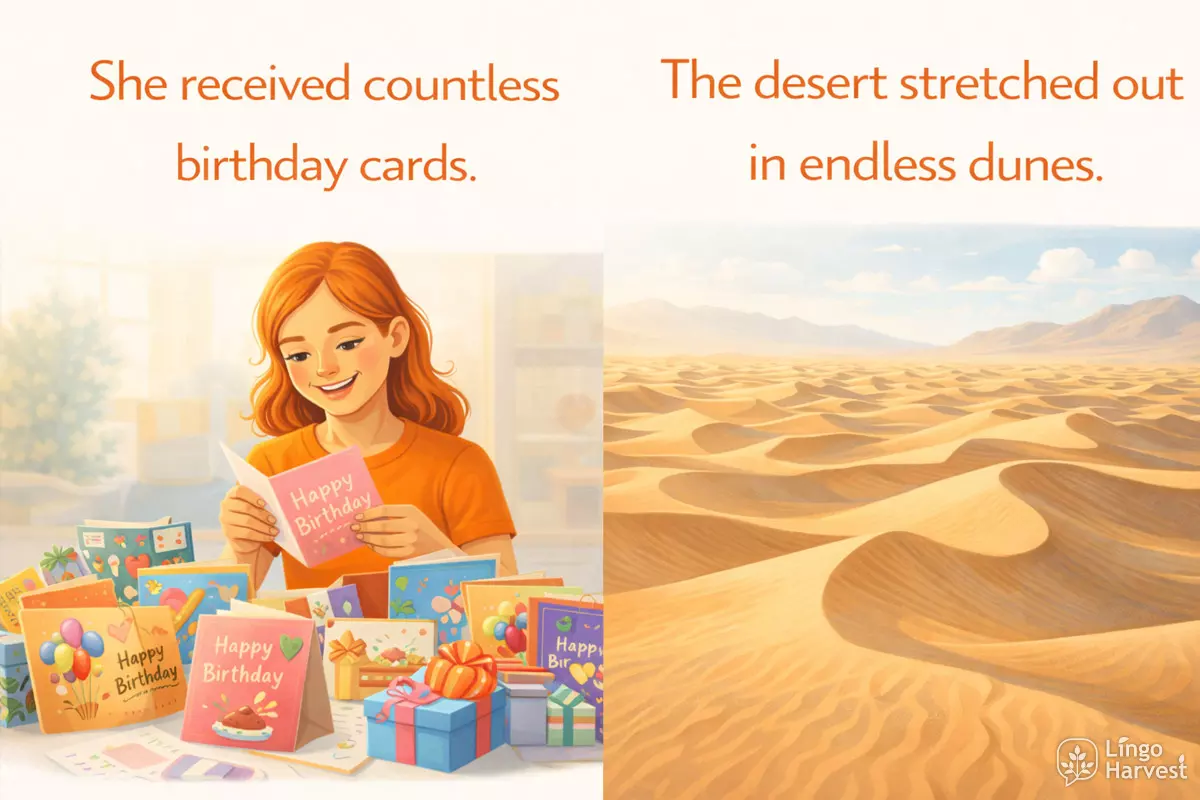
Here are real-world examples where choosing one term over the other changes the nuance of the message:
- She received countless birthday cards. (So many that you can't count them, but there is a limit.)
- The desert stretched out in endless dunes. (It appears to go on forever, with no end in sight.)
- After the announcement, there were countless questions from the audience. (A very large number, but not infinite.)
- He felt trapped in an endless meeting. (The meeting seemed to have no finish point.)
- The museum houses countless works of art. (An overwhelming quantity, but not literally infinite.)
- They wandered through endless corridors. (The hallways seemed to continue forever.)
- Countless stars filled the night sky. (So many stars, but not without boundary.)
- She faced an endless list of chores. (The list felt as if it would never be completed.)
- We heard countless stories during the trip. (A huge number, but a finite set.)
- The ocean waves seemed endless. (Their motion appeared never-ending.)
Side-by-side comparison
| Context | Preferred Word & Reason |
|---|---|
| Describing a very large number of items | Countless → Focuses on quantity too high to count |
| Describing something with no apparent end point | Endless → Emphasizes duration or extent without limit |
| Talking about stars or grains of sand | Countless → Implies an enormous but countable amount |
| Referring to a process or activity that seems never to finish | Endless → Suggests it goes on forever |
In summary, "countless" is best for overwhelming numbers, while "endless" brings out the idea of something without a conclusion. Choosing between them will sharpen your message and help you avoid ambiguity in both writing and conversation.
Practice: selecting the correct quantifier
Understanding when to use "countless" versus "endless" can be tricky, as both suggest a large or unmeasurable amount, but their nuances differ. The following exercises and examples will help you master choosing the right word in context.
Quick identification: When to use "countless" or "endless"?
Try the following sentences. Decide which quantifier fits best—think about whether you mean "so many you can't count them," or "something that never finishes or has no limit."
- There were _______ stars visible in the night sky.
- After the storm, we faced _______ delays on the road.
- She has made _______ contributions to the field of science.
- The desert seemed to stretch on for an _______ distance.
- He received _______ messages after the announcement.
- The project involved _______ revisions before approval.
- We listened to his _______ complaints without interruption.
- The athlete trained for _______ hours before the competition.
- The discussion turned into an _______ argument.
- Tourists took _______ photos of the landscape.
- The meeting felt like an _______ process.
- The author faced _______ rejections before success.
Show answers
- countless
- endless
- countless
- endless
- countless
- countless
- endless
- countless
- endless
- countless
- endless
- countless
Common contexts: How are "countless" and "endless" typically used?
Here are typical scenarios for each quantifier. Review these to see which word suits which context:
- "Countless" is best for things that can, in theory, be counted but are so numerous it feels impossible (e.g., insects, opportunities, books, people).
- "Endless" works for things experienced as having no end or boundary, either literally or figuratively (e.g., time, roads, discussions, patience).
Comparison Table: Usage Patterns
| Typical Usage | Example Sentence |
|---|---|
| Countless (large number, not literally infinite) | There are countless recipes for apple pie. |
| Endless (no apparent end or limit) | The meeting felt endless. |
| Countless (emphasizes variety or frequency) | He has faced countless challenges. |
| Endless (emphasizes duration or continuity) | We drove down an endless highway. |
Challenge: Rewrite for precision
For each sentence below, replace the highlighted word with either "countless" or "endless" to make the meaning clearer.
- We had many reasons to celebrate.
- The lecture seemed very long.
- She has received a lot of support from her friends.
- They spent a long time talking about the same topic.
- The scientist faced many challenges during the research.
- The road ahead looked very long.
- He answered a lot of emails after the launch.
- The discussion went on for a very long time.
- The writer had many ideas for the next book.
- Waiting for the results felt very long.
Show answers
- We had countless reasons to celebrate.
- The lecture seemed endless.
- She has received countless messages of support from her friends.
- They spent an endless amount of time talking about the same topic.
- The scientist faced countless challenges during the research.
- The road ahead looked endless.
- He answered countless emails after the launch.
- The discussion went on for an endless amount of time.
- The writer had countless ideas for the next book.
- Waiting for the results felt endless.
Tip: Substitute test
If you're unsure, try swapping the words:
- If "infinite" or "never-ending" fits, "endless" is probably right.
- If "numerous" or "myriad" fits, "countless" is usually better.
With practice, you'll start to feel the subtle differences and use each quantifier more naturally.