Strength Scale of Quantifiers: From Small to Large Amounts

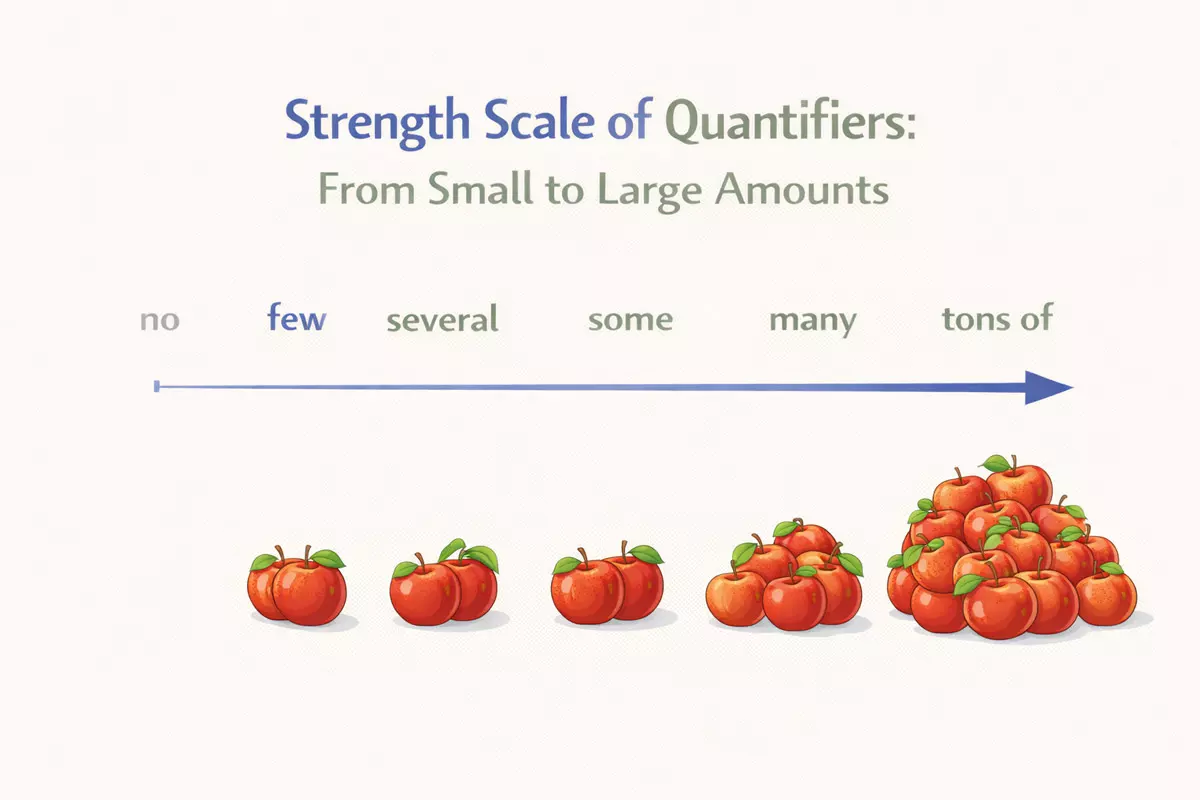 Here we how quantifiers work as a scale, how to rank them by strength, and why their meanings can overlap or shift with context. It covers common mistakes, visual tools for comparison, and offers practice with real-life examples.
- Concept of quantity as a scale
- Ordering quantifiers by relative strength
- Overlapping meanings and fuzzy boundaries
- How context affects perceived strength
- Gradual vs extreme quantity expressions
- Common mistakes when ranking quantifiers
- Visualizing quantity differences in usage
- Examples across different contexts
- Practice: placing quantifiers on a strength scale
Language allows us to express a wide range of quantities, from the smallest hint to an overwhelming abundance, using specific words and phrases that help us communicate more precisely. By choosing terms like few, several, many, or countless, we can indicate subtle differences in amount and intensity, shaping how our listeners interpret what we mean. This ability to convey varying degrees of quantity is an essential part of everyday communication, enabling us to share information more accurately and understand each other more clearly in both casual and formal settings.
Concept of quantity as a scale
Understanding how language expresses different amounts is crucial for interpreting meaning accurately. Rather than viewing words like "few," "some," or "many" as isolated categories, it’s helpful to imagine them arranged along a continuum. This scale-like perspective highlights subtle shifts in meaning and allows for more precise communication, especially when discussing amounts or proportions.
Quantifiers can be thought of as markers that help us gauge how much or how many of something is being referred to. The strength or intensity of these terms can vary greatly, forming a graduated sequence from the smallest to the largest amounts. This gradation is not always absolute—context and speaker intention can influence interpretation—but the general ordering remains consistent in most discussions.
Common quantifiers ordered by strength
To illustrate how these expressions fit along a continuum, here’s a list moving from the weakest to the strongest indication of amount:
- none — None of the files were saved correctly.
- hardly any — There was hardly any food left after the party.
- a few — I have a few questions about the assignment.
- some — Some students arrived late.
- several — Several issues were identified during testing.
- quite a few — Quite a few people disagreed with the proposal.
- many — Many employees work remotely now.
- most — Most customers prefer online support.
- almost all — Almost all participants completed the survey.
- all — All documents must be submitted by Friday.
Notice that each term marks a step up in the implied quantity or proportion. For example, "a few" suggests a small but nonzero number, while "most" refers to a large majority without being absolute.
Comparing quantifier strength in context
| Quantifier | Typical Meaning | Example Sentence |
|---|---|---|
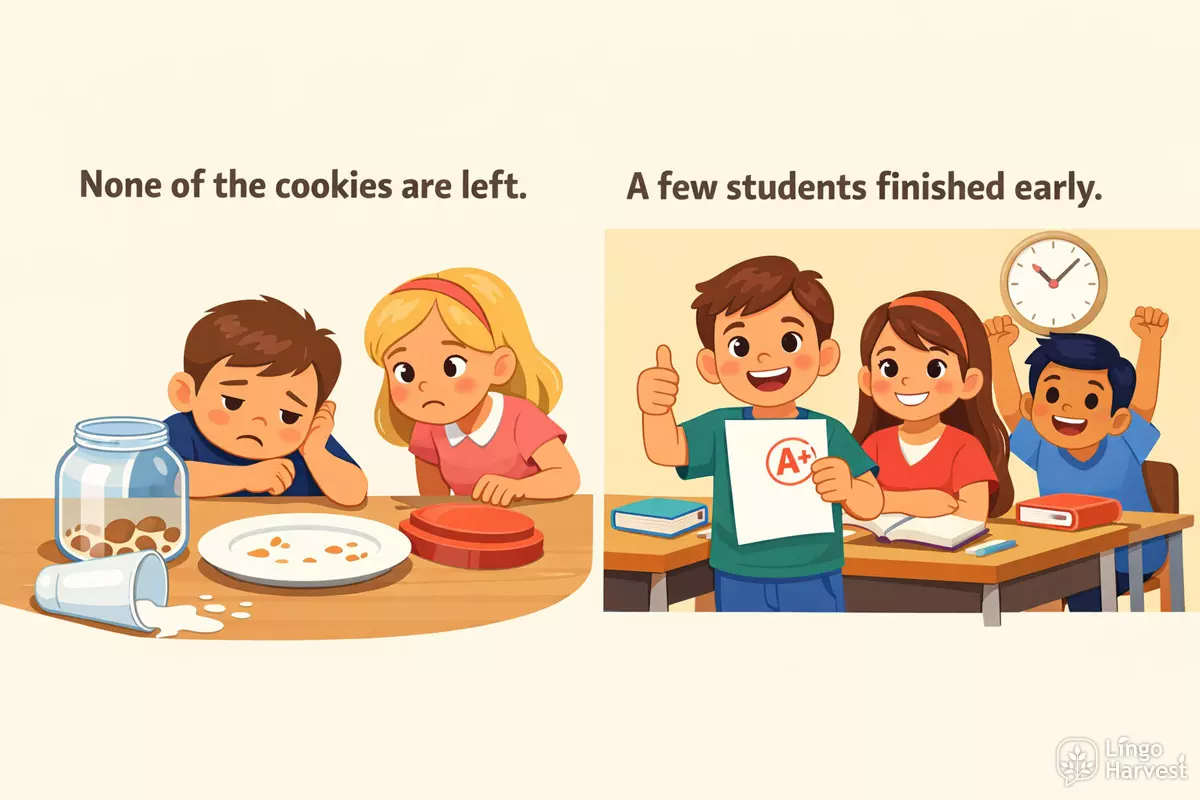
| none | zero, not any | None of the cookies are left. |
| a few | small number, more than two | A few students finished early. |
| some | an unspecified amount, not all | Some rain is expected tonight. |
| many | large number, but not the majority | Many people enjoy classical music. |
| most | majority, almost all | Most birds migrate in winter. |
| all | 100%, every one | All the seats are taken. |
These distinctions are not just academic—the choice of quantifier can affect the impression or precision of what is being communicated. For instance, saying "some" versus "many" can subtly change how a listener perceives the scale of an issue or the extent of a phenomenon.
Factors influencing interpretation
- Context: The setting or subject can shift the perceived quantity. "Many ants" may mean hundreds, while "many elephants" could be just a dozen.
- Speaker intent: Emphasis or understatement can alter which point on the scale is implied.
- Grammatical structure: The use of modifiers ("very few," "almost all") further refines the meaning.
By thinking of quantifiers as points on a scale, we gain a better grasp of their nuances and how they shape the information we receive or convey. This approach also helps in comparing similar expressions and choosing the right word for the desired degree of quantity.
Ordering quantifiers by relative strength
When thinking about how words like “few,” “some,” or “most” convey quantities, it helps to arrange them along a scale from weakest to strongest. This scale reflects how much of a group or amount is being referenced, from very small portions to nearly everything. Understanding these differences is key for clear communication, whether you’re interpreting data, reading research, or just having a conversation.
Understanding the scale of quantifiers
Quantifiers can be thought of as signposts that point to different parts of the amount spectrum. On one end, we have terms that refer to tiny quantities; on the other, those that suggest an overwhelming majority or entirety. The strength of a quantifier is its ability to indicate how much of a set is involved. Here’s a general progression of common English quantifiers, moving from those that indicate the smallest amounts to those that cover the largest:
- scarcely any — There was scarcely any evidence to support the claim.
- a couple of — I’ll be ready in a couple of minutes.
- a small number of — A small number of errors remained in the final draft.
- a handful of — Only a handful of people knew about the plan.
- plenty of — We have plenty of options to choose from.
- a large number of — A large number of applications were submitted.
- countless — She has helped countless students over the years.
- the majority of — The majority of voters supported the proposal.
- virtually everyone — Virtually everyone agreed with the decision.
- every single — Every single detail was carefully checked.
Comparing quantifier strength
It’s important to recognize that not all quantifiers are precise. “Some” and “several” both refer to more than one, but “several” suggests a higher count. “Many” is stronger than “some,” but not as strong as “most.” This relative scale helps avoid misunderstandings in both casual and formal settings.
| Quantifier | Relative Strength | Example Usage |
|---|---|---|
| few | low | Few students passed the test. |
| some | moderate | Some students passed the test. |
| many | high | Many students passed the test. |
| most | very high | Most students passed the test. |
| all | maximum | All students passed the test. |
Why quantifier order matters
Choosing the right quantifier can help you communicate more precisely. For example, if you say “a few people responded,” that sets a different expectation than “most people responded.” The ordering of these words by their strength lets listeners and readers gauge the scale of what’s being discussed. In summary, arranging quantifiers by their relative strength—from “almost none” up to “all”—gives you a useful framework for expressing quantity with clarity and nuance.
Overlapping meanings and fuzzy boundaries
When looking at quantifiers like "few," "some," "many," and "most," it's clear that their meanings often blur together rather than fall into neat categories. These words do not have fixed numerical values; instead, their interpretation depends on context, speaker intent, and cultural expectations. For example, what counts as "a few" cookies at a party may be different from "a few" hours spent working.
Contextual interpretation
Quantifiers can shift in meaning significantly depending on the subject matter and the expectations of the audience. "Several" apples might be three or four, but "several" people in a stadium could mean dozens. This flexibility is both a strength and a source of confusion, as listeners must infer the intended amount.
Gradual transitions between quantifiers
The language does not provide strict boundaries between these terms. Instead, their meanings often overlap, leading to fuzzy distinctions. For instance, "a few" and "some" can both refer to small amounts, but "some" can also refer to larger, indeterminate quantities.
- None → zero or absence
- A few → small, countable number (often 2–3, but variable)
- Several → slightly more than "a few," but still quite limited
- Some → an unspecified quantity, could be small or moderate
- Many → a large, countable number
- Most → more than half, but not all
- All → every member of a group
- Much → large, uncountable amount
- Little → small, uncountable amount
- Plenty → more than enough
- Almost all → nearly every member, but with rare exceptions
- Dozens of → explicitly multiple groups of twelve, but loosely used
- Tons of → an exaggerated large amount
Comparing quantifiers and their overlaps
To illustrate how these words relate and sometimes overlap, consider the following comparison:
| Quantifier | Possible Range or Overlap | Example Usage |
|---|---|---|
| A few | 2–5 (sometimes up to 7) | We have a few questions. |
| Several | 3–8 (overlaps with "a few" and "some") | Several students arrived early. |
| Some | Any non-zero, indeterminate (overlaps with "a few", "several", "many") | Some cookies are left. |
| Many | Large countable (starts where "several" ends, but not precise) | Many people enjoyed the concert. |
| Most | >50% of group (can overlap with "many") | Most birds migrate south. |
| All | 100% (clear boundary) | All lights are off. |
Ambiguity and interpretation
Because these quantifiers rely so much on context, misunderstandings are common. What one person calls "many" could be "some" to another. This ambiguity is a natural part of language, offering flexibility, but it also requires careful attention to context and intent. Recognizing these fuzzy boundaries can help in both understanding and using quantifiers more effectively in communication.
How context affects perceived strength
The perceived force of quantifiers—such as "some," "many," or "all"—shifts considerably depending on the surrounding situation, topic, and expectations. Readers and listeners interpret these words differently based on what’s typical, what’s at stake, and even cultural background. For example, "few" people at a concert implies something different than "few" people at a family dinner. The scale of reference matters just as much as the quantifier itself.
Influence of Reference Groups and Norms
The background expectation for a group or amount can alter how strong or weak a quantifier sounds. If you say "several drops of rain fell," it may seem minor, but "several drops of blood" might feel significant. This is because the norm for each context sets different expectations.
- Audience size: "Many" in a classroom (30 people) vs. a stadium (30,000 people)
- Risk or impact: "A little" poison can be deadly, while "a little" sugar is negligible
- Frequency: "Often" visiting a friend (monthly) versus "often" checking your phone (hourly)
- Time frame: "Rarely" in a lifespan vs. "rarely" in a single day
- Social expectations: "Most" people voting in an election (high turnout) vs. "most" people at a meeting (could mean only half)
Contextual Shifts in Quantifier Strength
The same quantifier can feel stronger or weaker depending on the logical or conversational context. For instance, in a warning, "some" can sound urgent ("Some wires are live!"), while in a casual conversation, it may seem less serious ("Some cookies are left").
| Quantifier | Contextual Example | Perceived Strength | Notes |
|---|---|---|---|
| Few | Few errors in a math test | Weak | Implies good performance |
| Few | Few survivors after an accident | Strong | Implies a negative outcome |
| Most | Most emails answered | Strong | Implies high completion |
| Most | Most parts assembled, but one missing | Weaker | Missing part may be critical |
| All | All lights are on | Absolute | No exceptions |
| All | All tasks finished except documentation | Relative | Exception reduces impact |
Common Factors That Shift Interpretation
- Prior knowledge or assumptions of the audience
- Emotional tone (urgent, casual, formal)
- Specificity of the items or people involved
- Implicit contrast with what is expected or usual
- Presence of qualifiers (e.g., "almost all," "just a few")
- Consequences implied by the quantifier
In summary, the meaning and impact of quantifiers are rarely fixed—they flex and adapt to the context in which they appear. Understanding these nuances can help you interpret and use quantifiers more precisely in communication.
Gradual vs extreme quantity expressions
When talking about amounts, language often distinguishes between expressions that suggest a smooth progression and those that signal the very edges of a scale. Some quantifiers gradually increase or decrease in intensity, while others mark only the smallest or largest possible quantities. Recognizing the difference helps speakers convey more precise meanings, whether they want to understate, exaggerate, or simply be accurate.
Comparing gradual and extreme quantifiers
Gradual quantifiers cover a range, allowing for nuanced descriptions of quantity. Think of words like "some," "several," or "many." In contrast, extreme expressions indicate the endpoints—either the bare minimum or the total maximum—such as "none" or "all." Both types are useful, but they serve different communicative purposes.
| Gradual Quantifiers | Extreme Quantifiers |
|---|---|
| a few | none |
| some | all |
| several | absolutely no |
| many | every single |
| most | the entirety of |
| a good number of | not a single |
| plenty of | zero |
| almost all | the whole lot |
When to use each type
Choosing between these categories depends on your intent. Gradual forms fit situations where the quantity is uncertain or you want to avoid precision. For example, "a few people arrived early" leaves room for interpretation. Extreme expressions are best for clarity or emphasis: "Everyone must attend" or "No one was present" leave no doubt.
- Gradual quantifiers are useful for softening statements, suggesting flexibility, or when you lack exact numbers.
- Extreme quantifiers are direct and often used in rules, instructions, or strong opinions.
Expanded examples in context

- There are a handful of cookies left. (gradual)
- Nearly all the tickets sold out. (gradual)
- No seats remain. (extreme)
- We saw dozens of birds. (gradual)
- She ate every last piece. (extreme)
- Most students passed the test. (gradual)
- Not a single answer was correct. (extreme)
- They found plenty of evidence. (gradual)
- The jar contained zero sugar. (extreme)
- Almost no traffic on the roads. (gradual/exaggeration)
Mastering these expressions adds subtlety to your descriptions and helps you adjust the strength of your statements to match your intent and context.
Common mistakes when ranking quantifiers
Understanding the scale of quantifiers can be tricky, especially since their meanings often overlap or shift depending on context. People frequently misjudge their relative strength or use them interchangeably without considering subtle differences. This can lead to confusion, miscommunication, or even misleading statements, particularly in academic writing, data interpretation, or everyday conversation.
Overlapping Meanings and Context Sensitivity
Quantifiers such as "few," "several," and "some" are highly context-dependent. A common error is treating them as fixed quantities rather than flexible terms whose strength depends on what is being counted or described. For instance, "a few grains of rice" is vastly different from "a few cars."
Assuming Linear Strength
Another pitfall is assuming that all quantifiers fit neatly on a single, linear scale from smallest to largest. In reality, some quantifiers overlap or have ambiguous boundaries. Words like "many" and "numerous" can be nearly synonymous, while "some" and "several" may trade places in perceived strength depending on context.
Ignoring Register and Formality
Some quantifiers change force depending on the register. For example, "a handful of" is informal and usually weaker than "several," but this is not always the case in casual speech. Failing to consider formality can result in over- or underestimating the intended amount.
Misinterpreting Implicit Negativity or Positivity
Certain quantifiers carry implicit connotations. "Few" often suggests not enough (negative), whereas "a few" can be more neutral or even positive. Overlooking these subtleties can distort the intended message.
Examples: Common Quantifier Confusions
- Assuming "some" is always less than "several"
- Using "few" and "a few" interchangeably
- Ranking "many" above "numerous" without context
- Believing "plenty" is always the strongest
- Overlooking that "most" does not mean "all"
- Equating "a couple of" with exactly two in all cases
- Thinking "almost all" is the same as "most"
- Taking "a number of" to mean a large quantity
- Using "several" for both small and moderate amounts
- Confusing "little" with "a little" (especially for uncountables)
- Assuming "countless" means a literal infinity
- Using "loads of" and "tons of" without considering exaggeration
- Forgetting that "some" can mean "any" in questions/negatives
- Interpreting "all" as always including every possible case
- Assuming "none" and "no" are always interchangeable
Comparison of Quantifiers: Overlaps and Ambiguities
| Quantifier | Potential Overlaps / Ambiguities |
|---|---|
| Few / A few | "Few" is often negative ("not many"), "a few" is neutral or positive |
| Some / Several | Can overlap; "some" is vaguer, "several" usually implies more |
| Many / Numerous | Often interchangeable, but "numerous" can sound more formal |
| Most / Almost all | Both mean a large majority, but "almost all" is closer to "all" |
| All / Every | "All" refers to the whole group; "every" emphasizes individuals within the group |
| Little / A little | Similar to "few" vs. "a few" but for uncountable nouns |
| Loads of / Tons of | Both are informal and exaggerated; not precise |
| Plenty of | Implies more than enough, but not necessarily a large number |
Summary Tips
- Always consider context before ranking quantifiers.
- Be aware of register and connotation.
- Don’t assume fixed positions on the strength scale.
- Look for implicit positivity or negativity in each term.
- When in doubt, clarify with numbers or additional explanation.
Visualizing quantity differences in usage
Understanding how different quantifiers express relative amounts can be much clearer when you see them side by side. Quantifiers help us describe everything from tiny amounts to massive quantities, but the boundaries between them are often subtle. By laying out common expressions on a spectrum, you’ll get a better sense of which terms suggest just a hint of something and which imply abundance.
Common quantifiers from least to most
- scarcely any — There was scarcely any food left after the meeting.
- hardly any — We had hardly any time to prepare.
- a few / a little — I have a few questions, but only a little time.
- some — Some people prefer working in the morning.
- several — Several students asked for extra practice.
- quite a few / quite a bit — Quite a few people signed up, and we learned quite a bit.
- many / much — Many students joined, but we didn’t have much space.
- plenty of — There’s plenty of room for everyone.
- numerous — Numerous studies support this approach.
- a great deal of — The project required a great deal of effort.
- a large number of — A large number of emails arrived overnight.
- tons of — She has tons of homework tonight.
- countless — He has told the story countless times.
- an abundance of — The area has an abundance of natural resources.
- innumerable — The city offers innumerable opportunities.
- all — All participants completed the survey.
Comparing quantifiers in context
It's not always obvious how the meaning shifts between different quantity words. The table below shows example sentences using various quantifiers, highlighting how they alter the sense of amount:
| Quantifier | Example Sentence |
|---|---|
| scarcely any | There were scarcely any cookies left on the plate. |
| some | Some students finished the assignment early. |
| many | Many people attended the festival. |
| tons of | There were tons of books piled on the desk. |
| all | All the seats in the theater were taken. |
Patterns in spoken and written usage
In everyday conversation, people often prefer less formal quantifiers ("loads of," "a bunch of") compared to written styles, which may favor more precise terms ("several," "numerous"). The choice of quantifier can also reflect a speaker’s attitude: "just a few" may sound modest, while "countless" suggests exaggeration or emphasis. Recognizing these nuances helps you choose the right expression for any context.
- Minimal: Scarcely any, hardly any
- Neutral: Some, several, a number of
- Large: Many, a great deal of, an abundance of
- Maximum: All, countless, innumerable
Visual tools and structured examples can make the differences between quantity words easier to grasp, whether you're learning English or refining your writing. By spotting where each quantifier falls on the scale, you can communicate amounts more precisely and naturally.
Examples across different contexts
Quantifiers are used in language to indicate amounts, and their strength can vary significantly depending on the context. Whether discussing quantities in math, describing groups in everyday conversation, or analyzing data, the scale of quantifiers helps specify the magnitude being referenced. Here we look at how these expressions shift in meaning and intensity across various scenarios.
Common Quantifiers Ranked by Strength
When expressing amounts, speakers often select from a range of quantifiers to communicate subtle differences in size or number. Here is a list of typical quantifiers, ordered from those that indicate the smallest to those that convey the largest amounts:
- none — None of the files were backed up.
- few — Few people noticed the mistake.
- a handful of — Only a handful of guests stayed until the end.
- several — Several students asked the same question.
- some — Some information is missing from the report.
- many — Many workers prefer flexible hours.
- numerous — Numerous attempts were made to fix the issue.
- a lot of — She has a lot of experience in marketing.
- plenty of — There’s plenty of food for everyone.
- most — Most customers pay online.
- almost all — Almost all participants completed the survey.
- all — All documents must be submitted today.
Practical Usage in Different Domains
The interpretation of quantifiers can depend on the context. For example, "few" in a classroom can mean three students, while in a stadium it might mean a hundred people. Here are some diverse settings where quantifier strength plays a key role:
- Academic settings: "Most students passed the exam" vs. "A few students struggled."
- Scientific reports: "A significant number of samples showed positive results."
- Everyday conversation: "I have a lot of work to do" vs. "I have some errands."
- Market analysis: "Almost all customers preferred the new product."
- Environmental science: "Plenty of rainfall this season improved crop yields."
Comparing Quantifiers in Sentences
The following table highlights how changing the quantifier can alter the meaning in otherwise similar sentences:
| Sentence | Implied Quantity |
|---|---|
| Few people attended the meeting. | Very small number |
| Several people attended the meeting. | More than a few, but not many |
| Many people attended the meeting. | Large number |
| Most people attended the meeting. | Majority, nearly all |
| All people attended the meeting. | Entire group, no exceptions |
Nuances and Cultural Variation
The strength of quantifiers is not always absolute. Cultural norms and expectations often affect how these words are interpreted. For example, "a lot" may be seen as a larger quantity in one culture than another. Understanding the subtle gradations in quantifier strength can improve clarity and prevent misunderstandings, especially in cross-cultural communication.
Practice: placing quantifiers on a strength scale
Arranging quantifiers by their strength helps clarify meaning and avoid confusion about quantity. Let’s practice ranking and recognizing common quantifiers from weakest (smallest amount) to strongest (largest amount). This section offers hands-on activities and examples to help you get comfortable with the scale.
Activity: Order the quantifiers
Below is a list of quantifiers. Try to arrange them from weakest to strongest, based on the amount or degree they express.
- a few
- most
- hardly any
- many
- all
- some
- several
- almost all
- none
- a lot of
Show answers
- none
- hardly any
- a few
- some
- several
- many
- a lot of
- most
- almost all
- all
Comparing quantifiers: Strength and meaning
Understanding the differences in strength between similar quantifiers can help you choose the most accurate word. Here’s a comparison table of common quantifiers, ranked from weakest to strongest, with typical usage contexts.
| Quantifier | Typical Meaning or Range |
|---|---|
| none | 0% |
| hardly any | almost none, less than 5% |
| a few / a little | small amount, about 5–15% |
| some | an unspecified, moderate amount, about 15–40% |
| several | more than a few, but not many (about 3–7 items); slightly stronger than "a few" |
| many / much | a large number or amount, about 40–70% |
| a lot of / lots of | a very large amount, roughly 60–85% |
| most | more than half, typically 70–95% |
| almost all | nearly everything, about 90–99% |
| all | 100% |
Task: Identify the quantifier strength
For each sentence, decide if the quantifier shows a small, medium, or large amount.
- There are a few cookies left in the jar.
- Most students passed the exam.
- Hardly any rain fell last month.
- She invited several friends to her party.
- All the lights are on.
- He has a handful of tasks to finish today.
- Some people prefer working at night.
- The company received numerous complaints.
- There is plenty of time before the deadline.
- Almost all participants agreed with the decision.
Show answers
- Small
- Large
- Small
- Medium
- Large
- Small
- Medium
- Large
- Large
- Large
Practicing with real examples and arranging quantifiers by their relative strength is one of the most effective ways to master their use in English.