Quantifiers in Spoken English vs Written English Compared

 Here we how English quantifiers differ in speech and writing, identifies those favored in each context, examines formality and register shifts, highlights common learner mistakes, and provides examples and practice for adapting quantifiers appropriately.
- Different communication goals in speech and writing
- Quantifiers common in everyday conversation
- Quantifiers preferred in written texts
- Register shifts and formality levels
- Reduction and emphasis in spoken usage
- Common mismatches learners make
- Contextual examples showing contrast
- Practice: adapting quantifiers to context
Have you ever noticed how we use words like some, many, or a lot differently when talking with friends compared to writing an essay? The way we express amounts or quantities often shifts depending on whether we are speaking informally or composing more formal text. In casual conversation, we might choose informal or vague expressions to sound more natural and relatable, while in formal writing, we tend to use more precise or specific terms to clearly convey our meaning. This contrast highlights interesting differences between everyday speech and academic or professional communication.
Different communication goals in speech and writing
Spoken and written English serve distinct communicative purposes, influencing how quantifiers are chosen and used. When people speak, their primary aim is often quick, clear exchange of ideas, allowing for immediate feedback and adjustment. In contrast, writing typically targets accuracy, permanence, and clarity for readers who may not have direct access to the author.
Immediate Interaction vs. Careful Planning
In conversation, speakers frequently use quantifiers like "a lot," "some," or "a few" to remain flexible and efficient. There’s less pressure to be exact, as listeners can ask for clarification. Writing, on the other hand, often favors more precise quantifiers such as "several," "many," "the majority of," or "approximately," since the reader cannot seek instant explanations.
Audience and Context Influence
Writers usually anticipate a broader, sometimes unknown audience, so they select quantifiers that minimize ambiguity. Speakers are guided by the reactions and expectations of their immediate listeners, making informal or vague quantifiers more acceptable.
Comparing Quantifier Choices
Below is a comparison of how quantifiers commonly differ between spoken and written English, reflecting the unique priorities of each mode.
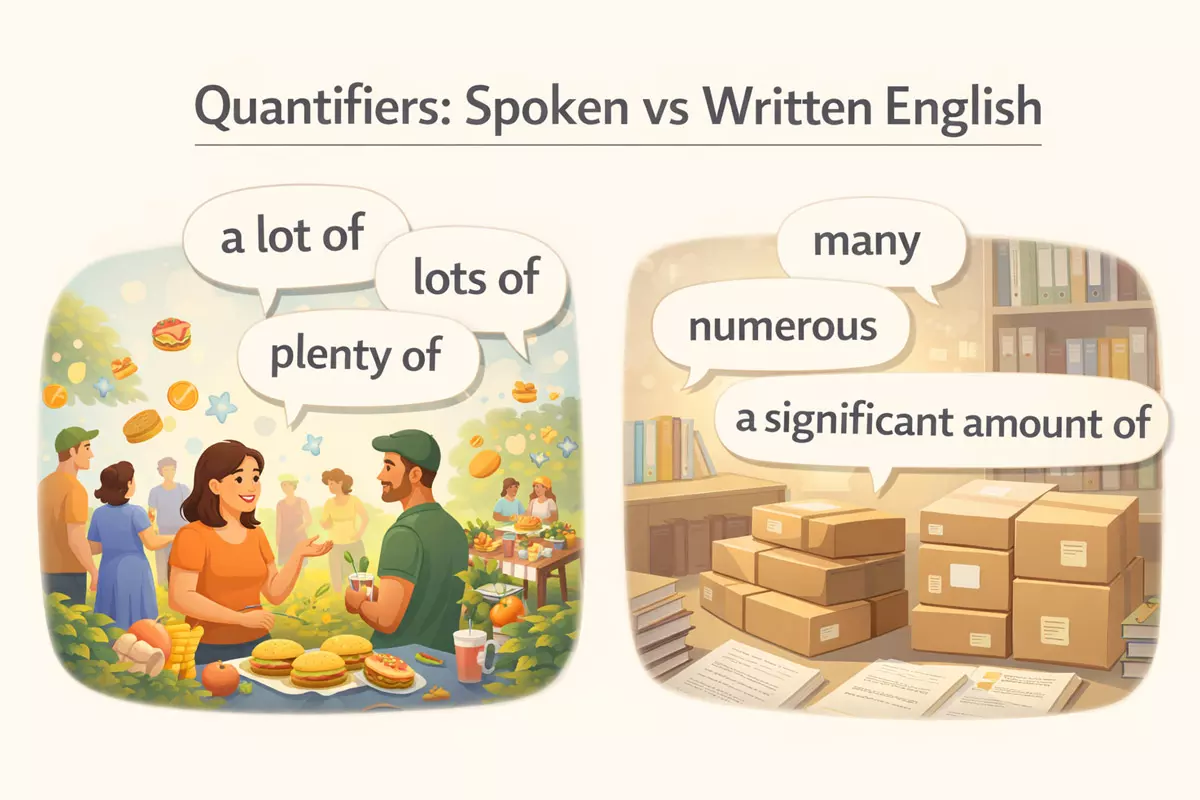
| Spoken English Examples | Written English Examples |
|---|---|
| a lot of | numerous |
| loads of | the majority of |
| a bunch of | several |
| plenty of | approximately |
| some | various |
| a few | the vast majority of |
| loads | considerable |
| tons of | significant number of |
| not much | limited |
| hardly any | minimal |
Flexibility and Precision
- Spoken language favors flexibility, using general quantifiers to keep the conversation flowing.
- Written language requires precision, often opting for quantifiers that define scope or amount more clearly.
- Writers may include supporting data or references to strengthen their quantifier choices, while speakers rely on context and tone.
Ultimately, the goals of each form—whether fostering quick understanding or ensuring lasting clarity—shape how quantifiers are selected and interpreted. This distinction helps explain why the same concept may be expressed differently depending on whether it’s spoken or written.
Quantifiers common in everyday conversation
Spoken English relies heavily on a core set of quantifying words and phrases to express quantity, frequency, and degree in a natural, fluid manner. These expressions are often simple, direct, and flexible, making them easy to use in a variety of everyday contexts. Unlike more formal or precise quantifiers that might appear in written texts, the ones heard in daily speech are chosen for quick understanding and ease of use.
Frequent quantifiers in spoken language

You’ll notice people intuitively reach for certain words and patterns when they describe amounts or frequencies. Here are some of the most commonly heard quantifiers in casual conversation:
- some → Some students stayed after class.
- a lot of → She has a lot of experience in teaching.
- lots of → There were lots of people at the concert.
- a few → I have a few questions about the topic.
- many → Many employees work remotely now.
- much → There isn’t much time left.
- plenty of → We have plenty of resources to continue.
- a bit of → Add a bit of salt to the soup.
- several → Several options are still available.
- a couple of → I’ll be ready in a couple of minutes.
- no → There is no evidence to support the claim.
- none → None of the answers were correct.
- most → Most people prefer online shopping.
- all → All participants completed the survey.
- enough → Do we have enough time to finish?
- any → Are there any questions?
- too much → There is too much noise here.
- too many → She has too many tasks today.
- hardly any → There was hardly any food left.
- quite a few → Quite a few guests arrived early.
These quantifiers help speakers communicate not just the quantity, but also their attitude—whether something feels like enough, too little, or more than expected.
Typical uses and nuances
Everyday language often favors quantifiers that are less exact and more subjective. For instance, "a lot of" and "lots of" are used liberally to mean a large quantity, regardless of whether the subject is countable or uncountable. Phrases like "a bit of" and "a couple of" soften statements and make them sound more informal or friendly. Many of these quantifiers can be adapted to fit both positive and negative contexts. For example:
- "Do you have any questions?" (open, neutral)
- "I don’t have any money." (negative)
- "There are hardly any cookies left." (almost none)
Comparison: spoken vs written quantifiers
Spoken English typically leans towards simpler, more flexible quantifiers, while written texts may use more specific or formal alternatives. Here’s a quick overview of how some quantifiers appear in conversation versus more formal writing:
| Spoken English | Common Written Alternative |
|---|---|
| a lot of / lots of | numerous / a considerable amount of |
| a couple of | two / a pair of |
| plenty of | an abundance of |
| a bit of | a small amount of |
| quite a few | several / a significant number of |
Flexible patterns in real speech
In conversation, quantifiers often appear with modifiers for extra emphasis or softening. You’ll hear people say “just a few,” “way too much,” or “not enough,” adapting the phrase to fit the situation. This flexibility is a hallmark of spoken English and helps speakers convey nuance efficiently. Overall, the quantifiers used in conversation are chosen for their clarity, convenience, and ability to convey feeling as well as fact. Their informal, adaptable nature makes them staples of everyday English.
Quantifiers preferred in written texts
Writers tend to select quantifiers with more precision and a formal tone than speakers do. In formal writing, there is often a greater emphasis on clarity and avoiding ambiguity, which leads to a preference for quantifiers that are explicit, nuanced, and sometimes more complex. These choices help ensure that information is conveyed accurately and that the intended meaning is clear to readers.
Common quantifiers in academic and formal writing
Texts such as essays, reports, and articles frequently use quantifiers that specify exact amounts, proportions, or degrees. This contrasts with the broader, sometimes vague quantifiers often found in conversation. Here are some quantifiers and quantifier phrases that are favored in written contexts:
- several → Several participants left early.
- numerous → Numerous reports confirm the findings.
- a significant number of → A significant number of users reported issues.
- the majority of → The majority of voters supported the proposal.
- a minority of → A minority of students disagreed with the decision.
- much → There isn’t much evidence available.
- many → Many people prefer flexible schedules.
- most → Most employees work remotely.
- little → There is little interest in the topic.
- few → Few errors were found in the final draft.
- various → Various approaches were tested.
- an abundance of → The region has an abundance of natural resources.
- a range of → The course offers a range of elective subjects.
- all → All documents must be submitted today.
- no → There is no solution to this problem.
- each → Each student received a certificate.
- every → Every detail was carefully checked.
- almost all → Almost all participants completed the survey.
- almost none → Almost none of the data was usable.
- certain → Certain rules must be followed.
More precise quantifiers for clarity
Writers often turn to quantifiers that express specific fractions, percentages, or measurable amounts. These are especially common in scientific, technical, and analytical texts, where vagueness can be problematic. Some examples include:
- one-third of → One-third of the budget was allocated to research.
- two-thirds of → Two-thirds of the class passed the exam.
- half of → Half of the population lives in urban areas.
- 25% of → 25% of respondents chose option A.
- the entirety of → The entirety of the document was revised.
- double → The new version requires double the storage space.
- triple → Production costs nearly tripled last year.
Comparing written and spoken preferences
While both spoken and written English use quantifiers, their distribution and formality differ. Writers are less likely to use informal or vague expressions like "loads of" or "a bunch of," which are common in conversation. Instead, they opt for more formal alternatives.
| Spoken Preference | Written Preference |
|---|---|
| a lot of | many / numerous |
| loads of | a large number of |
| a bunch of | several / various |
| tons of | an abundance of |
| pretty much all | almost all / the majority of |
Writers also tend to avoid slang and colloquial quantifiers, opting for phrases that are universally recognized and less likely to be misinterpreted. This careful selection supports clarity, accuracy, and a professional tone in written communication.
Register shifts and formality levels
Quantifiers behave differently depending on the level of formality and the context in which English is spoken or written. In casual conversation, speakers often opt for simpler quantifiers and contractions, while written forms—especially formal writing—tend to use more precise or varied expressions. These differences reflect how speakers adjust their language to fit the social situation, audience, and communicative purpose.
Spoken English: Informal Patterns
In everyday speech, quantifiers are typically less precise and more flexible. People frequently use general terms, approximate amounts, and colloquial phrases. Some quantifiers even have informal variants or are dropped entirely in conversation. Here are common features:
- Use of "a lot of" or "lots of" instead of "many" or "much"
- Preference for "some" in vague statements (e.g., "Can I have some water?")
- Frequent omission of quantifiers when context is clear ("Want coffee?")
- Use of "a couple of" or "a few" in place of exact numbers
- Informal intensifiers: "tons of", "loads of", "a bunch of"
- Contractions and ellipsis: "Got any bread?" rather than "Do you have any bread?"
- Overlap or mixing: "a little bit of", "a tiny bit"
- Flexible negatives: "not much", "not many", or even "hardly any"
- Informal negatives: "no" as a stand-alone ("No money left")
- Conversational hedges: "sort of", "kind of" with quantifiers ("kind of a lot")
Written English: Formal Preferences
In contrast, written English—especially in academic, business, or official contexts—favors precision and clarity. Quantifiers are chosen carefully to avoid ambiguity and to match the tone of the text. Writers often select more formal or less colloquial terms, and quantifiers are rarely omitted.
- Preference for "many", "much", "several", "numerous" in place of "lots of"
- Use of "few" and "little" for negative or limiting meanings
- Quantitative phrases: "a significant number of", "an insufficient amount of"
- Formal negatives: "no", "none", "neither", "scarcely any"
- Explicitness: "the majority of", "the minority of", "a small proportion of"
- Less use of informal intensifiers ("loads of", "tons of" are avoided)
- Use of "each", "every", "all", "both" for clarity and specificity
- Rare use of contractions or omission
- Greater attention to countable/uncountable noun distinction
- Hedging with quantifiers: "to some extent", "to a certain degree"
Comparing Quantifier Choices: Spoken vs Written
| Spoken English Example | Written English Example |
|---|---|
| "There’s a bunch of people outside." | "There are several people outside." |
| "Do you have any milk?" | "Please indicate whether any milk is available." |
| "Not much time left." | "There is little time remaining." |
| "Got loads of homework." | "I have a large amount of homework." |
| "No money left." | "There are no funds remaining." |
| "A couple of minutes" | "Approximately two minutes" |
Ultimately, the choice of quantifier signals not just how much or how many, but also the speaker’s or writer’s relationship with their audience and the context. Being aware of these shifts allows for more effective and appropriate communication, whether in relaxed conversation or formal correspondence.
Reduction and emphasis in spoken usage
In everyday conversation, quantifiers often undergo simplification or, conversely, are stressed for clarity or emotion. While written English tends to preserve full forms—such as “a great deal of,” “several,” or “a large number of”—spoken language frequently trims these down or substitutes them with more casual alternatives. Intonation, stress, and even word choice help speakers convey subtle distinctions or highlight particular quantities.
Common reduction patterns in speech
Listeners will notice that speakers typically favor brevity. For example, “a lot of” is far more prevalent in speech than “many” or “numerous,” especially in informal settings. Similarly, phrases like “a couple of,” “loads of,” or “tons of” replace more formal quantifiers. Some typical ways quantifiers are reduced or substituted in conversation include:
- “A lot of” instead of “many”
- “Loads of” or “tons of” for emphasis (e.g., “I have tons of work”)
- “A bunch of” for groups or collections
- Dropping “of” where context allows (“I’ve got plenty things to do”)
- “A bit of” instead of “a small amount of”
- “A couple” for two or a few
- “Some” as a vague, catch-all quantifier
- “A few” and “few” used interchangeably, sometimes losing strict distinctions
- “No” or “none” for absolute negation (e.g., “I’ve got no idea”)
- “Any” in negative or interrogative sentences (“You got any milk?”)
- “Lots” as a standalone (“There were lots”) without “of”
- Contractions and reductions: “kinda” (kind of), “sorta” (sort of)
Emphasis through stress and intonation
Speakers also frequently use stress or exaggerated intonation to modify the impact of quantifiers. This is especially noticeable when someone wants to underline how much or how little of something exists. For example, stretching the vowel in “so” (“so many people!”) or placing heavy stress on “every” (“every single time!”) draws attention to the quantity. Even vague quantifiers like “some” can be stressed to imply more than the literal meaning.
Comparing spoken and written quantifier use
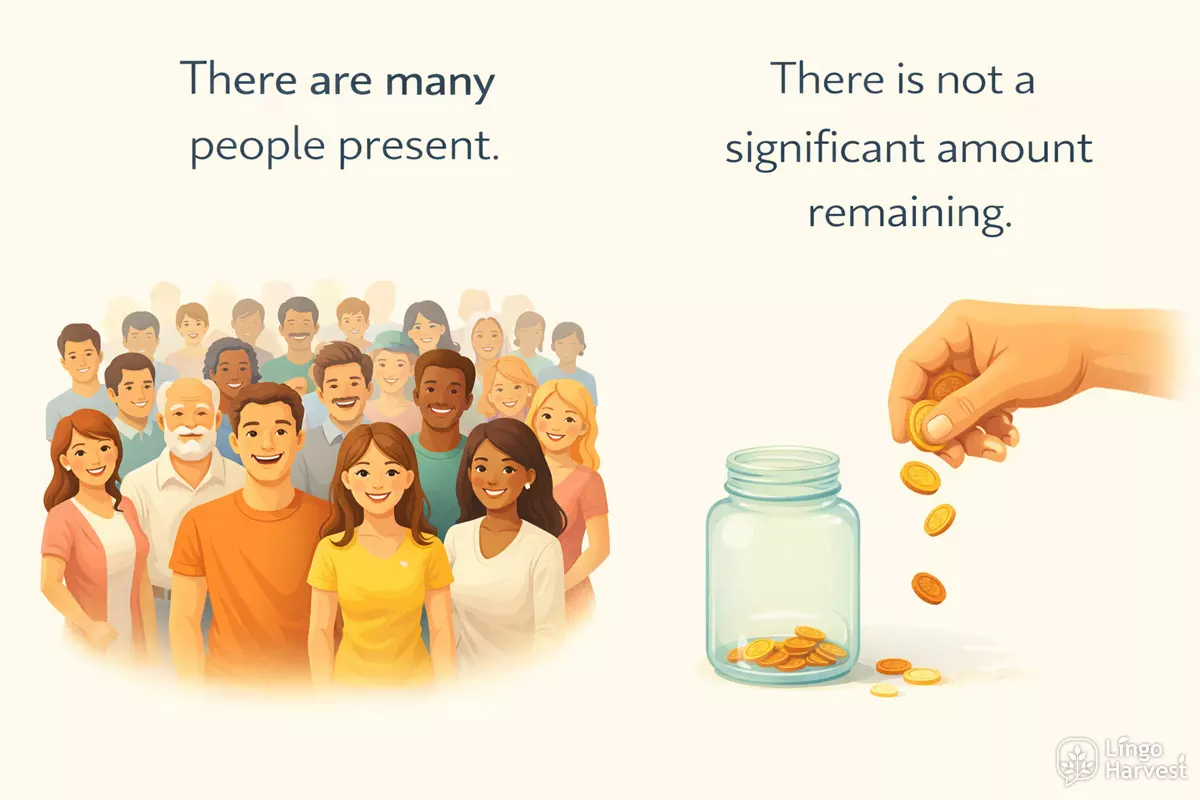
The table below contrasts some typical quantifier choices and forms in speech versus writing:
| Spoken English Example | Written English Equivalent |
|---|---|
| “There’s loads of people here.” | “There are many people present.” |
| “I’ve got a bunch of emails.” | “I have several emails.” |
| “Not much left.” | “There is not a significant amount remaining.” |
| “Any luck?” | “Did you have any success?” |
| “Just a bit.” | “Only a small amount.” |
| “So many choices!” | “There are numerous options available.” |
Key takeaways
- Spoken English leans toward brevity and expressiveness with quantifiers.
- Stress, intonation, and informal substitutes are used to signal emphasis or emotional nuance.
- Written forms favor precision and avoid ambiguity, often using more formal quantifiers.
Understanding these differences helps speakers and learners adjust their language to fit context and audience, ensuring their intended meaning comes across clearly.
Common mismatches learners make
Learners often find it tricky to use quantifiers appropriately in spoken versus written contexts. Spoken English tends to be more flexible, sometimes bending rules for the sake of fluency or informality. Written English, in contrast, generally sticks to stricter grammatical norms. This difference can lead to errors, especially for those who are more familiar with academic or textbook language.
Frequent Quantifier Confusion
Some quantifiers are used differently depending on whether the noun is countable or uncountable. In casual conversation, it's common to hear forms that would be marked incorrect in formal writing.
- Using "less" with countable nouns in speech (e.g., "less people" instead of "fewer people").
- Saying "much" with plural count nouns (e.g., "much cars") in informal talk, rather than "many cars".
- Choosing "some" or "any" incorrectly in questions or negatives ("Do you have some money?" instead of "any money?").
- Overusing "a lot of" where "many" or "much" would be more precise in written English.
- Mixing up "every" and "all" (e.g., "every students" instead of "all students" or "every student").
- Incorrectly pairing quantifiers with singular or plural nouns ("each people" instead of "each person").
- Substituting "few" for "a few" and vice versa, leading to the opposite meaning.
- Using "plenty" without "of" (e.g., "plenty money" instead of "plenty of money").
- Misplacing quantifiers in word order ("I have only seen few of them" instead of "I have seen only a few of them").
- Confusing "some" and "any" in offers and requests.
- Employing "most of" with general nouns ("Most of people" instead of "Most people").
- Omitting "of" after "all," "both," or "none" when needed ("all the students" vs. "all students").
Spoken vs. Written English: Typical Patterns
Learners sometimes default to structures from their native language or from speech, which can sound awkward or incorrect in formal writing. The table below highlights several mismatches between informal spoken usage and the more standard written forms.
| Spoken English Example | Written English Correction |
|---|---|
| There’s less people here today. | There are fewer people here today. |
| He didn’t have much friends. | He didn’t have many friends. |
| I don’t have no money. | I don’t have any money. |
| Every students must submit the form. | Every student must submit the form. |
| Most of people like pizza. | Most people like pizza. |
| Each of them have a ticket. | Each of them has a ticket. |
| Plenty water is needed. | Plenty of water is needed. |
| He has a few money. | He has a little money. |
| All of students passed. | All the students passed. |
| Some people doesn’t agree. | Some people don’t agree. |
Tips for Avoiding Common Pitfalls
To improve accuracy, it's helpful to:
- Practice distinguishing between countable and uncountable nouns.
- Notice how quantifiers are used in real-life conversations versus academic texts.
- Double-check written work for quantifier-noun agreement.
- Listen for subtle differences in quantifier usage in podcasts or interviews.
- Ask for feedback from native speakers or teachers on both spoken and written exercises.
Mastering quantifiers in both speech and writing takes attention to detail and regular exposure to authentic English.
Contextual examples showing contrast
When we compare how quantifiers appear in everyday speech versus formal or edited writing, clear differences emerge in both choice and structure. Spoken English often favors approximations, informal quantifiers, and simpler constructions, while written English tends toward precision, variety, and sometimes more complex phrasing.
Spoken English: Informality and Approximation
In conversation, speakers typically opt for straightforward quantifiers and may use vague or general expressions. Here are common patterns:
- Lots of people were there. (instead of "many people")
- I don't have any idea. (emphatic "any")
- A bunch of friends came over. (colloquial grouping)
- There were a few cookies left. (informal, approximate)
- Do you have some time?
- Plenty of food for everyone.
- There isn't much milk left.
- I saw a couple of movies last weekend.
- We have tons of work to do. (hyperbolic, casual)
- Not many people showed up.
Written English: Precision and Range
In contrast, formal writing often requires more exact language, with quantifiers chosen for accuracy and clarity. Writers may also use a wider variety of expressions to convey subtle distinctions.
- Several studies indicate a correlation.
- The project involved numerous participants.
- There is insufficient evidence to support the claim.
- Each respondent completed a survey.
- Few alternatives were considered.
- Only a small proportion of cases met the criteria.
- Considerable time was invested in research.
- All members agreed to the proposal.
- The experiment yielded no significant results.
- Every attempt was documented.
Side-by-Side Comparison of Quantifiers
To highlight the contrast, here’s a structured look at how similar meanings are expressed differently in speaking and writing:
| Spoken English Example | Written English Example |
|---|---|
| There were a lot of problems. | There were numerous issues. |
| Not many people came. | Only a few attendees were present. |
| I've got some money left. | A small amount of funds remain. |
| We saw a bunch of birds. | We observed several birds. |
| There's no milk. | There is no milk available. |
| We have tons of homework. | There is a significant amount of homework assigned. |
| All of them left early. | All participants departed prematurely. |
| I need a couple of minutes. | Several minutes are required. |
These examples illustrate how spoken language gravitates toward casual, easily understood quantifiers, while written forms often prioritize clarity, precision, and a broader range of vocabulary. Understanding these tendencies can help learners and users of English adjust their language depending on context → whether speaking informally or writing for a formal audience.
Practice: adapting quantifiers to context
Understanding how quantifiers shift between spoken and written English requires attention to both formality and clarity. In casual conversation, speakers often use simpler or more flexible quantifiers, while written texts—especially academic or formal ones—tend toward precise and explicit expressions. Practicing with realistic scenarios helps build a sense of which quantifiers fit best.
Choosing Quantifiers for the Situation
Selecting the right quantifier depends on factors like audience, purpose, and medium. Consider these examples that highlight differences between conversational and formal writing:
- Lots of people (spoken, informal) vs. Many individuals (written, formal)
- A bit of advice (spoken) vs. A small amount of advice (written)
- Plenty of time (spoken) vs. Sufficient time (written)
- Loads of work (spoken) vs. A large quantity of work (written)
- Hardly any mistakes (spoken) vs. Few errors (written)
- A bunch of reasons (spoken) vs. Several reasons (written)
- A few things (spoken) vs. A limited number of items (written)
- Some people (both, context-dependent)
- Not much money (spoken) vs. Insufficient funds (written)
- Almost no evidence (spoken) vs. Little evidence (written)
- So many options (spoken) vs. Numerous options (written)
- Quite a lot of interest (spoken) vs. Considerable interest (written)
Task: Match the Quantifier to the Context
Read the sentences below and decide which quantifier would sound more natural in each context—spoken or written. Choose from: "a lot of," "numerous," "a bit of," "a small amount of," "loads of," "several," "not much," "insufficient," "hardly any," "few," "plenty of," "sufficient."
- There were ______ problems with the software during the demonstration. (formal report)
- I’ve got ______ emails to answer before lunch. (chatting with a friend)
- The organization experienced ______ growth in recent years. (business article)
- We saw ______ people at the event last night! (casual conversation)
- The team found ______ evidence to support the claim. (academic paper)
- She had ______ trouble understanding the instructions. (everyday conversation)
- The report highlights ______ risks associated with the plan. (formal analysis)
- I still have ______ things to do today. (informal speech)
- The researchers collected ______ data over a ten-year period. (academic writing)
- There was ______ noise coming from the street. (everyday description)
- The startup achieved ______ success in its first year. (business context)
- He showed ______ interest in the proposal. (neutral tone)
Show answers
- few
- a lot of
- significant / considerable
- loads of
- little
- a bit of
- several / numerous
- a few
- a large amount of
- a lot of / much
- considerable / significant
- some
Table: Spoken vs. Written Quantifier Choices
| Spoken English | Written English |
|---|---|
| Lots of noise | Considerable noise |
| A bunch of questions | Several questions |
| Not much time | Insufficient time |
| Hardly any food | Little food |
| Loads of friends | Numerous friends |
| Plenty of space | Adequate space |
Task: Rewrite for the Opposite Context
Take each phrase from the first column (spoken) and rewrite it to fit a formal, written context. Then, do the reverse: make the written version more conversational.
Show answers
- Lots of noise → Considerable noise; Considerable noise → Lots of noise
- A bunch of questions → Several questions; Several questions → A bunch of questions
- Not much time → Insufficient time; Insufficient time → Not much time
- Hardly any food → Little food; Little food → Hardly any food
- Loads of friends → Numerous friends; Numerous friends → Loads of friends
- Plenty of space → Adequate space; Adequate space → Plenty of space
Practicing these shifts builds confidence in choosing the right quantifier, whether you’re working on a formal document or chatting with someone informally. Pay attention to the tone and purpose of your communication to guide your choice.