Using Quantifiers in Conditional Sentences Correctly

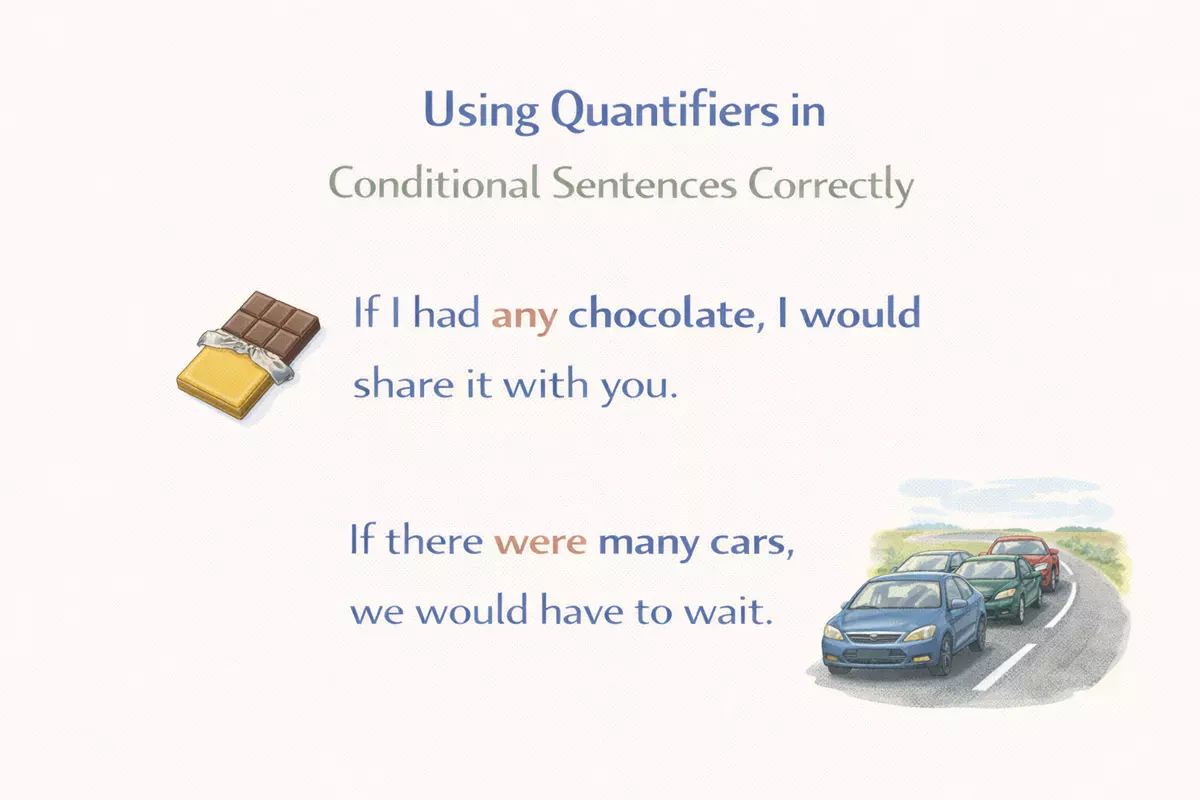 Here we how quantifiers impact the meaning of conditional sentences, covering their placement in if-clauses and result clauses, effects on real and unreal conditions, logical interpretation, common mistakes, style differences, and practice exercises.
- Role of quantifiers in conditional meaning
- Quantifiers in real vs unreal conditions
- Placement in if-clauses and result clauses
- How quantity affects logical interpretation
- Common errors in conditional structures
- Examples across different conditional types
- Style differences in formal and neutral contexts
- Practice: correcting conditional sentences
Combining words that express quantity with if-clauses can be challenging, even for advanced English learners, but mastering this skill greatly improves clarity and precision in your writing and speech. For example, using expressions like "few," "little," "many," or "much" with conditional statements requires careful attention to both grammar and meaning. By practicing these structures and reviewing common usage patterns, you can enhance your ability to communicate complex ideas more effectively and confidently.
Role of quantifiers in conditional meaning
Quantifiers like all, some, any, many, and few play a major part in shaping the meaning of conditional sentences. They specify how broadly or narrowly a condition applies, making your statements more precise or more general. For instance, saying "If all students submit their work, the teacher will be happy," is much stronger than "If some students submit their work, the teacher will be happy." The choice of quantifier can drastically affect the logical scope and implication of the condition.
How quantifiers influence conditionals
The presence of a quantifier in the if-clause or the main clause clarifies who or what is involved in the situation. Some quantifiers indicate universality (all, every), others suggest partiality (some, many, a few), and some imply possibility or uncertainty (any, either). Understanding these differences helps you avoid ambiguity and communicate your intended meaning.
- All: Applies the condition to every member of a group (“If all lights are off, the building is empty.”)
- Some: Indicates that the condition needs only part of the group (“If some people agree, we will proceed.”)
- Any: Suggests that just one instance is enough (“If any error is found, the process stops.”)
- Every: Similar to all, but often used with singular nouns (“If every child finishes, the game ends.”)
- Many: Highlights a significant but undefined number (“If many students are absent, class may be canceled.”)
- Few: Suggests a small number, sometimes with a negative connotation (“If few employees attend, the meeting will be rescheduled.”)
- None: States that the condition applies if no members meet the criteria (“If none of the keys work, call support.”)
- Most: Implies a majority (“If most questions are answered correctly, you pass.”)
- Either: Presents alternatives (“If either button is pressed, the alarm sounds.”)
- Several: Means more than a few, but not many (“If several requests come in, we’ll open a new line.”)
Comparison of quantifiers in typical conditional patterns
| Quantifier | Conditional Example | Implication |
|---|---|---|
| All | If all doors are locked, the alarm activates. | Complete group must meet condition. |
| Some | If some people object, the plan changes. | Only partial group triggers result. |
| Any | If any light is on, someone is home. | Single instance is sufficient. |
| None | If none arrive, the event is canceled. | Absence of all triggers outcome. |
| Most | If most voters agree, the law passes. | Majority required for result. |
Tips for choosing the right quantifier
- Decide whether your statement needs to be universal, partial, or possible.
- Use all or every for total inclusion, any for possibility, and some or many for partial inclusion.
- Consider the logical consequence: Does the result depend on everyone, just one, or a subset?
- Be aware of context. In legal, scientific, or formal writing, the specificity of quantifiers is especially important.
In summary, the choice and placement of quantifiers in conditional sentences is key to expressing clear, accurate, and nuanced meaning. Whether you want to set broad rules or highlight exceptions, understanding these words gives you more control over your language.
Quantifiers in real vs unreal conditions
Understanding how to use quantifiers in conditional sentences depends largely on whether the condition is real (likely or possible) or unreal (hypothetical or contrary to fact). The choice of quantifiers—such as some, any, much, many, a few, several, and little—can subtly affect meaning and correctness in both types of situations. This is especially important because the grammar and tone of a conditional often signal how probable or realistic a situation is.
Quantifiers in likely (real) conditionals

In real or possible conditions (usually with if + present simple), quantifiers reflect actual possibilities or quantities. For example:
- If you have any questions, ask now.
- If there are some tickets left, we can go together.
- If you need a little help, let me know.
- If many people come, we’ll need more chairs.
- If you have several options, choose the best one.
- If we get enough time, we’ll finish early.
- If much rain falls, the event will be postponed.
- If you see few errors, that’s a good sign.
- If all the lights are off, nobody is home.
- If no one answers, try again later.
Quantifiers in hypothetical (unreal) conditionals
Unreal or hypothetical conditions (often with if + past simple or if + past perfect) describe imagined situations. Here, quantifiers highlight the speculative nature:
- If I had any money, I would travel more. (But I don’t.)
- If there were some hope, we might try again.
- If she had enough courage, she would speak up.
- If many people knew, it could be a problem.
- If you had a few minutes, could you help?
- If there had been little noise, we would have heard the bell.
- If all the evidence were lost, the case would collapse.
- If no one cared, nothing would change.
Comparing quantifier use in both types
While the same quantifiers can appear in both real and unreal conditionals, their function and nuance may shift. Here’s a side-by-side comparison:
| Real Conditionals (If + present) | Unreal Conditionals (If + past/past perfect) |
|---|---|
| If you have any questions, ask now. ✅ | If I had any questions, I would ask. ❌ |
| If there are some seats left, join us. | If there were some seats left, we could join. |
| If we get enough rain, crops will grow. | If we had enough rain, crops would grow. |
| If many people agree, it will succeed. | If many people agreed, it would succeed. |
| If you have a few minutes, call me. | If you had a few minutes, you could call me. |
Notice how the verb tense and quantifier work together to express either a real possibility or an imagined scenario. In both types, quantifiers help clarify how much, how many, or what degree is being discussed, but the overall meaning depends heavily on the conditional structure.
Placement in if-clauses and result clauses
When using quantifiers such as "some," "any," "much," "many," "few," "little," "all," and "none" in conditional sentences, their position within the sentence impacts meaning and clarity. In conditionals, quantifiers can appear in either the "if" part (the condition) or the result part (the consequence), and sometimes in both. Understanding where to put them helps avoid ambiguity and ensures your message is clear.
If-clause: Where quantifiers appear
The quantifier is often placed right before the noun it modifies in the "if" clause. For example, "If any students need help,..." or "If all the lights are off,..." Using different quantifiers can change the scope of the condition:
- If any mistakes are found, we will correct them. (Applies to even a single mistake)
- If many people agree, we will proceed. (Depends on a large number)
- If few options remain, we must decide quickly. (Emphasizes scarcity)
- If no evidence is presented, the case will be dismissed. (Zero quantity)
- If some water is left, save it for later. (Indefinite but positive amount)
Result clause: Quantifiers after the condition
In the result part of the sentence, quantifiers generally follow the same pattern—placed before the noun they modify. However, the meaning sometimes shifts depending on whether the quantifier is in the "if" or the result clause:
- If you bring any snacks, I’ll eat them. (Willingness to eat whatever is brought)
- If you need help, some volunteers will assist you. (Not all, but a portion will help)
- If she finishes early, she will have more time to relax. (Emphasizes quantity in the result)
- If we forget, none of the tasks will be completed. (Zero outcome)
- If he studies hard, many opportunities will open up. (Highlights positive result)
Comparing quantifier placement
Sometimes, placing a quantifier in the "if" clause versus the result clause can subtly change the meaning or emphasis. The following table shows typical patterns and how meaning can shift depending on placement:
| Quantifier in If-Clause | Quantifier in Result Clause |
|---|---|
| If any errors occur, we will fix them. | If errors occur, we will fix any mistakes. |
| If all guests arrive on time, the event will start promptly. | If guests arrive on time, all seats will be filled. |
| If few people attend, the meeting will be short. | If people attend, few will stay until the end. |
| If no rain falls, the crops will suffer. | If rain falls, no plants will be left dry. |
Tips for clear and correct usage
- Place the quantifier directly before the noun it describes for clarity.
- Consider whether the quantity is part of the condition, the result, or both.
- Changing quantifier placement can shift emphasis or meaning—review your sentence to ensure it expresses your intended logic.
- Be especially careful with negative quantifiers ("no," "none") to avoid double negatives or unclear statements.
Mastering quantifier placement in conditional sentences helps your writing become more precise and expressive, especially when describing amounts or frequencies in hypothetical situations.
How quantity affects logical interpretation
The choice of quantifier—words like all, some, none, or many—can completely change the logic of a conditional sentence. In logic, the meaning of an if...then statement often depends on whether it’s being applied universally (to every case) or existentially (to at least one case). This distinction is crucial when interpreting arguments, instructions, or scientific statements.
Universal vs. Existential Quantifiers
When you use universal quantifiers (such as all or every) in conditionals, you’re making a statement about an entire group. Existential quantifiers (like some or at least one) claim that the condition holds for part of the group. The implications shift dramatically depending on which you choose.
| Quantifier | Conditional Example | Logical Meaning |
|---|---|---|
| All | If all birds fly, then penguins fly. | Requires every bird to fly for the conclusion to hold. If one doesn’t, the statement fails. |
| Some | If some birds fly, then birds can fly. | Only needs one example of a flying bird; doesn’t require all birds to fly. |
| No | If no cars are electric, then there are no electric vehicles. | States a total absence; a single exception disproves it. |
| Most | If most apples are red, then most apples at the store are red. | Majority-based; allows for exceptions, but the rule applies to more than half. |
| Exactly one | If exactly one student passed, then only one student gets a prize. | Specifies a unique case; neither zero nor more than one fits the claim. |
Common Quantifiers and Their Effects
- All: Generalizes to every member; often used in formal logic.
- Each: Similar to all, but emphasizes individuals in a group.
- Every: No exceptions allowed.
- Any: Sometimes universal, sometimes existential—context matters.
- Some: At least one; doesn’t specify how many.
- Many: Implies more than a few, but not all.
- Most: More than half, not necessarily all.
- Few: Less than half, but more than none.
- No: Asserts zero cases; disproved by a single counterexample.
- None: Equivalent to no in logic.
- Exactly one: Only one case satisfies the condition.
- Several: More than two, but still a minority.
- At least: Sets a minimum threshold.
- At most: Sets a maximum limit.
Ambiguity and Precision in Conditional Sentences
Ambiguous quantifiers can create confusion in conditional statements. For instance, “If any student finishes early, the test ends” could mean one or more students, or all, depending on context. Being precise with your quantifiers clarifies your intention and helps avoid misinterpretation.
In summary, the quantifier you select shapes both the scope and force of your conditional logic. Recognizing these nuances is key to constructing clear, valid arguments and understanding the intent behind statements involving conditions.
Common errors in conditional structures
Understanding how to use quantifiers in conditional sentences can be tricky, and many learners make similar mistakes. These missteps often stem from confusion about which quantifiers are appropriate for different types of conditions, or from misunderstanding the logic that connects the two clauses. Being aware of these pitfalls helps writers and speakers construct clearer, more precise sentences.
Frequent mistakes involving quantifiers and conditionals
- Using much with countable nouns (e.g., If you have much friends, call them.)
- Applying many to uncountable nouns (e.g., If you have many information, share it.)
- Confusing any and some in the if-clause (e.g., If you see some mistakes, let me know. vs. If you see any mistakes, let me know.)
- Placing all or every incorrectly (e.g., If every students pass, we celebrate. should be If every student passes, we celebrate.)
- Overusing a few and few interchangeably (e.g., If you have few minutes, help me. vs. If you have a few minutes, help me.)
- Neglecting subject-verb agreement with quantifiers (e.g., If any of them is available, call me. vs. If any of them are available, call me.)
- Using none with plural verbs (e.g., If none of the books are interesting, choose another.)
- Incorrect placement of quantifiers in the result clause (e.g., If you eat too much, you feels sick.)
- Mixing up little and a little (e.g., If there is little hope, keep trying. vs. If there is a little hope, keep trying.)
- Using each instead of every for groups (e.g., If each student pass, we celebrate.)
- Forgetting to match quantifiers with the correct noun type (countable/uncountable)
- Inserting double negatives with quantifiers (e.g., If you don't have no money, you can't buy it.)
Typical errors and their corrections

| ❌ Incorrect Structure | ✅ Corrected Example |
|---|---|
| If you have much friends, call them. | If you have many friends, call them. |
| If you see some mistakes, let me know. | If you see any mistakes, let me know. |
| If every students pass, we celebrate. | If every student passes, we celebrate. |
| If you have few minutes, help me. | If you have a few minutes, help me. |
| If none of the books are interesting, choose another. | If none of the books is interesting, choose another. |
| If you eat too much, you feels sick. | If you eat too much, you feel sick. |
Paying attention to the relationship between quantifiers and the nouns they modify is essential in conditional constructions. Always consider whether the noun is countable or uncountable, and whether the context calls for a positive, negative, or neutral meaning. Reviewing these common patterns helps avoid frequent errors and leads to more accurate conditional sentences.
Examples across different conditional types
Understanding how quantifiers function in various conditional sentence structures is key to using them accurately. Quantifiers like "some," "any," "many," "few," "all," and "none" can subtly shift meaning depending on the conditional form. Below, we'll look at common patterns and provide practical examples to illustrate how quantifiers interact with zero, first, second, and third conditionals.
Zero Conditional
In factual or general truth statements, quantifiers help describe frequency or quantity. For example:
- If any water freezes, it expands.
- If all students finish early, the class ends sooner.
- If no light enters, plants cannot photosynthesize.
- If some metals are heated, they expand.
First Conditional
When discussing real possibilities in the future, quantifiers often express likelihood or scope:
- If any guests arrive late, we will start without them.
- If many people sign up, the event will move to a larger venue.
- If some rain falls, the match might be delayed.
- If all reports are submitted, the team will receive a bonus.
Second Conditional
For hypothetical or unlikely situations, quantifiers show imagined amounts or frequencies:
- If few employees agreed, the policy would not change.
- If any errors occurred, they would be corrected immediately.
- If all machines worked, production would double.
- If some help were available, I would finish faster.
Third Conditional
This form addresses past situations that did not happen, with quantifiers indicating scope or extent:
- If any warnings had been given, the accident might have been avoided.
- If all files had been backed up, we would not have lost data.
- If some support had arrived earlier, the outcome could have changed.
- If no mistakes had occurred, the project would have finished on time.
| Conditional Type | Example with Quantifier |
|---|---|
| Zero | If any animal is hungry, it looks for food. |
| First | If some students miss the test, there will be a make-up session. |
| Second | If many people knew the answer, the quiz would be easier. |
| Third | If no one had helped, the task would have taken longer. |
These examples highlight how choosing the right quantifier in a conditional sentence can clarify meaning and intent. Notice how "any" is often used in negative or interrogative contexts, while "some" and "many" suggest partial or large quantities. Practicing with a variety of quantifiers in different conditional structures will help you master their correct usage.
Style differences in formal and neutral contexts
When using quantifiers in conditional sentences, the level of formality can affect both the choice of words and the structure of your statements. In more formal writing or speech, quantifiers tend to be precise, often accompanied by modal verbs or more elaborate clause structures. In contrast, neutral or everyday English favors simpler, more direct expressions and a less rigid style.
Common quantifiers in conditional sentences
- Any: "If you have any questions, let me know."
- Some: "If you need some help, just ask."
- Much: "If there is much traffic, we might be late."
- Many: "If many people arrive early, we'll start on time."
- Few: "If few options are available, we may have to wait."
- Little: "If little progress is made, we'll reconsider."
- No: "If no one calls, we'll leave."
- All: "If all goes well, we'll finish by noon."
- Each: "If each member agrees, we can proceed."
- Every: "If every detail is checked, mistakes are unlikely."
- None: "If none of the files open, restart the program."
- Several: "If several issues come up, notify the team."
- Either: "If either option works, choose one."
- Neither: "If neither answer is correct, try again."
Comparing formal and neutral usage
Writers often adjust quantifier use to match the tone of their audience. In official documents or academic writing, quantifiers are paired with more cautious or indirect phrasing. In everyday conversation or emails, sentences are shorter and more straightforward.
| Formal Example | Neutral Example |
|---|---|
| If any participant should require further information, please contact the organizer. | If you need more info, contact us. |
| If little progress has been observed, it may be necessary to consider alternative strategies. | If we don't make much progress, we might need to try something else. |
| If no objections are raised, the proposal will be approved. | If nobody objects, we'll approve it. |
| If several issues were to arise, the committee would convene an emergency meeting. | If a few problems come up, we'll meet quickly. |
Tips for adjusting quantifiers to context
- Choose any for open possibilities in both styles, but pair with modals for formality (e.g., "should you have any").
- Use some or a few for informal offers or requests.
- Prefer negative quantifiers like none, no, neither for clarity in both styles, but avoid double negatives in formal contexts.
- In formal writing, elaborate with modals (might, could, should) and passive forms.
- In neutral settings, keep sentences active and direct.
Adapting quantifiers to suit your audience helps ensure your conditional sentences are both accurate and appropriate for the situation.
Practice: correcting conditional sentences
Understanding how quantifiers fit into conditional statements is key to clear communication. Below, you'll find a variety of exercises that focus on identifying and correcting mistakes with quantifiers in “if” and “unless” clauses. These activities will help you recognize common pitfalls and refine your grammar.
Spot the Error
Read each sentence below. One or more quantifiers may be used incorrectly. Rewrite the sentence so that it’s grammatically correct.
- If you have much friends, you will never feel lonely.
- Unless she has any time, she can help us with the project.
- If there is little people at the event, we might cancel it.
- If you eat too much sweets, you might feel sick.
- Unless he has some money, he cannot buy lunch.
- If there are many information in the document, read it carefully.
- If you need few advice, just ask me.
- Unless there are enough chairs, some guests will stand.
- If you have a little friends, you will have fun at the party.
- Unless she gives all her attention, she could miss details.
Show answers
- If you have many friends, you will never feel lonely.
- Unless she has some time, she can’t help us with the project.
- If there are few people at the event, we might cancel it.
- If you eat too many sweets, you might feel sick.
- Unless he has any money, he cannot buy lunch.
- If there is much information in the document, read it carefully.
- If you need some advice, just ask me.
- Unless there are enough chairs, some guests will stand. (Correct as is.)
- If you have a few friends, you will have fun at the party.
- Unless she gives her full attention, she could miss details.
Choose the Correct Quantifier
Fill in the blanks with an appropriate quantifier: many, much, few, little, some, any, enough, all, or no.
- If there is ________ water left, we can make tea.
- Unless you have ________ questions, we will finish early.
- If you do not have ________ experience, this job will be difficult.
- If there are ________ volunteers, the event will run smoothly.
- Unless there is ________ time, we cannot discuss every topic.
- If ________ of the students finish, we can leave.
- If you bring ________ snacks, please share them.
- Unless there are ________ errors, your report will be accepted.
- If you have ________ patience, you will succeed.
- If ________ guests arrive, we will start the meeting.
Show answers
- some
- no
- any
- enough
- enough
- all
- any
- few
- enough
- all
Common Errors and Corrections
To help you visualize frequent mistakes with quantifiers in conditional sentences, see the table below comparing incorrect and correct versions:
| Incorrect Sentence | Correct Sentence |
|---|---|
| If you have much friends, call me. | If you have many friends, call me. |
| If there are less people, we can start early. | If there are fewer people, we can start early. |
| If you have little questions, ask now. | If you have few questions, ask now. |
| Unless he has enough informations, he cannot decide. | Unless he has enough information, he cannot decide. |
| If you have some money, you can buy the ticket. | If you have any money, you can buy the ticket. |
| If there is too many noise, close the window. | If there is too much noise, close the window. |
| Unless there are much options, pick one. | Unless there are many options, pick one. |
| If you have a few time, help me. | If you have a little time, help me. |
| If there are some water, water the plants. | If there is some water, water the plants. |
| Unless you have enough advices, ask for more. | Unless you have enough advice, ask for more. |
Practicing with these examples will help you avoid typical errors and use quantifiers naturally in conditional structures. Reviewing where and why corrections are made strengthens your understanding and builds confidence in both writing and speech.