Weak vs Strong Quantifiers: Meaning and Usage Differences

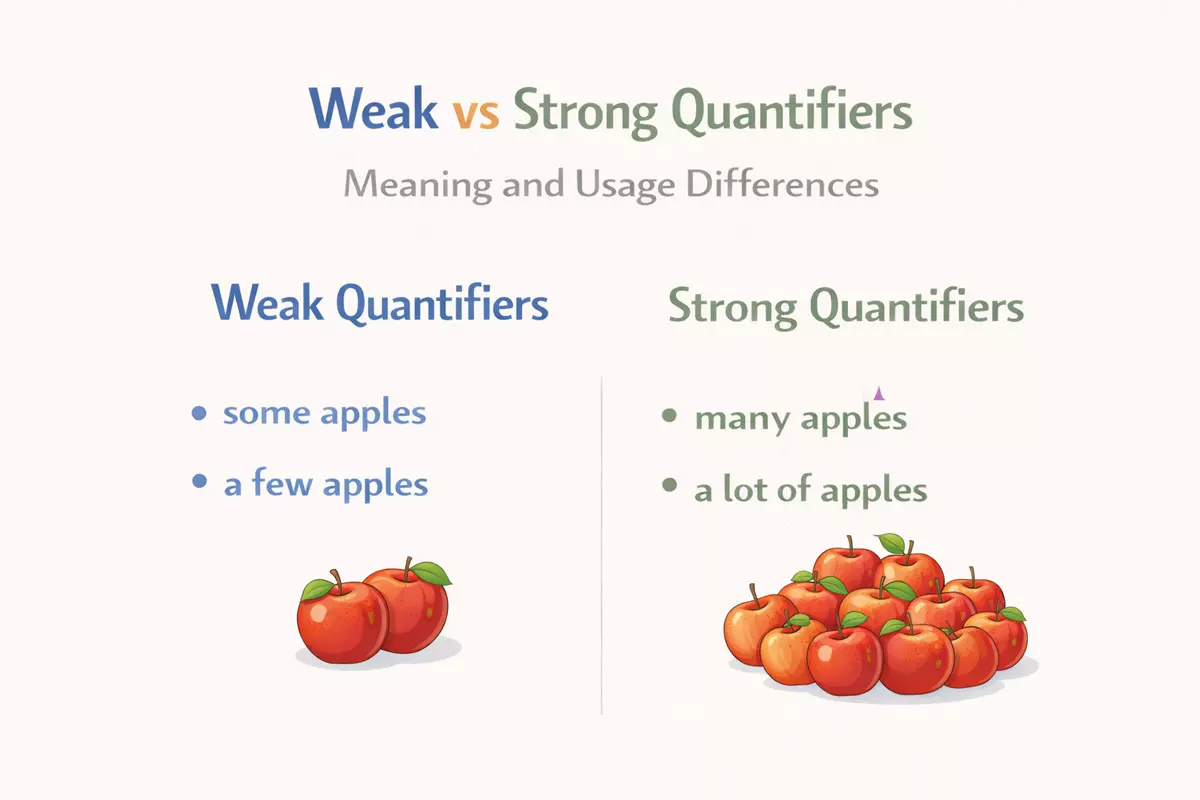 Here we what makes quantifiers weak or strong, how this influences a speaker’s attitude and emphasis, typical examples, contextual and register differences, frequent learner errors, and provides real-life comparisons and practice exercises.
- What makes a quantifier weak or strong
- How strength affects speaker attitude and emphasis
- Typical weak quantifiers and their implications
- Typical strong quantifiers and their force
- Contextual meaning shifts with the same noun
- Register differences between weak and strong forms
- Common learner misunderstandings
- Examples comparing strength in real contexts
- Practice: choosing the appropriate strength
Recognizing the subtle differences between less forceful and more emphatic quantifying words can significantly influence how we communicate and understand meaning. By carefully selecting terms such as some, many, most, or all, we can adjust the strength and clarity of our statements to reflect precise intentions. This attention to nuance not only helps us convey information more accurately but also allows us to interpret others' messages with greater insight, ultimately improving both written and spoken communication.
What makes a quantifier weak or strong
The distinction between weak and strong quantifiers comes down to how much specificity and presupposition they bring into a sentence. Weak quantifiers, such as some or many, typically indicate an indefinite quantity without making claims about the total set or its entirety. Strong quantifiers, like all or most, are more forceful—they imply a more comprehensive relationship with the group being discussed, sometimes even requiring that the group is known or definite.
How Weak and Strong Quantifiers Function in Sentences
Weak quantifiers usually allow for non-specific interpretation. For example, saying "Some students passed" does not clarify how many or which students, and it does not presuppose that all students exist or are relevant. Strong quantifiers, on the other hand, such as in "All students passed," assume a specific, identifiable group and make a claim about every member of that group.
- Weak quantifiers often introduce new, indefinite referents.
- Strong quantifiers tend to refer to known or contextually given sets.
- Weak quantifiers do not presuppose the existence of the set; strong ones usually do.
- Strong quantifiers can trigger inferences or entailments that weak ones cannot.
Common Examples
To clarify the difference, here's a list of quantifiers typically considered weak or strong:
- Weak: some, several, any, a few, many, few, at least one, more than one, certain, a number of, various, a couple of, handful of, enough, part of, less than half, either
- Strong: all, most, every, each, both, almost all, the whole, none, neither, the entire, at least half, exactly N (e.g. "exactly three")
Key Properties Compared
| Property | Weak Quantifiers | Strong Quantifiers |
|---|---|---|
| Reference | Often indefinite or new | Usually definite or known |
| Presupposition | No presupposition of total set | Presupposes existence of set |
| Entailment | Few or none | Strong, can trigger entailments |
| Usage in Negative Polarity | Compatible (e.g. "any") | Usually not compatible |
| Typical Examples | some, many, any | all, most, every |
Understanding these differences helps in both interpretation and production of precise statements in English. The choice between a weaker or stronger quantifier can influence the logical implications, presuppositions, and even conversational implicatures of your sentence.
How strength affects speaker attitude and emphasis
The choice between weak and strong quantifiers often reveals subtle cues about a speaker’s intent and the emphasis they wish to convey. Stronger quantifiers like all or every can make statements sound more categorical or absolute, while weaker ones such as some or few often introduce nuance or soften the claim. This selection impacts not just the literal meaning, but also how listeners interpret the speaker’s certainty, inclusiveness, or even politeness.
Influence on Speaker’s Attitude
Selecting a strong quantifier may signal confidence, authority, or insistence. In contrast, weaker quantifiers frequently suggest caution, tentativeness, or a desire to avoid overgeneralization. These differences can shape the perceived attitude behind a statement:
- All employees must attend. → Conveys strictness and no exceptions.
- Most employees must attend. → Implies broad participation, but allows for exceptions.
- Some employees must attend. → Suggests a smaller, less defined group.
- Few employees must attend. → Emphasizes the rarity or limited scope.
Emphasis and Pragmatic Effects

The level of quantifier strength can shift the focus or highlight particular aspects of a message. For instance, opting for a strong quantifier may draw attention to totality or universality, while a weak quantifier may downplay scope or stress uncertainty. This can be especially relevant in persuasive contexts, academic writing, or negotiations.
| Quantifier Strength | Speaker Implication | Common Example |
|---|---|---|
| Strong | Absolute, authoritative, sometimes rigid | All students passed the test. |
| Moderately Strong | Broad, but allows exceptions | Most students passed the test. |
| Weak | Non-committal, cautious, open-ended | Some students passed the test. |
| Minimally Weak | Highlights rarity, sometimes negative emphasis | Few students passed the test. |
Common Patterns and Their Effects
- Using every highlights inclusivity and leaves little room for exceptions.
- Each can focus attention on individuals within a group, stressing distributive action.
- No introduces total negation, often intensifying the claim.
- Many and several are less precise, but still suggest a significant portion.
- Any can express openness or lack of restriction, depending on context.
- Only limits the scope, frequently used for emphasis or restriction.
- A majority of versus a minority of—the former emphasizes consensus, the latter highlights exception.
- Almost all softens totality, showing near-completeness without being absolute.
- Hardly any underscores scarcity or near absence.
- One and none provide the most extreme ends of specificity.
In sum, the strength of a quantifier acts as a subtle tool for shaping tone and focus. By choosing carefully, speakers can underscore certainty, hedge their statements, or strategically draw attention to what matters most in their message.
Typical weak quantifiers and their implications
Understanding how weak quantifiers operate is essential for interpreting statements about quantity or existence in natural language and logic. Unlike their stronger counterparts, these determiners usually refer to non-specific, indefinite, or minimal amounts, leaving much open to interpretation and context.
Common examples of weak quantifiers
In both English and formal semantics, certain words and phrases frequently serve as weak quantifiers. These do not assert comprehensive or exclusive claims but rather indicate some, any, or an unspecified subset. Typical weak quantifiers include:
- some — Some people prefer working late in the evening.
- any — Do you have any questions about the task?
- a few — I have a few minutes before the meeting.
- several — Several options were discussed during the call.
- many — Many students struggle with this topic at first.
- few — Few customers complained about the service.
- a number of — A number of factors influence the final result.
- certain — Certain details were left out of the report.
- at least one — At least one solution must be approved.
- more than one — More than one participant disagreed with the decision.
- part of — Part of the budget was allocated to training.
- much — There isn’t much evidence to support the claim.
- various — Various approaches were considered.
- one or more — One or more errors were found in the document.
- less than half — Less than half of the audience responded.
- an amount of — An amount of data was lost during the transfer.
- multiple — Multiple attempts were required to fix the issue.
Implications and interpretation
Weak quantifiers typically leave room for ambiguity. For instance, “some students” could mean two or twenty, depending on context. These expressions do not entail the negation of the complement set; saying “some people arrived early” does not mean the rest did not. Additionally, they usually permit both affirmative and negative continuations, allowing for flexibility in conversation and argument.
Comparison of weak and strong quantifiers in context
| Weak Quantifier Example | Strong Quantifier Example |
|---|---|
| Some dogs bark at night. | All dogs bark at night. |
| Several students passed the exam. | Every student passed the exam. |
| Few solutions exist for this problem. | The only solution is this one. |
| Many guests enjoyed the party. | Each guest enjoyed the party. |
In summary, weak quantifiers are useful for expressing uncertainty, partiality, or non-exhaustive claims. Their flexibility makes them common in everyday speech, but their indeterminacy can lead to vagueness or misinterpretation unless clarified by context.
Typical strong quantifiers and their force
Strong quantifiers are expressions that refer to a definite amount or exhaustive scope within a set, often implying totality, exclusion, or a fixed number. Unlike weak quantifiers, which leave room for partial or indeterminate reference, these forms tend to leave little ambiguity about how much or how many are involved. They play a crucial role in shaping the meaning and precision of statements, particularly in logic, semantics, and everyday language use.
Common examples of strong quantifiers
- All – covers every member of a group, leaving no exceptions.
- Every – similar to "all," but often applies to each member individually.
- Each – emphasizes individual treatment within the whole.
- Both – refers specifically to two items, including each one.
- None – signals the total absence of members meeting a condition.
- No – denies the presence of any instances in a set.
- Exactly n (e.g., "exactly three") – specifies a precise quantity.
- Neither – negates both options in a pair.
- Each and every – a reinforced form for emphasis.
- The whole – stresses completeness.
- Not every – signals that at least one exception exists.
- Not all – indicates partial exclusion from the set.
How strong quantifiers affect interpretation
These quantifiers often determine the logical force of a statement. For instance, using "all" or "every" creates universal claims, while "none" or "no" constructs universal negatives. Such expressions leave little or no room for ambiguity, making them essential for clarity in both formal arguments and daily communication.
| Quantifier | Force/Scope | Example Sentence |
|---|---|---|
| All | Universal inclusion | All students passed the exam. |
| None | Universal exclusion | None of the answers are correct. |
| Exactly five | Specific number | Exactly five tickets remain. |
| Both | Complete pair inclusion | Both solutions are valid. |
| No | Absolute negation | No cars were parked outside. |
| Every | Distributive universality | Every participant received a medal. |
| Neither | Double negation (pair) | Neither answer is correct. |
| Each | Individual universality | Each apple was inspected. |
Key takeaways
- Strong quantifiers typically signal totality, exclusiveness, or a set number.
- They create statements with little room for ambiguity, crucial for precision.
- Understanding the force of these quantifiers helps in interpreting statements accurately in both formal and informal contexts.
Contextual meaning shifts with the same noun
Understanding how quantifiers interact with nouns is key to grasping subtle differences in meaning. The exact interpretation of a noun phrase can change dramatically depending on whether a weak or strong quantifier is used. This is because quantifiers not only indicate amount or quantity, but also shape how we view the set referred to by the noun. For example, "some students" versus "all students" or "most water" versus "each glass" can highlight collective or individual interpretations, as well as affect implications about completeness, typicality, or exception.
How quantifiers alter interpretation
The same noun can refer to different groupings or even different entities in context, depending on the quantifier chosen. Weak quantifiers (like "some," "many," "few") often leave room for ambiguity or partial reference, while strong quantifiers (such as "all," "every," "each") typically indicate exhaustive or distributive meaning. This distinction can change what is implied about the noun, influencing both logical meaning and conversational nuance.
- Some apples suggests an unspecified, possibly random subset of apples.
- All apples refers to the entire set of apples under discussion—no exceptions.
- Few apples implies the number is small, perhaps less than expected or desired.
- Most apples indicates a majority, but not totality.
- Every apple emphasizes each individual apple within the set.
- Several apples suggests more than two, but not a large number.
- Any apple can mean "no matter which" (often in negatives or questions).
- No apples means zero apples are included.
- Each apple focuses on apples one by one, rather than as a group.
- Plenty of apples conveys abundance, but not a precise count.
Comparing weak and strong quantifiers with the same noun
The following table shows how the meaning shifts for the noun "student" when paired with weak versus strong quantifiers:
| Quantifier Phrase | Interpretation |
|---|---|
| Some students | At least one, but not necessarily all; group is indefinite. |
| All students | The complete set; no one is excluded. |
| Few students | A small, possibly disappointing number; highlights scarcity. |
| Each student | Every individual considered separately; distributive sense. |
| Many students | A large, but not total, portion; emphasizes quantity. |
| Every student | All members, one by one; similar to "each" but often seen as more collective. |
Why these shifts matter
Choosing between weak and strong quantifiers can affect the truth conditions of a sentence, the inferences listeners make, and even the politeness or emphasis in communication. For instance, "Every student passed" (strong) asserts a universal outcome, while "Many students passed" (weak) suggests success was common but not universal. Recognizing these contextual shifts is essential for clear and precise language use.
Register differences between weak and strong forms
When comparing weak and strong quantifiers, one notable contrast lies in their appropriateness for different registers—formal, informal, spoken, and written. Weak quantifiers (like "some," "few," "many") tend to appear more frequently in everyday conversation and informal writing, while strong quantifiers ("all," "every," "most," "none") are often found in more precise or emphatic contexts.
Usage in Formal vs Informal Contexts

Speakers often choose quantifiers based on the level of certainty or emphasis they wish to convey. Strong forms are favored in academic papers, official documents, and situations requiring unambiguous statements, whereas weak forms suit casual dialogue and softening statements.
- Informal conversation: "Some people like this movie."
- Formal writing: "Most participants reported improvement."
- Emphatic statement: "All students must submit the assignment."
- Polite suggestion: "You may want to try a few options."
- Uncertainty or vagueness: "Several guests might arrive late."
- Totality or exclusion: "None of the results were significant."
- Generalization: "Every member has a responsibility."
- Minimizing impact: "A little rain won’t hurt."
- Hedging: "Somewhat fewer people attended than expected."
- Statistical reporting: "Most respondents agreed with the statement."
Summary Table: Register and Typical Usage
| Quantifier Type | Common Registers | Typical Functions | Example Phrases |
|---|---|---|---|
| Weak | Informal speech, conversational writing | Softening, vagueness, hedging | some, a few, several, a little, many |
| Strong | Formal writing, academic, legal, emphatic speech | Precision, totality, exclusion, generalization | all, every, most, none, both |
Pragmatic Effects and Register Sensitivity
Choice of quantifier can subtly shift the tone of a sentence. Using a strong quantifier may sound assertive or categorical, which is suitable in contexts demanding clarity or authority. In contrast, weak quantifiers can soften claims, reduce confrontation, or express politeness, which is especially valued in spoken interactions and interpersonal communication. Understanding these distinctions helps speakers and writers select quantifiers that match their intent and the social context, ensuring their message is interpreted as intended.
Common learner misunderstandings
Many English learners confuse weak and strong quantifiers because their distinctions are subtle and not always obvious in typical classroom explanations. These misunderstandings often lead to awkward or incorrect phrasing, especially in sentences involving negation, questions, or context-dependent emphasis.
Mixing up meaning and usage
One recurring challenge is telling when to use a weak quantifier (like "some," "many," "a few") versus a strong one (such as "every," "all," "most," "each"). Learners often mistakenly believe these terms are interchangeable. However, weak quantifiers generally indicate a non-specific or partial amount, while strong quantifiers refer to totality or a majority. This difference affects both the literal meaning and the nuance of a sentence.
Incorrect pairings with nouns and verbs
Another point of confusion is which quantifiers are compatible with countable or uncountable nouns, and how they interact with verb agreement. For instance, "many" is used with plural countable nouns ("many books"), but "much" is for uncountable nouns ("much water"). Strong quantifiers like "each" and "every" require singular nouns and verbs, which is often overlooked.
Overgeneralizing rules
Learners may overgeneralize the rules for quantifiers, applying patterns that only work in specific contexts. For example, using "all" with singular nouns ("all student") or "each" with plural verbs ("each are") is a common slip.
Examples of typical errors
- Using "much" with countable nouns: "I have much friends." ❌
- Using "every" with plural nouns: "Every students passed." ❌
- Using "some" when "any" is needed in negative sentences: "I don’t have some money." ❌
- Confusing "few" and "a few": "Few people came" (almost none) vs. "A few people came" (some did)
- Incorrect verb agreement: "Each of the answers are correct." ❌ (should be "is correct")
- Mixing "most" and "almost all": "Most all students..." ❌ (should be "Most students" or "Almost all students")
- Using "all" for partial groups: "All of my friends are here" when only some are present
- Using "every" with uncountable nouns: "Every advice was helpful." ❌
- Placing quantifiers in the wrong sentence position: "I every day read." ❌
- Assuming "some" and "any" are always interchangeable: "Do you want some coffee?" vs. "Do you want any coffee?"
Comparison of weak and strong quantifiers
| Weak Quantifier | Strong Quantifier |
|---|---|
| some (some books, some water) | all (all books, all water) |
| many (many problems) | every (every problem) |
| a few (a few ideas) | each (each idea) |
| several (several reasons) | most (most reasons) |
| much (much effort) | almost all (almost all effort) |
Nuances in context
It’s easy to overlook the subtle differences that quantifiers create in meaning. For example, "few" versus "a few" can dramatically change the implication: "few" suggests a scarcity, while "a few" implies at least some presence. Similarly, "most" and "almost all" are not identical, and using one instead of the other can misrepresent the speaker’s intent.
Summary tips
- Check if your noun is countable or uncountable before choosing a quantifier.
- Remember that strong quantifiers often imply totality or near-totality.
- Pay attention to verb agreement with quantifiers like "each" and "every."
- Practice with real examples to internalize the differences in meaning.
By recognizing these pitfalls, learners can gradually develop a more natural and accurate use of quantifiers in English.
Examples comparing strength in real contexts
To truly grasp the differences between weak and strong quantifiers, it helps to see how they operate in actual sentences. These quantifiers influence meaning, presupposition, and focus. In everyday language, the choice between a weak or strong quantifier can subtly shift the listener’s expectations or highlight different information.
Side-by-side sentence comparisons
| Weak Quantifier Example | Strong Quantifier Example |
|---|---|
| Some students passed the exam. | All students passed the exam. |
| Many people disagree with the proposal. | Each person disagrees with the proposal. |
| Several books are missing. | Every book is missing. |
| A few guests arrived early. | Both guests arrived early. |
| Few answers were correct. | No answer was correct. |
| Any child can solve this puzzle. | The whole class can solve this puzzle. |
Key usage patterns and interpretations
- Weak quantifiers (like some, many, few) often indicate an indefinite or partial group, leaving room for exceptions or alternatives.
- Strong quantifiers (such as all, each, every, no) signal exhaustive or total reference, reducing ambiguity and highlighting the whole set.
- With weak quantifiers, focus is often on the existence or possibility (e.g., “Some students finished early” implies at least one, but not all).
- Strong quantifiers typically trigger presuppositions about the group (e.g., “Every student finished” presupposes all were present and completed the task).
- Weak forms can sometimes sound less assertive or less informative, while strong forms are more categorical.
- In questions, weak quantifiers invite open answers (“Did any guests arrive?”), but strong ones may sound unnatural or overly restrictive (“Did every guest arrive?”).
- Negative polarity items (like any) are licensed by weak quantifiers in negative contexts (“No students brought any snacks”).
- Definiteness often aligns with strong quantifiers (e.g., “Both answers are correct” versus “Some answers are correct”).
- The choice of quantifier can affect implicature: “Few people attended” suggests a low turnout, but not zero; “No one attended” is absolute.
- Context determines appropriateness: in legal or scientific writing, strong quantifiers may be preferred for clarity, while everyday speech often uses weak ones for flexibility.
Summary of subtle effects
The impact of quantifier choice is not just grammatical. It shapes how listeners interpret statements, what information is foregrounded, and what is left open. By comparing these forms in real sentences, it becomes clear how quantifier strength guides understanding and communication.
Practice: choosing the appropriate strength
Selecting between weak and strong quantifiers isn’t just about grammar—it’s about precision and intent. The right choice can subtly shift the meaning of a sentence, especially in contexts like research, argumentation, or everyday conversation. Let’s explore practical scenarios and get hands-on with identifying the most fitting quantifier for a given context.
Quick Exercise: Fill in the Blanks
For each sentence below, decide whether a weak or strong quantifier is most appropriate. Choose from: some, many, all, few, most, none, several, each, every, any, much, little.
- ________ students completed the assignment ahead of time.
- ________ of the cake was left after the party.
- ________ participant agreed with the proposal.
- There isn’t ________ evidence to support the claim.
- ________ dogs love to play fetch, but not all.
- ________ knew the answer to the question.
- ________ of the suggestions were useful, but not all.
- ________ time remains before the deadline.
- ________ of the respondents reported issues.
- ________ solution will work in this situation.
Show answers
- Many
- Little
- Every
- Much
- Most
- None
- Some
- Little
- Several
- No/Any (depending on intended emphasis)
Comparison Table: Weak vs Strong Quantifiers in Context
| Weak Quantifier Example | Strong Quantifier Example |
|---|---|
| Some students passed the exam. | All students passed the exam. |
| Few people noticed the announcement. | Every person noticed the announcement. |
| Several options were available. | None of the options were available. |
| Many participants completed the survey. | Each participant completed the survey. |
| Some of the data was inaccurate. | Most of the data was inaccurate. |
Tips for Deciding on Quantifier Strength
- Use weak quantifiers (some, a few, several, any) for general statements or when you want to avoid overgeneralizing.
- Choose strong quantifiers (all, every, none, most, each) when you mean the whole group or want to emphasize the extent.
- Think about the evidence: If you have definite proof, a strong quantifier may be justified. If not, hedge with a weaker one.
- Audience matters: In academic writing, cautious language (weaker quantifiers) is often preferred unless data supports stronger claims.
- Watch for context clues: Words like "almost," "hardly," or "barely" can signal a weak quantifier is needed.
Challenge: Identify & Correct
Read the sentences and decide if the quantifier used is too strong, too weak, or just right for the likely context. If you think it’s not the best choice, suggest a better alternative.
- All employees were satisfied with the new policy.
- Few of the guests enjoyed the meal.
- Most people own a smartphone nowadays.
- Every child in the class finished the test early.
- Some of the team members contributed to the project.
- All customers agreed with the price increase.
- Many students understood the instructions immediately.
- None of the machines were working properly.
- Most of the evidence supports this theory.
- Several participants raised concerns during the meeting.
Show answers
- Too strong; "Most employees" or "Many employees" is more realistic unless you have proof of universal satisfaction.
- Possibly too weak; "Some" or "Several" may be more accurate unless very few enjoyed it.
- Just right; "Most" reflects a widespread but not universal trend.
- Possibly too strong; "Many" or "Most children" might be safer unless all truly finished early.
- Just right; "Some" is appropriately cautious if not all contributed.
- Too strong; "Most customers" or "Many customers" would usually be safer.
- Just right; "Many" fits a large but non-total group.
- Too strong; "Few" or "Hardly any" may be more realistic unless literally zero worked.
- Just right; "Most" suits evidence-based claims well.
- Just right; "Several" signals participation without exaggeration.
Practicing with real examples helps you develop an instinct for when to use a weak or strong quantifier. The key is to match the quantifier’s strength with the evidence and nuance you want to convey.