Common Quantifier Mistakes English Learners Often Make

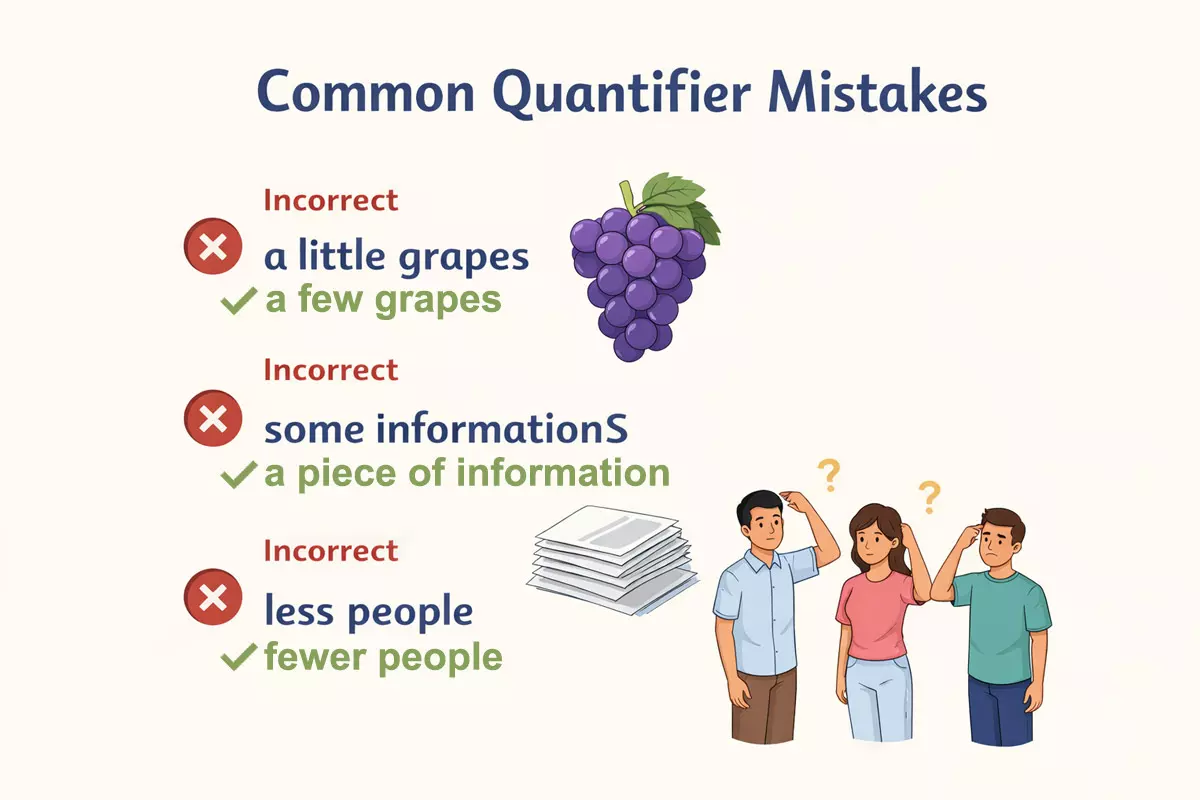 This article explains why quantifiers often cause errors, such as confusion with countable and uncountable nouns, overgeneralizing rules, register mistakes, and translation errors. It includes examples and practice with error correction.
- Why quantifiers cause frequent errors
- Confusion between countable and uncountable nouns
- Overgeneralization of common rules
- Register-related mistakes
- Errors caused by direct translation
- Meaning changes caused by small mistakes
- Examples of incorrect vs corrected sentences
- Practice: identifying and fixing errors
Learning to use expressions of quantity correctly in English can be challenging, as many learners struggle with choosing the right words to indicate amounts. Mistakes like confusing "much" with "many" or using "less" instead of "fewer" are common, but understanding the basic rules helps avoid these errors. By practicing with real examples and paying attention to how native speakers use quantity words, learners can gradually improve their accuracy and confidence in both writing and conversation.
Why quantifiers cause frequent errors
Many English learners find quantifiers confusing because their usage often depends on subtle grammar rules and the type of noun involved. This leads to frequent mistakes, as the patterns differ from those in other languages and can seem unpredictable at first.
Countable vs. uncountable nouns
One major source of confusion is that some quantifiers only work with countable nouns, while others are used with uncountable nouns. Learners often mix these up because their first language may not make the same distinctions, or the equivalents work differently.
| Quantifier | Used With | Example |
|---|---|---|
| Many | Countable nouns | Many books |
| Much | Uncountable nouns | Much water |
| Few | Countable nouns | Few apples |
| Little | Uncountable nouns | Little time |
| Some | Both types | Some money / Some chairs |
| Any | Both types | Any advice / Any questions |
Negative and positive contexts
Another reason for frequent mistakes is that quantifiers can change depending on whether a sentence is positive, negative, or a question. For example, "any" is typically used in negatives and questions, while "some" is preferred in positive statements. Confusing these can lead to unnatural or incorrect sentences.
Similar words, different uses
Words like "few" and "a few" or "little" and "a little" seem almost identical, but their meanings are quite different. This subtlety is easy to overlook, so learners often use them interchangeably, which can completely change the meaning of a sentence.
- Few = almost none (negative meaning)
- A few = some, but not many (positive meaning)
- Little = almost none (negative meaning)
- A little = some, but not much (positive meaning)
Common quantifiers that trip up learners
- Many learners struggle with articles at the beginning.
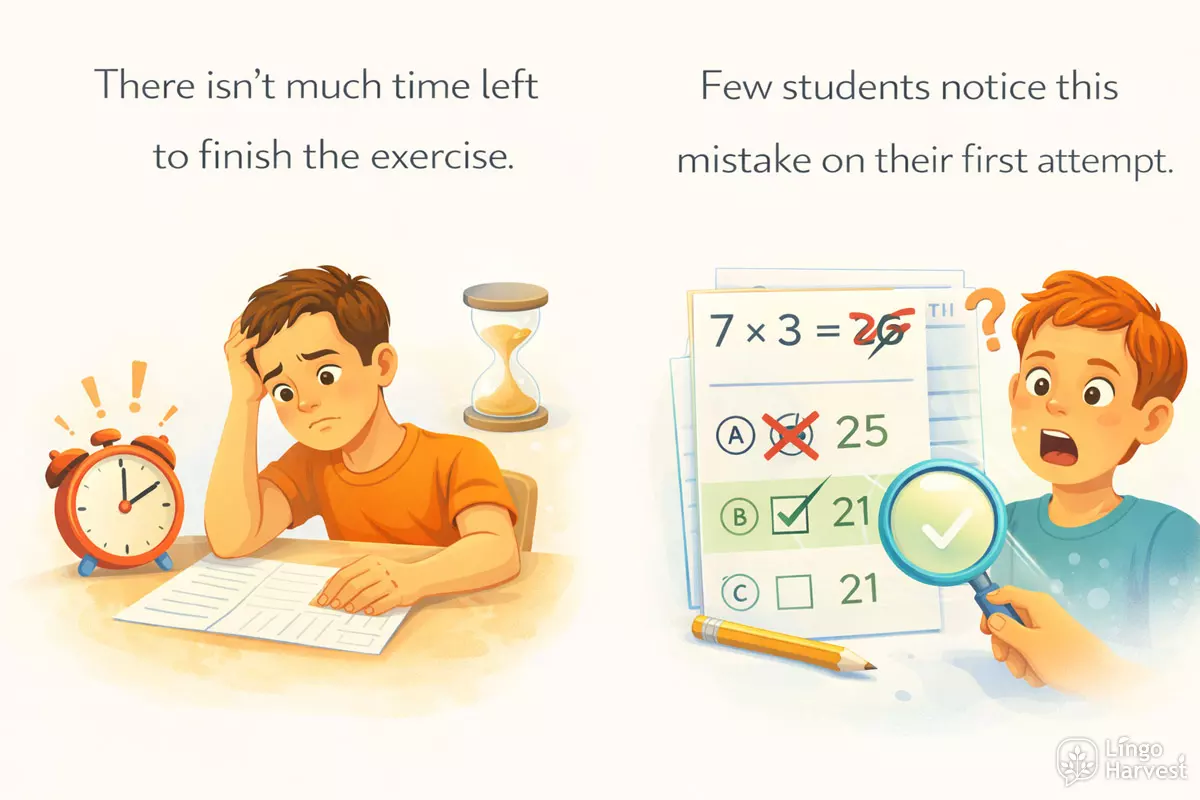
- There isn’t much time left to finish the exercise.
- Few students notice this mistake on their first attempt.
- There is little difference between these two answers.
- I need some clarification before moving on.
- Do you have any questions about this rule?
- Several examples help make the pattern clearer.
- She has a lot of experience teaching beginners.
- We have plenty of time to review the material.
- He didn’t have enough information to decide.
- Each student must submit the assignment individually.
- Every example follows the same structure.
- All learners make mistakes at some point.
- Most people find this explanation helpful.
- There was no improvement without regular practice.
- None of the answers matched the question exactly.
- Both options are grammatically correct.
- You can choose either method to solve the task.
- Neither explanation was clear enough.
In summary, quantifiers cause difficulties due to strict grammatical requirements, subtle differences in meaning, and patterns that are often not directly translatable. Practice with real examples is key to mastering their usage.
Confusion between countable and uncountable nouns
One of the biggest challenges for English learners is knowing which nouns can be counted and which cannot. This affects how quantifiers such as "much," "many," "few," and "little" are used. Using the wrong quantifier can make sentences sound unnatural or even change the meaning. For example, saying "much apples" or "many money" are mistakes that native speakers instantly notice.
Why this mistake happens
Many languages do not distinguish between countable and uncountable nouns in the same way English does. Learners often translate directly from their native language, which leads to errors. Words like "information," "advice," or "furniture" seem countable in some languages, but in English, they are not.
Common quantifier mix-ups
- Much is used with uncountable nouns (e.g., "much water," not "much books").
- Many is used with countable nouns (e.g., "many chairs," not "many rice").
- Little is for uncountable nouns ("little time").
- Few is for countable nouns ("few friends").
- "A lot of" and "some" can be used with both types, which sometimes causes confusion about when to use the more specific quantifiers.
Examples of nouns often confused
- Advice (uncountable: "some advice," not "an advice")
- Information (uncountable: "much information")
- News (uncountable: "good news," not "a news")
- Furniture (uncountable: "a piece of furniture")
- Equipment (uncountable: "some equipment")
- Money (uncountable: "much money")
- Water (uncountable: "a little water")
- Bread (uncountable: "some bread," not "a bread")
- Paper (uncountable, unless referring to newspapers: "some paper")
- Work (uncountable: "a lot of work")
- Time (uncountable: "much time")
- People (countable: "many people")
- Chair (countable: "a chair," "three chairs")
- Book (countable: "many books")
- Apple (countable: "an apple," "several apples")
- Idea (countable: "a few ideas")
- Car (countable: "two cars")
- Child (countable: "few children")
Correct quantifiers: a quick comparison
| Noun Type | Correct Quantifiers |
|---|---|
| Countable | many, a few, several, a number of |
| Uncountable | much, a little, a bit of, an amount of |
| Both | some, a lot of, no, plenty of, enough |
| Typical Errors | much apples ❌, many bread ❌ |
Tips to avoid mistakes
- Check a dictionary if unsure whether a noun is countable or not.
- Remember that substances, ideas, and abstract things are usually uncountable (e.g., "advice," "happiness").
- Physical objects you can count individually are countable (e.g., "tables," "cats").
- Practice with example sentences to get used to natural-sounding combinations.
Mastering countable and uncountable nouns will help you use quantifiers correctly and sound more fluent in English conversations and writing.
Overgeneralization of common rules
Many English learners try to apply familiar patterns to new situations, especially with quantifiers. While rules like “use much with uncountable nouns and many with countable nouns” are helpful, they don’t always apply perfectly. This tendency to stretch a rule too far can lead to errors and awkward sentences.
Why learners overapply quantifier rules
It’s natural to look for simple systems when learning a language, but English quantifiers often break their own patterns. Learners may memorize a specific use and then extend it to situations where it doesn’t fit. For example, thinking that “any” is only for negatives, or that “much” never appears in positive sentences, can cause confusion.
Common overgeneralizations and corrections
Some of the most frequent issues come from trying to use a “one size fits all” approach. Here are examples of quantifier mistakes caused by this habit:
- Using much in positive sentences: “I have much friends.” ❌ (Correct: “I have many friends.”)
- Assuming any is always negative: “Do you have some questions?” instead of “Do you have any questions?”
- Applying few and little interchangeably: “There are little apples on the tree.” ❌ (Correct: “There are few apples on the tree.”)
- Using some only in positive statements: “Can I have some water?” is correct, but some learners avoid it in questions.
- Forgetting that a lot of can be used with both countable and uncountable nouns.
- Overusing many in informal speech: “There are many people here.” (correct but sounds formal; “a lot of people” is more natural in conversation)
- Thinking all means “every”: “All student passed the test.” ❌ (Correct: “All students passed the test.” or “Every student passed the test.”)
- Assuming each and every are always interchangeable: “Each people has a ticket.” ❌ (Correct: “Each person has a ticket.”)
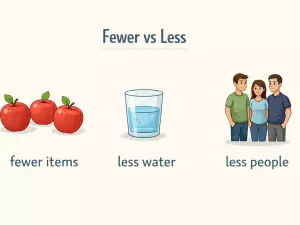
- Using less with countable nouns: “There are less cars on the road today.” ❌ (Correct: “There are fewer cars on the road today.”)
- Thinking none always means zero: “None of my friends are coming” (can mean not all, depending on context)
- Applying several to uncountable nouns: “I drank several water.” ❌ (Correct: “I drank some water.” or “I drank several glasses of water.”)
- Overapplying both to groups larger than two: “Both of my three sisters…” ❌ (Correct: “All three of my sisters…”)
- Using another with plurals: “I need another books.” ❌ (Correct: “I need another book.” or “I need other books.”)
- Assuming much and many are always required for negatives: “I don’t have apples.” (correct; “I don’t have many apples.” is also correct but not always necessary)
Common quantifier pairs: correct usage
To help clarify, here’s a comparison of quantifiers that are often mixed up:
| Quantifier | Example & Usage |
|---|---|
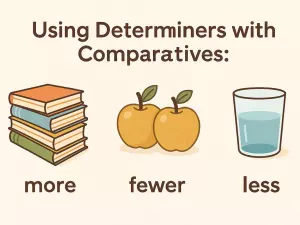
| Much / Many | Much (uncountable): “much water” Many (countable): “many books” |
| Few / Little | Few (countable): “few apples” Little (uncountable): “little time” |
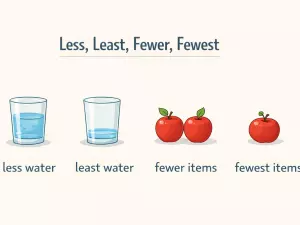
| Fewer / Less | Fewer (countable): “fewer cars” Less (uncountable): “less money” |
| All / Every / Each | All (plural group): “all students” Every (individuals in group): “every student” Each (individual focus): “each person” |
Recognizing these subtle distinctions helps avoid the most common pitfalls. Instead of applying a rule everywhere, try to notice the specific noun and the context. Careful attention to these details will make your English sound more natural and accurate.
Register-related mistakes
When choosing quantifiers, English learners sometimes overlook the importance of register—the level of formality or informality appropriate for a situation. Using the wrong quantifier in formal writing or casual conversation can make speech sound unnatural or even rude. Some quantifiers are preferred in academic, business, or polite contexts, while others fit best in everyday, relaxed exchanges.
Formal vs. informal quantifiers
Certain quantifiers carry a more formal tone, while others are quite casual. For example, "a large number of" sounds more formal than "lots of," and "much" is usually reserved for writing or questions, not casual positive statements. Misusing these can create awkwardness or miscommunication.
| Formal/Polite | Informal/Colloquial |
|---|---|
| a considerable amount of | lots of |
| a large number of | tons of |
| few / little (with emphasis: very few, very little) | hardly any |
| several | a bunch of |
| much (in questions/negatives) | a lot of |
| numerous | plenty of |
| sufficient | loads of |
| insufficient | not enough |
| an excessive amount of | way too much/many |
| the majority of | most of |
Common pitfalls with context and audience
- Using "a lot of" in a formal essay instead of "a significant amount of".
- Saying "tons of" during a business presentation, which can sound unprofessional.
- Writing "many" in casual texts, which may sound stiff compared to "lots of".
- Overusing "few" or "little" in negative contexts, making statements sound harsher than intended.
- Choosing "plenty of" in technical or academic writing, where "numerous" would be more appropriate.
Tips for choosing the right quantifier
- Consider your audience: Is it a professor, a friend, or a colleague?
- Think about the setting: Is this a formal report or a casual conversation?
- Check if the quantifier fits the tone: Would it sound too stiff or too relaxed?
- When in doubt, look for examples in authentic materials similar to your context.
- Avoid mixing formal and informal quantifiers in the same sentence or paragraph.
Being aware of register helps learners avoid awkwardness and communicate more naturally. Mastering this subtle aspect of quantifier use is key to sounding fluent and appropriate in various situations.
Errors caused by direct translation
Translating quantifiers directly from a native language into English is a major source of mistakes for learners. Many languages use quantifiers differently, and what works in one language may be ungrammatical or change the meaning entirely in English. Understanding the patterns and pitfalls can help learners avoid common errors and sound more natural.
Common direct translation pitfalls
Some quantifiers have no exact English equivalent, or their usage depends on whether the following noun is countable or uncountable. Learners often make mistakes when trying to match quantifiers word-for-word from their first language. Here are frequent issues:
- Using "much" with countable nouns: "much apples" instead of "many apples"
- Applying "many" to uncountable nouns: "many water" instead of "much water"
- Translating "some" or "any" incorrectly in questions and negatives
- Omitting "of" in phrases like "a lot of people" (saying "a lot people")
- Confusing "few" and "a few," or "little" and "a little," leading to the opposite meaning
- Using "a" before "lot" without "of": "a lot people" instead of "a lot of people"
- Misplacing "each" and "every"
- Employing "less" with countable nouns: "less cars" instead of "fewer cars"
- Directly translating expressions like "too much few" instead of "too few"
- Using "all" without the correct article: "all students" vs. "all of the students"
- Incorrectly using "some" in negative sentences: "I don't have some books" instead of "I don't have any books"
- Translating "everybody" and "all people" interchangeably
Comparing countable and uncountable quantifiers
To highlight how direct translation can lead to errors, here's a comparison of quantifiers used with countable vs. uncountable nouns:
| Countable Nouns | Uncountable Nouns |
|---|---|
| many | much |
| few / a few | little / a little |
| number of | amount of |
| fewer | less |
| several | some |
| a lot of | a lot of |
Why these mistakes happen
These issues arise because the logic behind quantifiers often differs across languages. For instance, in some languages, one word covers both "much" and "many," while in others, the difference between "few" and "a few" doesn't exist. Learners may also rely on literal translation, unaware that English distinguishes between countable and uncountable forms in a way their language does not.
To avoid these mistakes, learners should focus on learning quantifiers in context, paying attention to the type of noun they modify, and practicing with real examples rather than memorizing direct translations.
Meaning changes caused by small mistakes
Even a tiny error with quantifiers can completely change what a sentence means. Swapping “few” for “a few,” or misplacing “some” and “any,” can lead to misunderstandings, especially in English where these words subtly affect tone and facts. Paying attention to the right form and placement helps you avoid sending the wrong message.
Commonly Confused Quantifiers
Learners often mix up similar-looking quantifiers, which results in sentences that sound odd or communicate the opposite of what was intended. Here are some quantifiers that frequently cause confusion:
- few vs. a few
- little vs. a little
- much vs. many
- some vs. any
- no vs. none
- all vs. every
- each vs. every
- most vs. almost all
- several vs. some
- every vs. each
- plenty of vs. a lot of
- either vs. neither
How Small Quantifier Errors Affect Meaning

A single missing or added word can change a statement from positive to negative, or from general to specific. Here are some examples to illustrate how meaning shifts with small quantifier mistakes:
| Less natural / misleading usage | Clear or intended meaning |
|---|---|
| Few people came. | Almost nobody came (negative nuance). |
| A few people came. | Some people came (positive, neutral information). |
| She has little money. | She almost has no money (negative implication). |
| She has a little money. | She has some money, enough for something. |
| Do you have some questions? | Speaker expects questions (common in offers or polite prompts). |
| Do you have any questions? | Neutral question with no assumption. |
| There is much cars. | Incorrect with countable nouns → use many cars. |
| Each student has a book. | Focus on individuals one by one. |
| All students have books. | Focus on the group as a whole. |
| Most people like pizza. | More than half, but not everyone. |
Tips for Avoiding Quantifier Confusion
- Check if the noun is countable or uncountable before choosing your quantifier.
- Remember that “few” and “little” are negative, while “a few” and “a little” are positive.
- Use “many” for things you can count, “much” for things you cannot.
- “Some” is usually for positive statements and offers; “any” is for negatives and questions.
- When unsure, rewrite your sentence in another way to double-check the meaning.
Careful use of quantifiers can help you be clearer and more precise in English. Take a moment to review your sentences, and watch out for these small but important differences.
Examples of incorrect vs corrected sentences
Understanding how to use quantifiers such as much, many, few, and some can be challenging for English learners. Below, you’ll find a range of sample sentences highlighting frequent mistakes and their improved versions. These examples show how small changes in quantifier use can improve clarity and correctness.
Frequent quantifier errors and their fixes
- ❌ She doesn’t have much friends. → ✅ She doesn’t have many friends.
- ❌ There is too much people in the room. → ✅ There are too many people in the room.
- ❌ He has a little books on his shelf. → ✅ He has a few books on his shelf.
- ❌ We don’t have any informations. → ✅ We don’t have any information.
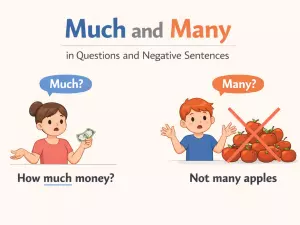
- ❌ How many money do you need? → ✅ How much money do you need?
- ❌ I have less apples than you. → ✅ I have fewer apples than you.
- ❌ She bought much clothes yesterday. → ✅ She bought many clothes yesterday.
- ❌ There isn’t some milk left. → ✅ There isn’t any milk left.
- ❌ He gave me too many advices. → ✅ He gave me too much advice.
- ❌ I don’t have much time for hobbies. (Correct: I don’t have much time for hobbies.)
Comparing quantifier mistakes in context
Often, errors happen when learners confuse countable and uncountable nouns or use the wrong quantifier for negative sentences. The table below compares several incorrect and corrected sentences, helping clarify proper usage.
| Incorrect Sentence | Corrected Sentence |
|---|---|
| There isn’t much chairs in the hall. | There aren’t many chairs in the hall. |
| She doesn’t eat many bread. | She doesn’t eat much bread. |
| Do you have some questions? | Do you have any questions? |
| I have little friends in this city. | I have few friends in this city. |
| He spent less hours at work this week. | He spent fewer hours at work this week. |
| How much cars do you own? | How many cars do you own? |
| There are too much noise outside. | There is too much noise outside. |
Paying attention to whether a noun is countable or uncountable, and choosing the right quantifier for the sentence structure, helps avoid these typical errors. Practice with real examples like those above can make using quantifiers much more natural over time.
Practice: identifying and fixing errors
Improving your use of quantifiers in English often comes down to recognizing common pitfalls. Below, you'll find a set of exercises designed to help you spot and correct frequent mistakes. The tasks focus on areas where learners often confuse much/many, few/a few, little/a little, and the use of quantifiers with countable and uncountable nouns.
Spot the mistake
Read each sentence carefully. Identify the error related to quantifiers and rewrite the sentence correctly.
- There isn't much apples in the basket.
- He has a little friends in this city.
- How much people were at the meeting?
- We don’t have many milk left in the fridge.
- She bought few bottles of water for the trip, so we should be fine.
- I have too much books to carry by myself.
- Is there any informations about the event?
- They invited less people than last year.
- Too many homework makes students tired.
- There are a lot of traffic on this road every morning.
Show answers
- There aren't many apples in the basket.
- He has a few friends in this city.
- How many people were at the meeting?
- We don’t have much milk left in the fridge.
- She bought a few bottles of water for the trip, so we should be fine.
- I have too many books to carry by myself.
- Is there any information about the event?
- They invited fewer people than last year.
- Too much homework makes students tired.
- There is a lot of traffic on this road every morning.
Choosing the correct quantifier
Select the best quantifier for each sentence. Choose from: much, many, little, a little, few, a few, some, any.
- We have ______ time before the movie starts.
- There are ______ students in the library today.
- She put ______ sugar in her tea.
- Do you have ______ money with you?
- He made very ______ mistakes on the test.
- There isn’t ______ water left in the bottle.
- I saw ______ interesting books at the shop.
- They don’t have ______ idea what to do next.
- Only ______ people came to the party.
- Can I have ______ more cake, please?
Show answers
- a little
- many
- some / a little (both acceptable)
- any
- few
- much
- some
- any
- a few
- some
Common quantifier corrections: countable vs. uncountable
Below is a table highlighting typical confusions between countable and uncountable nouns and the appropriate quantifiers to use with each. Study the examples to reinforce your understanding.
| Incorrect Usage | Corrected Form |
|---|---|
| much apples | many apples |
| many information | much information / a lot of information |
| few money | little money |
| less people | fewer people |
| too many furniture | too much furniture |
| a little friends | a few friends |
| much chairs | many chairs |
| too much books | too many books |
| fewer water | less water |
| many advice | much advice / a lot of advice |
Quick self-check: Do or Don’t?
Decide if each quantifier + noun combination is correct. Mark ✅ or ❌.
- Much rice
- Many money
- Few ideas
- Little chairs
- Much traffic
- Many traffic
- A few friends
- A little water
- Few information
- Fewer mistakes
- Less people
- Less time
- Many furniture
- Enough resources
- Several attempts
Show answers
- Much rice ✅
- Many money ❌
- Few ideas ✅
- Little chairs ❌
- Much traffic ✅
- Many traffic ❌
- A few friends ✅
- A little water ✅
- Few information ❌
- Fewer mistakes ✅
- Less people ❌
- Less time ✅
- Many furniture ❌
- Enough resources ✅
- Several attempts ✅