Less vs Least vs Fewer vs Fewest: Forms and Usage Explained

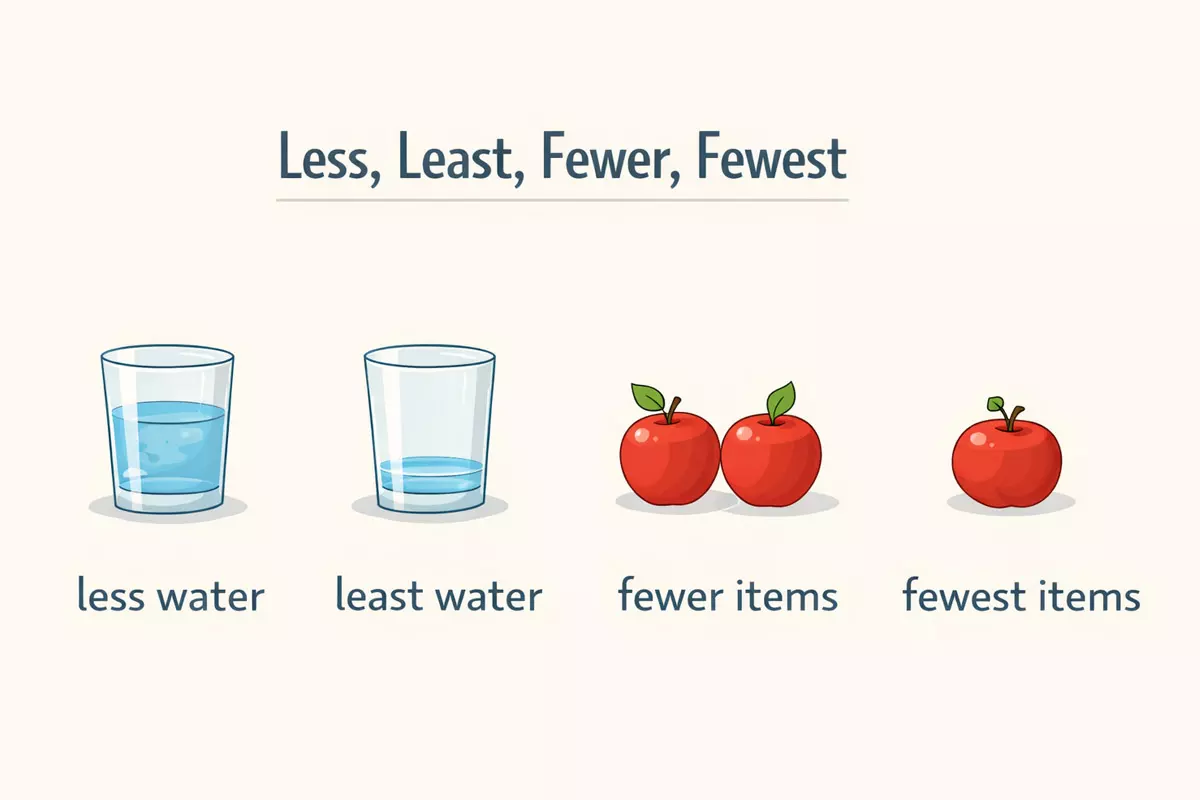 Here we comparative and superlative quantity forms, explains the difference between amount and number, and shows how to use them with countable and uncountable nouns. It also discusses sentence patterns, common mistakes, and provides practice examples.
- Comparative vs superlative quantity forms
- Difference between amount and number
- Use with countable and uncountable nouns
- Sentence patterns and common structures
- Meaning differences created by each form
- Frequent learner errors and confusion points
- Examples comparing all four forms
- Practice: selecting the correct quantity form
Choosing between words such as less, least, fewer, and fewest can be surprisingly challenging, even for native English speakers. The key is to remember that less and least are generally used with uncountable nouns, like water or time, while fewer and fewest are used with countable nouns, such as books or apples. Using these terms correctly not only improves the precision of your statements but also enhances your overall clarity, making your communication more effective and professional in both spoken and written English.
Comparative vs superlative quantity forms
Understanding how to express quantities with precision relies on using the correct comparative and superlative forms. English distinguishes between “few” and “fewer” for countable nouns, and “less” and “least” for uncountable nouns. The comparative form is used when comparing two quantities, while the superlative form indicates the extreme (either the smallest or the largest) within a group.
Comparative forms: indicating a smaller amount
Comparative quantity forms signal that something is less in number or amount compared to something else. For countable nouns, “fewer” is appropriate, while “less” is used for uncountable nouns. For example:
- There are fewer apples in this basket than in that one. (apples = countable)
- We have less water than yesterday. (water = uncountable)
- She made fewer mistakes than last time.
- He spends less money on coffee now.
- This year, there are fewer holidays in the calendar.
- You need less sugar in this recipe.
- There are fewer cars on the road at night.
- The new model uses less energy.
Superlative forms: expressing the lowest quantity

Superlative forms are used to highlight the smallest amount or number within a set. “Fewest” applies to countable nouns, while “least” is the choice for uncountable nouns. Here are some examples:
- This class made the fewest errors on the test. (errors = countable)
- Who has the least patience in the group? (patience = uncountable)
- Of all the teams, ours scored the fewest points.
- This recipe uses the least salt.
- He has the fewest books in his collection.
- Which solution involves the least effort?
- The fewest students attended on Friday.
- This brand has the least sugar per serving.
Summary of forms and usage
| Form | Used With | Example |
|---|---|---|
| Fewer | Countable nouns (comparative) | Fewer students attended the lecture. |
| Fewest | Countable nouns (superlative) | This route has the fewest stops. |
| Less | Uncountable nouns (comparative) | She has less experience than her colleague. |
| Least | Uncountable nouns (superlative) | This option requires the least time. |
Choosing between these forms depends on whether you’re talking about things you can count individually or substances and concepts that you measure as a whole. Using the right comparative or superlative helps your meaning stay clear and precise.
Difference between amount and number
When deciding between “amount” and “number,” it all comes down to whether you’re talking about things you can count individually or not. This distinction influences which terms—like “fewer” or “less”—are grammatically correct in a sentence. Let’s break down how these words are used in everyday English and why the difference matters.
Countable vs. Uncountable Nouns
“Number” is used with items you can count one by one, such as books, apples, or people. In contrast, “amount” refers to things you cannot count individually—think of sand, water, or information. Recognizing whether a noun is countable or uncountable helps you choose the right words when describing quantity.
| Use “Number” With (Countable) | Use “Amount” With (Uncountable) |
|---|---|
| people | water |
| cars | money |
| ideas | sand |
| books | patience |
| errors | information |
| questions | furniture |
| tickets | traffic |
| students | beauty |
| chairs | air |
| votes | time |
Examples in Sentences
- Correct: The number of apples on the table is surprising. ✅
- Correct: The amount of sugar in this recipe is high. ✅
- Incorrect: The amount of people waiting outside is large. ❌
- Incorrect: The number of water in the pool is rising. ❌
In summary, use “number” for things you can count and “amount” for things you measure in bulk or mass. This distinction is essential when choosing between “fewer/fewest” (for countable nouns) and “less/least” (for uncountable nouns) elsewhere in English grammar.
Use with countable and uncountable nouns
Choosing between “less”, “least”, “fewer”, and “fewest” depends on whether you’re talking about things you can count individually or substances and concepts that can’t be divided into separate items. This is a common source of confusion, but the distinction is straightforward once you see the patterns and examples.
Countable vs. uncountable: The core difference
“Fewer” and “fewest” are used with nouns you can count one by one, like “cars”, “apples”, or “mistakes”. On the other hand, “less” and “least” are used for things that are measured in bulk, amount, or degree—these are uncountable nouns, such as “water”, “money”, or “effort”.
| Form | Type of Noun | Example |
|---|---|---|
| Fewer | Countable (plural) | Fewer chairs are needed. |
| Fewest | Countable (plural, superlative) | This store sold the fewest books. |
| Less | Uncountable (mass/abstract) | We have less sugar in the jar. |
| Least | Uncountable (superlative) | She showed the least patience. |
Examples of countable and uncountable nouns in context
- Fewer students attended the lecture this week.
- There are fewer cars on the road on Sundays.
- He made the fewest mistakes in the class.
- We need less noise in the library.
- She has less interest in sports than her brother.
- This recipe calls for the least amount of sugar.
- Which student has the fewest absences?
- There’s less pollution in rural areas.
- He spent the least money on his vacation.
- The supermarket had fewer apples than usual.
- Who used the least energy this month?
Common pitfalls to avoid
- Don’t use “fewer” or “fewest” with singular or uncountable nouns (e.g., fewer water ❌).
- Avoid “less” with plural countables (e.g., less books ❌), except in set phrases like “less than 10 items”.
- For superlative forms, match “fewest” with countables and “least” with uncountables.
By matching the correct comparative or superlative with the right type of noun, your sentences will sound natural and be grammatically accurate. If you’re unsure, try substituting a specific number or a measurement—if it fits, it’s probably countable; if not, it’s likely uncountable.
Sentence patterns and common structures
When comparing "less," "least," "fewer," and "fewest," it's helpful to look at the typical grammatical patterns they follow. These words are used with different types of nouns and in various comparative and superlative contexts, so understanding their placement within sentences can make usage much clearer.
Typical usage patterns
- Less is generally used with uncountable nouns (e.g., "less water," "less time").
- Least is the superlative form for uncountable nouns (e.g., "the least patience").
- Fewer is reserved for countable nouns (e.g., "fewer books," "fewer cars").
- Fewest is the superlative form for countable nouns (e.g., "the fewest mistakes").
Common sentence structures
You’ll often find these terms in sentences that compare quantities or emphasize extremes. Here are some typical patterns:
- There is less [uncountable noun] than…
- She has the least [uncountable noun] of all.
- We need fewer [plural countable noun] this time.
- He made the fewest [plural countable noun] in the class.
- Can you use less sugar?
- This solution requires the least effort.
- There are fewer options available now.
- Out of all the candidates, she had the fewest votes.
- I have less money than you.
- They brought fewer chairs than needed.
- We experienced less rain this year.
- This recipe uses the least salt.
- He has fewer friends at school.
- She made the fewest errors on the test.
- There’s less traffic at night.
- He demonstrated the least enthusiasm.
- We need fewer volunteers this time.
- The store had the fewest customers during the storm.
Comparison overview
To clarify the distinctions and typical usage, here’s a summary of which form pairs with which type of noun and their comparative/superlative function:
| Word | Type of noun | Comparative/Superlative | Example |
|---|---|---|---|
| Less | Uncountable | Comparative | less water |
| Least | Uncountable | Superlative | the least patience |
| Fewer | Countable (plural) | Comparative | fewer apples |
| Fewest | Countable (plural) | Superlative | the fewest mistakes |
These sentence models and the chart above should help clarify how to select the right word for any context involving quantity or comparison.
Meaning differences created by each form
The words less, least, fewer, and fewest all refer to a smaller amount or number, but each one serves a different function in English. The distinctions depend on whether you’re talking about countable or uncountable nouns, and whether you're making a simple comparison or describing the extreme end of a scale.
Comparing countable and uncountable nouns
Fewer and fewest are used with countable nouns—things you can count individually (like apples, cars, or books). Less and least are generally used with uncountable nouns—things you measure but don’t count as separate items (like water, time, or money). Some exceptions to these rules exist, especially in informal or idiomatic usage, but following this guideline will keep your English clear and correct.
| Form | Typical Usage | Example |
|---|---|---|
| Less | Uncountable nouns, comparative | less sugar, less time |
| Least | Uncountable nouns, superlative | least noise, least patience |
| Fewer | Countable nouns, comparative | fewer cars, fewer mistakes |
| Fewest | Countable nouns, superlative | fewest problems, fewest votes |
How meaning shifts with each form
- Less means a smaller amount (uncountable): "There is less water in the glass."
- Fewer means a smaller number (countable): "She made fewer errors this time."
- Least expresses the smallest amount possible: "He had the least interest in the topic."
- Fewest expresses the smallest number possible: "This route has the fewest stops."
Comparative vs. superlative meanings
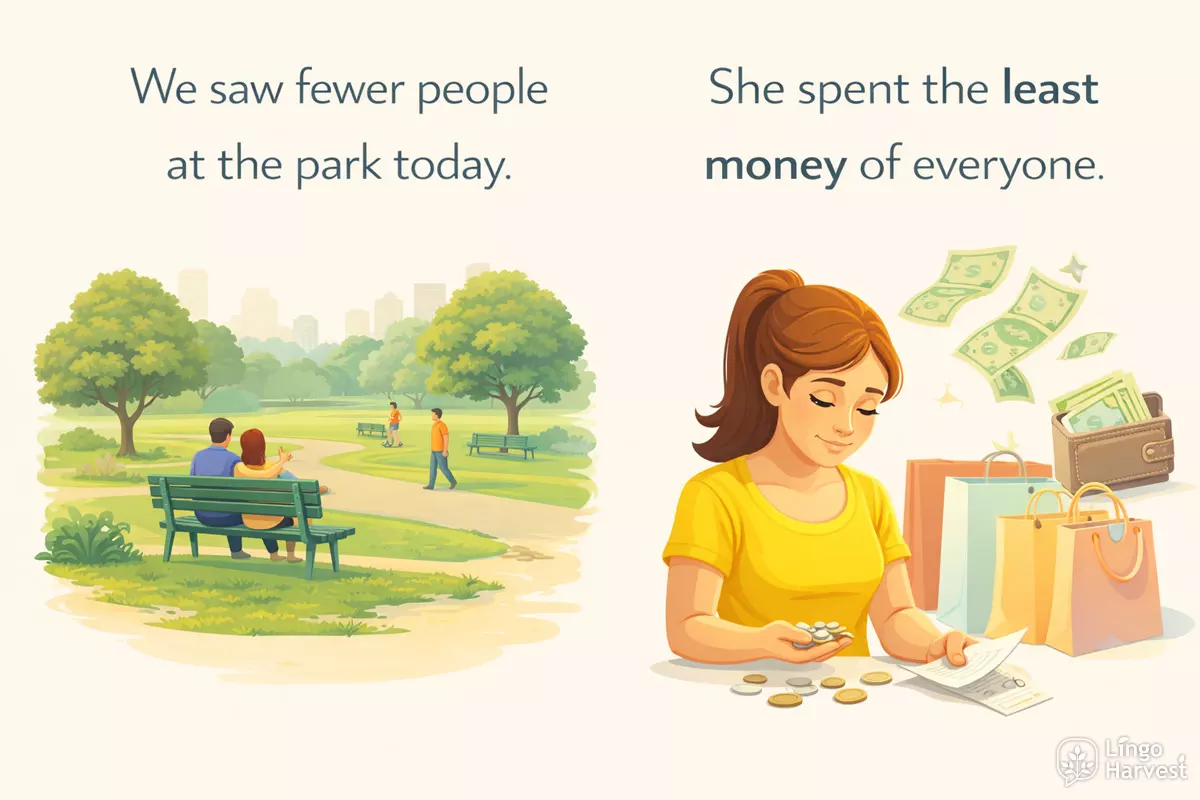
Both less and fewer compare two things or groups, indicating that one has a smaller quantity or number than the other. Least and fewest point to the extreme—nothing has a lower amount or number.
- Comparative (less/fewer): Comparing two or more things, but not all.
- "This recipe uses less salt than that one."
- "We saw fewer people at the park today."
- Superlative (least/fewest): Describing the minimum among all options.
- "She spent the least money of everyone."
- "That team made the fewest mistakes."
Quick reference: real-world examples
- less stress → I feel less stress after the exam.
- less homework → We have less homework this week.
- least effort → This option requires the least effort.
- least excitement → The announcement caused the least excitement.
- fewer chairs → There are fewer chairs in this room.
- fewer opportunities → She has fewer opportunities now.
- fewest votes → That candidate received the fewest votes.
- fewest interruptions → I work best with the fewest interruptions.
- less water → Drink less water before bedtime.
- fewer bottles → We need fewer bottles for the trip.
- least enthusiasm → He showed the least enthusiasm during the meeting.
- fewest accidents → This road has the fewest accidents.
In summary, choosing the right word depends on whether you’re talking about things you can count or measure, and whether you want to compare or find the minimum. This distinction helps your meaning stay precise and clear in any context.
Frequent learner errors and confusion points
Many English learners stumble over the differences among "less," "least," "fewer," and "fewest." The confusion usually comes from trying to use these words with the wrong types of nouns or misunderstanding their comparative and superlative roles. Below are some common traps and misunderstandings, along with practical examples.
Mixing up "less" and "fewer"
One of the most persistent issues is using "less" where "fewer" is correct, or vice versa. The basic guideline is:
- "Fewer" is used with countable nouns (things you can count individually).
- "Less" is used with uncountable nouns (things you can't count individually, like liquids or abstract concepts).
However, this rule is often broken in casual speech and writing, leading to confusion and sometimes criticism from grammar purists.
Problems with "least" and "fewest"
Learners sometimes swap "least" and "fewest" incorrectly, especially in superlative constructions. Remember:
- "Fewest" matches with countable nouns (e.g., "She made the fewest mistakes").
- "Least" is for uncountable nouns (e.g., "He showed the least interest").
Comparing forms and correct usage
To clarify these patterns, here's a comparison table with typical uses:
| Form | Example Sentence | Type of Noun | Correct? |
|---|---|---|---|
| Fewer | There are fewer cars on the road today. | Countable | ✅ |
| Less | I have less time this week. | Uncountable | ✅ |
| Fewest | She has the fewest apples. | Countable | ✅ |
| Least | He spent the least money. | Uncountable | ✅ |
| Fewer | There is fewer water in the glass. | Uncountable | ❌ |
| Less | There are less people at the party. | Countable | ❌ |
Other common mix-ups and uncertainty
- Using "less" before time, money, or distance (e.g., "less than ten dollars" is widely accepted, even though "dollars" are countable).
- Forgetting to use "the" before "fewest" and "least" in superlative sentences.
- Confusing the comparative ("fewer"/"less") with the superlative ("fewest"/"least").
- Overgeneralizing the countable/uncountable rule and not recognizing exceptions in idiomatic usage.
- Applying "fewest" or "least" incorrectly with adjectives instead of nouns (e.g., "the least delicious cake" is correct, but "the fewest delicious cake" is not).
- Misusing these words in negative sentences or questions (e.g., "Is there least milk left?" should be "Is there less milk left?").
Understanding these typical errors and their roots will help you use "less," "least," "fewer," and "fewest" more confidently and accurately in both writing and conversation.
Examples comparing all four forms
Understanding when to use less, least, fewer, and fewest can be tricky, especially since they often appear in similar contexts. The main distinction is that less and least are used with uncountable nouns, while fewer and fewest are for countable nouns. Let's look at some side-by-side examples to clarify how each term functions in different sentences.
| Sentence Using "Less" / "Least" | Sentence Using "Fewer" / "Fewest" |
|---|---|
| I have less water in my glass than you. | I have fewer glasses on my table than you. |
| This recipe needs less sugar. | This recipe needs fewer eggs. |
| She put the least effort into the project. | He made the fewest mistakes on the test. |
| There is less traffic on Sundays. | There are fewer cars on the road today. |
| Choose the option that takes the least time. | Pick the route with the fewest stops. |
| We have less information than before. | We have fewer emails to answer today. |
| She spent the least money of everyone. | He bought the fewest items in the store. |
| There is less noise at night. | There are fewer people at the concert now. |
| He experienced the least difficulty with the puzzle. | She solved the fewest puzzles in the group. |
| We need less salt in this soup. | We need fewer ingredients for this recipe. |
Quick Reference: How to Choose the Right Form
- Less / Least: Use with things you cannot count individually (e.g., water, time, money, noise).
- Fewer / Fewest: Use with things you can count (e.g., glasses, eggs, mistakes, people).
Notice how the word choice depends not on the meaning, but on whether the noun is countable or uncountable. Using the correct form helps your sentences sound natural and clear. If you’re ever unsure, try to determine whether you’re talking about individual items or a mass/amount.
Practice: selecting the correct quantity form
Getting comfortable with words like "less," "least," "fewer," and "fewest" means understanding both their meanings and their usage in context. The following activities and examples will help you recognize when to use each form for countable and uncountable nouns.
Common usage patterns
The table below summarizes typical contexts for each word, helping you compare their use with countable and uncountable nouns:
| Word | Used with | Example |
|---|---|---|
| less | Uncountable nouns | There is less water in the glass. |
| least | Uncountable nouns | This recipe needs the least sugar. |
| fewer | Countable nouns | She has fewer books than I do. |
| fewest | Countable nouns | He made the fewest mistakes. |
Choose the correct word
Read each sentence and decide which form fits best. Think about whether the noun is countable or uncountable.
- There are ________ cars on the road today than yesterday.
- I have ________ patience for delays now.
- She used the ________ ingredients of all the contestants.
- This exam has ________ questions than the last one.
- We have the ________ amount of time to finish our tasks.
- There is ________ noise in the office today.
- He made ________ mistakes than before.
- This option requires the ________ effort.
- They experienced ________ problems this year.
- She received the ________ votes in the election.
- We drank ________ water during the hike.
- This route has the ________ accidents.
Show answers
- fewer
- less
- fewest
- fewer
- least
- less
- fewer
- least
- fewer
- fewest
- less
- fewest
Spot the mistake
Some sentences below contain an error in quantity word choice. Identify the mistakes and correct them.
- She has less friends than her brother.
- This recipe uses the least eggs.
- There is fewer milk in the fridge than before.
- He owns fewer cars than anyone else in the family.
- We had less problems this week.
- This team made the least mistakes.
- There are less chairs in the room now.
- She drank the fewest water during the trip.
- He spent fewer money than expected.
- This route has the fewest traffic.
Show answers
- Should be "fewer friends" (friends = countable).
- Should be "fewest eggs" (eggs = countable).
- Should be "less milk" (milk = uncountable).
- Correct as is.
- Should be "fewer problems" (problems = countable).
- Correct as is.
- Should be "fewer chairs" (chairs = countable).
- Should be "least water" (water = uncountable).
- Should be "less money" (money = uncountable).
- Should be "least traffic" (traffic = uncountable).
Summary tips
- Use fewer/fewest with things you can count (books, mistakes, cars).
- Use less/least with things you cannot count (water, patience, time).
- Check the noun type before choosing the form.
- Superlative forms ("least," "fewest") show the lowest quantity in a group.
Practicing these distinctions will help you avoid common mistakes and sound more natural in English conversations and writing.