Much and Many in Questions and Negative Sentences

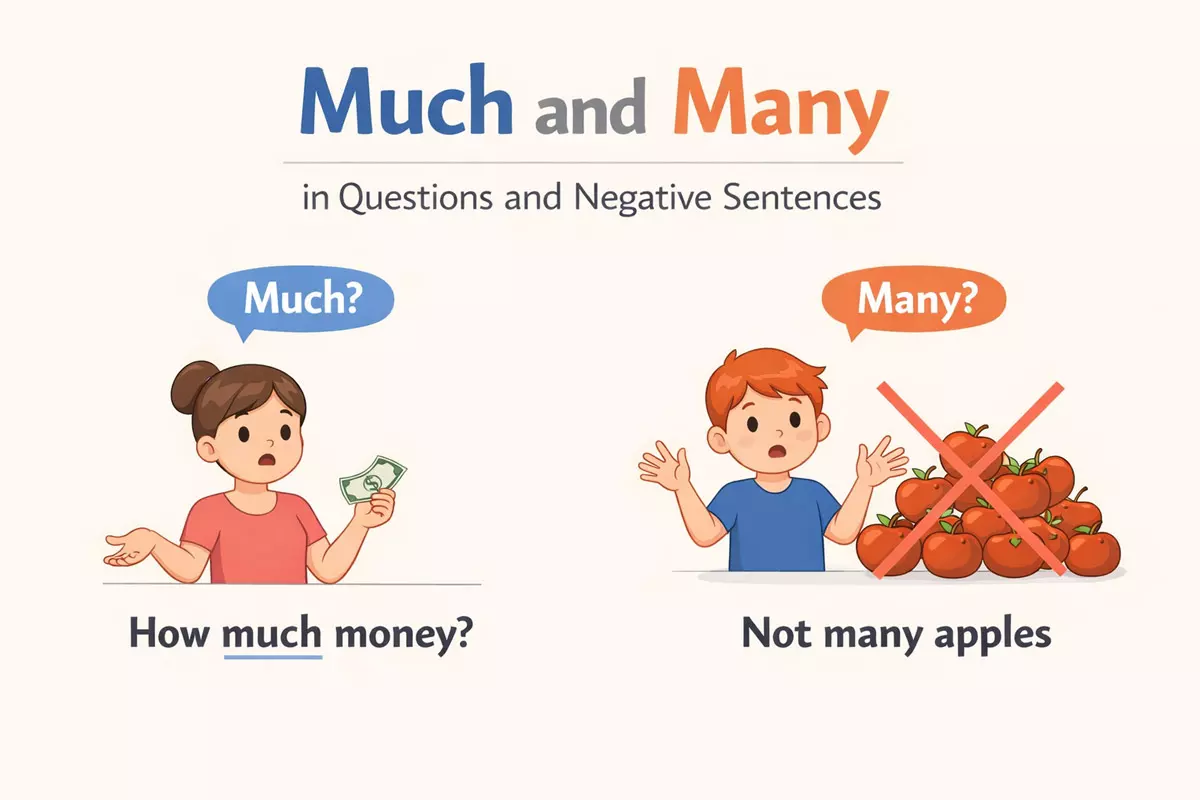 Here we how to use much and many with countable and uncountable nouns, their roles in questions and negatives, formal tone differences, alternatives for positives, typical placement, common mistakes, and offers practice for choosing the right word.
- Difference between countable and uncountable nouns
- Why much and many are common in questions
- Use in negative sentences vs affirmative ones
- Formal and neutral tone considerations
- Alternatives in positive statements
- Typical word order and placement
- Common learner errors and overuse
- Practice: choosing much or many correctly
Choosing the right words to express quantity in English can be challenging, particularly when forming questions or negative statements. Words like much, many, a lot of, and some each have specific uses depending on whether you are talking about countable or uncountable nouns. For example, use many with countable nouns and much with uncountable nouns in questions and negatives. Becoming familiar with these distinctions allows you to speak and write more accurately, making your communication clearer and more effective.
Difference between countable and uncountable nouns
Understanding the distinction between countable and uncountable nouns is essential when using words like much and many in questions or negative sentences. Countable nouns refer to things that can be separated and counted as individual units, while uncountable nouns describe items that are seen as a whole or mass, rather than as individual elements.
What are countable nouns?
Countable nouns are objects or concepts that can be counted directly. They usually have both singular and plural forms. For example, you can say "one apple," "two apples," or "several apples." These nouns can be preceded by numbers or words like many, a few, and several.
- car / cars
- book / books
- child / children
- idea / ideas
- student / students
- question / questions
- table / tables
- dog / dogs
- city / cities
- pen / pens
What are uncountable nouns?

Uncountable nouns refer to substances, concepts, or collective categories that cannot be counted individually. These nouns do not have a plural form, and you cannot use numbers directly before them. Examples include water, information, and advice. Words like much, a little, and some are commonly used with these nouns.
- milk → There is some milk in the fridge.
- rice → We need more rice for dinner.
- money → He doesn’t have much money.
- furniture → The furniture is very old.
- music → She listens to music every day.
- news → The news is not good today.
- bread → We bought some bread.
- equipment → This equipment is expensive.
- luggage → Her luggage is very heavy.
- sand → The sand is hot at noon.
- cheese → I like a little cheese on my pasta.
- advice → He gave me some useful advice.
Key differences at a glance
| Countable Nouns | Uncountable Nouns |
|---|---|
| Can use numbers (one, two, three…) | Cannot use numbers directly |
| Have singular and plural forms | No plural form |
| Use many in questions/negatives ✅ "Are there many chairs?" |
Use much in questions/negatives ✅ "Is there much milk?" |
| Examples: apples, cars, ideas, friends | Examples: water, information, furniture, music |
To summarize, choose many for things you can count individually, and much for things you cannot count directly. Recognizing which nouns belong to each group will help you form natural-sounding questions and negatives in English.
Why much and many are common in questions
People often use "much" and "many" when they want to ask about quantity, especially if they don't know the exact amount. In English, these words help us form questions about things we can or cannot count. "Much" is used for uncountable nouns, while "many" works with countable nouns. This distinction makes it easy to get specific information without needing to know numbers in advance.
When we ask about amounts, we usually do not know whether the answer will be "a lot," "a little," or "none." Using "much" and "many" lets the speaker keep the question open-ended. For example, "How much water do you drink?" allows for any answer, not just a number. The same goes for "How many apples are left?"—the answer could be 0, 1, or 100.
Why questions use these words so much
In everyday conversations, these words make it easy to check details, compare situations, or make decisions. They are also common in polite requests, where asking about quantity sounds less direct than asking for a number. This is especially useful in English for sounding natural and friendly.
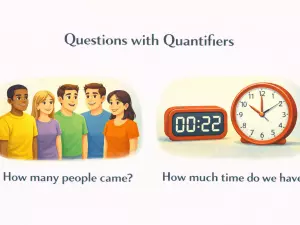
- How much time do we have?
- How many chairs are in the room?
- Is there much milk left?
- Are there many people at the party?
- Do you have much experience?
- Did many students finish the test?
- How much money do you need?
- How many emails did you get?
- Is much work left to do?
- Are many shops open on Sunday?
Comparing "much" and "many" in questions
To make it clear when to use each word, here is a quick overview of how they fit into questions with different nouns:
| Use | Example Question |
|---|---|
| Uncountable nouns (much) | How much sugar do you want? |
| Countable nouns (many) | How many books are there? |
| Uncountable in negative questions | Is there much traffic? |
| Countable in negative questions | Are there many mistakes? |
In short, these words are so common in questions because they let us ask about quantities in a flexible and natural way, without needing to know the answer first. This is especially helpful for everyday English, where being precise isn’t always possible or necessary.
Use in negative sentences vs affirmative ones
The words much and many behave differently depending on whether a sentence is negative or affirmative. In negative statements, both are commonly used to express a lack or absence of quantity, and they sound natural. In contrast, their use in positive (affirmative) sentences is less frequent, and often sounds formal or unusual in everyday English. Instead, terms like a lot of or lots of are preferred in affirmative contexts.
Negative Sentences
In negative sentences, much is used with uncountable nouns, while many goes with countable nouns. These forms are standard and expected.
- We don’t have much time. (uncountable)
- There aren’t many options. (countable)
- She doesn’t eat much sugar.
- He doesn’t know many people here.
- I haven’t got much money left.
- They don’t send many emails.
- We didn’t see much wildlife on the trip.
- He hasn’t made many mistakes.
- You won’t find much information online about this.
- There isn’t much water in the bottle.
Affirmative Sentences
In affirmative sentences, native speakers rarely use much or many unless the context is formal, literary, or the quantity is intentionally emphasized. Instead, a lot of or lots of are more natural choices.
- We have a lot of time. (natural in everyday speech)
- We have much time. (grammatical but uncommon in affirmative sentences)
- She has many friends. (correct, slightly formal)
- She has a lot of friends. (more common in conversation)
- There is a lot of sugar in this cake. (natural with uncountable nouns)
- He makes many mistakes. (correct, neutral to formal)
- He makes a lot of mistakes. (more conversational)
- I drink a lot of water every day. (natural and common)
- They send a lot of emails. (neutral, widely used)
- You can find a lot of information online. (natural with uncountable nouns)
| Sentence Type | Natural Usage | Example with "much" | Example with "many" |
|---|---|---|---|
| Negative | Common, natural | We don't have much time. | There aren't many options. |
| Affirmative | Rare, often formal | We have much time. ❌ | She has many friends. ✅ |
| Affirmative (everyday) | Preferred alternative | We have a lot of time. | She has a lot of friends. |
| Negative | Standard | There isn't much water left. | I don't know many people. |
Key Points to Remember
- Use much (uncountable) and many (countable) confidently in negative sentences.
- In positive sentences, prefer a lot of for natural, conversational English.
- Using much in positive statements is rare in speech and can sound awkward.
- Many is possible in affirmative sentences, but often sounds more formal than a lot of.
Formal and neutral tone considerations
When using much and many in questions and negative sentences, the level of formality and the intended neutrality of your language can influence which forms sound most appropriate. In formal settings—such as academic writing, business correspondence, or official documents—precision and an impersonal tone are often required. This affects not only word choice but also sentence structure.
Choosing between "much" and "many" in formal contexts
In formal English, much is typically reserved for uncountable nouns, while many is used with countable nouns. Although this rule holds in all contexts, formal speech and writing tend to avoid contractions and prefer complete forms.
- Much: "There is not much information available."
- Many: "Were there many participants at the conference?"
Neutral tone and conversational alternatives
A neutral tone aims for balance—neither too casual nor overly stiff. In less formal writing and speech, alternatives to much and many often appear in negative or interrogative sentences, especially when much would sound unnatural. For example, in everyday conversation, people often use a lot of or lots of instead of much, particularly in questions.
- "Do you have many friends in the city?" (neutral, countable)
- "Did you get much sleep last night?" (neutral, uncountable)
- "Are there a lot of options available?" (informal, neutral alternative to "many")
- "Is there a lot of noise outside?" (informal, neutral alternative to "much")
Comparison of usage in formal and neutral tones
| Context | Preferred Form |
|---|---|
| Formal question (countable) | “Are there many issues to discuss?” |
| Formal negative (uncountable) | “There is not much evidence.” |
| Neutral question (countable) | “Do you have a lot of questions?” |
| Neutral negative (uncountable) | “We don’t have a lot of time.” |
Key points for effective use
- In formal writing, avoid contractions and use the standard forms (much, many).
- For a neutral tone, alternatives such as a lot of or lots of may sound more natural, especially in spoken English.
- In negative sentences, much is less common in everyday speech—a lot of is often preferred.
- Questions in formal contexts tend to use many and much directly, while informal and neutral contexts may opt for alternatives.
Adapting your use of these quantifiers to suit the formality and neutrality of your context will help ensure clarity and appropriateness in both questions and negative sentences.
Alternatives in positive statements
When forming positive sentences, English speakers rarely use "much" or "many" in the same way as in questions or negatives. Instead, they often choose more natural-sounding alternatives to express quantity. These alternatives help the sentence sound smoother and more idiomatic, especially in everyday conversation.
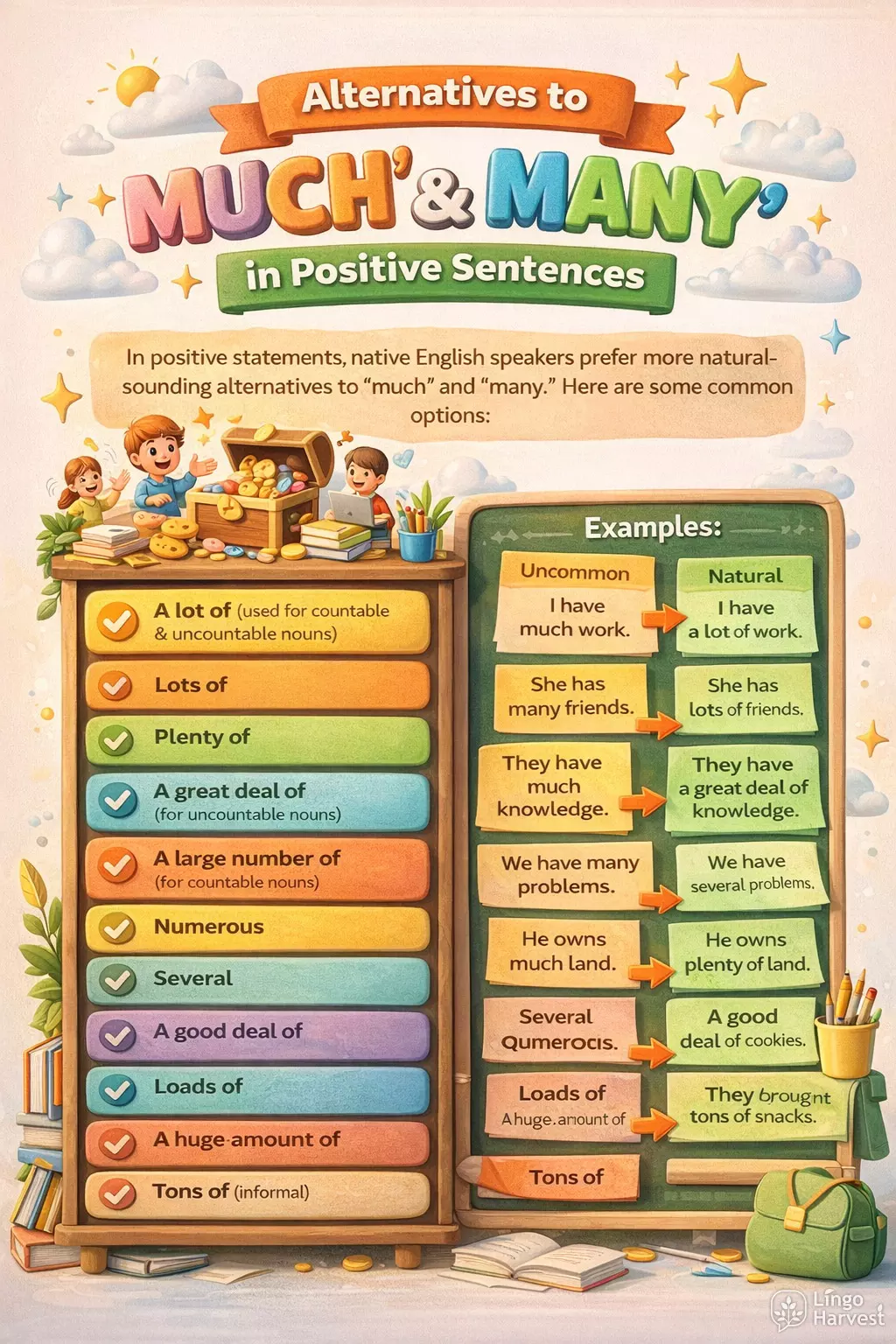
Common substitutes for "much" and "many" in affirmative sentences
Rather than saying, "I have much time" or "She has many friends," native speakers usually opt for phrases or quantifiers that better fit positive contexts. Here are some of the most frequent choices:
- a lot of (used for both countable and uncountable nouns): "We have a lot of ideas."
- lots of: "She owns lots of books."
- plenty of: "There is plenty of water."
- a great deal of (usually for uncountable nouns): "He has a great deal of patience."
- a large number of (for countable nouns): "A large number of students attended."
- numerous: "Numerous options are available."
- several: "Several questions remain."
- a good deal of: "A good deal of information was shared."
- loads of: "We ate loads of cookies."
- a huge amount of: "She invested a huge amount of money."
- a couple of (for small quantities): "He made a couple of mistakes."
- tons of (informal): "They brought tons of snacks."
- no shortage of: "There is no shortage of opinions."
Examples: Replacing "much" and "many" in positive sentences
The following table shows how alternative expressions are preferred over "much" and "many" in typical positive sentences:
| Unnatural/Uncommon | Natural Alternative |
|---|---|
| I have much work. | I have a lot of work. |
| She has many friends. | She has lots of friends. |
| They have much knowledge. | They have a great deal of knowledge. |
| We have many problems. | We have several problems. |
| He owns much land. | He owns plenty of land. |
Notice that phrases like "a lot of," "plenty of," and "loads of" are far more common in positive statements. Using these alternatives makes your speech and writing sound more fluent and natural.
Typical word order and placement
When forming questions and negatives with "much" and "many," English follows clear patterns. Understanding where these words appear in sentences helps learners avoid common mistakes and communicate more naturally.
Questions: Placement of "much" and "many"
In questions, "much" and "many" usually come directly after the auxiliary verb or at the start of the question if used with "how." The choice between "much" and "many" depends on whether the noun is countable or uncountable.
- How much money do you have?
- How many apples are there?
- Do you have much time?
- Are there many students in the class?
- Is there much traffic today?
- Did you eat many cookies?
- Have you got much experience?
- Were there many people at the party?
- Have they seen much improvement?
- Are many books missing from the shelf?
Notice that in yes/no questions, "much" and "many" follow the auxiliary verb (do, does, is, are, have, etc.). In "how much" and "how many" questions, the phrase comes at the start.
Negative Sentences: Positioning "much" and "many"
In negative statements, "much" and "many" are placed after the negative auxiliary. This structure is common when you want to express a lack or small quantity.
- I don't have much sugar left.
- She doesn't eat many vegetables.
- We haven't got much time.
- They don't know many people here.
- He isn't making much progress.
- There aren't many cars in the parking lot.
- We didn't receive much feedback.
- She hasn't read many books this year.
- I can't see much difference.
- They don't spend much money on clothes.
The negative word ("not," "don't," "doesn't," etc.) comes before "much" or "many," which then precede the noun.
Comparison Table: Questions vs. Negatives
| Structure | Example Sentence |
|---|---|
| How much + uncountable noun + auxiliary + subject? | How much water do you drink? |
| How many + countable noun + auxiliary + subject? | How many emails did you get? |
| Auxiliary + subject + much/many + noun? | Do you have many friends? |
| Subject + negative auxiliary + much/many + noun | We don't need much help. |
| Subject + negative auxiliary + many + plural noun | He doesn't watch many movies. |
| Subject + negative auxiliary + much + uncountable noun | They haven't got much patience. |
Common Pitfalls
Learners often place "much" or "many" incorrectly, especially in affirmative statements (where "a lot of" is more natural). In questions and negatives, however, "much" and "many" are standard and necessary. Pay attention to the noun type and the sentence structure for correct placement.
Common learner errors and overuse
Learners of English often mix up much and many in questions and negative sentences, especially when translating from their native languages. These mistakes usually happen because the distinction between countable and uncountable nouns is not always obvious, and some languages don’t make this difference at all. Overuse of one form, or using both words with the wrong types of nouns, is frequent at beginner and intermediate levels.
Typical mistakes with “much” and “many”
- Using much with countable nouns: ❌ “Do you have much friends?” → Correct: “Do you have many friends?”
- Using many with uncountable nouns: ❌ “I don’t have many money.” → Correct: “I don’t have much money.”
- Inserting much or many where “any” or “a lot of” is more natural: ❌ “Do you have much books?” → Better: “Do you have any books?” or “Do you have a lot of books?”
- Omitting much or many in negative sentences: ❌ “I don’t have apples.” → Better: “I don’t have many apples.”
- Using much in positive sentences (spoken English): ❌ “I have much time.” → Better: “I have a lot of time.”
Frequent overuse patterns
While both words are common in questions and negatives, learners sometimes use them unnecessarily, or in more places than native speakers do. For example, “much” is rarely used in positive sentences in everyday English except in formal contexts. Overusing “much” can make speech sound unnatural.
- “I much like chocolate.” (should be “I like chocolate a lot.”)
- “She has many homework.” (should be “She has much homework.” or “She has a lot of homework.”)
- “Do you have much pens?” (should be “Do you have many pens?”)
- “I don’t have many informations.” (“Information” is uncountable, so “much information” is correct.)
Comparison table: Correct usage of “much” vs. “many”
| Use with | Example (Question) | Example (Negative) |
|---|---|---|
| Countable nouns (many) | How many apples do you have? | I don’t have many apples. |
| Uncountable nouns (much) | How much water do you need? | She doesn’t have much water. |
| Incorrect pairing (avoid) | How much apples do you have? | I don’t have many water. |
| Alternative phrasing (a lot of) | Do you have a lot of apples? | I don’t have a lot of water. |
| Alternative phrasing (any) | Do you have any apples? | I don’t have any water. |
| More examples (countable vs uncountable) | How many emails did you send? | I don’t send many emails. |
| More examples (countable vs uncountable) | How much information do we have? | We don’t have much information. |
Summary tips
- Use many for things you can count (books, cars, friends).
- Use much for things you cannot count (water, time, information).
- In everyday conversation, “a lot of” is often more natural than “much” in positive sentences.
- Check if the noun is countable or uncountable before choosing “much” or “many.”
Practice: choosing much or many correctly
Understanding when to use "much" and "many" is essential for forming correct questions and negative sentences in English. Let's explore typical patterns, then try some practice tasks to reinforce your knowledge.
Quick reminder: when do we use each word?
- Much is used with uncountable nouns (things we cannot count individually, like water, time, or information).
- Many is used with countable nouns (things we can count one by one, like books, apples, or friends).
| Example Question | Correct Word |
|---|---|
| How _____ money do you have? | much |
| Are there _____ chairs in the room? | many |
| Is there _____ sugar left? | much |
| Do you have _____ brothers or sisters? | many |
| Did you get _____ sleep last night? | much |
| Were there _____ people at the party? | many |
Try it yourself: choose the right word
- There isn’t _____ milk in the fridge. (much/many)
- Do you know _____ languages? (much/many)
- We don’t have _____ time. (much/many)
- Are there _____ cars in the parking lot? (much/many)
- She doesn’t eat _____ bread. (much/many)
- Did you see _____ birds in the garden? (much/many)
- They haven’t made _____ progress. (much/many)
- Do you have _____ questions? (much/many)
- He didn’t buy _____ apples. (much/many)
- Is there _____ noise outside? (much/many)
Show answers
- much
- many
- much
- many
- much
- many
- much
- many
- many
- much
Spot the mistake
Some sentences below use the wrong word. Identify and correct them.
- There aren’t much apples left.
- Did you get many sleep?
- She doesn’t have much friends.
- Are there much problems?
- We don’t have many homework tonight.
- How much books did you buy?
- He doesn’t have many money.
- There isn’t many information available.
- Did she make much mistakes?
- We don’t have many time left.
Show answers
- There aren’t many apples left.
- Did you get much sleep?
- She doesn’t have many friends.
- Are there many problems?
- We don’t have much homework tonight.
- How many books did you buy?
- He doesn’t have much money.
- There isn’t much information available.
- Did she make many mistakes?
- We don’t have much time left.
Practice regularly with real examples, and soon you will feel confident using both "much" and "many" in questions and negative statements.