Using Determiners with Comparatives: more, fewer, less

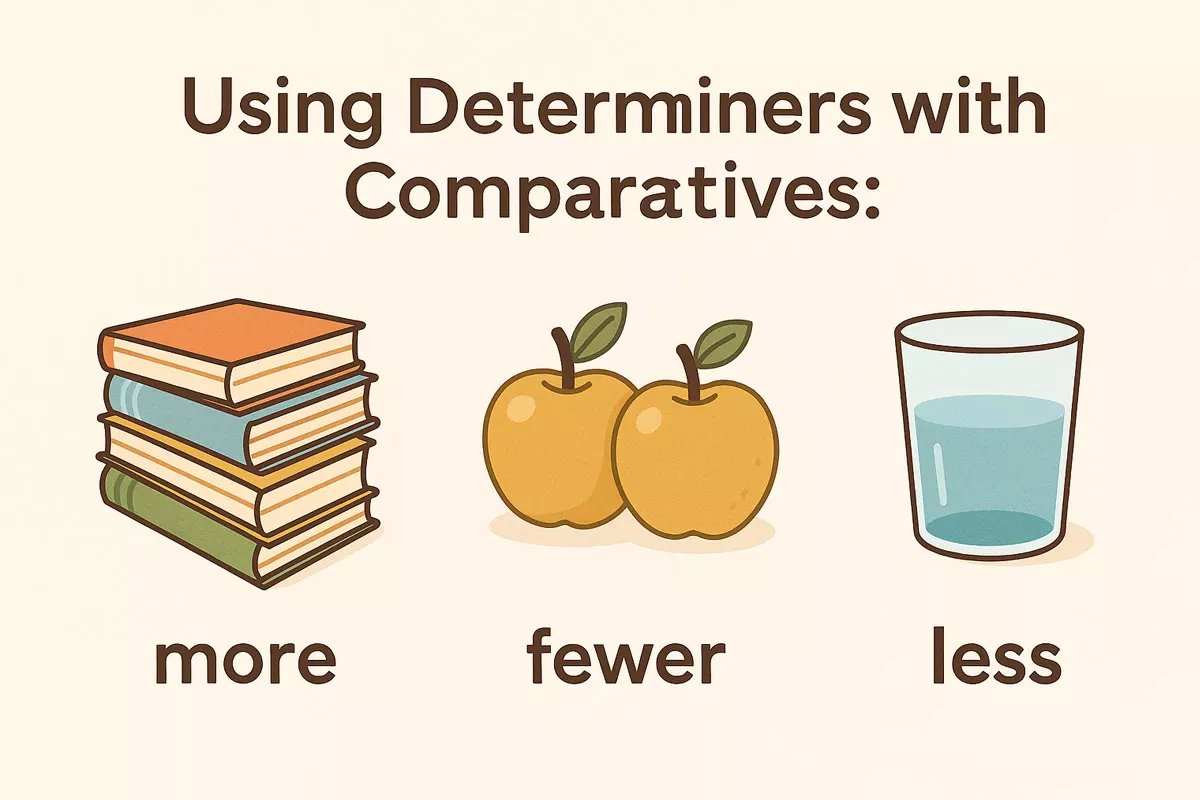 Here we comparative forms for quantity, how to use more, fewer, and less with countable and uncountable nouns, exceptions and trends, combining determiners with comparatives, common mistakes, and provides sentence rewriting practice.
- Review of comparative forms for quantity
- Using more with both countable and uncountable nouns
- Using fewer with countable nouns and less with uncountables
- Exceptions and modern trends with less and countable nouns
- Combining determiners and comparatives in longer phrases
- Typical mistakes with more, fewer, and less
- Practice: rewrite sentences using correct comparatives and determiners
Learning to pair words such as more, fewer, and less with the correct articles or quantifiers can be challenging for English learners, but mastering these combinations is essential for clear and natural communication. Using these words properly allows you to make accurate comparisons and convey your ideas more effectively, whether you are discussing quantities, amounts, or differences. With practice and attention to context, you will become more confident in using these comparative expressions in both writing and conversation.
Review of comparative forms for quantity
Comparing amounts in English relies on specific comparative forms, especially when talking about countable and uncountable nouns. The main determiners used for these comparisons are more, fewer, and less. Understanding when to use each is essential for clear and accurate communication.
Comparing Countable and Uncountable Nouns
When you compare quantities, it's important to know whether the noun is countable (e.g., apples, books) or uncountable (e.g., water, money). This affects which comparative form you choose:
- More is used with both countable and uncountable nouns: “more apples,” “more time.”
- Fewer is used only with countable nouns: “fewer cars,” “fewer mistakes.”
- Less is used with uncountable nouns: “less sugar,” “less information.”
Common Patterns and Examples
Here are some typical comparative structures used for expressing quantity:
- She has more friends than I do.
- They made fewer errors this time.
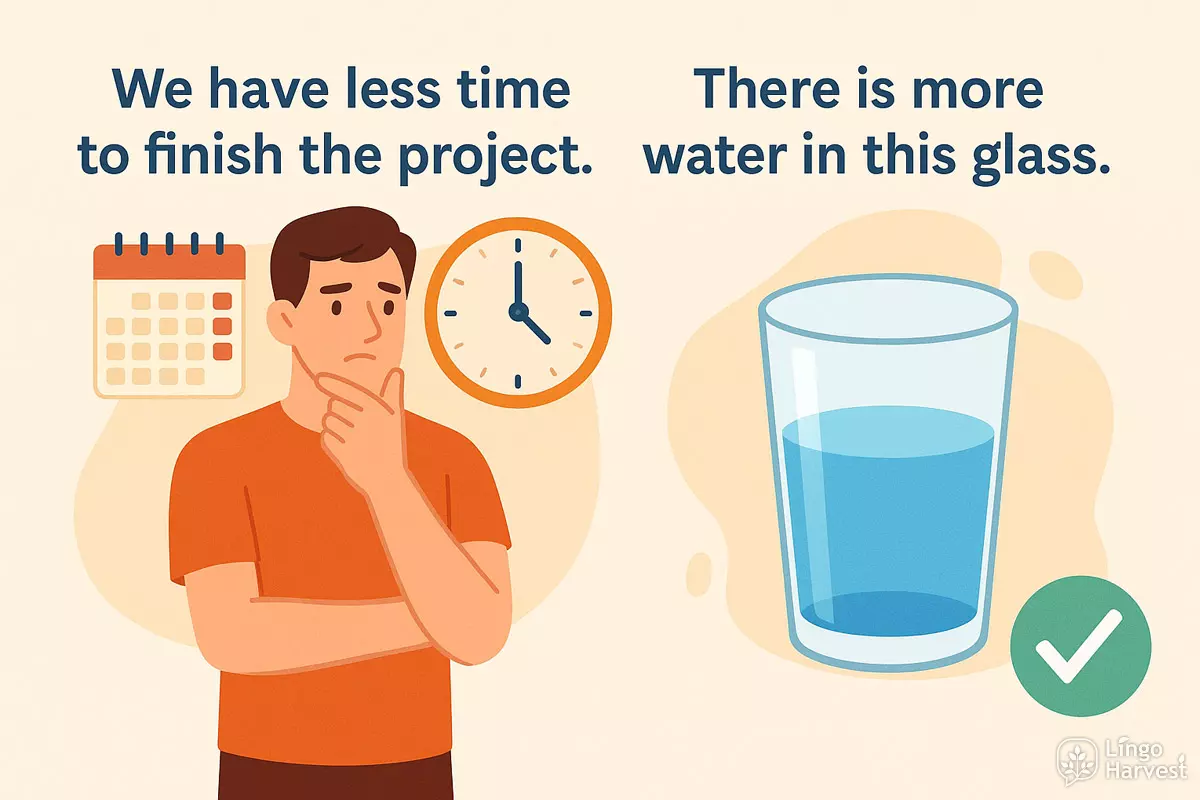
- We have less time to finish the project.
- There is more water in this glass.
- Fewer students attended the lecture today.
- He drinks less coffee these days.
- We need more chairs for the meeting.
- There are fewer options available now.
- Could you give me less advice?
- Do you have more information about the event?
- They bought fewer tickets than expected.
- This recipe needs less salt.
- She spends more money on books.
- We received fewer complaints this month.
- There’s less noise at night.
Summary Table: Comparative Forms for Quantity
| Determiner | Used with | Example |
|---|---|---|
| more | Countable & Uncountable nouns | more books, more water |
| fewer | Countable nouns only | fewer cars, fewer ideas |
| less | Uncountable nouns only | less sugar, less time |
Quick Practice: Choose the Correct Form
- There are _____ students in the class this year. (more / fewer / less)
- We need _____ information to complete the report. (more / fewer / less)
- She eats _____ snacks than before. (more / fewer / less)
- He spends _____ money on coffee now. (more / fewer / less)
- There are _____ cars on the road at night. (more / fewer / less)
- I have _____ time to finish this task today. (more / fewer / less)
- They made _____ mistakes on the second test. (more / fewer / less)
- We bought _____ sugar than last week. (more / fewer / less)
- There are _____ chairs in the meeting room today. (more / fewer / less)
- She drinks _____ water in winter. (more / fewer / less)
Show answers
- fewer
- more
- fewer
- less
- fewer
- less
- fewer
- less
- fewer
- less
Using more with both countable and uncountable nouns
When comparing quantities or amounts, English speakers often choose "more" because it works equally well with items you can count (like apples or books) and things you cannot count individually (such as water or information). This flexibility makes "more" an essential comparative determiner in both spoken and written English.
- Countable nouns refer to things we can count one by one—like "chairs," "cars," or "ideas." With these, "more" means a greater number. For example, "She has more friends than I do." Here, "friends" are individual people that can be counted.
- Uncountable nouns cover things that are seen as a mass or a whole—like "milk," "sand," or "patience." In these cases, "more" means a greater amount. For instance, "We need more sugar for the recipe." "Sugar" is not counted individually, but measured by weight or volume.
Common Patterns and Examples
Below are typical ways "more" is used with both types of nouns. Observe the structure of each sentence and notice how the meaning shifts slightly based on whether the noun is countable or not:
- Can I have more chairs? (countable)
- Could you add more salt? (uncountable)
- There are more options available. (countable)
- We need more time to finish. (uncountable)
- She bought more books last week. (countable)
- He wants more information about the topic. (uncountable)
- Do you have more pencils? (countable)
- Would you like more coffee? (uncountable)
- They noticed more problems this year. (countable)
- She put more effort into her project. (uncountable)
- The store offers more varieties than before. (countable)
- He has more experience than his colleagues. (uncountable)
- We need more volunteers. (countable)
- Can you give me more advice? (uncountable)
- There are more students in the new class. (countable)
- She needs more space in her office. (uncountable)
Comparison Table: Countable vs. Uncountable Usage
| With Countable Nouns | With Uncountable Nouns |
|---|---|
| More apples | More milk |
| More questions | More patience |
| More chairs | More information |
| More friends | More energy |
| More ideas | More water |
Notice that the word "more" stays the same regardless of whether the noun is countable or uncountable. The difference lies in the noun itself, not the determiner. This makes "more" a convenient word for expressing a greater quantity or amount in a wide range of contexts.
Using fewer with countable nouns and less with uncountables
Understanding the distinction between "fewer" and "less" is essential for clear and precise communication in English, especially when making comparisons. The choice depends on whether you’re referring to things you can count individually or substances and concepts you measure as a whole.
Countable vs. uncountable nouns
Countable nouns are items you can count one by one, like "apples," "cars," or "mistakes." For these, "fewer" is the correct comparative. Uncountable nouns, on the other hand, refer to things you cannot count individually, such as "water," "money," or "time." With these, "less" is the preferred word.
- Fewer books (books can be counted)
- Fewer students (students are countable)
- Less sugar (sugar is not counted in units)
- Less information (information is uncountable)
- Fewer tickets (tickets are individual items)
- Less pollution (pollution is a mass noun)
- Fewer cars (cars can be counted)
- Less traffic (traffic is seen as a whole)
- Fewer problems (problems are distinct items)
- Less furniture (furniture is uncountable)
- Fewer emails (individual messages)
- Less time (time is measured, not counted)
- Fewer bottles (bottles are separate objects)
- Less noise (noise is not easily counted)
- Fewer opportunities (opportunities as separate events)
- Less energy (energy is a mass noun)
Common errors and how to avoid them
A frequent mistake is using "less" with countable nouns, especially in everyday speech or informal writing. For instance, "less people" is incorrect; the correct form is "fewer people." Likewise, "fewer sand" should be "less sand." When in doubt, ask yourself: can I count these items individually? If yes, use "fewer." If not, choose "less."
Comparison table
| Correct Usage | Example Sentence |
|---|---|
| Fewer (countable) | There are fewer chairs in the room than yesterday. |
| Less (uncountable) | We have less milk than we need for the recipe. |
| Fewer (countable) | She made fewer mistakes on her test this time. |
| Less (uncountable) | He spent less time on homework this week. |
The distinction isn’t just academic—using the right form makes your meaning clearer. If you want to sound natural and accurate, pay attention to whether the noun you’re describing is something you can count or something you measure. This simple check will help you avoid common mistakes and communicate more effectively.
Exceptions and modern trends with less and countable nouns
Traditional grammar distinguishes between "fewer" for countable nouns and "less" for uncountable nouns. However, in everyday English, especially in informal contexts, this rule is often relaxed. Many speakers now use "less" with countable nouns, particularly in phrases involving time, money, distance, and even in supermarket signage (e.g., "10 items or less"). This shift reflects changing usage patterns rather than strict adherence to older rules.
Common situations where "less" is used with countables
- Supermarket signs: "5 items or less" instead of "5 items or fewer"
- Time expressions: "less than 10 minutes" (minutes are countable)
- Distances: "less than 5 miles"
- Amounts of money: "less than 10 dollars"
- Sports scores: "the team with less than 10 wins"
- Age: "children less than 12 years old"
- Weight: "less than 3 kilograms"
- People: "less than 50 people attended"
- Votes: "less than 100 votes"
- Rooms: "less than 20 rooms available"
- Pages: "less than 100 pages"
- Steps: "less than 50 steps to the top"
When "fewer" is still preferred
Despite these trends, many formal contexts and style guides still recommend using "fewer" for countable items, especially in writing where precision is valued. For example, "Fewer students attended the lecture" is generally preferred in academic settings.
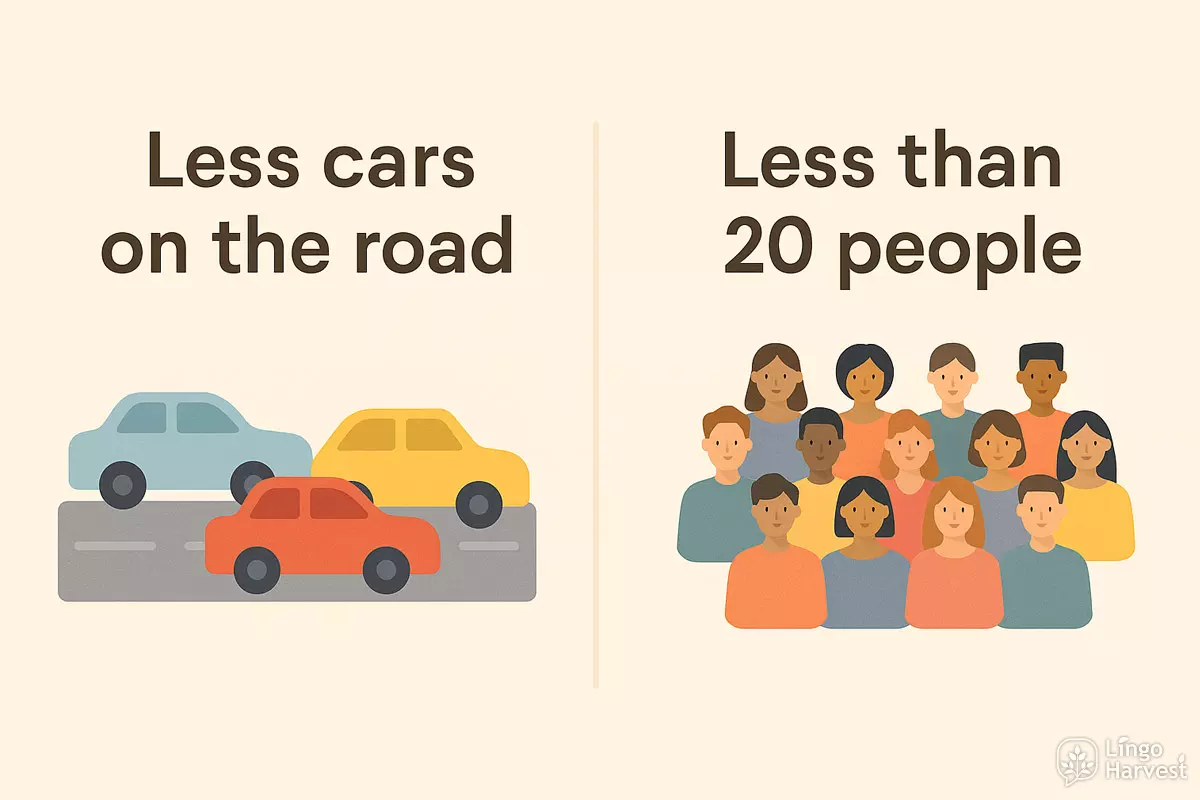
Comparing traditional and modern usage
| Traditional Standard | Modern/Informal Usage |
|---|---|
| Fewer cars on the road | Less cars on the road |
| Fewer than 20 people | Less than 20 people |
| Fewer bottles | Less bottles |
| Fewer books to read | Less books to read |
| Fewer items in the basket | Less items in the basket |
Summary of current tendencies
While language evolves and usage norms shift, understanding both traditional rules and contemporary trends helps speakers choose the most suitable form for their audience. In informal speech and many public contexts, using "less" with countable nouns is increasingly common and widely accepted. However, in formal writing, sticking to "fewer" for countable and "less" for uncountable nouns remains a safe choice.
Combining determiners and comparatives in longer phrases
When speaking or writing, we often need to use both determiners (like "some," "many," "a few") and comparative forms ("more," "fewer," "less") together to create clear, nuanced statements. This is especially useful for describing quantities, making comparisons, or giving advice. The order and combination of these words can sometimes feel tricky, but there are reliable patterns you can follow.
Common patterns with determiners and comparatives
Most often, the determiner comes first, followed by the comparative, and then the noun. Here are some typical structures:
- some more + plural/uncountable noun: some more water
- many more + plural noun: many more opportunities
- a few more + plural noun: a few more questions
- a little less + uncountable noun: a little less sugar
- a lot fewer + plural noun: a lot fewer cars
- much less + uncountable noun: much less time
- far more + plural/uncountable noun: far more patience
- several more + plural noun: several more days
- no more + noun: no more excuses
- much fewer + plural noun: much fewer mistakes
- any more + noun: any more questions
- so much less + uncountable noun: so much less noise
- too many more + plural noun: too many more steps
- quite a few more + plural noun: quite a few more books
- just a little more + uncountable noun: just a little more information
Comparing quantities with different determiners
To highlight the differences in meaning, here is a comparison of how various determiners can be paired with comparative forms. Notice how the meaning shifts depending on the combination.
| Determiner + Comparative | Example in a Phrase |
|---|---|
| some more | Can I have some more tea? |
| many more | There are many more options available. |
| a few more | We need a few more chairs. |
| much less | This version uses much less energy. |
| a lot fewer | There were a lot fewer complaints this time. |
| several more | He bought several more shirts. |
| no more | There are no more tickets left. |
| much fewer | We received much fewer responses than expected. |
| far more | She has far more experience than her peers. |
| a little less | Add a little less salt next time. |
Tips for natural phrasing
- Use "more" and "less" with both countable and uncountable nouns, but use "fewer" only with countable nouns.
- Pair "many," "few," "several," and "a lot" with countable nouns, and "much," "little," and "a bit" with uncountable nouns.
- For emphasis or nuance, add words like "far," "much," or "a lot" before the comparative: far fewer mistakes.
- Mastering these combinations helps you express quantity and comparison with greater precision and fluency in English.
Typical mistakes with more, fewer, and less
Many English learners—and even native speakers—sometimes mix up how to use “more,” “fewer,” and “less,” especially when talking about amounts and quantities. The root of the confusion is that “fewer” is used for countable nouns, while “less” is reserved for uncountable nouns. However, this rule is often overlooked, particularly in everyday speech or writing.
Common pitfalls in usage
One frequent error is saying “less” when “fewer” is correct. For instance, “less people” should be “fewer people,” because “people” can be counted. Similarly, using “fewer” with uncountable nouns, such as “fewer water,” is incorrect; it should be “less water.”
- “There are less cars on the road today.” ❌ → “There are fewer cars on the road today.” ✅
- “He drank fewer coffee than me.” ❌ → “He drank less coffee than me.” ✅
- “She has less friends than before.” ❌ → “She has fewer friends than before.” ✅
- “We need fewer information.” ❌ → “We need less information.” ✅
- “I spent less hours studying.” ❌ → “I spent fewer hours studying.” ✅
- “There are less children in the park today.” ❌ → “There are fewer children in the park today.” ✅
- “Fewer money was lost.” ❌ → “Less money was lost.” ✅
- “Less apples are left.” ❌ → “Fewer apples are left.” ✅
- “She wants fewer sugar in her tea.” ❌ → “She wants less sugar in her tea.” ✅
- “There are fewer bread on the table.” ❌ → “There is less bread on the table.” ✅
When “less” is acceptable with numbers
Although the rule is clear, there are some exceptions in common usage. For example, “less than 10 miles” or “less than 20 dollars” is widely accepted, even though “miles” and “dollars” are countable. This happens because these expressions refer to a single measurement or amount rather than individual items.
Quick reference: countable vs. uncountable
To help you remember when to use each word, here’s a structured comparison:
| Word | When to Use | Correct Example | Incorrect Example |
|---|---|---|---|
| fewer | With countable nouns (things you can count: books, people, chairs) | We have fewer cookies today. | We have less cookies today. |
| less | With uncountable nouns (things you can’t count: milk, time, rice) | She has less patience than before. | She has fewer patience than before. |
| more | With both countable and uncountable nouns | He wants more apples. He wants more water. |
– |
Summary tips
When in doubt, ask yourself if you can count the noun. If yes, use “fewer.” If not, choose “less.” “More” is flexible and works with both types. Paying attention to these distinctions will help you avoid the most frequent missteps with comparative determiners.
Practice: rewrite sentences using correct comparatives and determiners
When learning how to pair comparatives like “more,” “less,” and “fewer” with the right determiners, practice is essential. Below you’ll find a variety of sentences that need to be rewritten correctly, along with some tips and examples. This exercise helps you master both grammar and style.
Rewrite these sentences
For each item below, rewrite the sentence so it uses the correct comparative and determiner. Focus on countable vs. uncountable nouns and the correct use of “more,” “less,” or “fewer.”
- There are less students in the library today.
- She has fewer patience than before.
- We need more informations about the project.
- He eats less vegetables now.
- Do you have fewer money than last year?
- There is fewer traffic on Sundays.
- We should drink more waters during summer.
- They received less assignments this week.
- She wants fewer sugar in her coffee.
- He spends more time at work than at home.
Show answers
- There are fewer students in the library today.
- She has less patience than before.
- We need more information about the project.
- He eats fewer vegetables now.
- Do you have less money than last year?
- There is less traffic on Sundays.
- We should drink more water during summer.
- They received fewer assignments this week.
- She wants less sugar in her coffee.
- He spends more time at work than at home. (Already correct)
Common Patterns: Countable vs. Uncountable Nouns
Choosing between “fewer” and “less” depends on the noun. See which determiners pair with which types below:
- Fewer + plural countable noun: fewer books, fewer cars, fewer people
- Less + uncountable noun: less water, less time, less information
- More + both countable and uncountable: more apples, more advice
Quick Reference: Correct Usage
| Comparative | Example with Correct Noun |
|---|---|
| Fewer | Fewer mistakes (countable) |
| Less | Less noise (uncountable) |
| More | More books / More water (both types) |
| Fewer | Fewer opportunities (countable) |
| Less | Less furniture (uncountable) |
Extra Challenge: Make Your Own Sentences
Write five original sentences using “more,” “fewer,” or “less” with the correct type of noun. Check your work using the patterns above.
Show answers
- Fewer cars are on the road at night.
- I have less work today.
- She wants more friends at her party.
- They should use less plastic.
- More students attended the lecture this week.