Quantifiers + Of: When “Of” Is Required and When It Is Not

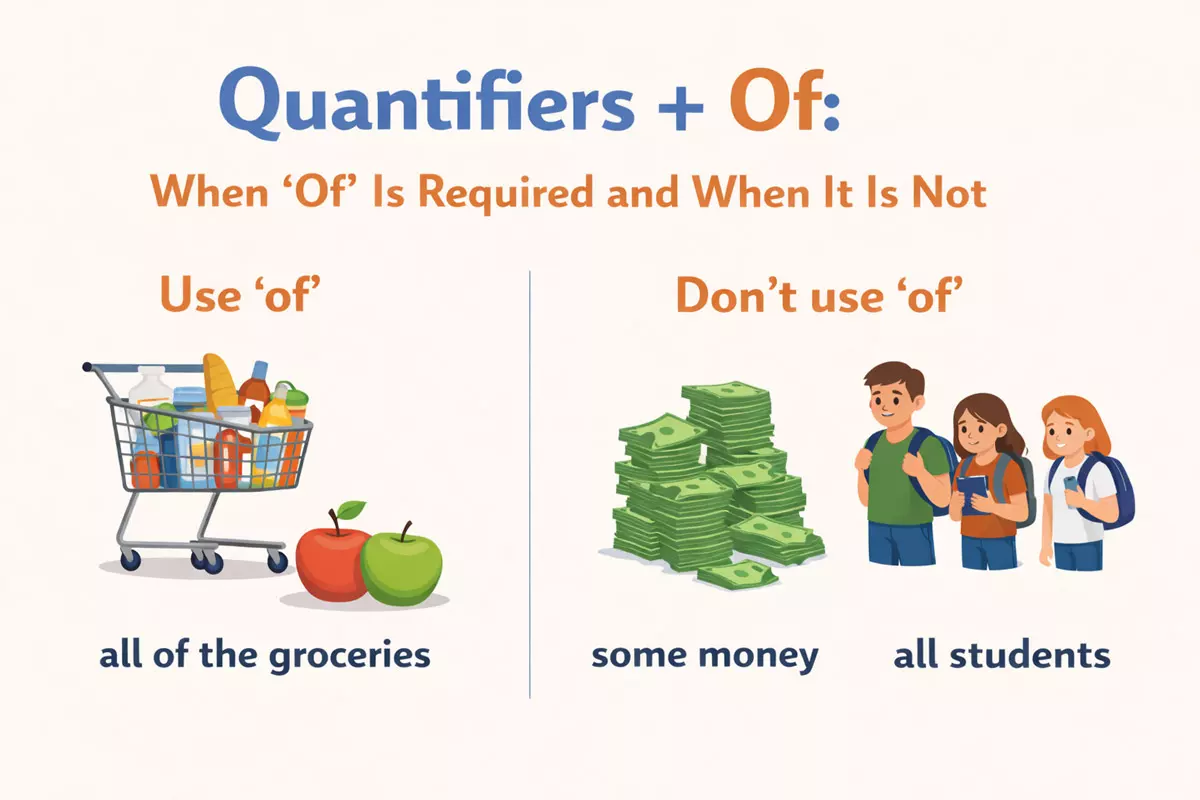 Here we how to use of with quantifiers, including when it is needed before nouns or pronouns, common patterns with words like some and most, typical learner mistakes, and provides examples and practice distinguishing correct usage.
- Difference between direct quantifiers and partitive forms
- When of is required before nouns
- Cases where of must be omitted
- Use of of with pronouns and determiners
- Common patterns with some, many, and most
- Typical learner mistakes and overgeneralization
- Examples contrasting correct and incorrect usage
- Practice: deciding whether of is needed
Knowing when to use "of" after words like many, some, or a few can be challenging for English learners, but mastering this detail is important for creating natural and accurate sentences. Generally, "of" is used when these words are followed by a specific noun with a determiner, such as an article or possessive pronoun—for example, "many of the students" or "some of my friends." However, when talking about things in general, without a determiner, you simply say "many students" or "some friends." Practicing these patterns will help your English sound more fluent.
Difference between direct quantifiers and partitive forms
Understanding when to use "of" after quantifiers often comes down to whether you’re dealing with a direct quantifier or a partitive form. In English, quantifiers can appear either directly before a noun or as part of a phrase with "of." The structure you choose affects both the meaning and grammatical correctness of your sentence.
Direct quantifiers: No "of" needed
Some quantifiers can be placed directly before plural or uncountable nouns without "of." These are often called direct quantifiers. They usually express quantity in a general sense, and are commonly used in everyday English.
- Many people like this song.
- We have few options today.
- I bought several books yesterday.
- There is some water in the bottle.
- All students must be on time.
- We travel there each year.
- Learn from every mistake.
- We have enough time to finish.
- I go for a walk on most days.
- There is no reason to worry.
Notice that in these examples, "of" is not only unnecessary, but its inclusion would be incorrect.
Partitive forms: "Of" is required
When a quantifier refers to a part or subset of a specific group—especially when the noun is preceded by a determiner (like "the," "these," "my," etc.) or is a pronoun—"of" becomes mandatory. This is called the partitive construction, and it helps clarify that you’re talking about a portion of a defined set, not the whole category.
- many of the people → Many of the people are waiting outside.
- few of those options → Few of those options are cheap.
- several of my books → Several of my books are new.
- some of the water → Some of the water is cold.
- all of the students → All of the students passed the test.
- each of the years → Each of the years was different.
- every one of the mistakes → Every one of the mistakes was small.
- enough of the time → I have enough of the time today.
- most of those days → Most of those days were rainy.
- none of the reason → None of the reasons make sense.
Here, "of" connects the quantifier to a specific group, making the meaning more precise.
Side-by-side comparison
| Direct Quantifier (no "of") | Partitive Form (with "of") |
|---|---|
| many students | many of the students |
| some water | some of the water |
| few mistakes | few of my mistakes |
| most days | most of those days |
| all people | all of the people |
| none survived | none of them survived |
Key points to remember
- Use direct quantifiers with bare nouns when talking about a general category.
- Use the partitive form with "of" when the noun is specified by a determiner or pronoun.
- Some quantifiers (like "all," "some," "most," "none," "each," "few," "many," "several") can appear in both forms, but the use of "of" changes the meaning to focus on a specific subset.
- For pronouns (e.g., "all of them," "none of us"), "of" is always necessary.
Choosing between a direct quantifier and a partitive structure with "of" is essential for clarity and accuracy in English. Paying attention to whether the noun is specific or general will help you decide which form to use.
When of is required before nouns
In English, certain quantifiers and expressions nearly always need the word of when they are placed directly before nouns, especially when those nouns are definite (with the, this, my, etc.) or plural countable nouns. The word of acts as a connector, helping the sentence sound natural and grammatically correct. Knowing when to include it is important for clear, accurate English.
Common quantifiers that require "of"

When you use quantifiers with definite nouns, of is needed. Some of the most frequent quantifiers and expressions that follow this pattern include:
- all of → All of the students are here.
- some of → Some of the answers are correct.
- many of → Many of the people agree.
- most of → Most of the work is done.
- none of → None of the rooms are free.
- each of → Each of the options is useful.
- both of → Both of the doors are open.
- half of → Half of the cake is gone.
- few of → Few of the guests arrived early.
- several of → Several of the books are missing.
- one of → One of the students is absent.
- much of → Much of the time was wasted.
- plenty of → Plenty of the food is left.
- a couple of → A couple of the chairs are broken.
- the rest of → The rest of the class is waiting.
- the majority of → The majority of the votes were counted.
- a number of → A number of the files were deleted.
- a lot of → A lot of the information is useful.
- lots of → Lots of the people supported the idea.
Definite and possessive nouns
The connector of is especially necessary when the noun is made definite by words like the, these, my, or any other possessive adjective. For example:
- All of the students passed the test.
- Many of my friends are coming tonight.
- None of these answers is correct.
- Half of her money was spent.
Comparing required and non-required cases
Not every use of a quantifier needs of. To highlight the difference, here’s a comparison:
| With "of" (Required) | Without "of" (Not Required) |
|---|---|
| Some of the books are missing. | Some books are missing. |
| Most of my classmates arrived early. | Most classmates arrived early. |
| Each of these solutions works. | Each solution works. |
| None of those options is ideal. | None is ideal. |
Special cases to remember
With pronouns or demonstratives like us, them, these, and those, of is always required after the quantifier:
- All of us agree.
- Some of them left early.
- Most of those are finished.
In summary, whenever a quantifier is followed by a definite article, possessive adjective, demonstrative, or pronoun, of is needed to make the phrase correct and natural in English.
Cases where of must be omitted
There are several situations in English where the use of "of" after quantifiers is not just unnecessary, but actually incorrect. Recognizing these patterns will help you avoid awkward phrasing and make your writing sound more natural. Typically, when quantifiers are used directly before nouns without any need for a prepositional phrase, "of" should be left out.
When quantifiers are used before countable or uncountable nouns
Words like "many," "few," "several," "some," "all," "most," "each," "every," and "both" are often followed immediately by a noun, without "of." The pattern is: quantifier + noun. This is the standard form when you are not specifying a particular group or subset.
- Many students passed the exam. ✅
- Few options remain. ✅
- Several books are missing. ✅
- Some water spilled. ✅
- All children must participate. ✅
- Most people agree. ✅
- Each answer was correct. ✅
- Every room is clean. ✅
- Both solutions work. ✅
Incorrect: Adding "of" before a noun
Placing "of" between these quantifiers and a noun is a common error. Notice how adding "of" makes the phrase incorrect or unnatural:
- Many of students ❌
- Few of options ❌
- All of children ❌
- Both of solutions ❌
Special note: "Of" with pronouns and determiners
"Of" is required when the quantifier is followed by a pronoun or a determiner like "the," "my," "these," etc. However, if these are not present, omit "of." Here’s a handy overview:
| Structure | Correct Usage |
|---|---|
| Quantifier + noun | Many people arrived. |
| Quantifier + of + pronoun/determiner | Many of them arrived. |
| Quantifier + of + "the"/"these"/"my" | All of the books are here. |
| Quantifier + noun (without "of") | Several chairs were broken. |
Common quantifiers that never take "of" directly before a noun
- Many → Many people like coffee.
- Few → Few students were late.
- Several → Several books are on the table.
- Some → Some water is left in the bottle.
- All → All answers are correct.
- Most → Most days are sunny here.
- Each → Each student has a card.
- Every → Every mistake is a lesson.
- Both → Both options are good.
- No → No reason was given.
- Another → Another problem appeared.
- Much → Much time was wasted.
- Little → Little progress was made.
- Enough → Enough food is prepared.
- Any → Any answer is acceptable.
- Either → Either choice will work.
- Neither → Neither option is correct.
- Less → Less noise is needed.
- More → More practice helps.
In summary, omit "of" when the quantifier is followed immediately by a noun. Only use "of" when a pronoun or a determiner comes after the quantifier. Keeping this distinction in mind will make your English sound smooth and precise.
Use of of with pronouns and determiners
When quantifiers are followed by pronouns or determiners, the word “of” often becomes necessary. This pattern is important because it helps avoid awkward or ungrammatical constructions. For example, we say “some of them” or “many of these,” not “some them” or “many these.” The inclusion of “of” is required when the noun after the quantifier is replaced by a pronoun (like “us,” “them,” “it,” etc.) or by a demonstrative determiner (such as “this,” “those,” “these,” “that”).
Quantifiers That Require “Of” Before Pronouns and Determiners
You’ll notice that certain quantifiers almost always use “of” before a pronoun or demonstrative. Here are some of the most common ones:
- all of them → All of them are ready.
- some of it → Some of it is missing.
- none of us → None of us knows the answer.
- most of you → Most of you understand this.
- many of those → Many of those were expensive.
- much of this → Much of this is new to me.
- several of these → Several of these are broken.
- few of us → Few of us arrived early.
- each of them → Each of them has a ticket.
- either of those → Either of those will work.
- neither of these → Neither of these is correct.
- half of it → Half of it is finished.
- one of them → One of them is missing.
- both of us → Both of us agree.
- plenty of those → Plenty of those are available.
- the rest of it → The rest of it can wait.
- the majority of them → The majority of them support the idea.
Why “Of” Is Needed in These Constructions
The reason for inserting “of” is that English does not allow a quantifier to directly modify a pronoun or a demonstrative. Without “of,” the phrase is incomplete or unclear. For example:
- ❌ “Most them left early.” → Incorrect
- ✅ “Most of them left early.” → Correct
This rule applies equally to all pronouns (me, you, him, her, us, them, it) and to determiners like “these,” “those,” “this,” and “that.”
Comparing Usage: With and Without “Of”
To make the distinction clearer, here’s a comparison of typical usage:
| Without Pronoun/Determiner | With Pronoun/Determiner (“of” required) |
|---|---|
| many students | many of them |
| some books | some of these |
| few people | few of us |
| all members | all of you |
| most questions | most of those |
| none answers | none of them |
Summary of the Pattern
Whenever a quantifier is followed by a pronoun or a demonstrative, “of” acts as the connector. This structure is not optional; omitting “of” leads to ungrammatical sentences. If the quantifier is followed by a regular noun, “of” is usually not needed. Keeping this distinction in mind helps you form natural and correct English phrases.
Common patterns with some, many, and most
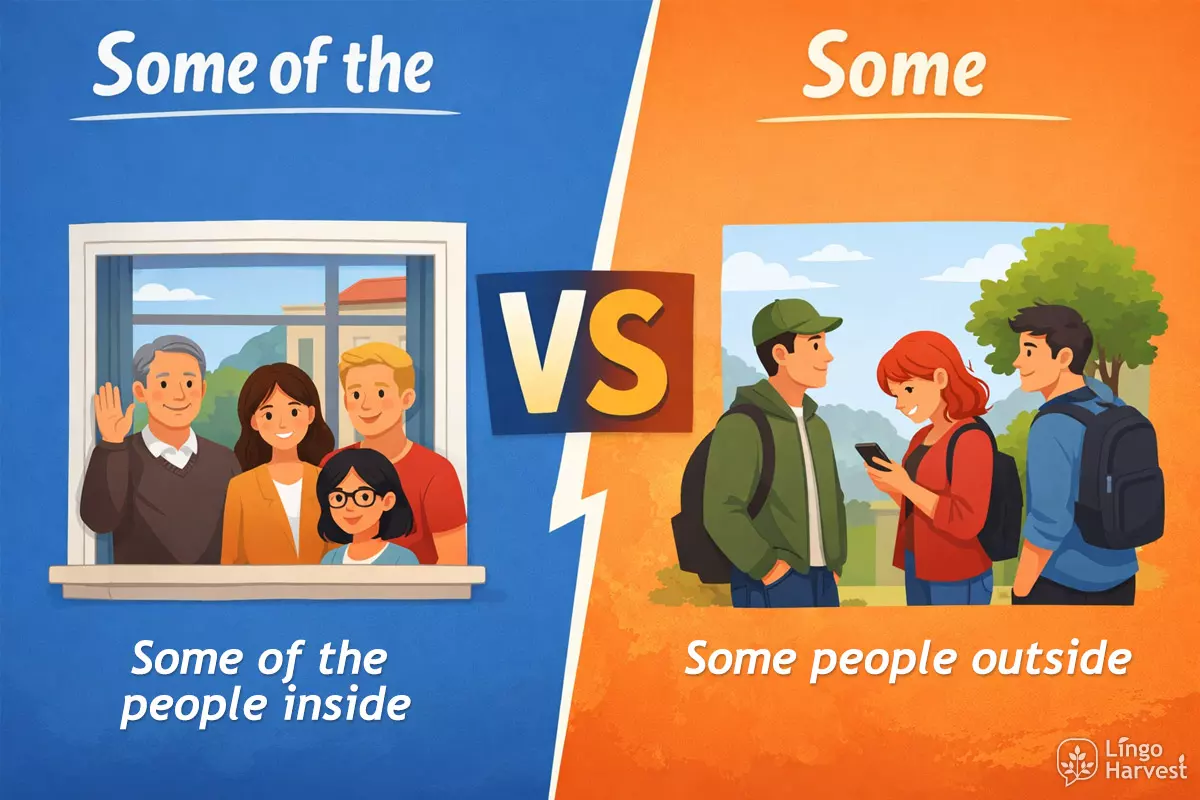
When using quantifiers such as some, many, and most with nouns, the presence or absence of “of” often depends on whether a determiner (like “the,” “my,” or a demonstrative) follows the quantifier. This section explores frequently used structures, typical mistakes, and guiding principles for choosing when “of” is needed.
Quantifier + “of” + Determiner
You generally need “of” when the quantifier is followed by a definite article, possessive adjective, or demonstrative. Here are some typical structures:
- some of the people → Some of the people are here.
- many of my friends → Many of my friends live nearby.
- most of these apples → Most of these apples are fresh.
- some of her advice → Some of her advice is helpful.
- many of those books → Many of those books are new.
- most of our time → Most of our time is spent at work.
- some of your questions → Some of your questions are easy.
- many of his ideas → Many of his ideas are good.
- most of that money → Most of that money is gone.
- some of the information → Some of the information is wrong.
Quantifier + Plural or Uncountable Noun (No “of”)
If the quantifier is used directly with a plural or uncountable noun, and there is no article or possessive, “of” is not used. Examples include:
- some people → Some people are waiting outside.
- many friends → Many friends came to my party.
- most apples → Most apples are sweet.
- some advice → Some advice is useful.
- many books → Many books are expensive.
- most time → Most time is spent online.
Exercises: Add “of” or No “of”
- _____ students in this class are new.
- _____ the students in this class are new.
- _____ my friends live in New York.
- _____ friends live in New York.
- _____ advice is helpful.
- _____ her advice is helpful.
- _____ books are expensive.
- _____ those books are expensive.
- _____ time is spent online.
- _____ our time is spent online.
- _____ people understand this rule.
- _____ the people in the room understand this rule.
- _____ money is already gone.
- _____ that money is already gone.
- _____ questions were easy.
- _____ your questions were easy.
Show answers
- Many
- Many of
- Many of
- Many
- Some
- Some of
- Many
- Many of
- Most
- Most of
- Many
- Many of
- Most
- Most of
- Some
- Some of
Comparing patterns: “of” required vs. not required
| With “of” | Without “of” |
|---|---|
| some of the students | some students |
| many of my colleagues | many colleagues |
| most of those options | most options |
| some of her suggestions | some suggestions |
| many of these questions | many questions |
| most of our money | most money |
General tips and common mistakes
- Use “of” when referring to a specific group or set defined by a determiner (e.g., “some of the cakes on the table”).
- Omit “of” when talking about things in general, with no specific reference (e.g., “most cakes are sweet”).
- Avoid using “of” with quantifiers and bare nouns (“many of books” ❌ should be “many books” ✅).
- Remember that “of” is also required before pronouns: “most of them,” “some of us,” “many of you.”
In summary, the structure you choose depends on whether you’re referencing a specific, defined group or speaking in general terms. This distinction helps clarify meaning and avoids common grammatical errors.
Typical learner mistakes and overgeneralization
Learners often struggle with when to use “of” after quantifiers. This is especially true for those whose first language uses similar constructions differently, or always includes a linking word. Many students end up either inserting “of” where it is not needed, or omitting it when it is required. Understanding these patterns can help prevent common pitfalls.
Frequent confusion: inserting “of” unnecessarily
Some quantifiers never take “of” before a noun unless that noun is preceded by a determiner (like “the,” “my,” or “these”). However, learners sometimes generalize the pattern from phrases like “some of the people” to “some of people,” which is incorrect. Here are some phrases that should NOT include “of”:
- Much water (not much of water)
- Many students (not many of students)
- Most time (not most of time)
- Some apples (not some of apples)
- Few answers (not few of answers)
- Several books (not several of books)
Omitting “of” when it’s required
The opposite error happens when “of” is actually necessary—usually before a pronoun or a noun phrase with a determiner. Learners sometimes drop “of,” leading to ungrammatical sentences. Notice the difference:
- Some of the students ✅ (correct)
- Some the students ❌ (incorrect)
- Many of them ✅
- Many them ❌
- Most of my friends ✅
- Most my friends ❌
- All of us ✅
- All us ❌
Comparison of correct and incorrect forms
| Incorrect Form ❌ | Correct Form ✅ |
|---|---|
| Some of apples | Some apples |
| Many of students | Many students |
| Most of time | Most time |
| Some the students | Some of the students |
| All us | All of us |
| Most my friends | Most of my friends |
| Several of books | Several books |
| Many them | Many of them |
Overgeneralization: applying the “of” rule everywhere
It’s easy to see why learners get confused: the rule for adding “of” seems to work in many situations, so it’s tempting to apply it everywhere. But English often drops “of” when the quantifier is followed directly by a noun (without a determiner), while it’s mandatory when a pronoun or a determiner is present. This subtlety requires practice and attention.
Tips to avoid mistakes
- Use “of” when the quantifier is followed by a pronoun or a noun with a determiner (the, my, this, etc.).
- Do NOT use “of” when the quantifier is directly before a noun with no determiner.
- Double-check sentences with quantifiers and pronouns, as these are the most common error spots.
- Practice with longer noun phrases: “some of the delicious apples,” not “some delicious apples.”
Awareness of these traps and regular practice with real examples will help you develop a natural sense for when “of” is needed—and when it’s not.
Examples contrasting correct and incorrect usage
Understanding when to include “of” after quantifiers is a subtle but important part of mastering English grammar. The presence or absence of “of” often depends on whether a noun is specified or left general, and whether a pronoun or a definite article follows. Let’s look at specific cases to highlight the difference between correct and incorrect forms.
Common quantifiers: “of” required vs. “of” omitted
The following list compares frequent quantifiers in sentences where “of” is necessary and where it should be left out. In each pair, the correct pattern is marked with ✅ and the incorrect one with ❌:
- ✅ Most of the students passed the exam.
❌ Most students of passed the exam. - ✅ Some of them are missing.
❌ Some them are missing. - ✅ Many people enjoy coffee.
❌ Many of people enjoy coffee. - ✅ All of the apples were fresh.
❌ All the apples were fresh. (acceptable, but “all of the apples” is often preferred for emphasis or clarity) - ✅ None of us knew the answer.
❌ None us knew the answer. - ✅ A few of my friends are coming.
❌ A few my friends are coming. - ✅ Much of this work is repetitive.
❌ Much this work is repetitive. - ✅ Several books were missing.
❌ Several of books were missing. - ✅ Half of the class was absent.
❌ Half class was absent. - ✅ Plenty of options are available.
❌ Plenty options are available. - ✅ Each of them received a prize.
❌ Each them received a prize. - ✅ Some people prefer tea.
❌ Some of people prefer tea.
Summary table: Quantifiers and “of” usage
For a clearer overview, here is a table summarizing when “of” is needed after common quantifiers, based on whether a definite noun, pronoun, or general noun follows.
| Quantifier | Followed by “of” | Followed without “of” |
|---|---|---|
| Most | most of the cake, most of them | most cakes, most people |
| Some | some of my friends, some of it | some friends, some water |
| All | all of the answers, all of us | all answers, all children |
| None | none of those, none of them | (rarely used without “of”) |
| Half | half of the group, half of it | half price, half measures |
| Several | several of these, several of them | several books, several people |
Quick guidelines
- Use “of” when the quantifier is followed by a pronoun (e.g., us, them, it) or a definite noun phrase (e.g., the students, my friends).
- Omit “of” when the quantifier is followed by a general or plural noun without a determiner (e.g., “many people,” “few options”).
- Some quantifiers, like “none,” almost always require “of.”
Recognizing these patterns helps you avoid common mistakes and write more clearly and naturally in English.
Practice: deciding whether of is needed
Understanding when "of" is required after quantifiers can be tricky. The best way to master this is by looking at real examples and trying a few exercises. Below you'll find explanations, example patterns, and a short quiz to check your intuition.
Common Quantifiers: When Does "Of" Appear?
Some quantifiers always need "of" before a noun or pronoun, while others do not. The rules depend on whether the noun is definite (the, my, these, etc.), indefinite, or uncountable. Here’s a structured overview:
| Quantifier Pattern | Correct Form |
|---|---|
| all, most, some, none, both, half, each, neither, either + definite noun (the/my/these...) | needs "of" (e.g., all of the students) |
| all, most, some, none, both, half, each, neither, either + plural/uncountable noun (no article or determiner) | no "of" (e.g., all students) |
| many, few, several, a couple + noun | no "of" (e.g., many people) |
| much, little + noun | no "of" (e.g., much time) |
| quantifier + pronoun (us, them, you, him, her, it) | needs "of" (e.g., all of us) |
Spot the Pattern: Examples
- Most of the cake was eaten. ✅
- Most cakes are sweet. ✅
- Some of my friends live abroad. ✅
- Some people like spicy food. ✅
- All of us agreed. ✅
- All children need sleep. ✅
- None of them arrived on time. ✅
- Many students passed the exam. ✅
- Much water was wasted. ✅
- Several of the answers were incorrect. ✅
- Half of my money is gone. ✅
- Half the fun was in getting there. ✅
Mini Quiz: Add "of" Where Needed
Fill in the blank with "of" if it is required. If not, leave the space blank.
- _____ my classmates are here.
- Some _____ the books are missing.
- None _____ us knew the answer.
- Most people enjoy music.
- Several _____ these paintings are originals.
- All students must register.
- Half _____ the cake is left.
- Much effort went into the project.
- All _____ them were surprised.
- Few friends called yesterday.
Show answers
- All my classmates are here. (no "of")
- Some of the books are missing.
- None of us knew the answer.
- Most people enjoy music. (no "of")
- Several of these paintings are originals.
- All students must register. (no "of")
- Half of the cake is left.
- Much effort went into the project. (no "of")
- All of them were surprised.
- Few friends called yesterday. (no "of")
Quick Recap
- Use "of" after quantifiers when a pronoun or a definite noun follows (the, my, these, us, them, etc.).
- Do not use "of" with quantifiers plus bare nouns (no article or determiner).
- Some quantifiers (many, few, much, several) never take "of" before a noun.
Try practicing with your own sentences to get comfortable with this distinction.