How Native Speakers Simplify Questions in Spoken English

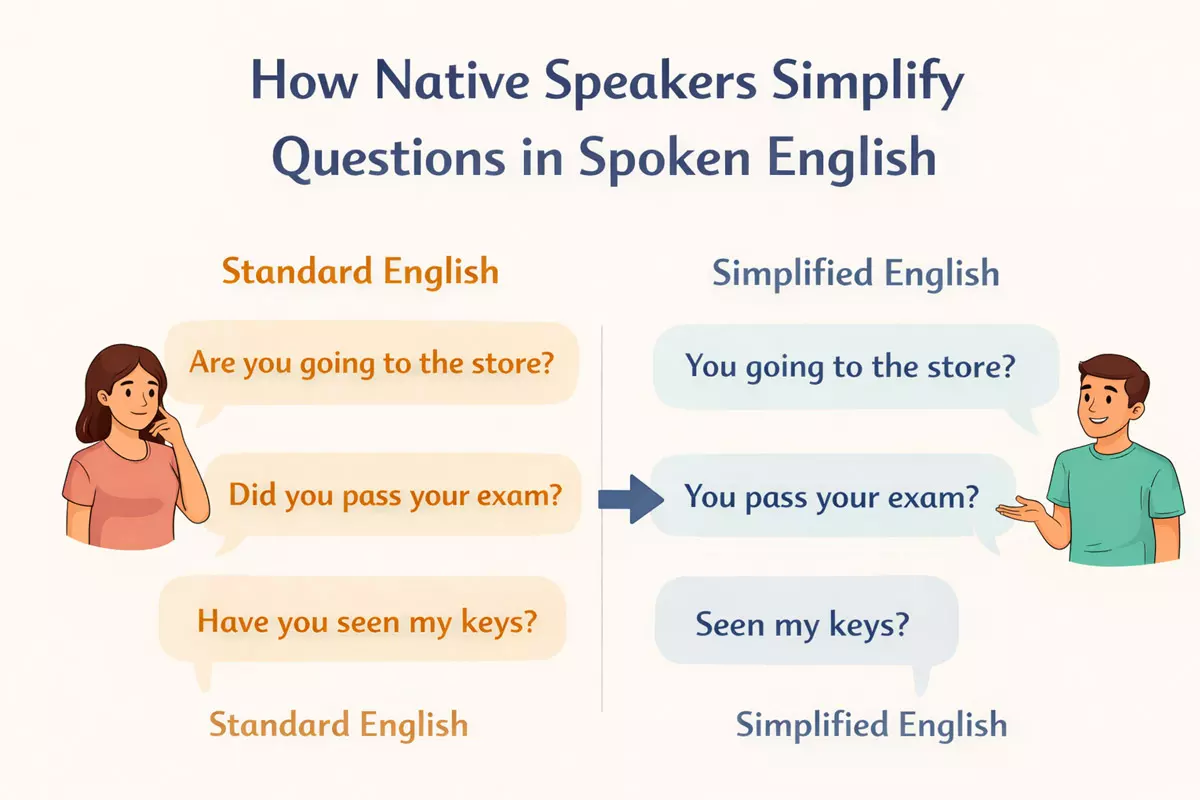 This article explains why native English speakers simplify questions, often by shortening forms or dropping auxiliary verbs in speech. It covers intonation, common patterns, yes/no questions, context-based queries, and includes practice exercises.
Fluent English speakers often make their questions sound shorter and more casual in everyday conversation, which can be confusing for learners. Instead of using full, formal phrases, they rely on contractions, dropped words, and a relaxed tone to communicate more naturally. For example, someone might say "You coming?" instead of "Are you coming?" or "Got a minute?" instead of "Do you have a minute?" Recognizing these common shortcuts helps learners feel more comfortable and confident in real-life situations, making conversations smoother and more engaging.
Why Native Speakers Simplify Questions
Everyday conversations in English tend to be fast-paced and informal, so native speakers often make their questions shorter and more direct. This habit isn’t about laziness; it’s a practical response to real-world communication needs. People want to save time, keep the conversation flowing smoothly, and avoid sounding overly formal or stiff with friends, family, or colleagues.
Efficiency and Speed
Native speakers usually aim for quick exchanges, especially in casual settings. Shortening questions helps keep interactions natural and prevents awkward pauses. Rather than using full, textbook-style sentences, speakers often drop auxiliary verbs or unnecessary words to get to the point faster.
- “You coming?” instead of “Are you coming?”
- “Want coffee?” instead of “Do you want some coffee?”
- “Seen my keys?” instead of “Have you seen my keys?”
- “Got a minute?” instead of “Do you have a minute?”
Context and Shared Understanding
Context plays a big role in how questions are formed. When both people share background knowledge, there’s less need for complete sentences. This can make questions sound incomplete to learners, but they remain clear to native listeners.
- “Lunch?” (meaning “Do you want to get lunch?”)
- “Finished?” (meaning “Are you finished?”)
- “Coming with?” (meaning “Are you coming with us?”)
- “Need help?” (meaning “Do you need help?”)
Natural Sounding Speech
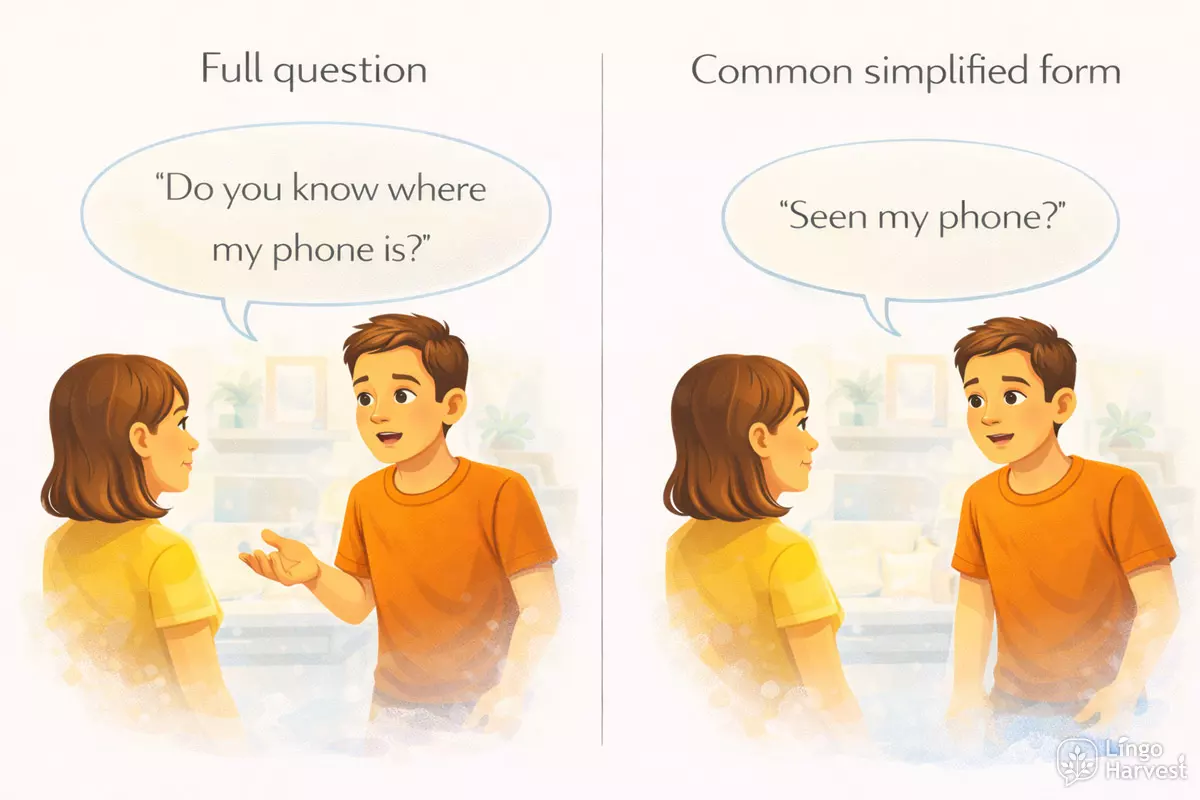
Overly formal questions can feel out of place in everyday talk. Native speakers adjust their language to match the setting, often using contractions or omitting words that are obvious from the situation. This makes their speech sound more relaxed and approachable.
| Full Question | Common Simplified Form |
|---|---|
| Are you going to the party tonight? | Going to the party? |
| Do you know where my phone is? | Seen my phone? |
| Would you like some tea? | Tea? |
| Have you finished your homework? | Finished your homework? |
| Can you help me with this? | Help me with this? |
Social Dynamics and Tone
Simplifying questions also helps speakers sound more friendly and less formal. In many groups, using short, direct forms signals closeness and comfort. Using the full, formal question can sometimes suggest distance or unfamiliarity.
- “Coming?” instead of “Are you coming?”
- “Need a hand?” instead of “Do you need a hand?”
- “Ready?” instead of “Are you ready?”
- “Going out?” instead of “Are you going out?”
The main reasons for simplifying questions come down to efficiency, shared context, and the desire for natural, friendly conversation. These patterns help native speakers communicate quickly and smoothly in everyday life.
Shortened Question Forms
When English speakers talk casually, they rarely use the full, textbook version of a question. Instead, they opt for more efficient, clipped forms that still carry the same meaning but sound more natural in conversation. These condensed versions help keep speech flowing and feel friendlier.
How Native Speakers Trim Questions
Most reductions happen by dropping auxiliary verbs, pronouns, or even whole words when the context is clear. For example, instead of asking, “Are you coming to the party?” someone might simply say, “Coming to the party?” The meaning remains intact because shared context fills in the gaps.
- Leaving out the subject: “(Are you) Ready?”
- Omitting auxiliary verbs: “(Did you) See that?”
- Dropping question words: “(What’s) Up?”
- Using only a verb: “Finished?”
- Shortening tag questions: “Nice day, isn’t it?” → “Nice day, eh?”
- Reducing yes/no questions: “(Do you) Want coffee?”
- Trimming multi-word questions: “(Are you) Going out?”
- Quick checks: “You okay?” instead of “Are you okay?”
- Abbreviating choices: “Coffee or tea?” instead of “Would you like coffee or tea?”
- Relying on intonation: “You coming?”
- Using a single word: “Lunch?”
- Cutting to the essential: “Need help?”
- Implied requests: “Window open?”
- Removing polite phrases: “(Could you) Help me?”
- Switching word order: “You got it?” instead of “Have you got it?”
- Minimal wh-questions: “Where to?”
Common Patterns in Everyday Speech
These pared-down formats are especially common among friends, family, and coworkers. The tone and context usually signal that a question is being asked, even if the grammar isn’t complete. Intonation—raising your voice at the end—often does the work of turning a statement into a question.
| Full Question | Natural Shortened Form |
|---|---|
| Are you coming with us? | Coming with us? |
| Did you see that movie? | See that movie? |
| Do you want some coffee? | Want coffee? |
| Are you feeling okay? | You okay? |
| Would you like to join? | Join us? |
| Is the window open? | Window open? |
| Where are you going? | Where to? |
| Do you need help? | Need help? |
Why These Forms Matter
Understanding and using these shortened question styles makes conversations smoother and helps non-native speakers sound more fluent. They’re a hallmark of natural English and show how context and tone can replace full grammar in everyday speech.
Dropping Auxiliary Verbs in Speech
In informal English, especially during rapid or casual conversation, speakers often leave out auxiliary verbs such as do, does, or did when forming questions. This shorthand approach is particularly common in certain dialects and regional varieties, but it can also appear in relaxed speech among native speakers everywhere. The omission is usually understood from context, and although it may not be considered standard in writing, it is a natural feature of spoken English.
Common Situations Where Auxiliaries Disappear
You’ll notice the auxiliary verb is frequently dropped in questions that are very short, or when the speaker expects the listener to fill in the missing words. Here are some typical scenarios:
- When asking for clarification or repetition – “You coming?” instead of “Are you coming?”
- In casual invitations – “Want some?” instead of “Do you want some?”
- When checking facts or plans – “You finished?” instead of “Are you finished?”
- In quick follow-ups – “He leave already?” instead of “Did he leave already?”
- With directions or instructions – “Need help?” instead of “Do you need help?”
- About preferences – “Like it?” instead of “Do you like it?”
- For offers – “Care to join?” instead of “Do you care to join?”
- With reminders – “Remember your keys?” instead of “Did you remember your keys?”
- In opinions – “Think it’ll rain?” instead of “Do you think it’ll rain?”
- For checks – “See my bag?” instead of “Did you see my bag?”
How Meaning Is Preserved
Even when the helping verb disappears, listeners easily understand the speaker’s intent thanks to context, intonation, and shared background. This pattern is less likely in formal settings, but is a staple of everyday English among friends, family, or colleagues.
Comparison: Full vs. Reduced Questions
| Standard Question | Spoken Shortcut |
|---|---|
| Do you want to come? | You want to come? |
| Are you ready? | You ready? |
| Did you eat? | You eat? |
| Does she know? | She know? |
| Did they call? | They call? |
| Do we need to go? | We need to go? |
| Did you finish? | You finish? |
| Does it work? | It work? |
While this streamlined style is often heard in many English-speaking communities, it’s best reserved for informal situations. Using the full form is safer in writing or when clarity and politeness are priorities.
Intonation Instead of Full Structure
Native English speakers often rely on the melody of their voice—intonation—rather than always using grammatically complete question forms. In casual conversations, the rising tone at the end of a sentence can signal a question, even if the structure is technically that of a statement. This habit allows for faster, more fluid exchanges and is a key way spoken English differs from what learners might find in textbooks.
Why Intonation Matters in Everyday Questions
Using pitch and rhythm, speakers can turn statements into questions with minimal effort. This works well when context is clear, and both parties understand what’s being asked. For example, simply saying “You’re coming?” with a rising tone instantly communicates a question, even though the sentence lacks the auxiliary verb “are.”
Common Patterns Where Intonation Replaces Structure
Here are typical ways native speakers simplify questions using tone instead of full grammar:
- “You ready?” instead of “Are you ready?”
- “He left?” instead of “Did he leave?”
- “Coming with us?” instead of “Are you coming with us?”
- “Got a minute?” instead of “Do you have a minute?”
- “Finished?” instead of “Have you finished?”
- “Coffee?” instead of “Would you like some coffee?”
- “All set?” instead of “Are you all set?”
- “You know her?” instead of “Do you know her?”
- “He’s here?” instead of “Is he here?”
- “Need help?” instead of “Do you need help?”
- “She called?” instead of “Did she call?”
- “This seat taken?” instead of “Is this seat taken?”
- “Coming?” instead of “Are you coming?”
- “Want some?” instead of “Do you want some?”
- “You okay?” instead of “Are you okay?”
- “It’s raining?” instead of “Is it raining?”
- “He knows?” instead of “Does he know?”
- “Going out?” instead of “Are you going out?”
Comparing Full and Reduced Forms
The difference between textbook grammar and how questions are actually asked can be summed up with these examples:
| Standard Question | Reduced Spoken Form |
|---|---|
| Are you coming? | Coming? |
| Do you want coffee? | Coffee? |
| Is she ready? | She ready? |
| Did you see it? | You saw it? |
| Do you need help? | Need help? |
Tips for Learners
- Listen for upward pitch—if the speaker’s voice rises at the end, it’s likely a question.
- Don’t be surprised if questions sound like statements. Context and tone usually make the meaning clear.
- Practicing with real conversations or audio can help you get used to these patterns.
- When speaking, try using simple forms with rising intonation in informal settings for a more natural sound.
Intonation is a powerful tool for simplifying questions in spoken English, making interactions smoother and less formal. Recognizing and using these patterns can help you sound more like a native speaker and understand conversations more easily.
Common Spoken Question Patterns
When native English speakers talk, they often rely on a range of informal and shortened ways to ask questions. These spoken forms are usually less rigid than what's found in textbooks. Many times, words get dropped, contractions are used, and the word order can shift. Understanding these variations helps learners catch the real meaning during conversations and respond more naturally.
Typical Reductions and Short Forms
In casual speech, question phrases are frequently shortened. Here are some of the most frequent ways native speakers simplify their questions:
- Dropping auxiliary verbs: You coming? instead of Are you coming?
- Using contractions: What’s up? instead of What is up?
- Leaving out the subject: Need help? for Do you need help?
- Ending with prepositions: Who’re you with? instead of With whom are you?
- Tag questions: Nice weather, isn’t it?
- Reduced wh-questions: Why’s that? for Why is that?
- “Gonna/wanna” forms: You gonna go? for Are you going to go?
- Implied yes/no questions: Coming tonight?
- Single-word queries: Really?, When?, Where?
- Using intonation only: Raising pitch at the end (e.g., You finished? as a question)
- Omitting question words when context is clear: That yours?
- Using “or what?”: Are you coming, or what?
- Softening with “just”: Just checking?
- Elliptical questions: Need a hand?
- Using “so” for follow-up: So, you’re not going?
Comparing Written and Spoken Forms
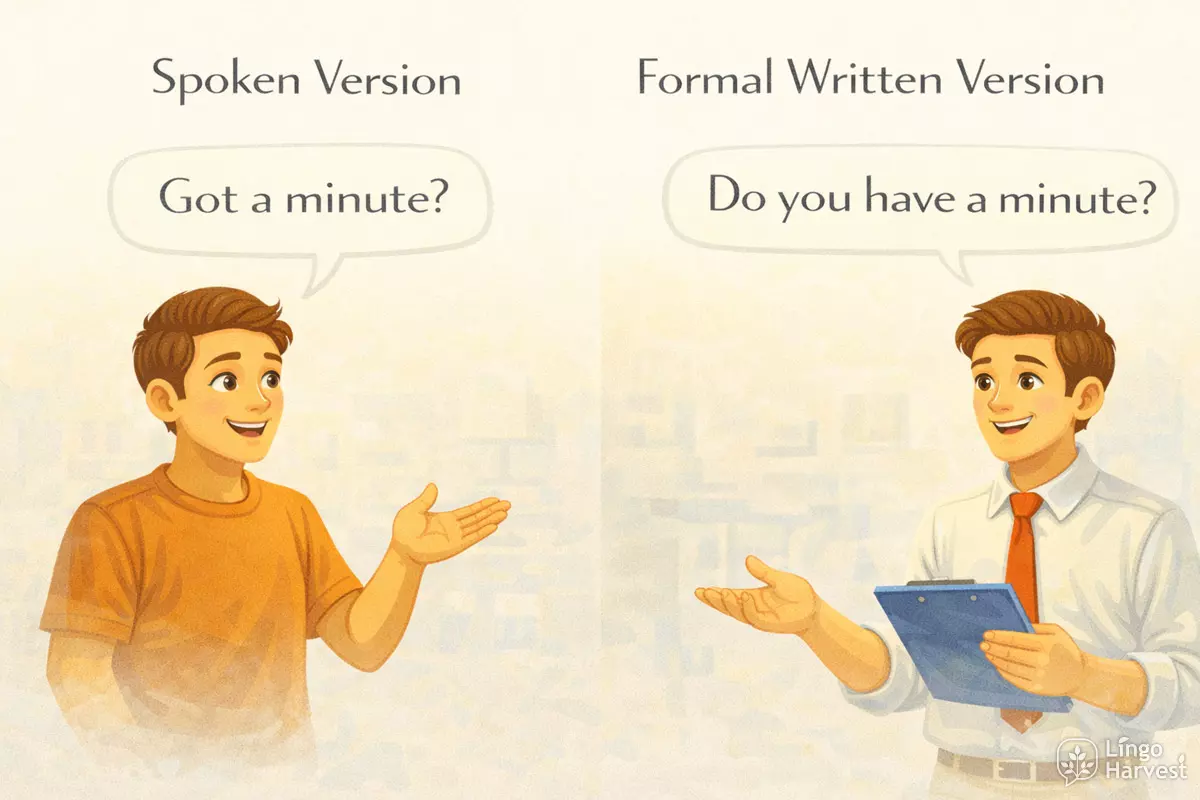
Many questions that sound natural in conversation would seem incomplete if written formally. Below is a comparison of how some typical queries appear in spoken English versus their more formal written counterparts.
| Spoken Version | Formal Written Version |
|---|---|
| Got a minute? | Do you have a minute? |
| Wanna come? | Do you want to come? |
| He’s here? | Is he here? |
| What for? | For what purpose? |
| Done yet? | Have you finished yet? |
| That okay? | Is that okay? |
Key Points to Remember
- Spoken questions are often much shorter than their written forms.
- Context and tone help listeners understand incomplete sentences.
- It’s common to rely on rising intonation to signal a question.
- Learning these patterns improves listening skills and helps you sound more fluent.
By getting comfortable with these familiar informal structures, you’ll find it easier to follow native conversations and participate more naturally.
Yes/No Short Questions
In everyday English conversations, native speakers often make their queries more concise and natural by trimming down full forms. This streamlining is especially noticeable with questions that require a simple yes or no answer. Instead of using the full structure, speakers tend to drop non-essential words, relying on context and intonation to convey meaning.
How Native Speakers Shorten Questions
Rather than asking, "Do you want some coffee?" it's common to hear just, "Want some coffee?" This omission of the subject and auxiliary verb helps keep exchanges quick and friendly. The listener still understands the intent because of the situation and the way the question is asked.
- Coming with us?
- Seen this movie?
- Got any idea?
- Heard the news?
- Need a hand?
- Can you help?
- Is it yours?
- Ready?
- Finished?
- Want one?
- Did you call?
- Going out?
- Have you eaten?
- Should I wait?
- All set?
- Still there?
Features of Shortened Yes/No Queries
These concise forms often drop the subject ("you") and auxiliary ("do," "have," "are"), especially when the meaning is obvious. The tone of voice and body language help clarify that a question is being asked, even when words are missing. This pattern makes spoken English sound more relaxed and efficient.
Full vs. Reduced Forms
To see how these conversational shortcuts compare with their more formal equivalents, here are some typical transformations:
| Full Question | Shortened Form |
|---|---|
| Do you want to join us? | Join us? |
| Have you finished? | Finished? |
| Are you coming? | Coming? |
| Did you see that? | See that? |
| Do you need help? | Need help? |
| Are you ready? | Ready? |
| Have you got time? | Got time? |
| Did you call? | Call? |
These shortened queries are a hallmark of casual, native-like English. Understanding and using them can help learners sound more natural and better follow real conversations. They also illustrate how context and shared understanding allow speakers to communicate efficiently without always relying on full grammatical forms.
Understanding Context-Based Questions
Native speakers often rely on context to streamline their questions in everyday conversations. Instead of asking fully detailed or grammatically complete questions, they use cues from the situation, shared knowledge, and what has just been said. This natural approach makes spoken English more efficient, but it can sometimes be confusing if you’re expecting textbook-style questions.
How Context Shapes Questions
When people talk, they rarely repeat information that’s already obvious or recently mentioned. Instead, they refer back to earlier parts of the conversation, use gestures, or rely on things everyone can see or hear. This gives rise to shorter, less formal questions that still make perfect sense in the moment.
- Dropping obvious subjects or objects: “Want some?” (instead of “Do you want some coffee?”)
- Using single words or fragments: “Coffee?” (meaning “Would you like some coffee?”)
- Tag questions for confirmation: “You’re coming, right?”
- Relying on shared experiences: “Same as yesterday?”
- Echoing key words: “The park?” (meaning “Are we going to the park?”)
- Using intonation to signal a question: “Now?”
- Implied choices: “Tea or coffee?”
- Short yes/no prompts: “Ready?”
- Abbreviated forms: “You okay?” instead of “Are you okay?”
- Repeating a phrase with a questioning tone: “Your keys?”
- Omitting auxiliary verbs: “You coming?”
- Using context clues: “After lunch?”
- Gesturing to an object and asking: “This one?”
- Combining a gesture and a word: (pointing) “Here?”
- Following up with clarifications: “Which one?”
- Elliptical questions: “Need help?”
- Minimal wh-questions: “Where?” or “When?”
- Repeating the last word as a question: “Tomorrow?”
Comparing Explicit and Context-Based Questions
To see how native speakers adjust their questions based on context, compare these typical forms:
| Full/Explicit Question | Context-Based/Spoken Form |
|---|---|
| Do you want to go for a walk? | Walk? |
| Are you finished with your meal? | Done? |
| Should I turn off the light now? | Now? |
| Would you like some water? | Water? |
| Are we meeting at the usual place? | Same place? |
| Do you need any help with that? | Help? |
| Is this your bag? | Yours? |
| Should I call you later? | Later? |
These patterns highlight how native speakers trust both parties to fill in the gaps using shared understanding. For learners, recognizing these compact forms—and the clues that make them clear—is crucial for natural conversation and listening skills.
Practice Exercises and Self-Check
Understanding how everyday speakers make their questions shorter and more natural is a practical skill. The following activities will help you recognize and use these streamlined forms in real conversations. Take your time with each task and check your answers when you're ready.
Spot the Simplified Question
Below are some questions as you might hear them in natural conversation. Identify what was left out or changed to make them sound more casual compared to their full, textbook versions.
- Got a minute?
- You coming tonight?
- Seen my phone?
- Wanna grab lunch?
- Need any help?
- Everything okay?
- He already left?
- What’s up?
- Anyone hungry?
- Ready to go?
Show answers
- Omitted "Have you" or "Do you" at the start.
- Left out "Are" at the beginning.
- Missing "Have you" or "Did you" at the start.
- Shortened "Do you want to" to "Wanna".
- Omitted "Do you" at the start.
- Left out "Is" at the beginning.
- Missing "Has" or "Did" at the beginning.
- Informal greeting; not a full question.
- Omitted "Is" or "Is anyone" at the start.
- Missing "Are you" at the beginning.
Transform to Conversational Style
Rewrite these formal questions as you would likely hear them in fast, informal English.
- Are you going to the store?
- Do you want to watch a movie?
- Did you see that email?
- Have you finished your homework?
- Is she coming with us?
- Are they waiting outside?
- Did you call him back?
- Have we met before?
- Is it working now?
- Do you need any help?
Show answers
- You going to the store?
- Wanna watch a movie?
- See that email?
- Finished your homework?
- She coming with us?
- They waiting outside?
- You call him back?
- We met before?
- Working now?
- Need any help?
Self-Check: Choose the Natural Spoken Version
For each full question, choose the more natural spoken version (A or B).
- Do you have a pen?
A) Got a pen?
B) Have you gotted a pen? - Are you ready?
A) Ready?
B) Are ready you? - Have you eaten yet?
A) Did you eaten yet?
B) Eaten yet? - Do you want to join us?
A) Wanna join?
B) Want you join? - Did you call her?
A) Called her?
B) Call her? - Is it raining?
A) It raining?
B) Raining? - Can you help me?
A) Help me?
B) Can help you me? - Are you okay?
A) You okay?
B) Okay are you? - Will you be late?
A) You will late?
B) Be late? - Should we go?
A) We should go?
B) Go?
Show answers
- A
- A
- B
- A
- B
- B
- A
- A
- B
- B
Self-Check: Listening for Shortened Questions
Imagine you’re listening to a fast conversation. Which option would sound most natural for a native speaker? Choose the best one.
- a) Do you want to come with me?
b) Wanna come? - a) Have you seen this?
b) Seen this? - a) Are you finished?
b) Finished? - a) Did you eat already?
b) Eat already? - a) Are you coming later?
b) Coming later? - a) Do you need help?
b) Need help? - a) Have you got a minute?
b) Got a minute? - a) Did you hear that?
b) Hear that? - a) Are they ready?
b) They ready? - a) Have we met before?
b) We met before?
Show answers
- b) Wanna come?
- b) Seen this?
- b) Finished?
- b) Eat already?
- b) Coming later?
- b) Need help?
- b) Got a minute?
- b) Hear that?
- b) They ready?
- b) We met before?
By practicing with these examples, you’ll become more comfortable both understanding and using the kinds of short, direct questions that are common in everyday spoken English. Try listening for these patterns in real conversations or media, and practice using them yourself.