Subject vs Object Questions in English Explained

 The article defines subject and object questions, compares their word order and auxiliary verb use, explains WH-word roles, covers common learner mistakes, offers tips to identify question types, and includes practice exercises for self-check.
Understanding how to distinguish between the person performing an action and the one receiving it is essential when forming questions in English. This distinction helps ensure that your questions are clear and that your listener or reader understands exactly what you mean. Mastering this aspect of English grammar can prevent confusion and make your conversations or written communication more effective. By practicing and paying attention to how questions are structured, you can improve both your comprehension and your ability to express yourself accurately.
What Subject Questions Are
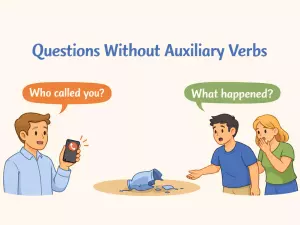
When you ask a question in English to find out who or what performs an action, you’re using a subject question. These questions focus on the “doer” of the verb, rather than the object or receiver. Unlike other question types, they don’t require auxiliary verbs (like “do” or “does”) for most tenses. The answer to this kind of question is almost always a person, group, or thing acting in the sentence.
How Subject Questions Work
In subject questions, the question word (often “who” or “what”) takes the place of the subject. The verb follows directly, just like in a statement. This pattern makes them simpler than object questions, which need extra words and word order changes.
- Who called you last night?
- What happened at the meeting?
- Which team won the game?
- Who made this cake?
- What caused that noise?
- Which student answered the question?
- Who knows the answer?
- What interrupted the class?
- Which company launched the new product?
- What started the fire?
Key Features of Subject Questions
- No auxiliary verb (“do/does/did”) in simple tenses
- The question word replaces the subject
- Verb comes directly after the question word
- Usually answered by naming a person, thing, or group
Forming Subject Questions: Quick Comparison
| Statement | Subject Question |
|---|---|
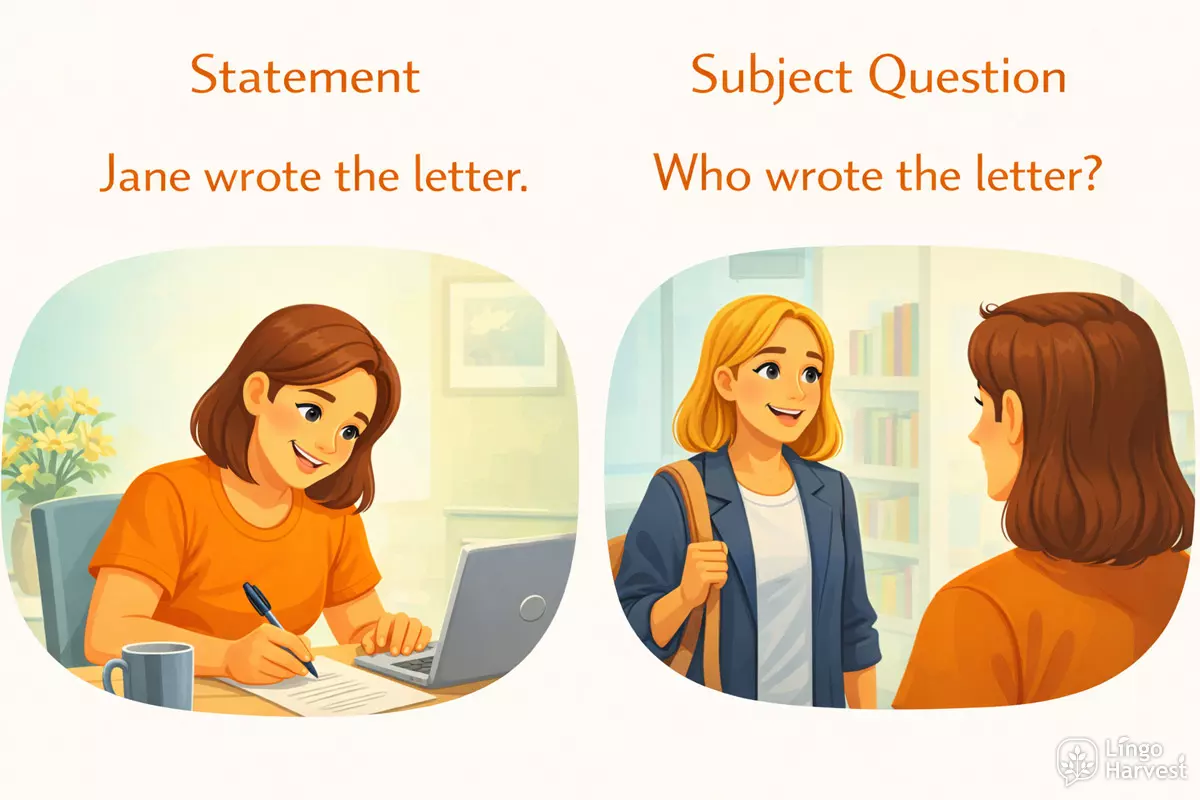
| Jane wrote the letter. | Who wrote the letter? |
| The noise woke me up. | What woke you up? |
| Tom fixed the car. | Who fixed the car? |
| The storm damaged the roof. | What damaged the roof? |
| This book inspired her. | What inspired her? |
Subject questions are a core part of English, used daily to discover who is responsible for actions or events. Their structure is straightforward, making them easy to recognize and use, especially compared to questions about objects or receivers.
What Object Questions Are
In English, questions can focus on different parts of a sentence: sometimes we want to know who or what did something (the subject), and other times we want to find out who or what received the action (the object). When the question targets the person or thing affected by the verb, it’s called an object question. These are common in everyday conversation and are essential for gathering new details or clarifying information.
Object questions ask about the receiver of an action rather than the one performing it. For example, in the sentence “Sarah called Tom,” if you want to know who Sarah called, you ask: “Who did Sarah call?” Here, “who” is the object because it stands for “Tom,” the person receiving the call.
How Object Questions Are Formed
Object questions in English follow a specific word order. Unlike subject questions, they require an auxiliary verb (like do, does, did) before the subject. Here’s the standard pattern:
- Question word (who, what, which, whom, etc.)
- Auxiliary verb (do/does/did, is/are/were, etc.)
- Subject
- Main verb
- Rest of the sentence
For example: What did you eat for lunch? (“what” = object; “did” = auxiliary; “you” = subject; “eat” = main verb)
Common Object Question Words
- Who (when asking about a person)
- Whom (formal alternative to “who” as object)
- What (for things or ideas)
- Which (when there is a limited choice)
- Where (when the location is the object)
- When (if asking about a time as the object)
- Why (when seeking the reason as the object)
- Whose (asking about possession as the object)
- How many (for countable objects)
- How much (for uncountable objects)
- Which one (when specifying a particular item)
- How long (when duration is the object)
- How often (when frequency is the focus)
- How far (when distance is the object)
Examples of Object Questions
- Who did you meet at the party? → I met my neighbors.
- What did she buy yesterday? → She bought a new jacket.
- Which book did you choose? → I chose the blue one.
- Whom did they invite? → They invited their coworkers.
- How much money did you spend? → I spent about fifty dollars.
- Where did you leave your keys? → I left them on the table.
- Why did he call you? → Because he needed help.
- How many emails did you send? → I sent five.
- Which one did you prefer? → I preferred the first one.
- How long did you wait? → I waited for ten minutes.
Comparing Subject and Object Questions
| Subject Question | Object Question |
|---|---|
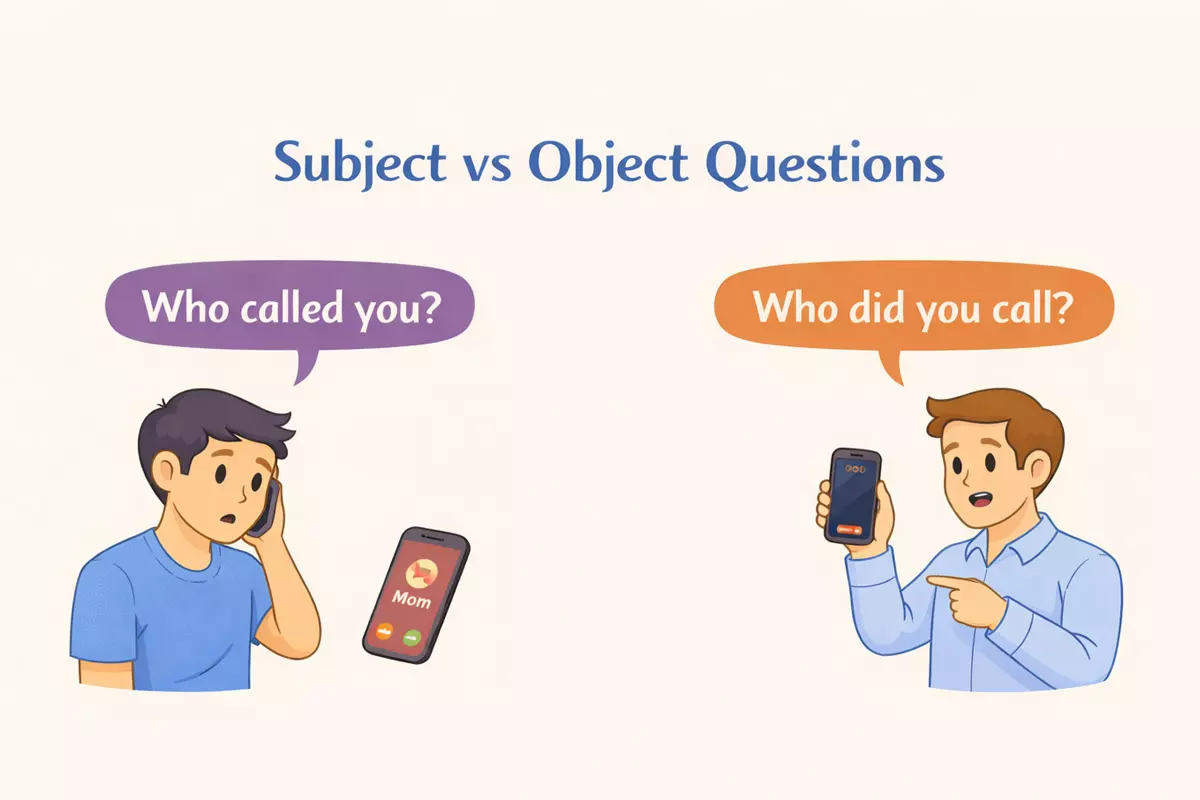
| Who called you? | Who did you call? |
| What broke the window? | What did you break? |
| Which student won? | Which student did the teacher praise? |
| Who left early? | Who did you see leave early? |
The main difference is that object questions use an auxiliary verb and put the subject after it, while subject questions don’t need an auxiliary and the question word itself is the subject. Recognizing this structure will help you form correct questions and understand English conversations more easily.
Word Order Differences
Understanding how word order changes between subject and object questions is key to forming correct English sentences. The main contrast lies in the position of the subject and the use of auxiliary verbs.
When asking about the subject of a sentence, the structure remains similar to a normal statement, but the subject is replaced by a question word (like "Who" or "What"). In contrast, object questions typically require an auxiliary verb (do/does/did, is/are/was/were, etc.) and a change in the sequence of words.
Subject Questions: Structure
Subject questions are straightforward. The question word replaces the subject, and the verb follows directly. No auxiliary verb is needed unless the verb is naturally formed with one, such as "be" verbs or modals.
- Who broke the window? → The kids did.
- What made that noise? → A loud bang did.
- Which student arrived first? → Anna did.
- Who is calling? → Your manager is.
- What happened yesterday? → There was an accident.
Object Questions: Structure
For object questions, the subject stays in the sentence, and the question word replaces the object. Here, an auxiliary verb is required before the subject, and the main verb appears in its base form. This change in sequence is crucial for clarity and correctness.
- Who did you see? → I saw my neighbor.
- What are they eating? → They are eating pasta.
- Which book did she read? → She read the history book.
- Who will you invite? → I will invite my friends.
- What did he break? → He broke his phone.
Direct Comparison
To highlight the difference, notice how the position of the subject and the presence of an auxiliary verb change the question's form. The table below summarizes the patterns:
| Type | Example Structure | Sample Question |
|---|---|---|
| Subject Question | Question Word + Verb (+ Object) | Who called you? |
| Object Question | Question Word + Auxiliary + Subject + Verb | Who did you call? |
| Subject Question | Question Word + Verb | What happened? |
| Object Question | Question Word + Auxiliary + Subject + Verb | What did she say? |
Summary Points
- Subject questions do not use auxiliary verbs (except with "be" or modals).
- Object questions require an auxiliary verb and subject-verb inversion.
- The question word replaces the subject or object, depending on the information being asked for.
- Using the wrong order can make questions confusing or ungrammatical.
Mastering these patterns helps learners ask clear questions and understand the intended meaning in conversation.
Use of Auxiliary Verbs
Auxiliary verbs play a crucial role in distinguishing between subject and object questions in English. They help form questions, indicate tense, and clarify which part of the sentence is being asked about. Understanding how these helping verbs function makes it easier to construct accurate questions and avoid common mistakes.
Auxiliary Verbs in Object Questions
For object questions, an auxiliary verb is almost always needed. The question word (who, what, which, etc.) is followed by the appropriate auxiliary (do/does/did, have/has, is/are/were, etc.), then the subject, and finally the main verb. This structure makes it clear that the question is about something or someone other than the subject.
- Who did you see at the party? → I saw my coworkers.
- What are they reading? → They are reading a novel.
- Which book has she borrowed? → She has borrowed my dictionary.
- Who will you invite? → I will invite my friends.
- What did he say? → He said he was busy.
- Which car is he driving? → He is driving a rental car.
- Who have they chosen? → They have chosen Alex.
- What can we do? → We can try again.
- Which film did you watch? → I watched the comedy.
- Who does she trust? → She trusts her sister.
Subject Questions: No Auxiliary Needed
In contrast, subject questions usually do not require an auxiliary verb. The question word itself acts as the subject, and the verb follows directly. This is one of the key differences in structure between subject and object queries.
- Who called you? → My manager did.
- What happened yesterday? → A minor accident happened.
- Which team won? → The home team did.
- Who arrived first? → Emma did.
- What made that noise? → A falling box did.
- Which student answered? → Daniel did.
- Who knows the answer? → The teacher does.
- Which book sold best? → The new thriller did.
- Who lives here? → My cousin does.
- What caused the delay? → Heavy traffic did.
Key Differences at a Glance
| Type of Question | Auxiliary Verb Needed? | Example |
|---|---|---|
| Subject Question | No | Who broke the window? |
| Object Question | Yes | Who did you call? |
| Subject Question | No | What happened? |
| Object Question | Yes | What did she say? |
Tips for Learners
- Check if the question word is the subject or the object: if it’s the subject, skip the auxiliary.
- Use do/does/did for present and past simple in object questions.
- Remember continuous and perfect tenses use be/have as auxiliaries.
- Practice by changing statements into both types of questions for clarity.
Mastering the placement and necessity of helping verbs helps you form clear, natural-sounding questions and improves overall fluency.
WH-Words in Subject and Object Questions
Understanding how different WH-words function in subject and object questions can help you form clearer, more natural English sentences. The role of the WH-word—such as who, what, or which—determines both the structure and the meaning of your question. The main difference lies in whether the WH-word is asking about the doer of the action (subject) or the receiver or object of the action.
Common WH-Words Used in Questions
- Who – usually refers to people
- What – can refer to things, ideas, or actions
- Which – asks for selection from a known set
- Whose – asks about ownership
- When – focuses on time (rare as subject, common as object)
- Where – refers to place (almost always object)
- Why – asks for reasons (typically object)
- How – queries about manner or process (usually object)
Patterns: Subject vs. Object Question Forms
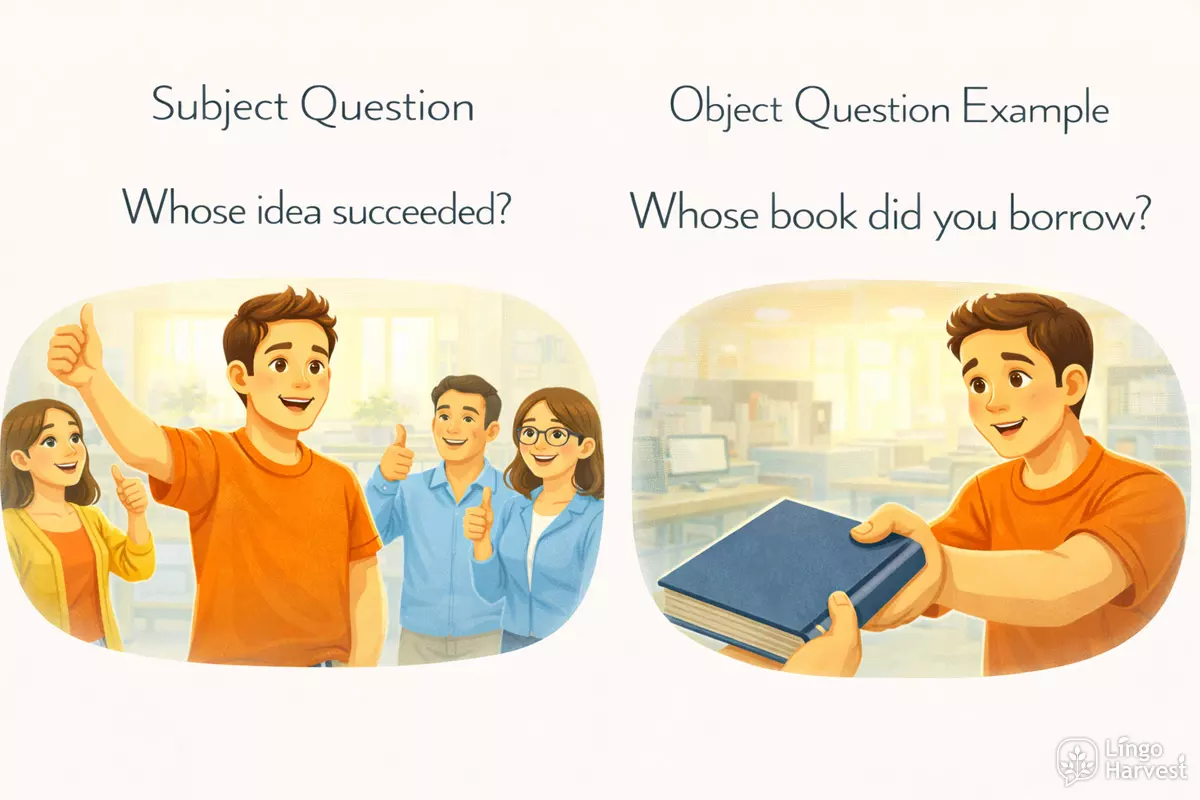
In subject questions, the WH-word replaces the subject and comes at the start. There’s no need for auxiliary verbs (like do, does, did) in most tenses. In contrast, object questions use the WH-word to replace the object, and they usually require an auxiliary verb for correct word order.
| WH-Word | Subject Question Example | Object Question Example |
|---|---|---|
| Who | Who called you? | Who did you call? |
| What | What happened? | What did you see? |
| Which | Which team won? | Which player did you meet? |
| Whose | Whose idea succeeded? | Whose book did you borrow? |
| When | When will help arrive? | When did you finish? |
| Where | (rare) Where collapsed? | Where did he go? |
| Why | (very rare) Why happened? | Why did she leave? |
| How | (very rare) How works? | How did you fix it? |
Tips for Choosing the Correct WH-Word
- Use who or what for the subject if you don’t know the “doer.”
- Choose which for a limited set of options.
- Pick whose to ask about possession, either as subject or object.
- Remember: most WH-words are more common as objects, except who and what.
Paying attention to the WH-word’s role in your question helps avoid confusion and makes your English sound more natural. Practicing with examples will help you quickly recognize whether you’re dealing with a subject or object question.
Common Learner Confusion
Many English language students find it tricky to tell the difference between subject and object questions. This is understandable, as the word order and structure can look quite similar at first glance. Learners often mix them up, especially when forming questions about “who” or “what.”
Mixing Up Who/What as Subject or Object
One frequent source of error is not knowing whether “who” or “what” is acting as the subject or the object in the question. For example, “Who called you?” (subject question) versus “Who did you call?” (object question). The presence or absence of auxiliary verbs like “do/does/did” is a common stumbling block.
Typical Mistakes and Why They Happen
- Adding “do/does/did” to subject questions by mistake
- Forgetting auxiliary verbs in object questions
- Using incorrect word order
- Confusing the main “actor” with the “receiver” of the action
- Overgeneralizing from patterns in the learner’s native language
- Misidentifying “who” or “what” as the subject when it’s actually the object
- Uncertainty about when to use “whom” (rare in modern spoken English)
- Assuming all questions need an auxiliary verb
- Misplacing the question word in the sentence
- Creating double subjects (e.g., “Who did call you?”)
Comparison of Subject and Object Questions
| Type | Question Structure | Example |
|---|---|---|
| Subject Question | [Who/What] + verb + (object)? | Who broke the window? |
| Object Question | [Who/What] + auxiliary + subject + verb? | Who did you see? |
| Subject Question | [Who/What] + verb + (object)? | What happened? |
| Object Question | [Who/What] + auxiliary + subject + verb? | What did she buy? |
How to Tell the Difference
To decide if you need a subject or object question, ask yourself: Am I asking who/what does the action (subject), or who/what receives the action (object)? Subject questions do not use “do/does/did,” while object questions normally do. Remember, the verb comes right after “who/what” in subject questions, but in object questions, there’s usually an auxiliary verb before the subject.
Quick Tips for Learners
- Check if “who/what” is doing the action (use subject question structure)
- If “who/what” is receiving the action, use an auxiliary (object question structure)
- Practice with both simple and complex verbs
- Listen for natural patterns in spoken English
- Review common question mistakes to recognize them in your own speech
How to Identify Question Type
Distinguishing between subject and object questions in English depends on the role of the unknown information in the sentence. Start by asking yourself: Is the question asking about the person or thing doing the action, or about the person or thing receiving the action? This one-step check is the foundation for understanding which kind of question you’re dealing with.
Key Differences at a Glance
Subject questions inquire about the doer of the action, while object questions target the receiver or result of the action. The grammatical structure also changes: subject questions usually don’t use auxiliary verbs (like “do/does/did”), whereas object questions almost always do.
| Type | Example Question | What is unknown? | Auxiliary Used? |
|---|---|---|---|
| Subject Question | Who broke the window? | The person who did the action | ❌ (No) |
| Object Question | What did Sarah break? | The thing that received the action | ✅ (Yes) |
| Subject Question | Which team won the match? | The team that did the action | ❌ (No) |
| Object Question | Who did the team beat? | The person or team affected by the action | ✅ (Yes) |
Quick Checklist for Spotting Each Type
- Does the question word (who, what, which) come at the start, followed immediately by a verb? → Likely a subject question.
- Is there an auxiliary verb (do/does/did, has/have) after the question word? → Probably an object question.
- Is the question asking about the agent (the one who performs the action)? → Subject.
- Is the question asking about the thing or person affected by the action? → Object.
- Can you replace the answer with “someone” or “something” as the subject of the verb? → Subject type.
- Can you replace the answer with “someone” or “something” as the object of the verb? → Object type.
Common Patterns
- Who/What/Which + main verb + rest of the sentence? (subject unknown)
- Who/What/Which + auxiliary + subject + main verb + rest? (object unknown)
- Who called you?
- Who did you call?
- What happened here?
- What did you see?
- Which student answered?
- Which book did you read?
- Who helped?
- Who did you help?
By focusing on the function of the missing information and the sentence structure, you’ll quickly get better at telling subject and object questions apart. Practice by checking which part of the sentence is being asked about—and whether an auxiliary verb is present—to master this distinction.
Practice Exercises and Self-Check
Test your understanding of how subject and object questions work in English by trying these exercises. These tasks will help you identify the difference between the two types of questions and practice forming each correctly. Read each instruction carefully and use the examples as a guide.
1. Identify the Question Type
Read each question below. Decide if it is a subject question or an object question.
- Who broke the vase?
- What did you eat for breakfast?
- Who called you last night?
- Which book did Sarah recommend?
- Who made this cake?
- What did they buy yesterday?
- Who sent the email?
- Which movie did you watch?
- Who opened the window?
- What did he forget at home?
Show answers
- Subject question
- Object question
- Subject question
- Object question
- Subject question
- Object question
- Subject question
- Object question
- Subject question
- Object question
2. Change the Sentences into Questions
Rewrite each statement as a subject or object question, as directed.
- Mary invited Tom to the party. (Ask about the subject)
- Mary invited Tom to the party. (Ask about the object)
- Someone left their bag in the classroom. (Ask about the subject)
- Someone left their bag in the classroom. (Ask about the object)
- John fixed the computer. (Ask about the subject)
- John fixed the computer. (Ask about the object)
- A student answered the question. (Ask about the subject)
- A student answered the question. (Ask about the object)
- Lisa wrote the report. (Ask about the subject)
- Lisa wrote the report. (Ask about the object)
Show answers
- Who invited Tom to the party?
- Who did Mary invite to the party?
- Who left their bag in the classroom?
- What did someone leave in the classroom?
- Who fixed the computer?
- What did John fix?
- Who answered the question?
- What did a student answer?
- Who wrote the report?
- What did Lisa write?
3. Spot the Difference: Subject vs. Object Questions
Compare the structures of subject and object questions. Notice how the word order and use of auxiliary verbs differ. The table below summarizes the key differences with sample sentences:
| Subject Question | Object Question |
|---|---|
| Who wrote the letter? | Who did you see at the park? |
| What happened here? | What did she buy? |
| Who made this noise? | Who did John invite? |
| Which student answered first? | Which book did you read? |
4. Create Your Own Questions
Try forming your own subject and object questions based on the prompts below. For each statement, write one question that asks about the subject and one that asks about the object.
- The teacher explained the lesson.
- Anna baked a cake.
- Someone fixed the computer.
- Mark sent an email.
- The manager approved the plan.
- Lisa bought a new phone.
- Someone opened the window.
- The students finished the project.
- John repaired the bike.
- Someone answered the question.
Show answers
- Who explained the lesson? / What did the teacher explain?
- Who baked a cake? / What did Anna bake?
- Who fixed the computer? / What did someone fix?
- Who sent an email? / What did Mark send?
- Who approved the plan? / What did the manager approve?
- Who bought a new phone? / What did Lisa buy?
- Who opened the window? / What did someone open?
- Who finished the project? / What did the students finish?
- Who repaired the bike? / What did John repair?
- Who answered the question? / What did someone answer?
By practicing with these examples, you’ll become more confident in recognizing and forming both types of questions. Review your answers and pay special attention to verb order and the use of auxiliary verbs in object questions.