Questions Without Auxiliary Verbs: Rules and Examples

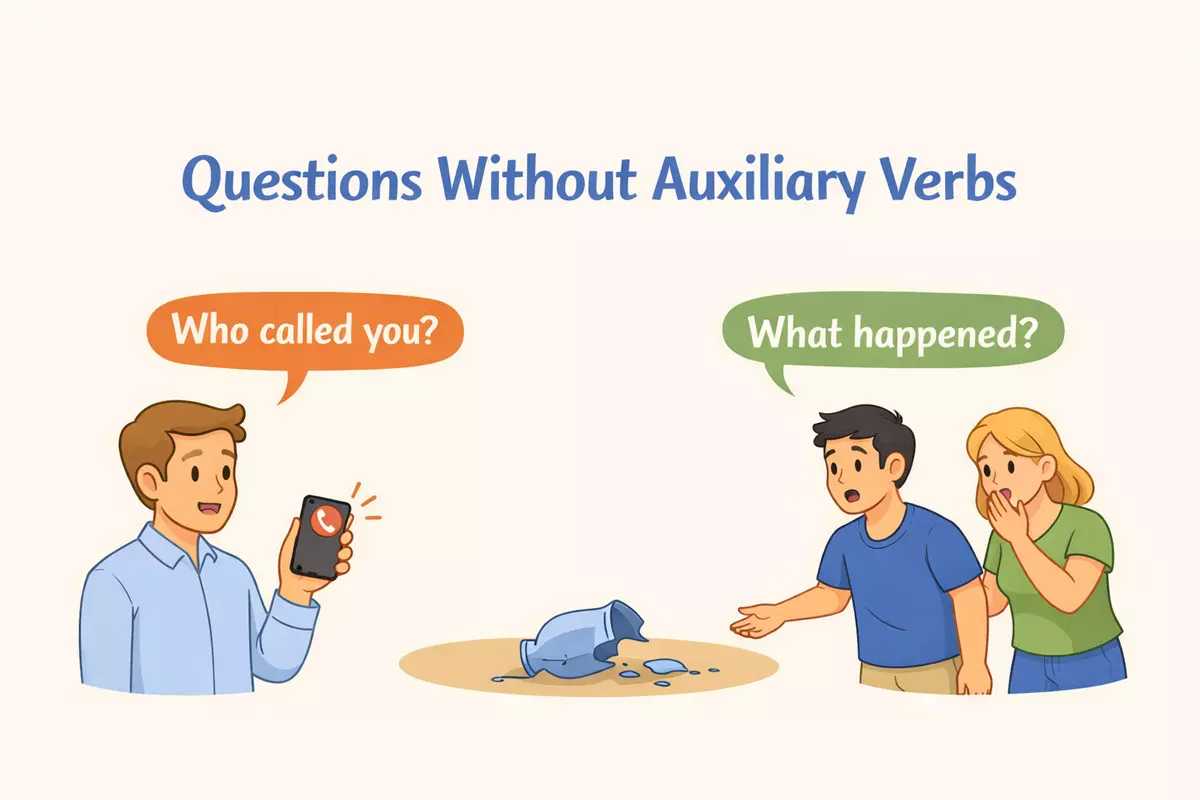 This article explains questions in English that do not use auxiliary verbs, focusing on subject questions. It covers when auxiliaries are omitted, key question words, word order, common mistakes, and includes practice exercises.
Curious about forming questions in English without using helping verbs? This article explains the rules and patterns behind such inquiries, clarifying when and why they are used in daily conversation. It also offers straightforward examples to help you recognize and construct these types of questions, making the process easier for both learners and advanced speakers. By understanding these guidelines, you can improve your communication skills and gain a deeper insight into the structure of English questions.
What Questions Without Auxiliaries Are
Not all English questions rely on auxiliary verbs like do, be, or have. In certain cases, especially with the verb be as a main verb, modal verbs, or in some informal or archaic structures, questions are formed without inserting an extra helping verb. Understanding these patterns helps you notice the difference between standard question forms and those that omit auxiliaries entirely.
When Are Auxiliary-Free Questions Used?
You’ll see questions without auxiliaries most often in these situations:
- When be is the main verb: Is she ready?
- With modal verbs: Can you swim?, Should we leave?
- In some informal or archaic questions: You coming?, What time you finish?
- With subject questions (when the question word is the subject): Who called?, What happened?
Typical Patterns Without Auxiliary Verbs
Questions that skip auxiliary verbs usually follow one of these patterns:
- Be as the first word: Are you tired?
- Modal verb (can, will, should, etc.) at the start: Will they help?
- Question word as subject, then main verb: Who knows the answer?
- Short, informal spoken forms: You hungry?
Examples for Reference
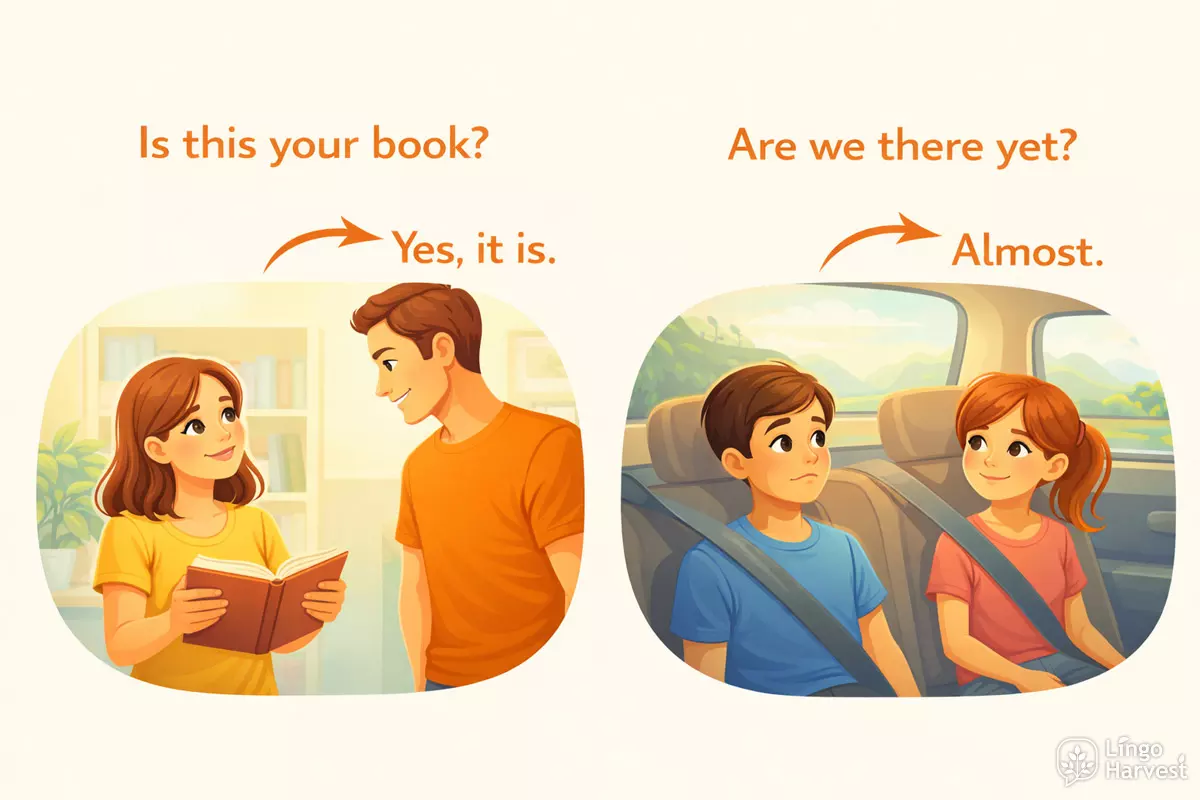
Here are some common examples of questions that do not use any auxiliary verb:
- Who broke the window? → Tom did.
- What caused the noise? → A car alarm.
- Which team won? → The home team.
- How many people came? → About twenty.
- Is this your book? → Yes, it is.
- Are we there yet? → Almost.
- Can you help? → Yes, I can.
- Should I call? → Yes, you should.
- Will it rain? → Probably.
- Why bother? → Because it matters.
- You finished? → Yes, I did.
- Anyone home? → Yes, I am.
- What time the train leaves? → At six thirty.
- Who wants pizza? → I do.
- What happens next? → We wait.
- Where is she? → At work.
- How is your day? → It’s going well.
Comparing Forms: With vs. Without Auxiliaries
| With Auxiliary | Without Auxiliary |
|---|---|
| Did you see her? | Who saw her? |
| Do they know the answer? | Who knows the answer? |
| Are you coming? | You coming? |
| Do you want pizza? | Who wants pizza? |
| Did it happen? | What happened? |
Recognizing when to leave out an auxiliary verb helps you create more natural questions and understand the nuances of both formal and informal English. Some question forms are only possible without an auxiliary, especially those where the question word is the subject.
When Auxiliaries Are Not Used
In English, not every question needs a helping verb like "do," "does," or "did." Certain types of sentences form questions by reordering words or using specific verbs, so extra support words aren’t required. This is common with the verb "to be," modal verbs, and in some set expressions. Understanding these patterns helps you ask direct questions clearly and naturally.
Questions with "To Be" as a Main Verb
When "to be" (am, is, are, was, were) acts as the main verb, questions are formed by simply inverting the subject and verb. No other auxiliary is needed. Here are some examples:
- Are you ready? → Yes, I am.
- Is she your teacher? → Yes, she is.
- Was it difficult? → Yes, it was.
- Were they at home? → No, they weren’t.
Questions with Modal Verbs
Modal verbs (can, could, will, would, shall, should, may, might, must) also allow direct question formation without extra auxiliaries. The modal comes first, followed by the subject and the base form of the main verb:
- Can you swim? → Yes, I can.
- Should I call? → Yes, you should.
- May we begin? → Yes, you may.
- Will they arrive soon? → Yes, they will.
- Must I finish this? → Yes, you must.
Subject Questions (Who/What as Subject)
When the question word itself is the subject, there’s no need for inversion or an auxiliary. The word order stays the same as in statements:
- Who called you? → She did.
- What happened? → An accident happened.
- Which car broke down? → The blue one.
- Who won the game? → Our team did.
- What caused the noise? → A loud bang.
Set Phrases and Polite Offers
Some questions are so set in the language that they don’t need extra support words. This is especially true for offers and requests:
- Need any help? → Yes, please.
- Want a drink? → Yes, I do.
- Care to join us? → Sure.
- Got a minute? → Yes, I have.
- Feeling okay? → Yes, I am.
Summary of Common Patterns
| Pattern | Example |
|---|---|
| Inversion with "to be" | Is she coming? |
| Modal verb first | Can you help? |
| Question word as subject | Who left? |
| Set phrase (informal) | Need a hand? |
Recognizing these structures makes forming and understanding direct questions much easier. Try listening for them in conversation or reading, and you’ll notice how often English skips auxiliaries in these cases.
Subject Questions Explained
When forming questions in English, sometimes the auxiliary verb is not needed. This happens most often when the question word is actually the subject of the sentence. In these cases, the structure is much simpler: the word order stays the same as in a statement, and no auxiliary verb (like do/does/did) is used.
How Subject Questions Work
Unlike typical questions where the auxiliary verb comes before the subject, subject questions place the question word (who, what, which) directly in the subject’s position. The rest of the sentence follows the normal statement order. This is why you might hear, “Who called you?” instead of “Who did call you?”
Here’s the basic pattern:
- Question word (as subject) + verb + rest of sentence?
Notice that the verb agrees with the unknown subject, and no auxiliary is needed.
Common Subject Question Words
- Who
- What
- Which
- Whose (sometimes, when it refers to the subject)
Examples of Subject Questions
- Who opened the door? → John did.
- What happened last night? → A storm hit the area.
- Which student answered first? → Emma did.
- Who knows the answer? → The teacher does.
- What made you laugh? → His joke did.
- Which team won the match? → The home team did.
- Who wants coffee? → I do.
- What caused the noise? → A falling box did.
- Which book belongs to you? → The red one does.
- Who broke the window? → The kids did.
- What started the fire? → A faulty wire did.
- Which car arrived first? → The taxi did.
- Who forgot their keys? → Mark did.
- What inspired you? → Her story did.
- Which animal escaped? → The rabbit did.
- Who finished the project? → Our team did.
- What fell off the shelf? → A glass did.
- Which artist painted this? → Picasso did.
Subject vs. Object Questions
It’s easy to confuse these with object questions, which do use auxiliaries. Here’s a quick comparison to help you spot the difference:
| Subject Question | Object Question |
|---|---|
| Who called you? | Who did you call? |
| What happened? | What did you see? |
| Which car stopped? | Which car did you buy? |
| Who knows the truth? | Who do you know? |
Notice how subject questions do not need an auxiliary verb, while object questions do. This distinction is a key part of forming questions without auxiliary verbs in English.
Common Question Words Without Auxiliaries
When forming direct questions in English, it's not always necessary to use auxiliary verbs like "do," "does," or "did." In many cases, certain interrogative words can introduce questions independently, especially when the verb "to be" is the main verb, or when asking about the subject of the sentence. Recognizing these patterns can help you create more natural and efficient questions.
Frequently Used Interrogative Words
Some question words frequently stand alone at the beginning of sentences without requiring an auxiliary verb. These are especially common in everyday conversation and informal writing. Here are some typical examples:
- Who – for asking about a person (subject): Who called you?
- What – for asking about things or information (subject): What happened?
- Which – for asking about a choice among options (subject): Which arrived first?
- Whose – for asking about possession (subject): Whose bag is on the table?
- Where – when the main verb is "be": Where is your brother?
- When – with "be": When was the meeting?
- Why – with "be": Why is she upset?
- How – with "be": How are you?
- How many – asking about quantity (subject): How many came?
- How much – asking about amount (subject): How much remains?
Subject Questions vs. Object Questions
Subject questions in English do not require an auxiliary verb because the question word itself acts as the subject. This is different from object questions, which usually need an auxiliary. For instance:
- Who made this cake? (subject question – no auxiliary needed)
- What broke the window? (subject question – no auxiliary needed)
- Who did you see? (object question – auxiliary "did" needed)
Examples: With and Without Auxiliaries
To see the difference in structure, compare these forms:
| Question Word | Question Without Auxiliary | Question With Auxiliary |
|---|---|---|
| Who | Who arrived early? | Who did you invite? |
| What | What caused that noise? | What did you hear? |
| Where | Where is my phone? | Where did you put my phone? |
| How many | How many joined? | How many did you invite? |
| Which | Which belongs to you? | Which did you choose? |
Quick Tips
- When the question word is the subject, no auxiliary is needed.
- If the main verb is "be," you can often ask a question without adding another verb.
- For questions about the object, include an auxiliary ("do," "does," "did").
Understanding when to omit auxiliary verbs helps streamline your questions and makes your English sound more natural.
Word Order in These Questions
Understanding the structure of questions that do not use auxiliary verbs is essential for forming correct sentences. In English, many question types—especially those with who, what, or which as the subject—omit the auxiliary verb. These questions rely on a specific arrangement of words that differs from the standard auxiliary-based format.
Basic Structure Without Auxiliary Verbs
When forming such questions, the typical sequence is: Question word + main verb + rest of the sentence. Unlike yes/no questions, there is no inversion of the subject and verb. The subject usually follows the question word directly, with the verb coming after.
- Who called you? → My manager did.
- What happened here? → An accident happened.
- Which car won the race? → The red car did.
- Who made this cake? → My sister did.
- What caused the delay? → Heavy traffic did.
- Who knows the answer? → The instructor does.
- Which student finished first? → Alex did.
- What broke the window? → A ball did.
- Who left the door open? → Someone did.
- Which team scored last? → The visitors did.
- Who wrote this book? → The author did.
- What started the argument? → A misunderstanding did.
- Which movie won the award? → The documentary did.
- Who designed the logo? → A local designer did.
- What ended the meeting? → A final vote did.
- Which animal escaped? → The dog did.
- Who suggested this idea? → One of the team members did.
- What interrupted the lesson? → A fire alarm did.
Comparison: With and Without Auxiliary Verbs
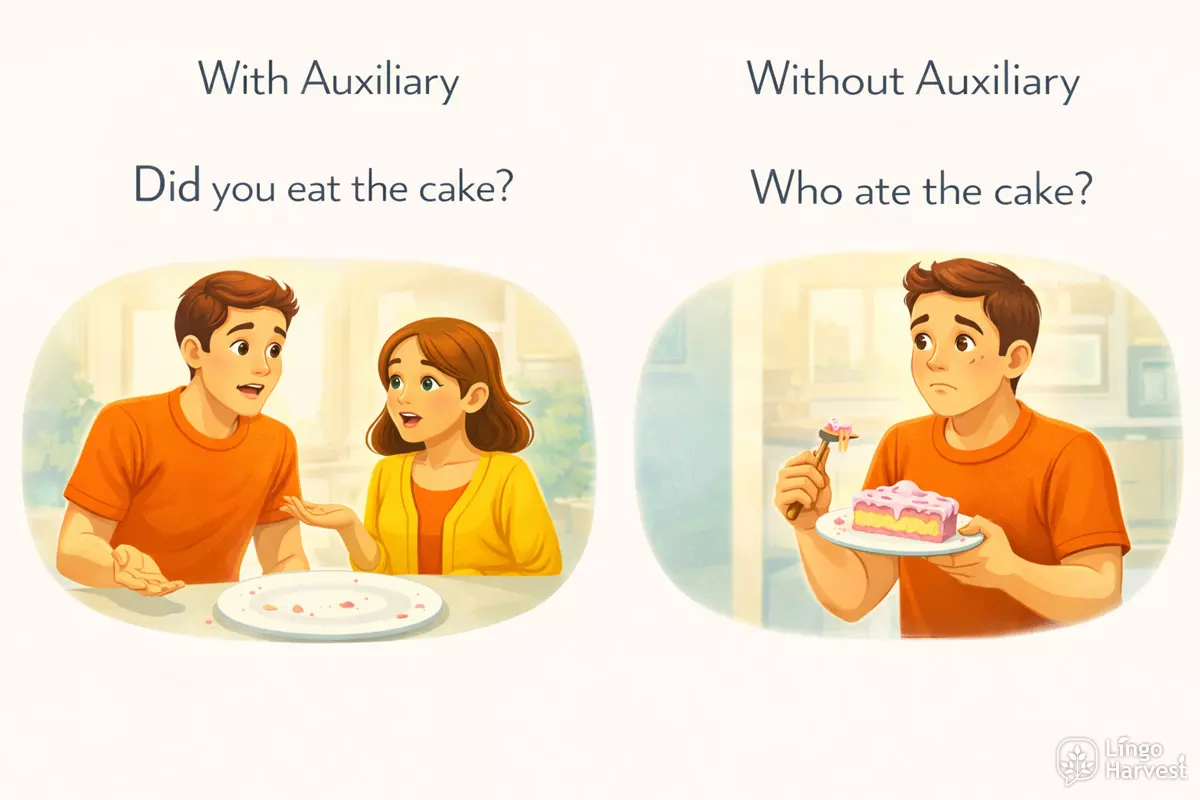
To highlight the difference, compare questions that require auxiliaries with those that do not. The following table shows both forms side by side, making it easier to spot the pattern:
| With Auxiliary | Without Auxiliary |
|---|---|
| Did you eat the cake? | Who ate the cake? |
| Does she know the answer? | Who knows the answer? |
| Did they break the window? | What broke the window? |
| Did the team win the race? | Which team won the race? |
| Did someone call you? | Who called you? |
Key Points to Remember
- The main verb comes directly after the subject in these questions.
- No auxiliary verb is used when the question word is itself the subject.
- These patterns are common with who, what, and which when asking about the subject.
- For questions about objects or additional information, an auxiliary is often required.
Mastering these structures will help you form natural, clear questions in everyday conversation and writing. Recognizing when to omit the auxiliary verb is a small detail that makes a big difference in fluency.
Typical Learner Mistakes
When forming questions without auxiliary verbs, many English learners encounter specific challenges. These errors often arise from transferring rules from standard question forms or from confusion about when to omit auxiliary verbs. Recognizing and addressing these patterns can help students ask questions more naturally and accurately in English.
Common Problems with Direct Question Structure
One major issue is using auxiliary verbs where they are not needed, especially in questions with "be," modal verbs, or when the main verb is "have" (in some varieties of English). Learners might also forget to invert the subject and verb, resulting in statements instead of questions. Here are some typical missteps:
- Adding do/does/did to questions with "be":
❌ Do you are happy? → Are you happy? - Forgetting inversion with "be":
❌ You are ready? → Are you ready? - Using auxiliaries with modal verbs:
❌ Do can you swim? → Can you swim? - Incorrect word order in subject questions:
❌ Who did come? → Who came? - Forgetting to omit "do/does" in present simple with "have" (British English):
❌ Do you have a car? (acceptable in American English, less common in formal British English) - Applying inversion to embedded questions:
❌ I wonder are you coming? → I wonder if you are coming. - Using auxiliary verbs in short answer questions:
❌ Is she does work here? - Using statement order for WH- questions:
❌ Where you live? → Where do you live? - Omitting the subject in direct questions:
❌ Is raining? → Is it raining? - Mixing up main verb and auxiliary in negative questions:
❌ Not you are coming? → Aren’t you coming?
Comparison of Correct vs. Incorrect Forms
| Incorrect Form | Correct Form |
|---|---|
| Do you are a doctor? | Are you a doctor? |
| Where you went? | Where did you go? |
| Who did call you? | Who called you? |
| Do can she drive? | Can she drive? |
| Is raining? | Is it raining? |
| I wonder are they here? | I wonder if they are here. |
| Not you like it? | Don’t you like it? |
Tips to Avoid These Pitfalls
- Remember: Use inversion (verb before subject) for "be" and modal verbs, but not with "do/does" unless needed.
- In subject questions, don’t add auxiliary verbs—just use the main verb.
- For embedded questions, keep the statement order (no inversion).
- Practice listening to native speakers to internalize natural question patterns.
Focusing on these key areas will help learners ask questions more accurately and confidently, reducing common errors in everyday conversation.
Comparison with Standard Questions
When exploring question formation in English, it's essential to understand how sentences without auxiliary verbs differ from regular interrogative forms. Standard questions typically require the use of auxiliary verbs (do, does, did, is, are, etc.), especially when inverting the subject and verb. In contrast, certain question types—especially those involving "who," "what," or "which" as the subject—do not require an auxiliary. Recognizing these differences can help learners form questions more naturally and accurately.
Key Differences in Structure
Questions without an auxiliary verb usually keep the subject-verb-object order, while standard yes/no or wh-questions often invert the subject and auxiliary. The table below highlights these structural contrasts:
| Standard Question (with Auxiliary) | Question Without Auxiliary |
|---|---|
| What did she say? | Who called you? |
| Where are they going? | What happened? |
| Did you see the movie? | Which bus goes downtown? |
| Does he play tennis? | Who knows the answer? |
| Have they finished? | What caused the noise? |
When to Use Each Type
- Use forms without auxiliaries when the question word is the subject (e.g., "Who made this?" not "Who did make this?").
- Standard forms (with auxiliaries) are used when asking about the object or other sentence elements (e.g., "What did you make?").
- Questions without auxiliaries typically do not work for yes/no questions.
Examples of Common Patterns
These patterns help clarify when to omit the auxiliary:
- Who knows the answer?
- What happened last night?
- Which student arrived first?
- Who broke the window?
- What caused the delay?
- Which team won?
- Who needs help?
- What comes next?
- Which book belongs to you?
- Who called this morning?
- What follows this step?
- Which train stops here?
- Who wants coffee?
- What worries you?
- Which solution works best?
- Who knows the rules?
- What remains to do?
- Which car is yours?
Summary
Understanding the contrast between these two types of questions helps avoid common mistakes, such as adding unnecessary auxiliaries or misplacing the question word. Mastering both forms also supports clearer, more natural English in both spoken and written contexts.
Practice Exercises and Self-Check
To help you master forming questions without auxiliary verbs, try the following activities. These exercises focus on identifying direct questions, creating your own, and spotting common mistakes. Remember, such questions often use the verb “be,” modal verbs, or the simple present/past with “who,” “what,” or “which” as the subject.
Identify the Correct Question Form
Choose the version that does not use an auxiliary verb:
- Who broke the window?
- Did who break the window?
- Who did break the window?
- Who opened the door?
- Did who open the door?
- Who did open the door?
- Who called the police?
- Did who call the police?
- Who did call the police?
- Who finished the report?
Show answers
- Who broke the window?
- Incorrect
- Incorrect
- Who opened the door?
- Incorrect
- Incorrect
- Who called the police?
- Incorrect
- Incorrect
- Who finished the report?
Transform Statements into Direct Questions
Rewrite each statement as a question without adding an auxiliary verb:
- John visited the museum.
- That noise woke you up.
- Mary knows the answer.
- Someone called last night.
- The storm damaged the roof.
- His comment caused confusion.
- The teacher explained the rule.
- Something broke the machine.
- A student solved the problem.
- This message surprised everyone.
Show answers
- Who visited the museum?
- What woke you up?
- Who knows the answer?
- Who called last night?
- What damaged the roof?
- What caused confusion?
- Who explained the rule?
- What broke the machine?
- Who solved the problem?
- What surprised everyone?
Practice: Subject vs. Object Questions
Decide if each example is a subject or object question:
- Who finished the project?
- What did you eat?
- Which team won?
- Who did you invite?
- What caused the delay?
- Who did she call?
- Which car broke down?
- What did they build?
- Who wrote the report?
- What did he forget?
Show answers
- Subject question
- Object question
- Subject question
- Object question
- Subject question
- Object question
- Subject question
- Object question
- Subject question
- Object question
Common Patterns: Direct Question Forms
Here are typical patterns for questions without auxiliary verbs. Notice how the question word is immediately followed by the verb:
- Who made this cake?
- Which book won the prize?
- What caused the problem?
- Who knows the answer?
- Which student arrived first?
- Who left the door open?
- What happened here?
- Who called you?
- Which car belongs to you?
- What made you laugh?
- Who told you that?
- Which player scored?
Table: Subject Questions vs. Object Questions
Compare how the structure changes when the question word is the subject versus when it is the object.
| Subject Question (no auxiliary) | Object Question (auxiliary used) |
|---|---|
| Who broke the vase? | What did you break? |
| Which player scored? | Which team did you support? |
| What caused the delay? | Who did you call? |
| Who made this decision? | What did they make? |
Self-Check: Make Your Own
Write three questions without auxiliary verbs using “who,” “what,” or “which” as the subject. Try using a variety of verbs and topics. Then, check your questions with the examples above.
Spot the Error
Which question below is incorrect? Explain why.
- Who ate the last cookie?
- Who did eat the last cookie?
- Who broke the window?
- Who did break the window?
- Who called you yesterday?
- Who did call you yesterday?
- Who opened the door?
- Who did open the door?
- Who solved the problem?
- Who did solve the problem?
Show answers
- Correct. “Who” is the subject, so no auxiliary verb is needed.
- Incorrect. “Did” is not used when “who” is the subject.
- Correct. Subject question without an auxiliary.
- Incorrect. Auxiliary “did” is unnecessary in subject questions.
- Correct. “Who” functions as the subject.
- Incorrect. Subject questions do not use “did.”
- Correct. Normal subject question form.
- Incorrect. Adding “did” makes the structure wrong.
- Correct. Simple past subject question.
- Incorrect. “Did” should not be added when “who” is the subject.