How to Use Modal Verbs in English Questions

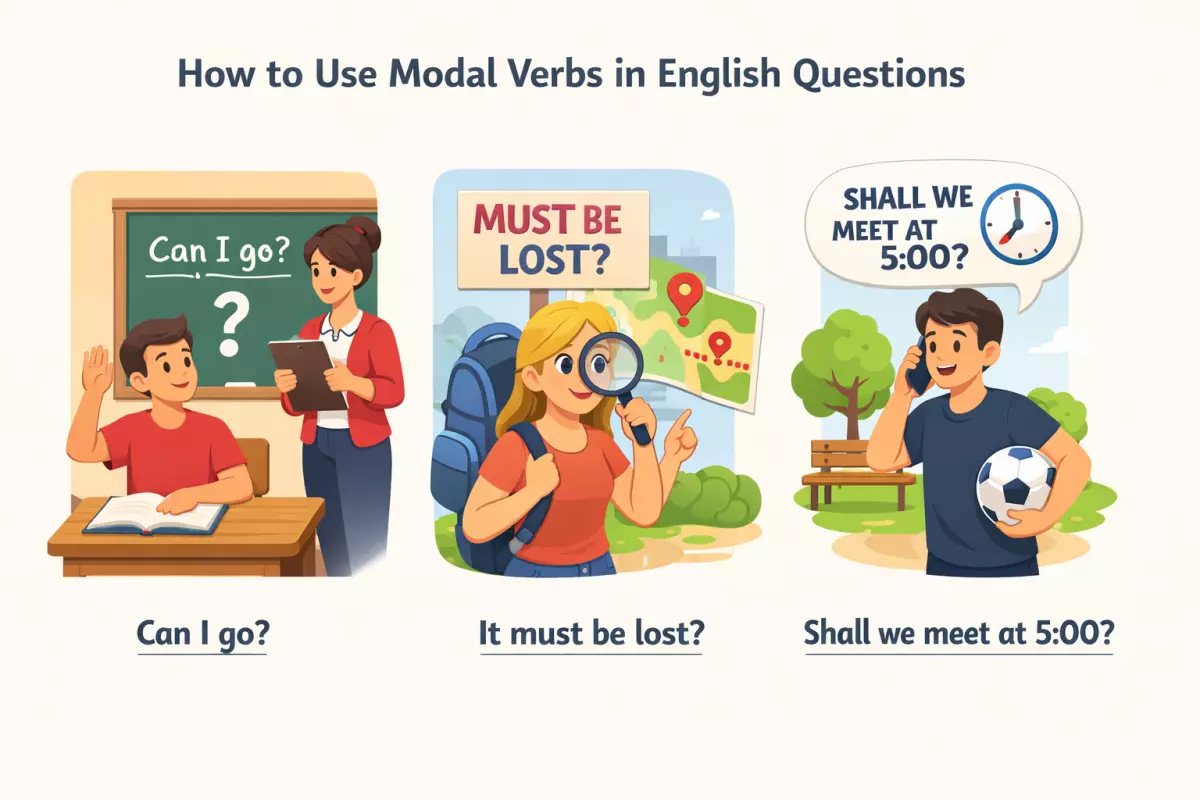 Learn how to form questions with modal verbs without do, using the right word order. You will see common patterns with can, could, may, and should, how they change tone for requests, offers, and permission, plus everyday examples, typical mistakes, and practice exercises.
- How modal verbs form questions without using the auxiliary 'do'
- The word order used in modal verb questions
- Common question patterns with can, could, may, and should
- How modal verbs change the tone of requests, offers, and permissions
- Examples of modal questions used in everyday conversation
- Typical mistakes learners make when forming modal questions
- Differences between direct questions and polite modal questions
- Exercises and practice tasks on building modal questions
Using modal verbs in questions is a quick way to sound polite, confident, and natural in English. You can use them every day to ask for help, check rules, make suggestions, or express uncertainty, such as Could you open the window, Should we leave now, or Might he be late. This guide explains how to form these question patterns and pick the best option for each situation.
How modal verbs form questions without using the auxiliary 'do'
With modal verbs, questions are formed by inverting the modal and the subject. This means the modal moves to the front, so you do not add do/does/did. The basic pattern is straightforward, and it stays the same across most modals.
Core word order patterns
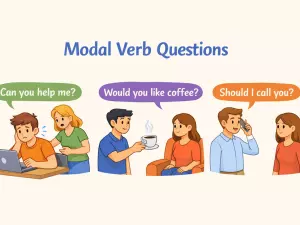
- Yes/No questions: Modal + subject + base verb (+ rest)?
→ Can you swim? / Should we leave now? - Wh- questions: Wh-word + modal + subject + base verb (+ rest)?
→ Where can I park? / Why should they apologize? - Short answers: Yes/No + modal (no main verb repeated).
→ Yes, I can. / No, she shouldn’t. - Negative questions: Modal + subject + not + base verb…? (or contracted modal + n’t).
→ Can you not hear it? / Can’t you hear it?
Examples with common modals (no do-support)
- Can + subject + base verb: Can he join us?
- Could + subject + base verb: Could you open the window?
- May + subject + base verb: May I ask a question?
- Might + subject + base verb: Might they be late?
- Must + subject + base verb: Must we sign this today?
- Shall + subject + base verb: Shall we start?
- Should + subject + base verb: Should I call her now?
- Will + subject + base verb: Will you help me?
- Would + subject + base verb: Would she prefer tea?
- Ought to + subject + base verb: Ought we to tell them?
- Used to + subject + base verb: Used he to live here? (formal; many speakers prefer Did he use to…?)
- Need (modal use) + subject + base verb: Need we wait? (formal; common alternative: Do we need to wait?)
Common mistakes to avoid
- ❌ Do can you swim? → ✅ Can you swim?
- ❌ Does she should go? → ✅ Should she go?
- ❌ Did they must leave? → ✅ Must they leave? (or change meaning with a different structure)
- ❌ Can you to help? → ✅ Can you help? (modal + base verb, no to)
- ❌ Where you can park? → ✅ Where can you park?
Because modals already function as auxiliary verbs, they take the role that do normally plays in questions. The result is a clean inversion pattern: put the modal first, keep the main verb in its base form, and add a question mark.
The word order used in modal verb questions

Modal questions follow a predictable inversion pattern: the modal verb moves in front of the subject, and the main verb stays in its base form. This is the core structure behind questions with can, could, may, might, must, shall, should, will, and would.
Basic pattern (yes/no questions)
- Form: Modal + subject + base verb (+ rest of sentence)?
- Key point: The main verb does not change for tense or person after a modal (no -s, no -ed).
- ✅ Can she drive at night?
- ❌ Can she drives at night?
- ✅ Should we leave now?
- ✅ Would they agree with this plan?
- ✅ Might he arrive late?
- ✅ Must I show my ID?
Wh- questions (information questions)
- Form: Wh-word + modal + subject + base verb (+ rest)?
- Common wh-words: what, where, when, why, who, which, how
- ✅ Where should we meet?
- ✅ Why would she say that?
- ✅ When can you call me?
- ✅ How might this affect costs?
- ✅ Which option should I choose?
Negative questions
- Form: Modal + subject + not + base verb…? (or contracted: modal + n’t + subject + base verb…?)
- Full “not” is often more formal; contractions are more common in speech and informal writing.
- ✅ Should we not wait for them?
- ✅ Shouldn’t we wait for them?
- ✅ Can’t you send it today?
- ✅ Wouldn’t it help to double-check?
Questions with adverbs and time expressions
- Place frequency adverbs (always, ever, just, really) after the subject and before the main verb.
- ✅ Can you really finish by Friday?
- ✅ Should we ever mention this again?
- ✅ Could she just sign here?
- Time expressions usually go later in the sentence.
- ✅ Can we meet tomorrow?
- ✅ Might they respond this afternoon?
Short answers and echo questions
- Short answers repeat the modal, not the main verb.
- ✅ “Can you swim?” “Yes, I can.” / “No, I can’t.”
- ✅ “Should we go?” “Yes, we should.”
- Echo questions often repeat the modal to confirm what was said.
- ✅ “I might be late.” “You might?”
Common word-order mistakes to avoid
- Do not add do/does/did with a modal. ❌ Do you can…? → ✅ Can you…?
- Do not put “to” before the main verb after a modal. ❌ Can you to help? → ✅ Can you help?
- Do not change the main verb form after the modal. ❌ She can goes. → ✅ She can go.
- Keep inversion in questions; avoid statement order. ❌ You can help me? → ✅ Can you help me?
Common question patterns with can, could, may, and should
These modals form questions by placing the modal before the subject, followed by the base verb. The choice of modal signals ability, possibility, permission, or advice, and it also changes the level of formality or politeness.
Core word order to remember
- Modal + subject + base verb: Can you help? / Could she join? / May I leave? / Should we call?
- Modal + subject + not + base verb (or contracted): Can’t you stay? / Shouldn’t we wait?
- Question word + modal + subject + base verb: Where can we park? / Why should I apologize?
- Short answers: Yes, I can. / No, he can’t. / Yes, you may. / No, we shouldn’t.
Patterns with can (ability, practical possibility, informal permission)
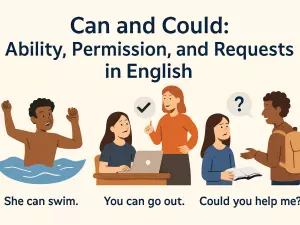
- Ability: Can you swim? / Can she drive a manual car?
- Practical possibility: Can we meet on Tuesday? / Can this door be opened from inside?
- Informal permission: Can I use your phone? / Can we sit here?
- Availability: Can you talk right now? / Can your manager speak to us today?
- Question-word form: How can I reset my password? / When can we start?
Patterns with could (polite requests, past ability, tentative suggestions)
- Polite request: Could you open the window? / Could you send that again?
- Polite permission request: Could I leave early today? / Could we borrow your charger?
- Past ability (general): Could you read when you were four? / Could he run fast as a child?
- Tentative possibility: Could this be a mistake? / Could the train be delayed?
- Suggestion framed as a question: Could we try a different approach? / Could you meet me halfway?
Patterns with may (formal permission, cautious possibility)
- Formal permission request: May I come in? / May we begin the meeting?
- Giving permission (often in replies): Yes, you may. / No, you may not.
- Cautious possibility: May this cause side effects? / May the results vary?
- Question-word form (more formal): When may I schedule the appointment? / Where may we leave our bags?
- Common contrast: ✅ May I speak to Dr. Lee? ❌ May you speak to Dr. Lee? (permission requests usually use “I/we,” not “you”)
Patterns with should (advice, expectations, “best choice”)
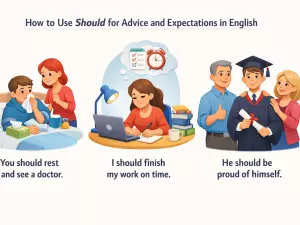
- Advice: Should I tell her the truth? / Should we take an umbrella?
- Asking for recommendations: What should I wear? / Which option should we choose?
- Checking expectations: Should the package arrive today? / Should this button light up?
- Negative advice: Shouldn’t you rest? / Shouldn’t we confirm the address first?
- Soft criticism or surprise: Should you really be driving in this weather? / Should he be speaking to customers like that?
Quick “which modal fits?” cues
- Can → ability or practical “is it possible?” in everyday situations.
- Could → more polite than can, or more tentative/less certain.
- May → formal permission or careful possibility (common in rules and official contexts).
- Should → advice, best action, or what is expected to happen.
How modal verbs change the tone of requests, offers, and permissions
In questions, modal verbs often signal how direct, polite, cautious, or formal you want to sound. Small changes (for example, can vs. could) can shift a question from casual to more respectful, or from confident to tentative. The patterns below show how speakers adjust tone when asking for help, offering assistance, or asking/giving permission.
Requests: choosing a softer or more direct question
- Can + subject + base verb...? (neutral, everyday)
Example: Can you email me the file? - Could + subject + base verb...? (more polite, less direct)
Example: Could you email me the file? - Would + subject + base verb...? (polite, often used for favors)
Example: Would you email me the file? - Would you mind + -ing...? (very polite; expects “no” to mean “no problem”)
Example: Would you mind emailing me the file? - Could you possibly...? (extra soft; useful for bigger requests)
Example: Could you possibly cover my shift? - Can you just...? (can sound pushy; use carefully)
Example: Can you just sign this now? - Will + subject + base verb...? (direct; can sound like an instruction)
Example: Will you send it by noon? - Would + subject + be able to...? (polite and practical; focuses on ability/availability)
Example: Would you be able to send it by noon? - May + subject + base verb...? (formal; less common in casual speech)
Example: May I ask you a quick question? - Might + subject + base verb...? (very tentative; often used to avoid pressure)
Example: Might you have time to review this today? - ✅ Could you help me? → polite request
❌ Could you to help me? (no to after a modal)
Offers: sounding friendly, helpful, or careful
- Can I + base verb...? (friendly offer; common)
Example: Can I help you with that? - Shall I + base verb...? (British English; polite, service-style)
Example: Shall I open the window? - Would you like me to + base verb...? (polite; gives the listener control)
Example: Would you like me to call them for you? - Should I + base verb...? (checks preference; can sound like advice)
Example: Should I book the earlier train? - Do you want me to + base verb...? (informal; can sound blunt in formal settings)
Example: Do you want me to send a reminder? - I can + base verb... as an offer (confident, practical)
Example: I can pick you up at 7. - I could + base verb... as a tentative offer (less pressure)
Example: I could pick you up if you want. - Would you like + noun...? (polite offer of a thing)
Example: Would you like some water?
Permission: asking, giving, and refusing politely
- Can I + base verb...? (common, neutral)
Example: Can I leave a bit early? - Could I + base verb...? (more polite; often used with strangers/authority)
Example: Could I leave a bit early? - May I + base verb...? (formal; careful tone)
Example: May I come in? - Is it OK if I + present...? (soft, collaborative)
Example: Is it OK if I use your laptop? - Would it be OK if I + past...? (very polite; “past” makes it more tentative)
Example: Would it be OK if I used your laptop? - You can... (permission granted; neutral)
Example: You can take Friday off. - You may... (formal permission; sounds official)
Example: You may begin the test. - You can’t / You may not... (refusal; may not is formal)
Example: You may not park here. - Could you...? is not permission (it’s a request)
Example: Could you open the window? (asking someone to do it) - Could I...? is permission (asking to do it yourself)
Example: Could I open the window? (asking if it’s allowed)
Quick pattern notes that affect tone
- Could and would often sound more polite than can and will, especially with strangers or in workplace emails.
- May is formal and can sound distant; it fits announcements, rules, and official situations.
- Adding softeners changes the feel of the question: please, just, a bit, possibly. Use just carefully because it can minimize the other person’s effort.
- Negative permission is sensitive: can’t is common; may not is stricter and more rule-focused.
- Modal questions keep the base verb form: Can you help? (not can you helps).
Examples of modal questions used in everyday conversation
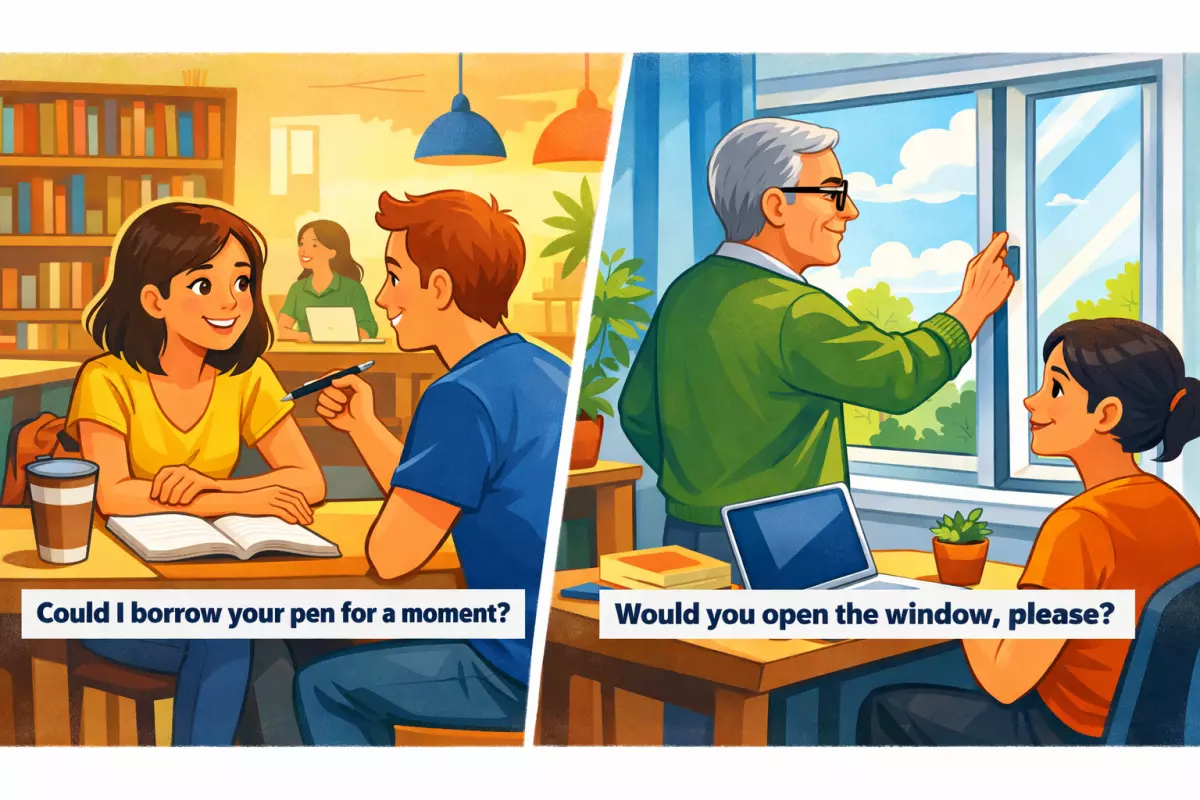
In real-life English, modal questions help you ask about permission, ability, possibility, advice, obligation, and polite requests. The most common pattern is Modal + subject + base verb (for example, “Can you help…?”), and the meaning changes depending on the modal you choose.
Permission and polite requests (can, could, may, would)
- Can I sit here?
- Could I borrow your pen for a moment?
- May I leave a little early today?
- Would you open the window, please?
- Could you speak a bit more slowly?
- Would you mind waiting for five minutes?
- Can you send me the file when you have time?
- Could you tell me where the nearest bus stop is?
Use could and would to sound more indirect and polite. With “Would you mind…?”, the verb after mind is usually an -ing form (“mind waiting”), not the base verb.
Ability and skills (can, could)
- Can you drive?
- Can she swim?
- Could you read when you were four?
- Can you hear me clearly?
- Could he finish the report by himself?
For present ability, can is typical. For past general ability, could is common (“Could you read when you were four?”). For a single successful past action, English often prefers “Was/Were you able to…?” rather than “Could you…?”
Possibility and probability (might, may, could, should)
- Could it be true?
- May it rain later?
- Might they be stuck in traffic?
- Could this be the right address?
- Should we expect delays?
When you’re guessing or considering options, might and could often suggest uncertainty. Should can ask about what is likely or expected based on what you know.
Advice and suggestions (should, could, shall)
- Should I call them now or wait?
- What should we do next?
- Should he apologize?
- Could you try restarting your phone?
- Shall we order food or cook?
Should is the standard choice for advice questions. Shall we…? is common for suggestions, especially in British English, and it often sounds cooperative and practical.
Obligation and rules (must, have to)
- Do I have to fill out this form?
- Do we have to wear badges?
- Must I sign here?
- Do they have to pay today?
- Must we finish by 5 p.m.?
Questions about obligation often use have to with do/does/did (“Do I have to…?”). Must is also possible, but it can sound more formal or rule-focused in everyday conversation.
Common accuracy reminders (form and word order)
- ✅ Can you help me? → ❌ Can you helps me? (use the base verb after a modal)
- ✅ Should we leave now? → ❌ Do should we leave now? (don’t add “do” with a modal)
- ✅ Could you tell me where it is? → ❌ Could you tell me where is it? (use statement word order in embedded questions)
Typical mistakes learners make when forming modal questions
Errors with modal-verb questions usually come from mixing up word order, adding unnecessary auxiliary verbs, or using the wrong modal for the meaning. The fixes are mostly pattern-based: place the modal before the subject, keep the main verb in base form, and choose a modal that matches time and certainty.
Common pattern and word-order problems
- Keeping statement word order instead of inverting: ❌ She can help? → ✅ Can she help?
- Adding “do/does/did” with a modal: ❌ Do you can drive? → ✅ Can you drive?
- Doubling auxiliaries (modal + another auxiliary without a reason): ❌ Can you are coming? → ✅ Are you coming? or Can you come?
- Forgetting the subject after the modal: ❌ Can go now? → ✅ Can I go now?
- Misplacing question words (wh- words): ❌ You can go where? → ✅ Where can you go?
- Using a full question when an embedded question is needed: ❌ Do you know where can I park? → ✅ Do you know where I can park?
- Using “is/are” when the structure needs a modal: ❌ Are you able to help? (possible, but different) → ✅ Can you help? (more direct and common)
Verb-form mistakes after modals
- Using “to” after a modal: ❌ Can you to send it? → ✅ Can you send it?
- Using -ing after a modal (when you mean a simple action): ❌ Can you helping me? → ✅ Can you help me?
- Using the past form after a modal: ❌ Can you went yesterday? → ✅ Could you go yesterday? (rare/odd) or better: Were you able to go yesterday?
- Forgetting “have” in perfect modal questions: ❌ Should I done it? → ✅ Should I have done it?
- Mixing perfect and simple time: ❌ Must you have go now? → ✅ Must you go now? (present) / Must you have gone already? (past inference)
Choosing the wrong modal for the meaning
- Using “must” for polite requests: ❌ Must you open the window? → ✅ Could you open the window? / Would you open the window?
- Confusing ability with permission: ❌ Can I use your phone? (common, but informal) → ✅ May I use your phone? (more formal) / Could I use your phone? (polite)
- Using “could” only as past ability: learners often avoid it for polite questions. ✅ Could you help me? is a present-time polite request, not a past-time question.
- Mixing “should” and “must”: ❌ Should I wear a seatbelt? (sounds like advice) → ✅ Must I wear a seatbelt? (rule/obligation) or Do I have to wear a seatbelt?
- Using “will” when you mean willingness, not future: ❌ Will you be able to help now? (future-leaning) → ✅ Can you help now? / Could you help now?
Negative and short-answer issues
- Placing “not” in the wrong spot: ❌ Can not you come? → ✅ Can’t you come? / Can you not come? (different emphasis; often sounds formal or annoyed)
- Using the wrong short answer auxiliary: ❌ Yes, I do. (to Can you...?) → ✅ Yes, I can.
- Answering with the main verb instead of the modal: ❌ Yes, I go. → ✅ Yes, I can. / No, I can’t.
- Confusing “needn’t” and “don’t need to” in questions: ✅ Need I bring anything? (formal) / Do I need to bring anything? (neutral, common)
When checking a modal question, focus on three checkpoints: modal first, subject second, base verb third. Then confirm the meaning (permission, ability, obligation, advice, probability) matches the modal you chose.
Differences between direct questions and polite modal questions
In English, question style changes the social meaning. A direct question often sounds efficient and task-focused, while a modal question softens the request, adds respect, or gives the listener room to refuse. The grammar signals this difference through verb choice (can/could/will/would/may), tense distance, and extra polite framing.
Key usage differences
- Purpose and tone: Direct forms ask for information or action plainly; modal forms often function as requests, offers, or permission checks.
- Verb pattern: Direct questions commonly use do/does/did or a simple auxiliary inversion; polite versions typically lead with a modal + subject + base verb.
- “Distance” for politeness: could/would often sound more polite than can/will because they create a more tentative, less demanding tone.
- Listener choice: Modal requests imply “if it’s possible/if you don’t mind,” which reduces pressure compared with a bare imperative or blunt question.
- Context sensitivity: With strangers, customers, teachers, or formal situations, modal questions are usually safer; with close friends, direct forms may sound normal and friendly.
- Permission vs. ability: Can can mean ability or informal permission; may is more clearly permission-focused and more formal.
- Common add-ons: Phrases like “please,” “just,” “a moment,” or “if you can” often appear with modal questions to soften them further.
- Negative questions: Polite negatives can sound like gentle suggestions (✅ “Couldn’t you email it?”), but they may also sound critical in some contexts, so use carefully.
Direct vs. modal: practical contrasts
| Direct question (more blunt/efficient) | Polite modal question (softer/more respectful) |
|---|---|
| Do you have a pen? | Could you lend me a pen? |
| Where is the bathroom? | Could you tell me where the bathroom is? |
| Open the window? | Would you mind opening the window? |
| Are you free tomorrow? | Would you be free tomorrow? |
| Can I leave early? | May I leave early? |
| Will you call me later? | Could you call me later? |
Patterns to copy
- Modal + subject + base verb: “Could you send the file?” / “Would you check this?”
- Could/Would + you + possibly: “Could you possibly reschedule?” (adds extra softness)
- Would you mind + -ing: “Would you mind waiting a minute?” (more formal; expects “No, not at all.”)
- Could you tell me + embedded question: “Could you tell me what time it starts?” (no inversion inside the embedded clause)
- May I + base verb: “May I ask a question?” (formal permission)
Example bank (direct → more polite)
- “What’s your name?” → “Could I have your name, please?”
- “Give me a minute.” → “Could you give me a minute?”
- “Send it today.” → “Could you send it today?”
- “Do you know the answer?” → “Would you happen to know the answer?”
- “Is this seat taken?” → “Would you mind if I sat here?”
- “Where do I sign?” → “Could you show me where to sign?”
- “Can you repeat that?” → “Could you repeat that, please?”
- “Are you using this?” → “Could I use this for a moment?”
- “Do you want to meet now?” → “Would you like to meet now?”
- “Will you help me?” → “Would you be able to help me?”
- “Do you have time?” → “Could you spare a moment?”
- “Is it okay if I open the window?” → “Would it be okay if I opened the window?”
Exercises and practice tasks on building modal questions
Use these tasks to practice the most common question patterns with modal verbs: modal + subject + base verb, plus the related negatives, short answers, and question tags. Focus on word order first, then on choosing the modal that matches meaning (ability, permission, advice, obligation, possibility, deduction).
1) Build the question (word order)
Reorder the words to make correct questions. Write the full question with correct capitalization and punctuation.
- (you / can / help / me)
- (we / should / leave / now)
- (she / might / be / late)
- (they / must / pay / today)
- (I / could / use / your phone)
- (he / may / come / in)
- (your brother / can / drive)
- (it / might / rain / later)
- (we / must / show / ID)
- (you / should / tell / her)
Show answers
- Can you help me?
- Should we leave now?
- Might she be late?
- Must they pay today?
- Could I use your phone?
- May he come in?
- Can your brother drive?
- Might it rain later?
- Must we show ID?
- Should you tell her?
2) Choose the best modal for the meaning
Complete each question with one modal: can, could, may, might, should, must. Choose the option that best fits the situation.
- _____ I open the window? (polite permission)
- _____ you swim when you were five? (past ability)
- _____ we book in advance? (recommendation)
- _____ she be at work already? (possibility)
- _____ I borrow your pen for a moment? (polite request)
- _____ visitors wear badges here? (rule/obligation)
- _____ you speak French? (present ability)
- _____ he be the new manager? (uncertain guess)
- _____ I leave early today? (formal permission)
- _____ we tell them now or wait? (advice)
- _____ I call you later? (offer/request depending on context)
- _____ we show our tickets at the entrance? (requirement)
Show answers
- May
- Could
- Should
- Could / Might
- Could
- Must
- Can
- Might
- May
- Should
- Can / Could
- Must
3) Make negative questions (and notice the meaning)
Change each prompt into a negative question. Keep the same modal. Negative questions often express surprise, doubt, or a suggestion.
- You can come tomorrow. → (negative question)
- We should call them. → (negative question)
- He could try again. → (negative question)
- She might know the answer. → (negative question)
- They must wear helmets. → (negative question)
- I may join you later. → (negative question)
Show answers
- Can’t you come tomorrow?
- Shouldn’t we call them?
- Couldn’t he try again?
- Mightn’t she know the answer?
- Mustn’t they wear helmets?
- Mayn’t I join you later?
Note: Some negative forms are rare in modern English (especially “mayn’t” and “mightn’t”). In everyday use, speakers often prefer alternatives such as “Can’t I…?” or “Isn’t it possible that…?” depending on meaning.
4) Short answers (yes/no) with modals
Answer each question with a short answer. Use the same modal in the reply (no main verb needed).
- Can you stay a bit longer?
- Should we bring cash?
- May I sit here?
- Could they hear us?
- Might he be busy?
- Must I sign this form?
- Can she drive a manual car?
- Should I email or call?
Show answers
- Yes, I can. / No, I can’t.
- Yes, we should. / No, we shouldn’t.
- Yes, you may. / No, you may not.
- Yes, they could. / No, they couldn’t.
- Yes, he might. / No, he might not.
- Yes, you must. / No, you mustn’t. / No, you don’t have to. (different meaning)
- Yes, she can. / No, she can’t.
- Yes, you should. / No, you shouldn’t. (If it’s a choice question, a full answer is often clearer: “You should email.”)
5) Fix the mistake (common modal-question errors)
Each sentence has one problem (word order, verb form, or extra auxiliary). Rewrite it correctly.
- ❌ Do can you help me?
- ❌ Can you to send it today?
- ❌ Must we to show our passports?
- ❌ Should we going now?
- ❌ Might she knows the answer?
- ❌ Could you please to repeat that?
- ❌ May I am late?
- ❌ Can he drives?
- ❌ Mustn’t we have to pay now?
- ❌ Should I to call you?
Show answers
- ✅ Can you help me?
- ✅ Can you send it today?
- ✅ Must we show our passports?
- ✅ Should we go now?
- ✅ Might she know the answer?
- ✅ Could you please repeat that?
- ✅ May I be late? / Might I be late? (depending on meaning)
- ✅ Can he drive?
- ✅ Must we pay now? / Don’t we have to pay now? (choose one meaning)
- ✅ Should I call you?
6) Question tags with modals
Add a question tag. Match the modal and use the correct polarity (positive statement → negative tag; negative statement → positive tag).
- You can meet us at six, _____?
- She shouldn’t say that, _____?
- They might be late, _____?
- He must wear a helmet, _____?
- We can’t park here, _____?
- I should email them today, _____?
Show answers
- can’t you?
- should she?
- mightn’t they?
- mustn’t he?
- can we?
- shouldn’t I?
Note: Some tags (especially with “might”) are less common in speech; many speakers use simpler tags like “..., right?” in informal contexts.