Direct Speech Punctuation vs Reported Speech Structure

 Here we key punctuation rules for direct speech, including quotation marks, explains how reported speech is structured and why punctuation is dropped, highlights common errors, and describes the process of changing direct speech to reported form.
Conveying spoken words in writing can be challenging, particularly when choosing between presenting someone’s exact words or summarizing their message. It is important to understand the difference between quoting speech directly, which involves using the speaker’s precise language, and rephrasing it indirectly, which captures the essence of what was said without repeating the original wording. Mastering these distinctions helps ensure your writing is clear, accurate, and effective when representing spoken communication.
Key punctuation features of direct speech
When writing out what someone says word for word, there are specific punctuation conventions to follow. These rules help readers clearly distinguish spoken words from the surrounding narrative. Proper use of punctuation in quoted speech makes text easy to follow and avoids confusion about who is speaking and what is being said.
Quotation marks
Direct quotations always appear within quotation marks. In British English, single marks (‘ ’) are common, while American English usually uses double marks (“ ”). The choice depends on style guides, but consistency is key.
Placement of commas and periods
Commas and periods typically go inside the closing quotation marks in American usage, but British style can place them outside if they are not part of the original speech. This subtle difference can affect the overall look of dialogue.
Capitalization
The first word of a complete quote is capitalized, even if it appears mid-sentence. If the quote continues after a reporting clause (like “he said”), the continuation is not capitalized unless it begins a new sentence.
Reporting clauses
When attributing speech, a reporting clause (e.g., she said, he replied) is separated from the direct quote by a comma. If the reporting clause comes before the quote, a comma precedes the opening quotation mark. If it follows, a comma, question mark, or exclamation mark ends the spoken words inside the quotation marks.
Punctuation with questions and exclamations
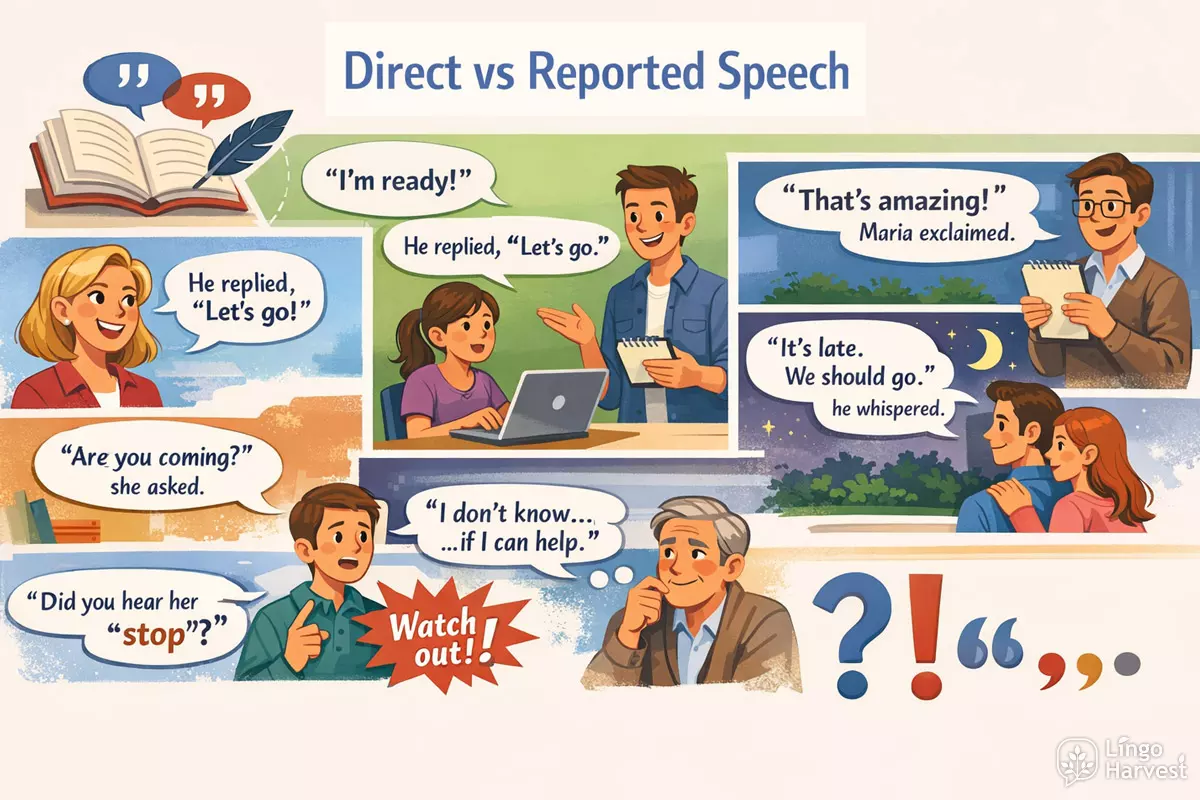
Question marks and exclamation marks stay inside the quotation marks if they are part of the quoted words. If they refer to the whole sentence (not just the quote), they may appear outside.
| Punctuation Feature | Example |
|---|---|
| Quotation marks | “I’m ready,” she said. |
| Comma before quote | He replied, “Let’s go.” |
| End punctuation inside quotes | “Are you coming?” he asked. |
| Reporting clause after quote | “That’s amazing!” Maria exclaimed. |
| Capitalization | She said, “It’s time to start.” |
| Interrupted speech | “I don’t know,” he admitted, “if I can help.” |
| Multiple sentences | “It’s late. We should go,” he whispered. |
| Nested quotation | “Did you hear her say ‘stop’?” |
| Exclamation/question marks | “Watch out!” she shouted. |
| Omitted words (ellipsis) | “Well... maybe,” he muttered. |
Summary of essential points
- Always enclose spoken words in quotation marks.
- Use commas to separate reporting clauses from speech.
- Capitalize the first word of each direct statement.
- Place ending punctuation inside quotation marks when it applies to the speech.
- Use single or double quotation marks for quotations within quotations.
Mastering these conventions ensures your dialogue is clear and professional, reducing ambiguity between narration and what is spoken aloud.
Quotation marks and punctuation rules
Understanding how to use quotation marks and punctuation is essential when writing direct speech and distinguishing it from reported speech. Direct speech requires specific punctuation to clearly indicate the words that are being quoted, while reported speech follows a different structure without quotation marks. Let's explore the main conventions and common pitfalls to help clarify these usages.
Direct Speech: Marking and Punctuation
When quoting someone’s exact words, use quotation marks to enclose the spoken statement. In English, these are typically double (“…”) or single (‘…’) marks, depending on regional preference. Punctuation such as commas, periods, question marks, and exclamation points are placed inside the closing quotation mark if they are part of the quoted material.
- “I love reading,” she said.
- He asked, “Are you coming?”
- ‘Don’t forget your umbrella,’ Mom reminded.
- “Wait!” shouted the coach.
Reported Speech: Structure and Punctuation
Reported speech does not use quotation marks, since it paraphrases what was said rather than quoting the exact words. The punctuation rules for reported speech are more straightforward: the sentence ends with a period unless it’s a question or exclamation.
- She said that she loved reading.
- He asked if I was coming.
- Mom reminded me not to forget my umbrella.
- The coach shouted to wait.
Comparing Direct and Reported Speech
To make the differences clearer, here’s a side-by-side comparison of how punctuation and quotation marks are used in each form:
| Direct Speech Example | Reported Speech Equivalent |
|---|---|
| “I can help you,” he said. | He said that he could help me. |
| She asked, “Where are you going?” | She asked where I was going. |
| “Please sit down,” the teacher said. | The teacher told us to sit down. |
| “I’m so tired!” exclaimed Tom. | Tom exclaimed that he was very tired. |
| “Don’t touch that!” warned Dad. | Dad warned me not to touch that. |
Common Rules and Tips
- Capitalize the first word inside the quotation marks for direct speech.
- Place commas before opening a direct quote if it follows an introductory phrase.
- When splitting a direct quote, use a comma, question mark, or exclamation point before closing the first part, and another set of quotation marks after the interruption (e.g., “I’m not sure,” she said, “if I can go.”).
- For reported speech, do not use quotation marks and adjust pronouns and verb tense as needed.
- Periods and commas in American English go inside quotation marks; in British English, placement depends on whether the punctuation is part of the quoted material.
Mastering these conventions helps avoid confusion and ensures your writing accurately reflects both what was said and how it was said. Consistency in applying these rules is key to clear and professional communication.
Structural features of reported speech
When we transform direct quotes into reported or indirect statements, several grammatical shifts take place. One of the most noticeable changes is the adjustment of pronouns, tenses, and time expressions. These modifications ensure the sentence fits smoothly within the context of the reporting sentence, rather than standing alone as a direct utterance.
Key grammatical transformations
- Pronoun changes: First and second person pronouns in direct speech usually change to third person in reported forms, reflecting the speaker and listener from the reporter’s perspective.
- Tense backshifting: Verbs typically shift one step back in time (e.g., present simple becomes past simple) unless the reporting verb is in the present or the statement is still true.
- Changes in time and place references: Words like “today,” “tomorrow,” or “here” are modified to suit the new perspective, such as “that day,” “the next day,” or “there.”
- No quotation marks: Unlike direct quotations, indirect or reported speech omits quotation marks and often introduces the statement with “that.”
- Reporting verbs: Common reporting verbs include “said,” “told,” “asked,” and “explained,” often followed by “that,” an infinitive, or a question word.
Common patterns in indirect statements
Reported sentences typically follow a consistent structure. The reporting clause comes first, followed by the reported clause. Below is a table showing typical transformations:
| Direct Speech | Reported Speech |
|---|---|
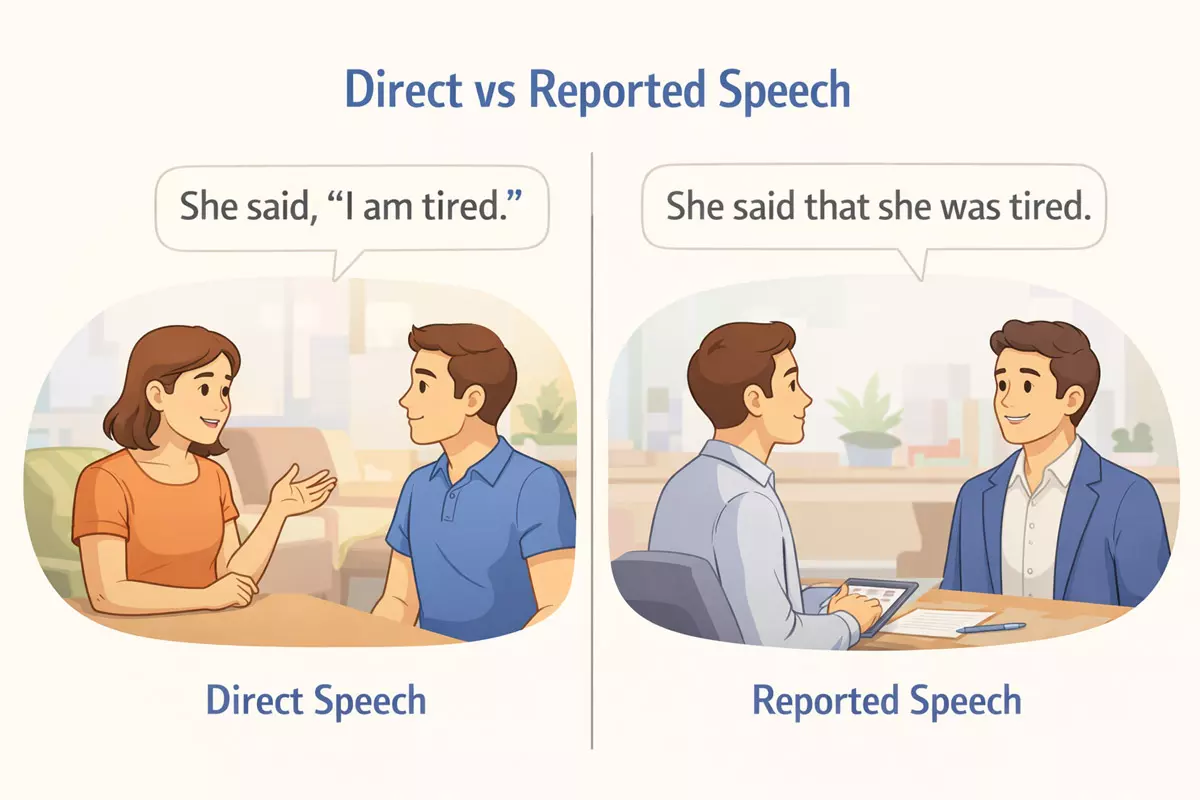
| “I am tired,” she said. | She said that she was tired. |
| “We will go tomorrow,” John explained. | John explained that they would go the next day. |
| “Can you help me?” he asked. | He asked if I could help him. |
| “This is my book,” Anna told me. | Anna told me that that was her book. |
| “Where are you going?” she asked. | She asked where I was going. |
Typical shifts in reported constructions
Several elements are regularly altered when converting direct quotations to the indirect form. Here are some of the most frequent changes:
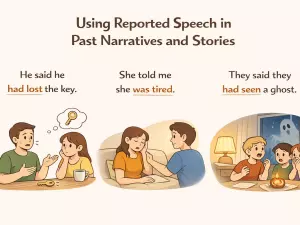
- Present simple → past simple (“I eat” → “he said he ate”)
- Present continuous → past continuous (“I am eating” → “she said she was eating”)
- Present perfect → past perfect (“I have eaten” → “he said he had eaten”)
- Will → would (“I will go” → “she said she would go”)
- Can → could (“I can help” → “he said he could help”)
- May → might (“I may come” → “she said she might come”)
- Here → there (“I am here” → “he said he was there”)
- Today → that day
- Tomorrow → the next day
- Yesterday → the previous day
- Now → then
- This/these → that/those
Indirect speech often requires careful attention to context so that meaning remains clear after all necessary grammatical changes. This process not only distinguishes reported forms from direct speech but also ensures clarity and precision in relaying someone else’s words.
Why punctuation is removed when reporting
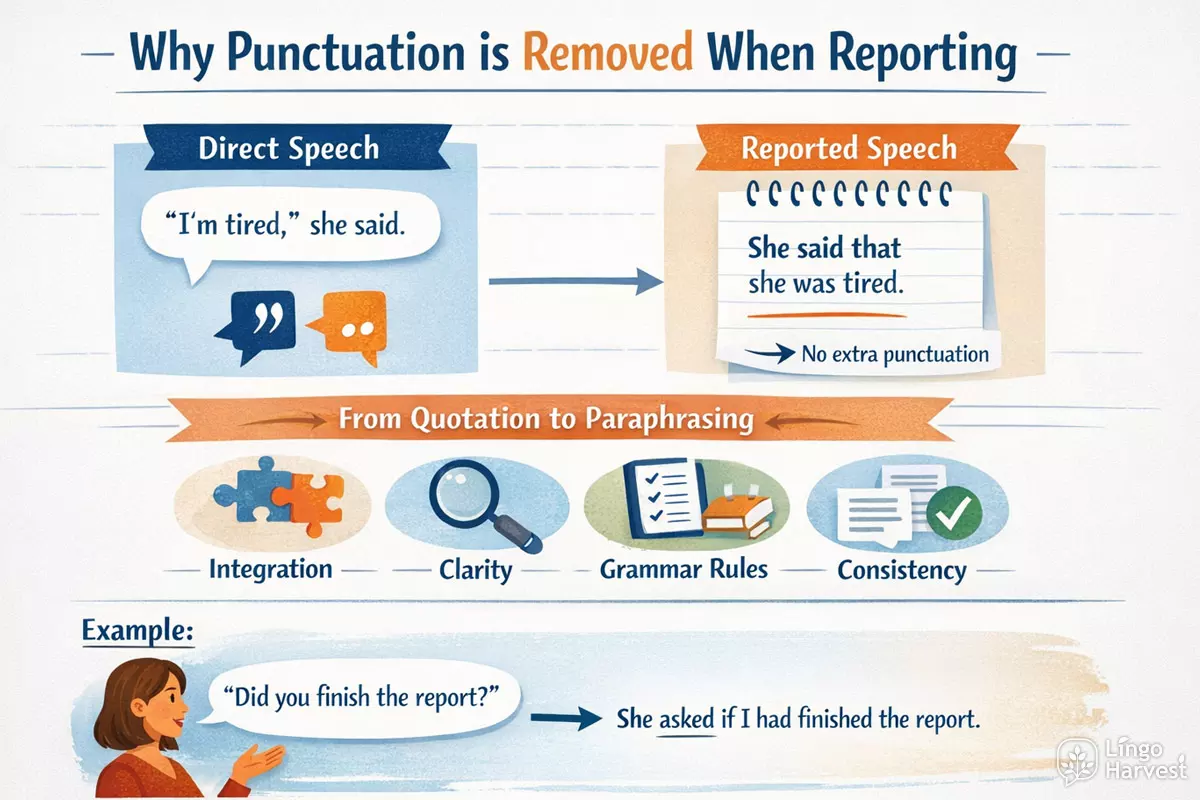
When we shift from quoting someone directly to paraphrasing their words, the structure of our sentences changes. In direct speech, punctuation like quotation marks, commas, and question marks are crucial for showing exactly what was said and how. However, once we move to reported speech, these punctuation marks are often dropped because the sentence is no longer a verbatim account but an interpretation or summary.
The shift from direct to reported speech
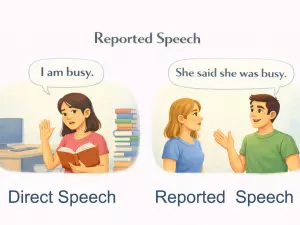
Direct speech uses punctuation to clearly separate the speaker’s words from the rest of the sentence. For example, “I’m tired,” she said. In contrast, reported speech integrates the speaker’s message into the reporting sentence, making extra punctuation unnecessary. Instead of quoting, we report: She said that she was tired.
Reasons for omitting punctuation
- Integration: Reported speech blends the original words into the grammar of the reporting sentence, so quotation marks and commas are not needed.
- Clarity: Removing extra punctuation helps avoid confusion, especially in longer sentences or complex reports.
- Grammar rules: The rules of indirect speech require sentence structure to change, which naturally eliminates the need for punctuation used in direct quotes.
- Consistency: Omitting punctuation creates a uniform style for reported information, regardless of the original tone or emotion.
Typical changes in reported speech
- Quotation marks (“ ”) are removed.
- Commas that separate the quote from the reporting verb are dropped.
- Question marks in quoted questions are replaced by full stops if the reported speech is not a direct question.
- Exclamation marks are usually omitted, unless the emotion is especially relevant.
- The sentence is restructured, often introducing conjunctions like that, if, or whether.
Comparing punctuation in direct and reported speech
| Direct Speech Example | Reported Speech Example |
|---|---|
| “Are you coming?” he asked. | He asked if I was coming. |
| Mary said, “I love chocolate!” | Mary said that she loved chocolate. |
| “Don’t touch that,” the teacher warned. | The teacher warned us not to touch that. |
| He said, “Where is my book?” | He asked where his book was. |
Key takeaways
- In reported speech, punctuation marks from direct quotations are not carried over.
- Sentence structure and word order change, making old punctuation unnecessary.
- This shift improves readability and aligns with English grammar conventions.
Understanding these changes helps writers and speakers transform direct speech into reported speech smoothly, ensuring clarity and accuracy in communication.
Common punctuation errors
When working with direct and reported speech, even experienced writers sometimes trip up on punctuation. The main challenge is knowing where to place commas, quotation marks, and periods, or how to adjust sentences when shifting from a speaker’s exact words to indirect reporting. Let’s look at the most frequent slip-ups so you can steer clear of them.
Misplacing punctuation with quotation marks
Writers often struggle with where to put commas and periods in relation to quotation marks. In American English, periods and commas always go inside the quotation marks, while in British English, placement depends on whether the punctuation is part of the quoted material.
- Incorrect: She said, "I’m ready".
- Correct (US): She said, "I’m ready."
Forgetting the comma before direct speech
A common blunder is omitting the comma that introduces someone’s exact words.
- Incorrect: He asked "Are you coming?"
- Correct: He asked, "Are you coming?"
Incorrect use of capitalization
The first word inside direct speech should be capitalized, even if it’s mid-sentence in the reporting clause.
- Incorrect: She replied, "yes, I will."
- Correct: She replied, "Yes, I will."
Mixing up direct and reported speech punctuation
When shifting to reported speech, quotation marks are dropped and word order often changes, but sometimes writers forget to remove the original punctuation.
- Incorrect: He said that "he was tired."
- Correct: He said that he was tired.
Neglecting question marks and exclamation points
It’s easy to misplace question marks or exclamation points when converting between speech types. In direct speech, they stay inside the quotation marks if they’re part of the quote.
- Correct: She asked, "Where are you going?"
- Correct: Did he really say, "I can’t believe it"?
Punctuation in split direct speech
Sometimes, the reporting clause interrupts the spoken words. Punctuation and capitalization rules here are often misunderstood.
- Correct: "I’m not sure," she said, "if I’ll go."
- Incorrect: "I’m not sure" she said, "if I’ll go."
Comparison: Direct vs. Reported Speech Punctuation
| Direct Speech | Reported Speech |
|---|---|
| Uses quotation marks e.g. He said, "I am tired." |
No quotation marks e.g. He said that he was tired. |
| Punctuation inside quotes e.g. "Are you coming?" she asked. |
Punctuation follows the reporting clause e.g. She asked if I was coming. |
| Comma before the quote e.g. She replied, "Yes." |
No comma before the reported clause e.g. She replied that she would come. |
| Capital letter starts the quote e.g. He said, "Let's go." |
No need for capital letter (unless a proper noun) e.g. He said that they should go. |
Additional trouble spots
Writers may also:
- Omit quotation marks entirely in direct speech.
- Use single and double quotation marks inconsistently.
- Forget to change verb tenses when switching to reported speech.
- Overuse commas after reporting clauses in reported speech.
- Misplace colons or semicolons with quoted material.
- Leave out closing quotation marks, leading to confusion.
- Ignore the need for a reporting verb in indirect statements.
- Use a period instead of a comma before the closing quotation mark when the speech is followed by a reporting clause.
Careful attention to these patterns will make your writing clearer and help your readers follow who is speaking or what was said, whether you’re quoting someone directly or paraphrasing.
Transition from direct to reported form
Shifting from direct speech to reported speech involves more than just removing quotation marks. The process requires changes in word order, pronouns, verb tense, and sometimes even time expressions. This transformation helps integrate someone’s exact words into the flow of a narrative or explanation, making the text less abrupt and more cohesive.
Key Changes When Converting Speech
When you turn a direct quotation into reported speech, several grammatical adjustments are usually necessary. These changes depend on the structure of the original sentence and the context in which it is being reported. Below are the most common modifications:
- Pronoun shifts: Change the pronouns to match the perspective of the reporter.
- Verb tense backshifting: Move the verb one step back in time (e.g., present to past, past to past perfect), unless the reporting verb is in the present or the information is still true.
- Time and place adjustments: Words like "now," "today," or "here" often change to "then," "that day," or "there."
- Quotation marks: Remove quotation marks and use a reporting verb ("said," "told," "asked," etc.) to introduce the reported clause.
- Sentence structure: Direct speech often uses a comma or colon, but reported speech typically relies on conjunctions like "that" (optional in informal English).
Common Patterns and Examples
Here are typical transformations you might encounter:
- "I am tired," she said. → She said (that) she was tired.
- "We will help you," they promised. → They promised that they would help me.
- "Do you like coffee?" he asked. → He asked if I liked coffee.
- "Where are you going?" she asked. → She asked where I was going.
- "I saw him yesterday," John said. → John said that he had seen him the day before.
- "This is my book," Anna said. → Anna said (that) it was her book.
- "I can't come now," Mark said. → Mark said that he couldn't come then.
- "We are meeting here," they said. → They said that they were meeting there.
- "She will call you tomorrow," he told me. → He told me that she would call me the next day.
- "Don't touch that!" the teacher warned. → The teacher warned not to touch that.
Comparison of Direct and Reported Forms
| Direct Speech | Reported Speech |
|---|---|
| "I'm leaving now," he said. | He said (that) he was leaving then. |
| "We saw her at the station," they reported. | They reported that they had seen her at the station. |
| "Can you help me?" she asked. | She asked if I could help her. |
| "I'll do it tomorrow," Tom promised. | Tom promised that he would do it the next day. |
| "Why are you late?" the teacher asked. | The teacher asked why I was late. |
| "Don't forget your keys," Mum said. | Mum told me not to forget my keys. |
Mastering these transformations makes your writing smoother and helps you accurately convey what was said, without relying on direct quotations. It’s essential for reporting speech in both formal and informal contexts.
Homework: Direct vs. Reported Speech Punctuation
Practice removing direct-speech punctuation and rewriting each sentence in reported speech. Focus on dropping quotation marks and commas, changing word order (especially in questions), and keeping the meaning clear.
Exercise 1: Convert direct speech to reported speech
- He said, "I am tired." (A) He said that he was tired. (B) He said that he is tired. (C) He said, that he was tired.
- She asked, "Are you coming?" (A) She asked if I was coming. (B) She asked was I coming. (C) She asked, "if I was coming".
- Tom said, "I can't help you now." (A) Tom said that he couldn’t help me then. (B) Tom said he can’t help you now. (C) Tom said that he couldn’t help you now?
- They said, "We will call you tomorrow." (A) They said they would call me the next day. (B) They said that we will call you tomorrow. (C) They said, "they would call me the next day."
- Maria said, "I love chocolate!" (A) Maria said that she loved chocolate. (B) Maria said that she loves chocolate! (C) Maria said, "that she loved chocolate".
- He asked, "Where is my book?" (A) He asked where his book was. (B) He asked where was his book. (C) He asked that where his book was.
- The teacher warned, "Don't touch that." (A) The teacher warned us not to touch that. (B) The teacher warned us don’t touch that. (C) The teacher warned that not touch that.
- She replied, "Yes, I will." (A) She replied that she would. (B) She replied that yes, I will. (C) She replied, that she would.
- John said, "I saw him yesterday." (A) John said that he had seen him the day before. (B) John said that he saw him yesterday. (C) John said he had seen him yesterday?
- Mum said, "Don't forget your keys!" (A) Mum told me not to forget my keys. (B) Mum said me don’t forget your keys. (C) Mum told me to not forget my keys!
Show answers
- A
- A
- A
- A
- A
- A
- A
- A
- A
- A
Exercise 2: Fix the punctuation and structure
- He said that "he was tired." (A) He said that he was tired. (B) He said, that he was tired. (C) He said that he was tired?
- She asked "Are you coming"? (A) She asked, "Are you coming?" (B) She asked if I was coming. (C) She asked, "if I was coming".
- Tom said, "I can’t help you now". (A) Tom said, "I can’t help you now." (B) Tom said that he couldn’t help me then. (C) Tom said that "he couldn’t help me then."
- They asked if was I ready. (A) They asked if I was ready. (B) They asked if was I ready? (C) They asked that I was ready.
- He asked where does she live. (A) He asked where she lived. (B) He asked where did she live. (C) He asked where she lives?
- The teacher said "Don’t be late", (A) The teacher said, "Don’t be late." (B) The teacher said that we shouldn’t be late. (C) The teacher said that "we shouldn’t be late."
- Maria said that, she loved chocolate. (A) Maria said that she loved chocolate. (B) Maria said she loved chocolate. (C) Maria said, that she loved chocolate.
- He asked if I could help him? (A) He asked if I could help him. (B) He asked, if I could help him. (C) He asked that I could help him.
- She said "Yes, I will". (A) She said, "Yes, I will." (B) She said that she would. (C) She said that, she would.
- John said that he had seen him the day before, (A) John said that he had seen him the day before. (B) John said that he had seen him, the day before. (C) John said that he had seen him the day before?
Show answers
- A
- B
- B
- A
- A
- B
- A
- A
- B
- A