Capitalization Rules for Nouns in English Writing Standards

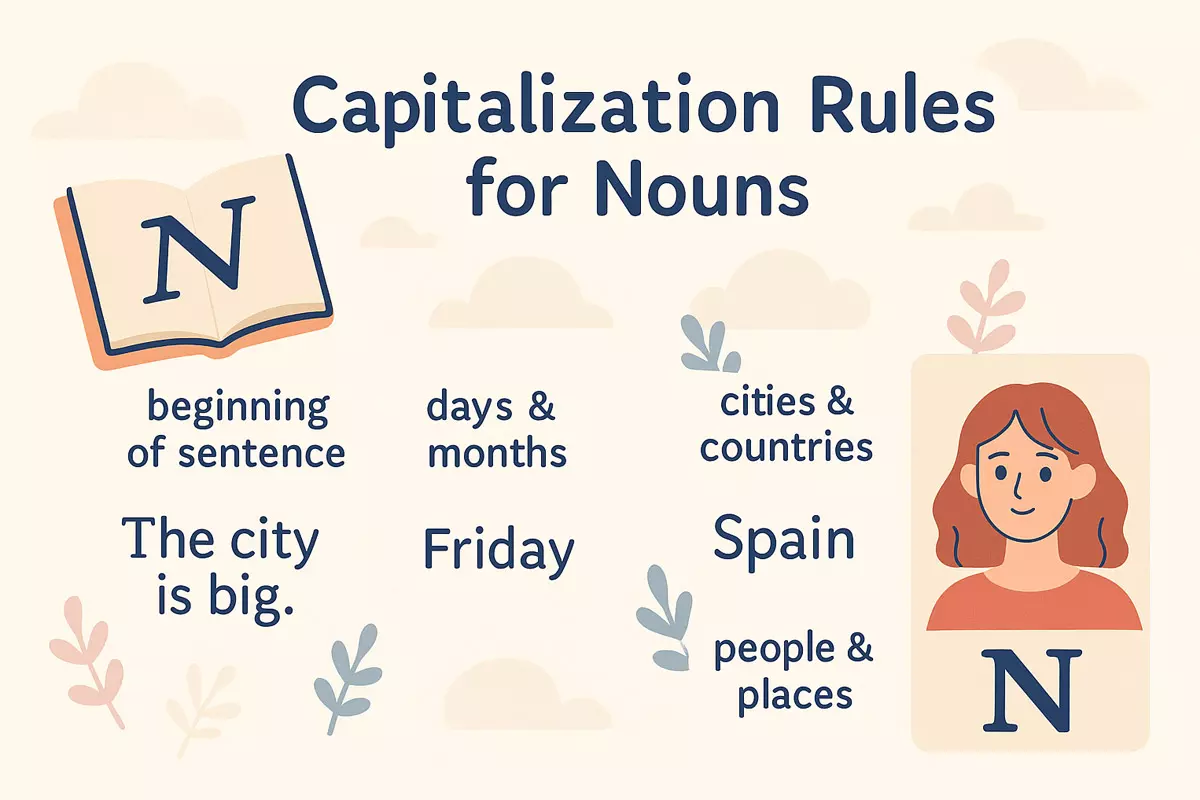 The article details how to capitalize common and proper nouns, including names, places, organizations, titles, days, months, and holidays. It also explains headline vs sentence capitalization, common mistakes, and provides practice correcting errors.
- Difference between common and proper noun capitalization
- Capitalizing names, places, and organizations
- Titles of people, books, and media as nouns
- Days, months, and holidays as capitalized nouns
- Capitalization in headlines vs normal sentences
- Typical learner mistakes with unnecessary capital letters
- Practice: correct capitalization errors in short texts
Knowing when to use capital letters for nouns is essential for creating polished and professional writing. In English, capitalizing proper nouns—such as names of people, places, and specific organizations—follows clear rules, while common nouns remain lowercase unless they start a sentence. Understanding these conventions not only helps your writing look correct but also ensures clarity and credibility. Paying attention to capitalization is a simple yet effective way to make your work more impressive and easy to read.
Difference between common and proper noun capitalization
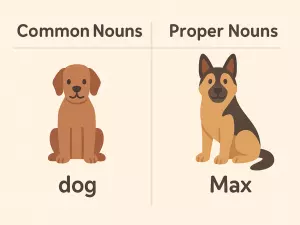
Understanding how to capitalize nouns correctly is essential for clear and standard English writing. The two main types of nouns—common and proper—follow different capitalization rules. Common nouns refer to general items, people, places, or concepts, and are not capitalized unless they start a sentence. In contrast, proper nouns name specific people, places, organizations, or things, and always begin with a capital letter, no matter where they appear in a sentence.
Common Nouns: General Terms
Common nouns are everyday words that identify non-specific things. They include terms like "river," "city," or "teacher." Unless these words begin a sentence, they are written in lowercase.
- dog → The dog is sleeping under the table.
- mountain → We climbed a mountain last summer.
- president → The president gave a speech yesterday.
- school → The school opens at eight in the morning.
- book → She borrowed a book from the library.
- country → He wants to visit another country.
- language → English is a global language.
- car → Their car broke down on the highway.
- month → This month feels especially busy.
- planet → Earth is the only known planet with life.
Proper Nouns: Specific Names
Proper nouns identify unique entities and always require capitalization. These include personal names, geographical locations, brand names, and days of the week.
- Albert Einstein → Albert Einstein developed the theory of relativity.
- Amazon River → The Amazon River flows through South America.
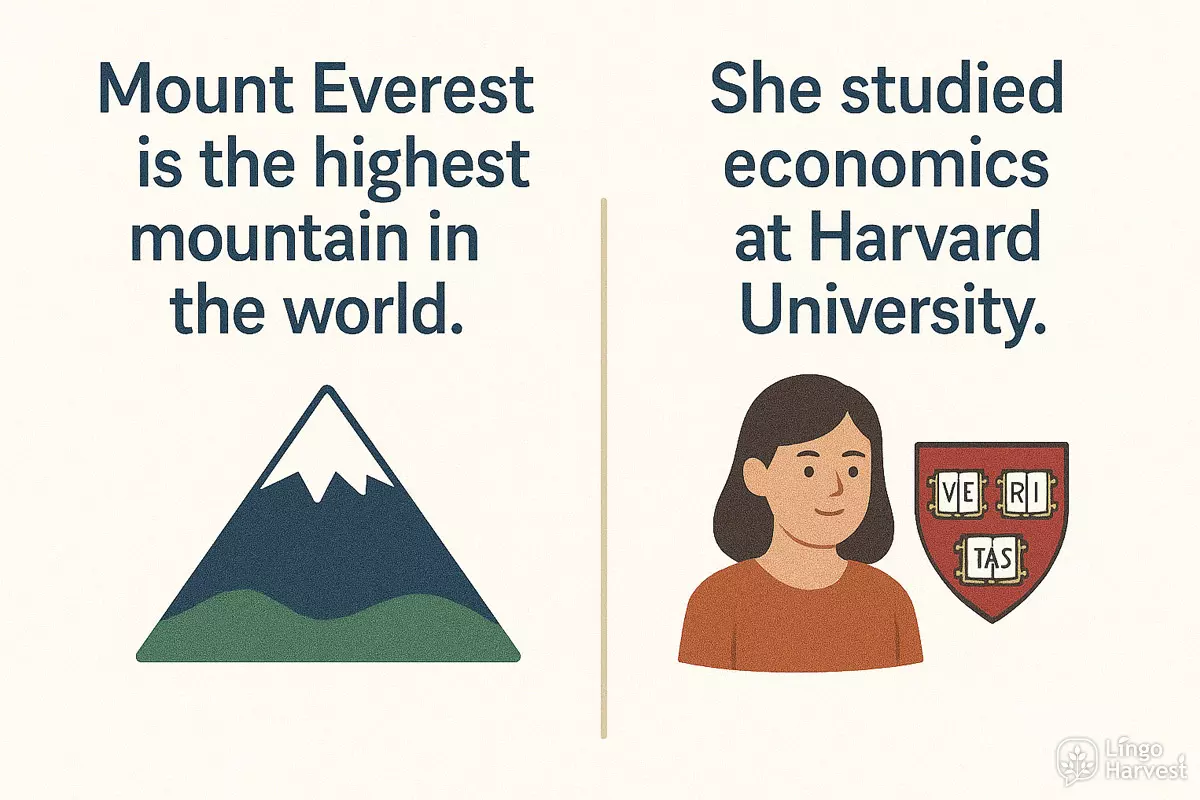
- Mount Everest → Mount Everest is the highest mountain in the world.
- President Lincoln → President Lincoln led the country during the Civil War.
- Harvard University → She studied economics at Harvard University.
- France → France is famous for its cuisine.
- English → English is spoken in many countries.
- Toyota → Toyota produces reliable cars.
- January → January is often the coldest month of the year.
- Mars → Mars is known as the Red Planet.
Quick Comparison: Capitalization Patterns
| Common Noun | Proper Noun |
|---|---|
| city | New York |
| river | Nile River |
| writer | Jane Austen |
| holiday | Thanksgiving |
| company | Apple Inc. |
| continent | Asia |
Summary of Core Differences
The main distinction lies in specificity and capitalization. Use lowercase for general terms unless they start a sentence, and capitalize the first letter of unique names at all times. This distinction helps readers immediately recognize whether a noun refers to something general or a particular entity. Attention to these conventions keeps writing professional and easy to understand.
Capitalizing names, places, and organizations
Correct use of uppercase letters for specific people, locations, and entities is a fundamental aspect of English writing standards. Proper nouns—including personal names, cities, countries, companies, and institutions—always begin with a capital letter. This distinguishes them from common nouns, which refer to general items or concepts.
Personal names
First and last names, as well as middle names or initials, must start with a capital letter. The same rule applies to titles when used as part of the name.
- Mary Shelley → Mary Shelley wrote the novel Frankenstein.
- Dr. James Wilson → Dr. James Wilson reviewed the medical report.
- A. J. Patel → A. J. Patel presented the final proposal.
- Professor Smith → Professor Smith teaches modern literature.
Geographical locations
When referring to specific places, such as countries, cities, continents, rivers, and mountains, the initial letter of each word in the official name should be capitalized.
- Asia → Asia is the largest continent in the world.
- Mount Everest → Mount Everest attracts climbers from around the globe.
- Amazon River → The Amazon River plays a vital role in the ecosystem.
- New York City → New York City is known for its cultural diversity.
- Lake Victoria → Lake Victoria supports millions of people in the region.
- Greenland → Greenland is famous for its vast ice sheets.
Organizations and institutions
Official names of companies, agencies, schools, and groups require capitalization for each significant word. Articles (a, an, the) and short prepositions (of, for, in) in the middle of names are not usually capitalized unless they begin the name.
| Correct Form | Incorrect Form |
|---|---|
| United Nations | united nations |
| Harvard University | harvard university |
| Google Inc. | google inc. |
| The Metropolitan Museum of Art | the metropolitan museum of art |
| World Health Organization | world health organization |
Additional capitalization tips
- Capitalize days of the week and months: Monday, September.
- Do not capitalize seasons: winter, autumn.
- Historic events and eras are capitalized: World War II, Renaissance.
- Languages and nationalities use capitals: Spanish, Brazilian.
- Brand names are always capitalized: Nike, Samsung.
Applying these conventions ensures clarity and accuracy in formal English writing, helping readers easily identify specific people, places, and organizations.
Titles of people, books, and media as nouns
When referring to the names of people’s roles, publications, and works of media as nouns in English, capitalization rules depend on context and formality. Proper nouns—such as the official name of a book or a person’s formal title—are always capitalized. In contrast, generic and descriptive uses are not capitalized.
People’s Titles: Formal vs. Generic Use
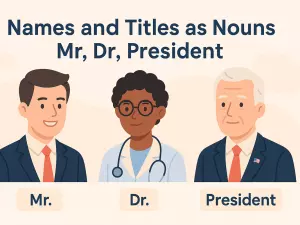
When a title comes directly before a person’s name or is used as a direct form of address, it should be capitalized. However, when the title is used generically or following a name, it is not capitalized. For example:
- President Lincoln delivered the address. ✅
- Abraham Lincoln, the president, delivered the address. ✅
- Dr. Smith will see you now. ✅
- She spoke to the doctor about her symptoms. ✅
Books, Films, and Other Media: Capitalization Patterns
Official titles of books, movies, and other creative works are considered proper nouns and should be capitalized according to standard title case conventions. This means capitalizing the first and last words, and all major words in between. Articles, short prepositions, and conjunctions are usually not capitalized unless they begin or end the title. Below is a comparison showing correct and incorrect capitalization for titles in various contexts:
| Correct Capitalization | Incorrect Example |
|---|---|
| The Great Gatsby | the great gatsby |
| Harry Potter and the Sorcerer’s Stone | Harry potter and the sorcerer’s stone |
| Time Magazine | time magazine |
| Star Wars: A New Hope | star wars: a new hope |
| The New York Times | the new york times |
| Professor Green | professor green |
Quick Reference: What to Capitalize
You should capitalize:
- Official names of people’s titles when used with a name (e.g., Judge Martinez)
- All main words in the titles of books, films, songs, and newspapers
- Honorifics and ranks as part of a name or in direct address (e.g., Captain, Professor)
- Brand names and series titles (e.g., Marvel Comics, The Lord of the Rings)
- Specific media outlets (e.g., BBC News, The Wall Street Journal)
Conversely, do not capitalize:
- Job descriptions or roles used generically (e.g., the journalist, a king)
- Articles, conjunctions, and prepositions in the middle of a media title (unless style guides require otherwise)
- Informal references to works or people (e.g., the movie, the author)
Understanding these distinctions ensures your writing meets English standards for clarity and professionalism.
Days, months, and holidays as capitalized nouns
In English writing, names for the days of the week, months of the year, and official holidays are always written with an initial capital letter. This practice distinguishes these specific time markers and celebrations from general nouns, helping to avoid confusion in both formal and informal contexts.
Capitalization of days and months
Whenever you refer to a day or month in a sentence, use a capital letter at the start. Generic references, such as "every day" or "the next month," do not require capitalization because they are not the names of specific entities.
- Monday, Tuesday, Wednesday
- Thursday, Friday, Saturday, Sunday
- January, February, March, April
- May, June, July, August
- September, October, November, December
Holiday names and capitalization
Official holidays, whether religious, national, or cultural, are treated as proper nouns. Every significant word in the name of a holiday should be capitalized. This includes multi-word holidays, where each word except prepositions and conjunctions is capitalized.
- Christmas → Families often gather together on Christmas.
- Thanksgiving → Thanksgiving is a time to share a meal with family.
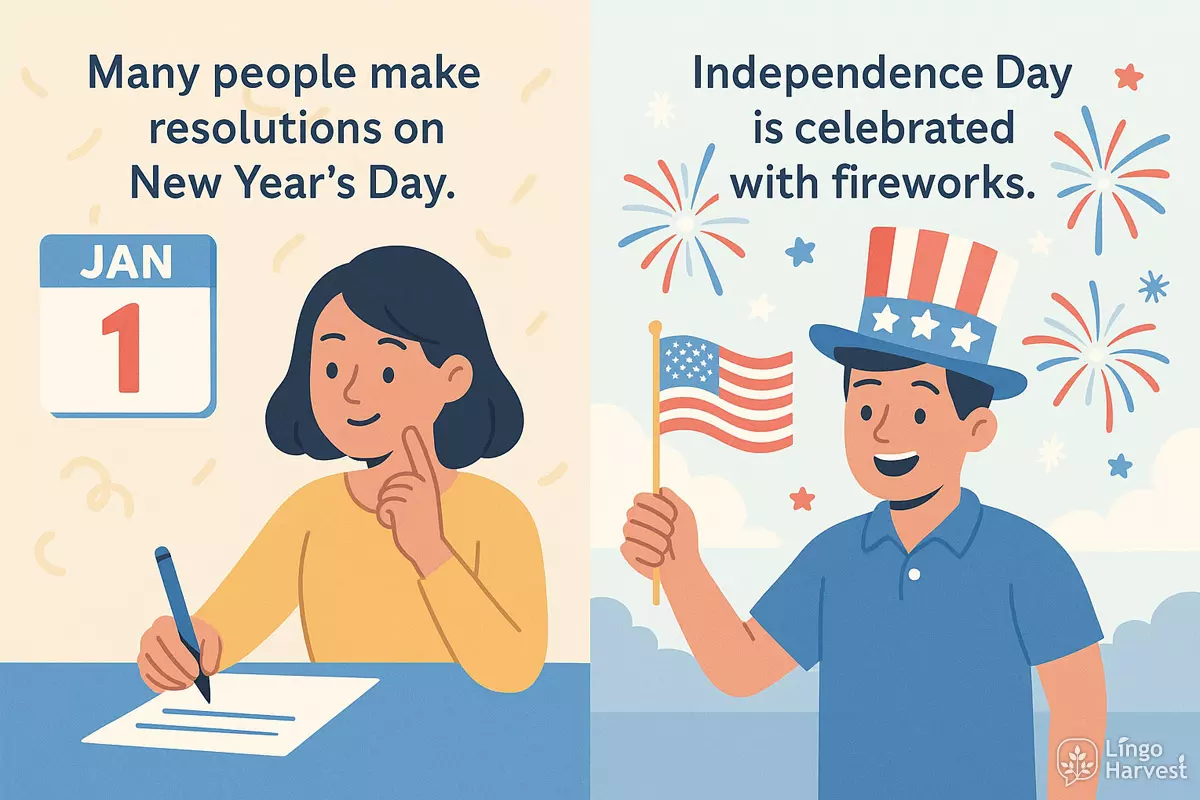
- New Year's Day → Many people make resolutions on New Year's Day.
- Independence Day → Independence Day is celebrated with fireworks.
- Labor Day → Labor Day marks the end of summer for many workers.
- Hanukkah → Hanukkah lasts for eight nights.
- Easter → Children often look for eggs on Easter.
- Halloween → Halloween is popular with costumes and decorations.
- Valentine's Day → Couples exchange cards on Valentine's Day.
- Martin Luther King Jr. Day → Martin Luther King Jr. Day honors civil rights leadership.
- Veterans Day → Veterans Day recognizes military service.
- Passover → Passover commemorates the Exodus.
- Diwali → Diwali is known as the festival of lights.
- Ramadan → Ramadan is a month of fasting and reflection.
Common capitalization mistakes
Writers sometimes forget to capitalize these terms or mistakenly capitalize related words that are not part of the official name. For example, "summer" and "autumn" are not capitalized unless they start a sentence, while "Christmas" and "July" always require an initial capital.
| Correct Usage | Incorrect Usage |
|---|---|
| We will meet on Monday. | We will meet on monday. |
| Her birthday is in August. | Her birthday is in august. |
| I love celebrating Thanksgiving. | I love celebrating thanksgiving. |
| School is closed for Labor Day. | School is closed for labor day. |
Remember: capitalizing these specific nouns is a fundamental part of standard English writing, and careful attention to these details can make your writing clearer and more professional.
Capitalization in headlines vs normal sentences
Writers often encounter different capitalization rules depending on whether they're composing a headline or a regular sentence. In headlines, style guides typically call for capitalizing major words, while in standard sentences, only the first word and proper nouns are capitalized. This distinction can sometimes cause confusion, especially when determining which nouns should be capitalized in each context.
Headline Capitalization: Key Points
When writing headlines (such as news titles, blog post headers, or article names), most style guides recommend "title case." This means:
- Capitalize the first and last words of the headline
- Capitalize all nouns, pronouns, verbs, adjectives, and adverbs
- Lowercase articles (a, an, the), coordinating conjunctions (and, but, or), and prepositions (in, on, at) unless they are the first or last word
For example:
- Correct: How Nouns Shape Our Language
- Incorrect: How nouns shape our language
Normal Sentence Capitalization: The Basics
In standard sentences, the approach is simpler. Only the first word of the sentence and any proper nouns are capitalized. Common nouns remain lowercase, regardless of their importance.
- Correct: Nouns are important in English writing.
- Incorrect: Nouns Are Important In English Writing.
Comparison of Capitalization Patterns
| Type | Example | Capitalized Words |
|---|---|---|
| Headline (title case) | The Power of Nouns in Writing | The, Power, Nouns, Writing |
| Normal sentence | The power of nouns in writing is significant. | The |
| Headline with proper noun | Nouns in English: A Writer’s Guide | Nouns, English, Writer’s, Guide |
| Sentence with proper noun | Nouns in English can be challenging for learners. | Nouns, English |
Common Mistakes to Avoid
- Over-capitalizing every word in a sentence ❌
- Forgetting to capitalize the first word in headlines ❌
- Leaving proper nouns uncapitalized in any context ❌
- Applying headline rules to normal sentences ❌
- Lowercasing the first word after a colon in a headline (if it begins a complete sentence) ❌
Understanding these distinctions helps writers maintain clarity and consistency, whether drafting formal essays or attention-grabbing titles. If in doubt, consult a style guide relevant to your publication or audience.
Typical learner mistakes with unnecessary capital letters
Many English learners tend to overuse capital letters, especially when writing nouns. This often happens due to interference from other languages or misunderstanding of English capitalization rules. Here are some common situations where extra uppercase letters appear but shouldn’t.
Common contexts where learners add capitals by mistake
- Days and months: Correct: Monday, June. Incorrect: monday, june (lowercase) or Monday, June (correct). But: in The June (incorrect capitalization of "The").
- Seasons: Learners often write “Spring,” “Winter,” etc. with a capital, but these words are not capitalized unless at the start of a sentence. Correct: I love spring.
- School subjects: Only languages (English, Spanish) and specific course titles are capitalized. Don’t capitalize general subjects: math, history, science.
- Job titles in sentences: “My father is a doctor.” (not “Doctor”). Only capitalize when the title comes before a name: “Doctor Smith.”
- Family relationships: Don’t capitalize unless used as a name: “my mom,” but “I asked Mom.”
- Common nouns in the middle of sentences: “The Cat sat on the roof.” (should be “cat”)
- Directions and compass points: Use lowercase unless part of a region: “I live north of London.” / “the North of England.”
- After prepositions: “The book is on The Table.” (should be “the table”)
- Every word in a title: English titles do not capitalize small words unless first or last: “The Lord of the Rings,” not “The Lord Of The Rings.”
- Names of objects or things: “I bought a New Car.” (should be “new car”)
- Holidays: Correct: “Christmas.” Incorrect: “christmas.” But avoid “On Christmas Day I went To The Park.”
- Organizations and companies: Only the official name is capitalized, not generic references: “She works at a bank.”
- Languages and nationalities: Correct: “French.” Incorrect: “french.” But do not capitalize the word “language” itself: “the French language.”
Frequent error patterns
Learners sometimes apply rules from their native language or assume all nouns need to be in uppercase. This leads to sentences like:
- “We visited The Museum in The City.”
- “He studies Biology And Chemistry.”
- “My Brother is an Engineer.”
- “I met with the President of the Company.”
In these examples, only the first word of a sentence and proper nouns (like “President Smith” or the actual name of a company) should be capitalized.
Quick comparison: Capitalize or not?
| Incorrect Capitalization | Correct Form |
|---|---|
| She Loves Spring. | She loves spring. |
| I study History at school. | I study history at school. |
| We went North last summer. | We went north last summer. |
| My Father is a Teacher. | My father is a teacher. |
| The Cat is sleeping. | The cat is sleeping. |
| He speaks English Language. | He speaks English. |
| My favorite Book is “The Hobbit”. | My favorite book is “The Hobbit”. |
| I met Doctor Jones yesterday. | I met doctor Jones yesterday. |
| We visited The Eiffel Tower. | We visited the Eiffel Tower. |
| She works At The Hospital. | She works at the hospital. |
How to avoid these mistakes
To prevent unnecessary capitals, remember: only capitalize the first word of a sentence, names of specific people, places, companies, languages, and official titles before names. For most common nouns and general words, lowercase is standard. Double-check your writing for stray capital letters, especially after prepositions and for ordinary objects. Developing this habit will make your English writing look more natural and professional.
Practice: correct capitalization errors in short texts
Applying capitalization rules correctly is essential for clear and professional English writing. Below, you'll find exercises designed to reinforce your understanding of when to use uppercase letters for nouns, proper nouns, and other important words. These activities focus on real-world examples and common mistakes, helping you recognize and fix errors in context.
Exercise 1: Identify and Correct Errors
Read the following sentences. Each contains at least one capitalization mistake involving nouns. Rewrite each sentence so that it follows standard rules.
- my uncle lives in paris near the seine river.
- the president of france will visit germany next week.
- we read about world war ii in our history class.
- her favorite book is pride and prejudice by jane austen.
- they visited the eiffel tower during summer vacation.
- professor smith teaches english at oxford university.
- the dog chased the ball across main street.
- my friend emily works at the british museum.
- last april, we went to yosemite national park.
- he studies mathematics and biology at university.
Show answers
- My uncle lives in Paris near the Seine River.
- The President of France will visit Germany next week.
- We read about World War II in our History class.
- Her favorite book is Pride and Prejudice by Jane Austen.
- They visited the Eiffel Tower during summer vacation.
- Professor Smith teaches English at Oxford University.
- The dog chased the ball across Main Street.
- My friend Emily works at the British Museum.
- Last April, we went to Yosemite National Park.
- He studies Mathematics and Biology at university.
Common Capitalization Mistakes: Quick Reference
- Not capitalizing the first word of a sentence.
- Forgetting to capitalize names of people and places.
- Leaving days of the week and months lowercase.
- Not capitalizing languages or nationalities.
- Using capitals for common nouns (e.g., Dog, Mountain).
- Missing capitals in book, movie, or song titles.
- Leaving historical events or periods in lowercase.
- Not capitalizing organizations and institutions.
- Randomly capitalizing words for emphasis.
- Forgetting to capitalize holidays and special events.
Exercise 2: Spot the Correct Sentence
Choose the sentence that uses capitalization correctly.
- a) We visited Central Park in New York City.
b) we visited central park in new york city. - a) She is studying French and literature.
b) She is studying french and literature. - a) The Olympic Games are held every four years.
b) The olympic games are held every four years. - a) He moved to canada last year.
b) He moved to Canada last year. - a) My birthday is in March.
b) My birthday is in march. - a) They crossed the Amazon River by boat.
b) They crossed the amazon river by boat. - a) She works at google as an engineer.
b) She works at Google as an engineer. - a) We met on Monday morning.
b) We met on monday morning. - a) He studies history at harvard university.
b) He studies history at Harvard University. - a) The President spoke on Independence Day.
b) The president spoke on independence day.
Show answers
- a)
- a)
- a)
- b)
- a)
- a)
- b)
- a)
- b)
- a)
Capitalization Patterns: Proper Nouns vs. Common Nouns
Understanding the difference between proper and common nouns is crucial for correct capitalization. Here’s a reference list to help clarify:
- Proper noun (capitalize): London, Microsoft, Atlantic Ocean, Christmas, Dr. Lee
- Common noun (lowercase): city, company, ocean, holiday, doctor
- Days and months (capitalize): Monday, July
- Languages and nationalities (capitalize): Spanish, Brazilian
- Titles of books/movies (capitalize main words): The Great Gatsby, Harry Potter and the Sorcerer’s Stone
- School subjects (capitalize if language or part of title): English, Biology 101; but: history, science
- Historical events (capitalize): Renaissance, Civil War
- Organizations (capitalize): United Nations, Red Cross
- Streets/roads (capitalize): Elm Street, Highway 101
- Holidays (capitalize): Thanksgiving, Ramadan