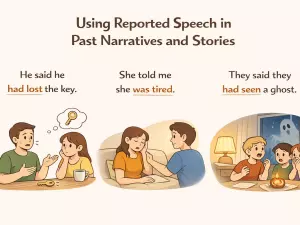
What Is Reported Speech in English: Direct vs Indirect Forms

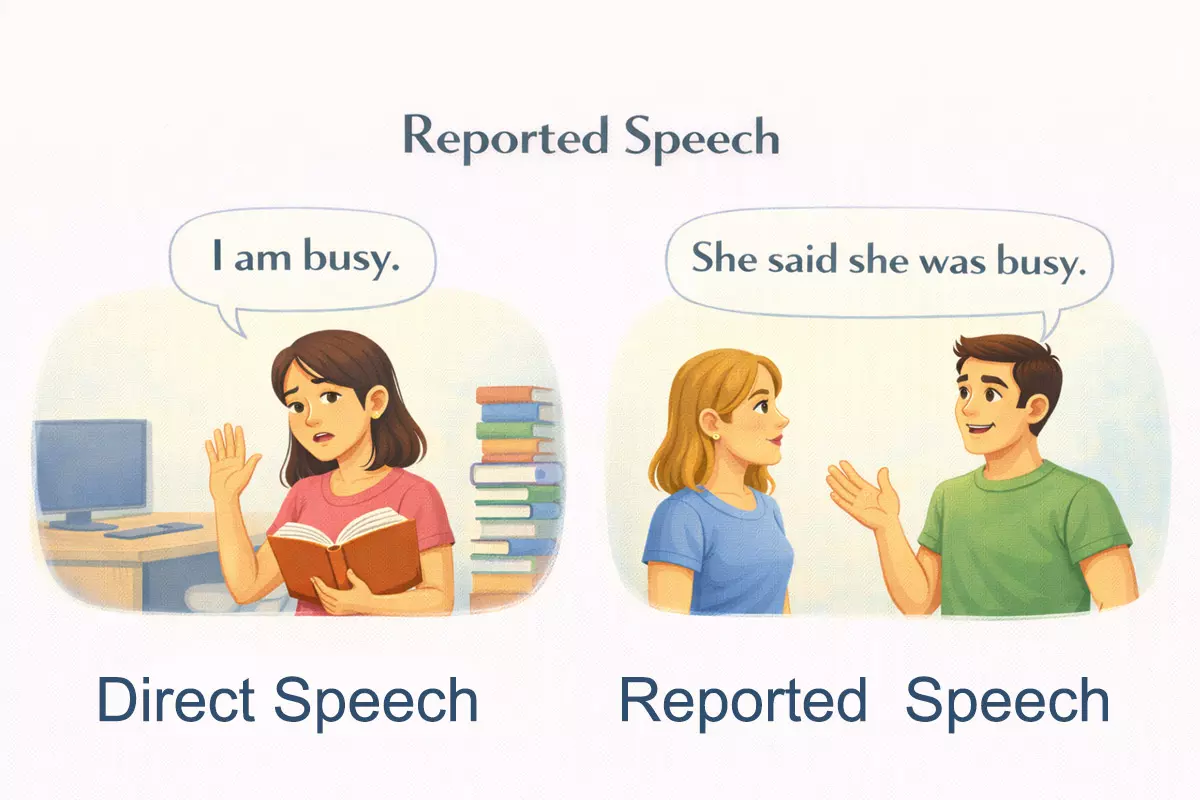 Reported speech helps you share what someone said without always repeating the exact words. This guide explains direct and indirect speech, how meaning is preserved, when to use each form, and the mistakes beginners should avoid.
- What reported speech is and why it is used
- Direct speech and its key features
- Indirect speech and its main characteristics
- Core differences between direct and indirect forms
- How meaning is preserved when reporting speech
- Choosing direct or indirect speech in context
- Typical beginner mistakes with reported speech
- Practice: convert direct and indirect speech
- FAQ
Reported speech is used when we tell someone what another person said, asked, explained, promised, or requested. Takeaway: direct speech repeats the exact words, while indirect speech reports the meaning in a new sentence. To use reported speech well, you usually need to adjust pronouns, tense, time words, place words, and question or command structure.
What reported speech is and why it is used
Reported speech is a way to share another person’s words, message, question, command, or idea. It is especially useful when the exact wording is less important than the meaning. For example, instead of repeating Anna said, “I am tired”, you can say Anna said that she was tired.
Reported speech is also called indirect speech, but in a broad sense, the topic includes both direct speech and indirect speech. Direct speech quotes the original words. Indirect speech reports the message in your own sentence.
Simple example
| Form | Example | What it does |
|---|---|---|
| Direct speech | She said, “I am tired.” | Quotes her exact words. |
| Indirect speech | She said that she was tired. | Reports the meaning, not the exact words. |
Why English uses reported speech
- To tell someone what another person said without quoting every word.
- To summarize a conversation, meeting, interview, or message.
- To report questions, instructions, promises, warnings, and requests.
- To make writing smoother in stories, news reports, emails, and academic work.
- To focus on the important meaning instead of the exact wording.
- To adapt a message to a new time, place, speaker, or listener.
How reported speech works
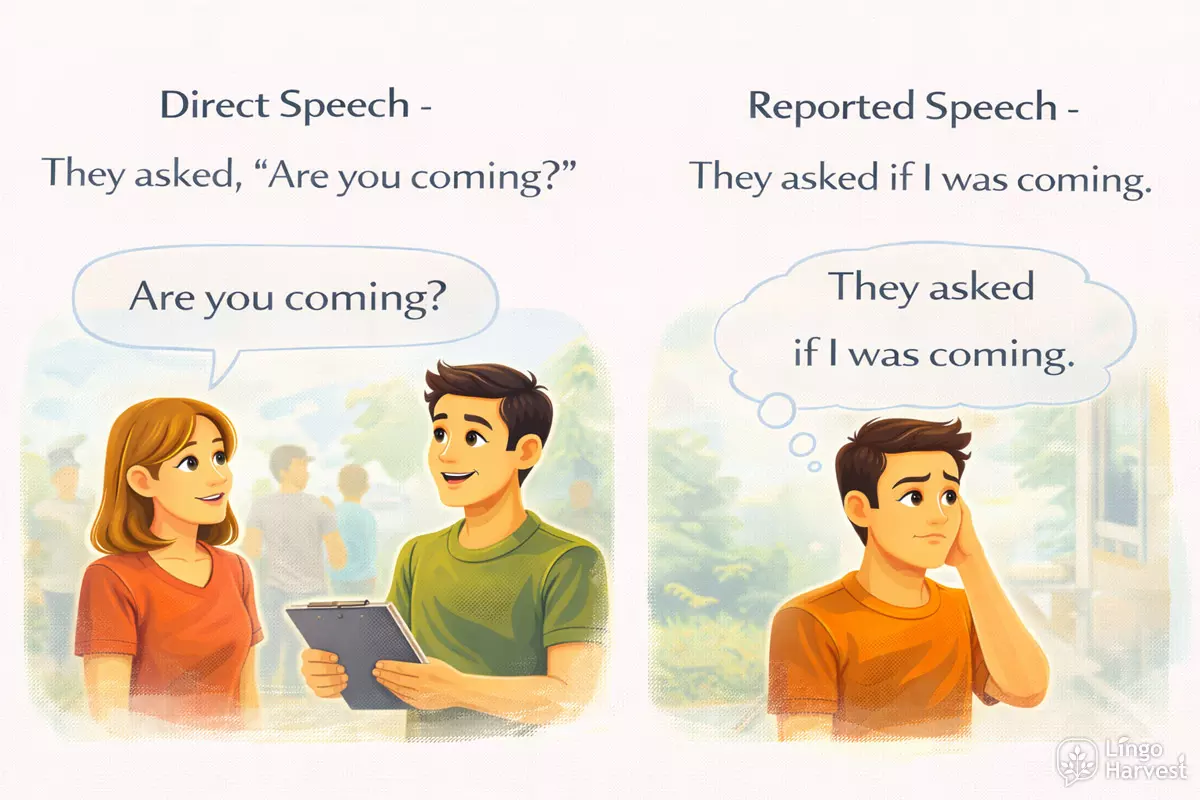
When you change direct speech into indirect speech, the sentence often changes in several ways:
- Pronouns change: I may become he, she, or they.
- Tenses may backshift: am may become was, will may become would.
- Time words may change: today may become that day.
- Questions use statement word order: Where are you going? becomes where I was going.
- Commands often use to + verb: Close the door becomes told me to close the door.
Quick examples
| Direct Speech | Reported Speech | Main change |
|---|---|---|
| She says, “I am hungry.” | She says that she is hungry. | Pronoun changes; tense stays because says is present. |
| He said, “I will call you.” | He said that he would call me. | I → he; will → would. |
| They asked, “Are you coming?” | They asked if I was coming. | Yes/no question uses if and statement word order. |
| John said, “I finished my work.” | John said that he had finished his work. | Past simple often shifts to past perfect. |
| Mary said, “I can help.” | Mary said that she could help. | can → could. |
For a focused lesson on statement reporting, see reported statements.
Direct speech and its key features
Direct speech repeats the speaker’s exact words. It is useful when the exact wording matters, when you want to show emotion, or when you are writing dialogue in a story or interview.
How direct speech is shown
Direct speech usually uses quotation marks. The reporting clause tells us who spoke.
- She said, “I’m learning English.”
- “I’m learning English,” she said.
- “Are you coming?” he asked.
- “Watch out!” the coach shouted.
Main features of direct speech
- Exact words: The quoted words stay the same.
- Quotation marks: The spoken words are shown inside quotation marks.
- Original pronouns: The speaker’s original pronouns remain inside the quote.
- Original tense: The quote keeps the tense used by the original speaker.
- Original tone: Direct speech can show emotion, hesitation, surprise, or personality.
- Dialogue use: Direct speech is common in stories, interviews, examples, and scripts.
Direct speech examples
- Tom said, “It’s raining.”
- Maria asked, “Are you coming to the party?”
- The teacher said, “Please open your books.”
- He whispered, “Don’t tell anyone.”
- She replied, “I can do it.”
- My brother said, “I left my keys at home.”
- Anna shouted, “Stop!”
Direct speech punctuation basics
| Pattern | Example | Note |
|---|---|---|
| Reporting clause before quote | He said, “I’m ready.” | Use a comma before the quote. |
| Quote before reporting clause | “I’m ready,” he said. | The comma usually goes inside the quotation marks. |
| Direct question | “Are you ready?” he asked. | The question mark belongs inside the quote. |
| Direct exclamation | “That’s amazing!” she said. | The exclamation mark belongs inside the quote. |
Reporting verbs for direct speech
Direct speech often uses simple reporting verbs. Do not overuse dramatic verbs if said or asked is enough.
- said: He said, “I agree.”
- asked: She asked, “Where are we going?”
- replied: “I don’t know,” he replied.
- shouted: “Look out!” she shouted.
- whispered: “Be quiet,” he whispered.
Indirect speech and its main characteristics
Indirect speech reports what someone said without using their exact words. It is common in everyday conversation, business communication, storytelling, news, and academic writing.
How indirect speech works
Indirect speech usually begins with a reporting verb such as said, told, asked, explained, or promised. The reported message then becomes part of a new sentence.
- Direct: “I am tired,” he said.
- Indirect: He said that he was tired.
- Direct: “Where are you going?” she asked.
- Indirect: She asked where I was going.
Key features of indirect speech
- No quotation marks: The original words are not quoted exactly.
- Pronouns often change: I, you, my, and our must match the reporting context.
- Tenses may backshift: This often happens when the reporting verb is in the past.
- Time and place words may change: now can become then; here can become there.
- Questions change word order: Reported questions use statement word order.
- Commands often use infinitives: Close the window becomes told me to close the window.
- That can often be omitted: She said that she was tired and She said she was tired are both common.
Common transformations in indirect speech
| Direct Speech | Indirect Speech | Change |
|---|---|---|
| “I am leaving now.” | She said she was leaving then. | I → she; am → was; now → then. |
| “We will call you tomorrow.” | They promised they would call me the next day. | will → would; tomorrow → the next day. |
| “Do you like pizza?” | He asked if I liked pizza. | Yes/no question uses if. |
| “Close the window.” | She told me to close the window. | Command uses told + object + to + verb. |
| “Where are you going?” | He asked where I was going. | Reported question uses statement word order. |
| “I have seen that movie.” | She said she had seen that movie. | have seen → had seen. |
Say vs tell
Say usually does not need a personal object. Tell usually needs one.
- Correct: She said that she was tired.
- Correct: She told me that she was tired.
- Incorrect: She said me that she was tired.
- Correct: She said to me that she was tired. (possible but less common than told me)
For more reporting verb patterns, see reporting verbs.
Core differences between direct and indirect forms
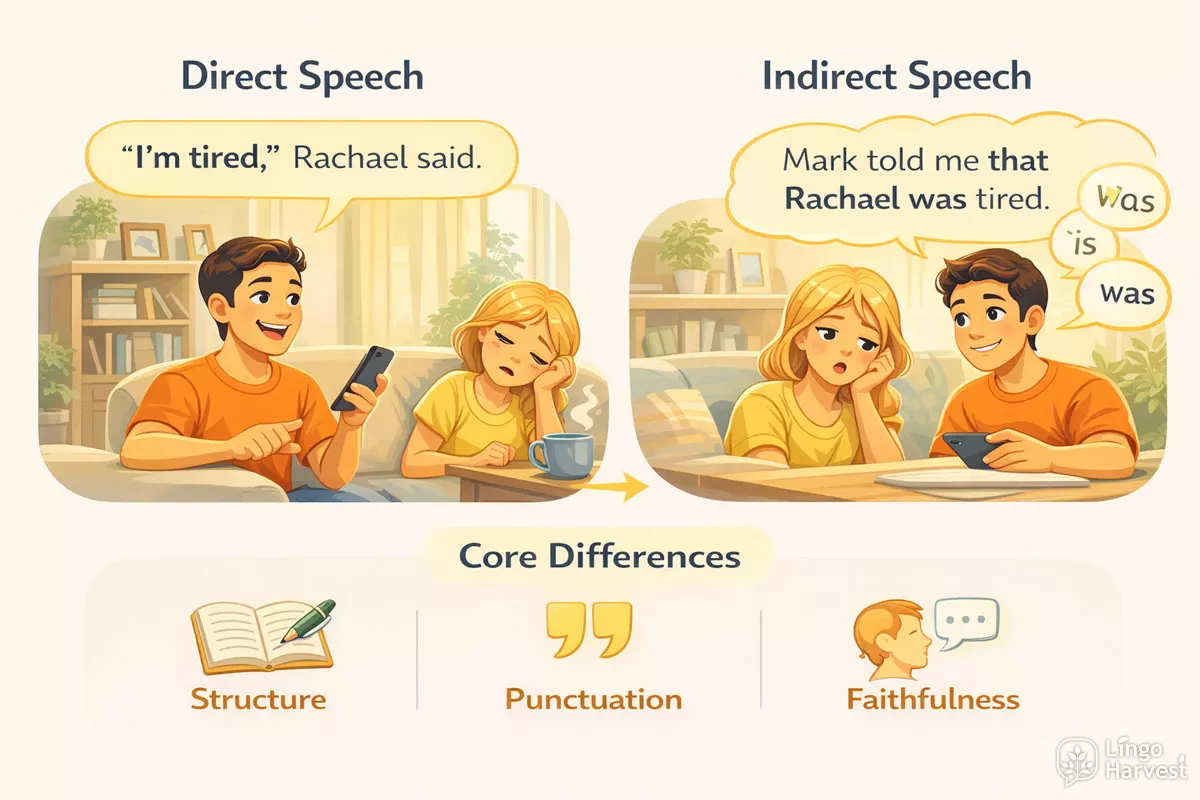
Direct and indirect speech differ in wording, punctuation, tense, pronouns, and structure. Direct speech keeps the original words visible. Indirect speech adapts the message to fit the new sentence.
Direct vs indirect speech table
| Feature | Direct Speech | Indirect Speech |
|---|---|---|
| Exact words | Uses the exact original words. | Reports the meaning, not always the exact words. |
| Quotation marks | Uses quotation marks. | No quotation marks. |
| Pronouns | Stay as originally spoken. | Change according to speaker and listener. |
| Tense | Stays inside the quote. | May backshift when the reporting verb is past. |
| Questions | Use normal question word order. | Use statement word order. |
| Commands | Use the original command form. | Often use told/asked + object + to + verb. |
| Style | More vivid, exact, and dramatic. | Smoother, shorter, and often more formal. |
Examples by sentence type
| Sentence type | Direct Speech | Indirect Speech |
|---|---|---|
| Statement | Mary said, “I love chocolate.” | Mary said that she loved chocolate. |
| WH question | He asked, “Where are you going?” | He asked where I was going. |
| Yes/no question | She asked, “Do you need help?” | She asked if I needed help. |
| Command | The teacher said, “Open your books.” | The teacher told us to open our books. |
| Request | He said, “Please wait here.” | He asked me to wait there. |
Typical shifts from direct to indirect
- Present simple → past simple: I like it → she liked it.
- Present continuous → past continuous: I am working → he was working.
- Will → would: I will call → she would call.
- Can → could: I can help → he could help.
- Today → that day: I am busy today → she was busy that day.
- Here → there: Wait here → he told me to wait there.
For a deeper tense lesson, review tense changes in reported speech.
How meaning is preserved when reporting speech
The goal of reported speech is not to change the speaker’s meaning. The goal is to keep the original message clear while adapting it to a new grammar context.
What must stay the same?
- The core message: The main idea should not change.
- The speaker’s intention: A question should stay a question in meaning, even if the grammar changes.
- The relationship between people: Pronouns must show who did what to whom.
- The time reference: Time words must make sense from the new reporting point of view.
- The tone when important: Reporting verbs can show whether someone warned, promised, admitted, explained, or complained.
Pronouns must match the new viewpoint
Pronoun changes are not random. They depend on who is reporting the speech and who was speaking originally. For more practice, use the guide to pronoun changes.
- Direct: Anna said, “I lost my keys.”
- Reported: Anna said that she had lost her keys.
- Direct: Tom said to me, “I will call you.”
- Reported: Tom told me that he would call me.
Time and place words must fit the reporting context
Words like today, tomorrow, here, and now may need to change if the reporting situation is different.
| Direct Speech Element | Common Reported Equivalent | Example |
|---|---|---|
| now | then / at that moment | She said she was busy then. |
| today | that day | He said the office was closed that day. |
| yesterday | the day before | She said she had called the day before. |
| tomorrow | the next day / the following day | They said they would arrive the next day. |
| here | there | He told me to wait there. |
| this / these | that / those | She said she liked those shoes. |
Questions must keep their meaning, not their question order
- Direct: “Where are you going?”
- Reported: He asked where I was going.
- Incorrect: He asked where was I going.
Reported questions are important enough to study separately: reported WH questions and reported yes/no questions.
Commands and requests must preserve intention
- Direct: “Close the window,” she said.
- Reported: She told me to close the window.
- Direct: “Please help me,” he said.
- Reported: He asked me to help him.
- Direct: “Don’t touch that,” the nurse said.
- Reported: The nurse told me not to touch that.
For commands and instructions, continue with reported commands.
Choosing direct or indirect speech in context
Direct and indirect speech are both useful. The better choice depends on your purpose. Use direct speech when exact wording matters. Use indirect speech when the message matters more than the exact words.
Use direct speech when...
- You need the exact words.
- You are writing dialogue in a story.
- You want to show emotion, personality, or tone.
- You are quoting an interview, speech, or memorable phrase.
- The wording is important for accuracy or responsibility.
Use indirect speech when...
- You are summarizing a conversation.
- The exact words are not important.
- You want a smoother, less repetitive sentence.
- You are reporting decisions, instructions, or information.
- You are writing in a more formal or academic style.
Context comparison
| Context | Better choice | Example |
|---|---|---|
| Story dialogue | Direct speech | “I can’t believe it!” she said. |
| Meeting summary | Indirect speech | She said that the deadline had changed. |
| News interview quote | Direct speech if exact wording matters | The mayor said, “We are reviewing the plan.” |
| Academic summary | Indirect speech | The author argues that the results are limited. |
| Retelling a conversation | Usually indirect speech | He told me that he would arrive late. |
Useful reporting verbs by purpose
| Purpose | Reporting verbs | Example |
|---|---|---|
| Neutral reporting | say, tell, mention, state | She said that she was ready. |
| Questions | ask, wonder, want to know | He asked where I lived. |
| Explanation | explain, clarify, point out | She explained that the system was down. |
| Promises and offers | promise, offer, agree | He promised to call later. |
| Warnings and advice | warn, advise, remind | They warned us not to wait outside. |
| Feelings or responsibility | admit, deny, complain, apologize | She admitted that she had made a mistake. |
Typical beginner mistakes with reported speech
Reported speech mistakes usually happen in five places: tense, pronouns, question order, reporting verbs, and time expressions. The table and examples below show the most common beginner errors.
Mistake 1: forgetting tense backshift
| Direct Speech | Incorrect Reported | Correct Reported |
|---|---|---|
| “I am tired.” | He said he is tired. | He said he was tired. |
| “We will go.” | She said they will go. | She said they would go. |
| “I have seen it.” | He said he has seen it. | He said he had seen it. |
| “She was sleeping.” | He said she was sleeping. | He said she had been sleeping. |
Mistake 2: changing tense when no backshift is needed
Backshift is common, but not automatic in every context. If the reporting verb is present, or the information is still true, the original tense may stay.
- Direct: She says, “I am tired.”
- Reported: She says that she is tired.
- Direct: The teacher said, “Water boils at 100°C.”
- Reported: The teacher said that water boils at 100°C. (general truth)
Mistake 3: pronoun confusion
- Direct: Anna said, “I love your music.”
- Incorrect: Anna said I loved your music.
- Correct: Anna said that she loved my music.
- Direct: Tom asked, “Are you coming?”
- Incorrect: Tom asked are you coming.
- Correct: Tom asked if I was coming.
Mistake 4: wrong word order in reported questions
- Direct: “Where are you going?”
- Incorrect: He asked where was I going.
- Correct: He asked where I was going.
- Direct: “What do you want?”
- Incorrect: She asked what did I want.
- Correct: She asked what I wanted.
Mistake 5: say vs tell
- Incorrect: She said me the answer.
- Correct: She told me the answer.
- Correct: She said that she knew the answer.
- Correct: She said to me that she knew the answer. (possible, but less common)
Mistake 6: treating that as always necessary
That is often optional in reported statements.
- Correct: She said that she would call me.
- Also correct: She said she would call me.
But after ask in yes/no questions, use if or whether, not that.
- Incorrect: He asked that I was ready.
- Correct: He asked if I was ready.
- Correct: He asked whether I was ready.
Quick correction table
| Problem | Incorrect | Correct |
|---|---|---|
| Say/tell | She said me the news. | She told me the news. |
| Reported question order | He asked where was I. | He asked where I was. |
| Yes/no question | She asked that I liked it. | She asked if I liked it. |
| Command structure | He told me wait. | He told me to wait. |
| Negative command | She told me to not touch it. | She told me not to touch it. |
| Quotation marks | He said that “he was tired.” | He said that he was tired. |
Practice: convert direct and indirect speech
Now practice changing direct speech into reported speech. Focus on the meaning first, then check pronouns, tense, time words, and sentence structure.
Exercise 1: Report the statements
Change each direct sentence into reported speech.
- Anna said, “I am busy today.”
- Tom said, “I will call you tomorrow.”
- Maria said, “I have finished the report.”
- They said, “We can help.”
- John said, “I saw Lisa yesterday.”
- My brother said, “I don’t like this song.”
- She said, “I am learning English.”
- He said, “I must leave now.”
- The teacher said, “The test is difficult.”
- Emma said, “I have never been there.”
Show answers
- Anna said that she was busy that day.
- Tom said that he would call me the next day.
- Maria said that she had finished the report.
- They said that they could help.
- John said that he had seen Lisa the day before.
- My brother said that he didn’t like that song.
- She said that she was learning English.
- He said that he had to leave then.
- The teacher said that the test was difficult.
- Emma said that she had never been there.
Exercise 2: Report the questions
Change each direct question into reported speech.
- He asked, “Are you ready?”
- She asked, “Where do you live?”
- They asked, “Can we join you?”
- Tom asked, “Why are you late?”
- Anna asked, “Did you finish the task?”
- He asked, “What time does the train leave?”
- She asked, “Have you seen my bag?”
- The manager asked, “Who sent this email?”
- My friend asked, “Will you come tomorrow?”
- He asked, “How much does it cost?”
Show answers
- He asked if I was ready.
- She asked where I lived.
- They asked if they could join me.
- Tom asked why I was late.
- Anna asked if I had finished the task.
- He asked what time the train left.
- She asked if I had seen her bag.
- The manager asked who had sent that email.
- My friend asked if I would come the next day.
- He asked how much it cost.
Exercise 3: Report commands and requests
Use told / asked + object + to + verb or not to + verb.
- She said, “Open the window.”
- He said, “Please wait here.”
- The teacher said, “Don’t use your phone.”
- Mom said, “Call me later.”
- The doctor said, “Take this medicine twice a day.”
- He said, “Don’t tell anyone.”
- The officer said, “Show me your ID.”
- She said, “Please send the file today.”
- The coach said, “Run faster.”
- He said, “Don’t be late.”
Show answers
- She told me to open the window.
- He asked me to wait there.
- The teacher told us not to use our phones.
- Mom told me to call her later.
- The doctor told me to take that medicine twice a day.
- He told me not to tell anyone.
- The officer told me to show him my ID.
- She asked me to send the file that day.
- The coach told us to run faster.
- He told me not to be late.
Exercise 4: Homework — write your own reported speech
Write one sentence for each prompt. Then compare your answers with the sample answers.
- Report a statement with said that.
- Report a statement with told me that.
- Report a yes/no question with asked if.
- Report a WH question with statement word order.
- Report a command with told me to.
- Report a negative command with not to.
- Report a sentence where will changes to would.
- Report a sentence where can changes to could.
- Report a sentence where today changes to that day.
- Report a sentence where I changes to she, he, or they.
Show sample answers
- She said that she was tired.
- He told me that he had finished the work.
- She asked if I was free.
- He asked where I lived.
- The teacher told me to open my book.
- Mom told me not to forget my keys.
- Anna said that she would call later.
- Tom said that he could help us.
- Maria said that she was busy that day.
- Emma said that she needed more time.
FAQ
1. What is reported speech in English?
Reported speech is a way to tell someone what another person said, asked, ordered, promised, or explained. It can quote the exact words in direct speech or report the meaning in indirect speech.
2. What is the difference between direct and indirect speech?
Direct speech repeats the exact words and uses quotation marks: She said, “I am tired.” Indirect speech reports the meaning without quotation marks: She said that she was tired.
3. Does reported speech always change tense?
No. Tense often changes when the reporting verb is in the past, but not always. If the reporting verb is present, or the information is still true, the tense may stay the same. For example: She says that she is tired.
4. Why do pronouns change in reported speech?
Pronouns change because the point of view changes. If Anna says I am ready, another person reports it as Anna said that she was ready. The pronoun must match the person being reported.
5. What happens to questions in reported speech?
Reported questions use statement word order. Say He asked where I was going, not He asked where was I going. Yes/no questions use if or whether.
6. What is the difference between say and tell?
Say usually does not take a personal object directly: She said that she was ready. Tell usually needs a person: She told me that she was ready. Do not say She said me.
7. Do I need to use that in reported speech?
In reported statements, that is often optional. Both She said that she was tired and She said she was tired are correct. But reported yes/no questions need if or whether, not that.
8. How do commands change in reported speech?
Commands usually change to told + object + to + verb. For example, “Open the door,” she said becomes She told me to open the door. Negative commands use not to: She told me not to open the door.
9. What is the easiest way to learn reported speech?
Start with four checks: pronouns, tense, time words, and sentence type. Ask yourself: Who said it? When was it said? Who is reporting it now? Was it a statement, question, command, or request?