How Reported Speech Is Used in Spoken English

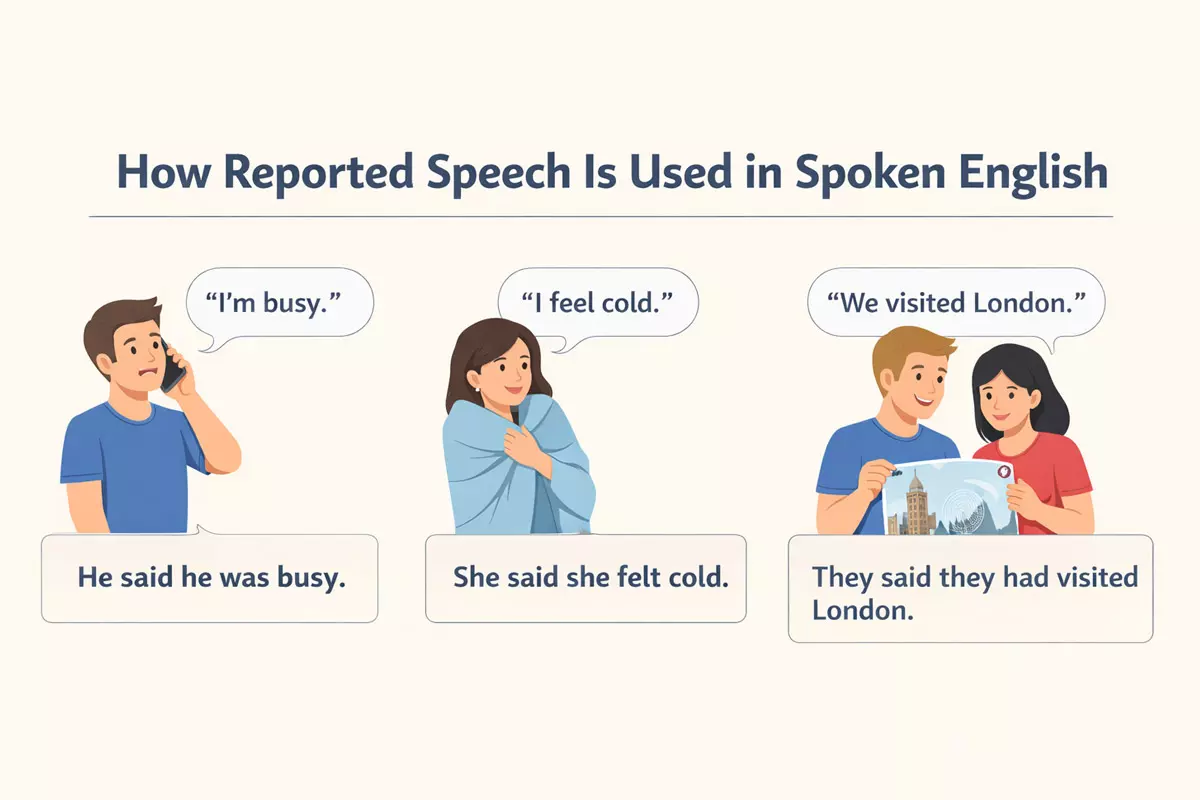 Here we key features of reported speech in conversation, including common reporting verbs, simplification in informal contexts, and optional tense changes. It also addresses natural speech rhythm, omissions, and frequent spoken usage mistakes.
In our daily lives, we frequently share information by repeating what others have told us, whether we are conveying stories, giving instructions, or passing on opinions. Being able to accurately relay someone else's words is crucial for effective communication, as it helps prevent misunderstandings and ensures that the intended message is delivered clearly. Mastering this skill not only enhances our ability to communicate but also fosters trust and reliability in our interactions with others.
Features of reported speech in conversation
In everyday English, people often use indirect ways of sharing what others have said. This style is less formal than what’s found in textbooks, and it adapts to the flow of conversation. When relaying someone’s words, speakers frequently simplify grammar, omit unnecessary details, and focus on the message rather than perfect structure.
Common Characteristics
- Flexible tense usage: Speakers sometimes keep the original tense, especially if the context is clear or the information is still true.
- Frequent use of “say” and “tell”: These verbs are the most common for introducing another person’s words.
- Omission of reporting verbs: In fast-paced dialogue, people may skip “he said” or “she told me” entirely if it’s obvious who is being referred to.
- Use of “like” and “go” as informal quotatives: For example, “She was like, ‘Really?’” or “He goes, ‘I don’t believe it!’”
- Shifts in pronouns and time expressions: Words like “I,” “here,” and “today” are adapted to fit the current speaker’s perspective.
- Reduced formality: Strict backshifting and word-for-word accuracy are less important in casual talk than in written English.
- Mixing direct and indirect speech: It’s common to blend direct quotes with paraphrased information in the same exchange.
- Use of intonation and gesture: Speakers may rely on voice or body language to indicate they are quoting someone.
- Ellipsis and incomplete sentences: Utterances are often shortened, leaving out subjects or verbs when the meaning is clear.
- Inclusion of personal commentary: People frequently add their own opinions or reactions when reporting what was said.
Typical Reporting Patterns
Conversation favors certain patterns and verbs for relaying speech. Here are some frequent structures:
- “He said (that) he was running late.”
- “She told me (that) she didn’t have my number.”
- “They were like, ‘No way! We can’t believe it.’”
- “I go, ‘Are you serious? This is happening right now?’”
- “He was all, ‘Don’t worry about it. I’ve got this.’”
- “So she goes, ‘I’m not doing that again.’”
- “He asked if I could help him for a minute.”
- “They mentioned that the meeting had been moved to Friday.”
- “She wondered whether he would actually show up.”
- “He explained (that) he had missed the bus.”
- “I heard (that) they were opening a new office downtown.”
- “She was saying she wanted to quit her job.”
Adapting Pronouns and Time Markers
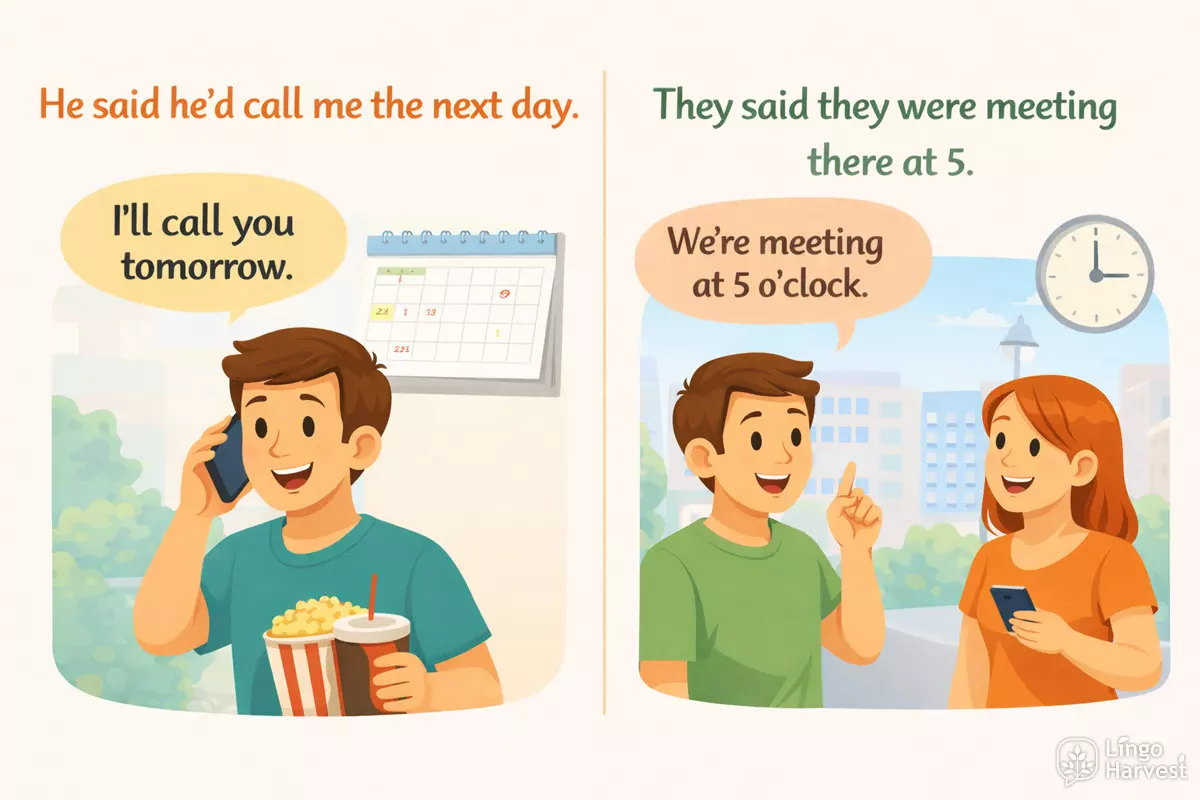
Speakers naturally adjust words to fit the new context. For example, “I” becomes “he” or “she,” and “here” might change to “there.” This helps keep the meaning clear for listeners.
| Original Statement | How It’s Reported in Conversation |
|---|---|
| “I’ll call you tomorrow.” | He said he’d call me the next day. |
| “We’re meeting here at 5.” | They said they were meeting there at 5. |
| “I can’t help you now.” | She told me she couldn’t help me then. |
| “I like this place.” | He said he liked that place. |
Mixing Direct and Indirect Forms
In spontaneous talk, it’s common for speakers to switch between quoting exact words and summarizing. This flexibility makes spoken English dynamic and responsive to the needs of real-life interaction.
Common reporting verbs in speech
When people report what someone else has said in English, they often use a range of verbs beyond just "say" or "tell." These verbs help express not only the content of speech, but also the attitude, intention, or manner in which something was communicated. Choosing the right verb can provide important context for the listener and clarify the speaker’s meaning.
Frequently used reporting verbs in conversation
English speakers regularly rely on certain verbs when relaying information, questions, or requests from others. Each reporting verb can subtly change the listener’s understanding of the original message. Here are some commonly used options, along with a brief note on how they are typically used:
- Say – Neutral; reports what someone said without extra meaning.
- Tell – Usually followed by a person; emphasizes giving information or instructions.
- Ask – Used when reporting questions or requests.
- Advise – Indicates that the speaker offered guidance or recommendations.
- Suggest – Reports that someone put forward an idea or proposal.
- Warn – Used when a caution or warning was given.
- Promise – Relays that a commitment or assurance was made.
- Admit – Shows that someone acknowledged or confessed something.
- Deny – Indicates that the speaker rejected or refused something.
- Remind – Used when someone was prompted to remember something.
- Complain – Expresses that someone voiced dissatisfaction.
- Agree – Reports that someone accepted or consented to something.
- Refuse – Indicates a rejection or unwillingness.
- Insist – Shows the speaker demanded or strongly asserted something.
- Offer – Used when someone volunteered help or something else.
- Explain – Reports that someone clarified or made something understandable.
- Recommend – Indicates a suggestion or endorsement was made.
- Order – Used for commands or directives.
- Encourage – Reports that the speaker gave motivation or support.
- Apologize – Relays that someone expressed regret.
How reporting verbs change meaning
Using different verbs can make a big difference in how the reported message is understood. For example, "She suggested leaving early" feels softer and less direct than "She ordered us to leave early." This choice allows speakers to reflect the original tone or intention more accurately.
| Reporting Verb | Typical Structure | Example |
|---|---|---|
| Tell | tell + (person) + (that) + clause | He told me that he was busy. |
| Ask | ask + (person) + (if/whether) + clause | She asked if I could help. |
| Suggest | suggest + (that) + clause / suggest + -ing | They suggested going out for dinner. |
| Promise | promise + (that) + clause / promise + to + verb | I promised to call her later. |
| Warn | warn + (person) + (that) + clause / warn + (person) + to + verb | He warned us not to touch it. |
| Advise | advise + (person) + to + verb / advise + (that) + clause | The doctor advised me to rest. |
| Remind | remind + (person) + to + verb | She reminded him to bring his keys. |
| Order | order + (person) + to + verb | The officer ordered them to stop. |
Understanding these verbs and their patterns can help you report speech more precisely and naturally in English conversations. The more varied your choice of reporting verbs, the more accurately you can convey not just what was said, but how it was said.
Simplification in informal contexts
When people use reported speech in everyday conversation, they often rely on much simpler structures than what textbooks teach. Rather than following all the grammatical rules for tense shifts or reporting verbs, speakers tend to prioritize speed and clarity. This leads to a range of shortcuts that help keep conversations flowing naturally, even if the language is less formal or technically precise.
Common Shortcuts in Everyday Speech
- Dropping the reporting verb ("He was like, 'I can't believe it!'")
- Using "like" or "go" instead of "say" or "tell"
- Skipping tense changes ("She said she is tired" instead of "was tired")
- Leaving out pronoun changes ("They said, 'We need help'" stays as "They said 'we'")
- Omitting "that" ("He said he’s coming" instead of "He said that he’s coming")
- Quoting directly instead of paraphrasing
- Using gestures or facial expressions to supplement the words
- Mixing direct and indirect speech in the same sentence
- Repeating only the gist or main idea, not the exact words
- Starting with "So" or "And then" to introduce reported speech
- Using present tense even when reporting past events
- Employing vague time references ("yesterday," "the other day," "just now") instead of specific ones
- Switching between first- and third-person pronouns without strict consistency
- Relying on intonation or emphasis instead of grammatical markers
- Abandoning formal sequence of tenses
- Leaving out the subject if it’s obvious ("Said he’d be late")
Examples: Formal vs. Informal Reporting
| Standard Form | Informal Spoken Form |
|---|---|
| He said that he was tired. | He was like, "I'm so tired." |
| She told me she would call later. | She goes, "I'll call you later." |
| They asked if we had finished the work. | They were like, "Did you finish?" |
| I told him that I didn't understand. | I was like, "What?" |
| He said that he couldn’t come. | He said he can’t come. |
Why Do Speakers Simplify?
These patterns reflect a preference for efficiency and relatability. In spontaneous conversation, people care more about getting their message across than about strict accuracy. Simplifying reported speech makes interactions quicker and helps listeners focus on the main point, rather than on formal details.
Understanding these informal strategies can help learners and listeners recognize meaning even when grammar isn't textbook-perfect. It also explains why spoken English can sound very different from what’s written or formally taught.
Optional tense changes in spoken English
In everyday conversation, English speakers often make choices about whether or not to shift tenses when reporting speech. While traditional grammar rules suggest backshifting (changing present tenses to past, for example), in real-life dialogue, speakers sometimes keep the original tense, especially when the information is still true or relevant.
When tense changes are optional

Tense shifts are less strict when the reported statement expresses something that remains true or is general knowledge. Context, intent, and the speaker’s perception of the information all influence whether a tense change is used. Some speakers prioritize clarity or immediacy, while others follow formal conventions.
- “He says he likes jazz.” (No tense change, fact still true)
- “She told me she lives in Paris.” (No shift, still her home)
- “They said they are coming.” (No shift, action is still expected)
- “He said he was tired.” (Traditional backshift, possible past feeling)
- “I heard you got the job.” (Shift to match past event)
- “She mentioned she can’t drive.” (No shift, ability is unchanged)
- “You told me you would help.” (Modal verb, already past form)
- “He said the earth is round.” (No shift, general truth)
- “She said she will call later.” (No shift, future action remains)
- “They said they were leaving.” (Backshift shows completed or ongoing action in the past)
Common patterns and speaker choices
The choice to shift tenses or not depends on several factors. Here’s a quick comparison of typical patterns in informal spoken English:
| Direct Speech | Reported Speech (No Tense Change) | Reported Speech (With Tense Change) |
|---|---|---|
| “I love pizza.” | He said he loves pizza. | He said he loved pizza. |
| “I’m tired.” | She said she is tired. | She said she was tired. |
| “We have a meeting.” | They said they have a meeting. | They said they had a meeting. |
| “The store opens at 9.” | He said the store opens at 9. | He said the store opened at 9. |
| “I will call you.” | She said she will call me. | She said she would call me. |
Situations where tense change is not needed
- Facts and general truths (e.g. “She said water boils at 100°C.”)
- Recent statements where the situation has not changed
- Promises, plans, or arrangements that are still valid
- Ability, permission, or obligation that remains true
To sum up, in spoken English, whether or not you shift tenses when reporting speech depends on the speaker’s goal, the context, and how current or relevant the information feels. This flexibility reflects how people naturally communicate, focusing on clarity and meaning over strict grammatical rules.
Natural speech rhythm and omission
Everyday spoken English flows quickly, and this natural speed often leads to words or sounds being left out. When people report what was said, they tend to use shorter, easier patterns that fit the pace of conversation. This can mean dropping certain words, condensing phrases, or even omitting parts that would be included in careful, written language.
How rhythm shapes reported speech
Spoken English prefers smooth, rhythmic chunks. This encourages speakers to simplify structures, especially when introducing someone’s words. Instead of always using full reporting clauses like “She said that…”, speakers often remove words such as “that,” pronouns, or even the reporting verb if the meaning is clear from context.
Common omissions in spoken reported speech
- Dropping the conjunction “that”: He said he was tired (instead of He said that he was tired).
- Leaving out pronouns: Told you I’d call (instead of I told you I’d call).
- Omitting auxiliary verbs: You coming? (instead of Are you coming?).
- Reducing verb phrases: She’s like, ‘No way!’ (instead of She was like, ‘There is no way!’).
- Skipping repeated information: John said he’d go, Mary too (instead of Mary said she’d go too).
- Contracting or merging words: Didn’t know (instead of I didn’t know).
- Using only the reporting verb: Said she’d help (instead of She said she’d help).
- Eliding parts of quotations: He was like, ‘Whatever’ (leaving out extra explanation).
- Shortening questions: He ask you? (instead of Did he ask you?).
- Abandoning full tense agreement: She said she’s busy (mixing past and present tenses in casual speech).
- Leaving out “to” in infinitives: She told me go home (instead of She told me to go home).
- Ignoring indirect objects: Promised would help (instead of She promised she would help).
Why do these omissions happen?
These reductions are not random; they help maintain a natural conversational tempo. Speakers rely on context, shared knowledge, and intonation to fill in the gaps. The listener usually understands the intended meaning even when pieces are missing, because the rhythm and flow of spoken English guide comprehension.
Comparison: Full vs. reduced reported speech
| Full Form | Typical Spoken Reduction |
|---|---|
| He said that he was tired. | He said he was tired. |
| I told you that I would call. | Told you I’d call. |
| Did she say that she’s coming? | She say she’s coming? |
| They asked if you wanted to join them. | Asked if you wanted to join. |
| She said that it was too late. | She said it was too late. |
| I did not know that you were here. | Didn’t know you were here. |
Recognizing these patterns helps learners understand why spoken English can sound so different from textbooks. Omission and rhythm work together to make reported speech feel light, quick, and natural in conversation.
Typical spoken usage mistakes
In everyday conversation, people often make errors when using reported speech, especially under time pressure or in informal settings. These errors can affect clarity or cause confusion, but they are common and, in most cases, easily corrected once you become aware of them.
Common problems with verb tense
One major source of confusion is shifting tenses incorrectly. In spoken English, speakers frequently forget to backshift the verb tense when reporting what someone said, especially with present and future forms. This can result in sentences that sound unnatural or misleading.
- Direct: "I am tired."
Incorrect reported: She said she is tired. ❌
Correct reported: She said she was tired. ✅ - Direct: "I will help."
Incorrect reported: He said he will help. ❌
Correct reported: He said he would help. ✅ - Direct: "I have seen it."
Incorrect reported: She said she has seen it. ❌
Correct reported: She said she had seen it. ✅
Mixing up pronouns
Another frequent error involves forgetting to change pronouns to match the perspective of the speaker and listener. This can make it unclear who is being referred to.
- Direct: "You need to finish this."
Incorrect reported: He said you need to finish this. ❌
Correct reported: He said I needed to finish that. ✅ - Direct: "I love my job."
Incorrect reported: She said I love my job. ❌
Correct reported: She said she loved her job. ✅
Using "say" and "tell" interchangeably
It’s easy to confuse when to use "say" and "tell." Remember, "tell" usually needs a person as an object, while "say" does not.
- Incorrect: She told me that she was tired. ✅
- Incorrect: She said me that she was tired. ❌
- Correct: She said that she was tired. ✅
Dropping "that" or using it redundantly
In spoken English, "that" is often omitted, which is usually fine, but sometimes its absence or unnecessary repetition can make sentences awkward or ambiguous.
- Natural: He said (that) he was coming.
- Awkward: He said that that he was coming. ❌
Confusing direct and indirect questions
When reporting questions, it’s common to keep the original question word order, which is incorrect. Indirect questions use statement word order.
| Direct Question | Incorrect Indirect | Correct Indirect |
|---|---|---|
| "Where is he going?" | She asked where is he going. ❌ | She asked where he was going. ✅ |
| "What did you eat?" | He asked what did you eat. ❌ | He asked what you had eaten. ✅ |
| "Can you help me?" | She asked can you help her. ❌ | She asked if I could help her. ✅ |
| "Are they coming?" | He wondered are they coming. ❌ | He wondered if they were coming. ✅ |
Omitting time/place word changes
Reported speech often requires shifting words like "today" to "that day," or "here" to "there." Skipping these changes can cause confusion, especially when the context has changed.
- "I’ll do it tomorrow." → She said she would do it the next day.
- "Meet me here." → He told me to meet him there.
Summary of frequent pitfalls
To sum up, the most frequent speaking errors with reported speech involve verb tense, pronouns, reporting verbs, word order in questions, and shifting references for time and place. Paying attention to these patterns helps make your English clearer and more accurate in conversation.
Homework
Practice optional tense changes in spoken reported speech and common reductions. Focus on meaning first: choose the form that sounds natural and keeps the timeline clear.
Task 1: Choose the best option (spoken English)
Pick the more natural sentence for everyday conversation. In some items, both are possible — choose the one that best matches the context.
- You are talking about your friend’s current hobby.
a) He said he loved jazz.
b) He said he loves jazz. - The person still lives in the same city now.
a) She told me she lived in Paris.
b) She told me she lives in Paris. - The plan is still happening later today.
a) They said they were coming.
b) They said they are coming. - You are reporting a past mood that likely changed.
a) He said he is tired.
b) He said he was tired. - You are reporting a completed past event (the result is known).
a) I heard you get the job.
b) I heard you got the job. - The ability is permanent and still true.
a) She mentioned she couldn’t drive.
b) She mentioned she can’t drive. - You are reminding someone of a promise made earlier.
a) You told me you will help.
b) You told me you would help. - General truth.
a) He said the earth is round.
b) He said the earth was round. - A future action is still expected and scheduled.
a) She said she would call later.
b) She said she will call later. - You are reporting something that already happened (they left earlier).
a) They said they were leaving.
b) They said they are leaving.
Show answers
- b
- b
- b
- b
- b
- b
- b
- a
- a
- a
Task 2: Rewrite into natural spoken reductions
Rewrite each sentence the way it might sound in casual conversation. Keep the meaning. Use contractions and common omissions where natural.
- I told you that I would call you later.
- He said that he was not coming tonight.
- Did she say that she is coming?
- They asked if you wanted to join them.
- I did not know that you were here.
- She said that it was too late.
- He said that he has already finished.
- She told me that she cannot drive.
- He said that he will text you in the morning.
- They said that they have a meeting today.
Show answers
- Told you I’d call you later.
- He said he wasn’t coming tonight.
- She say she’s coming?
- They asked if you wanted to join.
- Didn’t know you were here.
- She said it was too late.
- He said he’s already finished.
- She told me she can’t drive.
- He said he’ll text you in the morning.
- They said they’ve got a meeting today.