Formal Alternatives to Phrasal Verbs in English

 Here we why phrasal verbs are considered informal, provides formal alternatives, and explains their use in academic and professional writing. It also covers style differences, common mistakes, replacement strategies, and includes practice exercises.
- Why phrasal verbs sound informal
- Common phrasal verbs and formal equivalents
- Using formal verbs in academic writing
- Business and professional contexts
- Style differences in spoken and written English
- Typical replacement strategies
- Mistakes when choosing formal verbs
- Practice exercises on formal verb alternatives
Selecting accurate and refined vocabulary significantly enhances academic or professional communication. In casual conversation, people commonly use multi-word verbs, but in formal settings, opting for single-word alternatives can improve clarity and conciseness. Using precise language not only demonstrates a strong command of the subject but also makes the message more direct and effective, which is essential for conveying complex ideas or arguments clearly and persuasively in written or spoken form.
Why phrasal verbs sound informal
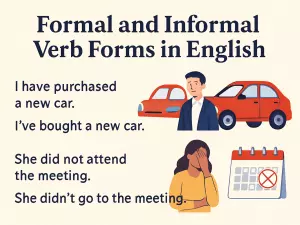
Phrasal verbs often give spoken and written English a relaxed, conversational feel. Unlike their single-word counterparts, these multi-word expressions—such as “give up” or “run into”—tend to be used naturally in everyday conversation, making them feel less formal than terms like “surrender” or “encounter.” This difference in tone comes from their origins, their structure, and the way they’re used in context.
Origins and Everyday Use
Many phrasal verbs have roots in Old or Middle English, evolving alongside the spoken language rather than through formal academic or legal channels. As a result, they’re closely linked to informal speech patterns and everyday interactions, which makes them sound more approachable and less rigid.
Structural Simplicity
The structure of these expressions is straightforward: a verb plus a preposition or adverb. This simplicity contrasts with the more complex or “Latinate” vocabulary found in formal writing. Because of this, they’re typically favored in casual settings, storytelling, and conversation.
Examples of Informal Phrasal Verbs

- bring up (mention) — She brought up an important concern during the final meeting.
- call off (cancel) — They called off the event after the venue failed the safety inspection.
- find out (discover) — We found out what caused the error by reviewing the server logs.
- go on (continue) — The discussion went on longer than expected because the stakes were high.
- look after (care for) — She looks after her grandfather while balancing a full-time job.
- put off (postpone) — They put off the decision until they had enough data to justify it.
- set up (establish) — The team set up a new workflow to reduce delays and confusion.
- take over (assume control) — A new manager took over and restructured the entire department.
- turn down (reject) — He turned down the offer because the terms were too restrictive.
- work out (resolve) — We worked out a compromise that protected both sides’ interests.
- carry on (persist) — She carried on with the plan despite criticism from senior colleagues.
- come across (encounter) — I came across a useful framework while reading a research paper.
- hand in (submit) — Please hand in the final draft by Friday so we can review it on time.
- make up (invent) — He made up a story to explain why the files were missing.
- point out (indicate) — The reviewer pointed out several inconsistencies in the methodology section.
- run out of (deplete) — We ran out of time before we could test the last two scenarios.
- show up (arrive) — Only a few participants showed up, so the session was rescheduled.
- sort out (organize) — Let’s sort out the priorities first, then allocate resources accordingly.
- take up (begin) — She took up coding seriously and progressed faster than anyone expected.
- back up (support) — The claim was backed up by multiple independent sources.
In summary, these expressions are a hallmark of informal English because they reflect how people actually speak to one another in daily life. While they are clear and direct, their casual tone may not suit academic, professional, or official documents, where more formal vocabulary is generally preferred.
Common phrasal verbs and formal equivalents
Understanding the contrast between informal multi-word verbs and their more formal single-word counterparts can help you sound more professional in academic, business, or official writing. Phrasal verbs are often used in everyday conversation, but replacing them with precise alternatives can make your English clearer and more sophisticated.
Typical examples and their formal substitutes
Below, you’ll find a table comparing frequently used phrasal verbs with suitable formal verbs or expressions. These alternatives are especially useful in written communication, reports, and formal presentations.
| Phrasal Verb | Formal Equivalent | Example Sentence |
|---|---|---|
| break down | analyze / decompose | The report breaks down the data into clearly defined categories. |
| bring about | cause / produce | The new policy brought about significant changes in workplace culture. |
| call for | require / demand | The situation calls for immediate action from senior management. |
| check out | verify / examine | You should check out the latest figures before drawing conclusions. |
| cut back on | reduce / limit | The company decided to cut back on unnecessary expenses. |
| drop out of | withdraw from | Several participants dropped out of the program due to time constraints. |
| figure out | determine / understand | It took months to figure out how the system had been compromised. |
| get across | communicate / convey | The speaker struggled to get his main point across. |
| keep up with | stay informed about | It is difficult to keep up with rapid developments in the field. |
| lay off | dismiss / make redundant | The firm had to lay off staff after profits declined. |
| move on | progress / advance | After resolving the issue, the team moved on to the next phase. |
| phase out | eliminate gradually | The company plans to phase out outdated technology. |
| pull off | achieve / accomplish | They pulled off a successful launch despite limited resources. |
| rule out | exclude / dismiss | Doctors ruled out any serious underlying condition. |
| step down | resign / withdraw | The CEO stepped down after a decade in the role. |
| take into account | consider | The analysis takes into account both economic and social factors. |
| touch on | mention briefly | The lecture touched on several controversial topics. |
| wind up | end / conclude | The discussion wound up earlier than expected. |
| weigh up | evaluate / assess | Investors are weighing up the risks before committing funds. |
| zero in on | focus on | The investigation quickly zeroed in on the primary cause. |
When to choose a formal alternative
Selecting a more formal verb is especially important in academic essays, business correspondence, and official documents. Using precise vocabulary can enhance the clarity and credibility of your message. However, in informal conversation, phrasal verbs remain perfectly natural.
- In a job application, use “conducted research” instead of “carried out research”.
- When writing a report, prefer “postpone the meeting” over “put off the meeting”.
- In presentations, try “eliminate errors” rather than “get rid of errors”.
Choosing the right level of formality helps your English sound polished and appropriate for the context. With regular practice, these alternatives will become second nature.
Using formal verbs in academic writing
Academic writing favors clarity and precision, which is why single-word verbs are generally preferred over informal phrasal verbs. Formal alternatives help convey ideas more directly and professionally, making your arguments stronger and your writing style more consistent. For non-native speakers, mastering these alternatives can significantly improve academic tone and credibility.
Why replace phrasal verbs?
Phrasal verbs such as "put off," "bring up," or "look into" tend to be informal and may sound vague in scholarly contexts. Substituting them with formal verbs not only increases the formality but also reduces ambiguity. For example, "investigate" is more precise than "look into," and "postpone" is clearer than "put off."
Common formal alternatives
Here are some frequent academic phrasal verbs alongside their more formal single-word counterparts, with example sentences:
- break down → (analyze, decompose) → The article breaks down complex theories into practical models.
- account for → (explain, justify) → These factors account for the rapid growth of the sector.
- result in → (lead to, cause) → Poor planning can result in significant financial losses.
- phase in → (introduce gradually) → The policy was phased in over a three-year period.
- draw on → (utilize, rely on) → The study draws on data collected over two decades.
- rule out → (exclude, dismiss) → The researchers ruled out alternative explanations.
- focus on → (concentrate on, emphasize) → The discussion focuses on long-term outcomes.
- refer to → (mention, cite) → The author refers to several earlier studies.
- stem from → (originate from) → Many of these issues stem from outdated regulations.
- contribute to → (support, promote) → Early education contributes to cognitive development.
- cope with → (manage, handle) → Governments must cope with increasing demographic pressure.
- amount to → (equal, represent) → The total cost amounts to several million dollars.
- adhere to → (comply with, follow) → All participants must adhere to ethical guidelines.
- point toward → (indicate, suggest) → The findings point toward a shift in consumer behavior.
- give rise to → (cause, generate) → Technological advances gave rise to new industries.
- center on → (revolve around) → The debate centers on data privacy concerns.
- set out → (outline, present) → The report sets out the key objectives of the project.
- fall behind → (lag, fail to keep pace) → Smaller firms risk falling behind their competitors.
- build on → (develop further, expand) → The new theory builds on earlier research.
- lead up to → (precede) → A series of events led up to the policy reform.
Tips for effective use of formal verbs
- Check your drafts for phrasal verbs and replace them with more formal options where appropriate.
- Be mindful of context—some phrasal verbs may be acceptable in less formal sections, like acknowledgements.
- Practice using formal verbs by rewriting sentences to improve academic tone and clarity.
Adopting precise verbs not only enhances the professionalism of your writing but also helps readers grasp your arguments more easily. Over time, favoring these alternatives will make formal English come more naturally in your academic work.
Business and professional contexts
In workplace communication, especially in formal documents, meetings, and emails, replacing phrasal verbs with more precise or elevated alternatives can improve clarity and professionalism. While phrasal verbs are common in casual speech, substituting them with single-word verbs or formal expressions often sounds more appropriate in corporate or academic settings.
Common Substitutions in Formal Writing
Consider the following examples where a direct verb or phrase offers a more polished tone than a typical phrasal verb. These alternatives are especially useful in reports, proposals, business correspondence, and presentations:
- apply for → (submit an application for) → She applied for the fellowship after completing her postgraduate research.
- back out of → (withdraw from) → The company backed out of the agreement at the last minute.
- brush up on → (refresh, improve) → He brushed up on his statistics before starting the new project.
- come down to → (depend on, be determined by) → The final decision comes down to budget constraints.
- cut across → (affect, overlap) → These issues cut across several academic disciplines.
- iron out → (resolve, eliminate) → The teams met to iron out the remaining inconsistencies.
- line up → (arrange, organize) → Several interviews have been lined up for next week.
- narrow down → (reduce, limit) → The researchers narrowed down the variables to three key factors.
- opt for → (choose, select) → Many students opt for a more flexible learning format.
- play out → (unfold, develop) → It remains unclear how the situation will play out.
- roll out → (introduce, implement) → The university rolled out a revised assessment system.
- scale up → (expand, increase) → The pilot program was scaled up after positive initial results.
- single out → (identify, select) → The report singles out climate change as a major risk factor.
- step aside → (resign, withdraw) → The chair stepped aside to allow an independent review.
- take on → (undertake, assume) → The department took on additional responsibilities last year.
- tie in with → (correspond with, align with) → The findings tie in with previous longitudinal studies.
- track down → (locate, identify) → The archivist managed to track down the original manuscript.
- wean off → (reduce gradually) → The policy aims to wean the economy off fossil fuels.
- work toward → (strive for, pursue) → The organization is working toward long-term sustainability.
- zero out → (eliminate, remove completely) → The adjustments effectively zeroed out the deficit.
Comparing Usage: Phrasal Verbs vs. Formal Alternatives
Understanding the distinction between informal and formal choices helps professionals adjust their language appropriately. The following table demonstrates typical substitutions that enhance the tone of business communication:
| Phrasal Verb | Formal Alternative |
|---|---|
| bring up | raise |
| look into | investigate |
| put off | postpone |
| find out | ascertain |
| set up | establish |
| turn down | decline |
| give up | relinquish |
| call off | cancel |
| carry out | conduct |
| take part in | participate in |
Why Use Formal Alternatives?
Choosing more precise verbs over multi-word expressions can reduce ambiguity and convey authority. Many formal alternatives are internationally recognized, which helps avoid misunderstandings in cross-cultural environments. This approach is especially valued in legal, technical, and administrative documents, where clarity and formality are essential.
In summary, while phrasal verbs are natural in speech, favoring their formal counterparts in professional English can enhance both the impact and clarity of your message.
Style differences in spoken and written English
English speakers often choose words and expressions differently depending on whether they’re communicating in speech or writing. One of the clearest distinctions is the preference for phrasal verbs in conversation, while more formal, single-word alternatives are favored in academic or professional texts. This shift isn’t just about vocabulary—register, tone, and even sentence structure tend to change as well.
Why does it matter?
Selecting the right level of formality is important for clarity and appropriateness. Informal conversation can sound awkward or unprofessional in essays or reports, while overly formal language may seem distant or unnatural in everyday speech. Understanding which expressions fit each context helps ensure effective communication.
Common patterns: spoken vs. written
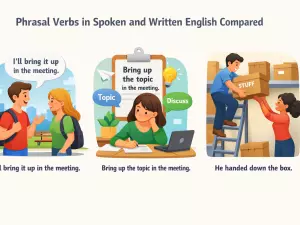
Spoken English tends to be more direct and idiomatic, using many two- or three-word verbs. In contrast, written English—especially in academic, business, or official contexts—relies on Latinate verbs or more precise vocabulary. Here are some frequent patterns:
- Spoken: “find out” → Written: “discover”
- Spoken: “give up” → Written: “surrender” or “abandon”
- Spoken: “put off” → Written: “postpone”
- Spoken: “bring up” → Written: “mention” or “raise”
- Spoken: “look into” → Written: “investigate”
- Spoken: “come up with” → Written: “devise” or “propose”
- Spoken: “turn down” → Written: “reject”
- Spoken: “set up” → Written: “establish”
- Spoken: “run into” → Written: “encounter”
- Spoken: “carry out” → Written: “conduct” or “perform”
- Spoken: “work out” → Written: “calculate” or “resolve”
- Spoken: “go on” → Written: “continue”
- Spoken: “call off” → Written: “cancel”
- Spoken: “deal with” → Written: “address” or “handle”
- Spoken: “make up” → Written: “invent” or “fabricate”
- Spoken: “get over” → Written: “recover from”
- Spoken: “point out” → Written: “indicate” or “highlight”
- Spoken: “take part” → Written: “participate”
- Spoken: “break down” → Written: “analyze” (for problems) or “collapse” (for machines)
Practical tips
- Use phrasal verbs in casual conversation, emails to friends, or informal notes.
- Choose single-word verbs or more precise terms for essays, reports, and business correspondence.
- Notice your audience and context: adjust your language for clarity and tone.
- Practice paraphrasing phrasal verbs into more formal alternatives to build flexibility.
Being aware of these stylistic distinctions allows you to tailor your English for any occasion, ensuring your message is both appropriate and effective.
Typical replacement strategies
When speakers or writers want to avoid using multi-word verbs, they often turn to more formal, single-word alternatives. These substitutions are common in academic, legal, and professional contexts, where clarity and precision are highly valued. The main approaches involve replacing the original verb phrase with a Latinate verb, rephrasing with a noun and verb combination, or restructuring the sentence for greater formality.
Common substitution patterns
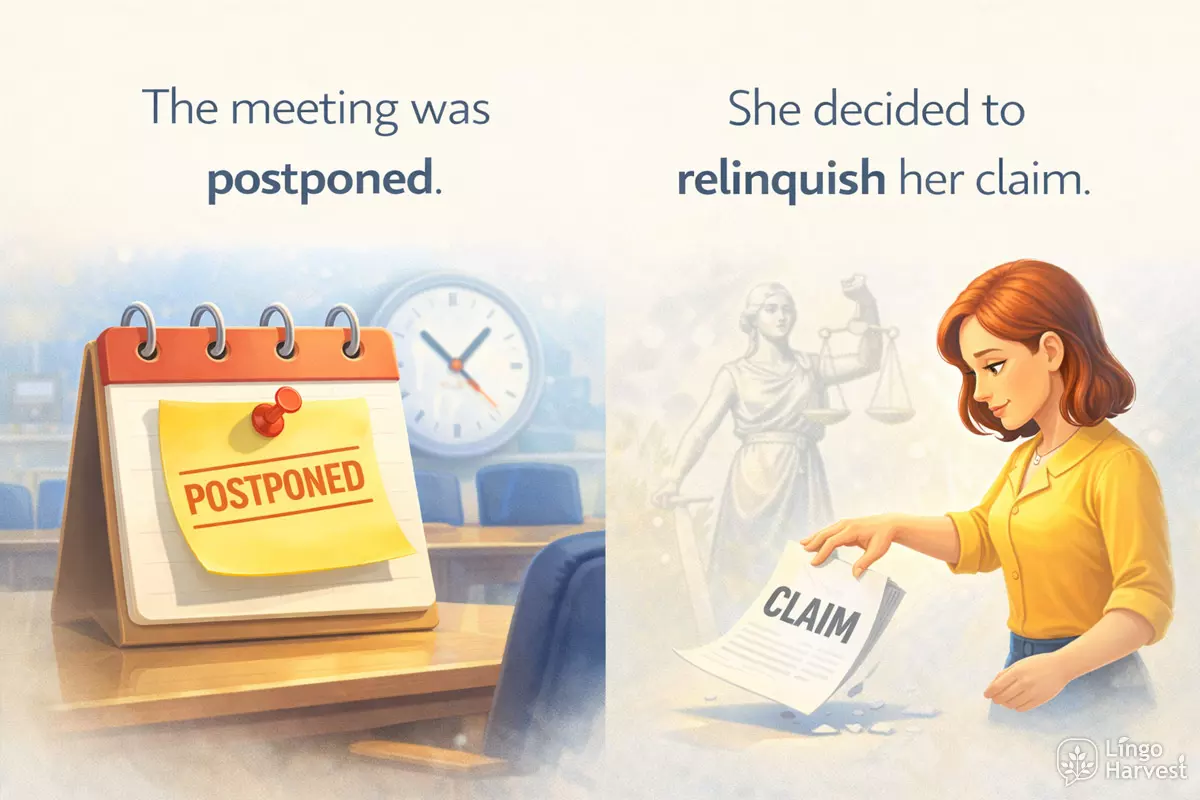
Most often, a phrasal verb is replaced by a verb of Latin or French origin. This swap usually results in a more formal or abstract tone. Another frequent strategy is to use a noun derived from the verb, sometimes with a supporting verb such as “make,” “give,” or “have.” In some cases, rewording the sentence entirely is the best solution, especially when no direct single-word equivalent exists.
| Phrasal Verb | Formal Alternative | Example Sentence |
|---|---|---|
| find out | discover / determine | We need to discover the cause. |
| put off | postpone / delay | The meeting was postponed. |
| give up | abandon / relinquish | She decided to relinquish her claim. |
| bring up | mention / raise | He did not mention the issue. |
| look into | investigate / examine | The committee will investigate the matter. |
| carry out | conduct / perform | The team will conduct the experiment. |
| set up | establish / arrange | The company was established in 1999. |
| turn down | reject / decline | The proposal was rejected. |
| come up with | devise / formulate | They managed to devise a solution. |
| get rid of | eliminate / remove | We must eliminate unnecessary steps. |
Additional methods
- Nominalization: Using a noun form plus a supporting verb (e.g., “make an appointment” instead of “set up an appointment”).
- Passive constructions: Shifting to the passive voice can sometimes avoid informal verb phrases (e.g., “The plan was carried out” instead of “They carried out the plan”).
- Relative clauses: Expanding with relative clauses may add formality (e.g., “The report that he submitted” instead of “The report he handed in”).
Choosing the appropriate substitute depends on context, audience, and the desired level of formality. While direct one-word replacements are often clear and concise, sometimes a more complex rephrasing is necessary to preserve the original meaning and tone.
Mistakes when choosing formal verbs
Selecting the right formal verbs instead of phrasal verbs can be surprisingly tricky, especially for non-native speakers. Sometimes, what looks like a direct swap can actually change the meaning, register, or even the clarity of a sentence. It’s easy to fall into common traps when trying to sound more academic or professional.
Common pitfalls to watch out for
- Choosing verbs with the wrong nuance: Not all formal verbs mean exactly the same as their phrasal verb counterparts. For example, “look into” and “investigate” are close, but “investigate” can sound much more serious.
- Overusing rare or awkward verbs: Sometimes, a formal alternative is so uncommon that it confuses the reader or listener. Words like “commence” instead of “start” may sound forced in everyday writing.
- Ignoring collocations: Some formal verbs don’t combine naturally with certain nouns or objects. For instance, “undertake a mistake” is incorrect, while “make a mistake” or “commit an error” would be right.
- Changing the tone inappropriately: Swapping in a formal verb can make a sentence sound too stiff or distant for the context. Conversational writing may not benefit from replacing every phrasal verb.
- Confusing similar verbs: Some formal verbs look similar but have different uses, like “assume” (to suppose) and “presume” (to take for granted without proof).
Examples of confusing substitutions
Here are some frequent mismatches or awkward choices that occur when trying to replace multi-word verbs with single-word alternatives:
- “Carry out” → “execute” (inappropriate for non-technical tasks)
- “Set up” → “establish” (too formal for casual contexts)
- “Go on” → “proceed” (may sound unnatural in some contexts)
- “Give up” → “surrender” (incorrect unless referring to conflict or competition)
- “Find out” → “ascertain” (can sound overly technical)
- “Put off” → “postpone” (correct but sometimes less natural in speech)
- “Make up” → “fabricate” (implies dishonesty, not simply “invent” or “create”)
- “Turn down” → “decline” (acceptable, but may be too formal for some situations)
- “Look after” → “supervise” (different meaning; “supervise” is more about oversight than care)
- “Bring up” → “mention” (incomplete if you mean to “raise a child”)
- “Call off” → “cancel” (correct, but “call off” can be more urgent or informal)
- “Break down” → “analyze” (only works in the sense of “explain in detail,” not for machines)
- “Take off” → “depart” (doesn’t always fit, especially with clothes or popularity)
- “Back up” → “support” (sometimes “backup” means a copy, not just support)
Comparison of phrasal verbs and formal alternatives
| Phrasal Verb | Formal Alternative | Notes |
|---|---|---|
| Look into | Investigate | “Investigate” is more formal and may suggest a legal or official inquiry. |
| Set up | Establish | “Establish” is formal; “set up” is more conversational. |
| Bring about | Cause | “Cause” is more direct and less idiomatic. |
| Get over | Recover (from) | “Recover” is the standard formal alternative in medical or emotional contexts. |
| Come up with | Devise | “Devise” means to invent or plan, but can sound technical. |
| Point out | Indicate | “Indicate” fits formal writing, but may lack emphasis. |
How to avoid common errors
- Check the context: Make sure the formal verb matches the tone and meaning needed.
- Consult a reliable dictionary or corpus to see how the formal verb is used in real sentences.
- Read examples in academic or professional texts to get a feel for natural usage.
- Ask for feedback from native speakers or experienced editors when in doubt.
By being careful with word choice and considering subtle differences in meaning and tone, you can confidently use formal verbs where appropriate and avoid common missteps.
Practice exercises on formal verb alternatives
Understanding how to replace informal phrasal verbs with more formal single-word verbs is an important skill in academic and professional English. This section provides practical activities to help you recognize and use these alternatives in context.
Identify the formal verbs
Below is a list of sentences. Each contains a phrasal verb. Rewrite each sentence by replacing the phrasal verb with a more formal verb.
- The manager will look into the problem tomorrow.
- We need to find out the cause of the delay.
- Please hand in your report by Friday.
- The company called off the meeting.
- She pointed out the mistake in my calculations.
- They put off the launch due to technical issues.
- The researchers carried out an experiment.
- He came up with an innovative idea.
- Can you go over this document?
- The team set up a new procedure.
Show answers
- The manager will investigate the problem tomorrow.
- We need to determine the cause of the delay.
- Please submit your report by Friday.
- The company cancelled the meeting.
- She indicated the mistake in my calculations.
- They postponed the launch due to technical issues.
- The researchers conducted an experiment.
- He proposed an innovative idea.
- Can you review this document?
- The team established a new procedure.
Matching formal verbs with phrasal verbs
Match each phrasal verb on the left with its more formal equivalent on the right.
| # | Phrasal Verb | Formal Alternative (choose one) |
|---|---|---|
| 1 | bring up | a) allocate · b) mention · c) abandon |
| 2 | take over | a) delegate · b) acquire · c) assume control |
| 3 | put forward | a) postpone · b) propose · c) enforce |
| 4 | find out | a) ascertain · b) notify · c) predict |
| 5 | get rid of | a) eliminate · b) obtain · c) compile |
| 6 | look into | a) observe · b) investigate · c) supervise |
| 7 | carry out | a) conduct · b) approve · c) assign |
| 8 | turn down | a) revise · b) reject · c) suspend |
| 9 | run into | a) encounter · b) resolve · c) allocate |
| 10 | draw up | a) draft · b) summarize · c) authorize |
Show answers
- bring up → b) mention
- take over → c) assume control
- put forward → b) propose
- find out → a) ascertain
- get rid of → a) eliminate
- look into → b) investigate
- carry out → a) conduct
- turn down → b) reject
- run into → a) encounter
- draw up → a) draft
Fill in the blanks
Choose the correct formal verb to complete each sentence. Options: assist, commence, distribute, obtain, terminate
- The conference will _______ at 9:00 AM.
- Please _______ the documents to all participants.
- We plan to _______ the contract at the end of this month.
- She will _______ you during the transition period.
- Did you _______ permission to access the files?
- The committee will _______ the proposal next week.
- The findings clearly _______ the need for further research.
- The company aims to _______ its operations in Asia.
- He refused to _______ responsibility for the error.
- The report seeks to _______ the underlying causes of the issue.
Show answers
- commence
- distribute
- terminate
- assist
- obtain
- review
- highlight
- expand
- assume
- identify
Expand your vocabulary
Here are more phrasal verbs and their formal equivalents. Review and try to use them in your own sentences:
- ask for → request
- give up → relinquish
- turn down → reject
- make up → fabricate
- deal with → address
- go on → continue
- set out → outline
- keep on → persist
- get rid of → eliminate
- run into → encounter
- bring about → cause
- cut down on → reduce
- show up → appear
- look after → supervise
- pick up → collect
Regular practice with these formal alternatives will help you communicate more effectively in formal writing and speech.