Pronunciation of Verb Endings: -s, -es, and -ed Explained

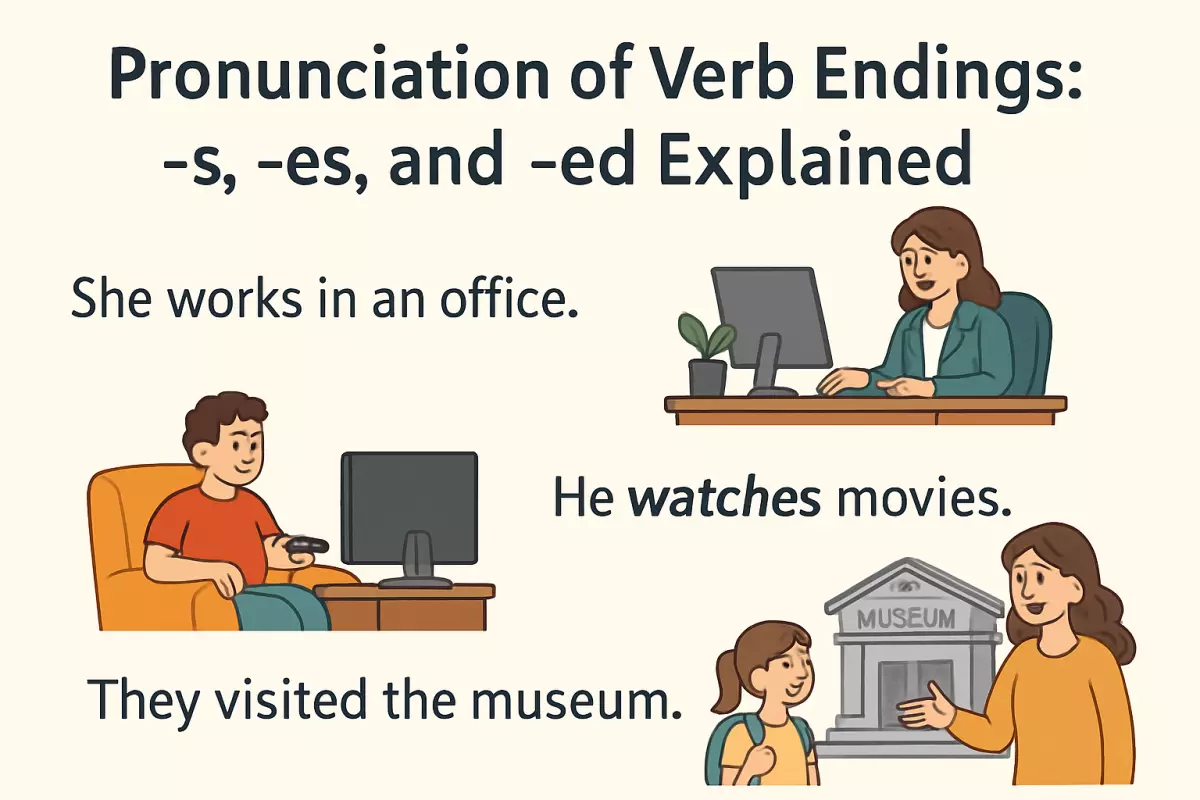 This article explains why verb endings change pronunciation, including the three sounds of -s/-es and -ed and how final sounds affect them. It also gives listening tips, flags common learner errors, and includes drills, patterns, and homework practice.
Small verb endings like s, es, and ed can completely change how a sentence sounds, and they often trip learners up. This guide helps you hear and practice the patterns native speakers use in everyday conversation, so you can pronounce these endings more naturally, avoid common mistakes, and speak with smoother rhythm and clearer timing. With focused listening and simple repetition, you’ll build confidence and sound more fluent in real situations.
Why verb endings change pronunciation
English adds endings like -s/-es and -ed to show grammar (third-person singular, plural, past tense), but the sound of the ending shifts to match the final sound of the base word. This happens because speakers naturally make speech smoother and faster: the voice may stay on, switch off, or an extra syllable may appear to avoid awkward sound combinations.
It depends on the final sound, not the final letter
The spelling can be misleading. What matters is the last sound you pronounce in the base form. For example, laugh ends with /f/ (voiceless), so the third-person ending is pronounced /s/: laughs /læfs/. Meanwhile, love ends with /v/ (voiced), so the ending is /z/: loves /lʌvz/.
Voicing: the main reason endings change
Many ending choices follow one simple pattern: sounds are either voiced (your vocal cords vibrate) or voiceless (they do not). English often keeps voicing consistent across the boundary between the base word and the ending.
- Voiceless final sound → ending tends to be voiceless: /s/ for -s, /t/ for -ed.
- Voiced final sound → ending tends to be voiced: /z/ for -s, /d/ for -ed.
- Sibilant or “hissing” final sound → an extra syllable is added: /ɪz/ for -es, /ɪd/ for -ed.
Extra syllables: avoiding difficult clusters
Sometimes English inserts a short vowel sound (usually /ɪ/) before the ending. This is not “optional” in standard pronunciation; it is the normal way to make the word pronounceable when the base already ends in a similar hissing sound.
- -s/-es adds a syllable /ɪz/ after: /s/, /z/, /ʃ/, /ʒ/, /tʃ/, /dʒ/ (examples: misses, washes, judges).
- -ed adds a syllable /ɪd/ after: /t/ or /d/ (examples: wanted, needed).
Common sound groups that trigger each ending
Use the sound category below to predict the ending. The examples are chosen to show the pattern clearly across different spellings.
| Base word ends with… | -s/-es ending sound + examples | -ed ending sound + examples |
|---|---|---|
| Voiceless sounds (p, t, k, f, θ) | /s/: stops, hits, asks, laughs, bathes (voiceless “th”) | /t/: stopped, kissed, asked, laughed, washed (note: washed ends /t/) |
| Voiced sounds (b, d, g, v, ð, m, n, ŋ, l, r, vowels) | /z/: grabs, calls, runs, lives, breathes (voiced “th”), plays | /d/: robbed, called, cleaned, lived, played |
| Sibilants (s, z, ʃ, ʒ, tʃ, dʒ) | /ɪz/: passes, loses, washes, measures, watches, changes | Usually /t/ or /d/ based on voicing: passed (/t/), changed (/d/). If base ends /t/ or /d/, then /ɪd/: waited, needed |
| Base ends in /t/ or /d/ | Regular voicing rule still applies: hits (/s/), adds (/z/) | /ɪd/: started, invited, added, ended |
Quick checks learners can use while speaking
- Say the base word clearly, then notice the last sound: is it voiced or voiceless?
- If it ends in a “hiss” sound (like /s/ or /ʃ/), expect an extra syllable: -es /ɪz/.
- If the past form would create t + d or d + d, English usually inserts /ɪ/: wanted, needed.
- Remember that letters can trick you: coughs ends /f/ → /s/, but moves ends /v/ → /z/.
These shifts are not random exceptions; they are predictable sound patterns that help English keep words easy to pronounce in connected speech.
Three sounds of -s and -es endings
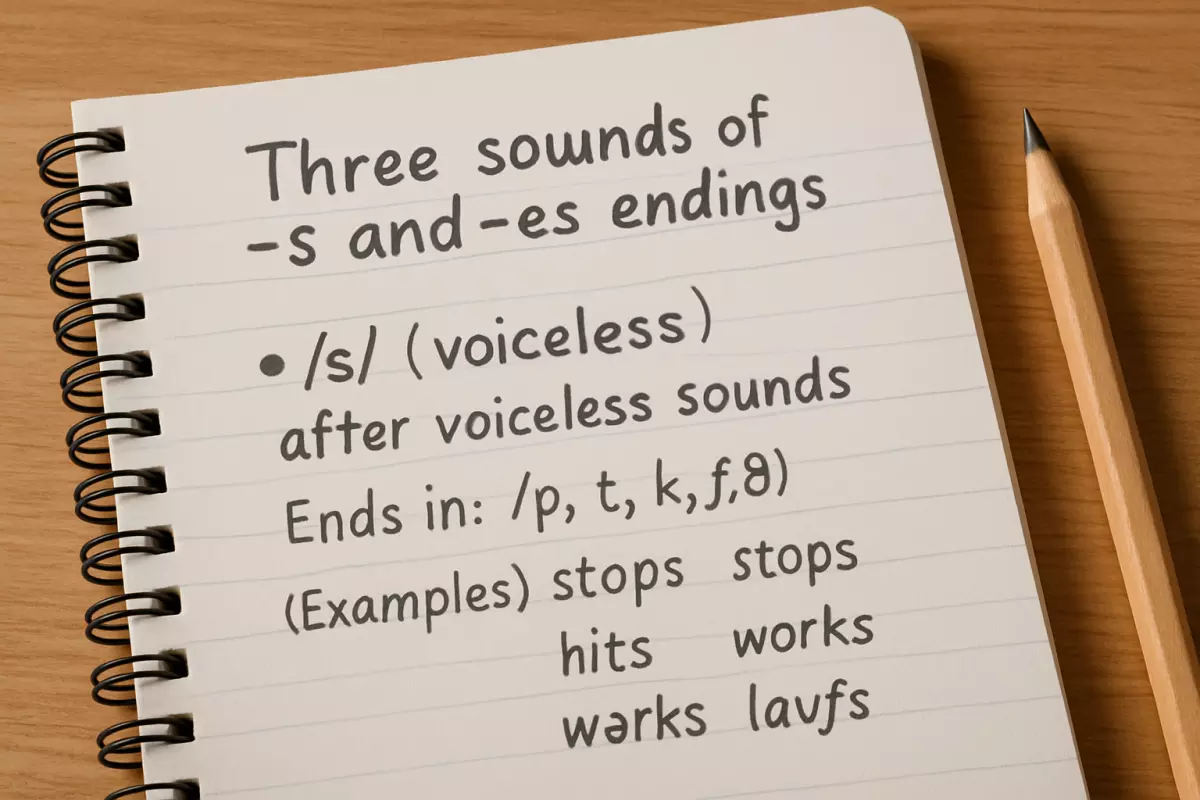
In the present simple (third-person singular) and in plural nouns, the written ending -s or -es can be pronounced in three different ways. The sound you use depends on the final sound of the base word, not on the spelling alone.
/s/ (voiceless) after voiceless sounds
Use /s/ when the word ends in a voiceless sound (your throat does not vibrate). Think of it as adding a quiet “s” sound.
- Ends in: /p, t, k, f, θ/ (as in think)
- Examples (verbs): stops /stɒps/, hits /hɪts/, works /wɜːks/, laughs /lɑːfs/, thinks /θɪŋks/
- Examples (nouns): cups, cats, books, cliffs, months
/z/ (voiced) after voiced sounds
Use /z/ when the word ends in a voiced sound (your throat vibrates), including vowels. This is the most common pronunciation.
- Ends in: vowels and /b, d, g, v, ð, m, n, ŋ, l, r/
- Examples (verbs): plays /pleɪz/, runs /rʌnz/, calls /kɔːlz/, drives /draɪvz/, remembers /rɪˈmembəz/
- Examples (nouns): dogs, cars, days, flowers, rooms
/ɪz/ (extra syllable) after sibilant sounds
Use /ɪz/ when the base word ends in a “hissing” or “shushing” sound. This adds an extra syllable, so the ending sounds like “iz.” In spelling, these words usually take -es.
- Ends in: /s, z, ʃ, ʒ, tʃ, dʒ/
- Examples (verbs): misses /ˈmɪsɪz/, uses /ˈjuːzɪz/, washes /ˈwɒʃɪz/, watches /ˈwɒtʃɪz/, judges /ˈdʒʌdʒɪz/
- Examples (nouns): buses, classes, boxes, dishes, bridges
| Pronunciation | When to use it (final sound) | Common spellings | Example words |
|---|---|---|---|
| /s/ | After voiceless sounds: /p, t, k, f, θ/ | Usually -s | stops, likes, laughs, thinks |
| /z/ | After voiced sounds and vowels | Usually -s | plays, reads, runs, drives |
| /ɪz/ | After sibilants: /s, z, ʃ, ʒ, tʃ, dʒ/ | Usually -es | washes, watches, misses, uses |
| Key reminder | Choose the sound by the final sound, not the final letter | Spelling can mislead | coughs (/s/), moves (/z/) |
Quick checks and common traps
- Vibration test: touch your throat and say the last sound of the base word. Vibration ✅ usually leads to /z/; no vibration ✅ usually leads to /s/.
- -es does not always mean /ɪz/: it usually does, but focus on the sound category (sibilant or not).
- Spelling traps: coughs ends with /f/ → /s/; clothes ends with /ð/ → /z/.
- Extra syllable only for sibilants: misses has two syllables, but miss + /s/ would be hard to say, so English inserts /ɪ/.
Three sounds of -ed endings
The past-tense spelling -ed can be pronounced in three different ways. The sound you choose depends on the final sound of the base verb (the verb without -ed), not on the spelling. Learning the pattern makes regular past forms much easier to understand in fast speech.
/t/ sound (voiceless ending)
Pronounce -ed as /t/ when the base verb ends in a voiceless sound (a sound made without vibrating the vocal cords). Think of sounds like /p, k, f, s, ʃ, tʃ/.
/t/ sound (voiceless ending)
Pronounce -ed as /t/ when the base verb ends in a voiceless sound. These sounds are produced without vibration of the vocal cords, such as /p, k, f, s, ʃ, tʃ/.
- work → worked (/t/)
- help → helped (/t/)
- laugh → laughed (/t/)
- miss → missed (/t/)
- wash → washed (/t/)
- watch → watched (/t/)
- dance → danced (/t/)
- jump → jumped (/t/)
- talk → talked (/t/)
- finish → finished (/t/)
- stop → stopped (/t/)
- pack → packed (/t/)
- laugh → laughed (/t/)
Tip: If the final sound feels like air flowing freely (for example /s/ or /f/), the -ed ending is usually pronounced /t/.
/d/ sound (voiced ending)
Pronounce -ed as /d/ when the base verb ends in a voiced sound. Voiced sounds involve vibration of the vocal cords and include all vowels and consonants like /b, g, v, z, m, n, l, r/.
- play → played (/d/)
- clean → cleaned (/d/)
- call → called (/d/)
- rain → rained (/d/)
- love → loved (/d/)
- close → closed (/d/)
- agree → agreed (/d/)
- listen → listened (/d/)
- answer → answered (/d/)
- allow → allowed (/d/)
- follow → followed (/d/)
- play → played (/d/)
- open → opened (/d/)
Quick check: Touch your throat while saying the last sound of the base verb. If you feel vibration (as in love or rain), the -ed ending will usually be /d/.
/ɪd/ (extra syllable)
Pronounce -ed as /ɪd/ (sometimes /əd/ in fast speech) when the base verb ends in /t/ or /d/. This creates an extra syllable to avoid difficult sound clusters.
- want → wanted (/ɪd/)
- need → needed (/ɪd/)
- wait → waited (/ɪd/)
- decide → decided (/ɪd/)
- invite → invited (/ɪd/)
- add → added (/ɪd/)
- start → started (/ɪd/)
- accept → accepted (/ɪd/)
- protect → protected (/ɪd/)
- edit → edited (/ɪd/)
- repeat → repeated (/ɪd/)
- land → landed (/ɪd/)
Quick reference: -ed pronunciation overview
| Ending sound of base verb | -ed pronunciation | Example |
|---|---|---|
| Voiceless (p, k, f, s, sh, ch) | /t/ | watched → /wɒtʃt/ |
| Voiced (vowels, b, g, v, m, n, l, r) | /d/ | played → /pleɪd/ |
| /t/ or /d/ | /ɪd/ | needed → /ˈniːdɪd/ |
Mastering -ed pronunciation is less about spelling and more about listening to the final sound of the base verb. Once learners focus on sound rather than letters, this rule becomes one of the most reliable and predictable patterns in English pronunciation.
Notice that this group is easy to spot: if the base form ends with a clear t or d sound, you almost always hear a full extra syllable at the end.
| Pronunciation of -ed | When it happens (final sound of the base verb) | Examples |
|---|---|---|
| /t/ | After voiceless sounds (not /t/) | worked, helped, laughed, washed |
| /d/ | After voiced sounds (not /d/) | played, cleaned, loved, rained |
| /ɪd/ (or /əd/) | After /t/ or /d/ | wanted, needed, decided, invited |
| Key idea | Choose by sound, not spelling | “watched” ends with /t/ because “watch” ends with /tʃ/ |
Common learner issues to watch for
- ❌ Adding a syllable every time: worked is one syllable at the end (/t/), not “work-id.”
- ❌ Using spelling instead of sound: laughed ends with /f/, so the ending is /t/.
- ✅ Listening for /t/ or /d/ in the base form: if you hear /t/ or /d/ already, use /ɪd/.
- ✅ Practicing minimal changes: compare play → played (/d/) and work → worked (/t/).
How final sounds affect pronunciation
The sound at the end of the base verb controls how the ending is spoken. English does this to keep speech smooth: the added ending “matches” the voicing and the type of final sound (a vowel, a voiced consonant, a voiceless consonant, or a sibilant like /s/ or /ʃ/). This is why the spelling may look similar, but the pronunciation changes in predictable ways.
1) Present simple: -s and -es (third-person singular)
For -s/-es, focus on the final sound of the verb (not the final letter). There are three common outcomes:
| Final sound of the base verb | Ending pronunciation | What you hear | Examples (base → 3rd person) |
|---|---|---|---|
| Voiceless consonant (not a sibilant): /p, t, k, f, θ/ | /s/ | A clear “s” sound | stop → stops, laugh → laughs, work → works, hit → hits, pass (final is sibilant, so see below) |
| Voiced sound (vowel or voiced consonant): vowels, /b, d, g, v, ð, m, n, ŋ, l, r/ | /z/ | A “z” sound | play → plays, go → goes, read → reads, live → lives, run → runs, call → calls |
| Sibilant: /s, z, ʃ, ʒ, tʃ, dʒ/ (sounds that “hiss” or “buzz”) | /ɪz/ (or /əz/) | An extra syllable: “iz/uhz” | miss → misses, watch → watches, wash → washes, judge → judges, buzz → buzzes |
| Spelling note (common trigger for -es) | Usually still follows the sound rules above | Don’t rely on letters alone | fix → fixes (/ɪz/ because /ks/ ends with /s/), choose → chooses (/ɪz/ because /z/), laugh → laughs (/s/ because final sound is /f/) |
- Key idea: /s/ and /z/ are one-syllable endings; /ɪz/ adds a syllable.
- Quick check: If the verb already ends with a “hissing/buzzing” sound, English usually inserts a short vowel sound before the ending (✅ watches /ˈwɒtʃɪz/; ❌ watchs).
- Sound over spelling: “goes” ends with /z/ (not /s/) because the base ends with a vowel sound.
2) Past tense and past participle: -ed
The -ed ending also changes based on the final sound of the verb. There are three patterns, and only one of them adds a full extra syllable.
- /t/ after a voiceless consonant (except /t/): walked, laughed, washed, fixed, helped.
- /d/ after a voiced sound (except /d/): played, cleaned, called, robbed, allowed, tried.
- /ɪd/ after /t/ or /d/ (extra syllable): wanted, needed, started, decided, added.
Notice the parallel with -s/-es: voiceless sounds tend to pair with voiceless endings (/s/, /t/), while voiced sounds tend to pair with voiced endings (/z/, /d/). The /ɪz/ and /ɪd/ options appear when English needs an extra vowel to separate similar sounds.
Common final-sound groups to practice
Grouping verbs by their ending sound makes the patterns easier to apply in real speech. Try these sets and listen for whether the ending is one syllable or two:
- Voiceless endings (/p, k, f, θ/): stop, help, work, laugh, cook, finish (ends /ʃ/ so different for -s).
- Voiced endings (/b, g, v, m, n, l, r/ and vowels): grab, beg, live, seem, plan, call, prefer, play, agree.
- Sibilant endings (/s, z, ʃ, tʃ, dʒ/): miss, lose, wash, watch, change, judge, relax (ends /s/), fix (ends /s/).
- /t/ or /d/ endings (special for -ed): wait, want, start, need, add, decide.
When you’re unsure, say the base verb aloud and identify the last sound you actually pronounce. Then choose the ending sound that fits the pattern: → /s/ vs /z/ vs /ɪz/ for present tense, and /t/ vs /d/ vs /ɪd/ for -ed.
Listening tips for natural speech
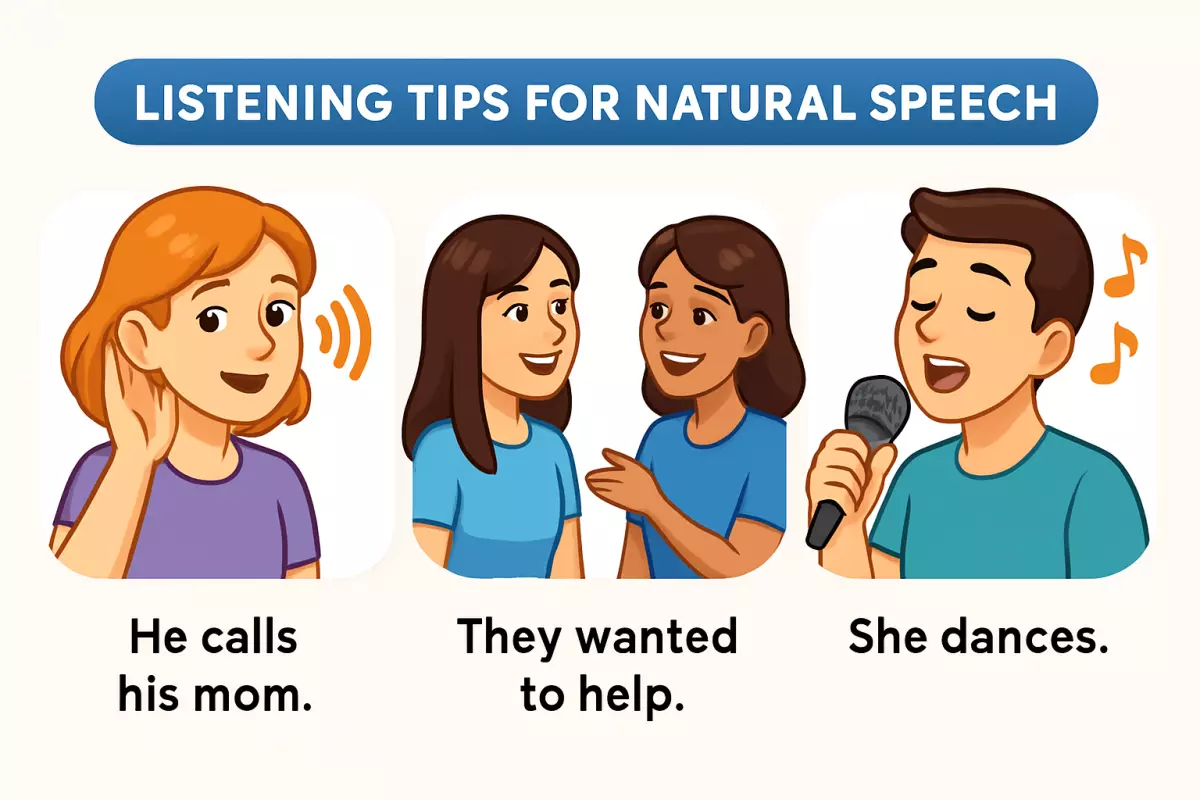
In real conversations, verb endings are often quiet, blended into the next sound, or reduced by faster rhythm. Training your ear to notice the final consonant or extra syllable will make -s/-es and -ed forms much easier to catch, even when speakers don’t “sound them out.”
Listen for the final sound, not the spelling
English endings change based on the last sound of the verb, so focus on what you hear right before the ending. A useful habit is to identify whether the verb ends in a voiced sound (vibration) or voiceless sound (no vibration), because that predicts the ending you’ll hear.
- Voiceless sounds (like /p, t, k, f, s/): endings tend to sound like /s/ or /t/.
- Voiced sounds (like /b, d, g, v, m, n, l, r/ and vowels): endings tend to sound like /z/ or /d/.
- After /s, z, ʃ, ʒ, tʃ, dʒ/, you often hear an extra syllable: /ɪz/ (for -es) or /ɪd/ (for -ed).
Use “next word” clues (linking and carryover)
Final consonants frequently attach to the next word. If you only listen for a clear ending before a pause, you may miss it. Instead, listen across word boundaries.
- Before a vowel sound, the ending may feel like it “moves forward”: plays on → /pleɪz ɑn/.
- Before a consonant, the ending may be shorter and less audible: worked hard → /wɜrkt hɑrd/.
- When the next word starts with a similar sound, endings can blend: stops suddenly may sound like a longer /s/.
- When speakers speed up, /t/ and /d/ can be very light: washed dishes may sound like /wɑʃ dɪʃɪz/ with minimal /t/.
Quick recognition targets (what to “hunt” for)
Rather than trying to hear every letter, listen for these high-value cues. They reliably signal the ending category.
- /ɪz/ at the end (extra syllable): watches, pushes, changes, judges, washes
- /ɪd/ at the end (extra syllable): needed, wanted, started, waited, decided
- Longer /s/ or /z/ at the end (no extra syllable): runs, calls, makes, lives, laughs
- Clean final /t/ after voiceless sounds: worked, laughed, missed, helped, fixed
- Clean final /d/ after voiced sounds: played, cleaned, called, answered, moved
| Ending you hear | Typical spelling | What it often sounds like in fast speech | Example (phrase) |
|---|---|---|---|
| /s/ | -s | Short, sharp hiss; may blend into next consonant | He stops there. |
| /z/ | -s | Buzzing sound; may link strongly to a following vowel | She plays outside. |
| /ɪz/ | -es | Extra syllable; usually stays clear even when fast | It changes a lot. |
| /t/ | -ed | May be very light or “held” before another consonant | They worked late. |
| /d/ | -ed | Can be subtle; often easiest to notice before vowels | We played again. |
| /ɪd/ | -ed | Extra syllable; strong clue for past tense in real time | He wanted coffee. |
Minimal-pair listening drills (short, high-contrast sets)
Choose a set and listen for the single feature that changes: voicing (/s/ vs /z/) or syllable count (no extra syllable vs /ɪz/ or /ɪd/). Then repeat with new verbs.
- walks (/s/) vs walls (/z/)
- packs (/s/) vs pags (rare word, but useful for sound contrast) (/z/)
- missed (/t/) vs mizzed (nonsense contrast) (/d/)
- watched (/t/) vs wanted (/ɪd/)
- washed (/t/) vs washes (/ɪz/)
Common listening mistakes to avoid
- ❌ Expecting -ed to always sound like “ed.” Most past forms are /t/ or /d/, not /ɪd/.
- ❌ Relying on pauses. In fluent speech, endings are clearer when linked to the next word than when isolated.
- ❌ Confusing plural nouns with third-person verbs. Use context words (he/she/it, yesterday, often) to confirm.
- ✅ Checking syllables first: one syllable (plays) vs two syllables (changes, wanted).
When you practice, aim to identify the ending category within the sentence, not the dictionary form. If you can consistently hear “/s/ vs /z/ vs /ɪz/” and “/t/ vs /d/ vs /ɪd/,” you’ll understand tense and subject agreement much more reliably in natural pace speech.
Common learner pronunciation errors
Many pronunciation problems with verb endings come from applying spelling rules instead of sound rules. English chooses the ending sound based on the final sound of the base word (voiced vs. voiceless, and whether it ends in a “hissing” sound), not on the written letter.
1) Adding an extra syllable to -s/-es when it is not needed
Learners often pronounce every third-person ending as /ɪz/ (like “iz”). That extra syllable is only correct after sibilant sounds: /s, z, ʃ, ʒ, tʃ, dʒ/.
- ❌ workes /wɜːrkɪz/ → ✅ works /wɜːrks/
- ❌ reades /riːdɪz/ → ✅ reads /riːdz/
- ✅ watches /wɒtʃɪz/ (extra syllable is correct)
- ✅ misses /mɪsɪz/ (extra syllable is correct)
2) Using /s/ and /z/ randomly for -s/-es
The plural/third-person ending is not “always /s/” or “always /z/”. It depends on whether the final sound of the base word is voiceless or voiced.
| Base word ends with… | Correct ending sound | Typical learner slip | Examples (base → 3rd person) |
|---|---|---|---|
| Voiceless sound (p, t, k, f, θ) | /s/ | Using /z/ | stop → stops, work → works, laugh → laughs |
| Voiced sound (b, d, g, v, ð, m, n, ŋ, l, r, vowels) | /z/ | Using /s/ | read → reads, live → lives, play → plays |
| Sibilant sound (s, z, ʃ, ʒ, tʃ, dʒ) | /ɪz/ | Dropping the extra syllable | watch → watches, pass → passes, change → changes |
| Spelling-based guess (not a sound category) | Use the sound rule above | Choosing by the final letter | cough (/f/) → coughs (/s/), move (/v/) → moves (/z/) |
3) Pronouncing -ed as /ɪd/ in every past tense form
Another frequent issue is adding a full syllable to all regular past verbs. The /ɪd/ ending happens only after /t/ or /d/. Otherwise, the ending is a single consonant: /t/ after voiceless sounds and /d/ after voiced sounds.
- ❌ walked /wɔːkɪd/ → ✅ /wɔːkt/
- ❌ cleaned /kliːnɪd/ → ✅ /kliːnd/
- ✅ needed /niːdɪd/ (extra syllable is correct)
- ✅ started /stɑːrtɪd/ (extra syllable is correct)
4) Dropping the final consonant in clusters (especially with -ed)
When the base verb already ends in a consonant, the past ending can create a difficult cluster (for example /k + t/). Learners may delete the final /t/ or /d/, which can make the tense unclear in fast speech.
- asked /æskt/ → often reduced to /æsk/ (tense becomes harder to hear)
- helped /helpt/ → often reduced to /help/
- watched /wɒtʃt/ → often reduced to /wɒtʃ/
- worked /wɜːrkt/ → often reduced to /wɜːrk/
A practical fix is to keep the final consonant short rather than adding a vowel: aim for a clean stop at the end instead of “work-uhd” or “help-uhd”.
5) Confusing spelling changes with pronunciation changes
Spelling rules like study → studies or stop → stopped can distract from the sound pattern. The pronunciation still follows the same ending rules.
- study → studies: ends with a vowel sound /i/ → /z/
- try → tries: ends with a vowel sound /aɪ/ → /z/
- stop → stopped: ends with /p/ (voiceless) → /t/
- plan → planned: ends with /n/ (voiced) → /d/
6) Over-voicing or devoicing the final sound
Some learners pronounce final consonants with the wrong voicing, which then triggers the wrong ending choice. If the base word’s final sound changes, the ending sound will likely change too.
- leaf ending /f/ (voiceless) → laughs uses /s/; if /f/ is voiced to /v/, learners may incorrectly choose /z/
- need ending /d/ (voiced) → needs /z/; if /d/ is devoiced, learners may incorrectly produce /s/
Quick self-check routine
- Say the base verb clearly (focus on the last sound, not the last letter).
- Decide: voiceless → /s/ or /t/; voiced → /z/ or /d/; sibilant (for -s/-es) or /t,d/ (for -ed) → /ɪz/ or /ɪd/.
- Say the full form without adding an extra vowel unless the rule requires it.
Pronunciation drills and patterns
Build accuracy by sorting verb endings into three sound groups and practicing them in short, repeatable chunks. The goal is to hear the final sound of the base word first, then choose the ending sound that matches the pattern.
Step 1: Quick pattern check (final sound → ending sound)
Before you speak, identify the last sound of the verb (not the last letter). Then apply the rule:
- -s / -es (present simple)
- Final voiceless sound (p, t, k, f, θ) → /s/ (works, stops, laughs)
- Final voiced sound (b, d, g, v, ð, m, n, ŋ, l, r, vowels) → /z/ (runs, lives, plays)
- Final sibilant sound (s, z, ʃ, ʒ, tʃ, dʒ) → /ɪz/ (watches, pushes, fixes)
- -ed (past)
- Final sound /t/ or /d/ → /ɪd/ (wanted, needed)
- Final voiceless sound (p, k, f, θ, s, ʃ, tʃ) → /t/ (helped, asked, laughed)
- Final voiced sound (b, g, v, ð, m, n, ŋ, l, r, vowels) → /d/ (robbed, cleaned, played)
Step 2: Minimal-pair style drills (feel the voicing)
Use these as short call-and-response lines. Keep the vowel length steady; change only the final voicing.
- /s/ vs /z/ for -s: stops → stubs; packs → bags; laughs → loves; hits → hides
- /t/ vs /d/ for -ed: asked → aged; packed → bagged; laughed → loved; missed → moved
Technique cue: for voiced endings (/z/, /d/), lightly touch your throat to feel vibration; for voiceless endings (/s/, /t/), there should be no vibration.
Step 3: Structured practice sets (say them in rows)
Read each row aloud twice: first slowly, then at natural speed. Focus on the final consonant cluster (for example, helps ends with /lps/).
| Ending sound | Target pattern | Examples to drill (10 items) |
|---|---|---|
| /s/ | -s after voiceless sounds | stops, works, laughs, cooks, helps, looks, speaks, sleeps, jumps, rests |
| /z/ | -s after voiced sounds and vowels | runs, calls, reads, plays, drives, lives, cleans, learns, comes, stays |
| /ɪz/ | -es after sibilants | watches, fixes, pushes, washes, misses, loses, teaches, judges, changes, closes |
| /t/ | -ed after voiceless sounds (not /t/) | worked, helped, laughed, asked, washed, missed, watched, danced, finished, jumped |
| /d/ | -ed after voiced sounds and vowels (not /d/) | played, cleaned, called, learned, opened, lived, arrived, answered, changed, followed |
| /ɪd/ | -ed after /t/ or /d/ | wanted, needed, waited, decided, started, invited, recorded, added, visited, shouted |
Step 4: Sentence rhythm drills (keep the ending audible)
Say each sentence three times: (1) slow and clear, (2) normal speed, (3) normal speed with stronger stress on the main verb.
- She works late and stops by the store.
- He plays tennis and drives home.
- It washes easily and dries quickly.
- They watched a movie and laughed a lot.
- We cleaned the room and opened the windows.
- I wanted to go, but I needed more time.
Self-check tasks (listen, choose, then say)
Decide the ending sound, then read the word aloud.
- likes
- moves
- watches
- helps
- played
- washed
- called
- needed
- asked
- changes
Show answers
- likes → /s/
- moves → /z/
- watches → /ɪz/
- helps → /s/
- played → /d/
- washed → /t/
- called → /d/
- needed → /ɪd/
- asked → /t/
- changes → /ɪz/
Homework: verb ending pronunciation practice
Use these tasks to build automatic pronunciation of common verb endings in everyday speech. Focus on the final sound of the base word first, then choose the ending sound that matches the pattern.
1) Quick self-check: choose the ending sound
Say each item aloud and write the ending sound (use these labels):
- /s/, /z/, or /ɪz/ for third-person singular -s/-es
- /t/, /d/, or /ɪd/ for past -ed
- work + s
- clean + s
- watch + es
- judge + s
- miss + es
- run + s
- stop + ed
- call + ed
- need + ed
- laugh + ed
- change + d
- fix + ed
Show answers
- /s/ (works)
- /z/ (cleans)
- /ɪz/ (watches)
- /ɪz/ (judges)
- /ɪz/ (misses)
- /z/ (runs)
- /t/ (stopped)
- /d/ (called)
- /ɪd/ (needed)
- /t/ (laughed)
- /d/ (changed)
- /t/ (fixed)
2) Pattern table: decide by the final sound
Use this chart while practicing. The key is the last sound of the base verb, not the last letter.
| Ending | When it happens (final sound of base verb) | Pronounced as | Examples (base → inflected) |
|---|---|---|---|
| -s / -es | Voiceless sounds: /p, t, k, f, θ/ (not sibilants) | /s/ | work → works; laugh → laughs; help → helps |
| -s / -es | Voiced sounds: vowels and /b, d, g, v, ð, m, n, ŋ, l, r, j, w/ (not sibilants) | /z/ | play → plays; clean → cleans; run → runs |
| -es | Sibilants: /s, z, ʃ, ʒ, tʃ, dʒ/ | /ɪz/ | miss → misses; watch → watches; judge → judges |
| -ed | Voiceless sounds (except /t/): /p, k, f, θ, s, ʃ, tʃ/ | /t/ | stop → stopped; fix → fixed; wash → washed |
| -ed | Voiced sounds (except /d/): vowels and /b, g, v, ð, m, n, ŋ, l, r, j, w, z, ʒ, dʒ/ | /d/ | call → called; clean → cleaned; change → changed |
| -ed | Base ends in /t/ or /d/ | /ɪd/ | need → needed; want → wanted; add → added |
3) Minimal-pair style drill (listen to your voicing)
Read each pair aloud. Keep the vowel length and stress similar; change only the ending sound. Record yourself if possible and check whether the final consonant is voiced (vibration) or voiceless (no vibration).
- He packs / He bags
- She laughs / She loves
- It stops / It stands
- He misses / He moves
- They washed / They changed
- I fixed / I called
4) Sentence practice: keep the ending clear in connected speech
Read the sentences twice: first slowly, then at natural speed. Pay attention to how the ending links to the next word.
- She works late on Fridays.
- He runs every morning.
- My phone needs a new battery.
- It stopped raining at noon.
- They watched a movie after dinner.
- The manager judges quickly.
- I cleaned the kitchen and fixed the sink.
- She wanted to leave early, but she waited.
5) Production task: write and read your own examples
Create your own short set of sentences and read them aloud. Include:
- 3 verbs where -s is pronounced /s/ (base ends in a voiceless sound like /k/ or /f/)
- 3 verbs where -s is pronounced /z/ (base ends in a vowel or voiced consonant like /n/ or /l/)
- 3 verbs where -es is pronounced /ɪz/ (base ends in a sibilant like /s/ or /tʃ/)
- 3 verbs where -ed is pronounced /t/
- 3 verbs where -ed is pronounced /d/
- 2 verbs where -ed is pronounced /ɪd/ (base ends in /t/ or /d/)
Checklist before you finish: ✅ you chose the ending based on the final sound, and ✅ the ending is audible but not over-stressed.