Editing Chains: Remove Fillers, Strengthen Verbs, Simplify Nouns

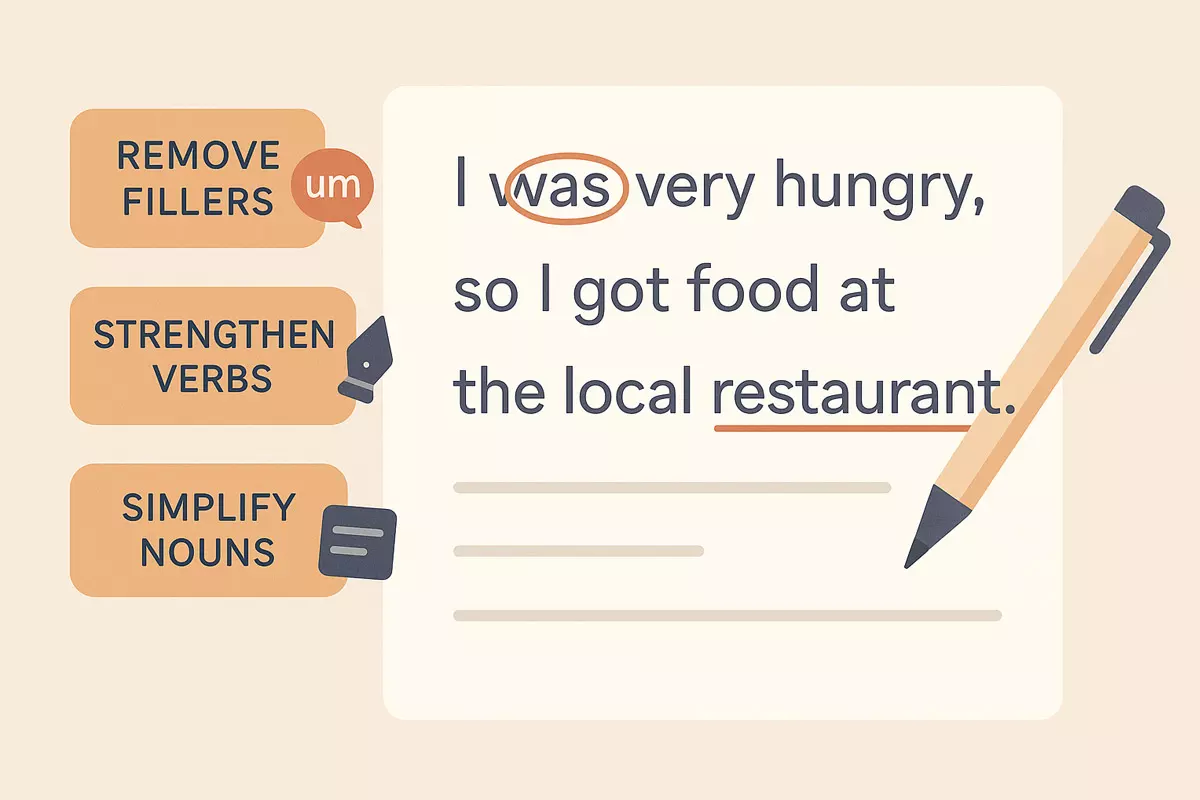 The article introduces editing chains and guides you through spotting fillers, cutting redundancies, using stronger verbs, and simplifying noun-heavy phrases. It also covers improving sentence flow and provides before-and-after examples plus editing practice.
To elevate your writing from cluttered to compelling, focus on trimming unnecessary words, selecting strong verbs, and using clear, concise nouns. These small but meaningful adjustments help sharpen your sentences and strengthen your message, making your writing more effective and engaging for readers. By consistently applying these strategies, you can improve clarity and ensure each word contributes to your overall purpose, resulting in more persuasive and impactful communication.
What Editing Chains Are
Editing chains are a systematic approach to revising text by applying a set sequence of targeted edits. Instead of making random or scattered changes, this method encourages writers to focus on one aspect at a time—such as removing filler words, strengthening verbs, or simplifying complex nouns—before moving on to the next step. The process is similar to a production line, where each stage polishes the writing in a specific way.
Why Use Sequential Edits?
Focusing on a single editing goal per pass helps prevent overwhelm and ensures that no detail is overlooked. For example, trying to delete filler words while also hunting for weak verbs can lead to missed opportunities for improvement. Chaining edits creates a repeatable workflow that can be tailored to different writing styles or goals.
Common Steps in a Revision Sequence
Writers often customize their own set of steps, but typical stages in a revision chain might include:
- Identifying and removing filler words (e.g., "just," "really," "very")
- Replacing vague verbs with more precise alternatives
- Shortening long noun phrases or technical jargon
- Eliminating redundant phrases
- Checking sentence structure for clarity
- Ensuring subject-verb agreement
- Improving transitions between ideas
- Standardizing terminology
- Cutting unnecessary adjectives or adverbs
- Streamlining passive voice into active constructions
- Breaking up overly long sentences
- Clarifying pronoun references
- Making sure each paragraph has a clear focus
- Aligning tone and style to the intended audience
- Reviewing for consistency in tense and person
Benefits of the Chain Approach
This structured method is especially useful for longer texts, collaborative documents, or when working under tight deadlines. It reduces the cognitive load on the editor and often results in clearer, more polished prose.
Example: Before-and-After Edits
Let’s see how a chain of edits transforms a sentence step by step:
- Original: "It is really important to basically make sure that you actually understand the main point."
- After removing fillers: "It is important to make sure you understand the main point."
- Strengthening the verb: "It is important to grasp the main point."
- Simplifying the noun: "Grasp the main point."
By breaking down editing into a series of manageable steps, writers can systematically enhance clarity, precision, and impact—one chain at a time.
Spotting Fillers and Redundant Phrases
Cluttered writing often sneaks in through unnecessary fillers and repetitive expressions. These elements dilute meaning and slow readers down. Identifying and trimming these verbal excesses is one of the simplest ways to make sentences clearer and more direct.
Common Fillers to Watch For

- Actually
- Basically
- Just
- Really
- Very
- Kind of
- Sort of
- In my opinion
- It seems that
- For the most part
- Due to the fact that
- At the end of the day
- In order to
- There is/are
- I think that
- As a matter of fact
- In terms of
- Needless to say
Redundant phrases are another frequent source of bulk. They often repeat information or use more words than necessary to express a point. Recognizing and eliminating them strengthens your writing by focusing on what’s essential.
Typical Redundant Phrases and Concise Alternatives
- Advance planning → Planning
- Absolutely essential → Essential
- End result → Result
- Free gift → Gift
- Past history → History
- Final outcome → Outcome
- Each and every → Each
- Basic fundamentals → Fundamentals
- Close proximity → Proximity
- Consensus of opinion → Consensus
- Period of time → Period
- Personal opinion → Opinion
- Revert back → Revert
- Unexpected surprise → Surprise
- Future plans → Plans
To become adept at identifying such phrases, read your text aloud or review it after a short break. If a word or phrase doesn’t add new meaning, consider cutting it. Over time, you’ll develop an instinct for what’s needed and what’s simply padding.
Quick Test: Can You Spot the Padding?
- “In order to improve” can usually become “To improve.”
- “At this point in time” is often better as “Now.”
- “He was able to finish” simplifies to “He finished.”
Strengthening Weak Verbs
Many sentences sag under the weight of vague or generic verbs. Swapping out these bland choices for precise, energetic alternatives can dramatically improve clarity and impact. Instead of relying on verbs like “make,” “do,” “have,” or “get,” opt for words that vividly capture the action or emotion you wish to convey.
Why Weak Verbs Hold Writing Back
General-purpose verbs often force readers to work harder to understand your meaning. They can blur the focus of a sentence, burying the core action under unnecessary words or turning strong ideas into dull statements. Replacing them with dynamic verbs sharpens your message and streamlines your prose.
Quick Fixes: Replace and Revise
Start by identifying the most common culprits in your drafts. Here are some typical weak verbs and suggestions for what to use instead:
- do → complete, perform, execute, undertake
- make → create, build, generate, produce
- get → receive, obtain, acquire, earn
- have → possess, experience, hold, contain
- go → travel, proceed, advance, move
- put → place, insert, position, arrange
- take → grasp, seize, collect, capture
- give → provide, offer, deliver, grant
- show → display, demonstrate, reveal, exhibit
- make a decision → decide, choose, select, determine
- do research → research, investigate, analyze, study
- get results → achieve, attain, produce, realize
- have an effect → affect, influence, alter, change
- go forward → progress, continue, advance, proceed
- put effort → strive, endeavor, exert, apply
- take action → act, intervene, respond, address
- give support → support, assist, aid, bolster
- show interest → express, convey, manifest, indicate interest
Before-and-After Comparisons
To see the difference, compare these sentences side by side:
| Weak Verb Version | Strong Verb Version |
|---|---|
| She made a suggestion to the team. | She proposed an idea to the team. |
| We did a review of the process. | We reviewed the process. |
| He got the information yesterday. | He obtained the information yesterday. |
| The company had an increase in sales. | The company’s sales increased. |
| They gave support to the project. | They supported the project. |
| She put the plan into action. | She implemented the plan. |
| We took steps to improve quality. | We improved quality. |
| The report shows the results. | The report reveals the results. |
Tips for Replacing Weak Verbs
- Look for nouns that hide a verb (e.g., “make a choice” → “choose”).
- Favor direct verbs over verb-noun combinations.
- Ask yourself: “What’s really happening here?” and pick a verb that says it plainly.
- Be cautious not to overcomplicate—clarity always comes first.
Replacing colorless verbs with specific ones not only energizes your writing but also makes every sentence easier to follow. With practice, spotting and strengthening weak verbs becomes second nature.
Simplifying Noun-Heavy Phrases
Dense chains of nouns can slow down your writing and make your ideas harder to follow. Instead of piling up abstract or stacked noun phrases, try breaking them apart, using verbs, or restructuring your sentences for clarity. This approach helps your readers understand your message faster and keeps your prose lively.
Why Condense Noun Phrases?
Long strings of nouns often appear in technical or formal writing, but they can quickly become confusing. Readers may struggle to parse meaning or remember what modifies what. By turning some nouns into verbs or adjectives, or by splitting up the information, you make your writing more direct and accessible.
Common Patterns (and How to Fix Them)
Writers sometimes string together nouns for brevity, but the result can be ambiguous. Here are some typical patterns and ways to revise them:
- Replace noun stacks with verbs: "data analysis process" → "process for analyzing data"
- Break up complex phrases: "employee performance evaluation report" → "report evaluating employee performance"
- Use prepositions to clarify relationships: "customer feedback survey results" → "results from the customer feedback survey"
- Convert nouns to actions: "decision-making strategy" → "strategy for making decisions"
- Shorten when possible: "budget allocation plan" → "budget plan" or "plan for allocating the budget"
- Swap for verbs: "implementation of recommendations" → "implementing recommendations"
- Clarify ownership or source: "project funding approval" → "approval for project funding"
- Simplify technical clusters: "server response time measurement tool" → "tool for measuring server response time"
- Reduce redundancy: "training program development process" → "process for developing a training program"
- Cut unnecessary words: "marketing strategy planning session" → "marketing strategy session"
Before and After: Noun Stack Transformations
You can often make your sentences clearer by untangling noun-heavy structures. Here’s a comparison of original noun stacks and their streamlined alternatives:
| Original Phrase | Improved Version |
|---|---|
| Monthly sales performance review meeting | Meeting to review monthly sales performance |
| Customer satisfaction survey analysis | Analysis of the customer satisfaction survey |
| Software development project timeline | Timeline for the software development project |
| Product launch marketing plan | Marketing plan for the product launch |
| Team communication improvement strategies | Strategies to improve team communication |
| Website user experience optimization | Optimizing the website’s user experience |
| Risk assessment procedure documentation | Documentation of the risk assessment procedure |
| Employee engagement survey results | Results from the employee engagement survey |
| Financial report approval process | Process for approving the financial report |
| Content management system upgrade | Upgrading the content management system |
Tips for Streamlining Dense Phrases
- Read your sentence aloud; if it sounds clunky, try breaking up the phrase.
- Use verbs for action instead of abstract nouns.
- Add prepositions to clarify how ideas relate.
- Favor shorter, more direct expressions where possible.
- Ask if every noun is necessary—cut or rephrase as needed.
Trimming down noun-heavy constructions makes your writing simpler and your message more memorable. When in doubt, choose clarity over complexity.
Improving Sentence Flow and Logic
Editing for smoother transitions and clearer arguments is essential for readable, compelling writing. When each sentence connects logically to the next, readers can follow your ideas without stumbling. This clarity comes from removing unnecessary fillers, choosing vivid verbs, and simplifying complex nouns.
Common Pitfalls That Disrupt Flow
Writers often fall into patterns that make text harder to follow. Watch out for these issues:
- Overusing vague fillers (e.g., "actually," "basically," "in terms of")
- Relying on weak verbs ("is," "have," "do") instead of action verbs
- Stuffing sentences with abstract noun phrases ("the implementation of policies")
- Shifting topics abruptly without transitions
- Repeating the same sentence structure, which can sound monotonous
- Adding redundant phrases that don't add meaning
Strategies for Smoother Sentences
To create a logical progression, try these approaches:
- Start each paragraph with a clear topic sentence
- Use transition words to guide readers (e.g., "however," "for example," "as a result")
- Replace nominalizations (nouns made from verbs) with strong verbs
- Break up long sentences, but link short ones when ideas are closely related
- Cut unnecessary qualifiers and repetition
- Ask yourself: Does each sentence follow naturally from the previous one?
Examples: Weak vs. Strong Sentence Flow
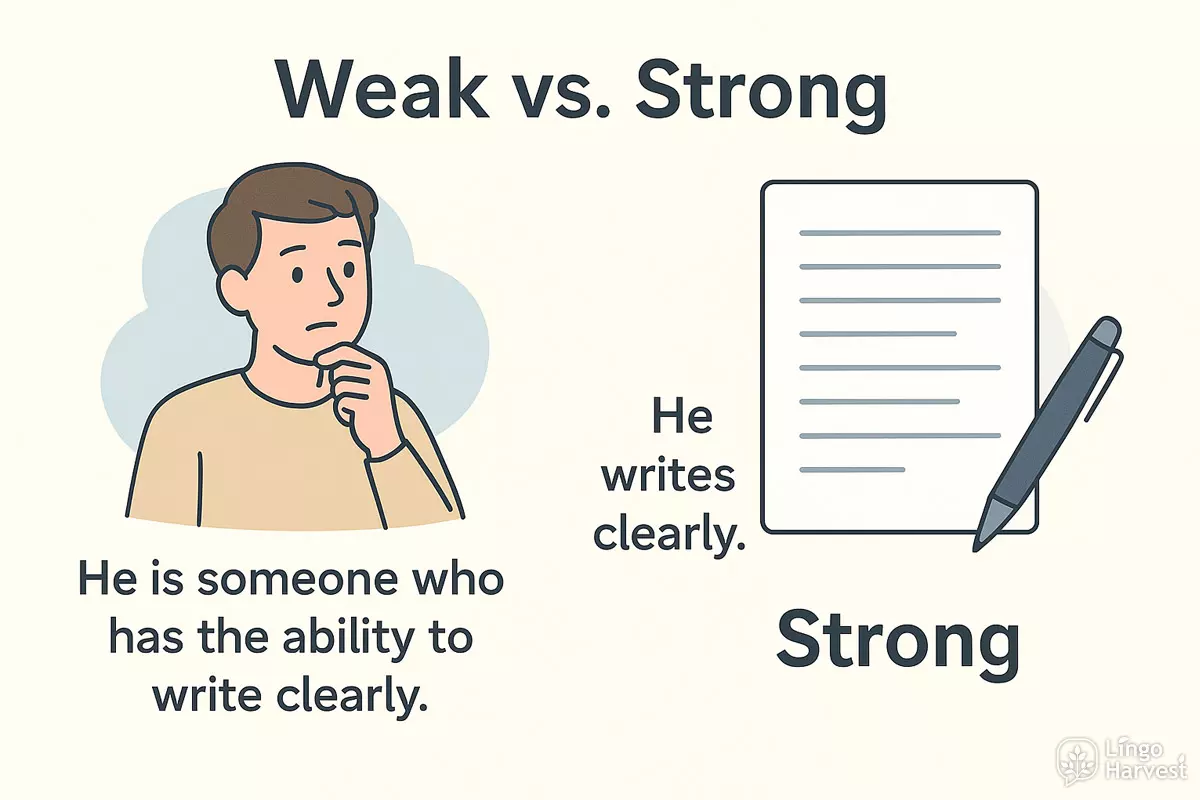
Below are some before-and-after examples to illustrate how editing for clarity and logic can transform writing.
| Before Editing | After Editing |
|---|---|
| There are a lot of people who are of the opinion that editing is basically difficult. | Many people believe editing is difficult. |
| The implementation of the new policy was done by the team in an efficient manner. | The team implemented the new policy efficiently. |
| In terms of results, it can be said that the project was successful. | The project succeeded. |
| He is someone who has the ability to write clearly. | He writes clearly. |
| Additionally, the fact that the report was not finished on time caused problems. | Also, the late report caused problems. |
Quick Checklist for Logical Flow
- Does every sentence add new information?
- Are transitions smooth and purposeful?
- Are verbs active and precise?
- Are nouns concise, not overloaded with modifiers?
- Is the argument or narrative easy to follow from start to finish?
By focusing on these elements, you’ll produce writing that feels natural and persuasive, keeping readers engaged from the first line to the last.
Before-and-After Editing Examples
Polishing sentences often means cutting out unnecessary words, making verbs more dynamic, and turning complicated nouns into simpler forms. Let’s look at how these adjustments can transform awkward or wordy phrases into clear, concise statements. By analyzing sample sentences, you can see the impact of these editing techniques in practice.
Common Edits: Fillers, Weak Verbs, and Noun Simplification
- Filler removal: Cutting out phrases like "in order to," "basically," or "in my opinion" often tightens writing.
- Stronger verbs: Replacing forms like "make a decision" with "decide" brings energy to your sentences.
- Simpler nouns: Instead of "utilization," just say "use." Instead of "assistance," try "help."
Transformation Examples
Below are several sentences showing a progression from wordy or weak to direct and vigorous. Each demonstrates how editing chains—removing fillers, strengthening verbs, and simplifying nouns—improves clarity.
| Original Version | Edited Version |
|---|---|
| It is important to note that the meeting will take place at 10 a.m. | The meeting starts at 10 a.m. |
| We are going to be making an announcement regarding the schedule change. | We will announce the schedule change. |
| In order to complete the task, you need to provide your assistance. | To finish the task, you need to help. |
| She was able to make a decision about the proposal quickly. | She decided on the proposal quickly. |
| The utilization of this software can improve efficiency. | Using this software can improve efficiency. |
| Basically, the results indicate an improvement. | The results show improvement. |
| There are a number of issues that need to be addressed. | Several issues need attention. |
| Due to the fact that the deadline is near, we must hurry. | Because the deadline is near, we must hurry. |
| He made an attempt to resolve the conflict. | He tried to resolve the conflict. |
| At this point in time, we are unable to proceed further. | Currently, we cannot proceed. |
Editing Patterns to Try
- Cut introductory phrases that add little meaning.
- Swap out "make/do/give" + noun for a more active verb.
- Replace long nouns formed from verbs (nominalizations) with the verb itself.
- Favor short, everyday words over jargon or bureaucratic terms.
- Be direct—say what you mean in as few words as possible.
These real-world examples show how a few targeted edits can dramatically improve readability and impact. By consistently applying these strategies, you can develop writing that’s both efficient and engaging.
Practice: Edit Sentences Using the Chain Steps
Ready to strengthen your editing skills? The following activities will help you apply the editing chain: removing fillers, choosing stronger verbs, and simplifying nouns. Each task asks you to transform wordy or weak sentences into clear, direct statements.
Step-by-Step Editing Tasks
- Identify and cut unnecessary filler words (e.g., "just," "really," "actually," "very").
- Replace weak or generic verbs (e.g., "make," "do," "get," "have") with more vivid or precise alternatives.
- Simplify complex noun phrases or nominalizations (e.g., "the act of deciding" → "deciding").
Editing Exercise: Try It Yourself
Rewrite each sentence using the three editing steps. Focus on clarity and conciseness.
- It is actually very important to make improvements in your writing on a regular basis.
- There was a decision that was made by the committee regarding the issue.
- She did a presentation that was really interesting to the audience.
- The use of strong verbs can help to make your sentences better.
- He got the information through the process of conducting research.
- In order to achieve success, you just need to put in effort.
- The plan was to have a discussion about the proposal.
- We are in the process of making changes to the document.
- They gave an explanation of the new policy to the staff.
- There is a need for the completion of the task before Friday.
Before and After: Example Edits
| Original Sentence | Edited Sentence |
|---|---|
| She did a presentation that was really interesting to the audience. | She gave an engaging presentation. |
| He got the information through the process of conducting research. | He researched to find the information. |
| There was a decision that was made by the committee regarding the issue. | The committee decided on the issue. |
| It is actually very important to make improvements in your writing on a regular basis. | Regularly improve your writing. |
| We are in the process of making changes to the document. | We are revising the document. |
| The plan was to have a discussion about the proposal. | The plan was to discuss the proposal. |
| They gave an explanation of the new policy to the staff. | They explained the new policy to the staff. |
| There is a need for the completion of the task before Friday. | Complete the task before Friday. |
| In order to achieve success, you just need to put in effort. | To succeed, put in effort. |
| The use of strong verbs can help to make your sentences better. | Strong verbs improve your sentences. |
Self-Check: How Did You Do?
Compare your revisions with the suggested edits below. Did you:
- Remove unnecessary words?
- Choose more forceful verbs?
- Turn long noun phrases into simpler forms?
Show answers
- Regularly improve your writing.
- The committee decided on the issue.
- She gave an engaging presentation.
- Strong verbs improve your sentences.
- He researched to find the information.
- To succeed, put in effort.
- The plan was to discuss the proposal.
- We are revising the document.
- They explained the new policy to the staff.
- Complete the task before Friday.
Practicing these steps will help you produce writing that is clearer, more concise, and more effective. Try applying the chain to your own drafts or assignments for noticeable improvements.