Introduction to English Punctuation: Basic Rules for Beginners

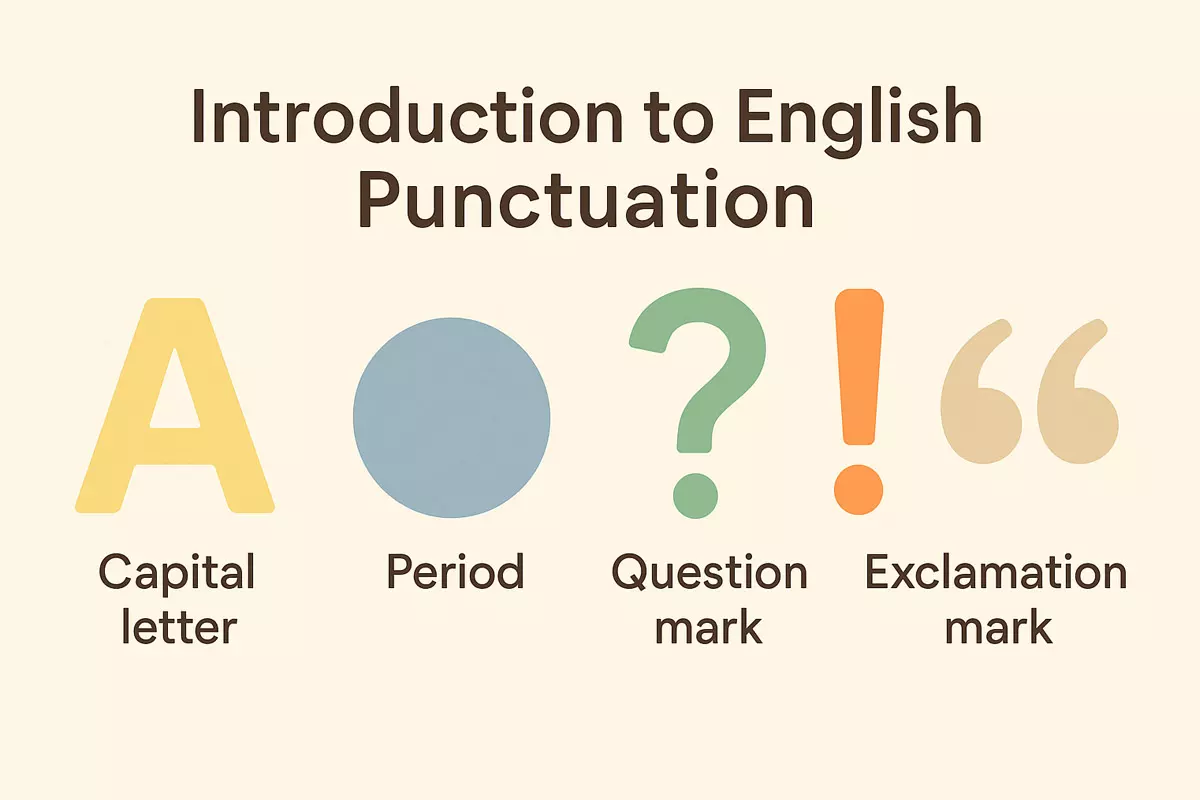 This article defines punctuation, reviews main marks, explains when to use capital letters, and covers periods, questions, exclamations, commas, quotation marks, and brackets. It also highlights common mistakes and offers practice with missing punctuation.
Mastering the marks that shape our sentences is essential for anyone beginning to learn English, as proper punctuation clarifies your writing and ensures your ideas flow smoothly for readers. By learning how to use periods, commas, question marks, and other punctuation marks correctly, you can avoid confusion and make your meaning clear. This skill not only improves your writing but also boosts your confidence when communicating in English, making your messages more effective and engaging for your audience.
What Is Punctuation?
Punctuation refers to the symbols and marks used in writing to clarify meaning, indicate pauses, and help readers understand how sentences are structured. These marks act as signposts, showing where one idea ends and another begins, where to pause, and how different parts of a sentence relate to each other. Good use of punctuation ensures clear and effective communication in both formal and informal writing.
Why Do We Use Punctuation Marks?
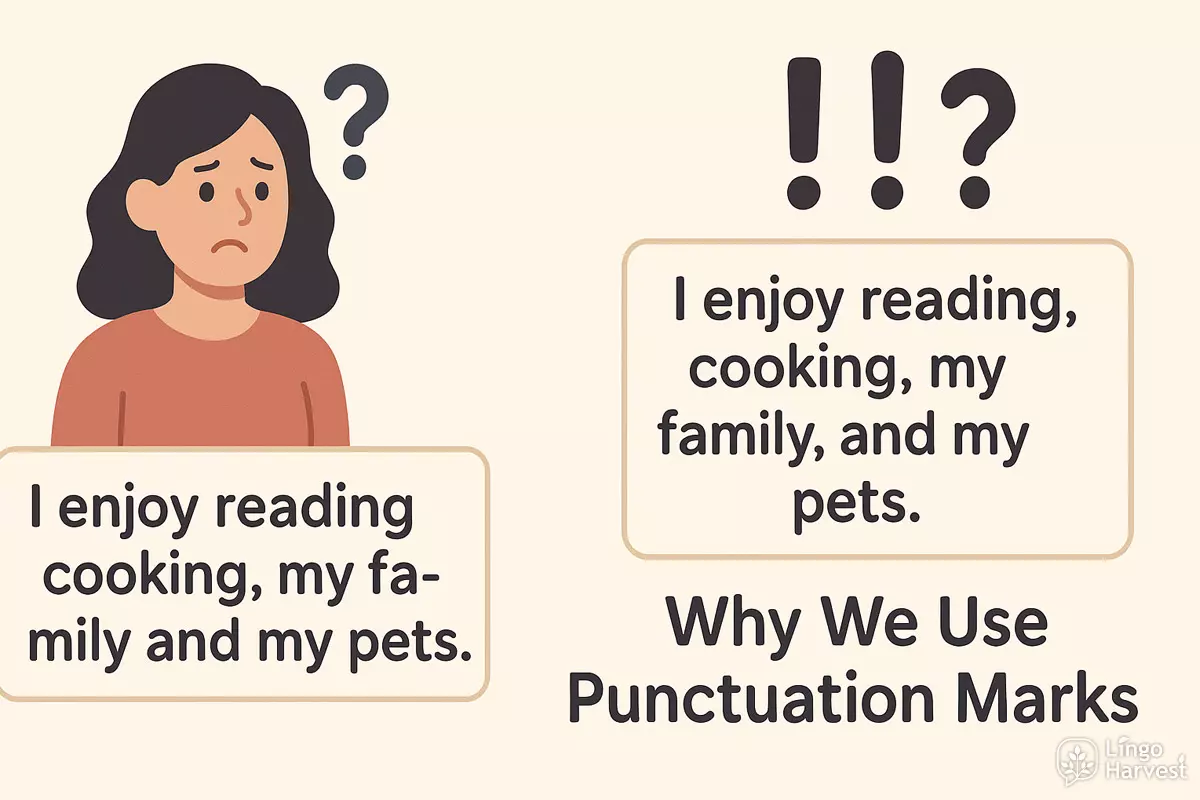
Without these marks, written language can become confusing or even misleading. Punctuation helps to separate sentences, highlight important information, and avoid misunderstandings. For example, a misplaced comma can change the entire meaning of a sentence.
- Separating sentences and clauses for clarity
- Marking the end of thoughts or statements
- Indicating pauses, stops, or changes in tone
- Showing ownership or possession
- Listing items or ideas efficiently
- Signaling questions or exclamations
- Introducing direct speech or quotations
- Clarifying meaning in complex sentences
- Connecting related ideas smoothly
- Providing structure to written language
Common English Punctuation Marks
Here are some of the most frequently used punctuation marks in English, along with their basic functions:
- Period (.) – Ends a sentence.
- Comma (,) – Separates items or clauses.
- Question mark (?) – Indicates a direct question.
- Exclamation mark (!) – Shows strong emotion.
- Colon (:) – Introduces a list or explanation.
- Semi-colon (;) – Connects related sentences or separates complex list items.
- Quotation marks (" ") – Show direct speech or quotations.
- Apostrophe (’) – Shows possession or contractions.
- Hyphen (-) – Joins words or splits a word at the end of a line.
- Dash (—) – Adds emphasis or extra information.
- Parentheses (()) – Include additional, non-essential information.
How Punctuation Affects Meaning
The placement and choice of a mark can completely alter the sense of a sentence. For instance, compare these two:
- Let’s eat, Grandma! → (inviting Grandma to eat)
- Let’s eat Grandma! → (suggests eating Grandma!)
As you can see, even a single comma can make a big difference. Understanding and using punctuation correctly is essential for anyone learning to write in English.
Main Punctuation Marks
Understanding the basic symbols used in English writing is essential for clear communication. Each mark serves a specific function, such as separating ideas, indicating pauses, or showing emotion. Mastering these tools will help you write sentences that are both accurate and easy to read.
Common Punctuation Symbols and Their Uses
Below is a list of the essential marks you will encounter in English writing, along with brief explanations:
- Period (.) – Ends a statement or declarative sentence.
- Comma (,) – Separates items in a list, clauses, or introductory elements.
- Question Mark (?) – Indicates a direct question.
- Exclamation Mark (!) – Expresses strong feeling or emphasis.
- Colon (:) – Introduces a list, explanation, or quotation after an independent clause.
- Semicolon (;) – Connects closely related independent clauses or separates items in a complex list.
- Apostrophe (’) – Shows possession or forms contractions.
- Quotation Marks (“ ”) – Enclose direct speech or quotations.
- Parentheses (()) – Add extra information or clarification.
- Dash (— or –) – Indicates a break in thought, an interruption, or a range.
- Hyphen (-) – Joins words in compound terms or splits words at the end of a line.
- Ellipsis (…) – Shows omitted content or unfinished thoughts.
- Slash (/) – Represents alternatives or fractions.
Comparison of Key End Punctuation
| Mark | Typical Use | Example |
|---|---|---|
| Period (.) | Ends a statement | She likes apples. |
| Question Mark (?) | Ends a question | Do you like coffee? |
| Exclamation Mark (!) | Shows emotion or emphasis | Watch out! |
| Ellipsis (…) | Indicates omitted words or trailing off | I’m not sure… |
Quick Tips for Beginners
- Use a period to finish most sentences.
- Place a comma before “and” in a list of three or more items.
- Remember to use an apostrophe for contractions: don’t, it’s.
- Quotation marks go around spoken words.
- Don’t overuse exclamation marks; save them for strong feelings.
By learning how and when to use each symbol, you can significantly improve the clarity and professionalism of your writing. Practice by reading and noticing how these marks are used in different texts.
When to Use Capital Letters
Capitalization in English follows specific rules, and understanding these guidelines helps make your writing clear and correct. Using uppercase letters at the right times is essential for proper punctuation and sentence structure. Here are the main situations where capital letters are required:
Beginning of Sentences
Always start a new sentence with a capital letter. This signals the start of a new idea and helps readers follow your writing more easily.
Proper Nouns
Names of specific people, places, and things begin with an uppercase letter. This distinguishes them from common nouns.
- First and last names: Maria Smith, William Shakespeare
- Cities and countries: London, Japan, Brazil
- Landmarks: Eiffel Tower, Mount Everest
- Brands: Nike, Google, Coca-Cola
Days, Months, and Holidays
Days of the week, months of the year, and official holidays are always capitalized.
- Monday, Friday
- January, September
- Christmas, Hanukkah, Ramadan
Pronoun "I"
The word “I” is always written with a capital letter, no matter where it appears in a sentence.
- I am learning English.
- My friend and I went to the park.
Titles of Works
Capitalize the main words in the titles of books, films, songs, and articles. Minor words (like "and," "of," "the") are usually lowercase unless they are the first word.
- Harry Potter and the Sorcerer’s Stone
- The Great Gatsby
- Gone with the Wind
Abbreviations and Acronyms
Most abbreviations and acronyms use capital letters:
- USA (United States of America)
- UNESCO (United Nations Educational, Scientific and Cultural Organization)
- BBC (British Broadcasting Corporation)
First Word in a Quotation
If a quotation is a complete sentence, the first word should start with a capital letter.
- She said, “Tomorrow will be a better day.”
- He replied, “Absolutely not.”
Letter Salutations and Closings
When writing letters or emails, capitalize the first word in both the greeting and the closing.
- Dear Mr. Lee,
- Yours sincerely,
Examples: Capital vs. Lowercase
| Capitalized Example | Incorrect (Lowercase) Example |
|---|---|
| My uncle lives in Paris. | My uncle lives in paris. |
| We celebrate Thanksgiving every year. | We celebrate thanksgiving every year. |
| I have a dog named Max. | i have a dog named max. |
| She said, “Let’s go.” | She said, “let’s go.” |
Summary List: Common Reasons to Use Capitals
- Start of every sentence
- Names of people and places
- Nationalities and languages (e.g., French, Spanish)
- Days, months, holidays
- The pronoun "I"
- Titles of books, movies, songs
- Abbreviations and acronyms
- Salutations and closings in correspondence
- First word in direct quotations
- Historical periods (e.g., Middle Ages, Renaissance)
Mastering these capitalization rules will help you write more clearly and professionally in English.
Sentence End Marks: Period, Question, Exclamation
Understanding how to end sentences correctly is a key part of using English punctuation. Each type of sentence-ending mark signals something different to the reader. Choosing the correct mark helps your writing sound clear and natural.
Period (.)
A period shows that a sentence finishes with a complete thought. Use it at the end of statements, commands, and indirect questions. This is the most common way to end a sentence in English.
- I like reading books.
- Please close the door.
- She asked if you were coming.
Question Mark (?)
A question mark is used after direct questions. It tells the reader that the sentence needs an answer or is asking for information.
- What time is it?
- Are you ready?
- Where did you go yesterday?
- Can you help me?
Exclamation Mark (!)
An exclamation mark expresses strong feeling, surprise, or emphasis. It can follow commands, interjections, or statements that show excitement or urgency.
- Watch out!
- That’s amazing!
- Stop!
- Congratulations!
Comparing Sentence End Marks
The three marks are not interchangeable. They change the tone and meaning of your sentence. Here’s a quick comparison:
| Mark | When to Use |
|---|---|
| Period (.) | To end statements, indirect questions, or commands with a neutral tone. |
| Question Mark (?) | To end direct questions or requests for information. |
| Exclamation Mark (!) | To show strong emotions, surprise, warnings, or emphasis. |
Common Mistakes
Many new writers confuse these marks or use them too often. For example, using too many exclamation marks can make writing seem less serious, while forgetting a question mark after a direct question can cause confusion. Practice helps you choose the right one for each situation.
Summary List: Examples in Use
- He likes pizza. (statement)
- Do you want some tea? (question)
- Look out! (exclamation)
- She wondered if it would rain. (indirect question, period)
- How are you? (direct question)
- What a beautiful day! (exclamation)
- Turn off the lights. (command, period)
- Why are you late? (question)
- Help! (exclamation)
- The meeting is at 3 p.m. (statement)
Mastering these simple punctuation marks will make your writing easier to read and understand. With practice, choosing the right one becomes second nature.
Commas and Their Functions
Commas are among the most frequently used punctuation marks in English. They help clarify meaning, separate elements, and guide readers through sentences. Understanding when and how to use them is essential for clear writing.
When to Use Commas
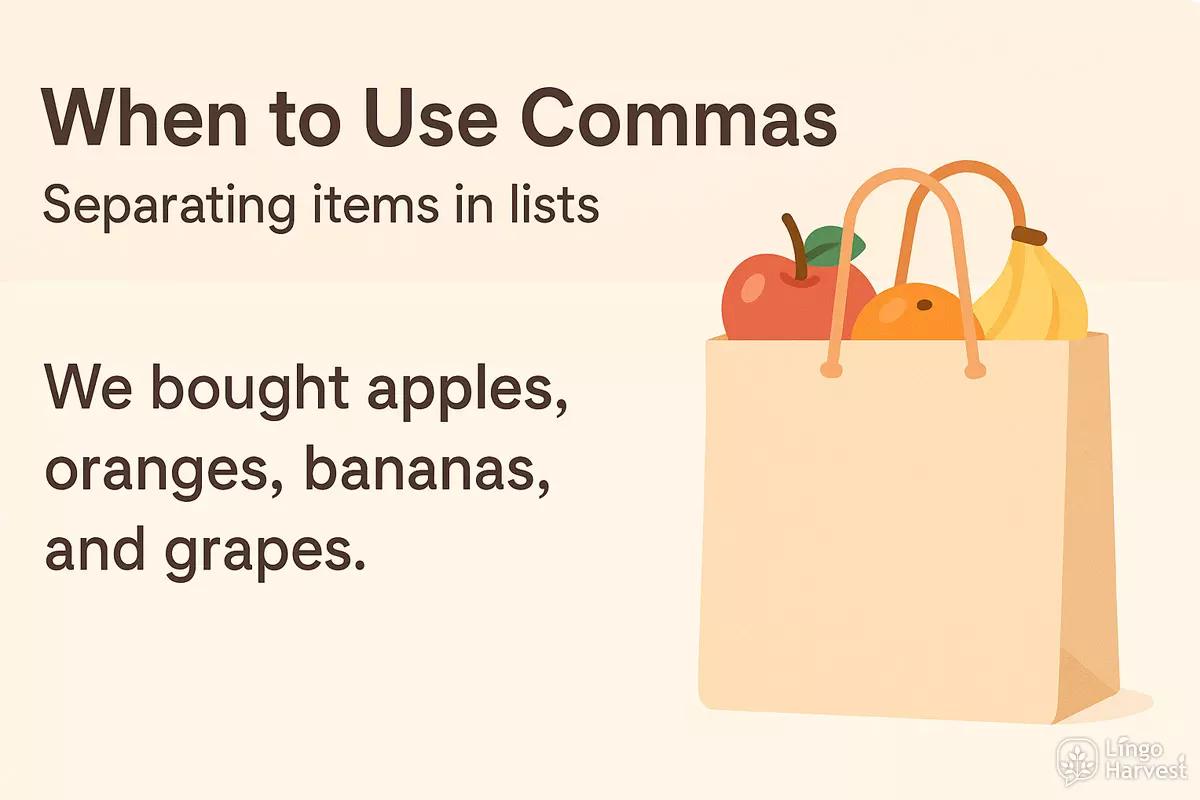
- Separating items in a list: Use a comma to divide three or more items. Example: We bought apples, oranges, bananas, and grapes.
- After introductory words or phrases: Place a comma after words like However, Yes, No, or introductory phrases. Example: After dinner, we went for a walk.
- Joining independent clauses: When connecting two complete sentences with coordinating conjunctions (and, but, or, nor, for, so, yet), insert a comma before the conjunction. Example: I wanted to go outside, but it was raining.
- Setting off non-essential information: Use commas to enclose extra details that are not crucial to the sentence’s main idea. Example: My brother, who lives in London, is visiting.
- Direct address: Place a comma when addressing someone directly. Example: Lisa, can you help me?
- With tag questions: Insert a comma before a tag question. Example: You’re coming, aren’t you?
- To avoid confusion: Sometimes, a comma is needed to prevent misreading. Example: To Emily, David was a hero.
- Dates and addresses: Use commas to separate elements in dates and addresses. Example: July 4, 2024, was a holiday.
- With quotations: A comma often introduces direct speech. Example: She said, “Let’s begin.”
- Between adjectives: If two adjectives equally describe a noun, use a comma. Example: It was a long, difficult journey.
Common Pitfalls
Writers sometimes overuse or omit commas, leading to confusion. For example, avoid placing a comma between a subject and its verb, or before every “and.” Remember, not all long sentences require many commas—clarity is the priority.
Quick Reference: Comma Usage
| Correct Use ✅ | Incorrect Use ❌ |
|---|---|
| After the meeting, we had lunch. | After the meeting we had, lunch. |
| My sister, Anna, is a doctor. | My sister Anna, is a doctor. |
| I like tea, but he prefers coffee. | I like tea but, he prefers coffee. |
| She said, “Thank you.” | She said “Thank you.” |
Mastering comma placement will make your writing easier to read and understand. Practice with different sentence types to build confidence using this essential punctuation mark.
Quotation Marks and Brackets
Quotation marks and brackets are essential for clear writing, especially when you want to include someone’s exact words, clarify meaning, or add extra information. Understanding when and how to use each punctuation mark can help your sentences stay precise and easy to follow. Let’s break down their main uses and some important rules to remember.
How to Use Quotation Marks
Quotation marks (“…”) are typically used to show direct speech, quotations from texts, or to highlight specific words. Here are some common scenarios:
- Enclosing direct speech: She said, “I’m ready.”
- Quoting from a book or article: The sign read, “No entry beyond this point.”
- Highlighting unusual or ironic terms: The so-called “expert” made a mistake.
- Titles of short works (like poems or articles): Have you read “The Road Not Taken”?
Rules for Quotation Marks
- Periods and commas usually go inside the closing quotation mark in American English: He called it “a breakthrough.”
- Question marks and exclamation points go inside if they belong to the quoted material: She asked, “Are you coming?”
- If the sentence itself is a question, the punctuation goes outside: Did he say “goodbye”?
- Use single quotation marks (‘…’) for a quote within a quote: He said, “I heard her shout, ‘Stop!’”
Using Brackets in English
Brackets come in two main forms: round (parentheses) and square. Each type has its own functions:
- Parentheses ( ): Add extra information, clarification, or an afterthought. I’ll meet you at 6 p.m. (if the train is on time).
- Square brackets [ ]: Insert your own words into a quotation for clarity or to add missing information. She said she would “arrive [at noon] without fail.”
Common Uses Compared
| Mark | Typical Use |
|---|---|
| Quotation Marks (“…”) | Direct speech, quotations, titles of short works, highlighting words |
| Single Quotation Marks (‘…’) | Quoting within a quotation |
| Parentheses ( ) | Extra information, minor explanations, afterthoughts |
| Square Brackets [ ] | Clarifying or adding words in a quotation, editorial notes |
Quick Reference: When to Use Each Mark
- To repeat someone’s exact words: use double quotation marks.
- To add missing words or explanations inside a quote: use square brackets.
- For extra comments not essential to the main sentence: use parentheses.
- When quoting someone who is already quoting: use single marks inside double marks.
Mastering these punctuation marks helps you write more clearly and accurately, making your meaning unmistakable to readers. Practice these conventions, and your writing will become more professional and easier to understand.
Common Beginner Mistakes
Learning to use punctuation in English can be tricky, especially at first. Many new learners struggle with the same types of errors, which can make sentences confusing or change their meaning. Recognizing these pitfalls early helps you build good writing habits.
Mixing Up End Punctuation
Choosing the wrong mark at the end of a sentence is a frequent oversight. For example, using a period when a question mark is needed, or forgetting to use any punctuation at all, can make your meaning unclear. Always check if your sentence is a statement, a question, or an exclamation.
- What time is it. ❌ (should be a question mark)
- I love pizza! ✅
- He went home ❌ (missing period)
Comma Confusion
Commas are often overused or forgotten entirely. Some learners add them after every word or phrase, while others skip them even when they’re necessary. This can make sentences hard to follow.
- Incorrect: She likes apples, and oranges, and bananas. ❌
- Correct: She likes apples, oranges, and bananas. ✅
- Incorrect: After dinner we went for a walk. ❌
- Correct: After dinner, we went for a walk. ✅
Misusing Apostrophes
Apostrophes are commonly placed incorrectly, especially in contractions and possessives. Knowing when to use them—and when not to—can prevent misunderstandings.
- Its raining outside. ❌ (should be It’s)
- The dogs bone is missing. ❌ (should be dog’s)
- Its color is blue. ✅ (possessive “its” is correct here)
Capitalization Mistakes
Forgetting to capitalize the first word of a sentence or proper nouns is a simple but common slip. Double-check your sentences for correct use of capital letters.
- i am learning English. ❌
- My friend lives in london. ❌
- She is from Brazil. ✅
Using Too Many or Too Few Punctuation Marks
Sometimes beginners add extra marks for emphasis, or forget to use them at all. Both habits can distract readers or make writing look unprofessional.
- What are you doing?? ❌ (only one question mark is needed)
- Wow!!! ❌ (one exclamation mark is enough: Wow!)
- Lets eat grandma ❌ (missing comma: Let’s eat, grandma)
Confusing Quotation Marks and Other Symbols
Quotation marks are used to show direct speech or quotations, but sometimes learners mix them up with apostrophes or use them unnecessarily.
- She said, 'Hello.' ✅
- She said, “Hello.’ ❌ (mixed styles)
- I heard “a strange sound”. ❌ (punctuation should be inside the quotes: “a strange sound.”)
Quick Reference: Common Punctuation Problems
| Mistake | How to Fix It |
|---|---|
| Missing period at the end of a statement | Add a period: I went home. |
| Using a comma splice (joining two sentences with a comma) | Use a period or semicolon: It’s late. I should go. |
| Incorrect apostrophe in possessives (the cats toy) | Add apostrophe: the cat’s toy |
| Not capitalizing “I” or names | Always capitalize: I went with John. |
| Forgetting a comma after introductory phrases | Add comma: After school, we played. |
By keeping these typical missteps in mind, you’ll find it easier to write clearly and avoid confusion in your English communication. Practice and careful proofreading are key to mastering correct punctuation.
Practice: Add Missing Punctuation
One of the best ways to improve your understanding of English punctuation is to practice editing real sentences. Below, you'll find a series of sentences that are missing important punctuation marks. Read each sentence carefully and decide which punctuation marks are needed and where they should be placed. This activity will help reinforce your knowledge of periods, commas, question marks, and exclamation points.
Task: Insert the Correct Punctuation
- i like to read books especially mystery novels
- what time does the train leave
- oh no i forgot my keys
- my favorite colors are blue green and yellow
- lets eat grandma
- can you help me with my homework
- she bought apples oranges bananas and grapes
- wait dont cross the street yet
- its raining outside bring an umbrella
- the cat slept on the sofa all day
- please sit down
- he asked where are you going
- be careful the floor is wet
- my sisters name is emily
- do you want tea or coffee
Show answers
- I like to read books, especially mystery novels.
- What time does the train leave?
- Oh no! I forgot my keys.
- My favorite colors are blue, green, and yellow.
- Let's eat, Grandma.
- Can you help me with my homework?
- She bought apples, oranges, bananas, and grapes.
- Wait! Don't cross the street yet.
- It's raining outside; bring an umbrella.
- The cat slept on the sofa all day.
- Please, sit down.
- He asked, "Where are you going?"
- Be careful! The floor is wet.
- My sister's name is Emily.
- Do you want tea or coffee?
Common Punctuation Marks and Their Uses
Before reviewing your answers, it may help to refresh your memory on the basic punctuation marks. Here is a quick overview of the most frequently used symbols and when to use them:
- Period (.) – Ends a statement or command.
- Comma (,) – Separates items in a list, clauses, or introductory phrases.
- Question mark (?) – Follows a direct question.
- Exclamation point (!) – Shows strong emotion or surprise.
- Apostrophe (') – Shows possession or forms contractions.
- Quotation marks (" ") – Enclose direct speech or quotations.
- Colon (:) – Introduces a list, explanation, or quotation.
- Semicolon (;) – Connects closely related independent clauses.
- Dash (—) – Adds emphasis or sets off additional information.
- Parentheses ( ) – Enclose extra information or asides.
Tips for Editing Sentences
- Read the sentence aloud; pauses often indicate where punctuation is needed.
- Look for lists or multiple ideas—commas often help separate them.
- Ask yourself if the sentence is a statement, question, or exclamation to choose the right ending mark.
- Check for missing capital letters at the start of sentences and names.
- Remember that introductory words (like "Oh" or "Wait") are usually followed by a comma or exclamation point.