Commas in Lists: Simple Rules and Examples

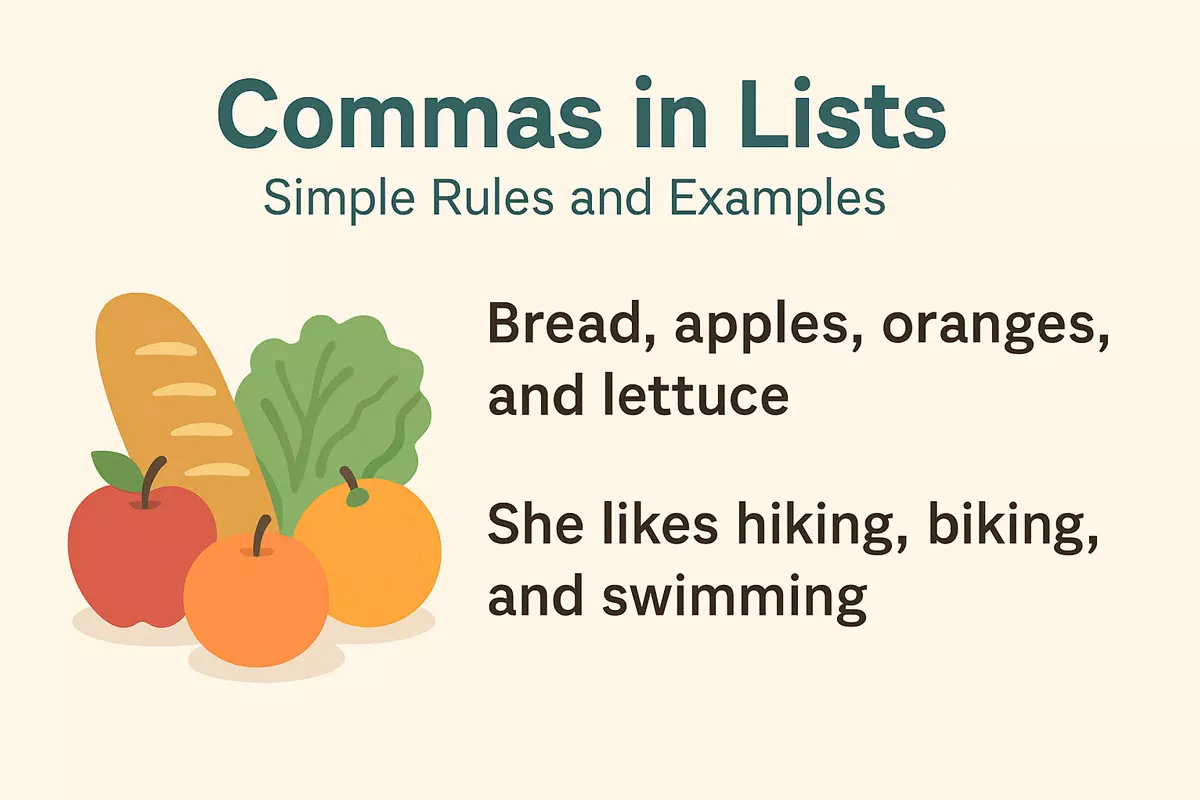 Here we using commas in simple lists and with phrases or clauses, explains when to use and or or before the final item, discusses parallel structure and semicolons in complex lists, highlights common list errors, and provides practice fixing punctuation.
Punctuation rules for writing lists can seem confusing at first, but with a few simple guidelines and practical examples, you can quickly learn how to punctuate lists correctly. This article provides clear instructions to help you understand when to use commas, semicolons, and conjunctions in a series of items, making your writing clearer and more professional. By following these straightforward tips, you will find it much easier to create well-structured and readable lists in any type of writing.
Commas in Simple Series
When listing three or more items in a sentence, proper punctuation helps the reader understand each element clearly. In English, the standard approach is to separate each item with a comma. The final item in the sequence is usually joined with a coordinating conjunction such as "and" or "or."
How to Punctuate a Basic List
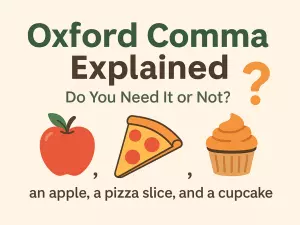
For straightforward lists of nouns, verbs, adjectives, or other short phrases, place a comma between each item except the last two, which are connected by a conjunction. This is often called the "serial comma" or "Oxford comma" when an extra comma precedes the conjunction, but its use can depend on style guides.
- We bought apples, oranges, and bananas.
- She likes hiking, swimming, and cycling.
- The project is creative, challenging, and rewarding.
- Please bring pencils, paper, and erasers.
- He laughed, cried, and cheered.
- Choose red, blue, or green.
- The dog barked, howled, and whined.
- Breakfast included eggs, toast, and juice.
- The meeting was long, dull, and necessary.
- She wore a hat, scarf, and gloves.
- We visited Paris, Rome, and Berlin.
- They offered tea, coffee, or water.
- The box contains books, photos, and souvenirs.
- He is smart, dedicated, and reliable.
- My favorite colors are purple, teal, and yellow.
- The store sells bread, milk, and cheese.
- We need energy, focus, and patience.
- She ordered soup, salad, and dessert.
With or Without the Oxford Comma?
The final comma before the conjunction ("and" or "or") is optional in some writing styles but required in others. Consider the clarity of your sentence; sometimes, including the last comma avoids ambiguity.
| With Oxford Comma | Without Oxford Comma |
|---|---|
| We invited the dancers, the musicians, and the manager. ✅ | We invited the dancers, the musicians and the manager. ❌ |
| I want pancakes, eggs, and toast. ✅ | I want pancakes, eggs and toast. ❌ |
| She met with her parents, Oprah, and Madonna. | She met with her parents, Oprah and Madonna. |
| Bring your phone, charger, and headphones. | Bring your phone, charger and headphones. |
Quick Tips
- Use commas to separate all items in a list of three or more.
- The final comma (before "and" or "or") may be optional, but can clarify meaning.
- Be consistent: follow your chosen style throughout a document.
In summary, commas play a crucial role in separating items in basic lists, improving readability and avoiding confusion. Whether or not you include the Oxford comma, prioritize clarity for your audience.
Commas with Phrases or Clauses
When writing lists, commas aren't just for separating single words—they also play a role with longer elements like phrases or clauses. If your list items are more complex than a single word, knowing where to place the comma helps your reader understand the intended separation.
Handling Phrases and Clauses in Lists
List items can be noun phrases, verb phrases, or even full clauses. Each should be separated by a comma, just as with single words, to keep the structure clear. This is especially important when the items themselves contain internal commas or are lengthy.
- She packed her laptop, several books for the flight, and a raincoat for unexpected weather.
- You can choose to write an essay, submit a video explaining your project, or create a slideshow presentation.
- For dinner, he made pasta with homemade sauce, grilled vegetables with herbs, and a fruit salad with citrus dressing.
Comma Placement with Dependent Clauses
When the list contains clauses (complete thoughts with a subject and verb), commas are still used to separate each item. If the clauses are long, consider using semicolons for extra clarity, but standard lists usually stick to commas.
- She wanted to visit the museum before it closed, see the river at sunset, and try the new restaurant downtown.
- He promised that he would call when he arrived, that he would check in daily, and that he would update us if plans changed.
Comparing Simple and Complex List Items
The difference between separating single words and longer elements is important. Here’s a quick comparison:
| Simple List | List with Phrases/Clauses |
|---|---|
| We bought apples, oranges, and bananas. | We bought apples from the market, oranges grown locally, and bananas that were perfectly ripe. |
| She ran, jumped, and laughed. | She ran to catch the bus, jumped over a puddle, and laughed when she saw her friend waiting. |
| He likes coffee, tea, and juice. | He likes coffee made strong, tea with lemon, and juice that is freshly squeezed. |
| Bring pencils, paper, and erasers. | Bring pencils for sketching, paper for notes, and erasers in case of mistakes. |
Tips for Clarity
- Use a comma after each item, whether it’s a word, phrase, or clause.
- If a list item already contains commas, consider using semicolons to separate items instead.
- Read the sentence aloud; if you pause naturally, a comma likely belongs there.
- Always include the final comma (Oxford comma) for clarity, especially with complex items.
By keeping these points in mind, you ensure your lists—no matter how complex—remain easy to read and unambiguous.
And/Or Before the Final Item
When listing items, writers often wonder whether a comma should be placed before conjunctions like "and" or "or" in the last part of a series. This is known as the serial (or Oxford) comma. The decision to use it can affect clarity, especially when the list items are complex or could be misread.
The Serial Comma Rule
A serial comma is the comma immediately before the final "and" or "or" in a list of three or more elements. Its use is optional in many style guides, but some (like Oxford and Chicago) recommend it for clarity.
- I bought apples, oranges, and bananas. ✅ (with serial comma)
- I bought apples, oranges and bananas. ❌ (without serial comma, potential ambiguity)
In short, the serial comma is not always required, but it can prevent misreading. For example:
- We invited the dancers, Jane, and Tom. (Three groups: the dancers, Jane, Tom)
- We invited the dancers, Jane and Tom. (Could mean "the dancers, who are Jane and Tom")
Using "Or" in Lists
The same guidelines apply when "or" is used instead of "and." The serial comma before "or" helps avoid confusion:
- You can have soup, salad, or breadsticks.
- Choose red, blue or green paint. (Style guides vary on requiring the comma here.)
Common Patterns and Examples
Writers frequently encounter these patterns:
- Books, pens, and pencils
- Cats, dogs, or rabbits
- Tea, coffee, and juice
- Spring, summer, or fall
- History, science, and math
- Salt, pepper, or sugar
- Shirts, ties, and jackets
- Apples, pears, or plums
- Milk, bread, and butter
- Gold, silver, or bronze
- Pizza, pasta, and salad
- Rain, snow, or hail
- Pens, markers, or highlighters
- Notebooks, folders, and binders
- Clocks, watches, or timers
- Tables, chairs, and desks
- Red, yellow, or blue crayons
- Apples, bananas, and grapes
Clarity vs. Simplicity
Some writers omit the serial comma for brevity, especially in informal contexts. However, omitting it can occasionally create ambiguity, so consider your audience and whether clarity or simplicity matters more for your particular sentence.
Summary Table: Serial Comma Usage
| Example | Does It Use a Serial Comma? |
|---|---|
| We brought sandwiches, chips, and drinks. | Yes ✅ (comma before "and") |
| We brought sandwiches, chips and drinks. | No ❌ (no comma before "and") |
| Bring pencils, pens, or markers. | Yes ✅ (comma before "or") |
| Bring pencils, pens or markers. | No ❌ (no comma before "or") |
In summary, using a comma before the final "and" or "or" in lists is a matter of style, but it often improves readability and prevents confusion, especially in more complex or formal writing.
Parallel Structure in Lists
When creating lists, keeping each item in the same grammatical form helps your writing stay clear and easy to follow. This approach means that all list elements should match in tense, structure, and part of speech. For example, if one item starts with a verb in the -ing form, the rest should as well; if you begin with a noun, continue with nouns.
Why Consistency Matters
Consistent structure in lists makes your points easier to read and understand. Readers can process information more quickly when patterns are predictable. Breaking this pattern—such as mixing verbs and nouns—can distract or confuse your audience.
Common Patterns for List Items
- Using all gerunds: Running, jumping, swimming
- Starting each item with an imperative verb: Wash the dishes, take out the trash, walk the dog
- Listing only nouns: Apples, bananas, oranges
- Keeping all items as phrases: In the morning, at noon, in the evening
Examples: Correct vs. Faulty Structure

| Consistent Structure ✅ | Inconsistent Structure ❌ |
|---|---|
| She likes reading, writing, and painting. | She likes reading, to write, and painting. |
| We need to buy groceries, clean the house, and call Mom. | We need to buy groceries, cleaning the house, and call Mom. |
| The options are apples, bananas, and pears. | The options are apples, bananas, and to eat pears. |
| He is smart, reliable, and friendly. | He is smart, reliability, and friendly. |
Tips for Achieving Consistency
- Check the first word or phrase of each item—are they the same part of speech?
- Keep verb tenses uniform throughout the list.
- Match the form: if you start with a phrase, keep using phrases.
- Read the list aloud to catch awkward or mismatched items.
- Revise any item that doesn’t align with the others in structure.
In summary, aligning the grammatical form of each entry in your lists helps readers follow your meaning without stumbling. Paying attention to this detail can improve both the professionalism and clarity of your writing, especially when using commas to separate items.
Using Semicolons for Complex Items
When listing items that already contain commas within them, relying on the standard comma separator can make your sentence confusing or even misleading. In these situations, semicolons act as a stronger divider, helping to clearly separate each item in the list. This is especially helpful when each element is a phrase or clause with its own internal punctuation.
When to Choose Semicolons in Lists
Use semicolons instead of commas when:
- List items are lengthy or contain their own commas.
- You want to avoid ambiguity or confusion in complex series.
- Each item in the list is an independent clause or contains descriptive phrases.
Examples of Complex Lists
- On our trip, we visited Paris, France; Rome, Italy; and Madrid, Spain.
- The committee included Sarah, the chairperson; Mike, the secretary; and Priya, the treasurer.
- For the event, please bring sandwiches with cheese, ham, or turkey; drinks such as water, soda, or juice; and desserts like cookies, cake, or fruit.
- Keynote speakers are Dr. Lee, expert in linguistics; Prof. Carter, a specialist in artificial intelligence; and Ms. Patel, who focuses on education technology.
- The package contained a red shirt, size medium; a blue jacket, size large; and a pair of black shoes, size 10.
- Participants came from Albany, New York; Dallas, Texas; and Seattle, Washington.
- The recommended readings are "Moby Dick," by Herman Melville; "Pride and Prejudice," by Jane Austen; and "1984," by George Orwell.
- Our options include staying at the Grand Hotel, which has a pool; the City Inn, known for its breakfast; or the Beachside Resort, which offers ocean views.
- To register, complete the online form, which is available on the website; send a check, if paying by mail; or visit our office in person.
- The colors available are navy blue, a classic choice; emerald green, which is vibrant; and charcoal gray, a neutral option.
- She ordered a salad with tomatoes, cucumbers, and olives; a soup with lentils, carrots, and celery; and a dessert with chocolate, cream, and berries.
- During the meeting, we discussed budgets, both annual and quarterly; timelines, including deadlines; and staffing, with current and future needs.
Common Mistakes ❌
- Using semicolons in simple lists without internal commas is unnecessary.
- Mixing commas and semicolons inconsistently within the same list can confuse readers.
- Forgetting to place a semicolon before the final conjunction (and or or) in a complex series may result in ambiguity.
Quick Reference: Comma vs. Semicolon in Lists
| List Type | Recommended Separator |
|---|---|
| Simple items (single words or short phrases) | Comma (,) |
| Items with internal commas or phrases | Semicolon (;) |
| Independent clauses in a list | Semicolon (;) |
| Lists with both simple and complex items | Semicolon (;) for clarity |
Semicolons aren’t just for connecting independent clauses—they’re essential for clarity in detailed or layered lists. This technique helps readers easily distinguish between each group, especially when commas alone would make things unclear.
Common List Errors
When writing lists, several typical mistakes can make sentences unclear or grammatically incorrect. Understanding these pitfalls helps you communicate more precisely and avoid confusion for your readers.
Omitting Necessary Commas
Leaving out commas where they are needed often leads to ambiguity. For instance, "I love cooking, my family and my dog" could be interpreted as loving "cooking your family and your dog." Proper punctuation clarifies your meaning.
Misusing the Serial (Oxford) Comma
The serial comma—used before "and" or "or" in a list—can change the meaning of a sentence. Consider the difference between:
- "We invited the strippers, JFK and Stalin." (Implies JFK and Stalin are strippers.)
- "We invited the strippers, JFK, and Stalin." (Clarifies that three distinct groups were invited.)
Some style guides require the serial comma for clarity, while others do not. Consistency is key.
Mixing List Types
Switching between phrases and full sentences within the same list makes reading awkward. For example:
- Going to the store
- To buy eggs
- Milk
- And then I went home.
Stick to a consistent grammatical structure throughout your list.
Incorrect Use of Semicolons and Commas
Long or complex items in a list may require semicolons instead of commas. Using only commas can confuse readers, especially if list items contain internal commas.
| Incorrect | Correct |
|---|---|
| I brought apples, which are red, oranges, which are orange, and grapes, which are purple. | I brought apples, which are red; oranges, which are orange; and grapes, which are purple. |
| She likes dancing, singing, and to swim. | She likes dancing, singing, and swimming. |
| My favorite foods are pizza, sushi and, ice cream. | My favorite foods are pizza, sushi, and ice cream. |
| We need to buy bread, milk cheese, and eggs. | We need to buy bread, milk, cheese, and eggs. |
Examples of Frequent List Punctuation Mistakes
Here are some common slip-ups to watch for:
- Forgetting the comma before "and" in a list of three or more items.
- Using inconsistent punctuation marks within the same list.
- Placing a comma after the last item in a simple list.
- Adding unnecessary commas before "or" in short lists.
- Combining fragments and complete sentences within one list.
- Failing to use semicolons in lists with lengthy or complex items.
- Misaligning parallel structure in list items.
- Inserting extra commas between adjectives when not needed.
- Leaving out commas when listing locations, dates, or names with titles.
- Overusing commas, making the list choppy and difficult to read.
- Neglecting to use a colon before a list introduced by a complete sentence.
- Using "and" or "or" more than once in the same list, causing confusion.
Paying attention to these details ensures your lists are both grammatically correct and easy to understand.
Practice: Fix the Punctuation
Test your skills by correcting the punctuation in these sentences that contain lists. Each one is missing commas, has them in the wrong places, or needs a serial (Oxford) comma. Review the sentences, decide where commas should be added or removed, and rewrite them correctly.
Exercise: Add or Remove Commas Where Needed
- I bought apples oranges bananas and pears.
- For breakfast she likes eggs toast juice and coffee.
- My bag contains a pen a notebook and a calculator.
- We visited London Paris Rome and Berlin last summer.
- You need to bring your passport tickets wallet and phone.
- The cake was sweet moist rich and delicious.
- On our hike we saw birds rabbits squirrels and deer.
- The library has books magazines newspapers and DVDs.
- He ordered pizza salad garlic bread and soda.
- To make the recipe you will need flour sugar eggs and butter.
- She bought a red blue green and yellow shirt.
- Our team includes designers developers testers and managers.
- At the store I found apples, oranges bananas and grapes.
- We need to buy plates cups forks and spoons.
- The festival had music food games and rides.
Show answers
- I bought apples, oranges, bananas, and pears.
- For breakfast, she likes eggs, toast, juice, and coffee.
- My bag contains a pen, a notebook, and a calculator.
- We visited London, Paris, Rome, and Berlin last summer.
- You need to bring your passport, tickets, wallet, and phone.
- The cake was sweet, moist, rich, and delicious.
- On our hike, we saw birds, rabbits, squirrels, and deer.
- The library has books, magazines, newspapers, and DVDs.
- He ordered pizza, salad, garlic bread, and soda.
- To make the recipe, you will need flour, sugar, eggs, and butter.
- She bought a red, blue, green, and yellow shirt.
- Our team includes designers, developers, testers, and managers.
- At the store, I found apples, oranges, bananas, and grapes.
- We need to buy plates, cups, forks, and spoons.
- The festival had music, food, games, and rides.
Quick Reference: Common List Punctuation Mistakes
- Omitting commas between items (e.g., apples oranges bananas)
- Forgetting the serial (Oxford) comma before "and" or "or" in longer lists
- Adding extra commas where not needed (e.g., between only two items)
- Using semicolons instead of commas for simple lists
Remember: In English, use commas to separate three or more items in a series. The final comma before "and" or "or" (the Oxford comma) is recommended for clarity, especially in complex lists.