Basic Sentence Structure: Subject + Verb + Object Explained

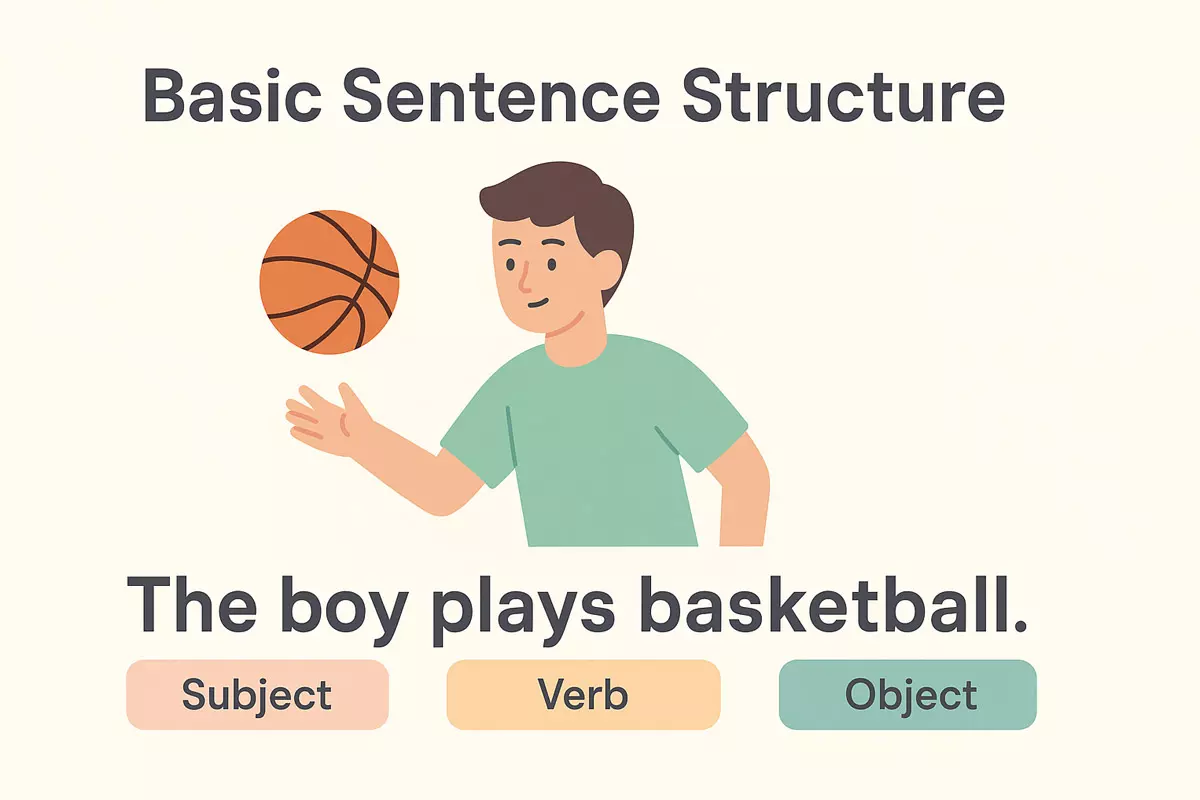 The article defines what a sentence is, explains subjects, verbs, and objects, and describes basic English word order. It also gives examples with common verbs, highlights common mistakes, and includes practice for building simple sentences.
Simple sentences in English are formed by connecting key parts: the subject, which tells us who or what performs the action; the verb, which expresses the action itself; and sometimes the object, which receives the action. For example, in the sentence "The cat chased the mouse," "the cat" is the subject, "chased" is the verb, and "the mouse" is the object. By understanding how these elements fit together, you can create clear and effective sentences that convey your message accurately and make your writing easier to understand.
What Is a Sentence?
A sentence is a group of words that expresses a complete thought. In English, this usually means it includes at least a subject and a verb, and often an object as well. The main purpose is to communicate an idea clearly, whether it's a statement, a question, a command, or an exclamation. Unlike phrases or fragments, a full sentence stands alone and makes sense by itself.
Core Elements of a Sentence
The essential parts that make up a standard English sentence are:
- Subject: who or what the sentence is about
- Verb: the action or state of being
- Object (sometimes): who or what receives the action
Some sentences may include additional information, such as modifiers, complements, or adverbial phrases, but the backbone remains the same.
Types of Sentences
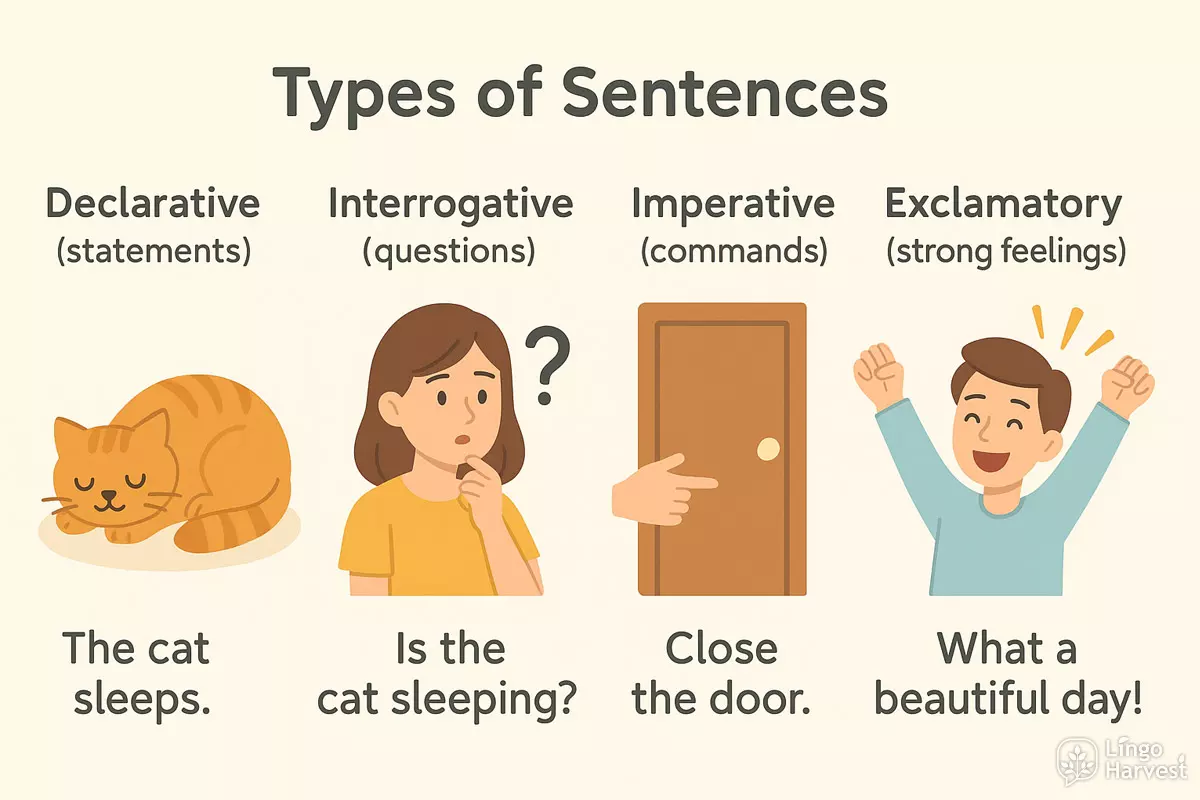
Depending on their function, sentences can be grouped into categories:
- Declarative (statements): The cat sleeps.
- Interrogative (questions): Is the cat sleeping?
- Imperative (commands): Close the door.
- Exclamatory (strong feelings): What a beautiful day!
Examples of Complete and Incomplete Sentences
To illustrate the difference between a full sentence and a fragment, here are some comparisons:
- ✅ She laughed. (complete)
- ✅ The dog chased the ball. (complete)
- ❌ Running in the park (incomplete – missing a verb or subject)
- ❌ Because he was tired (incomplete – subordinate clause only)
Common Sentence Patterns
English sentences can take many shapes, especially as they become more complex. Here are some fundamental structures:
- Subject + Verb: Birds sing.
- Subject + Verb + Object: She reads books.
- Subject + Verb + Complement: He is a teacher.
- Subject + Verb + Indirect Object + Direct Object: Mary gave John a gift.
- Subject + Verb + Adverbial: They arrived late.
Recognizing these patterns helps in both understanding and constructing clear, effective sentences. Each structure serves a different communicative purpose, but all rely on the presence of a subject and a verb to form a complete thought.
Understanding Subject, Verb, and Object
Every complete sentence in English typically relies on three core components: the subject, the verb, and the object. Grasping how each part functions is essential for writing and speaking clearly.
What Is the Subject?
The subject is the person, place, thing, or idea that performs the action in a sentence. In most cases, it comes at the beginning. For example:
- She reads every morning.
- The cat chased the mouse.
- My friends enjoy music.
What Role Does the Verb Play?
Verbs are action words or states of being. They tell us what the subject is doing or what state it is in. Without a verb, a sentence cannot express a complete thought. Some examples include:
- run
- eat
- think
- is
- feel
Understanding the Object
The object receives the action from the verb. Not every sentence has an object, but when it does, it usually follows the verb. Objects can be people, places, things, or even ideas. Notice how the object answers "what?" or "whom?":
- She reads books.
- The dog ate the food.
- We watched a movie.
Simple Sentence Patterns
Here are some straightforward examples to show how these elements fit together:
- Anna (subject) loves (verb) chocolate (object).
- Birds (subject) build (verb) nests (object).
- They (subject) play (verb) soccer (object).
- Tom (subject) lost (verb) his keys (object).
- Children (subject) draw (verb) pictures (object).
- The wind (subject) broke (verb) the window (object).
- We (subject) visited (verb) the museum (object).
- Lisa (subject) found (verb) a solution (object).
- Cats (subject) chase (verb) mice (object).
- The chef (subject) prepared (verb) dinner (object).
Comparing the Core Elements
| Element | Function in a Sentence | Typical Question Answered | Examples |
|---|---|---|---|
| Subject | Who or what does the action | Who? / What? | Julia, dogs, the teacher |
| Verb | Shows action or state | What happens? | runs, writes, is |
| Object | Receives the action | Whom? / What? | cake, the ball, lessons |
Why It Matters
Recognizing these components helps you build clear, effective statements. Whether forming questions, making statements, or giving instructions, knowing how subjects, verbs, and objects interact is the foundation of English sentence construction.
Basic Word Order in English
The typical structure of an English sentence follows a predictable pattern: first comes the person or thing doing the action, then the action itself, and finally the person or thing affected by that action. This arrangement helps listeners and readers quickly understand who is involved and what is happening. While English is quite flexible, most simple statements and questions follow this standard sequence.
Standard Sequence: Who + Does + What
In everyday communication, the subject (who or what the sentence is about) leads, followed by the verb (the action or state), and then the object (who or what receives the action). This order makes sentences clear and straightforward. For example:
- She (subject) reads (verb) books (object).
- They (subject) built (verb) a house (object).
- Tom (subject) likes (verb) apples (object).
Common Patterns and Variations
Although the SVO (Subject-Verb-Object) arrangement is the most frequent, English allows for additional elements, such as adverbs or indirect objects, to be included. These elements usually appear after the object or between the verb and object, depending on what is being emphasized.
- He quickly finished his homework.
- Lisa gave her friend a gift.
- We watched a movie last night.
- The cat caught a mouse.
- My parents visited us yesterday.
- She bought a new laptop.
- They sent me an invitation.
- The teacher explained the lesson clearly.
- John opened the window.
- The children played soccer after school.
Question and Negative Forms
When asking questions or making negative statements, the word order changes slightly, but the basic sequence remains easy to follow. For example:
- Do you like pizza?
- She doesn't understand the problem.
- Did they finish the project?
Comparison: English vs. Other Languages
Some languages use a different arrangement, which can make English sentences seem unfamiliar at first. Here’s a quick comparison of word order in several languages:
| Language | Typical Word Order | Example (English Translation) |
|---|---|---|
| English | Subject – Verb – Object | Mary eats apples. |
| Japanese | Subject – Object – Verb | Mary apples eats. |
| German | Subject – Verb – Object (main clause) | Mary eats apples. |
| Turkish | Subject – Object – Verb | Mary apples eats. |
| Arabic | Verb – Subject – Object | Eats Mary apples. |
Understanding this basic sequence makes it much easier to build clear, accurate sentences in English. As you practice, pay attention to the placement of each part to ensure your meaning is understood.
Examples with Common Verbs
Understanding how to use basic verbs in simple sentences helps you build a strong foundation in English grammar. The most common sentence structure uses a subject, a verb, and an object. Let’s look at how this pattern works with frequently used verbs.
Here are some sample sentences using everyday action words. Notice how each sentence follows the pattern: someone (subject) does something (verb) to someone or something (object).
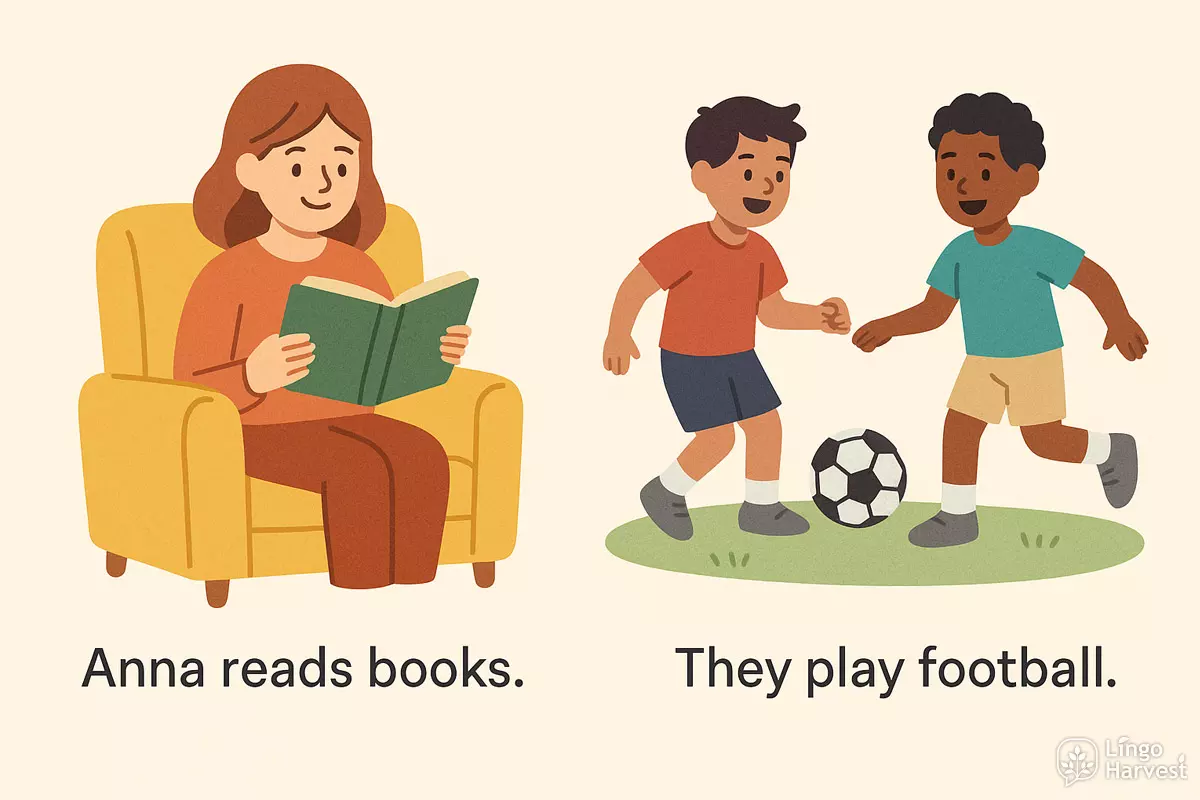
- Anna reads books.
- They play football.
- He drinks water.
- We watch movies.
- You eat pizza.
- The dog chases the ball.
- The teacher explains the lesson.
- Children draw pictures.
- My friend buys flowers.
- She writes emails.
- I study English.
- Sam fixes cars.
- Birds build nests.
- Parents love their children.
- Lisa opens the window.
- Workers repair roads.
- John cooks dinner.
- We visit museums.
Comparing Verb Usage in Sentences
Different verbs can take different types of objects, but the basic pattern remains the same. Here’s a comparison of common verbs and how they fit into the subject + verb + object structure:
| Subject | Verb | Object |
|---|---|---|
| I | like | music |
| She | sees | her friend |
| We | make | a cake |
| They | clean | the room |
| He | finds | the keys |
Tips for Practicing Basic Patterns
To improve your understanding of simple sentence structure, try creating your own examples using familiar verbs. Change the subject or object to see how the meaning shifts. Start with basic actions and everyday vocabulary—this will help you become more confident with sentence building.
Mistakes to Avoid
Understanding how to properly build a simple sentence is crucial, but there are some frequent errors that many learners make. Being aware of these issues can help you communicate more clearly and avoid confusion. Below, you'll find common missteps, explanations, and some practical examples to illustrate each point.
1. Missing Subjects or Verbs
Leaving out the subject or the verb is a frequent problem, especially for beginners. Every complete sentence in English needs both. For example, saying “Ate breakfast” lacks a subject and feels incomplete. The correct version would be “She ate breakfast.”
2. Using the Wrong Word Order
English word order is usually subject + verb + object. Placing words incorrectly can make your sentence sound odd or change its meaning. For instance, “A sandwich ate the boy” is not the same as “The boy ate a sandwich.”
3. Adding Extra Words
Sometimes, people add unnecessary words, which can confuse the sentence’s meaning. Keep sentences straightforward unless you intend to add description or detail.
4. Confusing Objects and Complements
It’s easy to mix up what comes after the verb. Some verbs need an object (“She reads books”), while others take a complement (“She is happy”). Mixing these up can cause misunderstandings.
5. Run-On Sentences
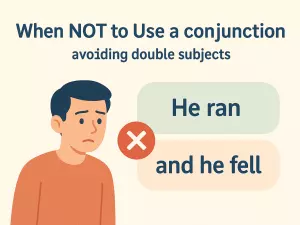
Combining multiple ideas without proper punctuation or connectors leads to run-on sentences. For example, “He likes pizza he eats it every day” should be separated or connected properly: “He likes pizza, and he eats it every day.”
6. Subject-Verb Agreement Errors
The verb must match the subject in number and person. For example: “He go to school” ❌ should be “He goes to school” ✅.
Common Errors and Corrections
Below is a comparison table to help clarify typical issues and their correct forms:
| Incorrect Example | Correct Example |
|---|---|
| Walks the dog. | She walks the dog. |
| The cat chased. | The cat chased the mouse. |
| Him likes books. | He likes books. |
| Books reads she. | She reads books. |
| They is happy. | They are happy. |
| He play football every day. | He plays football every day. |
Quick Reference: Frequent Pitfalls
- Omitting the subject or verb
- Placing the object before the verb
- Using the wrong verb form for the subject
- Forgetting articles (“a”, “the”) when needed
- Combining two sentences without a connector
- Using object pronouns (me, him, her) as subjects
- Mixing up singular and plural forms
- Repeating the subject unnecessarily (“She she likes music”)
- Using fragments instead of complete sentences
- Adding extra verbs (“He does eats lunch”)
Focusing on these areas will help you avoid common pitfalls and write clear, effective sentences. Practice identifying these mistakes in your own writing for improvement.
Practice: Build Simple Sentences
Building sentences with a clear subject, verb, and object is a fundamental skill for expressing ideas in English. Here you’ll find hands-on exercises and a variety of examples to help you internalize this structure. As you work through the activities, pay attention to word order and how each part contributes to meaning.
Common Patterns: Subject + Verb + Object
Start by reviewing some straightforward examples. Notice how each sentence follows the basic structure: someone (subject) does something (verb) to something or someone (object).
- The cat (subject) eats (verb) fish (object).
- Maria (subject) reads (verb) a book (object).
- They (subject) play (verb) soccer (object).
- We (subject) watch (verb) movies (object).
- John (subject) kicks (verb) the ball (object).
- I (subject) like (verb) chocolate (object).
- She (subject) paints (verb) pictures (object).
- The dog (subject) chases (verb) the cat (object).
- My friends (subject) bake (verb) cookies (object).
- The teacher (subject) explains (verb) the lesson (object).
- You (subject) open (verb) the door (object).
- He (subject) drinks (verb) coffee (object).
- Anna (subject) writes (verb) emails (object).
- We (subject) solve (verb) problems (object).
- Children (subject) draw (verb) pictures (object).
Mini-Quiz: Identify the Parts
For each sentence below, identify the subject, verb, and object. Write your answers as: Subject – Verb – Object.
- Lisa feeds the birds.
- The students answer questions.
- Tom builds a sandcastle.
- She drinks water.
- We study grammar.
Show answers
- Lisa – feeds – the birds
- The students – answer – questions
- Tom – builds – a sandcastle
- She – drinks – water
- We – study – grammar
Build Your Own Sentences
Now, try creating your own sentences. Use the patterns below as a guide. Choose a subject from column 1, a verb from column 2, and an object from column 3 to make a complete thought.
| Subject | Verb | Object |
|---|---|---|
| I | read | the news |
| He | drives | his car |
| Sarah | finds | keys |
| We | visit | the museum |
| The chef | cooks | dinner |
| They | draw | animals |
| My sister | buys | a gift |
| We | watch | TV |
| The children | collect | shells |
| You | finish | your homework |
Mix and match from each column to practice forming new sentences. This exercise helps reinforce the order and function of each part.
Quick Check: Correct or Incorrect?
Read each sentence and decide if it uses the correct order. Mark ✅ for correct, ❌ for incorrect.
- The dog eats food.
- Plays she tennis.
- We open the window.
- Books he reads.
Show answers
- ✅ The dog eats food. (Correct)
- ❌ Plays she tennis. (Incorrect — correct order: She plays tennis.)
- ✅ We open the window. (Correct)
- ❌ Books he reads. (Incorrect — correct order: He reads books.)
With regular practice, forming sentences with a clear subject, verb, and object will become second nature. Experiment with different words, and soon you’ll build more complex thoughts with confidence.