Voice and Valency: How Many Arguments a Verb Takes

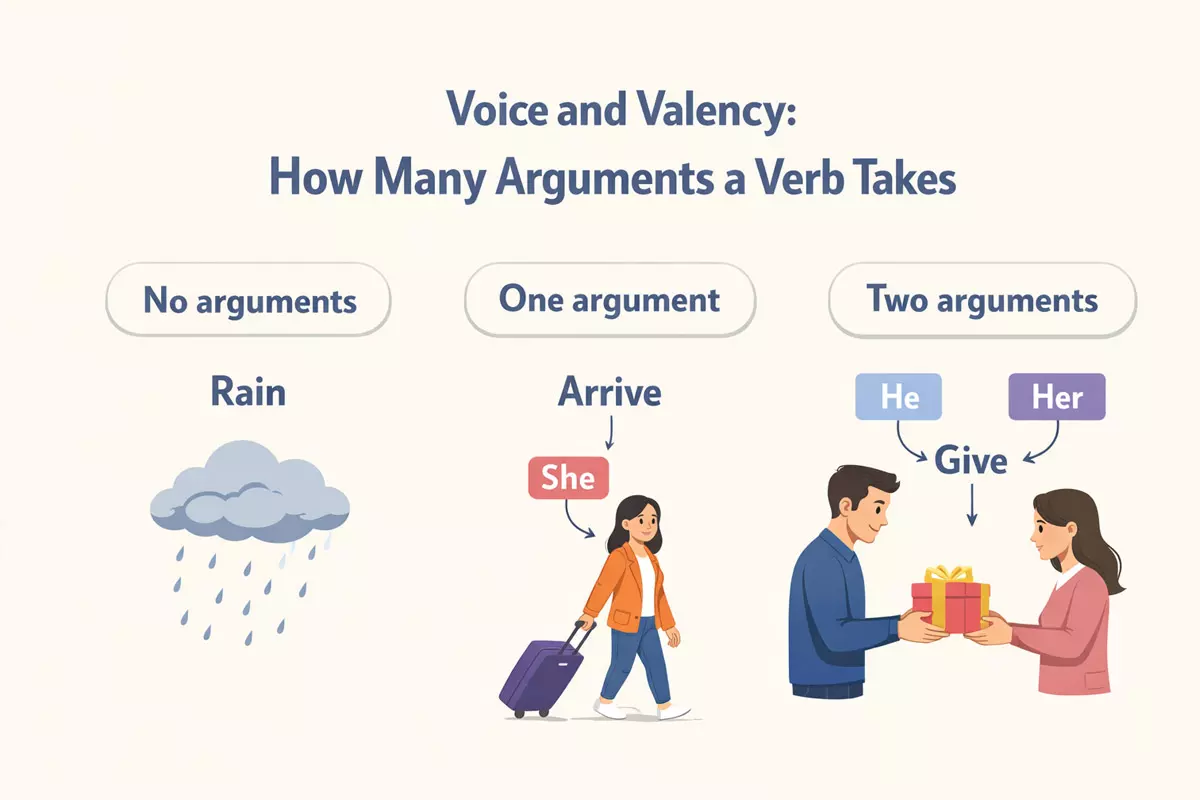 Here we what valency means in grammar, explains intransitive, transitive, and ditransitive verbs, discusses how valency affects sentence structure and passive voice, and highlights common learner errors and practice exercises.
Have you ever noticed that some verbs in language only need a subject, while others require both a subject and an object or even additional elements? This difference explains how verbs interact with different participants in a sentence, influencing the way we express actions and relationships. By understanding these patterns, we gain insight into the structure of grammar and how language allows us to communicate who is doing what to whom, which is essential for clear and effective communication.
What valency means in grammar
In linguistics, valency describes the number of arguments a verb can combine with to form a complete and meaningful sentence. These arguments can include the subject, objects, and sometimes additional elements like complements. The concept is similar to how chemical valency indicates an atom’s bonding capacity—here, it’s about the “bonding” between verbs and their required parts.
A verb’s valency tells us how many participants or elements must appear alongside it. For instance, some verbs require only a subject, while others need both a subject and an object, or even more. Recognizing a verb’s valency helps us understand sentence patterns and why certain combinations sound natural or ungrammatical.
Types of valency
Linguists often classify verbs based on how many arguments they take. Here are common types:
- Zero-valent (avalent): No arguments needed (e.g., “It rains.”)
- Monovalent (intransitive): Requires one argument (the subject). Example: “She sleeps.”
- Divalent (transitive): Needs two arguments—usually a subject and a direct object. Example: “They built a house.”
- Trivalent (ditransitive): Takes three arguments, often a subject, a direct object, and an indirect object. Example: “He gave her flowers.”
Examples of verb valency in English

Understanding how different verbs behave can clarify why some sentences sound complete while others seem incomplete or awkward. Here’s a comparison of verbs with different valencies:
| Verb | Typical Argument Structure | Example Sentence |
|---|---|---|
| rain | Zero (avalent) | It rains. |
| run | One (monovalent) | She runs. |
| eat | Two (divalent) | They eat apples. |
| give | Three (trivalent) | He gave her a book. |
| put | Three (trivalent) | She put the keys on the table. |
Why valency matters
Grasping how many arguments a verb can take is essential for constructing grammatical sentences and understanding voice (active, passive, etc.). It also helps language learners avoid common errors and gives insight into how sentence structures can change when verbs shift their valency, such as through passivization or causative constructions.
In summary, the valency of a verb defines its “argument slots,” shaping the skeleton of sentences and guiding how we express actions, experiences, and relationships in language.
Intransitive, transitive, and ditransitive verbs
Understanding how many arguments a verb takes is central to analyzing its valency. In grammatical terms, verbs can require none, one, two, or even three arguments, depending on their function in a sentence. The most common valency patterns are intransitive, transitive, and ditransitive, each shaping the sentence structure in a distinct way.
Intransitive verbs
An intransitive verb requires only a subject and does not take a direct object. The action stops with the subject—there is no recipient of the action in the sentence. For example, in "She sleeps," the verb "sleeps" has no object. Intransitive verbs are common in both English and many other languages.
- arrive – The train arrived.
- laugh – They laughed.
- fall – Leaves fall.
- swim – He swims.
- exist – Unicorns do not exist.
- die – The plant died.
- run (sometimes transitive in other contexts) – I run every morning.
- sit – Please sit.
- yawn – She yawned.
- appear – A rainbow appeared.
Transitive verbs
Transitive verbs require both a subject and a direct object. The action passes from the subject to the object, as in "She reads a book." Here, "reads" is the verb, and "a book" is the direct object receiving the action. Most English verbs can be transitive in at least some uses.
- eat – He eats an apple.
- build – They built a house.
- see – I see the mountain.
- find – She found her keys.
- paint – He painted the fence.
- open – Please open the window.
- kick – The player kicked the ball.
- watch – We watch movies.
- write – She wrote a letter.
- carry – He carried the box.
Ditransitive verbs
Ditransitive verbs take three arguments: a subject, a direct object, and an indirect object. The indirect object typically represents the recipient or beneficiary of the action, as in "She gave him a gift." Some verbs alternate between transitive and ditransitive patterns, depending on meaning and structure.
| Verb | Example Sentence | Direct Object | Indirect Object |
|---|---|---|---|
| give | She gave him a book. | a book | him |
| send | They sent their friend a postcard. | a postcard | their friend |
| tell | I told her the story. | the story | her |
| show | He showed us his photos. | his photos | us |
| teach | She taught the children mathematics. | mathematics | the children |
| offer | He offered me advice. | advice | me |
| bring | They brought their mother flowers. | flowers | their mother |
| promise | She promised her friend help. | help | her friend |
By distinguishing between these three verb types, we can analyze how different verbs structure their arguments and how this affects sentence construction. Not all languages use the same patterns, but the distinction between verbs that take zero, one, two, or three arguments is a crucial part of understanding valency and voice.
How valency affects sentence structure
The number of arguments a verb requires directly shapes how we build sentences. Each verb’s valency determines how many participants must be mentioned for a statement to feel complete. For example, an intransitive verb like “sleep” needs only a subject: “She sleeps.” In contrast, a transitive verb such as “eat” expects both a subject and an object: “He eats an apple.” If the necessary arguments are missing, sentences sound incomplete or ungrammatical.
Types of valency and their effects
- Zero-valent (avalent): No explicit arguments (e.g., “It rains”).
- Monovalent (intransitive): One argument, usually the subject (“The dog barks”).
- Divalent (transitive): Two arguments, subject and object (“She reads books”).
- Trivalent (ditransitive): Three arguments: subject, direct object, and indirect object (“He gave her flowers”).
As verbs gain more required arguments, sentence structure becomes more complex. Ditransitive verbs, for instance, require careful placement of both direct and indirect objects to avoid confusion. Some languages allow flexible word order, but in English, argument positions are often fixed.
Comparing sentence patterns by verb valency
| Verb Type | Sentence Pattern Example |
|---|---|
| Avalent | It snows. |
| Intransitive | The baby cried. |
| Transitive | She kicked the ball. |
| Ditransitive | They sent Tom a postcard. |
| Complex transitive | We elected her president. |
Common argument structures (examples)
- Subject only: “Birds fly.”
- Subject + object: “Cats chase mice.”
- Subject + indirect object + direct object: “She told him a story.”
- Subject + object + complement: “They named the puppy Max.”
- Impersonal subject: “It seems likely.”
- Subject + prepositional object: “We listened to music.”
- Subject + object + adjunct: “He placed the book on the table.”
- Subject + object + infinitive: “She wanted him to leave.”
- Subject + clause: “I believe that you’re right.”
- Subject + object + participle: “I saw her running.”
Understanding how verbs select and demand arguments helps explain why sentences are structured the way they are. Changing a verb’s valency—by adding or removing arguments—can shift focus, alter meaning, or even create ungrammatical sentences if the requirements aren’t met. This interplay between verb properties and clause structure is fundamental to both grammar and effective communication.
Valency changes in passive voice
When a verb is transformed into its passive construction, the number and arrangement of its core arguments often shift. In the active voice, the subject typically performs the action, while the object receives it. Switching to passive, the former object becomes the grammatical subject, and the original subject is either omitted or demoted to an optional adjunct (often introduced by “by”). This reorganization changes not only the syntax but also the argument structure, or valency, of the verb.
How passive constructions affect argument structure
In most languages with a clear active-passive distinction, the passive form reduces the number of required arguments. Specifically, the agent (doer) is no longer obligatory; the patient (receiver) moves into the subject position. Some verbs, especially those that do not take a direct object (intransitive verbs), cannot form true passives since there is no object to promote.
- Active: The chef cooked the meal. (Subject: chef, Object: meal)
- Passive: The meal was cooked (by the chef). (Subject: meal, optional agent: chef)
- Active: Researchers analyzed the data.
- Passive: The data were analyzed (by researchers).
- Active: The cat chased the mouse.
- Passive: The mouse was chased (by the cat).
- Active: She reads the book.
- Passive: The book is read (by her).
- Intransitive example: The baby slept. (No passive possible)
- Ditransitive active: She gave him a gift. (Subject: she, Indirect object: him, Direct object: gift)
- Ditransitive passive: A gift was given to him (by her).
- Ditransitive passive (alternative): He was given a gift (by her).
Comparison of argument realization in active vs. passive
| Active Voice | Passive Voice |
|---|---|
| Subject (Agent) + Verb + Object (Patient) | Subject (Patient) + Verb (+ optional Agent) |
| The teacher explains the lesson. | The lesson is explained (by the teacher). |
| They built the bridge. | The bridge was built (by them). |
| Maria sent a letter to John. | A letter was sent to John (by Maria). |
| John received a letter from Maria. | A letter was received from Maria (by John). |
It’s worth noting that not all languages or verbs allow for the same types of argument shifts in the passive. Some languages have restrictions, and certain verbs resist passivization entirely. In English, however, the passive often results in the loss of one core argument, especially the agent, which is no longer required. This makes the passive a useful tool for focusing on the action or its recipient, rather than on who performed it.
In summary, passive constructions typically decrease the number of obligatory arguments a verb takes, altering the mapping between syntactic roles and semantic roles. This shift is central to understanding how voice and valency interact in natural language.
Optional and required arguments
When analyzing verbs, it’s important to distinguish between the arguments that must appear in a clause and those that can be left out. Some verbs demand certain participants to make a complete and grammatical sentence, while others allow for elements to be omitted depending on context or meaning. Linguists call these required or obligatory arguments, and optional arguments, respectively. Understanding which is which helps clarify how verbs interact with their surrounding elements in a sentence.
What makes an argument obligatory?

Certain verbs cannot form a grammatical sentence unless specific arguments are present. For example, the verb “give” requires three participants: the giver (subject), the thing given (direct object), and the recipient (indirect object). Omitting any of these leads to an incomplete or ungrammatical sentence. In contrast, verbs like “sleep” only require a subject, and any additional information is optional.
- She gave him a book. ✅ (all core arguments present: subject, indirect object, direct object)
- She gave a book. ❌ (recipient missing: incomplete for a ditransitive verb)
- She gave him. ❌ (theme missing: incomplete)
- She slept. ✅ (intransitive verb: only subject required)
- She slept on the couch. ✅ (location is optional, adds extra information)
- She slept deeply. ✅ (manner adjunct, optional)
- The committee approved the proposal. ✅ (subject + object required)
- The committee approved. ❌ (object missing: approve is transitive)
- They put the files on the desk. ✅ (verb requires both object and location)
- They put the files. ❌ (location missing: incomplete)
- They put on the desk. ❌ (object missing)
- She explained the problem to the team. ✅ (theme + recipient expressed)
- She explained the problem. ⚠️ (recipient omitted: grammatically possible, pragmatically incomplete)
- He relied on his assistant. ✅ (prepositional object required)
- He relied. ❌ (complement missing)
- The data suggests a correlation. ✅ (subject + object required)
- The data suggests. ❌ (incomplete: what does it suggest?)
- She placed the vase carefully on the shelf. ✅ (all required arguments + optional modifiers)
- She placed the vase carefully. ❌ (location missing)
- They accused him of misconduct. ✅ (object + prepositional complement required)
- They accused him. ❌ (charge missing)
- He persuaded her to resign. ✅ (object + infinitive complement)
- He persuaded her. ❌ (result clause missing)
- The results depend on external factors. ✅ (prepositional complement required)
- The results depend. ❌ (incomplete)
- She considers him competent. ✅ (object + object complement)
- She considers him. ❌ (evaluation missing)
Common optional participants
Many verbs allow for extra details—such as locations, manners, or times—that are not strictly essential. These are typically called adjuncts rather than core arguments. For instance, in “He read the letter quickly,” the adverb “quickly” is not necessary for grammaticality, but adds information.
- He ate (breakfast) (at 7 am) (in the kitchen).
- They talked (about politics) (for hours).
- The cat slept (on the sofa) (peacefully).
- We met (at the park) (yesterday).
- She laughed (loudly).
- He arrived (late).
- I wrote (a letter) (to my friend).
- She danced (gracefully) (at the party).
- They ran (quickly) (down the hill).
- We studied (together) (for the exam).
How do languages show these differences?
Languages often mark obligatory and optional arguments differently, sometimes with case marking or word order. In English, word order is especially important: “John gave Mary a book” is clear and grammatical, but “Gave Mary a book” is not. In other languages, case endings or particles might signal which nouns are required participants.
| Verb | Required Arguments | Optional Elements (Adjuncts) |
|---|---|---|
| eat | subject | object, location, time, manner |
| give | subject, object, recipient | location, time, manner |
| sleep | subject | location, time, manner |
| put | subject, object, location | time, manner |
| arrive | subject | location, time |
| tell | subject, recipient, content | location, time, manner |
| walk | subject | location, time, manner |
| make | subject, object | recipient, location, time, manner |
Recognizing the distinction between core participants and optional details is central to understanding how verbs function across languages. It also informs how sentences are constructed and interpreted, highlighting both the flexibility and the constraints of verbal argument structure.
Typical learner errors with valency
Many language learners struggle with using the correct number and type of arguments for verbs, leading to sentences that sound unnatural or are hard to understand. These issues often arise because valency patterns differ between languages, and direct translation from a native language can introduce mistakes.
Common patterns of confusion
Students frequently misjudge whether a verb requires an object, omits one, or accepts more than one. This can affect both meaning and grammatical accuracy. Below are some recurring issues learners face:
- Adding an unnecessary object (e.g., “arrive the station” instead of “arrive at the station”).
- Omitting a required object (“She explained” when “She explained the rules” is needed).
- Using the wrong preposition or none at all (“listen music” vs. “listen to music”).
- Confusing transitive and intransitive verbs (“He fell the glass” instead of “He dropped the glass”).
- Overusing the passive voice where not allowed (“It was disappeared” instead of “It disappeared”).
- Incorrect double objects (“Explain me the answer” instead of “Explain the answer to me”).
- Transferring argument structure from the native language (e.g., “marry with someone” instead of “marry someone”).
- Confusing verb forms that change valency (“He raised up” vs. “He rose up”).
- Attempting to use a verb without its necessary complement (“depend” without “on”).
- Not recognizing verbs that can take both direct and indirect objects (“give”, “send”).
- Adding extra arguments where English does not allow them (“discuss about the book” instead of “discuss the book”).
- Confusing reflexive requirements (“He enjoyed” vs. “He enjoyed himself”).
- Using prepositional phrases as objects for verbs that do not take them (“enter into the room” instead of “enter the room”).
- Misapplying causative structures (“He made cook dinner” instead of “He made her cook dinner”).
- Omitting necessary recipients (“She sent” vs. “She sent him a letter”).
Comparing verbs by argument structure
Some verbs look similar but differ in how many arguments they take. Recognizing these differences is crucial for accurate communication. The table below contrasts common English verbs with different valency requirements:
| Verb | Typical Arguments | Correct Example | ❌ Common Error |
|---|---|---|---|
| arrive | Subject (+ prepositional phrase) | She arrived at noon. | She arrived the station. |
| explain | Subject + object (+ to someone) | He explained the rule to me. | He explained me the rule. |
| listen | Subject + to + object | They listened to music. | They listened music. |
| enjoy | Subject + object (sometimes reflexive) | She enjoyed herself. | She enjoyed. |
| discuss | Subject + object | We discussed the plan. | We discussed about the plan. |
Why these mistakes happen
Most of these errors stem from interference from the learner’s first language or from overgeneralizing patterns seen in English. Since verbs behave differently across languages, it’s easy to assume that similar words will have the same argument structure. Careful attention to verb patterns and frequent exposure to authentic examples can help reduce these issues.
Voice and meaning differences
Grammatical voice—such as active, passive, and middle—plays a crucial role in shaping the meaning a verb conveys and the number of participants it involves. The choice of voice can highlight or hide certain arguments, change the focus of a sentence, and even alter the verb’s valency (the number of arguments a verb takes).
How voice affects argument structure
Changing voice can increase or decrease valency. For example, the active voice typically presents both an agent and a patient (“The chef cooked the meal”), while the passive may suppress the agent (“The meal was cooked [by the chef]”). Some languages use special voices to add or remove arguments, like the causative (adding a causer) or the antipassive (removing or demoting the object).
- Active: The subject performs the action (e.g., “The dog chased the cat”).
- Passive: The subject receives the action (e.g., “The cat was chased by the dog”).
- Middle: The subject acts upon itself, or the focus is on the process (e.g., “This shirt washes easily”).
- Causative: Introduces a new agent (e.g., “She made him cry”).
- Antipassive: Emphasizes the agent, often omitting or demoting the patient (common in ergative languages).
- Reflexive: The subject and object are the same (e.g., “He hurt himself”).
- Reciprocal: Mutual action (e.g., “They hugged each other”).
Shifts in meaning caused by voice
Altering the voice can sometimes change not only the structure but also the interpretation of a sentence. Passive constructions, for instance, can be used to omit unknown or irrelevant agents, while causative forms introduce new participants. In some cases, switching from active to passive or middle voice changes the verb’s meaning or the perceived responsibility for the action.
| Voice Type | Example Sentence | Arguments Expressed | Focus/Meaning Shift |
|---|---|---|---|
| Active | The teacher explained the lesson. | 2 (subject, object) | Agent-centered |
| Passive | The lesson was explained (by the teacher). | 1 or 2 (subject, optional agent) | Patient-centered, agent optional |
| Middle | The door opens easily. | 1 (subject) | Focus on process/result, agent backgrounded |
| Causative | She had the mechanic fix the car. | 3 (causer, agent, patient) | Introduces new causer |
| Reflexive | He prepared himself. | 1 (subject=object) | Agent and patient are the same entity |
| Reciprocal | They greeted each other. | 2 (mutual agents) | Action is mutual |
Summary of effects
In short, the grammatical voice chosen for a verb can directly impact not just who is involved in the action, but also which roles are highlighted or backgrounded. This flexibility allows speakers to tailor their message, foregrounding the most relevant participants or shifting blame, credit, or focus as needed.
Practice exercises on voice and valency
Understanding how many arguments a verb takes—and how voice changes that structure—is essential for analyzing sentences. The following activities will help you identify argument patterns (valency), distinguish between voices, and transform sentences accordingly.
Identifying verb valency in sentences
Read each sentence below and decide how many arguments the verb takes (intransitive, transitive, ditransitive, etc.). List the arguments (subject, object, etc.) for each example.
- The dog barked.
- Maria opened the window.
- The teacher gave the student a book.
- It rained all night.
- They elected her president.
- The manager approved the budget.
- She put the keys on the table.
- He depends on his colleagues.
- They blamed him for the failure.
- She persuaded him to resign.
Show answers
- One argument (subject: the dog) – intransitive.
- Two arguments (subject: Maria, object: the window) – transitive.
- Three arguments (subject: the teacher, indirect object: the student, direct object: a book) – ditransitive.
- One argument (subject: it / expletive) – intransitive (weather verb).
- Three arguments (subject: they, object: her, object complement: president) – complex transitive.
- Two arguments (subject: the manager, object: the budget) – transitive.
- Three arguments (subject: she, object: the keys, required location: on the table) – ditransitive pattern (V + O + Locative complement).
- Two arguments (subject: he, complement: on his colleagues) – prepositional verb (required complement).
- Two arguments (subject: they, object: him, complement: for the failure) – verb + prepositional complement (required).
- Three arguments (subject: she, object: him, infinitive complement: to resign) – complex transitive (V + O + to-infinitive).
Transforming between active and passive voice
Rewrite the following sentences in the passive voice. Identify the new subject and any changes in the number or type of arguments.
- The chef cooked dinner.
- Someone stole my bicycle.
- The committee will announce the winner tomorrow.
- Lightning struck the tree.
- The editors rejected the manuscript.
- The team has completed the analysis.
- They will implement the policy next year.
- Someone leaked the documents to the press.
- The panel selected two finalists.
- The company offered her a senior role.
Show answers
- Dinner was cooked (by the chef).
- My bicycle was stolen (by someone).
- The winner will be announced by the committee tomorrow.
- The tree was struck by lightning.
- The manuscript was rejected by the editors.
- The analysis has been completed by the team.
- The policy will be implemented next year (by them).
- The documents were leaked to the press (by someone).
- Two finalists were selected by the panel.
- She was offered a senior role (by the company).
Comparing verb valency and voice: structured examples
Examine how different verbs behave with respect to valency and voice. Consider the following table, which contrasts verbs with varying numbers of arguments and gives examples in both active and passive forms.
| Verb Type | Active Voice Example | Passive Voice Example | Arguments in Active | Arguments in Passive |
|---|---|---|---|---|
| Intransitive | The child laughed. | – (not possible) | 1 (subject) | – |
| Transitive | The cat chased the mouse. | The mouse was chased (by the cat). | 2 (subject, object) | 1–2 (subject, optional agent) |
| Ditransitive | Emma sent Tom a letter. | Tom was sent a letter (by Emma). A letter was sent to Tom (by Emma). |
3 (subject, indirect object, direct object) | 2 (subject, optional agent) |
| Complex Transitive | They named the puppy Max. | The puppy was named Max (by them). | 3 (subject, object, object complement) | 2 (subject, optional agent) |
Practice: spotting valency changes in voice alternations
For each verb below, indicate whether it can be used in both active and passive voice. If so, give an example of each. If not, explain why.
- Arrive
- Discover
- Give
- Sleep
- Choose
Show answers
- Arrive: No passive (intransitive, e.g., She arrived).
- Discover: Yes (They discovered the island / The island was discovered).
- Give: Yes (She gave him a gift / He was given a gift / A gift was given to him).
- Sleep: No passive (intransitive, e.g., He slept).
- Choose: Yes (They chose a leader / A leader was chosen).
Challenge: writing sentences with specified valency
Create original sentences using the following patterns. For each, underline the verb and identify the arguments.
- Intransitive verb (one argument)
- Transitive verb (two arguments)
- Ditransitive verb (three arguments)
- Complex transitive verb (subject, object, object complement)
- Intransitive verb with optional adjunct
- Prepositional verb (verb + required prepositional complement)
- Complex transitive verb with infinitive complement
- Complex transitive verb with gerund complement
- Linking verb with subject complement
- Weather / impersonal verb
Show answers
- The sun shines. (subject: the sun)
- She wrote a letter. (subject: she, object: a letter)
- He told her a story. (subject: he, indirect object: her, direct object: a story)
- They painted the house blue. (subject: they, object: the house, object complement: blue)
- She slept on the sofa. (subject: she; location is optional)
- He depends on his team. (subject: he; required prepositional complement: on his team)
- They persuaded him to resign. (subject: they, object: him, infinitive complement: to resign)
- She kept him waiting. (subject: she, object: him, gerund complement: waiting)
- The plan seems unrealistic. (subject: the plan, subject complement: unrealistic)
- It snowed overnight. (expletive subject: it)