Present Simple Passive: Is Done, Are Made

 Here we the present simple passive: what it means, when English uses it, and how am, is, and are change with the subject. It also explains verb forms, statements, negatives, questions, active vs passive examples, common mistakes, practice, and an FAQ.
- What the present simple passive means
- When English uses the present simple passive
- How am, is, and are change with the subject
- Present simple passive with regular and irregular verbs
- Affirmative, negative, and question forms
- Present simple passive for facts, routines, and general rules
- Active vs passive examples in present simple
- Common mistakes with is done and are made
- Practice set: build present simple passive sentences
- FAQ: present simple passive voice
When we describe something that is made, cleaned, checked, sold, or used regularly, the action often matters more than the person doing it. That is why the present simple passive is so useful in English. You hear it in everyday sentences such as “Lunch is served at 12,” “English is spoken here,” and “These products are sold online.”
This structure is not only for formal writing. It appears in signs, routines, company procedures, product descriptions, school rules, customer service messages, and general facts. Once you understand it as a way to describe repeated actions and general situations, it becomes much easier to use naturally.
What the present simple passive means
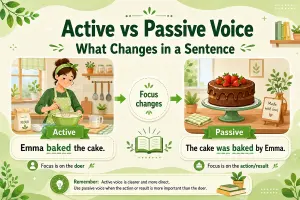
The passive voice changes the focus of a sentence. Instead of starting with the person or thing that does the action, we start with the person or thing that receives the action. In the present simple passive, the basic pattern is am / is / are + past participle.
Compare these two sentences:
- People clean the rooms every day.
- The rooms are cleaned every day.
Both sentences describe the same repeated action, but the focus is different. The active sentence focuses on “people.” The passive sentence focuses on “the rooms.” This is useful when the doer is unknown, obvious, general, or not important.
The form is called present simple passive because it uses the present simple form of be plus a past participle:
- The report is sent on Friday.
- English is spoken here.
- These products are made in Italy.
- I am invited to the meeting every year.
If you want a wider view of passive forms across different tenses, review passive voice verb forms. For this article, we will stay focused on the present simple pattern: am / is / are + past participle.
Teacher note: Do not think of the passive as a “more advanced” version of every active sentence. It has a job: it changes the focus. If the receiver, rule, process, or result is the main point, the passive can sound very natural.
When English uses the present simple passive

English uses the present simple passive when the result, process, rule, routine, or object is more important than the person doing the action. This is common in descriptions of systems, services, school rules, workplace procedures, and general facts.
For example, in a factory description, a school notice, or a museum rule, the speaker usually wants to say what regularly happens, not who personally does it:
- Orders are processed within 24 hours.
- Phones are not allowed during the exam.
- Visitors are asked to keep quiet.
- Fresh bread is sold here every morning.
The present simple passive is especially useful in these situations:
- When the doer is unknown: My bike is repaired in that shop, but I do not know which mechanic does it.
- When the doer is not important: The office is cleaned every evening.
- When the doer is general: Coffee is grown in Brazil.
- When the focus is on the object or process: Payment is made online.
- When giving formal instructions or notices: Bags are checked at the door.
You can still mention the doer with by if it matters: “The website is updated by the marketing team.” But in many present simple passive sentences, English simply leaves the doer out because the process or result is enough.
This choice is part of the larger difference between active and passive voice. Active voice highlights the doer. Passive voice highlights what happens to the subject.
How am, is, and are change with the subject
The most important grammar choice in this structure is the correct form of be. The past participle does not change for the subject, but am, is, and are do. If you choose the wrong form of be, the whole sentence sounds incorrect.
Use am with I, is with singular subjects, and are with plural subjects and you. After that, add the past participle: done, made, written, called, cleaned, sent, built, and so on.
| Subject | Be | Example in the passive |
|---|---|---|
| I | am | I am asked to help every month. |
| he / she / it | is | It is done by hand. |
| singular noun | is | The cake is made fresh each morning. |
| you / we / they | are | They are invited every year. |
| plural noun | are | The files are stored online. |
Notice the difference between singular and plural subjects:
- The bill is paid at the front desk.
- The bills are paid at the front desk.
- This car is washed every weekend.
- These cars are washed every weekend.
Long subjects can make agreement harder. Find the real head noun before choosing is or are:
- The list of names is checked every morning.
- The students in this class are tested twice a term.
- The information on these pages is updated regularly.
For more help with choosing the right verb form for the subject, see verb agreement made simple. The same agreement logic is important in passive sentences.
Present simple passive with regular and irregular verbs
After am / is / are, you need the past participle. With regular verbs, this is usually easy because the participle normally ends in -ed: cleaned, opened, packed, checked, delivered. With irregular verbs, you must know the correct participle form: made, done, written, built, sent, taken, chosen.
This is why learners sometimes say “is make” or “are do.” Those forms are wrong because the passive is built from be + past participle, not be + base verb.
| Verb | Past participle | Passive example |
|---|---|---|
| clean | cleaned | The classrooms are cleaned after school. |
| deliver | delivered | The package is delivered before noon. |
| make | made | These chairs are made from recycled wood. |
| do | done | The work is done in small teams. |
| write | written | The email is written in English. |
| send | sent | The invoices are sent on the last day of the month. |
| build | built | Most houses here are built with brick. |
Two forms in this topic appear again and again: is done and are made. They are just examples of the same pattern:
- The homework is done online.
- The payments are made by card.
- The coffee is made with oat milk.
- The desks are moved before the lesson.
Irregular participles are a major source of passive mistakes. If you often confuse forms like wrote / written, took / taken, or chose / chosen, review irregular verb patterns and learn the third form, not only the past simple form.
Teacher note: When students struggle with the passive, the problem is often not the passive idea itself. It is the participle. If you know the third form, the sentence becomes much easier to build.
Affirmative, negative, and question forms
Once you know the basic pattern, you need to use it in three ways: statements, negatives, and questions. The changes happen in the verb be. The past participle stays the same.
In negative sentences, add not after am / is / are. In questions, move am / is / are before the subject.
- Affirmative: The form is signed at reception.
- Negative: The form is not signed at reception.
- Question: Is the form signed at reception?
Here are more complete examples:
- The windows are opened every morning.
- The windows are not opened on cold days.
- Are the windows opened before class?
- I am invited to staff meetings.
- I am not invited to private client calls.
- Am I invited to tomorrow’s meeting?
- The reports are sent by email.
- The reports are not sent by post.
- Are the reports sent by email?
Short answers also follow the verb be:
- Is breakfast served here? — Yes, it is.
- Are mobile phones allowed? — No, they aren’t.
- Am I included in the list? — Yes, you are.
Be careful not to use do / does for passive questions and negatives in the present simple. We say “Is it made here?” not “Does it made here?” If question word order is still confusing, see English verb question formation.
Present simple passive for facts, routines, and general rules

This form is especially useful when you describe things that are generally true, regularly repeated, or officially required. That includes scientific facts, company procedures, school routines, public rules, manufacturing processes, and service information.
For facts, the passive helps you focus on the thing itself. For routines, it shows repeated actions in an organized system. For rules, it sounds natural and often more polite than directly naming people.
- Facts: Silver is used in electronics. Olive oil is produced in many Mediterranean countries. Rice is eaten in most homes here.
- Routines: Attendance is checked at 8:30. Orders are packed in the back room. The coffee machine is cleaned every evening.
- General rules: Helmets are required on this site. Visitors are asked to show ID. Food is not allowed in the library.
Notice how useful this is in professional English:
- Invoices are processed within three working days.
- Personal data is stored securely.
- Returns are accepted with a receipt.
And in everyday situations:
- Dinner is served at seven in my grandparents’ house.
- The dog is fed twice a day.
- The doors are locked at night.
This use overlaps with general repeated actions. For more context on repeated actions in English, see habitual actions and repeated events.
Teacher note: When learners write about business processes or school rules, the passive often sounds more natural than repeating “people” or “they” in every sentence.
Active vs passive examples in present simple
The clearest way to understand the passive is to compare it with the active voice. In active voice, the subject does the action. In passive voice, the subject receives the action. The meaning is related, but the focus changes.
Below are several pairs. Notice not only the grammar, but also the reason for choosing one form over the other.
- Active: The chef prepares the meals every afternoon.
Passive: The meals are prepared every afternoon. - Active: The company makes these batteries in Korea.
Passive: These batteries are made in Korea. - Active: The receptionist answers all calls before 6 p.m.
Passive: All calls are answered before 6 p.m.
Here are three more pairs where the change in focus is especially useful:
- Active: The school gives students a free planner in September.
Passive: Students are given a free planner in September. - Active: The lab technicians test the samples every morning.
Passive: The samples are tested every morning. - Active: Our team sends the newsletter on Monday.
Passive: The newsletter is sent on Monday.
Sometimes the active sentence is more natural because the doer matters:
- My brother cooks dinner every Friday.
- The manager checks my work.
- Our teacher explains grammar very clearly.
Sometimes the passive sentence is better because the process or result matters more:
- Dinner is cooked at 7 in this hostel.
- All documents are checked before payment.
- Grammar is taught through short practice tasks in this course.
Use the active when you want to highlight who does it. Use the passive when you want to highlight what happens or what receives the action.
Common mistakes with is done and are made
Most errors with the present simple passive come from five problems: using the base verb instead of the past participle, choosing the wrong form of be, using do / does incorrectly, mixing active and passive patterns, and forgetting that some English nouns are singular.
If you remember one thing, remember this pattern: subject + am / is / are + past participle. Not base verb, not present simple active verb, and not do / does.
1. Using the base verb instead of the past participle
- ❌ The work is do at home.
✅ The work is done at home. - ❌ These bags are make in Spain.
✅ These bags are made in Spain. - ❌ The letters are send every Friday.
✅ The letters are sent every Friday.
2. Choosing is or are incorrectly
- ❌ The shoes is cleaned every week.
✅ The shoes are cleaned every week. - ❌ My password are changed every month.
✅ My password is changed every month. - ❌ Those files is stored on the server.
✅ Those files are stored on the server.
3. Using do or does with the passive
- ❌ Does breakfast served here?
✅ Is breakfast served here? - ❌ The rooms don’t are cleaned on Sunday.
✅ The rooms aren’t cleaned on Sunday. - ❌ Do these products made locally?
✅ Are these products made locally?
4. Mixing active and passive forms
- ❌ The staff is checks the tickets.
✅ The staff checks the tickets. - ❌ The tickets check at the entrance.
✅ The tickets are checked at the entrance. - ❌ This machine makes by hand small labels.
✅ Small labels are made by hand with this machine.
5. Forgetting that some subjects are singular in English
- ❌ The information are given at reception.
✅ The information is given at reception. - ❌ The news are shared every morning.
✅ The news is shared every morning. - ❌ The furniture are delivered on Tuesday.
✅ The furniture is delivered on Tuesday.
Some passive sentences also appear with modal verbs, especially in rules and instructions: “Helmets must be worn,” “The form should be signed,” “This file can be opened online.” That pattern is explained in the guide to passive modal verbs.
Teacher note: When students keep saying “is make” or “is do,” I stop the sentence and ask for the participle only: made, done, sent, written. That small correction habit helps a lot.
Practice set: build present simple passive sentences
Now it is time to produce the structure yourself. Work slowly and check two things in every answer: first, the correct form of be; second, the correct past participle. Most mistakes happen in those two places.
The three blocks below test different skills. Try to answer aloud as well as in writing. Saying passive sentences helps them feel more natural.
1. Choose the correct form
Choose the correct present simple passive form.
- This cheese (is made / are made) in France.
- The windows (is cleaned / are cleaned) every Saturday.
- My name (is spelled / are spelled) with a double n.
- These documents (is kept / are kept) in a locked drawer.
- Lunch (is served / are served) at 1 p.m.
- The homework (is done / does done) online.
- Those machines (are repaired / is repaired) once a year.
- English (is spoken / are spoken) in this office.
- I (am included / is included) in the group email.
- All visitors (are asked / do asked) to sign in.
Show answers
- is made
- are cleaned
- is spelled
- are kept
- is served
- is done
- are repaired
- is spoken
- am included
- are asked
2. Rewrite in the passive
Rewrite each sentence in the present simple passive.
- The company prints the invoices on blue paper.
- People sell fresh bread here every morning.
- The school sends report cards by email.
- They grow oranges in this region.
- The hotel provides towels in every room.
- The staff checks passports at the desk.
- Our teacher gives extra exercises on Friday.
- The museum displays local art in the main hall.
- The app stores your photos in the cloud.
- Workers pack the boxes by hand.
Show answers
- The invoices are printed on blue paper.
- Fresh bread is sold here every morning.
- Report cards are sent by email.
- Oranges are grown in this region.
- Towels are provided in every room.
- Passports are checked at the desk.
- Extra exercises are given on Friday.
- Local art is displayed in the main hall.
- Your photos are stored in the cloud.
- The boxes are packed by hand.
3. Find and correct the mistake
Each sentence contains a mistake with the present simple passive. Correct it.
- The reports is sent every Monday.
- These phones are make in Vietnam.
- Does the room cleaned every day?
- The information are updated weekly.
- My bag is keep under the desk.
- Are breakfast served before 10?
- The walls is painted once a year.
- The forms don’t are checked at lunchtime.
- This medicine are not sold without a prescription.
- I is invited to the annual dinner.
Show answers
- The reports are sent every Monday.
- These phones are made in Vietnam.
- Is the room cleaned every day?
- The information is updated weekly.
- My bag is kept under the desk.
- Is breakfast served before 10?
- The walls are painted once a year.
- The forms aren’t checked at lunchtime.
- This medicine is not sold without a prescription.
- I am invited to the annual dinner.
FAQ: present simple passive voice
These are short answers to questions learners often ask after they understand the basic rule but still feel uncertain in real use.
1. Can I use the present simple passive in conversation, or is it only for formal writing?
Yes, you can use it in normal conversation. It is common when you talk about services, routines, and rules: “Breakfast is included,” “Cards are accepted,” “The trash is collected on Tuesdays.” It can sound formal in some contexts, but it is not only formal English.
2. Do I always need to say who does the action?
No. Many passive sentences do not mention the doer at all. If the doer is obvious, unknown, or not important, English usually leaves it out: “The building is locked at night.” If the doer matters, add by: “The building is locked by security staff at 10 p.m.”
3. What is the difference between “is made” and “is done”?
That depends on the main verb. Made comes from make, and done comes from do. We say “The cake is made fresh daily,” but “The homework is done after dinner.” You must use the participle of the correct verb.
4. Can I use contractions in negative passive sentences?
Yes. In everyday English, contractions are common: “is not” becomes isn’t, and “are not” becomes aren’t. For example: “The office isn’t open on Sundays” and “Pets aren’t allowed here.” In very formal writing, full forms may be preferred.
5. How do I make passive questions with question words?
Use the question word first, then be, then the subject, then the participle: “Where is lunch served?” “How are these products made?” “When are the results announced?” This pattern is common in customer service and classroom English.
6. Is every active sentence better in the passive if I want to sound advanced?
No. Good English is not about making everything passive. If the doer is important, active voice is usually clearer: “The doctor checks the patient” is often better than “The patient is checked” if the main point is the doctor’s action.
7. Why do some words that look plural take “is” in the passive?
Some nouns are grammatically singular in English even if they seem plural or refer to many things. For example, we say “The information is shared,” “The news is announced,” and “The furniture is delivered.” These nouns do not normally take are.
8. How can I practice this structure effectively?
Notice passive language around you and copy the pattern. Read signs, emails, product labels, school rules, and website instructions. Then write your own versions: “Orders are confirmed by email,” “Homework is uploaded before midnight,” “Bikes are kept outside.” Short repeated practice works better than memorizing one long rule.