Say It Better: Rewrite Practice for Clear English

 This article explains how rewriting can improve your English by simplifying long sentences, replacing repeated words, and making your sentences sound more natural. It also includes practice exercises to help you rewrite sentences for better clarity.
Improving your ability to express ideas simply can significantly enhance how well others comprehend your message. By regularly practicing how to rephrase sentences, you not only build confidence but also learn to communicate your thoughts with greater clarity and precision. This skill is valuable in both personal and professional settings, as it helps prevent misunderstandings and ensures your audience can easily follow your reasoning. Making an effort to simplify your language can ultimately lead to more effective and impactful communication.
Why Rewriting Improves English
Practicing rewriting is one of the most effective ways to build language skills. When you take an idea and express it in a new way, you’re forced to think about vocabulary, grammar, and clarity at the same time. This process helps you notice mistakes, expand your choice of words, and develop a natural, flexible writing style.
How Rewriting Helps Learners
- Encourages you to spot and fix awkward sentences
- Reinforces grammar by applying rules in new contexts
- Expands your vocabulary through searching for synonyms
- Improves understanding of subtle differences in meaning
- Builds confidence to express the same idea in several ways
- Trains you to think about your audience and purpose
- Teaches you to simplify complex sentences for clarity
- Helps avoid direct translation from your native language
- Develops editing skills for all types of writing
- Promotes active learning, not just passive reading
From Passive Reading to Active Mastery
Many learners read or listen to English, but rewriting transforms this into active practice. By reconstructing sentences or paragraphs, you internalize the patterns and logic of the language. This makes it easier to recall and use correct forms when speaking or writing on your own.
Common Rewriting Techniques
- Paraphrasing: Restate information using different words
- Summarizing: Shorten text to its most important points
- Expanding: Add details or explanations for clarity
- Combining: Merge short sentences into one longer sentence
- Simplifying: Replace complex structures with simpler ones
- Changing perspective: Rewrite from another point of view
- Altering tense or form: Practice with past, present, future, or passive voice
- Varying sentence types: Use questions, negatives, or conditionals
Before and After: A Rewriting Example
| Original Sentence | Rewritten Version |
|---|---|
| The weather was bad, so we decided to stay indoors. | Because it was raining, we chose not to go outside. |
| She finished her work quickly and left the office. | After completing her tasks, she exited the office promptly. |
| I don’t like eating spicy food. | Spicy dishes aren’t my preference. |
| They were tired, but they kept working until midnight. | Even though they were exhausted, they continued working late into the night. |
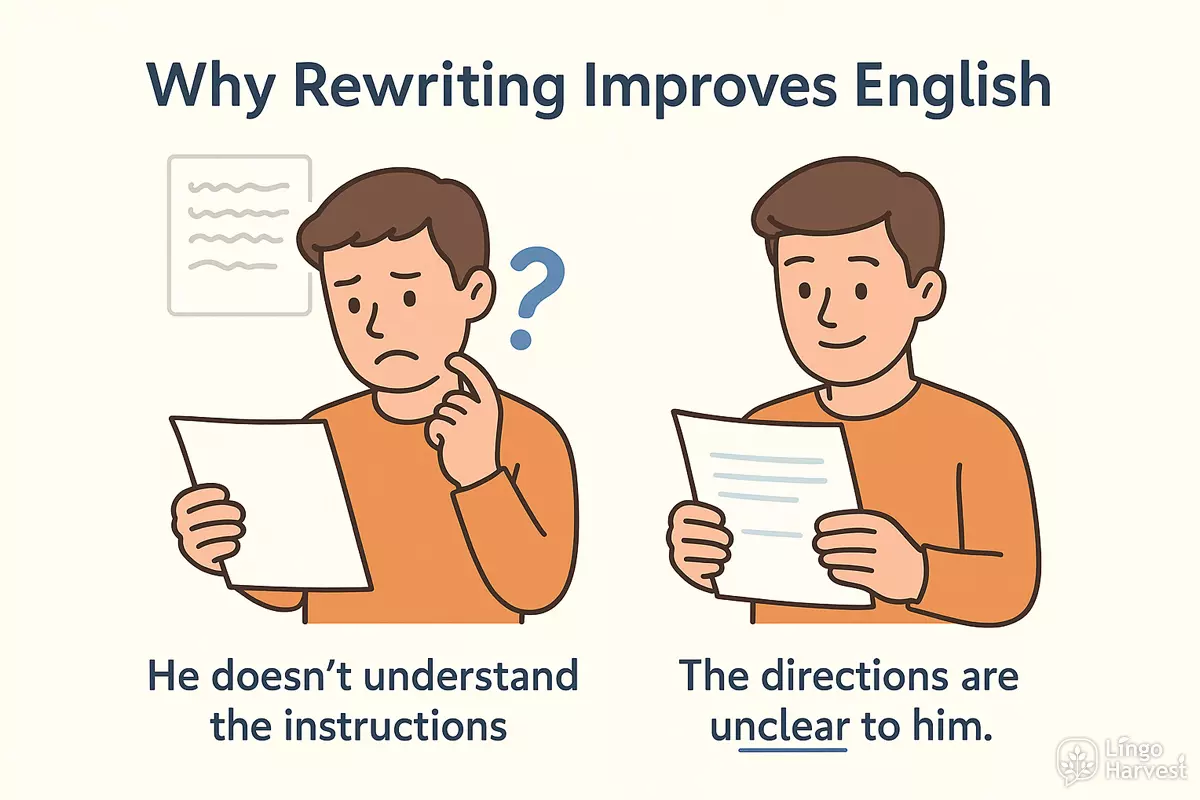
| He doesn’t understand the instructions. | The directions are unclear to him. |
Rewriting is more than just a language exercise—it’s a way to deepen your understanding and use of English. By consistently practicing these techniques, you develop a more flexible, precise, and confident command of the language.
Simplifying Long Sentences
Long, complicated sentences can confuse readers and hide your main point. Breaking them down helps your message stand out. When you encounter a lengthy sentence, look for ways to divide ideas, remove extra words, or turn complex structures into simpler ones. This approach makes your writing easier to digest and more effective for all audiences.
How to Break Down Complex Sentences
- Identify main ideas: Separate the core message from supporting details.
- Use shorter sentences: Express one idea at a time for clarity.
- Replace or remove unnecessary words: Cut out fillers and redundancies.
- Convert clauses to phrases: Change “because he was tired, he left early” to “He was tired. He left early.”
- Turn lists into bullet points: If you’re describing several items, present them as a list for readability.
- Watch for connecting words: Words like “which,” “that,” “although,” or “however” often signal where you can split sentences.
- Be direct: Say what you mean with as few words as possible.
Common Patterns for Shortening Sentences
Here are practical ways to turn wordy statements into clear, crisp sentences:
- Replace passive voice with active voice.
- Remove extra qualifiers (very, really, quite, etc.).
- Use simple verb forms (avoid “has been going to” when “goes” works).
- Change long noun phrases into shorter ones.
- Eliminate double negatives.
- Split compound sentences into two or more.
- Summarize long explanations in a single, focused sentence.
- Move explanations or details to a new sentence or paragraph.
- Replace relative clauses with adjectives or appositives.
- Use pronouns to avoid repetition.
Before and After: Sentence Simplification Examples
| Original Version | Simplified Version |
|---|---|
| If you are interested in participating in the meeting, which will be held on Thursday at the downtown office, please let me know as soon as possible so that we can reserve a spot for you. | If you want to join the Thursday meeting at the downtown office, please tell me soon so we can reserve your spot. |
| The project, which was started last year and has involved many different departments and teams, is now nearing completion and will be finished by the end of this month. | The project began last year, involved many teams, and will finish by month’s end. |
| Although the weather was bad and the traffic was heavy, we managed to arrive on time, which surprised everyone. | Despite bad weather and heavy traffic, we arrived on time. Everyone was surprised. |
| She is a person who is always willing to help others, no matter how busy her schedule may be. | She always helps others, even when she is busy. |
Quick Tips for Streamlining Sentences
- Focus on one message at a time.
- Read your sentence aloud—if you run out of breath, it’s probably too long.
- Ask a friend to read your writing; if they look confused, try making it shorter.
- Use punctuation—periods, commas, and dashes—to break up ideas.
- Revise with clarity as your main goal.
By applying these strategies, you’ll make your writing more accessible and engaging for everyone.
Replacing Repeated Words
Effective writing often means avoiding unnecessary repetition. When the same word appears too often in a paragraph or even a sentence, the result can sound awkward or monotonous. Instead, using a variety of expressions helps your writing flow and keeps readers interested. Learning how to swap out overused terms is a core skill for anyone aiming to communicate clearly in English.
Why Avoid Repetition?
Repeating the same word too frequently can distract your audience and weaken your message. It also makes your writing appear less polished. By varying your vocabulary and sentence structure, you help your reader focus on your ideas rather than on the language itself.
Strategies for Varying Your Language
- Use synonyms: Replace commonly repeated words with alternatives that fit the context.
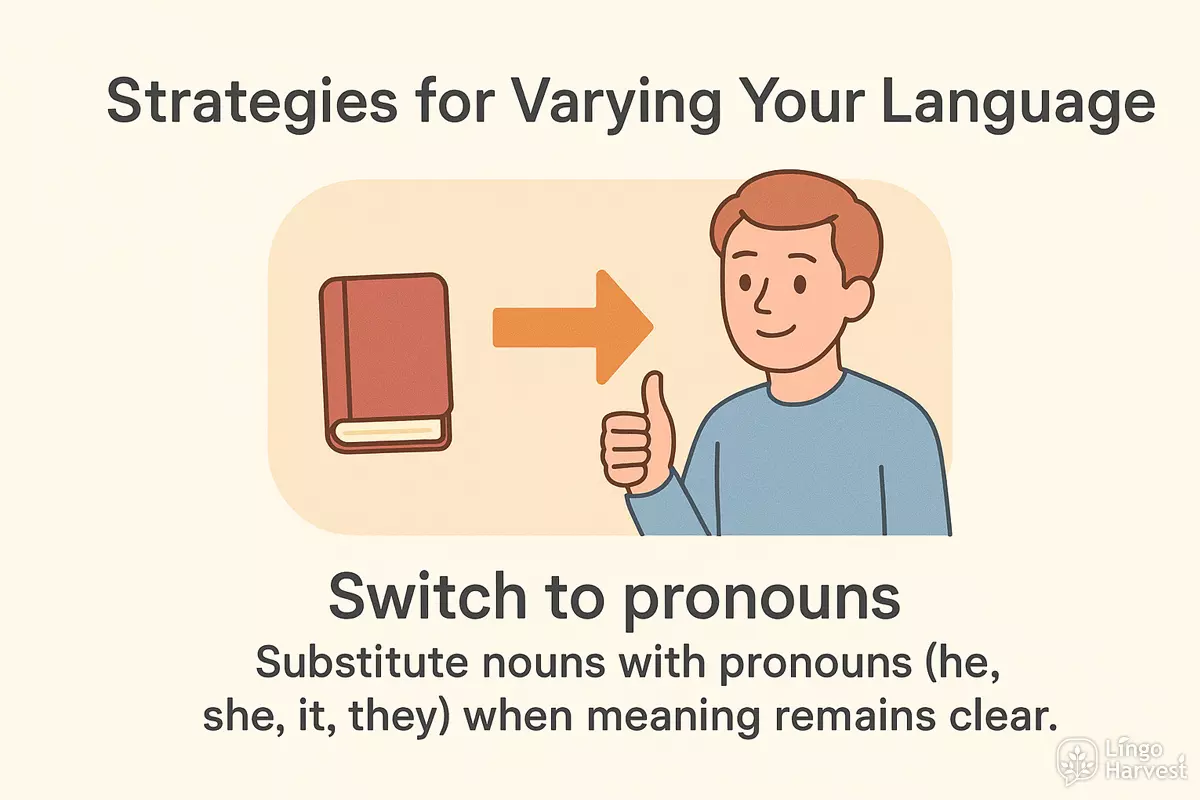
- Switch to pronouns: Substitute nouns with pronouns (he, she, it, they) when meaning remains clear.
- Rephrase sentences: Change the structure of a sentence to avoid restating the same word.
- Combine sentences: Merge two sentences to reduce repetition of key terms.
- Use descriptive phrases: Sometimes, a short descriptive phrase can replace a repeated word and add detail.
- Employ ellipsis: If context makes it clear, you can sometimes omit repeated words altogether.
Common Examples of Word Variation
Below is a selection of words and possible alternatives that can help you diversify your vocabulary and make your writing more engaging:
- big → large, huge, enormous, massive
- important → crucial, vital, significant, essential
- say → state, declare, mention, express, remark
- good → excellent, positive, beneficial, favorable
- bad → poor, negative, detrimental, harmful
- help → assist, support, aid, facilitate
- show → demonstrate, reveal, display, illustrate
- think → believe, consider, suppose, assume
- make → create, produce, generate, develop
- get → obtain, receive, acquire, gain
- start → begin, commence, initiate, launch
- end → finish, conclude, complete, terminate
- like → enjoy, appreciate, prefer, admire
- need → require, demand, necessitate, call for
- find → discover, locate, detect, identify
- use → employ, utilize, apply, exploit
- look → glance, gaze, observe, examine
- ask → inquire, request, question, seek
Comparing Repetition and Variation
| Repetitive Example | Improved Version |
|---|---|
| I think that the solution is good because the good results will help. | I believe the solution is effective because the positive results will assist. |
| She said that she would say more later. | She mentioned she would elaborate later. |
| The project needs more time. The project will need approval, too. | The project requires more time and also needs approval. |
| He looked at the document and then looked at the chart. | He examined the document and then reviewed the chart. |
Tips for Practice
When reviewing your writing, highlight any words that appear several times in close proximity. Challenge yourself to replace some of them using the techniques above. Over time, your ability to use varied language will grow, making your English clearer and more engaging for any reader.
Making Sentences Sound Natural
Fluent English often sounds effortless, but it actually relies on some simple habits. To help your writing and speaking flow, pay attention to how words fit together and choose expressions that real people use. Instead of translating ideas word-for-word, focus on patterns that native speakers prefer. This approach makes your communication clearer and more relatable.
Tips for Smoother, More Authentic Sentences
- Use contractions when appropriate (e.g., "I'm," "they're," "can't").
- Prefer active voice over passive voice for directness.
- Start with the subject, then add details.
- Avoid overly formal or stiff phrases—choose everyday words.
- Break up long sentences into shorter ones for clarity.
- Use linking words like "so," "but," "because" to connect ideas.
- Check if your sentence is something you’d actually say aloud.
- Eliminate unnecessary repetition.
- Replace awkward literal translations with common English expressions.
- Read your sentences out loud to spot anything unnatural.
Common Unnatural vs. Natural Ways to Say Things
Sometimes, small changes make a big difference. Consider these examples:
| Unnatural Sentence | More Natural Alternative |
|---|---|
| I very like pizza. | I really like pizza. |
| He has 25 years old. | He is 25 years old. |
| It makes cold today. | It's cold today. |
| I go to home now. | I'm going home now. |
| She explained me the rules. | She explained the rules to me. |
| We see us tomorrow. | See you tomorrow. |
| Can you borrow me your pen? | Can you lend me your pen? |
| I have much work. | I have a lot of work. |
| I am agree with you. | I agree with you. |
| He told to me the story. | He told me the story. |
Practice: How to Rewrite for Clarity
When revising your sentences, ask yourself: Does this sound like what a native speaker would say? Try replacing formal or awkward words with simpler alternatives, and rearrange phrases to match typical English order. Over time, these small changes will help your English sound clear and natural in any context.
Practice: Rewrite Sentences for Clarity
Effective communication often relies on clear, direct sentences. Sometimes, sentences become confusing due to unnecessary words, passive voice, or complex structure. Practicing how to revise these sentences will help you express ideas more simply and accurately.
Common Problems in Unclear Sentences
- Too many unnecessary words
- Passive instead of active voice
- Vague references (using "this," "it," or "they" without a clear subject)
- Jargon or overly complex vocabulary
- Long, complicated sentence structure
- Double negatives
- Ambiguous pronouns
- Unnecessary repetition
- Missing or unclear subjects
- Mixed or confusing time references
Rewrite Practice: Try These Sentences
Read each sentence. Rewrite it to be clearer and more direct. Focus on removing extra words, clarifying the subject, and using active voice when possible.
- Because of the fact that the weather was rainy, the event was postponed.
- The report that was written by the manager was not clear to the staff.
- There are many people who believe that exercise is important.
- If you don’t fail to submit the form, you won’t be ineligible for the prize.
- The decision was made after a long discussion, which lasted several hours.
- This is something that we should take into consideration.
- The equipment that is used by the team needs to be replaced.
- Due to the fact that she was late, the meeting started without her.
- It is important for all employees to read the manual before operating the machine.
- The survey was completed by 200 participants, and their answers were analyzed.
Show answers
- The event was postponed because it rained.
- The manager’s report was unclear to the staff.
- Many people believe exercise is important.
- If you submit the form, you will be eligible for the prize.
- After hours of discussion, they made a decision.
- We should consider this.
- The team needs new equipment.
- Because she was late, the meeting started without her.
- All employees should read the manual before using the machine.
- Two hundred participants completed the survey, and their answers were analyzed.
Tips for Making Sentences Clearer
- Use fewer words whenever possible.
- Choose active verbs over passive ones.
- Be specific—avoid vague pronouns.
- Break up long sentences into two or more shorter ones.
- Replace complex phrases with simple words.
- Check for and remove repetition.
- Make sure each sentence has a clear subject and verb.
- Keep the main idea at the start of the sentence.
- Use consistent tense throughout your writing.
- Read your sentence aloud to check for clarity.
Before and After: Sample Rewrites
| Unclear Sentence | Clearer Version |
|---|---|
| At this point in time, we are unable to provide a response. | We cannot respond now. |
| The decision to close the store was made by the owner. | The owner decided to close the store. |
| There were several issues that needed to be addressed by the team. | The team needed to address several issues. |
| It is necessary for you to submit your application before the deadline. | You must submit your application before the deadline. |
| The information that was provided was not sufficient. | The information provided was insufficient. |
| The project was completed in a timely manner by the group. | The group completed the project on time. |
| The instructions were not clear to the participants. | The participants did not understand the instructions. |
| Your request cannot be processed at this moment in time. | We cannot process your request now. |
| It is recommended that you review the guidelines. | Please review the guidelines. |
| There is a need for better communication among team members. | Team members need to communicate better. |
Regularly practicing these techniques will help you become a more effective and confident communicator. Try rewriting sentences from your own emails or reports to reinforce your skills.