Adverb Placement to Adjust Emphasis (He nearly won…)

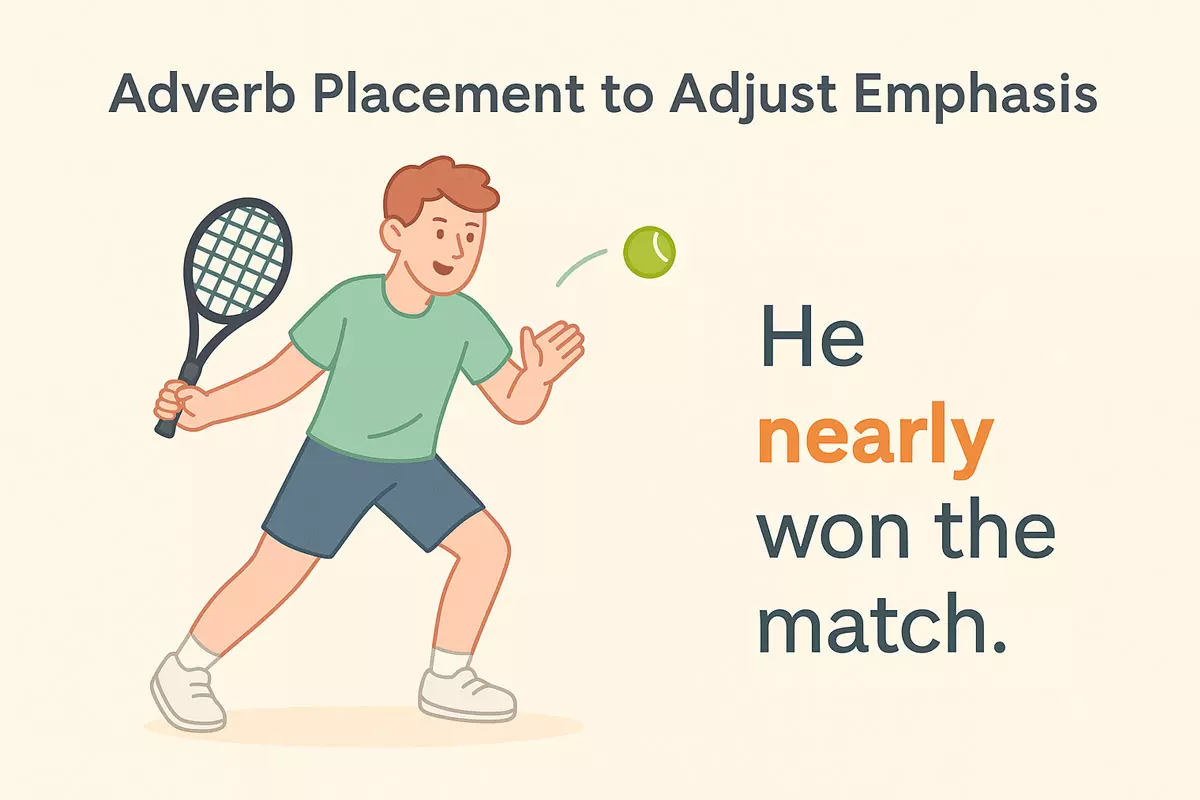 This article explains how emphasis adverbs like nearly and only affect sentence meaning depending on their position. It covers main adverb placements, how placement changes emphasis, common patterns, examples, and tips to avoid ambiguity.
Changing the position of an adverb within a sentence can subtly alter the reader’s focus, as shown by the contrast between he almost achieved victory and he achieved victory almost. This demonstrates how word order provides writers with the ability to control emphasis and meaning with remarkable accuracy. By simply shifting a single word, you can guide the reader’s attention and influence the interpretation of a sentence, making word placement a powerful tool in effective communication.
What Emphasis Adverbs Do
Adverbs like "nearly," "just," "even," and "almost" play a key role in shaping the nuance or intensity of a statement. By modifying verbs, adjectives, or even whole clauses, these words shift the focus and highlight specific aspects of information. The position of such adverbs in a sentence can subtly alter the meaning or suggest how close something came to happening, how exclusive an action was, or how unexpected an outcome felt.
How Emphasis Adverbs Influence Meaning
Shifting the adverb changes what gets highlighted. For example, compare these:
- He nearly won the race. (He was very close, but didn’t win.)
- He won nearly every race. (He won most, but not all.)
The placement changes what’s being emphasized: the outcome, the process, or the scope.
Common Emphasis Adverbs
Writers and speakers use a variety of adverbs to adjust tone, certainty, or surprise. Here are some commonly used for emphasis:
- almost
- barely
- just
- even
- actually
- simply
- really
- merely
- hardly
- totally
- only
- exactly
- virtually
- completely
- absolutely
- indeed
- truly
- literally
- just about
Impact on Sentence Emphasis
The choice and placement of an adverb can clarify intent or introduce ambiguity. For instance, "She only called him yesterday" suggests calling was the sole action, while "Only she called him yesterday" points to her as the exclusive caller. This flexibility allows speakers to fine-tune what they want listeners to notice.
| Sentence | Effect of Emphasis Adverb |
|---|---|
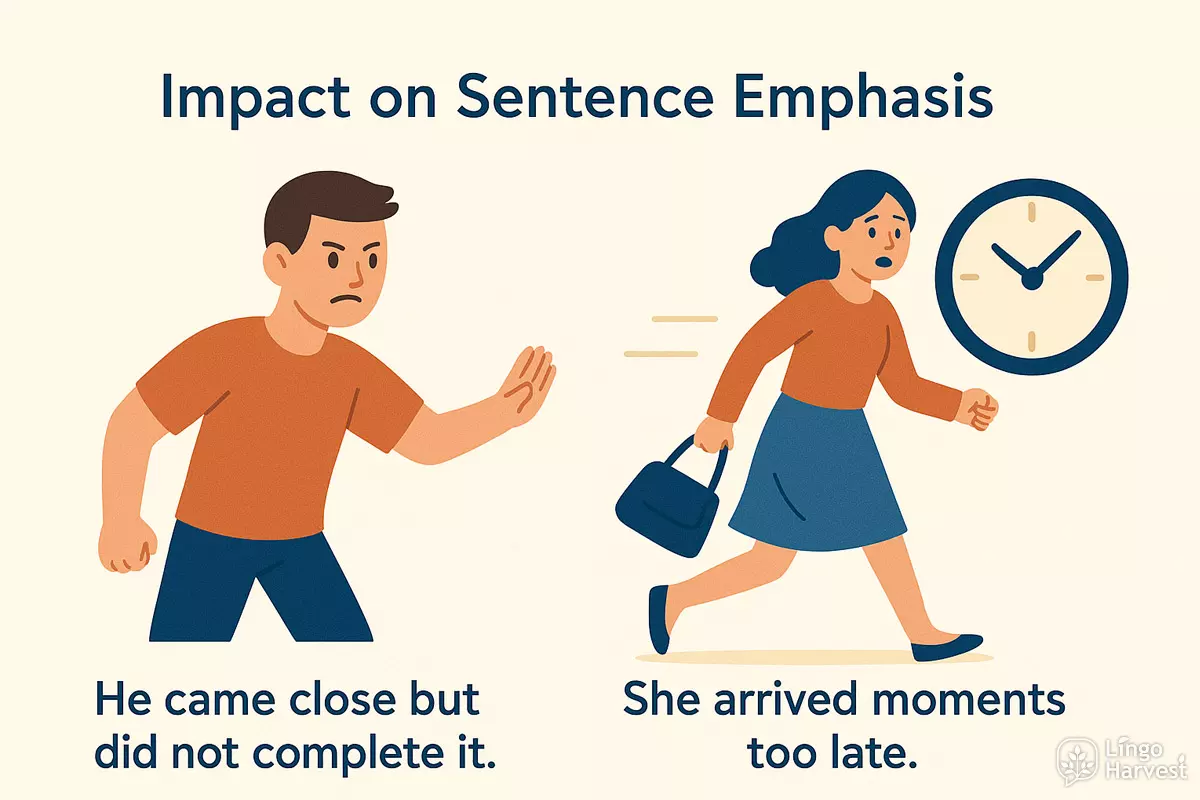
| He almost finished the project. | He came close but did not complete it. |
| She just missed the bus. | She arrived moments too late. |
| They actually solved the problem. | It’s surprising or unexpected that they succeeded. |
| I barely know him. | The relationship is minimal or distant. |
| You even remembered my birthday! | Emphasizes surprise at the action. |
| We literally ran out of time. | Stresses that it’s not an exaggeration. |
In short, these adverbs act as tools for precision and subtlety, letting writers and speakers bring attention to the most relevant part of their message. They help clarify intent, add drama, or soften statements, all depending on their placement and choice.
Main Positions for Adverbs
Adverbs can appear in different spots within a sentence, and their placement affects which part of the sentence they emphasize. Understanding where you put an adverb helps you control the nuance and focus of your message. Let’s look at the typical locations and the impact they create.
Common Placements in Sentences
Most adverbs can go in one of three main areas:
- Beginning (Front Position): Before the subject — often used for linking ideas or adding emphasis to the whole statement.
Example: Nearly, he won the race. - Middle (Mid Position): Usually between the subject and main verb, or after “be” verbs — this spot often highlights the verb.
Examples: He nearly won. She always arrives early. - End (End Position): After the verb or object — this can emphasize the action or result.
Example: He won nearly.
How Placement Changes Emphasis
The exact position of an adverb can subtly shift the meaning or focus. For instance, “He almost always forgets” (mid) signals frequency, while “Almost, he always forgets” (front) is less common and can sound awkward, but puts stress on “almost” as a qualifier for the whole sentence.
| Adverb Position | Example & Effect |
|---|---|
| Front | Quickly, she finished her work. → Emphasizes “quickly” as a comment on the whole action. |
| Mid (before main verb) | She quickly finished her work. → Focuses on the manner of finishing. |
| Mid (after “be” verb) | She is always cheerful. → Highlights frequency/state of being. |
| End | She finished her work quickly. → Emphasizes the result or outcome. |
Adverb Placement Patterns
Some adverbs are more flexible than others, but certain types tend to favor specific locations:
- Frequency adverbs (always, never, often): usually mid position
- Degree adverbs (almost, nearly, just): often before the verb or adjective
- Manner adverbs (slowly, carefully): commonly at the end, but can go mid for extra emphasis
- Time adverbs (today, now, soon): often at the end or sometimes the beginning
Examples of Flexible and Fixed Placement
Here are some sample sentences to illustrate the variety:
- He just missed the bus. (mid)
- Suddenly, the lights went out. (front)
- She finished the test easily. (end)
- They will probably arrive late. (mid)
- I never eat dessert. (mid)
- Tomorrow, we leave for Paris. (front)
- He replied politely. (end)
- They have already left. (mid)
- We are completely lost. (mid, after “be”)
- She can barely hear you. (mid)
- I will see you soon. (end)
Strategic use of adverb placement lets you fine-tune what stands out in your sentence. Experiment with different positions to see how the meaning or emphasis shifts in your own writing.
How Placement Changes Meaning
The position of an adverb within a sentence can significantly influence what the sentence communicates. Moving an adverb like "nearly" or "only" changes which part of the sentence it modifies, sometimes even reversing the intended message. For example, "He nearly won" suggests he did not win, while "He won nearly" (though less common) may hint at a different nuance, possibly about the manner or timing of the win.
Common Shifts in Emphasis
Adverbs often move around in English sentences, but their placement is rarely random. Consider the following ways that shifting an adverb alters what the speaker is highlighting:
- He nearly won. → He was close to winning, but did not.
- He won nearly every game. → He won most games, but not all.
- Nearly he won. → Emphasizes the closeness to victory, but is less natural in modern English.
- She only eats fruit. → Fruit is the sole thing she eats.
- Only she eats fruit. → No one else eats fruit, just her.
- She eats only fruit. → Again, fruit is the exclusive food.
- He almost always arrives on time. → He is punctual, with rare exceptions.
- He always almost arrives on time. → He is usually just a bit late.
- She just called. → She called a moment ago.
- She called just to say hi. → The reason for calling was only to say hi.
- He even finished early. → Finishing early is surprising or unexpected.
- Even he finished early. → Out of everyone, it is surprising that he, in particular, finished early.
Comparing Nuances
Sometimes, the difference is subtle but important. Take "almost" and "nearly"—their position can affect whether they refer to the action or the object. Compare the following:
| Sentence | Implication |
|---|---|
| She almost ate the whole cake. | She did not eat all of it; a little was left. |
| She ate almost the whole cake. | She ate most of the cake, but not quite all. |
| He only spoke to John. | John was the sole person he addressed. |
| He spoke only to John. | He did not speak to anyone but John. |
Key Takeaways
Choosing where to place an adverb is not just about grammar; it’s about shaping meaning. By adjusting word order, you can clarify what is important, what is surprising, or what is limited in your statement. Paying attention to adverb position helps your English sound more precise and natural.
Common Emphasis Patterns
Understanding how adverbs shift the focus in a sentence can clarify what the speaker wants to highlight. By changing the position of an adverb, you can subtly alter the meaning or stress a different part of the message. This flexibility allows for more nuanced communication in both spoken and written English.
Adverb Position and Its Effect
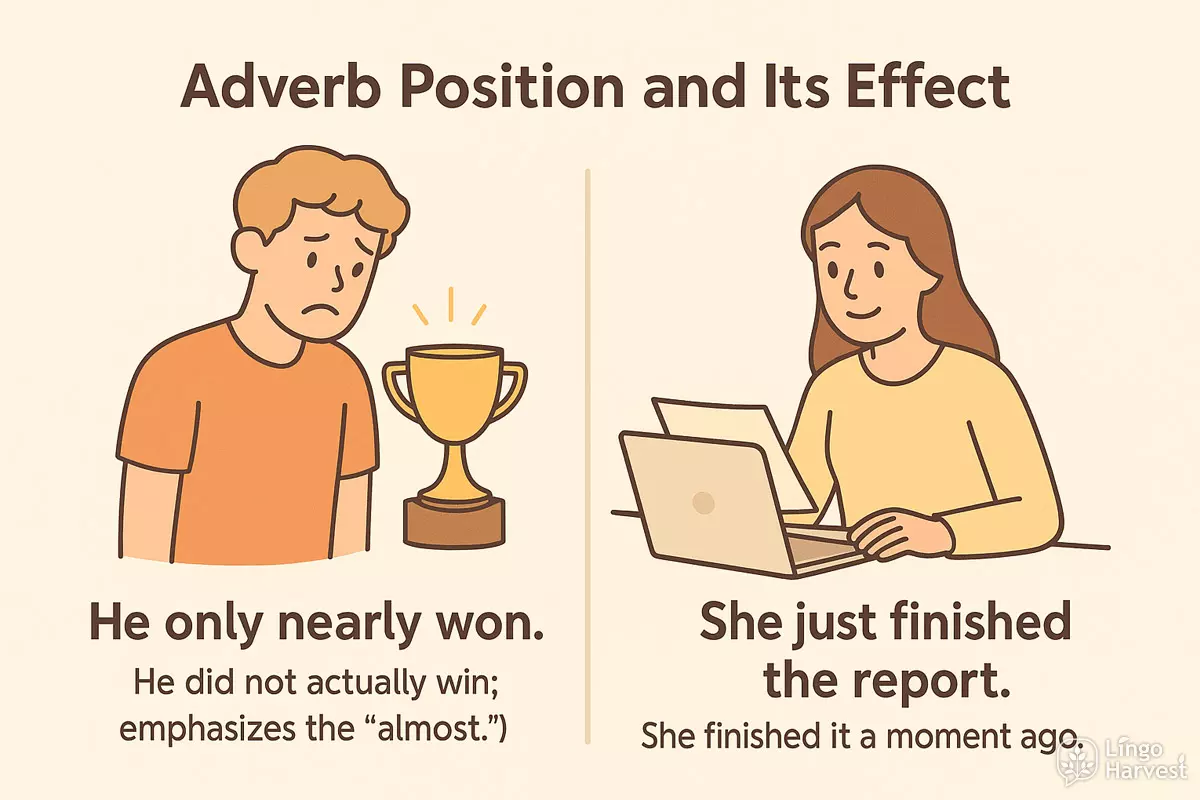
The placement of adverbs, especially those like "nearly," "only," "just," "almost," and "even," often determines which part of the sentence stands out. For instance, moving an adverb closer to a verb, object, or subject can shift the reader’s attention.
- He nearly won the race. (He came close to winning, but did not.)
- He won nearly the race. (Unusual; not standard in English.)
- He only nearly won. (He did not actually win; emphasizes the "almost.")
- She just finished the report. (She finished it a moment ago.)
- She finished just the report. (She finished only the report, not other tasks.)
- I almost missed the bus. (I caught the bus, but it was close.)
- I missed almost the bus. (Unusual; not standard.)
- He even remembered my birthday. (Surprisingly, he remembered.)
- He remembered even my birthday. (He remembered everything, including my birthday.)
- She barely passed the exam. (She passed, but with a low score.)
Adverbs in Different Sentence Positions
Adverbs can appear at the beginning, middle, or end of a sentence. Each position can create a different nuance or draw attention to a different idea. Compare these:
- Suddenly, the lights went out. (The manner is highlighted.)
- The lights suddenly went out. (The action is abrupt.)
- The lights went out suddenly. (The timing is stressed.)
Comparison Table: Shifting Emphasis with Adverb Placement
| Sentence | Emphasized Meaning |
|---|---|
| He nearly won the match. | He came close to winning, but did not succeed. |
| He won nearly every match. | He won almost all matches, but not every single one. |
| Only he nearly won the match. | No one else came as close to winning as he did. |
| He almost always wins. | He wins most of the time; exceptions are rare. |
| He always almost wins. | He often gets close to winning, but rarely actually does. |
Quick Tips for Adjusting Focus
- Placing an adverb before the verb usually modifies the action.
- Inserting it between the subject and verb can sound more formal or literary.
- End-position adverbs often highlight the manner or timing of the action.
- Fronting the adverb (putting it at the beginning) can add dramatic emphasis or set the scene.
- Be careful: some adverbs are position-sensitive and may cause confusion if misplaced.
By experimenting with adverb placement, speakers and writers can fine-tune the impression or priority of information, ensuring the intended part of the sentence stands out.
Examples with Nearly, Only, Simply
Adverbs like nearly, only, and simply often shift the focus of a sentence depending on where they're placed. Small changes in position can dramatically alter the meaning or what is being emphasized. Let's look at how these adverbs function in different contexts and sentence structures.
How Placement Changes Meaning
The words nearly, only, and simply tend to modify the word or phrase that immediately follows. Moving them around in a sentence can clarify or change what you want to stress. Here are some typical examples:
- Nearly:
- He nearly won the race. → He came close to winning, but did not win.
- She nearly finished her homework. → She did most of it, but not all.
- They nearly missed the train. → They caught it, but just barely.
- Only:
- Only he saw the accident. → No one else saw it.
- He only saw the accident. → He didn't hear it or experience it, just saw it.
- He saw only the accident. → He didn't see anything else.
- He saw the accident only yesterday. → It happened just the day before.
- Simply:
- Simply put, the project failed. → To put it in basic terms, it failed.
- She simply refused to go. → She flatly refused; there was no negotiation.
- It was simply amazing. → It was amazing in an uncomplicated or pure way.
- He simply didn’t care. → He had no concern at all.
Comparing Emphasis: "Only" in Different Positions
The position of only is especially important. Notice how the meaning shifts in these sentences:
| Sentence | Meaning |
|---|---|
| Only Sarah gave John a book. | Sarah was the only person who gave John a book (no one else did). |
| Sarah only gave John a book. | All Sarah did was give a book; she didn’t do anything else for John. |
| Sarah gave only John a book. | John was the only recipient of the book from Sarah (not anyone else). |
| Sarah gave John only a book. | Sarah gave John nothing except a book (not money, not advice, etc.). |
Quick Reference: Typical Patterns
- Nearly usually comes before the verb or adjective it modifies.
- Only can come before the subject, verb, or object, depending on what you want to highlight.
- Simply often adds emphasis to the verb or describes the manner of an action.
- Check your sentence for ambiguity—moving these adverbs can clarify your meaning.
- Native speakers often rely on context, but formal writing benefits from careful placement.
When using adverbs such as nearly, only, and simply, always check what part of the sentence you're highlighting. Their position can make a subtle but important difference in your message.
Avoiding Ambiguous Adverb Position
When placing adverbs in a sentence, clarity is key. An adverb’s position can change meaning, sometimes dramatically. Misplacing an adverb like “nearly” or “only” often leads to confusion about what exactly is being modified. For example, “He nearly won every match” means he came close to winning each match, while “He won nearly every match” means he won most matches. Such differences highlight the importance of precise placement.
Common Pitfalls with Adverb Placement
Writers and speakers sometimes unintentionally obscure their intended meaning. This usually happens when adverbs are inserted between the subject and verb, or before/after objects, without considering what they’re modifying. To prevent misunderstandings, always ask: What is the adverb qualifying?
- “She only eats vegetables.” → She eats nothing but vegetables.
- “She eats only vegetables.” → Same as above.
- “She eats vegetables only.” → She eats vegetables, not fruit or meat.
- “He almost drove his friends crazy.” → He didn’t quite make them crazy.
- “He drove almost his friends crazy.” → Nearly all of his friends, but not everyone, were affected.
- “I nearly lost $500.” → I did not lose the money, but it was close.
- “I lost nearly $500.” → I lost about $500, not exactly.
- “She even called her boss.” → She called her boss, in addition to others.
- “Even she called her boss.” → Unexpectedly, she was the one who called.
- “He just finished the report.” → He finished it a moment ago.
- “He finished just the report.” → He finished only the report, not other tasks.
- “I simply can’t understand.” → I truly cannot understand.
- “I can’t simply understand.” → Understanding is not straightforward.
Guidelines for Clear Adverb Use
Place adverbs close to the word or phrase they modify. If you’re unsure, try moving the adverb to different spots and see how the meaning changes. Reading the sentence aloud can also help reveal ambiguity. For adverbs like “almost,” “only,” “just,” and “even,” double-check the sentence to ensure your intended emphasis is clear to the reader or listener.
Quick Reference: Shifting Adverb Placement
| Sentence | Interpretation |
|---|---|
| He nearly won the race. | He was close to winning, but didn’t. |
| He won nearly the race. | Ambiguous/wrong; “nearly” does not modify “race” sensibly. |
| She only said that she loved him. | She said it, but didn’t show it or act on it. |
| She said that she only loved him. | She loved him and no one else. |
| They almost always agree. | They agree most of the time. |
| They always almost agree. | They agree on most things, but not quite everything. |
| I just asked her to help. | I only asked for help; nothing more. |
| I asked her just to help. | I asked for help specifically, not for other things. |
Careful adverb placement ensures your sentences say exactly what you mean. When in doubt, rephrase or move the adverb until the intended meaning is unmistakable.
Practice: Move the Adverb to Change Emphasis
Understanding how adverb placement shifts the meaning of a sentence is an essential part of mastering English nuance. By moving adverbs such as "nearly," "only," or "just" within a sentence, you can subtly or dramatically change what the listener understands as important. Let's explore this with activities and examples.
Compare the Emphasis
Review the following sentences. Notice how moving the adverb alters the sentence’s focus:
- He nearly won the race. (He did not win, but came close.)
- He won nearly the race. (Unusual; not standard in English.)
- He won the race nearly. (Unusual; can sound awkward.)
- He only nearly won the race. (He came close, but that’s all.)
In most cases, adverbs like "nearly" are placed before the verb or before the phrase they modify for clear emphasis.
Task: Move the Adverb
Try shifting the adverb in each sentence below to see how the meaning changes. Write the new sentence, then decide what is now emphasized.
- She almost finished the entire puzzle.
- They just missed the last train.
- We only saw John at the party.
- He barely touched his food.
- I nearly forgot your birthday.
- Anna simply smiled at the news.
- Tom merely suggested a change.
- We hardly knew anyone there.
- The dog nearly caught the ball.
- They only wanted to help.
Show answers
- Finished almost the entire puzzle. (Emphasizes the quantity she finished, not the action of finishing.)
- Missed just the last train. (Emphasizes the specific train missed.)
- Saw only John at the party. (Emphasizes John was the only person seen.)
- Touched barely his food. (Awkward, but puts focus on the amount of food touched.)
- Forgot nearly your birthday. (Not natural; "nearly forgot" is standard.)
- Simply Anna smiled at the news. (Not standard; "Anna simply smiled" is correct.)
- Suggested merely a change. (Unusual; "merely suggested a change" is better.)
- Knew hardly anyone there. (Both "hardly knew anyone" and "knew hardly anyone" are acceptable.)
- Caught nearly the ball. (Not standard; "nearly caught the ball" is correct.)
- Wanted only to help. (Emphasizes the intention of helping.)
Common Patterns for Adverb Placement
Here are some typical ways adverbs are positioned in English sentences. Moving them can change what part of the sentence is highlighted.
- Before the main verb: She barely spoke.
- After the subject (for emphasis): He only laughed.
- At the end of the sentence (less common, usually with time/frequency adverbs): They arrived late.
- Before an adjective or another adverb: It was almost impossible.
- Between auxiliary and main verb: She has just left.
Mini-Quiz: Where’s the Emphasis?
For each pair, choose which sentence stresses the action, and which highlights the subject or object.
- Only Sarah baked the cake.
Sarah only baked the cake. - He nearly ate the whole pizza.
He ate nearly the whole pizza. - We just finished the project.
We finished just the project. - She almost passed the exam.
She passed almost the exam.
Show answers
- First: Only Sarah (no one else baked). Second: Sarah only baked (she didn’t do anything else with the cake).
- First: Nearly ate (ate, but not quite all). Second: Ate nearly the whole pizza (emphasis on the amount).
- First: Just finished (recently completed). Second: Finished just the project (nothing else was finished).
- First: Almost passed (came close to passing). Second: Passed almost the exam (awkward; not standard).
By practicing moving adverbs, you’ll gain a sharper sense of how subtle shifts can change the interpretation of a sentence. This skill is especially useful in both writing and conversation for expressing exactly what you mean.